


Give way to oncoming trafficChina
 Traffic rules
 China
1. Give way to oncoming traffic
Give way to oncoming traffic means that drivers must allow vehicles approaching from the opposite direction to pass first through a narrow section of road. The rule is normally indicated by a sign facing the direction that must yield and a corresponding priority sign facing oncoming traffic.
Drivers must reduce speed and stop when necessary before entering the narrow passage. They may continue only when they can do so safely and without obstructing oncoming traffic that has priority.
When must I give way to oncoming traffic in China?
Where priority signs, temporary signals or an authorised controller in China require your direction to yield at a narrow road or bridge, allow opposing traffic through first. Do not assume every narrowing has the same priority arrangement.
🔗 jtgl.beijing.gov.cn • Beijing Traffic Police — full Road Traffic Safety Law, 2021 amended text
🔗 samr.gov.cn • SAMR — full implementing Regulations, 2017 amended text
🔗 szjj.sz.gov.cn • Shenzhen Traffic Police — official sign categories and their functions
🔗 openstd.samr.gov.cn • SAMR — current GB 5768.2-2022 status, not the full standard
🔗 std.sacinfo.org.cn • SAC — published first sign-standard amendment, effective 1 January 2026
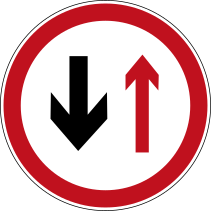 Road narrowing, give way to oncoming drivers.
English • Traffic sign 禁3 • Give way to oncoming traffic. Stop and let opposing vehicles pass first.
中文 • 禁3 • 会车让行。 会车时应停车,让对向车辆先行。
Sources
🔗 Commons.wikimedia.org
🔗 Openstd.samr.gov.cn • 国家标准全文公开 • GB 5768.2-2022(含第1号修改单)
🔗 Upload.wikimedia.org • 标准原文镜像 • PDF第29页
SVG source: Beijing Traffic Management Bureau • Public domain • Original revision 2020-03-19. Wikimedia original unmodified.
Artwork verified against Openstd.samr.gov.cn • official published diagram 禁3.
Does a road-narrows warning automatically give oncoming traffic priority in China?
Not necessarily. A warning of a narrow carriageway is not itself the same as an instruction to give way. Check whether there is a separate priority sign, signal or temporary traffic control, and take account of any rules for an obstruction on your side.
🔗 jtgl.beijing.gov.cn • Beijing Traffic Police — full Road Traffic Safety Law, 2021 amended text
🔗 samr.gov.cn • SAMR — full implementing Regulations, 2017 amended text
🔗 szjj.sz.gov.cn • Shenzhen Traffic Police — official sign categories and their functions
🔗 openstd.samr.gov.cn • SAMR — current GB 5768.2-2022 status, not the full standard
🔗 std.sacinfo.org.cn • SAC — published first sign-standard amendment, effective 1 January 2026
What if an oncoming vehicle is already entering a narrow passage in China?
Reduce speed and wait where you can do so safely rather than forcing two vehicles into insufficient space. Even if a sign gives your approach priority, that does not justify a collision or endangering another road user.
🔗 jtgl.beijing.gov.cn • Beijing Traffic Police — full Road Traffic Safety Law, 2021 amended text
🔗 samr.gov.cn • SAMR — full implementing Regulations, 2017 amended text
🔗 szjj.sz.gov.cn • Shenzhen Traffic Police — official sign categories and their functions
🔗 openstd.samr.gov.cn • SAMR — current GB 5768.2-2022 status, not the full standard
🔗 std.sacinfo.org.cn • SAC — published first sign-standard amendment, effective 1 January 2026

