


ExpresswaySpain
 Traffic rules
 Spain
1. Expressway
An expressway is a road intended to carry through traffic efficiently, usually at higher speeds than ordinary roads. Expressways often have limited access, multiple lanes, separated carriageways or grade-separated junctions, but their design and legal status vary between countries.
An expressway is not always a motorway. It may have intersections, traffic lights or direct access, and the permitted road users, speed limits and special rules depend on local signs and regulations.
How do people refer to an expressway in Spain?
Spanish road categories include autovía, a motorway-type divided road, and vía para automóviles, a single-carriageway road reserved for the legal automóvil category. Their speed and access rules differ; an English expressway label is not enough to identify the category.
🔗 boe.es • Spain: official sign catalogue, Royal Decree 465/2025
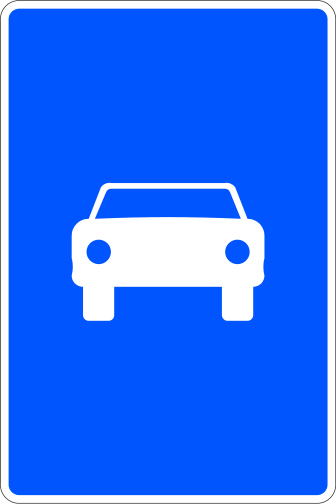 Start of an expressway.
English • Traffic sign S-3 • Road reserved for motor vehicles. Marks the beginning of a road reserved for motor vehicles.
Español • S-3 • Vía reservada para automóviles. Indica el principio de una vía reservada a la circulación de automóviles.
Sources
🔗 Commons.wikimedia.org
🔗 Boe.es • Reglamento General de Circulación • anexo I • catálogo vigente
🔗 Boe.es • Real Decreto 465/2025 • S-3 • página 73
SVG source: Author not stated on source page • Public domain • Original revision 2026-01-11. Wikimedia original unmodified.
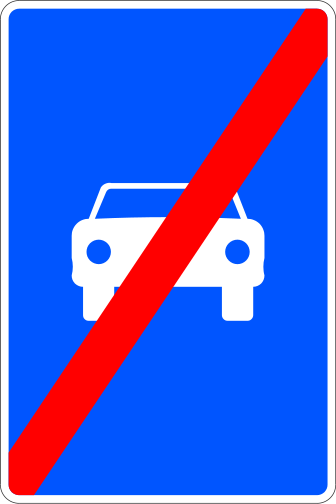 End of the expressway.
English • Traffic sign S-4 • End of road reserved for motor vehicles. Marks the end of the reserved road.
Español • S-4 • Fin de vía reservada para automóviles. Indica el final de una vía reservada para automóviles.
Sources
🔗 Commons.wikimedia.org
🔗 Boe.es • Reglamento General de Circulación • anexo I • catálogo vigente
🔗 Boe.es • Real Decreto 465/2025 • S-4 • página 73
SVG source: Author not stated on source page • Public domain • Original revision 2026-01-11. Wikimedia original unmodified.
What speed limit applies to cars on an expressway in Spain?
For an ordinary car, the general maximum on an autovía outside built-up areas is 120 km/h; within a settlement it is normally 80 km/h unless an authorised signed change applies. A non-motorway road reserved for motor vehicles normally has the 90 km/h rural maximum. Read the road designation, signs and vehicle restrictions.
🔗 boe.es • Spain: official sign catalogue, Royal Decree 465/2025
Can cyclists use a Spanish motorway-type expressway?
On a road designated as autovía, cyclists aged over 14 may use the shoulder unless cycling is prohibited by a sign. This exception does not allow cycling on an autopista or on a road reserved exclusively for motor vehicles.
🔗 boe.es • Spain: official sign catalogue, Royal Decree 465/2025
Does Spain’s expressway minimum speed apply to every road with a car-symbol sign?
No. The normal 60 km/h minimum applies to motorways and motorway-type expressways, subject to justified traffic or safety exceptions. Do not apply that rule solely from an English road name or to every road reserved for motor vehicles.
🔗 boe.es • Spain: official sign catalogue, Royal Decree 465/2025

