


One-way trafficNorway
 Traffic rules
 Norway
1. One-way traffic
One-way traffic means that vehicles on a road or carriageway may travel only in one designated direction. The permitted direction is normally indicated by traffic signs, lane arrows or road markings.
Some road users, such as cyclists or public-transport vehicles, may be allowed to travel in the opposite direction when signs expressly permit it. A one-way road does not by itself determine the speed limit, priority or parking rules.
How should I read a one-way restriction in Norway?
Norwegian one-way rules apply to vehicle drivers, including cyclists, on the road concerned. The entry and direction signs identify which end and direction may be used.
🔗 lovdata.no • Norwegian signing regulation — current sign catalogue, markings and signals
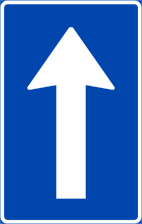 Road with one-way traffic.
English • Traffic sign 526.1 • One-way traffic. Driving is permitted only in the arrow's direction up to the first junction.
Norsk bokmål • Skilt 526.1 • Envegskjøring. Skiltet angir at kjøring bare er tillatt i pilens retning fram til første vegkryss.
Sources
🔗 Commons.wikimedia.org
🔗 Lovdata.no • Skiltforskriften § 12
SVG source: Peter J. Acklam converted the original EPS file to PDF with Ghostscript’s ps2pdf utility and the PDF file to SVG with Inkscape. • Public domain • Original revision 2008-08-04. Wikimedia original unmodified.
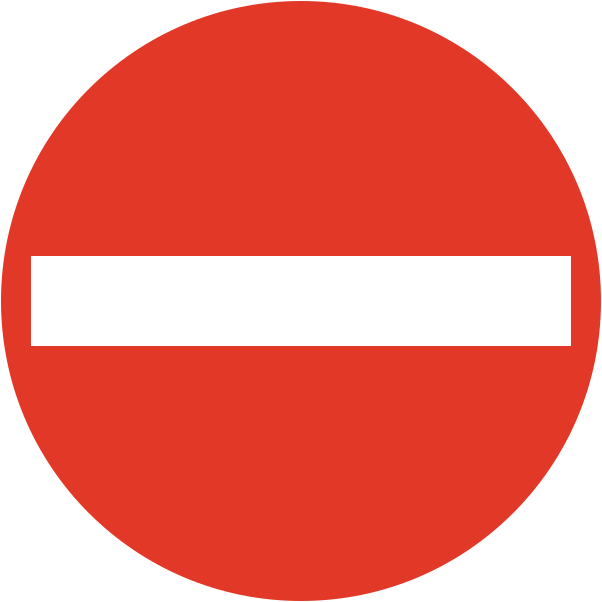 No entry.
English • Traffic sign 302 • No entry. Driving past the sign is prohibited. Cycling and use of small electric motor vehicles on the pavement remain permitted in accordance with the traffic rules.
Norsk bokmål • Skilt 302 • Innkjøring forbudt. Skiltet angir forbud mot å kjøre forbi skiltet. Sykling og bruk av liten elektrisk motorvogn på fortau kan likevel foregå i samsvar med trafikkreglene.
Sources
🔗 Commons.wikimedia.org
🔗 Lovdata.no • Skiltforskriften § 8
SVG source: Peter J. Acklam converted the original EPS file to PDF with Ghostscript and the PDF file to SVG with Inkscape. • Public domain • Original revision 2022-02-05. Wikimedia original unmodified.
May cyclists travel against the general traffic direction in Norway?
A supplementary panel such as sykkel unntatt, meaning cycles excepted, can allow cycling in both directions. The Public Roads Administration stresses extra care when cycling against motor traffic; a separate pavement has its own rules.
🔗 lovdata.no • Norwegian signing regulation — current sign catalogue, markings and signals
Does one-way traffic give me priority or a different speed limit in Norway?
A one-way restriction concerns direction. Continue to follow the applicable speed limit, signals, give-way or stop controls and junction-priority rules. Where authorised counterflow traffic exists, check for it before turning or crossing; your permitted direction is not automatic junction priority.
🔗 lovdata.no • Norwegian signing regulation — current sign catalogue, markings and signals

