


Priority at the next junctionNorway
 Traffic rules
 Norway
1. Priority at the next junction
Priority at the next junction means that drivers travelling on a particular road have priority over traffic entering from intersecting roads at the next junction. The priority arrangement is normally indicated by signs facing both the priority traffic and the traffic that must give way.
Unlike a continuing priority road, this priority applies only at the indicated intersection. Drivers must still approach cautiously and obey traffic lights, authorised officers, crossings, turning rules and other applicable signs.
How is priority at the next junction determined in Norway?
Norwegian sign 210 warns of a dangerous priority junction where side-road or crossing traffic must give way under sign 202 or 204. It differs from sign 206, which designates a priority road. The warning does not cancel traffic lights or duties towards pedestrians and other road users.
🔗 lovdata.no • Norwegian signing regulation — current sign catalogue, markings and signals
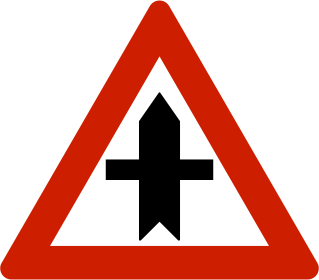 Priority at the junction.
English • Traffic sign 210 • Priority junction. Warns of a dangerous junction where traffic from a side road or intersecting road must give way under sign 202 ‘Give way’ or 204 ‘Stop’.
Norsk bokmål • Skilt 210 • Forkjørskryss. Skiltet varsler om farlig vegkryss hvor kjørende fra sideveg eller kryssende veg er pålagt vikeplikt med skilt 202 «Vikeplikt» eller 204 «Stopp».
Sources
🔗 Commons.wikimedia.org
🔗 Lovdata.no • Skiltforskriften § 6
SVG source: Peter J. Acklam converted the original EPS file to PDF with Ghostscript and the PDF file to SVG with Inkscape. • Public domain • Original revision 2013-07-21. Wikimedia original unmodified.
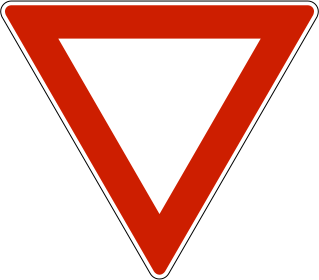 Give way.
English • Traffic sign 202 • Give way. Drivers must give way to traffic in both directions on the intersecting road.
Norsk bokmål • Skilt 202 • Vikeplikt. Skiltet angir at kjørende har vikeplikt for kjørende trafikk i begge retninger på kryssende veg.
Sources
🔗 Commons.wikimedia.org
🔗 Lovdata.no • Skiltforskriften § 6
SVG source: Peter J. Acklam converted the original EPS file to PDF with Ghostscript and the PDF file to SVG with Inkscape. • Public domain • Original revision 2013-07-21. Wikimedia original unmodified.
 Start of a priority road.
English • Traffic sign 206 • Priority road. Traffic from side roads or intersecting roads must give way under sign 202 ‘Give way’ or 204 ‘Stop’. Applies until sign 208 ‘End of priority road’, 202 ‘Give way’ or 204 ‘Stop’. In lanes marked with 531 ‘Acceleration lane’, the traffic rules for that lane nevertheless apply.
Norsk bokmål • Skilt 206 • Forkjørsveg. Skiltet angir at kjørende som kommer fra sideveg eller kryssende veg, er pålagt vikeplikt med skilt 202 «Vikeplikt» eller 204 «Stopp». Skiltet gjelder til det blir opphevet med skilt 208 «Slutt på forkjørsveg» eller skilt 202 «Vikeplikt» eller skilt 204 «Stopp». I kjørefelt med skilt 531 «Felt for fartsøkning» gjelder likevel trafikkreglenes bestemmelser om kjøring i slikt felt.
Sources
🔗 Commons.wikimedia.org
🔗 Lovdata.no • Skiltforskriften § 6
SVG source: Peter J. Acklam converted the original EPS file to PDF with Ghostscript and the PDF file to SVG with Inkscape. • Public domain • Original revision 2014-03-21. Wikimedia original unmodified.
Does priority at one junction automatically continue along the entire road in Norway?
No. One-junction priority and continuing priority-road status are distinct concepts. Check the local signs at each following junction, including any end-of-priority marker, traffic signal or new Give Way or Stop sign.
🔗 lovdata.no • Norwegian signing regulation — current sign catalogue, markings and signals
May a driver with priority ignore pedestrians or another safety obligation at the next junction in Norway?
No. Junction priority does not cancel duties towards pedestrians, traffic signals, emergency vehicles or other road users where the law gives them precedence. Approach at a speed allowing you to stop safely.
🔗 lovdata.no • Norwegian signing regulation — current sign catalogue, markings and signals

