


Road narrowingUruguay
 Traffic rules
 Uruguay
1. Road narrowing
A road narrowing is a section where the available width of the road or carriageway becomes smaller. The narrowing may occur on both sides, on one side only, or because one or more traffic lanes end.
Drivers should reduce speed, observe approaching and adjacent traffic, maintain sufficient lateral clearance and merge when necessary. Warning signs do not always determine priority, so drivers must follow any priority signs, lane markings and local traffic rules.
What does a road-narrowing warning mean in Uruguay?
Uruguayan warning signs and the national safe-speed rules require attention to restricted road width. Check the passage and any separate priority or signal control rather than assuming the first visible vehicle can always proceed.
 Warning for a road narrowing.
English • Traffic sign P-21a • Road narrows. The carriageway narrows on both sides. Reduce speed and maintain a safe clearance.
Español • P-21a • Estrechamiento de calzada. Advierte que la calzada se estrecha por ambos lados. Reduce la velocidad y conserva una separación segura.
Sources
🔗 Commons.wikimedia.org
🔗 Gub.uy • MTOP, Norma Uruguaya de Señalización Vertical, PDF p. 97
🔗 Gub.uy • MTOP, significado, PDF p. 42
Image via Commons.wikimedia.org
Intendencia de Durazno • Public domain • Source revision 2014-03-12. Wikimedia original unmodified.
 Warning for a road narrowing on the right.
English • Traffic sign P-21b • Road narrows on the right. The right edge moves inward, reducing available width.
Español • P-21b • Estrechamiento por la derecha. Advierte que el borde derecho de la calzada se aproxima y disminuye el ancho disponible.
Sources
🔗 Commons.wikimedia.org
🔗 Gub.uy • MTOP, Norma Uruguaya de Señalización Vertical, PDF p. 97
🔗 Gub.uy • MTOP, significado, PDF p. 42
Image via Commons.wikimedia.org
Intendencia de Durazno • Public domain • Source revision 2014-03-12. Wikimedia original unmodified.
Does a narrowing warning give you priority in Uruguay?
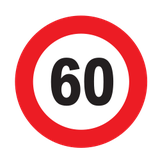
No. A narrowing warning does not allocate priority. However, on rural roads outside urban and suburban areas, a danger warning without a numerical maximum triggers the statutory reduction to 60 km/h. Follow any lower applicable limit, separate priority controls and meeting rules, and slow further or wait where safe passage requires it.
What should you do if traffic lanes merge at a narrowing in Uruguay?
Read the lane-ending signs and markings, check surrounding traffic and signal any lane change as required. Apply the local merging rule and enter only when safe. Do not assume the driver in an ending lane always has priority, or confuse merging with meeting oncoming traffic.

