

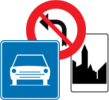
Passing placeFlanders
 Traffic rules
 Flanders
1. Passing place
A passing place is a widened section beside or within a narrow road where vehicles can move aside so that traffic travelling in opposite directions can pass safely. Passing places are commonly used on single-track roads or other roads that are too narrow for two vehicles to pass each other normally.
Drivers should approach passing places at a suitable speed, cooperate with oncoming traffic and avoid blocking the widened area unnecessarily. The priority rules and signs used at passing places vary between countries.
Is there a specific Belgian road sign for a passing place?
No dedicated passing-place sign is defined in the current Belgian Road Code. A widened area may be provided as part of the road design, while drivers must follow the normal rules for meeting opposing traffic.
Can drivers use the verge when two vehicles cannot pass easily in Belgium?
Yes, under certain conditions. When the carriageway is too narrow for vehicles to pass easily, a driver may use a level verge or lateral strip provided this does not endanger road users who are using it.

