

Traffic signsFlanders
 Traffic rules
 Flanders
26. Railway crossing
A railway crossing, also called a level crossing or railroad crossing, is a place where a road or path crosses railway tracks at the same level. It may be protected by barriers, warning lights, bells, traffic signs or a combination of these measures.
Road users must approach carefully and never enter when a train is approaching, warning signals are active or the exit is blocked. They should cross promptly and must never stop, wait or become trapped on the tracks.
Wikimedia.org • Marc Ryckaert • CC BY-SA
Which Belgian traffic signs are used at a railway crossing?
Belgian railway crossings can be indicated by several traffic signs depending on the type of crossing. Warning sign A41 warns of a railway crossing with barriers or half-barriers, while warning sign A43 warns of a railway crossing without barriers. At the crossing itself, traffic signs A45 and A47 indicate a railway crossing with one or more tracks.
🔗 wegcode.be • Belgian Road Code, Articles 20, 66
 Warning for a railway crossing with barriers.
English • Traffic sign A41 • Level crossing with barriers.
Français • Signal routier A41 • Passage à niveau avec barrières.
Nederlands • Verkeersbord A41 • Overweg met slagbomen.
Sources
SVG source: Commons.wikimedia.org
Vascer • Public domain. Original SVG unmodified.
🔗 Wegcode.be • Artikel 66. Gevaarsborden (NL)
🔗 Codedelaroute.be • Article 66. Signaux de danger (FR)
 Warning for a railway crossing without barriers.
English • Traffic sign A43 • Level crossing without barriers.
Français • Signal routier A43 • Passage à niveau sans barrières.
Nederlands • Verkeersbord A43 • Overweg zonder slagbomen.
Sources
SVG source: Commons.wikimedia.org
Vascer • Public domain. Original SVG unmodified.
🔗 Wegcode.be • Artikel 66. Gevaarsborden (NL)
🔗 Codedelaroute.be • Article 66. Signaux de danger (FR)
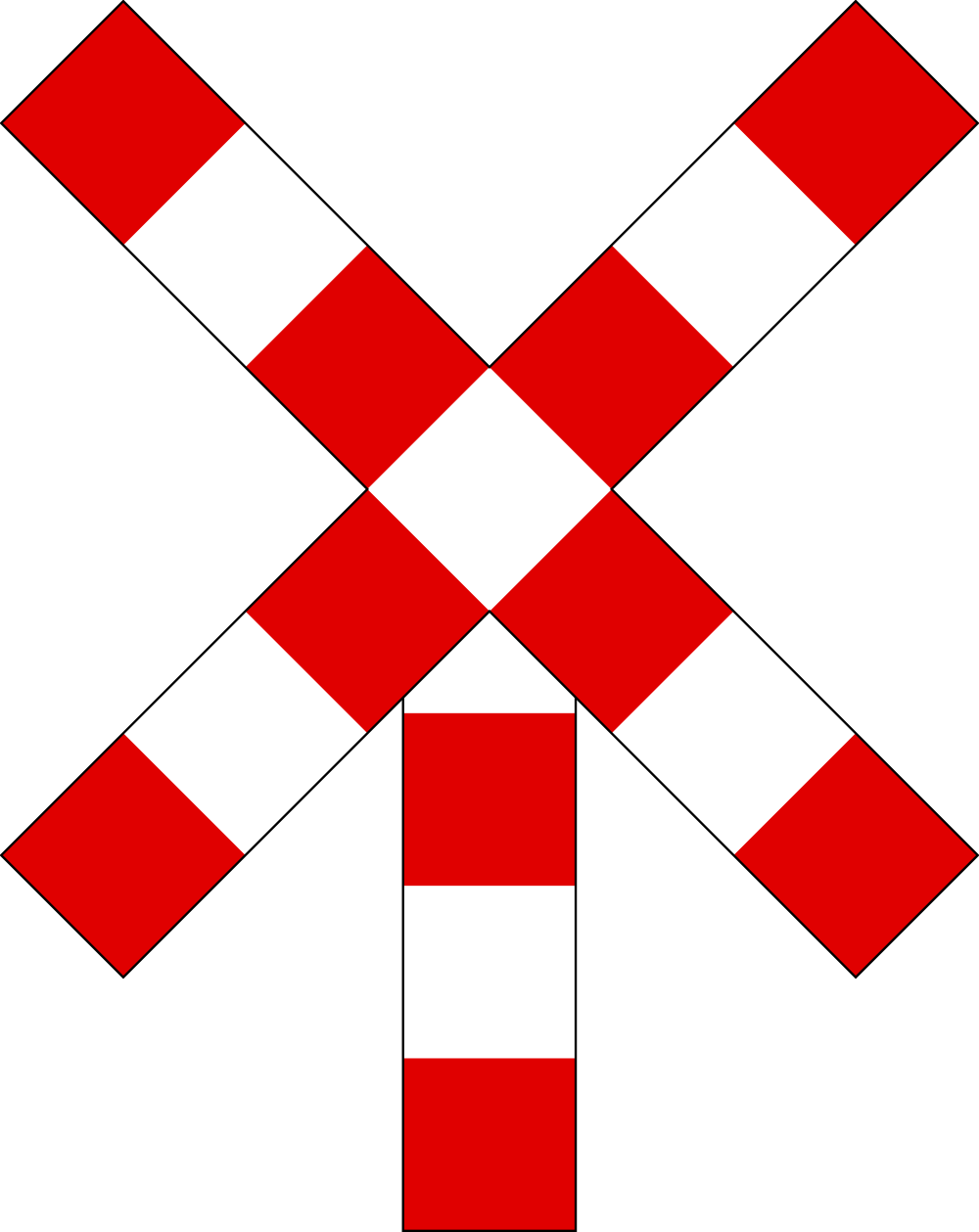 Warning for a railway crossing with one track.
English • Traffic sign A45 • Single-track level crossing.
Français • Signal routier A45 • Passage à niveau à voie unique.
Nederlands • Verkeersbord A45 • Overweg voor enkel spoor.
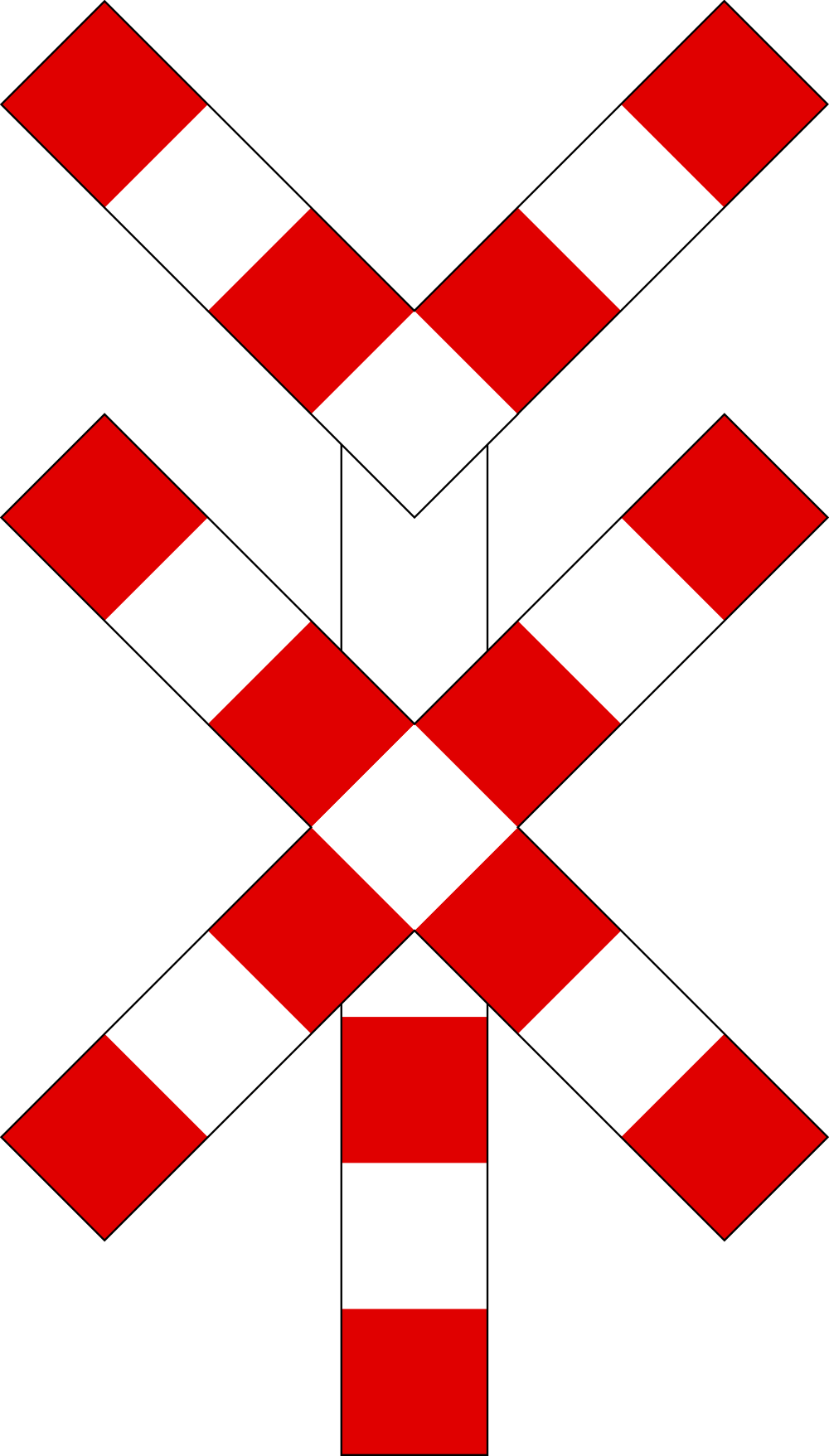 Warning for a railway crossing with two or more tracks.
English • Traffic sign A47 • Level crossing with two or more tracks.
Français • Signal routier A47 • Passage à niveau à deux ou plusieurs voies.
Nederlands • Verkeersbord A47 • Overweg voor twee of meer sporen.
How must you approach a Belgian railway crossing?
Every road user must approach with extra caution and take all necessary measures to avoid an accident.
Where must you stop for the red lights?
Stop before the stop line. When no stop line is present, stop before the railway-crossing signal without entering the tracks.
🔗 wegcode.be • Belgian Road Code, articles 12, 17, 20, 40, 64, 66, 71 and 76
May you enter when traffic is queued beyond the tracks?
No. A driver may not enter when traffic is so obstructed that the vehicle would probably have to stop on the railway crossing.
Do the Belgian railway-crossing rules apply to cyclists and pedestrians?
Yes. The red lights, barriers and audible signals apply to every road user, including pedestrians and cyclists.
What should you do if your vehicle becomes stuck on a Belgian railway crossing?
Leave the vehicle and railway tracks immediately, move everyone to safety and call Infrabel on 1711 so railway traffic can be stopped. You may also call the emergency services on 112.
🔗 infrabel.be • Infrabel, railway danger reporting via 1711; 🔗 infrabel.be • Infrabel, level-crossing emergency numbers and location stickers

27. Mandatory direction
A mandatory-direction sign requires drivers to travel only in the direction or one of the directions indicated by its arrow or arrows. It may require traffic to continue straight ahead, turn, or pass an obstacle on a specified side.
The sign does not itself determine priority or speed. Drivers must still use the appropriate lane, signal when required and give way according to local traffic signs and regulations.
Wikimedia.org • Jeanhousen • CC BY-SA
Which Belgian sign indicates a mandatory direction?
Traffic sign D1 requires drivers to follow the direction indicated by its arrow.
🔗 codex.vlaanderen.be • Belgian Road Code — articles 6, 12, 19, 65.2, 69.3–69.4 (D1/D3) and 77.1
 Driving straight ahead mandatory.
English • Traffic sign D1 • The direction indicated by the arrow must be followed. The road layout determines the position of the arrow. If a sign with a straight arrow is placed on an obstacle, it requires passing on the side indicated by the arrow.
Français • Signal routier D1 • Obligation de suivre la direction indiquée par la flèche. La disposition des lieux détermine la position de la flèche. Si le signal présentant une flèche non coudée, est placé sur un obstacle, il signifie obligation de passer du côté indiqué par la flèche.
Nederlands • Verkeersbord D1 • Verplichting de door de pijl aangeduide richting te volgen. De plaatsgesteldheid bepaalt de stand van de pijl. Wanneer het verkeersbord dat een niet-gebogen pijl voorstelt, op een hindernis geplaatst is, betekent het dat langs de door de pijl aangeduide richting moet voorbijgereden worden.
Sources
SVG source: Commons.wikimedia.org
Vascer • Public domain. Original SVG unmodified.
🔗 Wegcode.be • Artikel 69. Gebodsborden (NL)
🔗 Codedelaroute.be • Article 69. Signaux d'obligation (FR)
Can a Belgian mandatory-direction sign allow a choice of directions?
Yes. D1 requires the direction shown by its single arrow. D3 shows alternative permitted directions, and drivers must choose one of them. A mandatory-direction sign does not give priority.
🔗 codex.vlaanderen.be • Belgian Road Code — articles 6, 12, 19, 65.2, 69.3–69.4 (D1/D3) and 77.1
Driving straight ahead mandatory.
English • Traffic sign D1 • The direction indicated by the arrow must be followed. The road layout determines the position of the arrow. If a sign with a straight arrow is placed on an obstacle, it requires passing on the side indicated by the arrow.
Français • Signal routier D1 • Obligation de suivre la direction indiquée par la flèche. La disposition des lieux détermine la position de la flèche. Si le signal présentant une flèche non coudée, est placé sur un obstacle, il signifie obligation de passer du côté indiqué par la flèche.
Nederlands • Verkeersbord D1 • Verplichting de door de pijl aangeduide richting te volgen. De plaatsgesteldheid bepaalt de stand van de pijl. Wanneer het verkeersbord dat een niet-gebogen pijl voorstelt, op een hindernis geplaatst is, betekent het dat langs de door de pijl aangeduide richting moet voorbijgereden worden.
Sources
SVG source: Commons.wikimedia.org
Vascer • Public domain. Original SVG unmodified.
🔗 Wegcode.be • Artikel 69. Gebodsborden (NL)
🔗 Codedelaroute.be • Article 69. Signaux d'obligation (FR)
 Driving straight ahead or turning left mandatory.
English • Traffic sign D3 • One of the directions indicated by the arrows must be followed. The road layout determines the position of the arrows.
Français • Signal routier D3 • Obligation de suivre une des directions indiquées par les flèches. La disposition des lieux détermine la position des flèches.
Nederlands • Verkeersbord D3 • Verplichting één van de door de pijlen aangeduide richtingen te volgen. De plaatsgesteldheid bepaalt de stand van de pijlen.
Sources
SVG source: Commons.wikimedia.org
Gigillo83 • Public domain. Original SVG unmodified.
🔗 Wegcode.be • Artikel 69. Gebodsborden (NL)
🔗 Codedelaroute.be • Article 69. Signaux d'obligation (FR)
 Driving straight ahead or turning right mandatory.
English • Traffic sign D3 • One of the directions indicated by the arrows must be followed. The road layout determines the position of the arrows.
Français • Signal routier D3 • Obligation de suivre une des directions indiquées par les flèches. La disposition des lieux détermine la position des flèches.
Nederlands • Verkeersbord D3 • Verplichting één van de door de pijlen aangeduide richtingen te volgen. De plaatsgesteldheid bepaalt de stand van de pijlen.
Sources
SVG source: Commons.wikimedia.org
Vascer • Public domain. Original SVG unmodified.
🔗 Wegcode.be • Artikel 69. Gebodsborden (NL)
🔗 Codedelaroute.be • Article 69. Signaux d'obligation (FR)
Does a mandatory direction give you priority?
No. Drivers must still comply with priority signs, traffic lights and the normal rules concerning turning, crossing and manoeuvres.
🔗 codex.vlaanderen.be • Belgian Road Code — articles 6, 12, 19, 65.2, 69.3–69.4 (D1/D3) and 77.1
May cyclists be exempted from a Belgian mandatory-direction sign?
Yes. A supplementary panel showing a bicycle exception indicates that the mandatory direction does not apply to cyclists.
🔗 codex.vlaanderen.be • Belgian Road Code — articles 6, 12, 19, 65.2, 69.3–69.4 (D1/D3) and 77.1
28. Turn prohibition
A turn prohibition prevents drivers from turning in the direction indicated by a traffic sign. It may prohibit a left turn, a right turn or a U-turn at an intersection or along a specified section of road.
Drivers must continue along a permitted route and follow any lane arrows or mandatory-direction signs. A turn prohibition does not itself determine priority or speed, and any exemption for cyclists, public transport or other road users must be expressly indicated.
Wikimedia.org • Jean Housen • CC BY-SA
Which Belgian signs prohibit turning?
Traffic signs C31a and C31b prohibit drivers from turning at the next intersection in the direction shown by the crossed arrow.
 Turning left prohibited.
English • Traffic sign C31a • At the next junction, turning in the direction indicated by the arrow is prohibited.
Français • Signal routier C31a • Au prochain carrefour, interdiction de tourner dans le sens indiqué par la flèche.
Nederlands • Verkeersbord C31a • Verbod aan het volgend kruispunt af te slaan in de richting door de pijl aangegeven.
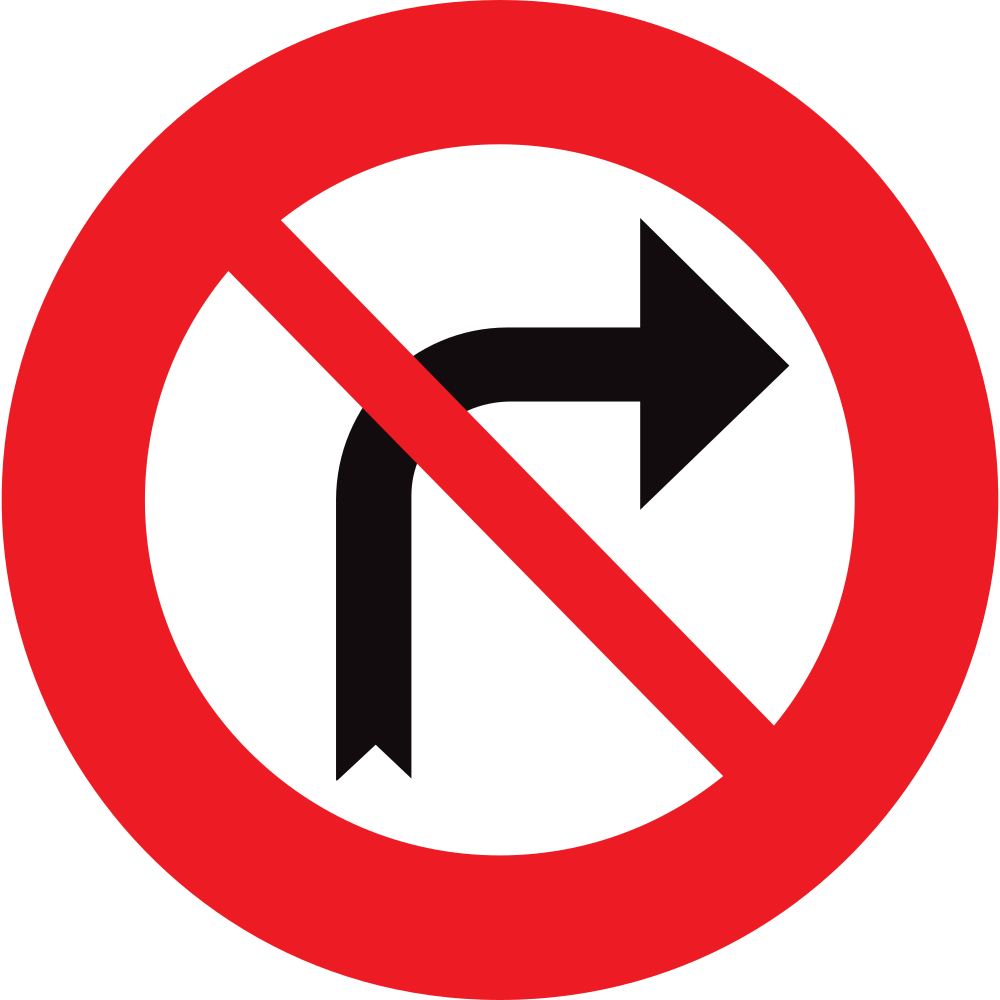 Turning right prohibited.
English • Traffic sign C31b • At the next junction, turning in the direction indicated by the arrow is prohibited.
Français • Signal routier C31b • Au prochain carrefour, interdiction de tourner dans le sens indiqué par la flèche.
Nederlands • Verkeersbord C31b • Verbod aan het volgend kruispunt af te slaan in de richting door de pijl aangegeven.
Where does a Belgian no-left-turn or no-right-turn sign apply?
The prohibition applies at the next intersection encountered after the sign.
Does a Belgian no-turn sign determine priority?
No. When continuing or making another permitted turn, drivers must still follow traffic lights, priority signs and the ordinary priority rules.
May cyclists be exempted from a Belgian no-turn sign?
Yes. A supplementary panel showing a bicycle exception indicates that the no-turn prohibition does not apply to cyclists.
29. School area
A school area is a road or group of roads near a school where large numbers of children may walk, cycle, cross the road or enter and leave vehicles. It may be identified by warning signs, zone signs, road markings, traffic-calming measures or flashing lights.
Special speed limits, parking restrictions or access rules may apply permanently or only during school arrival and departure times. Drivers should reduce speed, watch carefully for children and be prepared to stop.

Wikimedia.org • Alain Rouiller • CC BY-SA
What is legally considered a school area in Belgium?
A Belgian schoolomgeving is a zone consisting of one or more public roads or road sections that includes an entrance to a school and is marked by the legally prescribed entrance and exit signs.
 Warning for children.
English • Traffic sign A23 • Place particularly frequented by children.
Français • Signal routier A23 • Endroit spécialement fréquenté par des enfants.
Nederlands • Verkeersbord A23 • Plaats waar speciaal veel kinderen komen.
Sources
SVG source: Commons.wikimedia.org
Vascer • Public domain. Original SVG unmodified.
🔗 Wegcode.be • Artikel 66. Gevaarsborden (NL)
🔗 Codedelaroute.be • Article 66. Signaux de danger (FR)
When does the Belgian school-area 30 km/h limit apply?
A school area marked by F4a and F4b has a maximum of 30 km/h. A permanently displayed restriction applies at all times, including outside school hours. Variable school-area signs may display the restriction during arrival and departure periods. When it is not displayed, apply the otherwise applicable regional, zonal or signed limit and slow further when children or conditions require it.
 Start of a zone with speed limit.
English • Traffic sign F4a • Beginning of a zone where the speed limit is 30 km/h. This sign is placed on the right at every entrance to a zone where the speed limit is 30 km/h; it may be repeated on the left.
Français • Signal routier F4a • Commencement d'une zone dans laquelle la vitesse est limitée à 30 km à l'heure. Ce signal est placé à droite de chaque accès à une zone dans laquelle la vitesse est limitée à 30 km à l'heure; il peut être répété à gauche.
Nederlands • Verkeersbord F4a • Begin van een zone met een snelheidsbeperking van 30 km per uur. Dit verkeersbord wordt rechts geplaatst aan elke toegang tot een zone met een snelheidsbeperking van 30 km per uur; het mag links herhaald worden.
Sources
SVG source: Commons.wikimedia.org
Vascer • Public domain. Original SVG unmodified.
🔗 Wegcode.be • Artikel 71. Aanwijzingsborden (NL)
🔗 Codedelaroute.be • Article 71. Signaux d'indication (FR)
 End of the zone with speed limit.
English • Traffic sign F4b • End of a zone where the speed limit is 30 km/h. This sign is placed on the right at every exit from a zone where the speed limit is 30 km/h; it may be repeated on the left.
Français • Signal routier F4b • Fin d'une zone dans laquelle la vitesse est limitée à 30 km à l'heure. Ce signal est placé à droite de chaque sortie d'une zone dans laquelle la vitesse est limitée à 30 km à l'heure; il peut être répété à gauche.
Nederlands • Verkeersbord F4b • Einde van een zone met een snelheidsbeperking van 30 km per uur. Dit verkeersbord wordt rechts geplaatst aan elke uitgang van een zone met een snelheidsbeperking van 30 km per uur; het mag links herhaald worden.
Is a school area the same as a Belgian school street?
No. A school area is principally a signed 30 km/h environment. A schoolstraat temporarily restricts motor-vehicle access during specified periods.
Must drivers take special care around children?
Yes. Belgian drivers must be especially cautious around children, reduce speed and stop when necessary.
How does a crossing supervisor stop traffic?
The authorised supervisor uses a hand-held disc displaying traffic sign C3. Road users must stop when directed.
 Access prohibited in both directions.
English • Traffic sign C3 • No access in either direction for any driver or rider.
Français • Signal routier C3 • Accès interdit, dans les deux sens, à tout conducteur.
Nederlands • Verkeersbord C3 • Verboden toegang, in beide richtingen, voor iedere bestuurder.
Sources
SVG source: Commons.wikimedia.org
Vascer • Public domain. Original SVG unmodified.
🔗 Wegcode.be • Artikel 68. Verbodsborden (NL)
🔗 Codedelaroute.be • Article 68. Signaux d'interdiction (FR)
30. Crossing animals
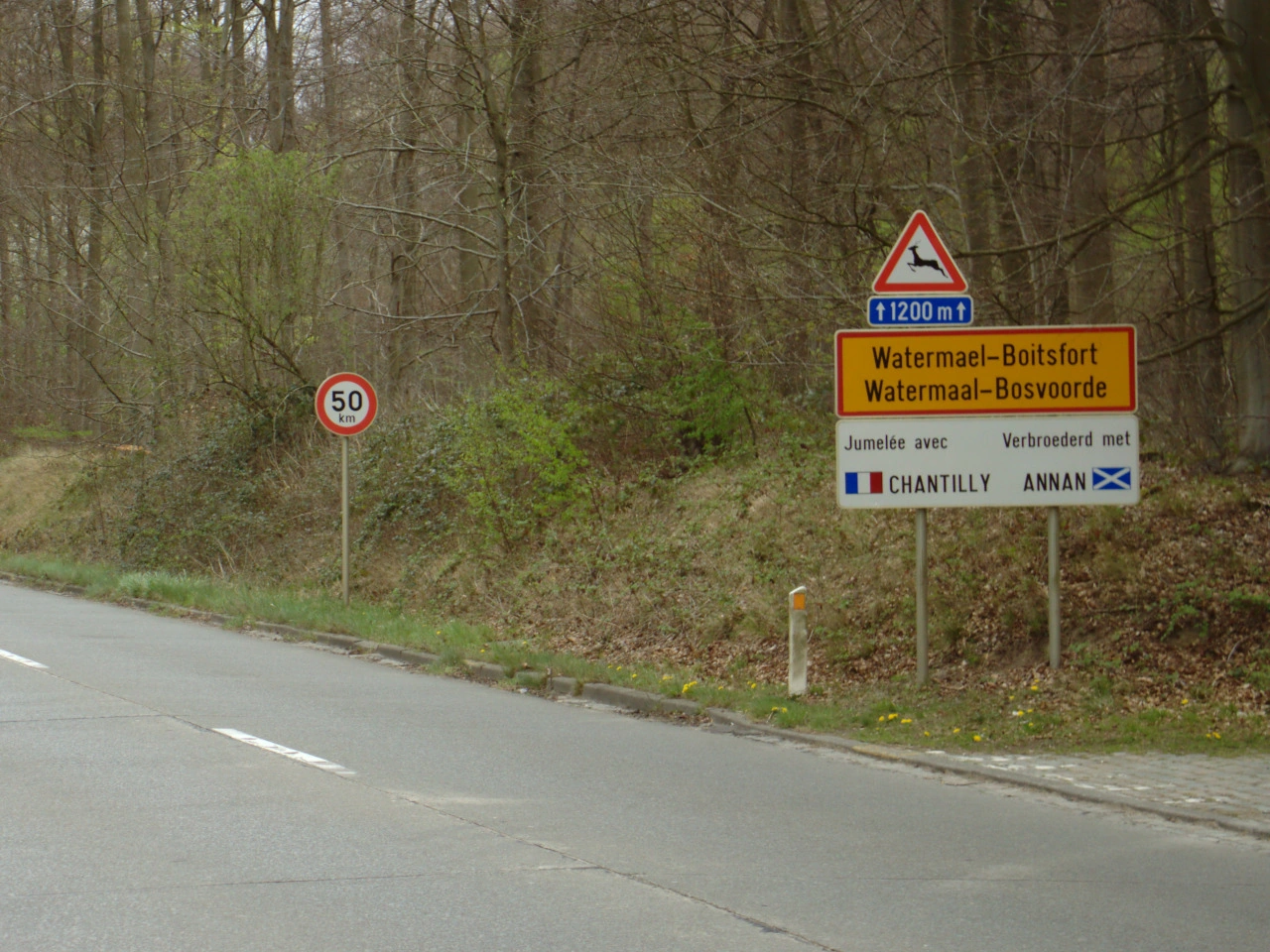
An animals-crossing warning indicates a place or road section where wild animals, livestock or ridden animals may enter or cross the road. Animals may appear suddenly, move unpredictably or be difficult to see in darkness, vegetation or poor weather.
Drivers should reduce speed, scan both sides of the road and remain prepared to stop. The warning sign does not itself give animals priority or impose a numerical speed limit, but drivers must avoid frightening, endangering or colliding with them.
Wikimedia.org • Aktron • CC BY
Which Belgian signs warn of animals crossing?
Under the current Belgian Highway Code, traffic sign A27 warns of large wild animals and traffic sign A29 warns of livestock crossing.
🔗 codex.vlaanderen.be • Belgian Road Code — articles 7–8, 10.1–10.3, 33 and 66.4 (A27/A29)
🔗 wegcode.be • Belgian Road Code of 1 December 1975 — articles 7–8, 10.1–10.3, 33 and 66.4 (A27/A29)
 Warning for crossing deer.
English • Traffic sign A27 • Large wild animals crossing.
Français • Signal routier A27 • Traversée de gros gibier.
Nederlands • Verkeersbord A27 • Doortocht van groot wild.
Sources
SVG source: Commons.wikimedia.org
Vascer • Public domain. Original SVG unmodified.
🔗 Wegcode.be • Artikel 66. Gevaarsborden (NL)
🔗 Codedelaroute.be • Article 66. Signaux de danger (FR)
 Warning for cattle on the road.
English • Traffic sign A29 • Cattle crossing.
Français • Signal routier A29 • Traversée de bétail.
Nederlands • Verkeersbord A29 • Doortocht van vee.
Sources
SVG source: Commons.wikimedia.org
Vascer • Public domain. Original SVG unmodified.
🔗 Wegcode.be • Artikel 66. Gevaarsborden (NL)
🔗 Codedelaroute.be • Article 66. Signaux de danger (FR)
Does a Belgian animal-crossing warning sign impose a speed limit?
No. They are warning signs. The applicable regional, zonal, posted and vehicle-specific speed limits remain in force.
🔗 codex.vlaanderen.be • Belgian Road Code — articles 7–8, 10.1–10.3, 33 and 66.4 (A27/A29)
🔗 wegcode.be • Belgian Road Code of 1 December 1975 — articles 7–8, 10.1–10.3, 33 and 66.4 (A27/A29)
Must you drive below the speed limit?
Yes, when necessary. Belgian drivers must adapt their speed to visibility, traffic, road conditions and foreseeable hazards and remain able to stop before an obstruction.
🔗 codex.vlaanderen.be • Belgian Road Code — articles 7–8, 10.1–10.3, 33 and 66.4 (A27/A29)
🔗 wegcode.be • Belgian Road Code of 1 December 1975 — articles 7–8, 10.1–10.3, 33 and 66.4 (A27/A29)
When must you stop near controlled animals?
You must stop when the animals show signs of fear.
🔗 codex.vlaanderen.be • Belgian Road Code — articles 7–8, 10.1–10.3, 33 and 66.4 (A27/A29)
🔗 wegcode.be • Belgian Road Code of 1 December 1975 — articles 7–8, 10.1–10.3, 33 and 66.4 (A27/A29)
Does the same specific stopping rule apply to wild animals?
The express rule concerning frightened animals applies to draft, load and riding animals and livestock. A driver encountering wild animals must still reduce speed or stop whenever necessary to avoid danger.
🔗 codex.vlaanderen.be • Belgian Road Code — articles 7–8, 10.1–10.3, 33 and 66.4 (A27/A29)
🔗 wegcode.be • Belgian Road Code of 1 December 1975 — articles 7–8, 10.1–10.3, 33 and 66.4 (A27/A29)
31. Rockfall
A rockfall warning indicates a road section where rocks or stones may fall from a cliff, cutting or steep slope, or where fallen material may already be present on the road. The danger may affect the full carriageway and can appear suddenly.
Drivers should reduce speed, scan the road and slopes ahead, increase their following distance and remain prepared to stop. They should avoid unnecessary stopping in the exposed section and never attempt to move unstable rocks themselves.

Wikimedia.org • Jeanhousen • CC BY-SA
Which Belgian sign warns of falling rocks?
Traffic sign A19 warns drivers of falling rocks.
🔗 codex.vlaanderen.be • Belgian Road Code — articles 4–6, 7, 9.1.2, 10.1 and 66.4 (A19)
🔗 wegcode.be • Belgian Road Code of 1 December 1975 — articles 4–6, 7, 9.1.2, 10.1 and 66.4 (A19)
 Warning for falling rocks.
English • Traffic sign A19 • Falling rocks.
Français • Signal routier A19 • Chutes de pierres.
Nederlands • Verkeersbord A19 • Vallende stenen.
Sources
SVG source: Commons.wikimedia.org
Vascer • Public domain. Original SVG unmodified.
🔗 Wegcode.be • Artikel 66. Gevaarsborden (NL)
🔗 Codedelaroute.be • Article 66. Signaux de danger (FR)
Does a Belgian falling-rocks warning sign impose a speed limit?
No. The falling-rocks sign is a warning sign. The applicable regional, zonal, posted and vehicle-specific speed limits remain in force.
🔗 codex.vlaanderen.be • Belgian Road Code — articles 4–6, 7, 9.1.2, 10.1 and 66.4 (A19)
🔗 wegcode.be • Belgian Road Code of 1 December 1975 — articles 4–6, 7, 9.1.2, 10.1 and 66.4 (A19)
Must you drive below the applicable speed limit?
Yes, when necessary. Belgian drivers must adapt their speed to the road layout, visibility, weather, road condition and foreseeable obstructions.
🔗 codex.vlaanderen.be • Belgian Road Code — articles 4–6, 7, 9.1.2, 10.1 and 66.4 (A19)
🔗 wegcode.be • Belgian Road Code of 1 December 1975 — articles 4–6, 7, 9.1.2, 10.1 and 66.4 (A19)
Must you be able to stop before a fallen rock?
Yes. Drivers must always remain able to stop before an obstruction that can reasonably be foreseen.
🔗 codex.vlaanderen.be • Belgian Road Code — articles 4–6, 7, 9.1.2, 10.1 and 66.4 (A19)
🔗 wegcode.be • Belgian Road Code of 1 December 1975 — articles 4–6, 7, 9.1.2, 10.1 and 66.4 (A19)
May cyclists leave a bike path to avoid fallen rocks?
Yes. Cyclists and permitted moped riders may leave a bike path to travel around an obstruction. They must check traffic and make the movement safely.
🔗 codex.vlaanderen.be • Belgian Road Code — articles 4–6, 7, 9.1.2, 10.1 and 66.4 (A19)
🔗 wegcode.be • Belgian Road Code of 1 December 1975 — articles 4–6, 7, 9.1.2, 10.1 and 66.4 (A19)
32. Curve
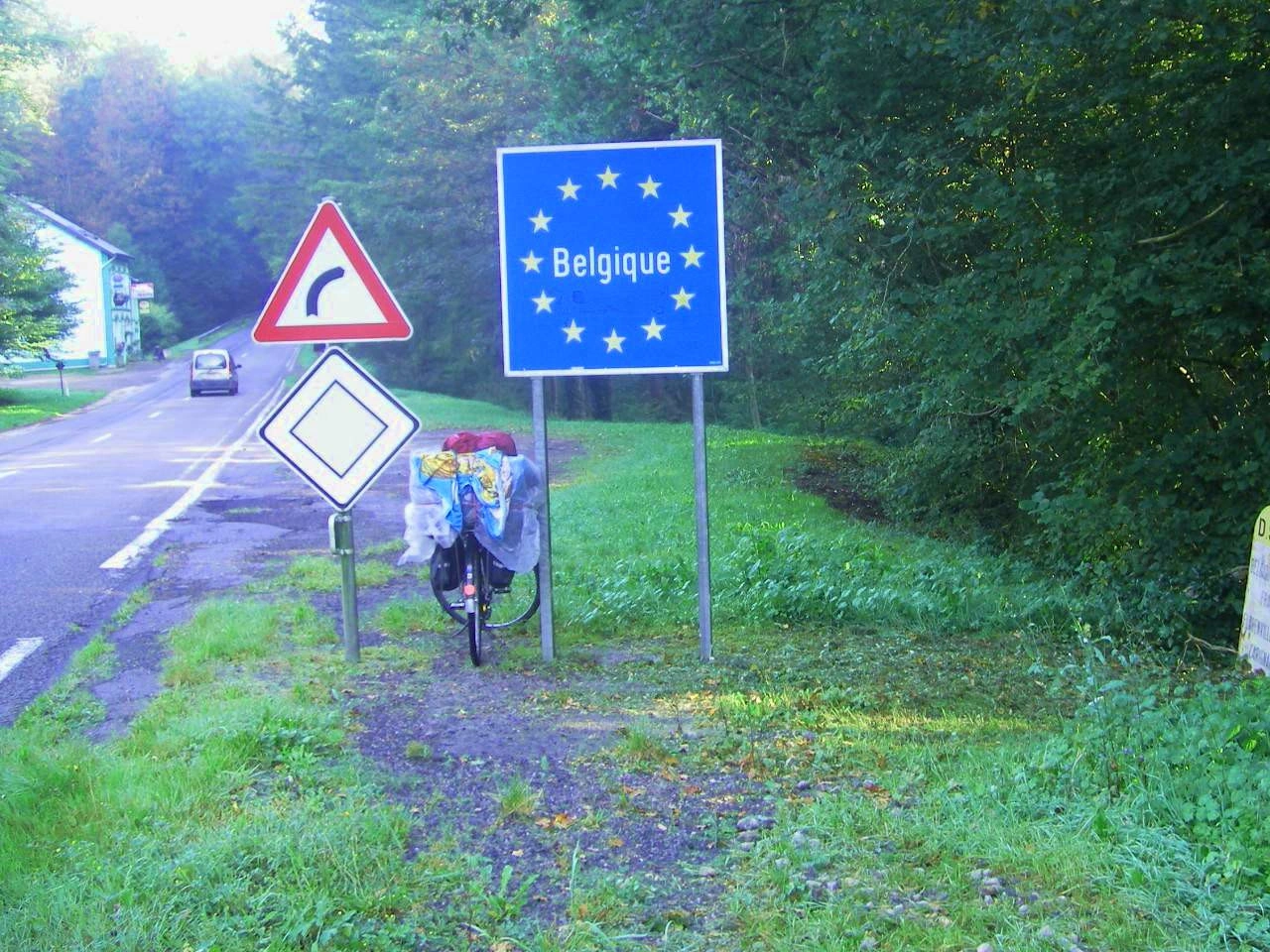
A curve is a section of road that changes direction to the left or right. A sharp, unexpected or poorly visible curve can reduce a driver’s view of approaching traffic, stopped vehicles, pedestrians and other hazards.
Drivers should reduce speed before entering the curve, remain within their lane and use smooth steering, braking and acceleration. Warning signs may indicate the direction of the first curve or a series of successive curves.
Wikimedia.org • Szeder László • CC BY-SA
Which Belgian signs warn of dangerous curves?
Belgian traffic signs A1a, A1b, A1c and A1d warn of dangerous curves.
🔗 codex.vlaanderen.be • Belgian Road Code — articles 8.3, 10.1, 17.1–17.2, 24(6), 66.1 and 66.4 (A1)
 Warning for a curve to the left.
English • Traffic sign A1a • Dangerous bend. Left-hand bend.
Français • Signal routier A1a • Virage dangereux. Virage à gauche.
Nederlands • Verkeersbord A1a • Gevaarlijke bocht. Bocht naar links.
Sources
SVG source: Commons.wikimedia.org
Vascer • Public domain. Original SVG unmodified.
🔗 Wegcode.be • Artikel 66. Gevaarsborden (NL)
🔗 Codedelaroute.be • Article 66. Signaux de danger (FR)
 Warning for a curve to the right.
English • Traffic sign A1b • Dangerous bend. Right-hand bend.
Français • Signal routier A1b • Virage dangereux. Virage à droite.
Nederlands • Verkeersbord A1b • Gevaarlijke bocht. Bocht naar rechts.
Sources
SVG source: Commons.wikimedia.org
Vascer • Public domain. Original SVG unmodified.
🔗 Wegcode.be • Artikel 66. Gevaarsborden (NL)
🔗 Codedelaroute.be • Article 66. Signaux de danger (FR)
 Warning for a double curve, first left then right.
English • Traffic sign A1c • Dangerous bend. Double bend or a series of more than two bends, the first to the left.
Français • Signal routier A1c • Virage dangereux. Double virage ou succession de plus de deux virages, le premier à gauche.
Nederlands • Verkeersbord A1c • Gevaarlijke bocht. Dubbele bocht of opeenvolging van meer dan twee bochten, de eerste naar links.
Sources
SVG source: Commons.wikimedia.org
Vascer • Public domain. Original SVG unmodified.
🔗 Wegcode.be • Artikel 66. Gevaarsborden (NL)
🔗 Codedelaroute.be • Article 66. Signaux de danger (FR)
 Warning for a double curve, first right then left.
English • Traffic sign A1d • Dangerous bend. Double bend or a series of more than two bends, the first to the right.
Français • Signal routier A1d • Virage dangereux. Double virage ou succession de plus de deux virages, le premier à droite.
Nederlands • Verkeersbord A1d • Gevaarlijke bocht. Dubbele bocht of opeenvolging van meer dan twee bochten, de eerste naar rechts.
Sources
SVG source: Commons.wikimedia.org
Vascer • Public domain. Original SVG unmodified.
🔗 Wegcode.be • Artikel 66. Gevaarsborden (NL)
🔗 Codedelaroute.be • Article 66. Signaux de danger (FR)
Can a panel indicate the distance to the curve?
Yes. A supplementary distance panel may indicate approximately how far ahead the dangerous curve begins.
🔗 codex.vlaanderen.be • Belgian Road Code — articles 8.3, 10.1, 17.1–17.2, 24(6), 66.1 and 66.4 (A1)
Does a Belgian dangerous-curve warning sign impose a speed limit?
No. The applicable regional, zonal, posted and vehicle-specific speed limits remain in force.
🔗 codex.vlaanderen.be • Belgian Road Code — articles 8.3, 10.1, 17.1–17.2, 24(6), 66.1 and 66.4 (A1)
Must you sometimes drive below the speed limit?
Yes. Belgian drivers must adapt their speed to the road layout, visibility, weather, traffic and vehicle condition and remain able to stop before a foreseeable obstruction.
🔗 codex.vlaanderen.be • Belgian Road Code — articles 8.3, 10.1, 17.1–17.2, 24(6), 66.1 and 66.4 (A1)
May you stop or park in a Belgian curve?
Stopping and parking on the carriageway are prohibited in a curve when visibility is insufficient.
🔗 codex.vlaanderen.be • Belgian Road Code — articles 8.3, 10.1, 17.1–17.2, 24(6), 66.1 and 66.4 (A1)
33. Chevron
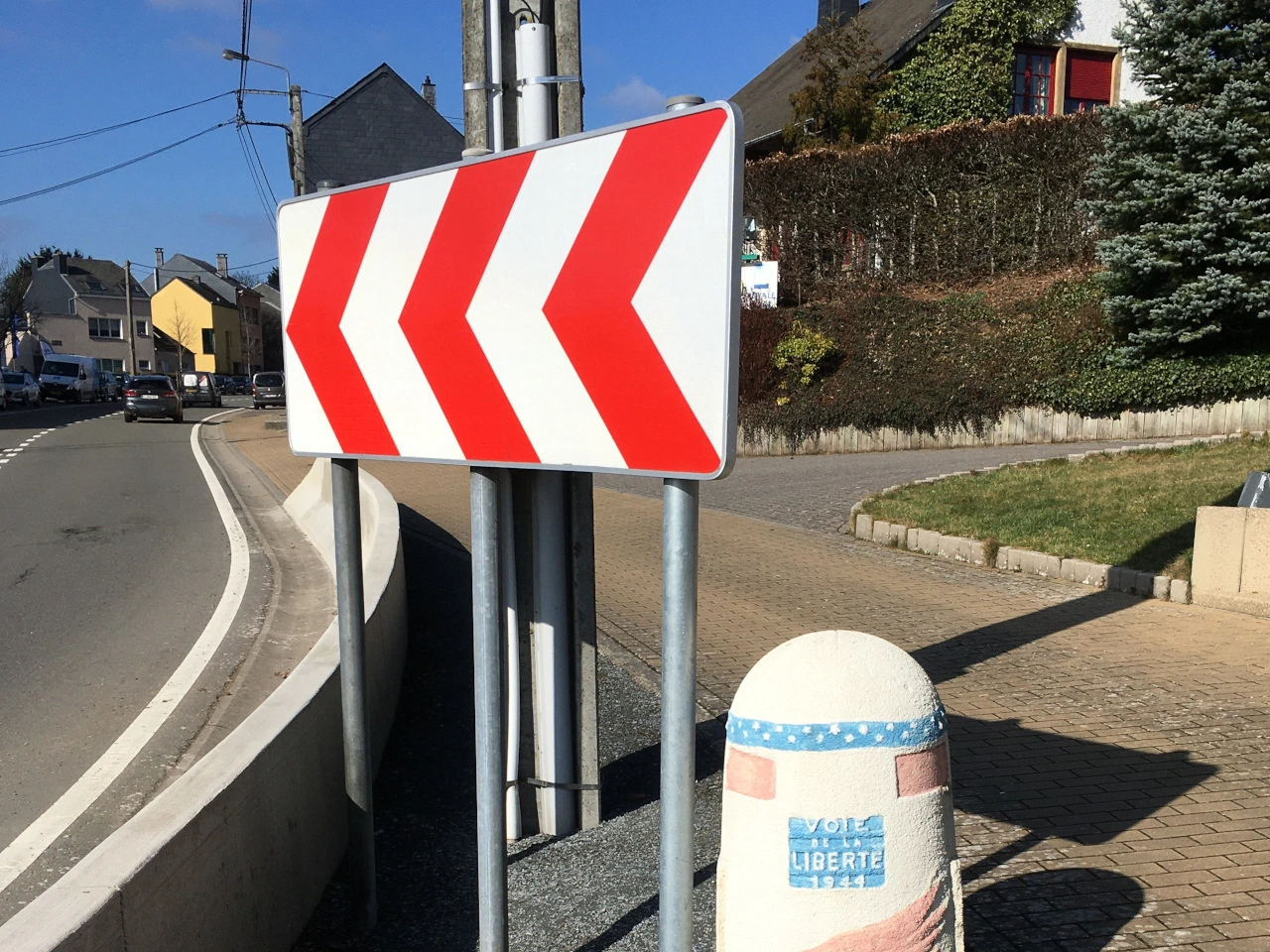
A chevron is a V-shaped or arrow-shaped road marker used to show a sharp change in the direction of a road. Chevron boards are normally placed along the outside of a curve so that their points indicate the direction in which the road continues.
Chevrons improve the visibility and alignment of a curve, especially in darkness or poor weather. They do not normally impose a speed limit or determine priority, so drivers must reduce speed before the curve and follow all other signs and road markings.
Wikimedia.org • ARLONVIRTON • CC BY-SA
What is a chevron board in Belgium?
A chevron board is an alignment panel with one or more arrow-shaped chevrons. Boards placed along a bend help drivers see the direction of the road and follow its alignment. They are distinct from mandatory-direction signs and do not themselves set a numerical speed limit.
🔗 securotheque.wallonie.be • SPW Sécurothèque — curve alignment and chevron boards
What is the difference between a dangerous-curve warning sign and chevron boards in Belgium?
A dangerous-curve warning sign warns drivers before the curve. Chevron boards are placed in or around the curve to show its alignment and guide drivers while they negotiate it.
🔗 securotheque.wallonie.be • SPW Sécurothèque — curve alignment and chevron boards
Do Belgian chevrons impose a speed limit?
No. They guide drivers through the curve. Only an applicable C43 sign, speed zone or general road rule establishes the legal maximum speed.
🔗 securotheque.wallonie.be • SPW Sécurothèque — curve alignment and chevron boards
 Start of a speed limit.
English • Traffic sign C43 • Travelling faster than the indicated speed is prohibited from the sign up to and including the next junction, or until any C43 sign, with or without zonal validity, or a sign marking the beginning or end of a built-up area, residential area (zone résidentielle or zone de rencontre), or pedestrian zone.
Français • Signal routier C43 • A partir du signal jusqu'au prochain carrefour inclus, ou jusqu’à chaque signal C43 avec ou sans validité zonale, ou jusqu’au signal indiquant le début ou la fin d’une agglomération, d’une zone résidentielle, d’une zone de rencontre ou d’une zone piétonne, interdiction de circuler à une vitesse supérieure à celle qui est indiquée.
Nederlands • Verkeersbord C43 • Vanaf het verkeersbord tot en met het volgend kruispunt, of tot elk verkeersbord C43 met of zonder zonale geldigheid, of tot het verkeersbord dat het begin of het einde van een bebouwde kom, van een woonerf of erf, of van een voetgangerszone aanduidt, verbod te rijden met een grotere snelheid dan deze die is aangeduid.
Do chevrons give you priority?
No. They do not change priority at an intersection or against oncoming traffic.
🔗 securotheque.wallonie.be • SPW Sécurothèque — curve alignment and chevron boards
How should motorcyclists follow Belgian chevrons?
Look through the curve, select a suitable speed beforehand and maintain a stable line. Both the rider and motorcycle must remain within the correct part of the carriageway.
🔗 securotheque.wallonie.be • SPW Sécurothèque — curve alignment and chevron boards
34. Wrong-way driving
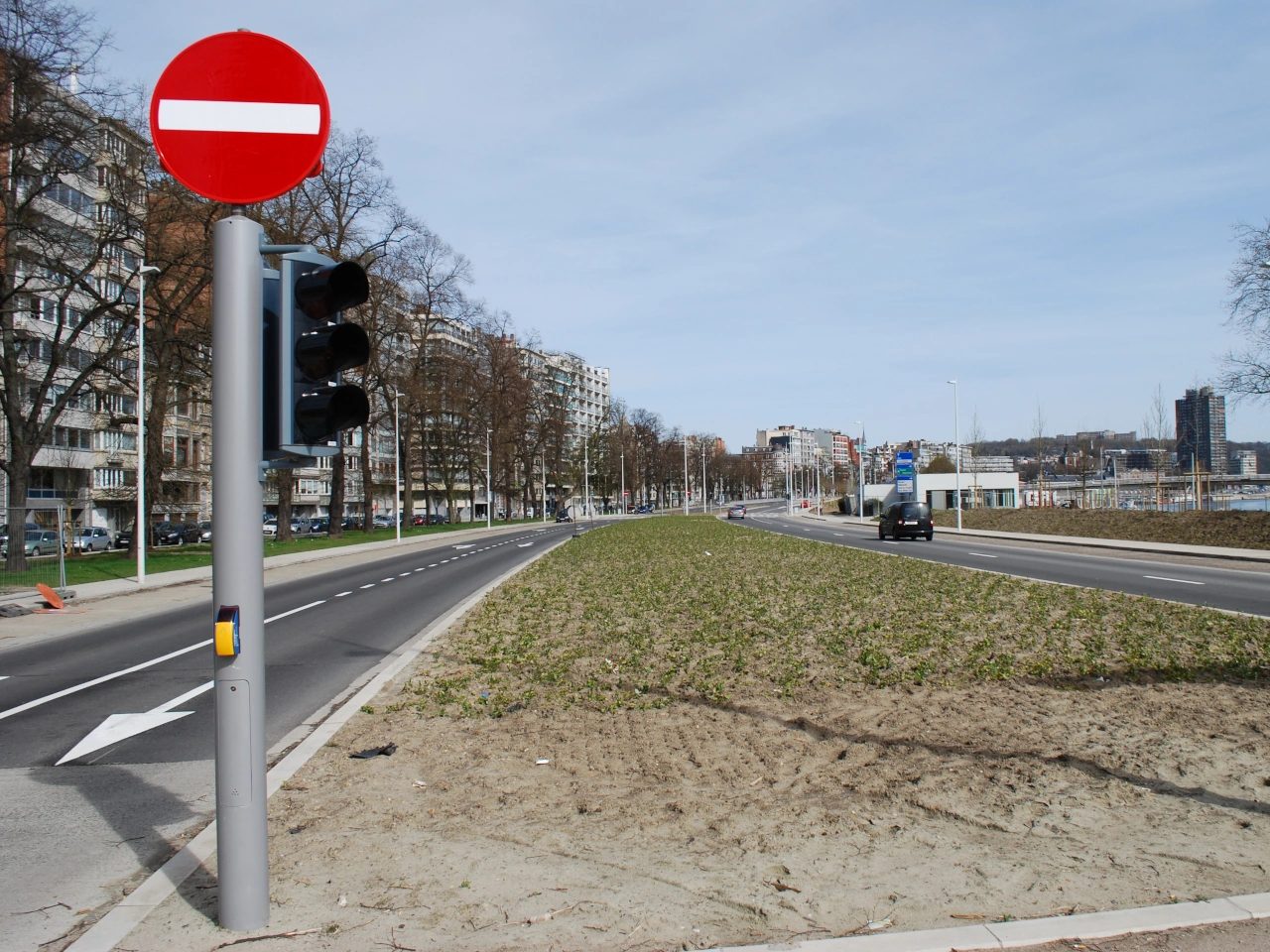
Wrong-way driving occurs when a driver travels against the legally permitted direction of traffic. It may happen on a one-way road, divided road, motorway entrance or exit, or another road section reserved for traffic travelling in one direction.
Wrong-way driving creates an extreme risk of a head-on collision. Drivers must follow direction signs, no-entry signs, lane arrows and road markings. Anyone who accidentally enters a road in the wrong direction should slow down, warn other traffic, stop in the safest available place and contact the emergency services.
Wikimedia.org • Jeanhousen • CC BY-SA
What is wrong-way driving called in Belgium?
The Dutch term is spookrijden. In Belgian road-safety usage, it normally refers specifically to driving in the wrong direction on a motorway.
🔗 belgium.be • Belgium.be — avoiding and responding to motorway wrong-way driving
How are no-entry and one-way traffic signs normally used together in Belgium?
The no-entry sign faces drivers approaching the prohibited entrance. The one-way traffic sign is normally placed at the opposite end to show the legally permitted direction.
🔗 belgium.be • Belgium.be — avoiding and responding to motorway wrong-way driving
May class A mopeds or speed pedelecs use the contraflow direction?
They may do so when the appropriate supplementary signs expressly include their vehicle category.
🔗 belgium.be • Belgium.be — avoiding and responding to motorway wrong-way driving
Can roadworks send traffic onto the opposite carriageway?
Yes. Temporary signs and markings may guide traffic through a central-reservation crossing or onto another carriageway. This is legal when drivers follow the temporary arrangement.
🔗 belgium.be • Belgium.be — avoiding and responding to motorway wrong-way driving
Where should you stop?
When there is no approaching traffic, move to the emergency lane and stop. When oncoming vehicles are present, remain as far right as possible so they have more room to avoid you.
🔗 belgium.be • Belgium.be — avoiding and responding to motorway wrong-way driving
35. Roadworks
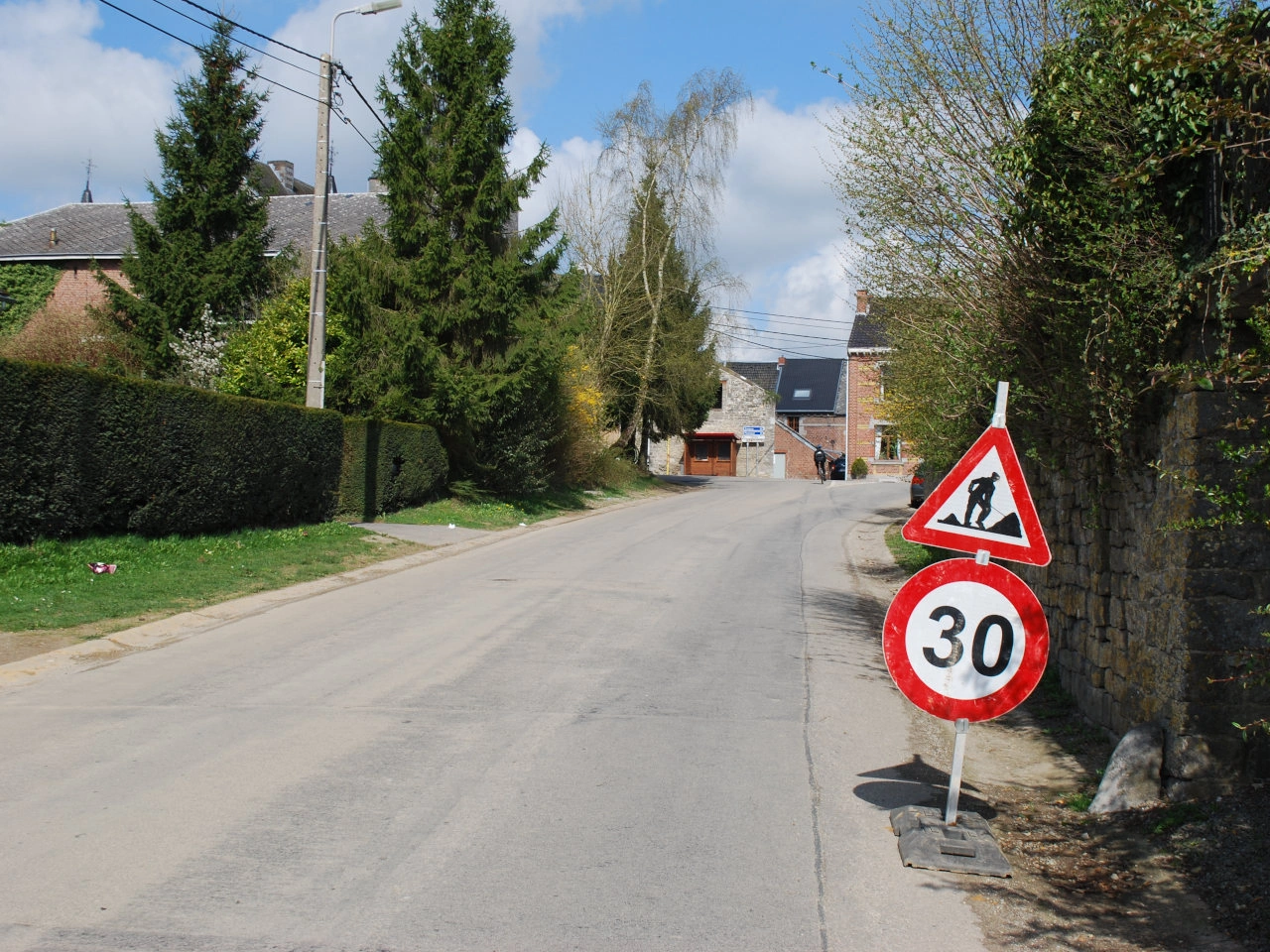
Roadworks are construction, maintenance, repair or inspection activities carried out on or beside a road. They may temporarily change the road layout, lane widths, speed limits, priority, permitted directions and facilities for pedestrians or cyclists.
Drivers must follow the temporary signs, traffic lights, barriers, road markings and instructions from authorised personnel. They should reduce speed, increase their following distance and remain prepared for narrow lanes, stopped traffic, workers, machinery and sudden changes in the route.
Wikimedia.org • Jeanhousen • CC BY-SA
Which Belgian sign warns of roadworks?
Traffic sign A31 warns that roadworks are being carried out on or beside the public road.
 Warning for roadworks.
English • Traffic sign A31 • Roadworks.
Français • Signal routier A31 • Travaux.
Nederlands • Verkeersbord A31 • Werken.
Sources
SVG source: Commons.wikimedia.org
Vascer • Public domain. Original SVG unmodified.
🔗 Wegcode.be • Artikel 66. Gevaarsborden (NL)
🔗 Codedelaroute.be • Article 66. Signaux de danger (FR)
Must you reduce speed after a Belgian roadworks warning sign?
Yes, when necessary. Drivers must adapt their speed to the temporary layout, traffic, workers, machinery, visibility and condition of the road.
What if your lane ends at Belgian roadworks?
Observe the lane-reduction signs and markings. In flowing traffic, changing lanes is a manoeuvre and you must give way to drivers already using the target lane.
What should cyclists do when a bike path is closed?
Follow the signed temporary route. When leaving an obstructed bike path, check traffic carefully and make the lateral movement safely.
36. Height limit
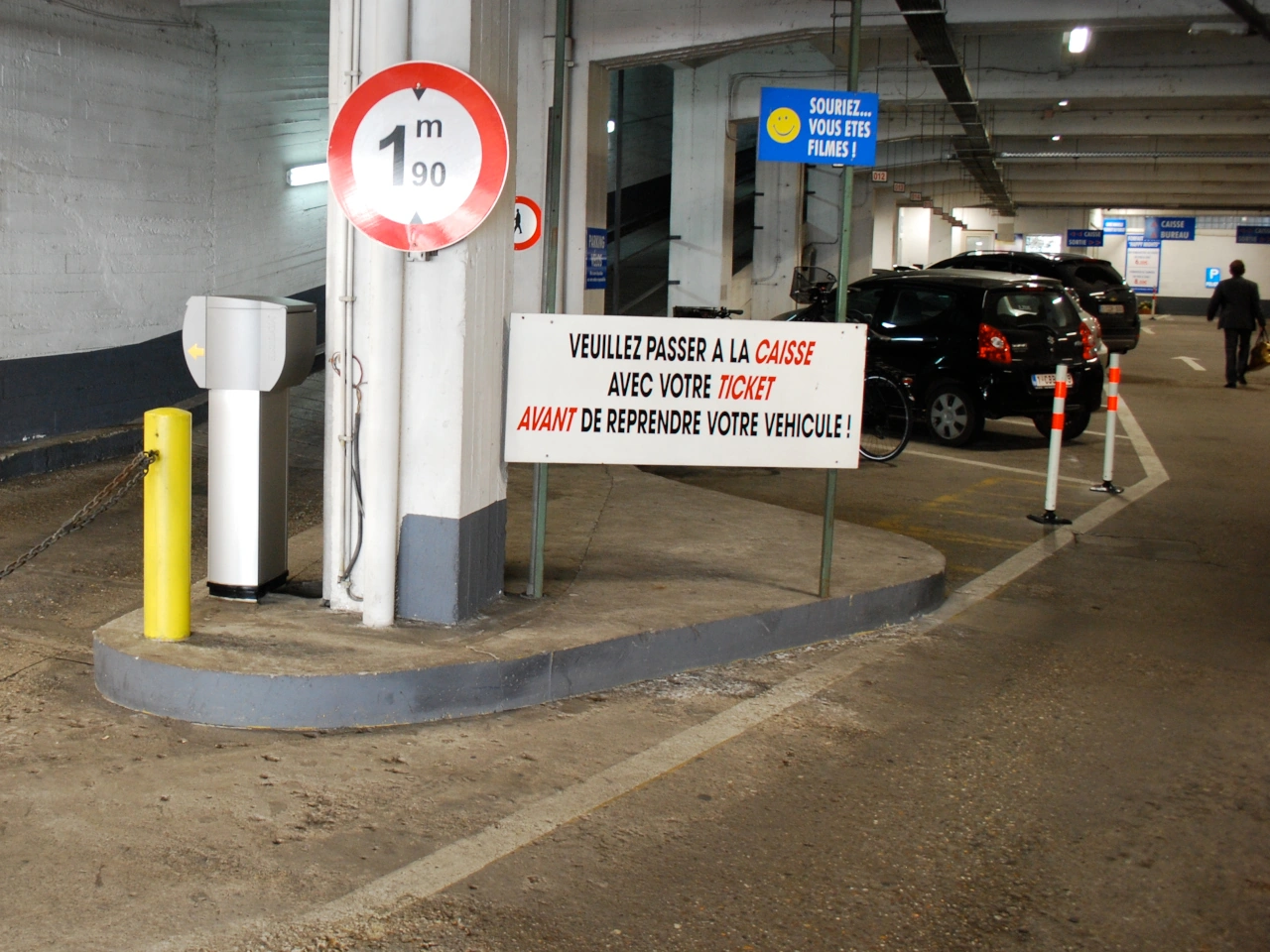
A height limit prohibits vehicles whose total height exceeds the value shown from entering or passing a road section, bridge, tunnel, gateway or other structure. The vehicle’s height includes its load and any equipment attached above it.
Drivers of high vehicles must know their exact height, observe advance warnings and use an alternative route when necessary. They should never rely only on visual judgement or attempt to pass beneath a structure when safe clearance is uncertain.
Wikimedia.org • Jeanhousen • CC BY-SA
Which Belgian sign indicates a height limit?
Traffic sign C29 prohibits access for vehicles whose height, including their load, exceeds the height displayed on the sign.
🔗 codex.vlaanderen.be • Belgian Road Code — articles 6, 12, 45, 46.3 and 68.3 (C29)
🔗 wegcode.be • Belgian Road Code of 1 December 1975 — articles 6, 12, 45, 46.3 and 68.3 (C29)
 Vehicles higher than indicated prohibited.
English • Traffic sign C29 • No drivers of vehicles whose height, including the load, exceeds the indicated height.
Français • Signal routier C29 • Accès interdit aux conducteurs de véhicules ayant, chargement compris, une hauteur supérieure à celle indiquée.
Nederlands • Verkeersbord C29 • Verboden toegang voor bestuurders van voertuigen waarvan de hoogte, lading inbegrepen, groter is dan de aangeduide.
Sources
SVG source: Commons.wikimedia.org
Vascer • Public domain. Original SVG unmodified.
🔗 Wegcode.be • Artikel 68. Verbodsborden (NL)
🔗 Codedelaroute.be • Article 68. Signaux d'interdiction (FR)
Does a Belgian height-limit sign apply only to trucks?
No. It applies to every vehicle that exceeds the displayed height, including buses, motorhomes, vans, cars with high roof loads and other vehicles.
🔗 codex.vlaanderen.be • Belgian Road Code — articles 6, 12, 45, 46.3 and 68.3 (C29)
🔗 wegcode.be • Belgian Road Code of 1 December 1975 — articles 6, 12, 45, 46.3 and 68.3 (C29)
What is the normal maximum vehicle height in Belgium?
The general maximum height of a loaded vehicle is 4 metres. Cycles without a motor have a lower 2.50-metre loaded-height limit. Flanders and Wallonia provide a specific 4.30-metre exception for loads of compressed flax bales. These general provisions do not override a lower C29 height restriction, the actual clearance or other vehicle-specific conditions.
🔗 codex.vlaanderen.be • Belgian Road Code — articles 6, 12, 45, 46.3 and 68.3 (C29)
🔗 wegcode.be • Belgian Road Code of 1 December 1975 — articles 6, 12, 45, 46.3 and 68.3 (C29)
Does a Belgian height-limit sign change priority?
No. Drivers must continue to obey traffic lights, priority signs and the ordinary priority rules.
🔗 codex.vlaanderen.be • Belgian Road Code — articles 6, 12, 45, 46.3 and 68.3 (C29)
🔗 wegcode.be • Belgian Road Code of 1 December 1975 — articles 6, 12, 45, 46.3 and 68.3 (C29)
What should you do at a Belgian height-limit sign if your vehicle is too tall?
Do not pass the sign. Stop where safe and follow the indicated diversion. Contact the police or road authority when turning or reversing cannot be done safely.
🔗 codex.vlaanderen.be • Belgian Road Code — articles 6, 12, 45, 46.3 and 68.3 (C29)
🔗 wegcode.be • Belgian Road Code of 1 December 1975 — articles 6, 12, 45, 46.3 and 68.3 (C29)
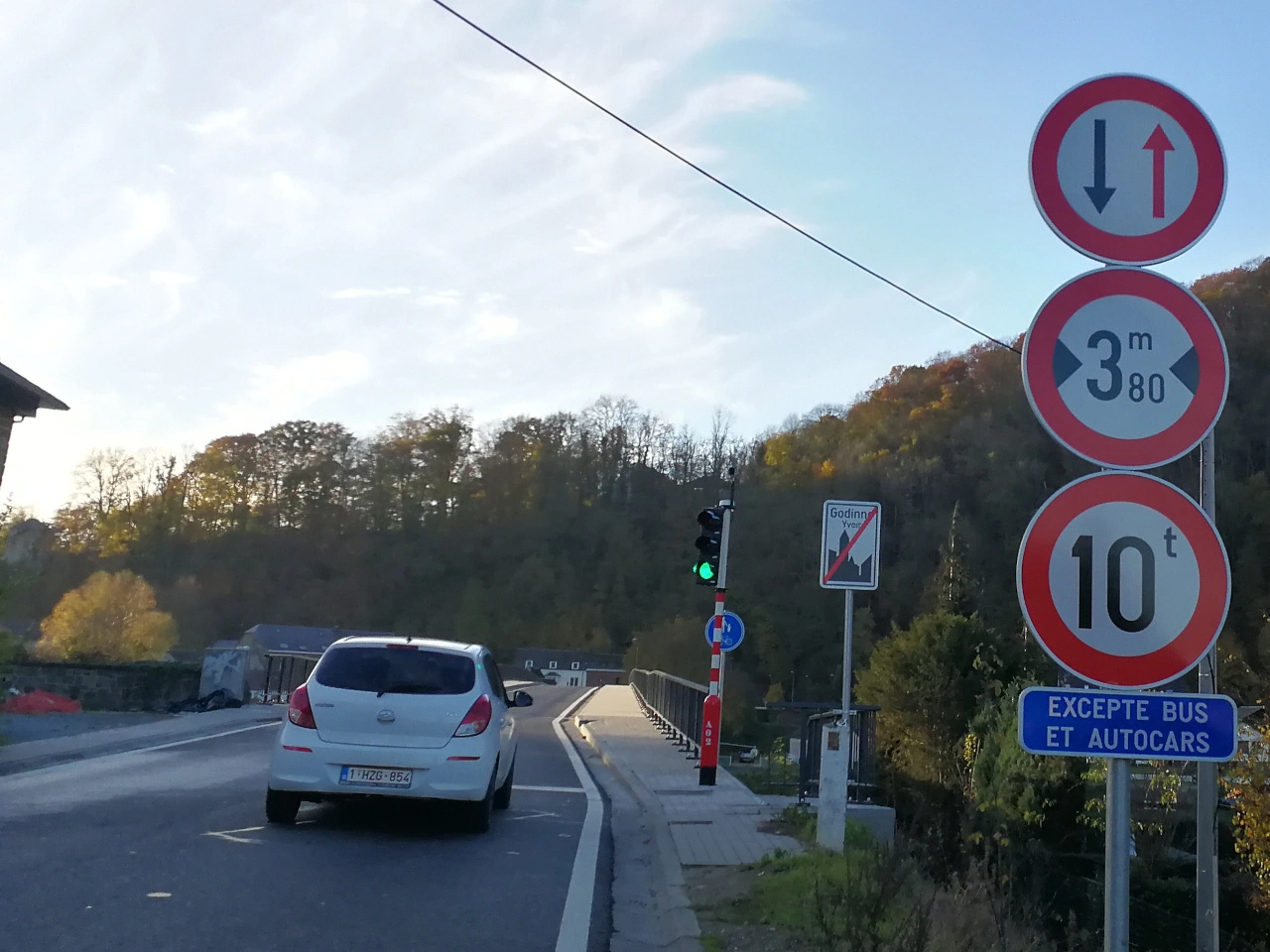
37. Width limit
A width limit prohibits vehicles or vehicle combinations whose total width exceeds the value shown from entering or passing a road section, bridge, tunnel, gateway or other narrow passage. The width includes the vehicle’s load and any equipment or objects extending from its sides.
Drivers must know the maximum travelling width of their vehicle and load, observe advance warnings and use an alternative route when necessary. They should never enter when sufficient lateral clearance is uncertain.
Wikimedia.org • Miguel Tremblay • CC0
Which Belgian sign indicates a width limit?
Traffic sign C27 prohibits access for drivers of vehicles whose width, including their load, exceeds the width displayed on the sign.
🔗 codex.vlaanderen.be • Belgian Road Code — articles 6, 12, 45, 46.1 and 68.3 (C27)
🔗 wegcode.be • Belgian Road Code of 1 December 1975 — articles 6, 12, 45, 46.1 and 68.3 (C27)
 Vehicles wider than indicated prohibited.
English • Traffic sign C27 • No drivers of vehicles whose width, including the load, exceeds the indicated width.
Français • Signal routier C27 • Accès interdit aux conducteurs de véhicules ayant, chargement compris, une largeur supérieure à celle indiquée.
Nederlands • Verkeersbord C27 • Verboden toegang voor bestuurders van voertuigen waarvan de breedte, lading inbegrepen, groter is dan de aangeduide.
Sources
SVG source: Commons.wikimedia.org
Vascer • Public domain. Original SVG unmodified.
🔗 Wegcode.be • Artikel 68. Verbodsborden (NL)
🔗 Codedelaroute.be • Article 68. Signaux d'interdiction (FR)
Do objects extending from the sides count?
Yes. Loads, equipment, securing devices and other projecting parts that increase the travelling width must be taken into account.
🔗 codex.vlaanderen.be • Belgian Road Code — articles 6, 12, 45, 46.1 and 68.3 (C27)
🔗 wegcode.be • Belgian Road Code of 1 December 1975 — articles 6, 12, 45, 46.1 and 68.3 (C27)
What is the general maximum width of a loaded vehicle in Belgium?
For a motor vehicle, horse-drawn vehicle or trailer, the general maximum width is 2.55 metres, or 2.60 metres when the vehicle is legally constructed with that width under the technical regulations.
🔗 codex.vlaanderen.be • Belgian Road Code — articles 6, 12, 45, 46.1 and 68.3 (C27)
🔗 wegcode.be • Belgian Road Code of 1 December 1975 — articles 6, 12, 45, 46.1 and 68.3 (C27)
Does a Belgian width-limit sign change priority?
No. Drivers must continue to obey traffic lights, priority signs and the ordinary priority rules.
🔗 codex.vlaanderen.be • Belgian Road Code — articles 6, 12, 45, 46.1 and 68.3 (C27)
🔗 wegcode.be • Belgian Road Code of 1 December 1975 — articles 6, 12, 45, 46.1 and 68.3 (C27)
What should you do at a Belgian width-limit sign if your vehicle is too wide?
Do not pass the sign. Stop where safe and follow the indicated diversion. Contact the police or road authority when turning or reversing cannot be completed safely.
🔗 codex.vlaanderen.be • Belgian Road Code — articles 6, 12, 45, 46.1 and 68.3 (C27)
🔗 wegcode.be • Belgian Road Code of 1 December 1975 — articles 6, 12, 45, 46.1 and 68.3 (C27)
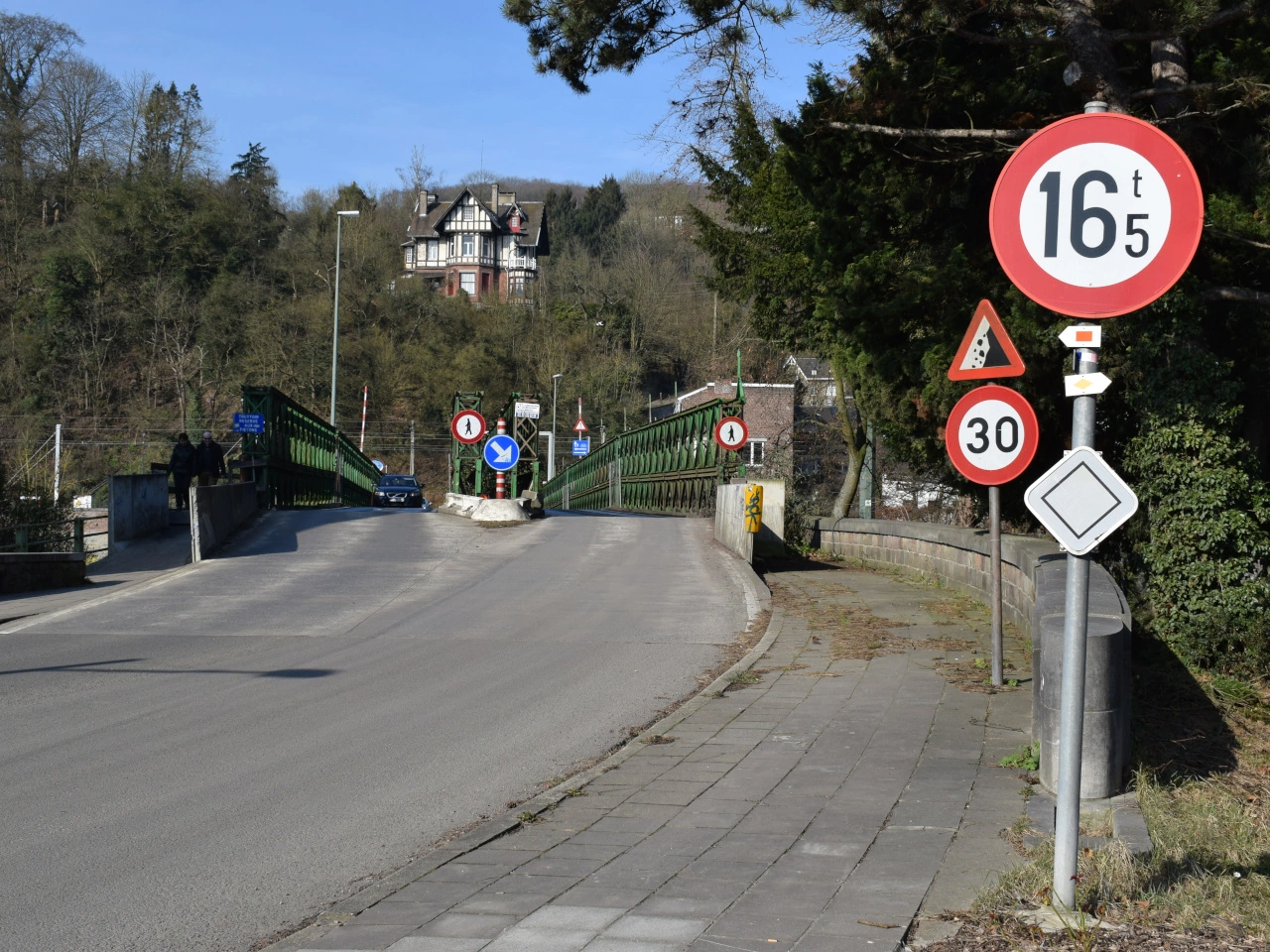
38. Weight limit
A weight limit prohibits vehicles or vehicle combinations whose mass exceeds the value shown from entering or passing a road section, bridge, tunnel or other structure. Depending on local law, the restriction may concern the vehicle’s actual loaded mass, maximum authorised mass or load on an individual axle.
Drivers must know which type of mass the sign refers to and must include the vehicle, passengers, cargo and any trailer where required. A vehicle that exceeds the limit must use another suitable route.
Wikimedia.org • Jeanhousen • CC BY-SA
Which Belgian sign indicates a weight limit?
Traffic sign C21 prohibits access for drivers of vehicles whose actual loaded mass exceeds the mass displayed on the sign.
🔗 codex.vlaanderen.be • Belgian Road Code — articles 2.16–2.17, 6, 12 and 68.3 (C21/C23)
🔗 wegcode.be • Belgian Road Code of 1 December 1975 — articles 2.16–2.17, 6, 12 and 68.3 (C21/C23)
 Vehicles heavier than indicated prohibited.
English • Traffic sign C21 • No drivers of vehicles whose laden mass exceeds the indicated mass.
Français • Signal routier C21 • Accès interdit aux conducteurs de véhicules dont la masse en charge dépasse la masse indiquée.
Nederlands • Verkeersbord C21 • Verboden toegang voor bestuurders van voertuigen waarvan de massa in beladen toestand hoger is dan de aangeduide massa.
Sources
SVG source: Commons.wikimedia.org
Vascer • Public domain. Original SVG unmodified.
🔗 Wegcode.be • Artikel 68. Verbodsborden (NL)
🔗 Codedelaroute.be • Article 68. Signaux d'interdiction (FR)
Is a Belgian weight-limit sign based on the maximum authorised mass in the vehicle documents?
No. The weight-limit sign concerns the vehicle's actual mass while loaded, which may be lower than its maximum authorised mass.
🔗 codex.vlaanderen.be • Belgian Road Code — articles 2.16–2.17, 6, 12 and 68.3 (C21/C23)
🔗 wegcode.be • Belgian Road Code of 1 December 1975 — articles 2.16–2.17, 6, 12 and 68.3 (C21/C23)
What is the difference between actual mass and maximum authorised mass?
Actual loaded mass is what the vehicle currently weighs. Maximum authorised mass is the highest total mass for which the vehicle is legally approved.
🔗 codex.vlaanderen.be • Belgian Road Code — articles 2.16–2.17, 6, 12 and 68.3 (C21/C23)
🔗 wegcode.be • Belgian Road Code of 1 December 1975 — articles 2.16–2.17, 6, 12 and 68.3 (C21/C23)
How can a Belgian driver determine the actual mass?
The vehicle can be weighed on a suitable weighbridge. Registration documents normally provide technical and authorised limits rather than the current mass of the loaded vehicle.
🔗 codex.vlaanderen.be • Belgian Road Code — articles 2.16–2.17, 6, 12 and 68.3 (C21/C23)
🔗 wegcode.be • Belgian Road Code of 1 December 1975 — articles 2.16–2.17, 6, 12 and 68.3 (C21/C23)
Does a Belgian weight-limit sign change priority?
No. Drivers must continue to obey traffic lights, priority signs and the ordinary priority rules.
🔗 codex.vlaanderen.be • Belgian Road Code — articles 2.16–2.17, 6, 12 and 68.3 (C21/C23)
🔗 wegcode.be • Belgian Road Code of 1 December 1975 — articles 2.16–2.17, 6, 12 and 68.3 (C21/C23)
39. Radar speed sign
A radar speed sign warns drivers that vehicle speeds may be monitored by a fixed camera, mobile radar, lidar or average-speed enforcement system. It reminds drivers to check and respect the applicable speed limit.
The sign does not normally establish the speed limit itself. Drivers must follow the general, posted or variable speed limit applying to the road and must not brake suddenly merely because speed enforcement is indicated.
Wikimedia.org • Romaine • CC0
Is there an official national radar traffic sign in Belgium?
No. The Belgian Highway Code does not currently include a numbered national traffic sign specifically indicating speed radar enforcement.
Does Wallonia use a radar warning sign?
Yes. Wallonia’s official signing guidance includes a blue radar information board among signs used in Wallonia but not listed as numbered signs in the current Belgian Road Code. It warns of enforcement and does not set the speed limit. This is a documented regional example; do not assume that every Belgian region uses an identical board.
Does the Walloon radar board impose a speed limit?
No. It announces speed enforcement but does not establish a numerical limit. Drivers must follow the applicable C43 sign, speed zone or general speed limit.
Start of a speed limit.
English • Traffic sign C43 • Travelling faster than the indicated speed is prohibited from the sign up to and including the next junction, or until any C43 sign, with or without zonal validity, or a sign marking the beginning or end of a built-up area, residential area (zone résidentielle or zone de rencontre), or pedestrian zone.
Français • Signal routier C43 • A partir du signal jusqu'au prochain carrefour inclus, ou jusqu’à chaque signal C43 avec ou sans validité zonale, ou jusqu’au signal indiquant le début ou la fin d’une agglomération, d’une zone résidentielle, d’une zone de rencontre ou d’une zone piétonne, interdiction de circuler à une vitesse supérieure à celle qui est indiquée.
Nederlands • Verkeersbord C43 • Vanaf het verkeersbord tot en met het volgend kruispunt, of tot elk verkeersbord C43 met of zonder zonale geldigheid, of tot het verkeersbord dat het begin of het einde van een bebouwde kom, van een woonerf of erf, of van een voetgangerszone aanduidt, verbod te rijden met een grotere snelheid dan deze die is aangeduid.
How is lidar at Walloon roadworks announced?
Wallonia’s official guidance includes an orange RADAR CHANTIER board with a radar symbol to announce lidar enforcement at a worksite. This is a Walloon signing arrangement, rather than one verified uniform announcement rule for every Belgian region. Obey the applicable speed restriction whether or not a camera is announced.
Does passing the radar end a Belgian speed restriction?
No. A speed limit ends only according to the applicable signs and road rules, not because the camera has been passed.
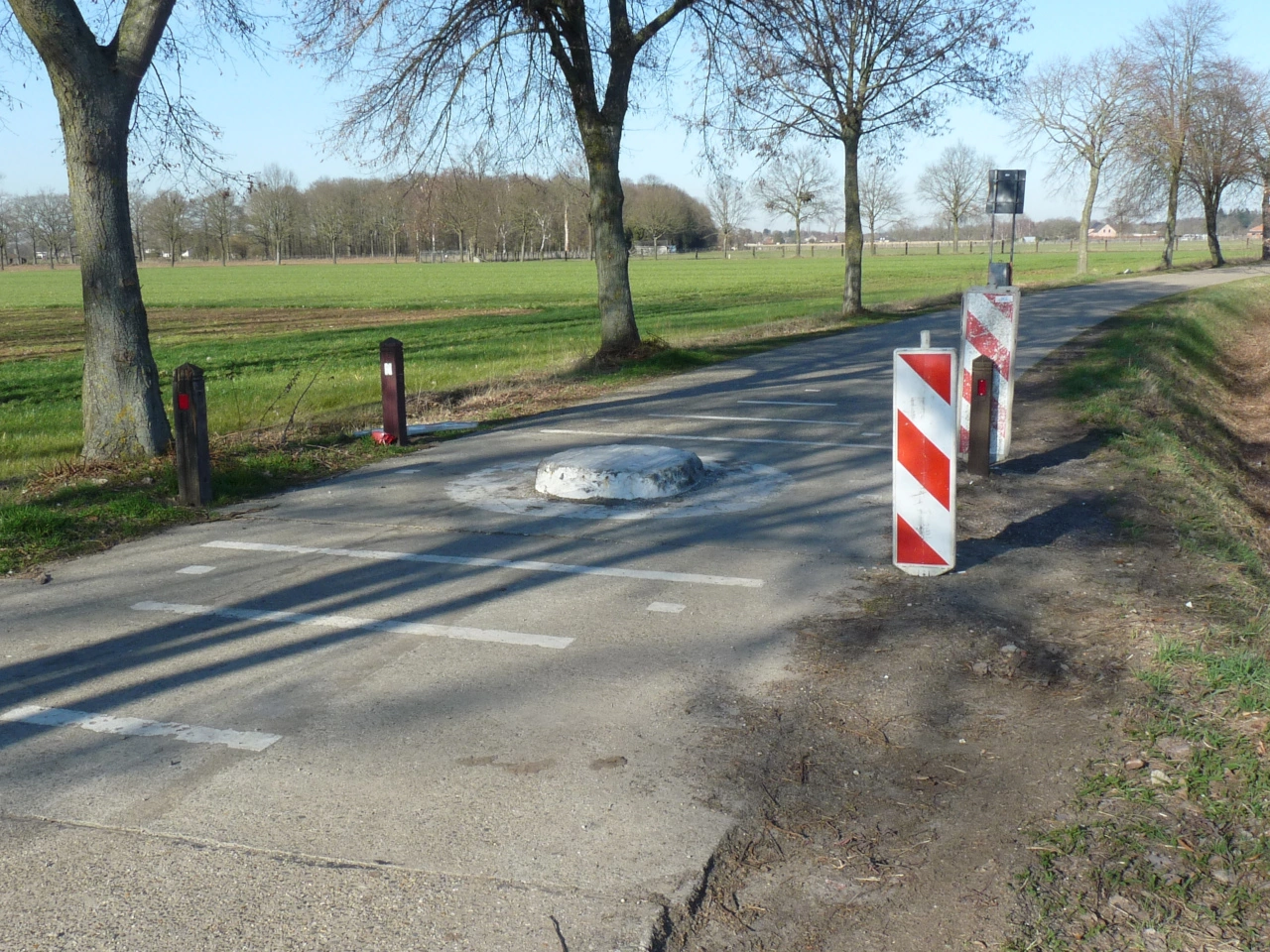
40. Selective barriers
Selective barriers are physical access-control devices that allow certain road users or authorised vehicles to pass while restricting other traffic. They may include fixed, removable, folding or retractable bollards, gates, barriers and width-filtering installations.
The permitted users are determined by traffic signs, access conditions and local regulations, not by the barrier alone. Drivers should approach slowly, verify that they are authorised and wait until any moving barrier is fully open or retracted before continuing.
Wikimedia.org • Hodagoe • CC BY-SA
Are selective barriers a separate legal road category in Belgium?
No. The current Belgian Highway Code does not define selective barriers as a separate road category. Access is determined by the applicable traffic signs, permits and local regulations.
🔗 wegcode.be • Belgian current Road Code — Articles4–5,65.2 and68.3 — access signs and M-panels
Which Belgian sign may prohibit access at a selective barrier?
Traffic sign C3 prohibits access in both directions for every driver. Supplementary signs may exempt particular categories.
🔗 wegcode.be • Belgian current Road Code — Articles4–5,65.2 and68.3 — access signs and M-panels
Access prohibited in both directions.
English • Traffic sign C3 • No access in either direction for any driver or rider.
Français • Signal routier C3 • Accès interdit, dans les deux sens, à tout conducteur.
Nederlands • Verkeersbord C3 • Verboden toegang, in beide richtingen, voor iedere bestuurder.
Sources
SVG source: Commons.wikimedia.org
Vascer • Public domain. Original SVG unmodified.
🔗 Wegcode.be • Artikel 68. Verbodsborden (NL)
🔗 Codedelaroute.be • Article 68. Signaux d'interdiction (FR)
May cyclists be exempted from a Belgian sign prohibiting vehicles in both directions?
Yes. A supplementary panel showing a bicycle exception indicates that the prohibition on vehicles in both directions does not apply to cyclists.
🔗 wegcode.be • Belgian current Road Code — Articles4–5,65.2 and68.3 — access signs and M-panels
May speed-pedelec riders be exempted?
Yes. Panel M11 may exempt speed-pedelec riders, while M12 may exempt cyclists, class A moped riders and speed-pedelec riders.
🔗 wegcode.be • Belgian current Road Code — Articles4–5,65.2 and68.3 — access signs and M-panels
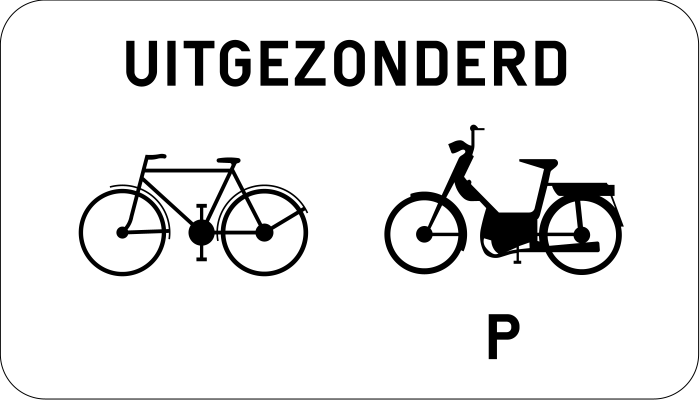 Cyclists and class P mopeds allowed.
English • Traffic sign M11 • Supplementary plate used with signs C1, C3 and C31 to indicate that the prohibition does not apply to cyclists or speed pedelec riders.
Français • Signal routier M11 • Panonceau utilisé avec les signaux C1, C3 et C31 pour indiquer que l'interdiction ne s'applique pas aux cyclistes ni aux conducteurs de speed pedelecs.
Nederlands • Verkeersbord M11 • Onderbord gebruikt samen met C1, C3 en C31 om aan te duiden dat het verbod niet geldt voor fietsers en bestuurders van speedpedelecs.
Sources
SVG source: Commons.wikimedia.org
Userc11 • Public domain. Original SVG unmodified.
🔗 Wegcode.be • Artikel 65. Algemene bepalingen (NL)
🔗 Codedelaroute.be • Article 65. Dispositions générales (FR)
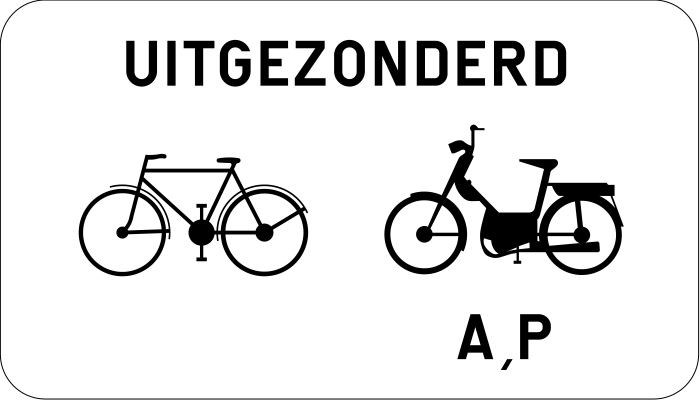 Cyclists and class A and P mopeds allowed.
English • Traffic sign M12 • Supplementary plate used with signs C1, C3 and C31 to indicate that the prohibition does not apply to cyclists, class A moped riders or speed pedelec riders.
Français • Signal routier M12 • Panonceau utilisé avec les signaux C1, C3 et C31 pour indiquer que l'interdiction ne s'applique pas aux cyclistes, aux conducteurs de cyclomoteurs de classe A ni aux conducteurs de speed pedelecs.
Nederlands • Verkeersbord M12 • Onderbord gebruikt samen met C1, C3 en C31 om aan te duiden dat het verbod niet geldt voor fietsers en bestuurders van bromfietsen klasse A en speedpedelecs.
Sources
SVG source: Commons.wikimedia.org
Userc11 • Public domain. Original SVG unmodified.
🔗 Wegcode.be • Artikel 65. Algemene bepalingen (NL)
🔗 Codedelaroute.be • Article 65. Dispositions générales (FR)
What should you do when a retractable bollard is rising or lowering?
Stop and wait until the installation has completed its movement. Proceed only when authorised and when the bollard is fully lowered.
🔗 wegcode.be • Belgian current Road Code — Articles4–5,65.2 and68.3 — access signs and M-panels
41. Intersection direction sign
An intersection direction sign shows the destinations and routes available at an approaching or current intersection. Arrows, road numbers, symbols and place names help drivers choose the correct direction and, where indicated, the correct traffic lane.
The sign provides route guidance but does not normally establish priority, permission to turn or a speed limit. Drivers must still obey traffic lights, regulatory signs, lane arrows, road markings and local traffic rules.
Wikimedia.org • Jean Housen • CC BY-SA
Which Belgian signs guide drivers before an intersection?
Traffic signs F25 and F27 are Belgian advance direction signs, legally called voorwegwijzers.
🔗 codex.vlaanderen.be • Belgian Road Code — articles 6, 10, 12–14, 67.2, 71.2 (F25/F27), 72 and 77.1
🔗 wegcode.be • 1976 sign-placement order — article 12.8, statutory reproduction
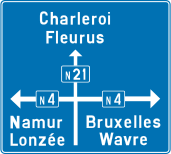 Junction layout, directions and destinations.
English • Traffic sign F25 • Advance direction sign.
Français • Signal routier F25 • Signal de préavis.
Nederlands • Verkeersbord F25 • Voorwegwijzer.
Sources
SVG source: Commons.wikimedia.org
Vascer • Public domain. Original SVG unmodified.
🔗 Wegcode.be • Artikel 71. Aanwijzingsborden (NL)
🔗 Codedelaroute.be • Article 71. Signaux d'indication (FR)
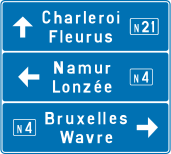 Junction directions and destinations.
English • Traffic sign F27 • Advance direction sign.
Français • Signal routier F27 • Signal de préavis.
Nederlands • Verkeersbord F27 • Voorwegwijzer.
Sources
SVG source: Commons.wikimedia.org
Vascer • Public domain. Original SVG unmodified.
🔗 Wegcode.be • Artikel 71. Aanwijzingsborden (NL)
🔗 Codedelaroute.be • Article 71. Signaux d'indication (FR)
How does a Belgian direction sign showing a junction diagram identify the priority road?
The road that has priority at the intersection is represented by a wider line.
🔗 codex.vlaanderen.be • Belgian Road Code — articles 6, 10, 12–14, 67.2, 71.2 (F25/F27), 72 and 77.1
🔗 wegcode.be • 1976 sign-placement order — article 12.8, statutory reproduction
How do Belgian advance direction signs with a junction diagram differ from signs with separate arrows?
One type shows a schematic drawing of the junction, with destinations linked to the roads. The other groups destinations in separate text-and-arrow sections without reproducing the junction as a road diagram.
🔗 codex.vlaanderen.be • Belgian Road Code — articles 6, 10, 12–14, 67.2, 71.2 (F25/F27), 72 and 77.1
🔗 wegcode.be • 1976 sign-placement order — article 12.8, statutory reproduction
Can Belgian advance direction signs with a junction diagram or separate arrows display kilometre distances?
No. Under the current Belgian placement rules, these two types of advance direction sign do not display kilometre distances. Other types of direction sign may show distances.
🔗 codex.vlaanderen.be • Belgian Road Code — articles 6, 10, 12–14, 67.2, 71.2 (F25/F27), 72 and 77.1
🔗 wegcode.be • 1976 sign-placement order — article 12.8, statutory reproduction
Does a guide sign change the speed limit?
No. The applicable regional, zonal, posted and vehicle-specific speed limits remain in force.
🔗 codex.vlaanderen.be • Belgian Road Code — articles 6, 10, 12–14, 67.2, 71.2 (F25/F27), 72 and 77.1
🔗 wegcode.be • 1976 sign-placement order — article 12.8, statutory reproduction
42. Priority at the next junction
Priority at the next junction means that drivers travelling on a particular road have priority over traffic entering from intersecting roads at the next junction. The priority arrangement is normally indicated by signs facing both the priority traffic and the traffic that must give way.
Unlike a continuing priority road, this priority applies only at the indicated intersection. Drivers must still approach cautiously and obey traffic lights, authorised officers, crossings, turning rules and other applicable signs.
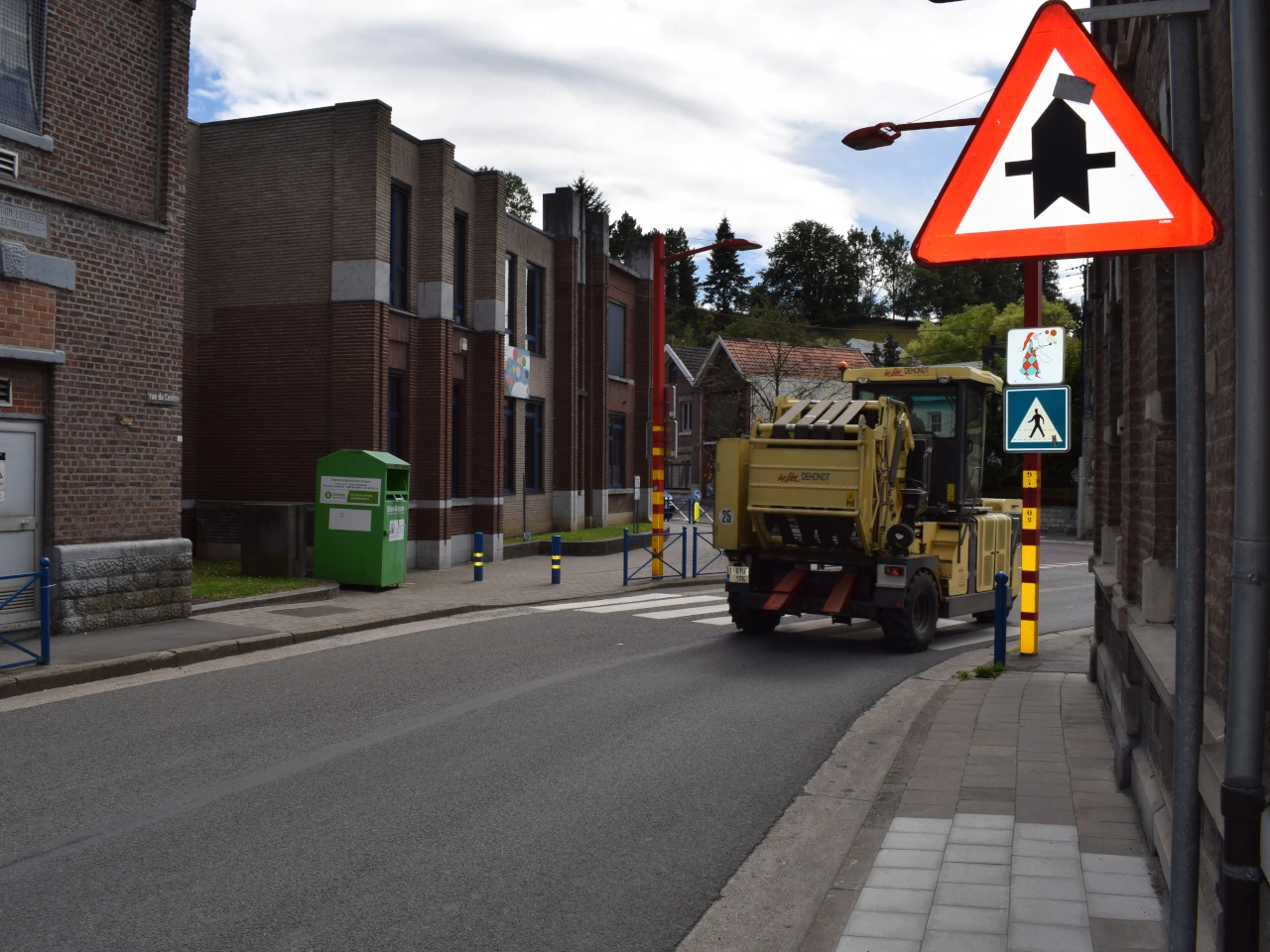
Wikimedia.org • Jean Housen • CC BY-SA
Which Belgian sign gives priority at the next junction?
Traffic sign B15 indicates that drivers have priority at the next junction.
 Priority at the junction.
English • Traffic sign B15 • Priority of passage. The horizontal bar of the symbol may be modified to represent the road layout more clearly.
Français • Signal routier B15 • Priorité de passage. La barre horizontale du symbole peut être modifiée de façon à représenter plus clairement la disposition des lieux.
Nederlands • Verkeersbord B15 • Voorrang. De horizontale streep van het symbool mag worden gewijzigd om duidelijker plaatsgesteldheid weer te geven.
Sources
SVG source: Commons.wikimedia.org
Vascer • Public domain. Original SVG unmodified.
🔗 Wegcode.be • Artikel 67. Verkeersborden betreffende de voorrang (NL)
🔗 Codedelaroute.be • Article 67. Signaux relatifs à la priorité (FR)
What is the difference between priority at the next junction and a priority road in Belgium?
The triangular priority-at-the-next-junction sign gives priority at one junction. The diamond-shaped priority-road sign indicates a continuing priority road whose status remains in force until an end-of-priority-road sign.
Can a Belgian priority-at-the-next-junction sign show the actual junction layout?
Yes. The horizontal or side lines may be modified so that the symbol more clearly represents the actual road layout.
Does a Belgian priority-at-the-next-junction sign give priority over pedestrians?
No. Drivers must still respect pedestrian crossings and give way to pedestrians crossing the road they enter when turning.
43. Traffic lights
Traffic lights use coloured lights, arrows or symbols to regulate when road users may proceed, must prepare to stop or must remain stopped. Separate signals may apply to particular directions, lanes, pedestrians, cyclists or public-transport vehicles.
A green light permits movement only when the route is clear and the movement is otherwise legal. Road users must still follow priority rules, turning restrictions, lane markings and instructions from authorised traffic controllers.

Wikimedia.org • Smiley.toerist • CC BY-SA
Which Belgian sign warns that traffic lights are ahead?
Traffic sign A33 warns drivers that they are approaching traffic lights.
🔗 wegcode.be • Belgian Road Code, Article 66.4, sign A33
 Warning for traffic lights ahead.
English • Traffic sign A33 • Traffic lights.
Français • Signal routier A33 • Signaux lumineux de circulation.
Nederlands • Verkeersbord A33 • Verkeerslichten.
Sources
SVG source: Commons.wikimedia.org
Vascer • Public domain. Original SVG unmodified.
🔗 Wegcode.be • Artikel 66. Gevaarsborden (NL)
🔗 Codedelaroute.be • Article 66. Signaux de danger (FR)
What do red, orange-yellow and green mean in Belgium?
Red means stop before the stop line or, if there is none, before the light. Steady orange-yellow also means stop unless you are too close to stop safely. Green permits proceeding, but you must still respect pedestrians and avoid blocking the junction.
🔗 wegcode.be • Belgian Road Code, Articles 61.1, 63.1-63.2, 67.3
May you enter a blocked intersection on green?
No. You may not enter when congestion is likely to force you to stop inside the intersection and obstruct or prevent crossing traffic.
Where must you stop?
Stop before the white continuous stop line. When no stop line is present, stop before the traffic light itself.
🔗 wegcode.be • Belgian Road Code, Articles 61.1, 63.1-63.2, 67.3
What does an additional green arrow displayed with red or orange-yellow mean?
You may proceed only in the direction shown, provided you give way to drivers lawfully approaching from other directions and to pedestrians.
🔗 wegcode.be • Belgian Road Code, Articles 61.1, 63.1-63.2, 67.3
Do priority signs apply while normal traffic lights are working?
No. Priority signs placed on the same road at that location do not apply while the normal traffic lights are operating.
🔗 wegcode.be • Belgian Road Code, Articles 61–64, 67; Articles 12–14, 19 and 67
When may cyclists pass a red light in Belgium?
B22: B22 permits cyclists and speed-pedelec riders to pass a red or orange-yellow light to turn right, provided they give way to every other road user.
B23: B23 permits cyclists and speed-pedelec riders to pass a red or orange-yellow light to continue straight ahead, provided they give way to other road users. It may be used only where they do not cross another traffic stream.
These exceptions apply only to cyclists and speed-pedelec riders; they do not allow ordinary car drivers to pass a red light.
What if a police officer gives a different instruction?
Follow the officer’s instruction immediately. Orders from authorised persons take precedence over traffic lights, signs, road markings and ordinary rules.
44. Pedestrian lights
Pedestrian lights are traffic signals that regulate when pedestrians may begin crossing a road. They normally display a red standing figure to prohibit starting and a green walking figure to permit crossing.
A flashing signal or countdown may warn that the permitted crossing period is ending. Pedestrians should cross without unnecessary delay, while turning drivers must remain alert and allow pedestrians who entered lawfully to finish crossing safely.
Wikimedia.org • Jean Housen • CC BY-SA
What does a red pedestrian light mean in Belgium?
A red pedestrian light means that pedestrians are not permitted to enter the carriageway.
What does a green pedestrian light mean?
A green pedestrian light means that pedestrians are permitted to enter the carriageway and cross.
Where are the red and green lights positioned?
The red light is positioned above the green light.
Must drivers allow you to finish crossing?
Yes. Even when traffic in their direction is permitted to proceed, drivers must allow pedestrians who entered the carriageway lawfully to finish crossing at a normal pace.
Do pedestrian lights apply to cyclists?
An ordinary pedestrian-only signal applies to pedestrians. A cyclist who remains mounted must follow the applicable bicycle or vehicle signal. Belgium also has combined pedestrian-and-bicycle signals: these apply to pedestrians, cyclists and eligible two-wheeled moped riders using the cycle path. Check the symbols shown.
45. Driving licence
A driving licence is an official document authorising a person to drive one or more specified categories of motor vehicle. It may contain conditions, restrictions, category codes and expiry dates that determine which vehicles the holder may drive.
Drivers must hold a licence that is valid for the vehicle category and jurisdiction concerned. A licence may be provisional, full, restricted, suspended or withdrawn, and additional qualifications may be required for professional driving.
Wikimedia.org • Kingdom of Belgium • CC0
Must you have a driving licence to drive in Belgium?
Yes. Anyone driving a motor vehicle on a Belgian public road must hold and carry a valid Belgian or legally recognised foreign licence for the vehicle category concerned, unless a specific legal training or examination exception applies.
Must you carry the driving licence while driving?
Yes. The driver must carry the valid licence or legally equivalent document while driving on a public road.
Which driving-licence categories exist in Belgium?
The principal Belgian categories include AM, A1, A2, A, B, BE, C1, C, C1E, CE, D1, D, D1E, DE and G.
How long is a Belgian bank-card driving licence valid?
The bank-card-format Belgian driving licence has an administrative validity of no more than 10 years. A category or medical authorisation may have a shorter validity.
Can medical fitness limit a Belgian licence?
Yes. A medical-fitness assessment may impose a shorter validity period, vehicle adaptations or conditions recorded on the licence.
46. Location marker
A location marker is a roadside reference showing a measured position along a road. It normally identifies a kilometre, mile or smaller interval measured from an established starting point on that route.
Kilometre and hectometre markers help road users, emergency services, road authorities and maintenance crews identify an exact section of road. They do not impose a speed limit, priority rule or access restriction.

Wikimedia.org • FrDr • CC BY-SA
What is a location marker in Belgium?
A Belgian road location marker is a kilometre or hectometre reference point indicating a measured position along a numbered motorway or regional road.
🔗 wegenenverkeer.be • AWV — road number and kilometre point on hectometre posts
🔗 geoportail.wallonie.be • SPW — Bornes routières et autoroutières, updated 7 October 2026
What is a Belgian hectometre point?
It represents a position measured in increments of 100 metres along the road.
🔗 wegenenverkeer.be • AWV — road number and kilometre point on hectometre posts
🔗 geoportail.wallonie.be • SPW — Bornes routières et autoroutières, updated 7 October 2026
May you stop on the motorway merely to inspect a marker?
No. Stopping on a motorway is permitted only in legally allowed places or because of traffic, an emergency or another unavoidable situation.
🔗 wegenenverkeer.be • AWV — road number and kilometre point on hectometre posts
🔗 geoportail.wallonie.be • SPW — Bornes routières et autoroutières, updated 7 October 2026
Does a Belgian location marker impose a speed limit?
No. It is a reference indication and does not replace a C43 speed sign, speed zone or general speed rule.
🔗 wegenenverkeer.be • AWV — road number and kilometre point on hectometre posts
🔗 geoportail.wallonie.be • SPW — Bornes routières et autoroutières, updated 7 October 2026
Start of a speed limit.
English • Traffic sign C43 • Travelling faster than the indicated speed is prohibited from the sign up to and including the next junction, or until any C43 sign, with or without zonal validity, or a sign marking the beginning or end of a built-up area, residential area (zone résidentielle or zone de rencontre), or pedestrian zone.
Français • Signal routier C43 • A partir du signal jusqu'au prochain carrefour inclus, ou jusqu’à chaque signal C43 avec ou sans validité zonale, ou jusqu’au signal indiquant le début ou la fin d’une agglomération, d’une zone résidentielle, d’une zone de rencontre ou d’une zone piétonne, interdiction de circuler à une vitesse supérieure à celle qui est indiquée.
Nederlands • Verkeersbord C43 • Vanaf het verkeersbord tot en met het volgend kruispunt, of tot elk verkeersbord C43 met of zonder zonale geldigheid, of tot het verkeersbord dat het begin of het einde van een bebouwde kom, van een woonerf of erf, of van een voetgangerszone aanduidt, verbod te rijden met een grotere snelheid dan deze die is aangeduid.
47. Traffic mirror
A traffic mirror is a convex mirror installed near an intersection, driveway, bend or other location with restricted visibility. Its curved surface provides a wider view of approaching road users than an ordinary flat mirror.
A traffic mirror is only a visibility aid. It may distort distance, speed and direction and may be affected by darkness, weather, dirt or damage. Drivers must continue to observe the road directly, obey all priority rules and proceed only when it is safe.

Wikimedia.org • Jeanhousen • CC BY-SA
Is a traffic mirror an official Belgian traffic sign?
No. A traffic mirror is roadside equipment and does not have its own numbered sign or regulatory meaning in the Belgian Highway Code.
Does a Belgian traffic mirror change priority?
No. Drivers must continue to follow B1, B5, traffic lights, priority from the right and every other applicable priority rule.
Does the mirror establish a recommended speed?
No. The applicable speed limit remains in force, but drivers must adapt their speed to the restricted visibility and remain able to stop safely.
48. International border
An international border is the legal boundary between two countries. A border sign may identify the country being entered and remind drivers that different traffic laws, speed limits, road signs, vehicle requirements and document rules may apply.
The border sign itself does not normally require drivers to stop. Passport, immigration or customs controls may take place at a checkpoint, but some international borders can be crossed without routine controls under regional agreements.
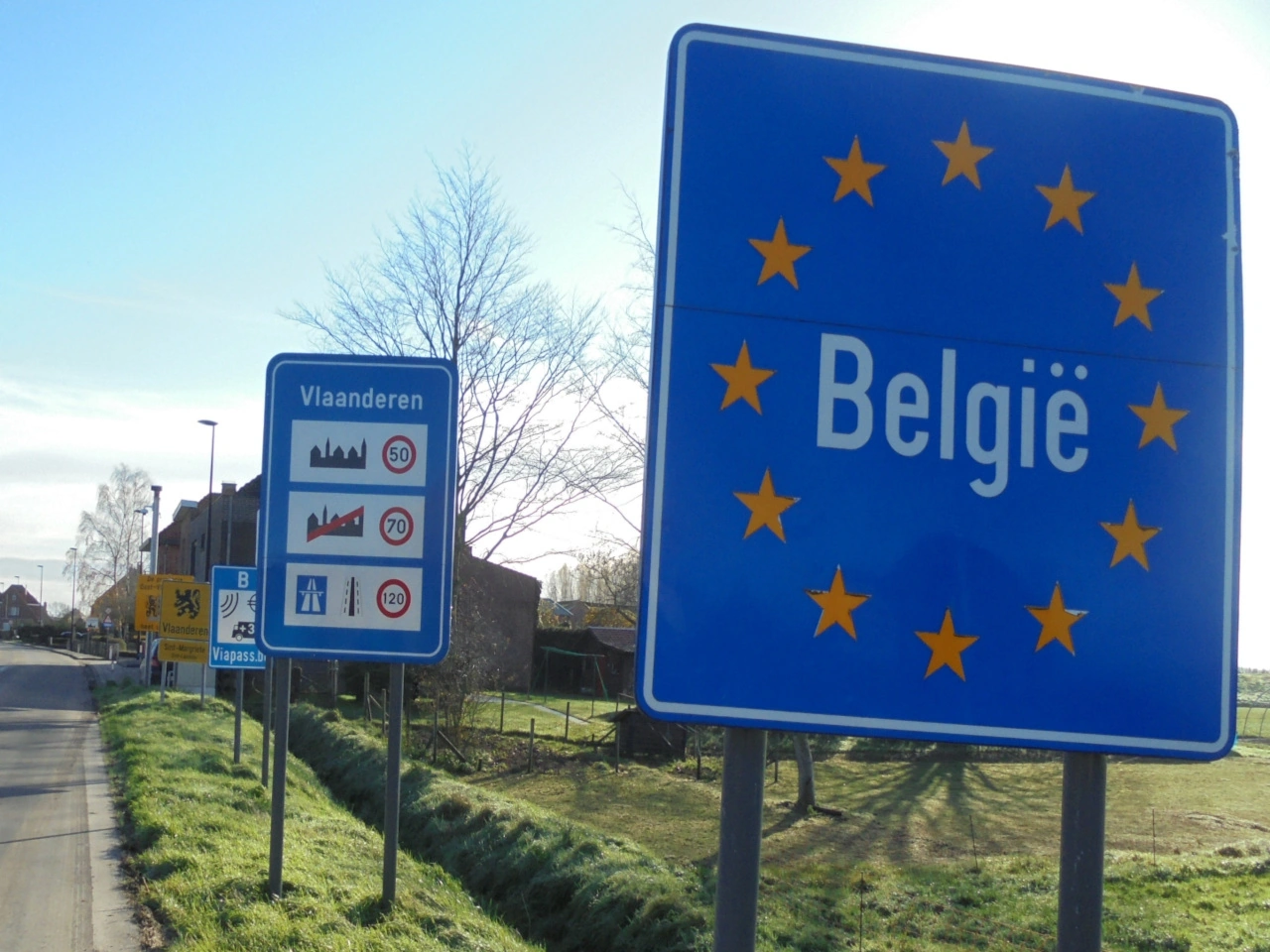
Wikimedia.org • Spotter2 • CC BY-SA
Are there normally passport checkpoints at Belgium’s land borders?
No. Routine checks on people are normally absent at internal Schengen borders.
🔗 europa.eu • European Union — travel documents and checks at internal Schengen borders
Can Belgian customs still conduct checks near an internal border?
Yes. Customs and police may still check excise goods, commercial transport, restricted products, fraud and other legal requirements.
🔗 europa.eu • European Union — travel documents and checks at internal Schengen borders
When do Belgian traffic rules begin to apply?
Belgian traffic law applies from the moment a road user crosses into Belgian territory, whether or not F100 or a control point is present.
🔗 wegcode.be • Belgian current Road Code — relevant current provisions and sign catalogue
Which vehicle documents should a driver carry in Belgium?
A driver should carry the required driving licence, vehicle-registration documents and legally required insurance evidence, together with the travel documents required for the journey.
🔗 vlaanderen.be • Flemish Government, documents to carry when driving
🔗 wegcode.be • Vias/Wegcode, Vehicle Registration Decree, Articles 1–3, 16–17
🔗 economie.fgov.be • FPS Economy, electronic motor-insurance certificates
🔗 europa.eu • Your Europe, travel documents for EU citizens, EU travel documents
What should you do if a border crossing is closed?
Do not pass the closure. Follow the signed diversion or instructions from the authorities and use another authorised crossing.
🔗 wegcode.be • Belgian current Road Code — relevant current provisions and sign catalogue
49. Cycling route
A cycling route is a planned or signposted route intended to guide cyclists between places or through a particular area. It may follow cycle paths, quiet streets, shared roads, greenways or other routes considered suitable for cycling.
A cycling route does not necessarily give cyclists exclusive use of the road or path and should not be confused with a cycle path or cycle lane. The traffic rules, priority rules and permitted road users depend on the individual roads and paths that form the route and on the local signs and regulations.
Wikimedia.org • Jean Housen • CC BY-SA
How can you recognise a cycling route in Belgium?
Cycling routes may be indicated by direction signs carrying a bicycle symbol, as well as by regional or local route markers. Belgian traffic signs can indicate a recommended route for particular categories of road users, including cyclists.
Do cyclists have priority because they are following a cycling route?
No. A cycling-route designation does not itself give cyclists priority. At intersections and crossings, cyclists must obey the normal priority signs, traffic lights, road markings and other applicable rules.
Can speed pedelecs use a Belgian cycling route?
The cycling-route designation alone does not determine whether a speed pedelec may use every part of the route. Its access depends on the type of road or cycle facility, the applicable speed limit and the traffic signs on each section.
50. Parking
Parking means leaving a vehicle stationary at a place for a period of time rather than stopping only briefly because of traffic conditions or another immediate necessity. Many countries distinguish parking from a short stop made to pick up or drop off passengers or to load or unload goods, although the exact legal definition varies.
Parking may be permitted, restricted, reserved, time-limited or prohibited by traffic signs, road markings, parking zones and local regulations. Drivers must park without creating a danger or unnecessary obstruction and must comply with any conditions concerning payment, permits, vehicle categories or maximum parking duration.
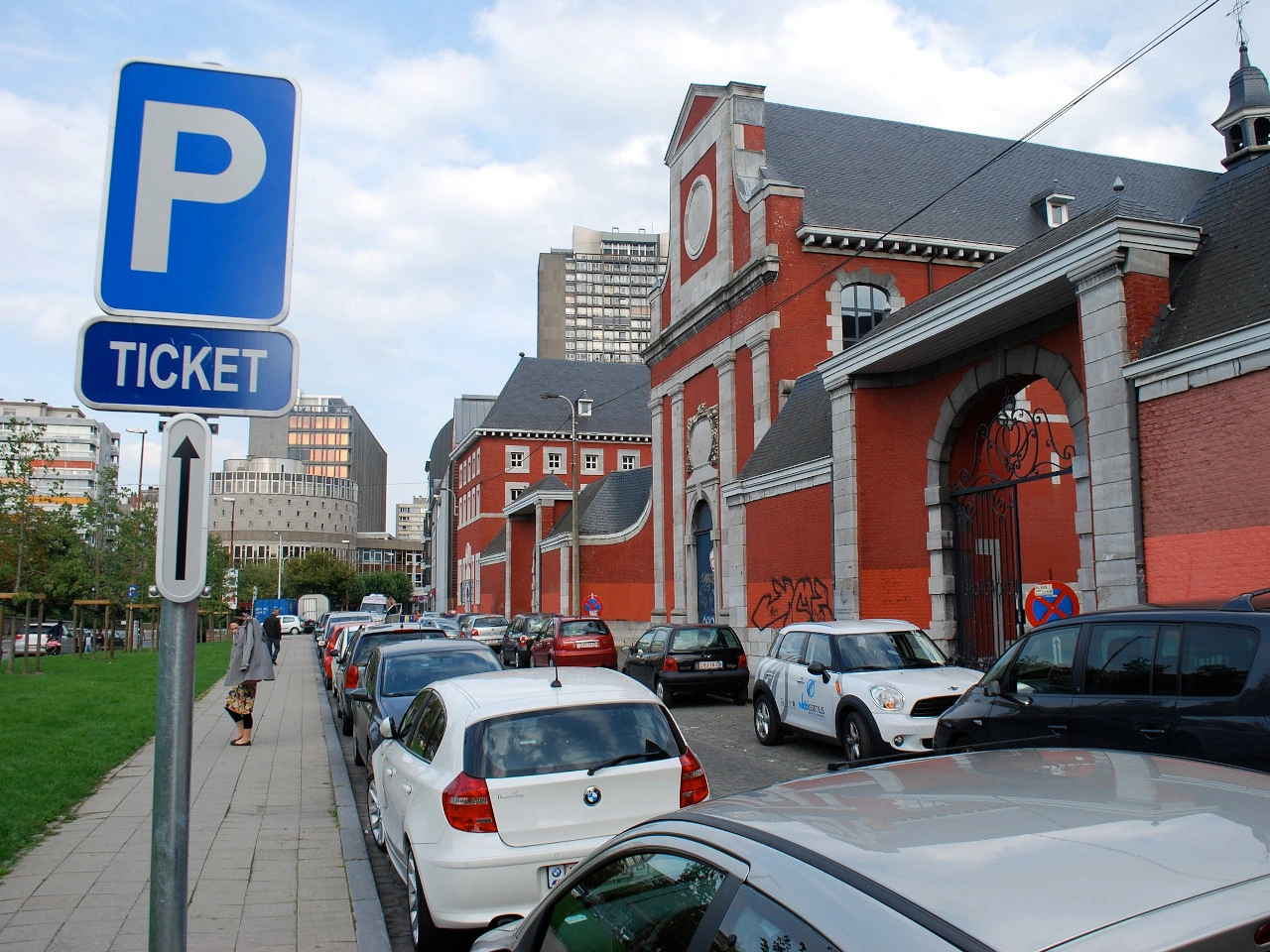
Wikimedia.org • Jean Housen • CC BY-SA
When is a vehicle considered parked in Belgium?
A vehicle is considered parked when it remains stationary for longer than necessary for passengers to get in or out or for goods to be loaded or unloaded. Refuelling a vehicle or charging the battery of an electric or hybrid vehicle is also considered parking.
🔗 wegcode.be • Belgian Road Code, Articles 23–27ter, 70–71; Articles 23–27 and 51–52
On which side of the road should you park in Belgium?
A parked vehicle must normally be positioned on the right-hand side relative to its direction of travel. On a one-way carriageway, it may be positioned on either side. A vehicle parked wholly or partly on the carriageway must normally be placed as far as possible from the centre, parallel with the edge and in a single line.
🔗 wegcode.be • Belgian Road Code, Articles 23–27ter, 70–71; Articles 23–27 and 51–52
How does a Belgian blue parking zone work?
Where the parking-disc rules apply, the driver must place an approved parking disc visibly in the vehicle and set the arrow to the mark immediately following the arrival time. Unless the signs specify different conditions, the system applies from 09:00 to 18:00 on working days and allows a maximum parking period of two hours.
🔗 wegcode.be • Belgian Road Code, Articles 23–27ter, 70–71; Articles 23–27 and 51–52
How much space must remain between parked vehicles in Belgium?
Leave at least 1 metre both in front of and behind another stopped or parked vehicle. Do not prevent anyone from entering or moving their vehicle.