

道路標識世界
 交通ルール
交通ルール
 世界
世界
51. 幅制限
幅制限は、表示値を超える全幅の車両または車両組合せが道路区間、橋、トンネル、門、その他の狭い場所へ進入・通過することを禁止します。全幅には積荷や車体側面から突出する装備・物体も含まれます。
運転者は車両と積荷の走行時最大幅を把握し、事前警告に従い、必要なら別ルートを使用します。十分な左右の余裕が不明な場合は進入してはいけません。
What does a width-limit sign mean?
It prohibits vehicles or vehicle combinations whose total width exceeds the displayed value from continuing beyond the sign.
How can you recognise a width-limit sign?
It is commonly a circular regulatory sign showing a width in metres, feet or another local unit between horizontal arrowheads.
What is included in the vehicle’s total width?
The width includes the vehicle, its load and attached equipment or objects that extend from either side.
Does the width of a trailer count?
Yes. Every part of the vehicle combination must comply, including the towing vehicle, trailer and load.
Do roof-mounted bicycles or equipment count?
Yes, when they extend beyond the sides of the vehicle. Drivers must consider the widest point of the complete travelling vehicle.
Does an open vehicle door affect the legal width?
Doors should be closed while driving. The ordinary travelling width is measured with the vehicle properly configured for road use.
Does the sign show the exact width of the passage?
Not necessarily. It shows the maximum legally permitted vehicle width. The physical passage may be wider, but drivers should not assume that additional clearance is available.
May a vehicle exactly as wide as the displayed value pass?
The sign normally prohibits vehicles wider than the displayed value. However, drivers should not attempt to pass without a practical safety margin because measurements and vehicle movement may vary.
Why is additional clearance important?
A vehicle may move sideways because of steering corrections, road camber, wind, suspension movement or an uneven surface.
Can the available width vary along the passage?
Yes. Walls, barriers, columns, bends, kerbs and protruding structures may make one part narrower than another.
Can different lanes have different width limits?
Yes. Lane-specific signs may impose different restrictions where the available width varies between lanes.
Can roadworks introduce a temporary width limit?
Yes. Barriers, machinery and shifted lanes may reduce the usable width. Temporary width-limit signs must be obeyed.
Is a width-limit sign a warning or a prohibition?
It is normally a prohibition. A vehicle that exceeds the displayed width may not pass.
Does a width-limit sign impose a speed limit?
No. The applicable general, zonal or posted speed limit remains in force, although drivers should approach narrow passages slowly.
Does the sign change priority?
No. Traffic lights, priority signs and the ordinary priority rules remain applicable.
Can a width restriction be announced in advance?
Yes. An advance sign may show the restriction and the distance to it so that wide vehicles can choose another route.
What should you do when your vehicle is too wide?
Do not continue. Stop where safe and use the signed diversion or another suitable route.
Should you rely on a navigation system?
No. Navigation information may be outdated or incomplete. Traffic signs and actual road conditions always take precedence.
Should professional drivers know their vehicle’s width?
Yes. Drivers of trucks, buses, agricultural vehicles, motorhomes and vehicles carrying wide loads should know the maximum travelling width before beginning the journey.
How should the width be measured?
Measure the widest part of the vehicle and load in its normal travelling configuration. Consider equipment, securing devices and any load extending beyond the bodywork.
Can folding equipment reduce the width?
Yes. Mirrors, arms, steps or machinery designed to be folded or retracted should be placed in the legally required travelling position before driving.
May you change lanes to use a wider passage?
Only when signs and markings permit it and the manoeuvre can be completed safely. Do not cross a closed lane, continuous line or opposing traffic to avoid the restriction.
What should you do when uncertain about the width?
Stop before the restriction in a safe place and verify the vehicle’s dimensions. Choose another route when adequate clearance cannot be confirmed.
Should another person guide a wide vehicle?
A guide may help during a slow manoeuvre in a controlled location, but the driver remains responsible. The guide must remain visible and stay away from moving traffic and crushing hazards.
What should you do if the vehicle strikes a structure?
Stop immediately where safe, activate the hazard warning lights and contact the police or emergency services. Do not continue when the vehicle, load or structure may be damaged or unstable.

52. 長さ制限
長さ制限は、指定された最大長を超える車両または車両組合せの道路や区域への進入を禁止する規制です。国の規則で定められている場合、表示された長さには通常、車両組合せ全体と積荷が含まれます。
長い車両が狭い道路、急カーブ、橋、トンネルなどを安全に通行できない場所で使われます。表示された制限を超える車両は、別の通行可能な経路を使用しなければなりません。
What does a vehicle length limit mean?
A length limit indicates the maximum vehicle or vehicle-combination length permitted beyond the restriction. Vehicles exceeding the displayed value may not proceed.
Does a length limit include a trailer?
Normally the relevant measurement applies to the complete vehicle or vehicle combination covered by the sign. National rules determine precisely how trailers and projecting loads are included.
Why are vehicle length limits used?
They are used where long vehicles could have difficulty negotiating the road safely, such as on narrow streets, tight bends, constrained junctions or other locations with limited manoeuvring space.
53. 重量制限
重量制限は、表示された値を超える質量の車両または車両組合せが道路区間、橋、トンネル、その他の構造物へ進入・通過することを禁止します。現地法により、実際の積載質量、最大許容質量、または個別車軸荷重を指す場合があります。
運転者は標識がどの質量を指すか理解し、必要に応じて車両、乗員、積荷、トレーラーを含めて計算する必要があります。制限を超える車両は別の適切な経路を使用しなければなりません。
What does a weight-limit sign mean?
It prohibits vehicles or vehicle combinations whose relevant mass exceeds the value displayed on the sign.
How can you recognise a weight-limit sign?
It is commonly a circular regulatory sign showing a mass in tonnes, kilograms or another local unit.
Is a weight-limit sign a warning or a prohibition?
It is normally a prohibition. A vehicle exceeding the displayed limit may not continue beyond the sign.
What is actual loaded mass?
Actual loaded mass is the weight of the vehicle as it is currently travelling, including the vehicle itself, its load, driver, passengers and other relevant equipment.
What is maximum authorised mass?
Maximum authorised mass is the highest total mass at which the vehicle is legally approved to operate. It is normally recorded in the vehicle documents.
Is actual mass the same as maximum authorised mass?
No. A lightly loaded vehicle may have an actual mass below its maximum authorised mass. A restriction may legally refer to either measurement, depending on the sign and local law.
Does the load count towards the weight limit?
Yes. Cargo, passengers, fuel, equipment and other carried items may all contribute to the vehicle’s actual loaded mass.
Does the driver’s weight count?
Where the restriction concerns actual loaded mass, the driver and other occupants are normally included.
Does a trailer count?
This depends on the wording of the restriction. It may apply to each vehicle separately or to the combined mass of the complete vehicle combination.
What is an axle-weight limit?
An axle-weight limit restricts the amount of mass carried by one axle or axle group rather than the total mass of the vehicle.
Why can axle load matter when total mass is legal?
A vehicle may comply with the total weight limit while too much of its load is concentrated over one axle, creating excessive stress on the road or bridge.
Where are weight limits commonly used?
They are often used at bridges, weak roads, historic centres, tunnels, temporary structures and roads unsuitable for heavy traffic.
Does the sign show the maximum capacity of a bridge?
Not necessarily. The displayed legal limit may include engineering and safety margins and should not be interpreted as the structure’s exact failure point.
May a vehicle exactly equal to the displayed weight pass?
A sign normally prohibits vehicles exceeding the displayed value. The driver must still be certain that the relevant mass does not exceed it.
How can a driver determine the actual mass?
The most reliable method is to use an authorised or suitable weighbridge. Vehicle documents alone normally show approved limits rather than the vehicle’s current loaded mass.
Can the mass be estimated from the cargo weight?
An estimate may help with planning, but it must include the vehicle, fuel, occupants, equipment, load and trailer. A weighbridge is preferable when the remaining margin is small.
Can moving a load change the total mass?
No. Moving cargo within the vehicle does not change its total mass, but it can change the load carried by each axle.
Can unloading part of the cargo make the vehicle legal?
Yes, when done lawfully and safely. The vehicle may continue only after its relevant mass complies and the remaining load is properly secured.
Can a temporary weight limit apply?
Yes. Temporary restrictions may protect a damaged bridge, weakened road, roadworks structure or road affected by flooding or thawing.
Can different lanes have different weight limits?
Yes. Lane-specific signs may direct heavier vehicles towards a lane or structure designed to carry them.
Can a weight restriction be announced in advance?
Yes. Advance signs may give the distance to the restriction or indicate a diversion so affected vehicles can choose another route.
Does a weight-limit sign impose a speed limit?
No. The applicable general, zonal or posted speed limit remains in force.
Does the sign change priority?
No. Traffic lights, priority signs and ordinary priority rules remain applicable.
What should you do when your vehicle exceeds the limit?
Do not continue. Stop where safe and follow a signed diversion or another route suitable for the vehicle’s mass.
Should you rely on a navigation system?
No. Navigation information may be incomplete or outdated. Traffic signs and official restrictions always take precedence.
May you reverse away from a restriction?
Only when reversing is lawful and can be completed safely. Use assistance where necessary, particularly with a long or heavy vehicle combination.
What can happen if an overweight vehicle continues?
The vehicle may damage the road or structure and may be stopped, fined, unloaded or prohibited from continuing under local law.
54. 速度取締表示
速度取締表示は、固定カメラ、移動式レーダー、ライダー、区間速度取締などで速度が監視される可能性を運転者へ知らせます。適用される速度制限を確認し守るよう促すものです。
この標識自体が速度制限を設定するものではありません。道路に適用される一般、標示、可変の速度制限に従い、取締表示を見たことだけを理由に急ブレーキをかけてはいけません。
What does a radar speed sign mean?
It warns that vehicle speeds may be measured or enforced on the road ahead or throughout a specified section.
Is a radar speed sign the same as a speed-limit sign?
No. A speed-limit sign establishes the maximum legal speed. A radar sign only warns that compliance with an applicable limit may be monitored.
Where can the applicable speed limit be found?
Check the most recent speed-limit sign, variable sign, speed-zone sign or general limit applying to the road and vehicle category.
Does the radar sign impose a lower speed?
No. It does not normally change the existing limit. Drivers must nevertheless travel more slowly when traffic, visibility, weather or road conditions require it.
Does the sign mean a camera is definitely present?
It may announce a permanent camera, a mobile-control area or a section where enforcement can occur. The exact meaning depends on the country and sign design.
Does the sign guarantee that the camera is active?
No. Drivers should never rely on assumptions about whether equipment is operating and should respect the speed limit at all times.
What is a fixed speed camera?
A fixed speed camera is permanently installed at a particular location and measures the speed of passing vehicles.
What is a mobile speed camera?
A mobile speed camera is temporarily positioned in a police vehicle, trailer, roadside unit or another approved location.
What is lidar speed enforcement?
Lidar uses laser pulses to measure the speed and position of vehicles. It may be used by police officers or in temporary automatic installations.
What is average-speed enforcement?
Average-speed enforcement records a vehicle at two or more points and calculates its average speed across the controlled section.
Can slowing only at the camera avoid an average-speed offence?
No. Average-speed enforcement considers the travel time across the complete measured section rather than speed at only one point.
Can a camera enforce both speed and red lights?
Yes. Some systems monitor vehicle speed and whether a vehicle passes a red traffic signal.
Is a radar warning sign legally required everywhere?
No. Some authorities announce speed cameras, while others permit enforcement without advance warning. The rules differ between countries and regions.
Can speed enforcement occur without a radar sign?
Yes. The absence of a warning sign does not normally prevent police or authorised authorities from carrying out a lawful speed check.
Does the sign give permission to drive at the displayed road limit?
The applicable limit remains a maximum rather than a target. Drivers must reduce speed whenever travelling at that limit would be unsafe.
Should you brake suddenly after seeing the sign?
No. Check your speed and reduce it smoothly when necessary. Sudden braking can cause a rear-end collision.
May you accelerate again after passing the camera?
Only while remaining within the applicable limit and driving safely. The restriction may continue, and another camera or average-speed section may follow.
Does the radar sign end the speed limit?
No. Passing a camera or radar sign does not end the applicable speed restriction.
What is a radar speed display?
A radar speed display measures an approaching vehicle and shows its current speed, sometimes with a colour, message or smiley symbol.
Is a radar speed display an enforcement camera?
Not necessarily. Many displays are preventive devices intended to make drivers aware of their speed and may collect anonymous traffic statistics without issuing penalties.
Is the displayed speed legally authoritative?
No. The roadside display is generally informational. Drivers remain responsible for observing the vehicle’s speedometer and the legal speed limit.
Can radar monitor motorcycles?
Yes. The technical ability to measure a motorcycle and the method used to identify it depend on the enforcement equipment.
Can a camera monitor several lanes?
Yes. Modern systems may measure vehicles in one or more lanes and may distinguish between traffic directions or vehicle categories.
Can different vehicles have different speed limits?
Yes. Heavy vehicles, buses, trailers or other vehicle categories may be subject to lower limits than passenger cars on the same road.
What should you do when you are already exceeding the limit?
Release the accelerator and reduce speed smoothly and safely. Do not brake harshly or make an abrupt lane change.
55. 選択式バリア
選択式バリアは、特定の道路利用者や許可車両だけを通過させ、その他の交通を制限する物理的なアクセス制御設備です。固定・可動・折り畳み・昇降式ボラード、ゲート、バリア、幅制限設備などがあります。
通行可能者はバリア自体ではなく、交通標識、進入条件、現地規則によって決まります。ゆっくり接近し、通行権限を確認し、可動バリアが完全に開くか収納されるまで待ってから進みます。
What is a selective barrier?
A selective barrier is a physical access-control device that blocks some traffic while allowing specified road users or authorised vehicles to pass.
What types of selective barriers exist?
Common examples include fixed bollards, removable posts, folding posts, retractable bollards, gates, rising barriers and width-filtering installations.
Why are selective barriers used?
They may prevent through traffic, protect pedestrian or cycling routes, control access to restricted areas or allow only residents, public transport, deliveries or emergency services to enter.
Does the barrier itself determine who may pass?
Not normally. The permitted users are determined by traffic signs, permits, access systems and local regulations.
May cyclists pass through a selective barrier?
Only when cycling is permitted and sufficient safe space is provided. Cyclists must follow the signs applying to the road or path.
May pedestrians pass through?
Pedestrians may pass where pedestrian access is permitted and a safe route is available. They should not walk beneath a moving gate or through a vehicle-only opening.
May motorcycles pass between bollards?
Only when motorcycles are legally permitted beyond the barrier and the opening is intended for them. Being physically able to fit through does not create permission.
May emergency vehicles pass?
Emergency vehicles may have keys, remote controls, automatic recognition or another authorised method of opening the barrier. Other road users must keep the access clear.
May residents or delivery vehicles enter?
They may enter only when local access rules, permits or traffic signs authorise them. Permission may apply only during specified hours.
What is a retractable bollard?
A retractable bollard is a post that can rise from or lower into the road surface to control vehicle access.
How may a retractable bollard be activated?
It may operate through a badge, remote control, access code, number-plate recognition, timer, control centre or automatic detection system.
When may you drive over a retractable bollard?
Only after confirming that you are authorised and the bollard is fully lowered. Do not move merely because another vehicle has activated it.
May you follow another authorised vehicle through?
No, unless your own access is also authorised and the system clearly permits it. The barrier may rise immediately after the first vehicle.
What do warning lights near a barrier mean?
Red lights normally require road users to stop, while another signal may indicate when passage is permitted. Follow the displayed signals and local instructions.
What should you do when the barrier is moving?
Stop at a safe distance and wait until it has completed its movement. Never drive, cycle or walk beneath a moving gate or across a rising bollard.
What if the barrier appears to be stuck?
Do not force, move or drive around it. Use the intercom or contact the operator, road authority or emergency service indicated at the location.
May you move a removable bollard yourself?
No, unless you are specifically authorised. Removing or repositioning access-control equipment may create danger and allow prohibited traffic to enter.
Does a lowered bollard mean everyone may enter?
No. Traffic signs and access restrictions remain applicable even when the physical barrier is temporarily open or lowered.
Does an open gate cancel a no-entry sign?
No. An open physical barrier does not cancel a regulatory traffic sign.
Does a selective barrier impose a speed limit?
Not by itself. Drivers must follow the applicable speed limit and approach slowly enough to stop before the installation.
Does it change priority?
No. Traffic lights, priority signs and ordinary priority rules remain applicable unless another traffic arrangement indicates otherwise.
May you stop or park in front of a selective barrier?
Do not stop or park where the vehicle would block authorised access, emergency services, pedestrians or cyclists.
Why are bollards dangerous for cyclists and motorcyclists?
They may be difficult to see, especially in darkness, congestion or poor weather. A collision can cause a rider to fall into nearby traffic or other obstacles.
How should cyclists approach bollards?
Reduce speed, identify the intended opening and pass through in a straight and controlled line. Avoid overtaking another cyclist at the barrier.
What should drivers do when leaving a restricted area?
Approach slowly, wait for the access system to respond and check for pedestrians and cyclists before crossing their route.
What if your vehicle strikes a barrier?
Stop safely, activate the hazard warning lights where appropriate and report the collision. Do not continue if the vehicle, barrier or access system may be damaged.
56. 低排出ゾーン
低排出ゾーン(LEZ)は、交通由来の大気汚染を減らすため、排出量の多い車両の進入を制限する区域です。基準を満たさない車両は進入禁止、または一時許可、免除、1日券などが必要になる場合があります。
進入条件は通常、車種、燃料、Euro排出基準などで決まります。要件は国や都市によって異なるため、運転者は進入前に適用規則を確認する必要があります。
What is a low-emission zone?
A low-emission zone is an area where access by more polluting vehicles is restricted in order to improve air quality.
Why are low-emission zones introduced?
They are intended to reduce traffic-related air pollution, particularly pollutants produced by older or higher-emitting vehicles.
Which vehicles can be restricted in a low-emission zone?
Restrictions may apply to cars, vans, trucks, buses, motorcycles or other motor vehicles, depending on the local regulations.
How is access to a low-emission zone determined?
Access commonly depends on the vehicle's fuel type, Euro emission standard, vehicle category and sometimes other technical characteristics.
What is a Euro emission standard?
A Euro emission standard indicates which European pollutant-emission requirements a vehicle satisfies. Higher Euro numbers generally represent newer and stricter emissions requirements.
Are diesel and petrol vehicles treated the same?
Not necessarily. Low-emission zones often apply different access criteria to diesel and petrol vehicles because their pollutant-emission characteristics differ.
Can electric vehicles enter a low-emission zone?
Fully electric vehicles are generally permitted because they produce no combustion-engine exhaust emissions while driving, although local registration or administrative requirements may still apply.
Can a vehicle that does not meet the normal criteria still enter?
Some low-emission zones provide exemptions, temporary permits or day passes for certain vehicles or circumstances.
How can you recognise a low-emission zone?
Traffic signs normally indicate the entrance and exit of the zone. Drivers should check the applicable restrictions before passing the entry sign.
How are low-emission zones enforced?
Enforcement may use automatic licence-plate cameras, roadside controls or registration databases. The exact system varies between cities and countries.
Do foreign vehicles have to follow low-emission-zone rules?
Yes. Foreign vehicles must comply with the applicable access criteria and may also have to complete an online registration before entering.
Are low-emission-zone rules the same everywhere?
No. Each country, region or city can establish different boundaries, emission requirements, exemptions and enforcement procedures.
57. 交差点方面案内標識
交差点方面案内標識は、接近中または現在の交差点で利用できる目的地や経路を示します。矢印、道路番号、記号、地名により、正しい方向や必要に応じて正しい車線を選べます。
この標識は経路案内を行うもので、通常、優先関係、右左折の許可、速度制限を設定しません。信号、規制標識、車線矢印、路面表示、現地交通規則に従う必要があります。
What is an intersection direction sign?
It is a sign that shows the destinations and routes available at an intersection.
What is an advance direction sign?
An advance direction sign is placed before an intersection so drivers can identify their route and choose the correct lane in good time.
What is a direction sign?
A direction sign is normally placed at or close to the intersection and points towards a particular destination or route.
How can you recognise an intersection direction sign?
It commonly displays place names, arrows, road numbers, route symbols or diagrams of the intersection.
What do the arrows mean?
The arrows show which direction drivers should follow to reach the displayed destinations.
Does an upward arrow always mean straight ahead?
Usually, yes. Arrow design and orientation can vary, especially on signs positioned above traffic lanes.
What does a schematic intersection diagram show?
It shows the approximate arrangement of the roads and exits at the approaching intersection without necessarily reproducing every island, verge or road detail.
Does the diagram show the exact shape of the intersection?
No. It simplifies the layout to make the available directions easier to understand.
Can the sign show road numbers?
Yes. Road numbers help drivers follow a numbered national, regional, international or motorway route.
Can the sign show motorway or expressway symbols?
Yes. A symbol may indicate that the displayed route leads to or continues over a motorway, expressway or another particular road category.
Can the sign show local facilities?
Yes. Separate direction signs may indicate hospitals, railway stations, airports, parking areas, ports, tourist attractions and other destinations.
Does the sign require you to follow the displayed route?
No, unless another regulatory sign or lane marking makes that direction mandatory. A route-guidance sign normally provides information rather than imposing a movement.
Does the sign give you permission to turn?
No. A displayed destination does not override a no-turn sign, mandatory direction, traffic light or lane arrow.
Does the sign determine priority?
No. Priority is determined by traffic lights, priority signs and the applicable intersection rules.
Does it impose a speed limit?
No. Drivers must follow the applicable general, zonal, posted or vehicle-specific speed limit.
When should you choose your lane?
Choose the appropriate lane as early as reasonably possible after reading the sign and checking the lane arrows and road markings.
May you change lanes after reading the sign?
Yes, when the movement is legal and safe. Check mirrors and blind spots, signal where required and give way to traffic already using the target lane.
What if the destination appears above one lane?
The indication normally relates to that lane or group of lanes. Follow the lane arrows and overhead signs carefully.
What if the route sign conflicts with a regulatory sign?
Follow the regulatory sign, traffic light or authorised officer. Route guidance does not override a prohibition or obligation.
What if temporary roadworks signs show another route?
Follow the temporary diversion and traffic arrangement that is legally in force, even when permanent direction signs still show the usual route.
What should you do after missing the indicated turn?
Continue safely and find another legal route. Do not reverse, stop suddenly or cut across traffic lanes.
Should you rely only on navigation software?
No. Navigation instructions may be outdated or unsuitable for the vehicle. Traffic signs and current road conditions take precedence.
Can a route be unsuitable for certain vehicles?
Yes. A route may include height, width, weight, access or dangerous-goods restrictions. Drivers must observe every applicable sign.
Can destinations be written in more than one language?
Yes. The language or languages used depend on the country, region and local signing rules.
Does the order of destinations have a meaning?
Often, yes. Destinations may be grouped or ordered according to direction, importance or distance, but the exact convention differs between countries.
58. 次の交差点で優先
次の交差点で優先とは、特定道路を走る車両が、次の交差点で交差道路から進入する交通より優先されることを意味します。通常、優先側と譲る側の両方へ標識で示されます。
継続する優先道路とは異なり、この優先は指定交差点だけに適用されます。運転者は慎重に接近し、信号、交通整理員、横断場所、右左折規則、その他の標識にも従います。
What does priority at the next junction mean?
It means that drivers travelling on the indicated road have priority over traffic entering from intersecting roads at the next junction.
Is this the same as a priority road?
No. Priority at the next junction applies to one particular junction. A priority road normally keeps its priority across several junction until its status ends.
Is a main road always a priority road?
No. The term main road may describe a larger, busier or more important road, but legal priority is determined by traffic signs, signals and local rules.
How can you recognise priority at the next junction?
It may be indicated by a priority-junction sign showing a thick line for the priority route and thinner lines for the roads that must give way.
Does the thick line show the priority route?
Yes. On signs using a junction diagram, the thicker line normally represents the road followed by traffic with priority.
Does the priority route always continue straight ahead?
No. The priority route may turn left or right. A diagram or supplementary panel may show which branch retains priority.
What signs do drivers on the side roads normally see?
They commonly face a give-way or stop sign, requiring them to yield to traffic on the priority route.
Does priority from the right still apply?
Not when legally placed signs establish another priority arrangement at that junction. Drivers must follow the actual signs rather than the ordinary default rule.
Does the sign give priority at later junctions?
No. After passing the indicated junction, the priority arrangement at the next junction must be determined separately.
Does having priority mean you may enter without slowing down?
No. Approach at a safe speed and remain prepared for another road user to fail to give way.
Does having priority mean you must proceed first?
No. Priority is not an obligation to continue. Slow down or stop whenever proceeding would create danger.
May you enter a blocked junction?
No. Do not enter when congestion is likely to leave your vehicle stopped inside the junction and obstructing other traffic.
Does the sign impose a speed limit?
No. The applicable general, zonal, posted or vehicle-specific speed limit remains in force.
Does it give priority over pedestrians?
No. Drivers must still yield to pedestrians where crossings, traffic signals or turning rules require it.
Does it give priority over cyclists?
It regulates priority between traffic approaching the junction, but drivers must still respect continuing bike paths, cycle crossings and turning rules.
Must you signal when the priority route turns?
Yes, when following the route involves a change of direction and local law requires signalling. Priority does not remove the obligation to indicate.
Does signalling give you priority?
No. An indicator communicates your intended movement but does not allow you to endanger or obstruct another road user.
Must you yield to oncoming traffic when turning left?
Normally, yes. Priority over side-road traffic does not automatically give a left-turning driver priority over lawful oncoming traffic.
Do functioning traffic lights override the priority signs?
Functioning traffic lights normally control the junction instead of the priority signs. Local rules determine what applies when the lights are switched off or flashing.
Do authorised officers override the signs?
Yes. Instructions from an authorised traffic controller normally take precedence over signs, signals and ordinary priority rules.
Does the sign prohibit overtaking?
No. Overtaking remains subject to the ordinary rules, visibility, road markings and any separate prohibition signs.
Does the sign prohibit stopping or parking?
No. The ordinary stopping and parking rules and any local signs or markings remain applicable.
What applies after you pass the intersection?
The special priority indicated by the sign has been completed. At later junctions, follow the signs, signals or default priority rule applying there.
59. 信号機
信号機は、色灯、矢印、記号によって道路利用者が進行できる時、停止準備をする時、停止し続ける時を規制します。進行方向、車線、歩行者、自転車、公共交通ごとに別の信号がある場合があります。
青信号でも、進路が空いており、その動きが法的に許可される場合にのみ進めます。優先規則、右左折制限、車線表示、交通整理員の指示にも従う必要があります。
What are traffic lights?
Traffic lights are signals that use coloured lights, arrows or road-user symbols to regulate traffic movements.
What does a red traffic light mean?
A red light requires road users to stop before the stop line or signal and remain stopped until movement is permitted.
What does a steady amber light mean?
A steady amber light normally requires drivers to stop unless they are already too close to stop safely. It warns that the signal is changing to red.
What does a green traffic light mean?
A green light permits road users to pass the signal, but only when the route is clear and the intended movement is otherwise legal.
Does green mean that you have priority over everyone?
No. You may still have to give way to pedestrians, cyclists, oncoming traffic or other road users when turning or following a conditional arrow.
May you enter a blocked intersection on green?
No. Do not enter when congestion is likely to leave you stopped inside the intersection and obstructing crossing traffic.
Where should you stop at a red light?
Stop before the stop line. When no stop line is provided, stop before the traffic light or at another legally prescribed position.
May you cross the stop line and then stop?
No. The required stop must normally be completed before the stop line. Do not stop on a pedestrian or cycle crossing.
What if the light changes to amber while you are approaching?
Stop when this can be done safely. Continue only when you are already too close to stop without creating danger.
Should you accelerate to pass an amber light?
No. Do not accelerate to avoid stopping. Maintain control and stop unless doing so safely is no longer possible.
What do arrow-shaped traffic lights mean?
They have the same general meaning as circular lights, but the prohibition or permission applies only to the direction shown by the arrow.
What does a green arrow displayed with a red light mean?
It may permit travel in the indicated direction while other movements remain prohibited. Drivers may still have to give way to conflicting traffic and pedestrians.
Does a green arrow override a no-turn sign?
Not universally. Drivers must follow the complete local sign arrangement. A traffic signal does not necessarily cancel a separate regulatory prohibition.
May you turn right on red?
Only where local law or a specific sign or signal expressly permits it. There is no universal right to turn on red.
What does a flashing amber light mean?
It warns of a potential hazard and normally allows cautious passage. The ordinary priority arrangement remains applicable.
What should you do when the normal lights are flashing amber?
Reduce speed, observe the intersection carefully and follow the applicable priority signs or default priority rules.
What does a flashing red light mean?
Its meaning depends on local law. At railway crossings and some movable bridges, flashing red lights normally require road users to stop.
What do lane-control signals mean?
A red cross normally closes the lane, a green downward arrow opens it and an amber diagonal arrow instructs drivers to leave the lane in the indicated direction.
May you continue beneath a red lane-control cross?
No. Move out of the lane safely before reaching the red cross unless an authorised person or emergency rule directs otherwise.
What does an amber diagonal lane arrow mean?
It warns that the lane is closing or unavailable ahead. Drivers must move into the adjacent lane indicated by the arrow when safe.
Can separate lights apply to cyclists?
Yes. A signal displaying a bicycle symbol applies to the road users legally covered by that signal rather than to general motor traffic.
Can separate lights apply to pedestrians?
Yes. Pedestrian lights normally use red and green human figures to indicate whether pedestrians may begin crossing.
What does a flashing green pedestrian light mean?
It normally warns that the crossing period is about to end. Pedestrians who have not started should wait for the next green signal.
What if the pedestrian signal changes while someone is crossing?
A person who entered lawfully should continue without unnecessary delay. Turning drivers must allow the crossing to be completed safely.
Can buses and trams have separate traffic lights?
Yes. Public-transport signals may use bars, circles, triangles or other symbols that apply only to authorised service vehicles.
Do functioning traffic lights override priority signs?
They commonly replace the priority arrangement at that location. Priority signs may apply again when the normal signals are inactive or flashing.
Do instructions from a police officer override traffic lights?
Yes. Instructions from an authorised traffic controller normally take precedence over lights, signs, markings and ordinary rules.
What should you do when the lights are not working?
Reduce speed and follow the priority signs, temporary signals, authorised personnel or default priority rules that apply.
May you clear an intersection after the light turns red?
Yes, when you entered lawfully and must leave the intersection. Complete the movement cautiously without endangering other road users.
Does a green light impose a minimum speed?
No. Drivers may proceed but must continue at a safe and legal speed.
May you use a handheld phone while waiting at red?
This depends on local law. In many countries, a driver temporarily stopped in traffic is still considered to be driving and may not use a handheld device.
60. 信号機あり警戒
信号機あり警戒は、前方に信号機があることを運転者へ知らせる警戒標識です。信号が予想しにくい、遠くから見えにくい、停止準備に時間が必要な道路などで使われます。
接近時は必要に応じて減速し、前方信号を確認し、信号変化や交差点の待ち交通に備えて停止できるようにする必要があります。
What does a traffic lights warning mean?
A traffic lights warning alerts drivers that traffic signals are located ahead.
Why is a traffic lights warning sign used?
It may be used where traffic lights are unexpected, difficult to see sufficiently early or located on a road where advance warning improves safety.
How should you react to a traffic lights warning?
Remain alert, reduce speed when necessary and be prepared to stop at the traffic lights or behind waiting traffic.
61. 歩行者信号
歩行者信号は、歩行者が道路を横断し始めてよい時を規制する信号です。通常、赤い立ち姿で横断開始を禁止し、青または緑の歩行姿で横断を許可します。
点滅表示やカウントダウンで横断可能時間の終了を知らせることがあります。歩行者は不必要に遅れず横断し、右左折車は注意して、適法に横断を開始した歩行者が安全に渡り終えられるようにします。
What are pedestrian lights?
Pedestrian lights are traffic signals that indicate when pedestrians may begin crossing a road.
How can you recognise pedestrian lights?
They commonly display a red standing person and a green walking person. Their design may vary between countries.
What does the red pedestrian light mean?
It means that pedestrians must not begin crossing.
What does the green pedestrian light mean?
It means that pedestrians may begin crossing, provided they still observe the road and cross without unnecessary delay.
Does green guarantee that no vehicle will cross your path?
No. Turning vehicles, emergency vehicles or traffic following another authorised signal may still cross the pedestrian route. Pedestrians should remain attentive.
What does a flashing green pedestrian light mean?
It normally warns that the permitted crossing period is about to end. Pedestrians who have not started should consider waiting for the next green signal.
What does a flashing red pedestrian light mean?
Its meaning varies between countries. It commonly means that pedestrians must not begin crossing, while those already on the road should finish without delay.
What does a countdown display mean?
A countdown may show approximately how much time remains before the signal changes. It does not remove the duty to cross cautiously.
May you begin crossing when the countdown is nearly finished?
Begin only when there is enough time to cross safely and without stopping unnecessarily on the road. Waiting for the next green phase may be safer.
What if the signal changes to red while you are crossing?
Continue crossing at a normal pace towards the nearest safe side. Do not turn back suddenly, stop unnecessarily or run into another traffic stream.
Must drivers allow pedestrians to finish crossing?
Yes. Drivers should allow pedestrians who entered lawfully to complete the crossing safely, even when vehicle traffic receives permission to proceed.
May turning drivers cross during the pedestrian green phase?
Some signal systems permit turning vehicles and pedestrians at the same time. Turning drivers must give way where required and must not endanger pedestrians.
What is a conflict-free pedestrian phase?
It is a signal phase during which conflicting vehicle movements are stopped so pedestrians can cross without permitted traffic turning across their route.
What is an all-pedestrian phase?
It is a phase in which pedestrians may cross several or all approaches while vehicle traffic is stopped. Diagonal crossing is permitted only when the signals and markings allow it.
What do arrows around a pedestrian symbol mean?
They may indicate that the same pedestrian signal applies simultaneously to several crossing directions. The exact meaning depends on local law.
What should pedestrians do before stepping onto the road?
Check that approaching and turning vehicles are stopping and that the route is clear. A green signal does not make a collision impossible.
Must pedestrians cross without delay?
Yes. They should proceed at a normal pace and should not linger, stop unnecessarily or obstruct traffic on the crossing.
What if there are no pedestrian lights?
Pedestrians may have to follow the traffic lights controlling vehicles, an authorised officer or the ordinary pedestrian-crossing rules.
What is a pedestrian push button?
A push button normally registers a request for a pedestrian crossing phase. Pressing it does not itself permit crossing; pedestrians must wait for the appropriate signal.
Does repeatedly pressing the button make the signal change faster?
Normally not. Once the request has been registered, additional presses usually have no effect.
What are audible pedestrian signals?
Audible signals use sounds to help pedestrians with visual impairments identify when crossing is permitted or when the signal is changing.
What are tactile pedestrian signals?
Tactile signals may use a vibrating button, rotating cone or raised markings to provide crossing information to pedestrians with visual impairments.
Do pedestrian lights apply to cyclists?
Not normally. A cyclist riding a bicycle must follow the applicable cycle or vehicle signal unless a combined pedestrian-and-cycle signal applies.
What if a cyclist walks beside the bicycle?
A person walking beside a bicycle is normally treated as a pedestrian and follows the pedestrian signal.
What are combined pedestrian-and-cycle lights?
They display pedestrian and bicycle symbols and apply to the road users indicated by those symbols.
May pedestrians cross when an authorised officer signals them to wait?
No. Instructions from an authorised traffic controller normally take precedence over pedestrian lights.
What should you do when the pedestrian lights are not working?
Cross only according to the functioning vehicle signals, priority rules and instructions from authorised personnel. Proceed cautiously and take approaching traffic into account.
62. 路面標示
路面標示は、道路利用者を規制、案内、情報提供するため路面に描かれる線、記号、矢印、文字などです。車線や対向方向を分け、停止・譲る位置、歩行者・自転車横断、特定利用者専用区域などを示します。
道路利用者は各路面標示の意味を守り、標識、信号、交通規則と合わせて判断します。色、模様、法的意味は国によって異なることがあります。
What are road markings?
Road markings are lines, symbols, arrows or words placed on the road surface to regulate, guide or provide information to road users.
What are road markings used for?
They can separate traffic lanes, indicate stopping or priority points, guide traffic movements and mark crossings or reserved areas.
Are road markings the same in every country?
No. Many markings are internationally similar, but their colours, designs and exact legal meanings can vary between countries.
63. 全方向一時停止
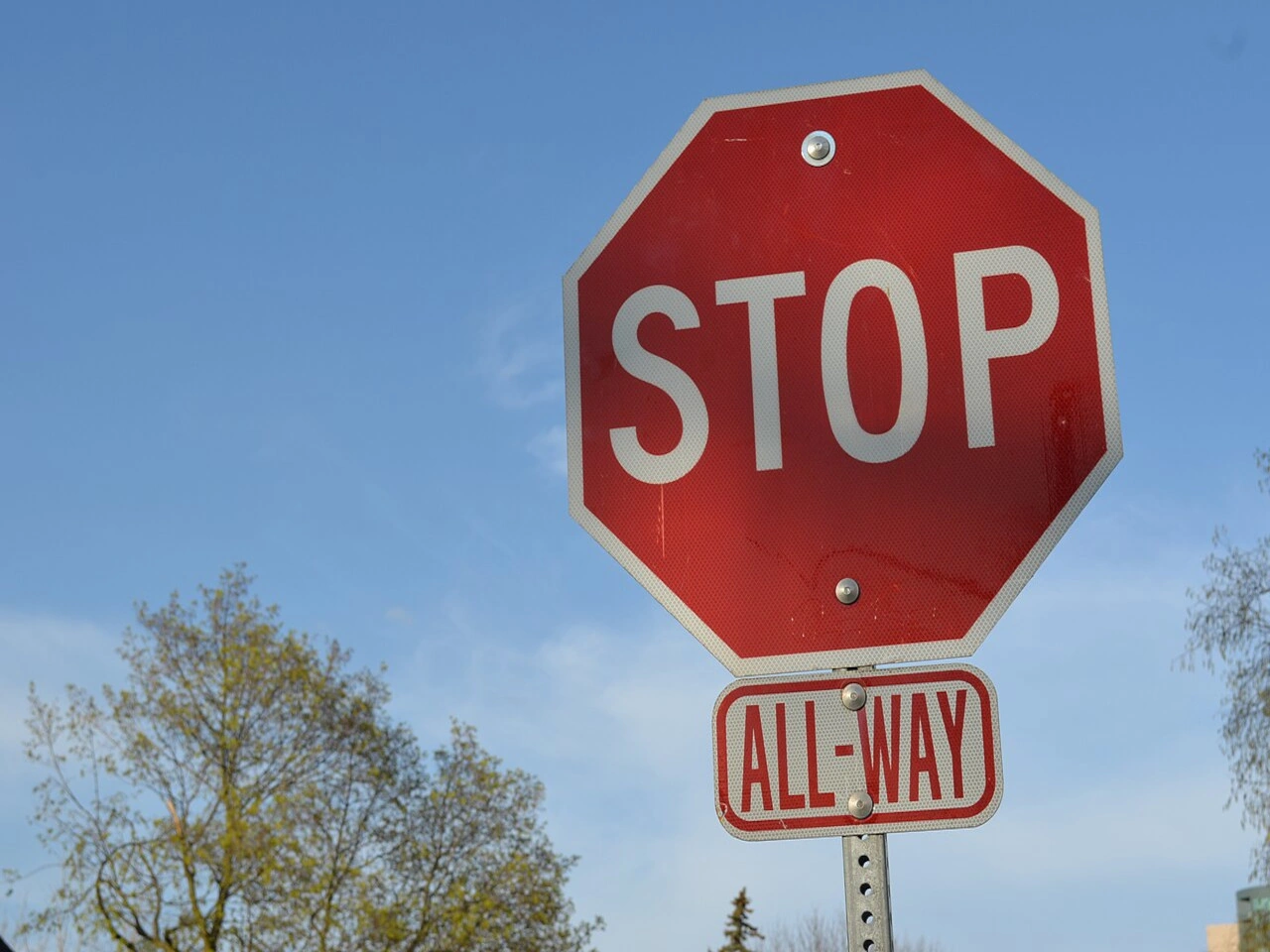
全方向一時停止は、交差点へ進入するすべての方向の交通が停止を義務付けられる交差点です。通常、各進入口にSTOP標識があり、信号なしで交差道路の交通を制御するために使われます。
すべての運転者は完全停止し、安全かつ許可されている場合にのみ進行します。どの車両が先に進めるかの規則は国により異なるため、最初に到着した車が常に優先と決めつけず現地の優先規則に従います。
What is an all-way stop?
An all-way stop is an intersection where drivers approaching from every direction are required to stop before entering.
Who goes first at an all-way stop?
The applicable priority rules depend on the country. Some countries use arrival order and additional right-of-way rules, while others apply different rules, so drivers should follow the local traffic regulations.
Do you still have to stop when no other traffic is present?
Yes. Where a stop sign requires a complete stop, the driver must stop even when no other vehicles or road users are visible.
64. 交差点形状図
交差点形状図は、前方の交差点やジャンクションの形を模式的に示す図です。道路がどのように分岐、交差、継続するかを示し、到達前に進行方向を理解する助けになります。
この図は事前方面案内標識でよく使われます。国の標識体系によっては、主要道路、側道、路線番号、目的地も区別して示します。
What is a crossroad shape?
A crossroad shape is a simplified diagram showing the physical arrangement and directions of roads at an upcoming intersection.
Why is the shape of an intersection shown on a road sign?
It helps drivers understand the junction layout in advance and choose the correct direction before reaching the intersection.
Does a crossroad-shape diagram always show every physical detail?
No. These diagrams are normally simplified and may omit features such as traffic islands, medians or other minor road details so that the important directions remain easy to understand.
65. 登坂車線
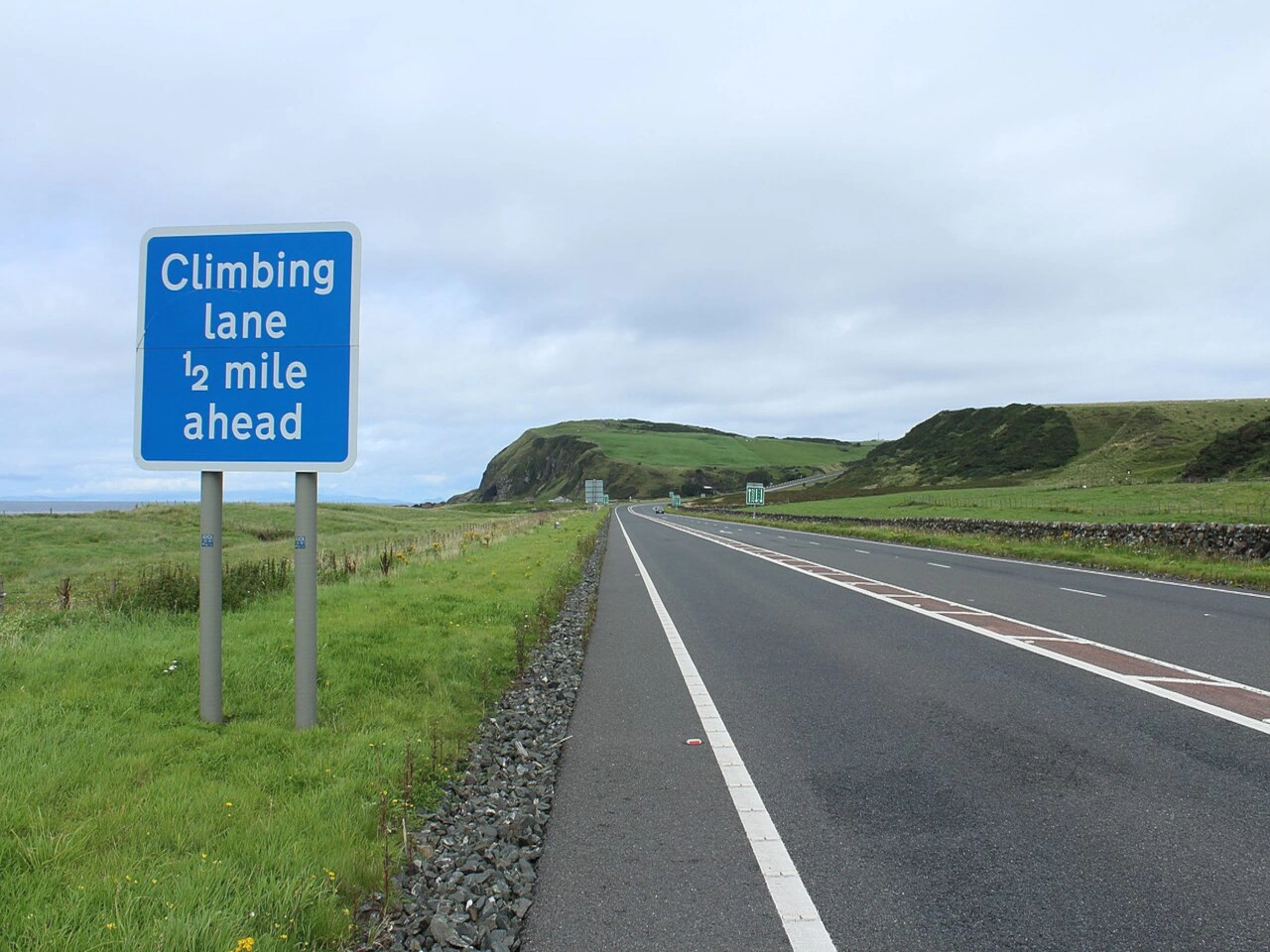
登坂車線は、上り坂で大幅に速度が落ちる重い車両や出力の低い車両のために設けられる追加車線です。速い車両は対向車線へ出ずに追い越せます。
利用者は誰がその車線を使えるかを示す標識や路面表示に従い、登坂車線終了時には安全に通常車線へ合流します。具体的規則や利用可能者は国によって異なります。
What is a climbing lane?
A climbing lane is an additional lane on an uphill section of road that provides space for slower vehicles while allowing faster vehicles to continue past them.
Who should use a climbing lane?
Climbing lanes are generally intended for vehicles travelling substantially slower than the normal traffic flow, particularly heavy vehicles. The exact restrictions depend on local signs and traffic rules.
What should you do when a climbing lane ends?
Follow the road markings and signs, check surrounding traffic and merge safely into the continuing traffic lane without forcing other road users to brake or change direction suddenly.
66. 自転車待機ボックス
自転車待機ボックス(advanced stop area)は、信号交差点で赤信号時に自転車が自動車より前で待機できるよう路面表示された区域です。通常、2本の停止線の間にあり、自転車記号が描かれることがあります。
自転車待機ボックスは自転車の視認性を高め、交通が動き出す前に明確な位置を取れるようにするためのものです。利用者、表示、信号規則は国によって異なります。
What is a bike box?
A bike box is a marked waiting area at a signal-controlled intersection where cyclists can position themselves ahead of motor vehicles during a red light.
Why are bike boxes used?
They help make cyclists more visible to drivers and allow cyclists to position themselves according to the direction they intend to travel.
Can cars stop inside a bike box?
Normally, no. Motor vehicles should stop behind the stop line provided for them so that the designated cyclist waiting area remains clear.
67. 左側通行
左側通行は、車両が通常道路の左側を走る交通制度です。左側通行国では通常、右側から追い越し、多くの車両は右ハンドルです。
慣れていない運転者は、交差点、ラウンドアバウト、右左折、道路への出入りで特に注意する必要があります。右側通行と比べて慣れた交通動作が左右逆になるためです。
What does left-hand traffic mean?
Left-hand traffic means that vehicles normally drive on the left side of a two-way road. Traffic approaching from the opposite direction therefore passes on the driver's right.
On which side do you normally overtake in left-hand traffic?
Vehicles normally overtake on the right, although exceptions can apply depending on the road layout and national traffic rules.
Which side is the steering wheel on in countries with left-hand traffic?
Most vehicles designed for left-hand traffic have the steering wheel on the right-hand side. However, vehicles with the steering wheel on the opposite side can also be legally used in many countries.
68. 速度フィードバック
速度フィードバックは、接近車両の速度を測定し、その速度を運転者へ表示する交通安全システムです。測定速度に加え、速度制限内かどうかを示すメッセージ、色、記号などを表示する場合があります。
主な目的は運転者に自分の速度を認識させ、必要に応じて減速を促すことです。通常、新しい速度制限を設定するものではなく、予防・教育目的で使われます。
What is a speed feedback display?
A speed feedback display is an electronic roadside device that measures an approaching vehicle's speed and shows that speed to the driver.
Why are speed feedback displays used?
They are used to increase drivers' awareness of their actual speed and encourage compliance with the applicable speed limit.
Does a speed feedback display set the speed limit?
Normally, no. The legally applicable speed is determined by the traffic rules and regulatory speed-limit signs, while the feedback display simply informs the driver of their measured speed.
69. 運転免許証
運転免許証は、特定の1種類以上の自動車カテゴリーを運転することを許可する公的文書です。運転可能な車両を決める条件、制限、カテゴリーコード、有効期限が記載されることがあります。
運転者は対象車種と管轄地域で有効な免許を所持しなければなりません。免許には仮免許、本免許、限定免許、停止中、取消などがあり、職業運転には追加資格が必要な場合があります。
What is a driving licence?
A driving licence is an official authorisation to drive specified categories of motor vehicle.
Is a driving licence the same as a driving permit?
The terms may refer to the same document, depending on the country. Some countries use permit specifically for learners or temporary authorisations.
What is a provisional driving licence?
A provisional or learner licence allows a person to practise driving under specified restrictions before obtaining a full licence.
What is a full driving licence?
A full licence is issued after the holder has completed the required tests or training. Restrictions may still apply because of age, vehicle type, medical fitness or licence codes.
Does one licence allow you to drive every vehicle?
No. Driving licences are divided into categories for motorcycles, cars, buses, trucks, trailers and other vehicles.
What is a licence category?
A licence category identifies the type and size of vehicle the holder is authorised to drive.
Must the licence be valid for the vehicle being driven?
Yes. Holding a licence for one category does not normally authorise driving a vehicle belonging to another category.
Can a licence contain restrictions?
Yes. Codes may restrict the holder to an automatic transmission, corrective lenses, an adapted vehicle or another specified condition.
What is the difference between an automatic and manual licence?
In some countries, passing the test in an automatic vehicle restricts the holder to automatic vehicles until an additional test or procedure is completed.
Does a driving licence expire?
Usually, yes. The document, individual categories or medical authorisation may have expiry dates and require renewal.
May you drive with an expired licence?
No. The licence and the category required for the vehicle must remain valid.
Must you carry your driving licence?
This depends on local law. Many countries require drivers to carry the original licence and present it to an authorised officer when requested.
Is a photograph or copy of the licence sufficient?
Not normally. A photograph, scan or photocopy is not generally a substitute for the original document unless an official digital-licence system is legally recognised.
Does a driving licence prove that you own the vehicle?
No. It proves driving authorisation, not ownership, registration or insurance.
What tests are required to obtain a licence?
Requirements may include a theory test, eyesight test, practical driving test, medical examination or compulsory training.
Is there a universal minimum driving age?
No. Minimum ages differ between countries and vehicle categories.
Can a learner drive without supervision?
Only where the provisional-licence system permits independent driving. Other learners must be accompanied by an approved supervisor or instructor.
Can a learner drive in another country?
Often not. Provisional and learner licences are frequently valid only in the country or region that issued them.
What is an international driving permit?
An international driving permit is a standardised translation of a valid national licence intended to help authorities interpret it abroad.
Does an international driving permit replace a national licence?
No. It normally has legal value only when presented together with the valid national driving licence on which it is based.
Is a national licence valid abroad?
This depends on the destination, length of stay, residence status and agreements between the countries concerned. An exchange or international permit may be required.
Can a foreign licence be exchanged?
Some countries exchange recognised foreign licences without new tests, while others require theory, practical or medical examinations.
Can medical fitness affect a licence?
Yes. A medical condition may require an assessment, shorter validity period, adapted vehicle or licence restriction.
Must changes in medical fitness be reported?
This depends on local law. Drivers remain responsible for ensuring that they are physically and mentally fit to drive safely.
Do professional drivers need additional qualifications?
Often, yes. Drivers of trucks, buses, taxis or vehicles used commercially may require professional competence, medical examinations or periodic training.
What happens when a licence is suspended?
The holder may not drive during the suspension period, even if the physical document remains in their possession.
What is disqualification from driving?
Disqualification is a legal prohibition on driving, usually imposed by a court or competent authority for a specified period or until conditions are fulfilled.
What should you do if the licence is lost or stolen?
Report it where required and apply for a replacement through the competent licensing authority. Do not continue driving when local law requires the original document to be carried.
What should you do if the licence is damaged?
Request a replacement when the document is unreadable, damaged or no longer allows the holder to be identified reliably.
Does changing address require a new licence?
This depends on the country and whether the address appears on the licence. Drivers must follow the local notification and replacement procedure.
70. 位置標識
位置標識は、道路上の測定位置を示す路側の基準表示です。通常、その路線の定められた起点からのキロ、マイル、またはより細かい区間を示します。
キロ・ヘクトメートル標は、道路利用者、緊急サービス、道路管理者、保守作業員が正確な道路区間を特定するために役立ちます。速度制限、優先、進入規制を設定するものではありません。
What is a road location marker?
A road location marker is a numbered reference point identifying a measured position along a particular road or route.
What is a kilometre marker?
A kilometre marker indicates the number of kilometres measured from an established starting point on the road.
What is a hectometre marker?
A hectometre marker identifies a position at intervals of 100 metres. One kilometre contains ten hectometres.
What does a marker showing 14.7 mean?
It normally identifies a point approximately 14 kilometres and 700 metres from the route’s reference origin.
Is the marker the distance to the next town?
No. It normally measures the position along the road from a fixed reference origin rather than the remaining distance to a destination.
Where does the kilometre measurement begin?
It begins at a reference point chosen for that road, such as the start of the route, a border, an administrative boundary or another officially defined origin.
Does the numbering always increase in the direction of travel?
No. It increases in the officially defined direction of the route. Drivers travelling in the opposite direction may see the values decrease.
How can you recognise a location marker?
It may appear as a numbered roadside post, small sign, plate, marker attached to a barrier or numbers painted beside the carriageway.
Are kilometre markers used in every country?
Many countries use kilometre markers, while countries using imperial measurements may use mile markers. Designs and intervals differ.
Are hectometre markers always placed every 100 metres?
They are intended to represent 100-metre intervals, but their physical placement and permitted tolerances depend on the road authority and local conditions.
What information should you give during an emergency?
Give the road number, marker value, direction of travel and nearest junction or landmark where possible.
Why is the road number important?
The same kilometre value may occur on many different roads. The road number identifies which route the marker belongs to.
Why is the direction of travel important?
Divided roads have separate carriageways. Reporting the direction helps emergency services approach the correct side without making a long diversion.
Can a marker help locate a breakdown?
Yes. Reporting the nearest marker can help breakdown and emergency services identify the affected road section more accurately.
Can it help report debris or another hazard?
Yes. The marker can help road authorities locate an obstruction, damaged barrier, animal, collision or other dangerous situation.
Is a location marker a traffic sign?
Normally not. It is a reference or identification device rather than a regulatory sign.
Does it impose a speed limit?
No. The applicable speed comes from general traffic rules and regulatory speed signs.
Does it change priority?
No. Traffic lights, priority signs and ordinary intersection rules remain applicable.
Does it mark the beginning of a new road rule?
No. Passing a kilometre or hectometre marker does not normally begin or end a traffic regulation.
Can markers be used for road maintenance?
Yes. Road authorities use reference points to locate signs, barriers, bridges, defects, works and other infrastructure precisely.
Can navigation coordinates replace a location marker?
Coordinates can be useful, but a road reference marker may be easier for road operators and emergency services to connect with the correct carriageway and road section.
What if the marker is damaged or missing?
Use the nearest visible marker together with the road number, direction, junctions and other identifiable features.
Should a driver stop simply to read a marker?
No. Do not stop in a live lane or another prohibited location. A passenger may note the marker, or the driver may read it after stopping somewhere safe during an actual emergency.
Can temporary roadworks change the marker values?
Normally not. Temporary traffic routes may move traffic away from the marker’s usual position, but the official road reference system generally remains unchanged.
71. 道路番号
道路番号は、道路網の特定の道路・路線を識別する番号または文字と数字の組み合わせです。道路種別を区別し、都市、地域、国の間を案内するために使われます。
道路番号は通常路線標識や方面案内標識に表示されます。形式、色、接頭辞は国によって異なり、高速道路、国道、地方道、国際路線などを示す場合があります。
What is a road number?
A road number is an identifier assigned to a particular road or route, usually consisting of numbers alone or a combination of letters and numbers.
Where can you find road numbers?
Road numbers are commonly displayed on route markers, direction signs and advance direction signs to help drivers follow the correct route.
Do road-number systems differ between countries?
Yes. Countries use different prefixes, colours and numbering systems to distinguish motorways, national roads, regional roads and international routes.
72. 距離予告マーカー
距離予告マーカーは、高速道路出口、交差点、踏切など特定地点が近づいていることを段階的に知らせる路側標識です。減っていくバーなどの記号で、前方地点までの接近を判断できます。
通常、前方地点へ近づくにつれて順に短い距離で設置されます。デザイン、間隔、意味は国によって異なるため、バー1本が常に同じ距離を意味するとは限りません。
What are countdown markers?
Countdown markers are a series of signs that progressively indicate how close a driver is to an upcoming exit, junction, crossing or other important point.
What do the bars on countdown markers mean?
The number of bars normally decreases as the driver approaches the indicated location. Depending on the country, the bars may represent fixed distances or simply successive stages of the approach.
Where are countdown markers commonly used?
They are commonly associated with motorway exits, major junctions and railway crossings, although their use and design differ between countries.
73. 公衆トイレ
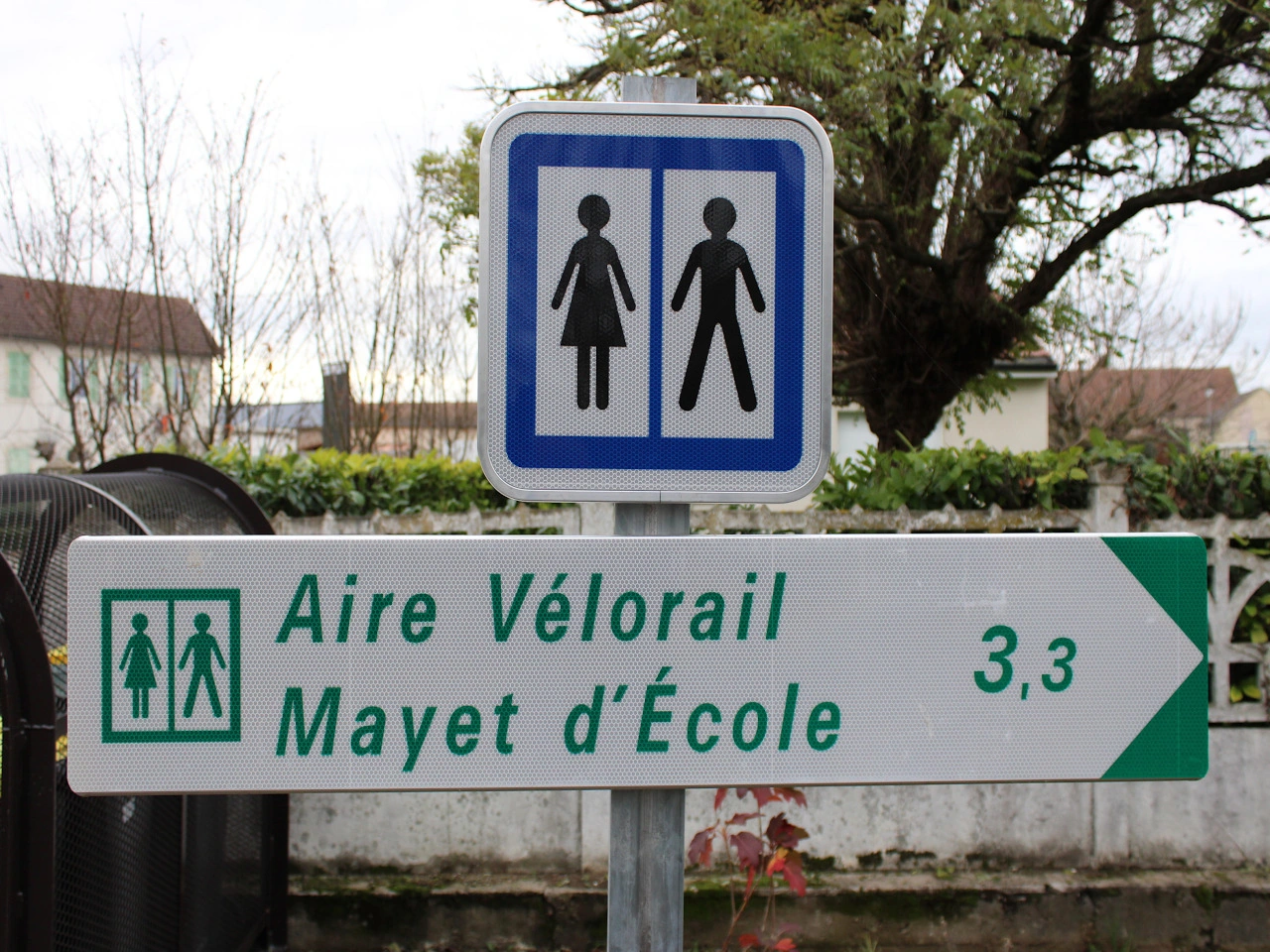
公衆トイレは、旅行者または一般の人が利用できるトイレ設備です。道路沿いではサービスエリア、休憩所、給油所、駐車施設、観光地などに設置されます。
トイレのピクトグラムを使った施設・サービス標識で示されることがあります。標識デザイン、無料・有料、利用可能時間は国や場所によって異なります。
What is a public toilet?
A public toilet is a toilet facility provided for travellers or members of the public, often at rest areas, service stations, parking facilities or tourist locations.
How are public toilets indicated on roads?
They are commonly indicated by a toilet or WC pictogram on service, facility or direction signs. The design varies between countries.
Where can public toilets be found along major roads?
They are commonly available at rest areas, motorway service areas, filling stations and other traveller facilities.
74. 休憩所
休憩所は、道路や高速道路の本線交通から離れて休憩できる指定場所です。駐車スペースのほか、場所によってトイレ、ピクニック設備、飲食、燃料、充電設備などがあります。
運転者と乗員が走行交通から離れたより安全な場所で休息できるようにする施設です。設備内容や案内標識は国によって異なります。
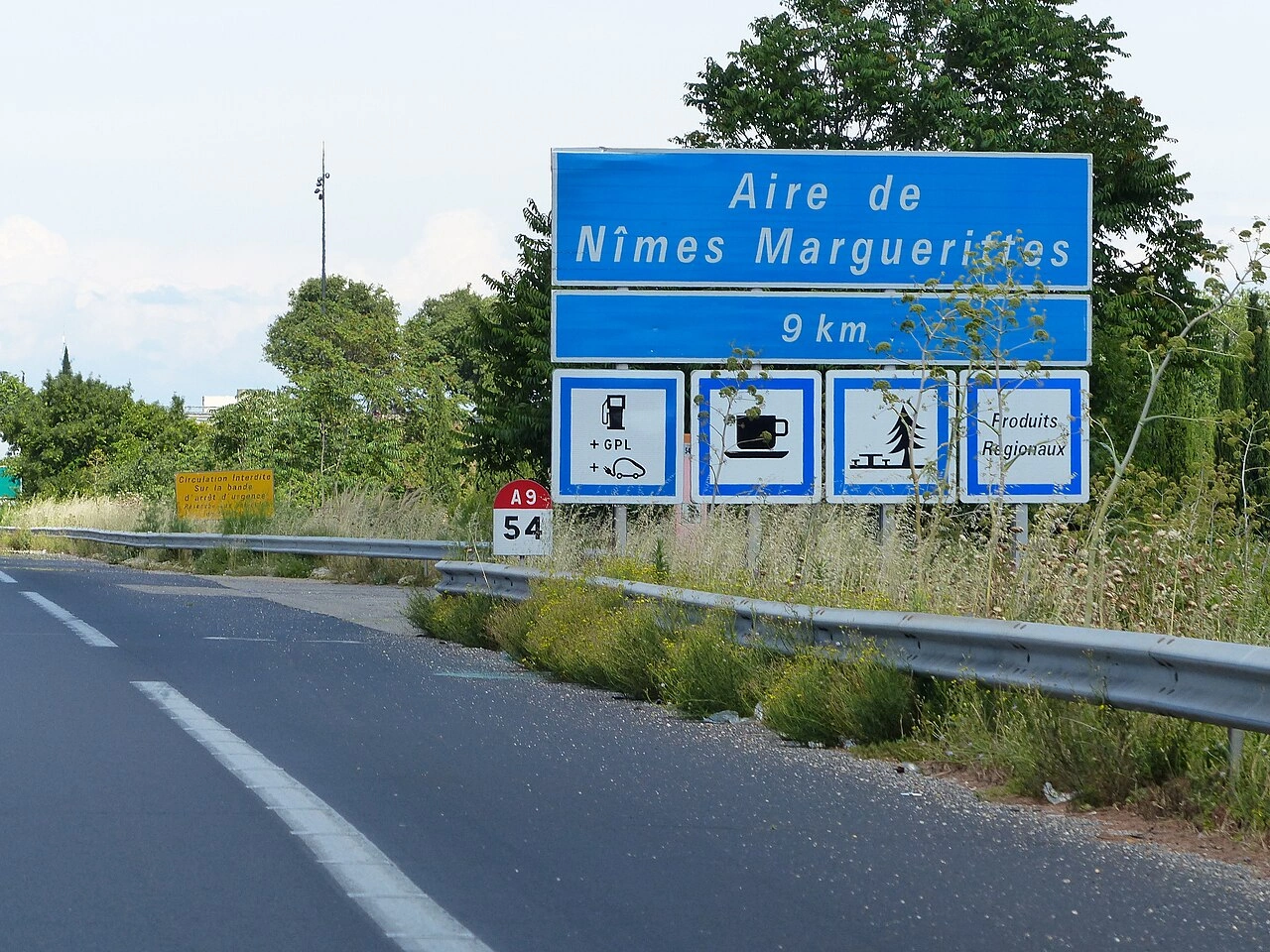
What is a rest area?
A rest area is a designated place beside a road or motorway where travellers can park and take a break from their journey.
What facilities can a rest area provide?
Depending on the location, a rest area may provide parking, toilets, picnic facilities, food, fuel, charging stations or other traveller services.
Why are rest areas important?
Rest areas give drivers a suitable place to stop, rest and reduce fatigue without stopping on the main traffic lanes or roadside.
75. 道路反射鏡
道路反射鏡は、見通しの悪い交差点、出入口、カーブなどに設置される凸面鏡です。曲面により通常の平面鏡より広い範囲の接近交通を確認できます。
道路反射鏡はあくまで視認補助です。距離、速度、方向が歪んで見え、暗闇、天候、汚れ、破損の影響も受けます。運転者は直接道路も確認し、優先規則に従い、安全な場合にのみ進行します。
What is a traffic mirror?
A traffic mirror is a convex roadside mirror that helps road users see around an obstruction or into a road with limited visibility.
Where are traffic mirrors commonly installed?
They may be placed near intersections, narrow roads, bends, car-park exits, private driveways, tunnels or other locations where buildings, vegetation or road geometry obstruct the view.
Why is the mirror curved?
A convex surface provides a wider field of view than a flat mirror, allowing more of the approaching road to be seen.
Does a traffic mirror show an exact image?
No. The reflected image is distorted, and objects normally appear smaller and farther away than they really are.
Can you accurately judge speed in a traffic mirror?
Not reliably. The curved image makes it difficult to estimate how fast another road user is approaching.
Can you accurately judge distance in the mirror?
No. Distance can appear greater than it really is, so an approaching vehicle may reach the intersection sooner than expected.
Can the mirror create a blind area?
Yes. Its position and viewing angle may leave parts of the road outside the reflected image. Small cyclists, motorcycles or pedestrians may also be difficult to notice.
Does a traffic mirror give you priority?
No. It does not change priority. Drivers must continue to follow stop signs, give-way signs, traffic lights and the ordinary priority rules.
Does seeing an empty mirror mean the road is clear?
No. Another road user may be outside the reflected area, hidden by glare or too small to notice. Always check the road directly before proceeding.
Must you still stop at a stop sign?
Yes. The mirror does not replace the mandatory complete stop. Stop at the prescribed position, then use direct observation and the mirror as additional information.
Must you still give way?
Yes. You may proceed only when traffic with priority can continue without being forced to brake, stop or change direction.
How should you use a traffic mirror?
Approach slowly, stop when required and scan the mirror for movement. Then look directly in both directions and continue only after confirming that the road is clear.
Should you look only at the mirror?
No. Alternate between the mirror and direct observation. The mirror should supplement rather than replace normal checks.
Can rain affect a traffic mirror?
Yes. Rain, water droplets and spray may blur or partially obscure the reflected image.
Can frost or condensation affect it?
Yes. Dew, condensation, frost, ice or snow may make the mirror difficult or impossible to use.
Can sunlight cause problems?
Yes. Sunlight may create glare or reflections that hide approaching road users.
Can headlights be misleading at night?
Yes. Reflected headlights may make it difficult to determine the exact direction, distance or speed of an approaching vehicle.
Can the mirror move out of position?
Yes. Wind, impacts, vandalism, vibration or temperature changes may alter its orientation and make the reflected view inaccurate.
What if the mirror is dirty or damaged?
Do not rely on it. Proceed with additional caution and report the defect to the responsible road authority or property owner.
Does a traffic mirror impose a speed limit?
No. The applicable road or posted speed limit remains in force, but restricted visibility normally requires a lower approach speed.
Does it require drivers to sound the horn?
No. Use the horn only where local law permits it and a warning is reasonably necessary to prevent danger.
Can pedestrians and cyclists use the mirror?
Yes. It may help them observe approaching traffic, but they must also look directly and follow the applicable crossing and priority rules.
Can a private individual install a traffic mirror?
A mirror may generally be installed on private property with the owner’s permission, subject to local rules. Installing one on, above or beside a public road normally requires permission from the road authority.
Should a mirror replace better road design?
No. Removing vegetation, relocating parking, improving the intersection layout or changing traffic circulation may provide a safer and more reliable solution.