


Traffic signsCzechia
 Traffic rules
 Czechia
26. Railway crossing
A railway crossing, also called a level crossing or railroad crossing, is a place where a road or path crosses railway tracks at the same level. It may be protected by barriers, warning lights, bells, traffic signs or a combination of these measures.
Road users must approach carefully and never enter when a train is approaching, warning signals are active or the exit is blocked. They should cross promptly and must never stop, wait or become trapped on the tracks.
Wikimedia.org • ŠJů • CC BY-SA
When must drivers stop at a railway level crossing in Czechia?
Do not enter while alternating red crossing lights or the crossing’s warning sound operate, or while barriers are lowering, down or rising. Do not enter when a train is seen or heard approaching, except for the statutory flashing-white-light situation, or when railway staff signal a stop or the exit is blocked. A STOP sign requires a full stop. Only an authorised railway employee may give the statutory permission to proceed despite the specified lights, sound or barrier warning.
🔗 mze.gov.cz • Czech Ministry of Agriculture, Road Traffic Act 361/2000, section 29; 🔗 mze.gov.cz • Czech Ministry of Agriculture, Road Traffic Act 361/2000, section 28
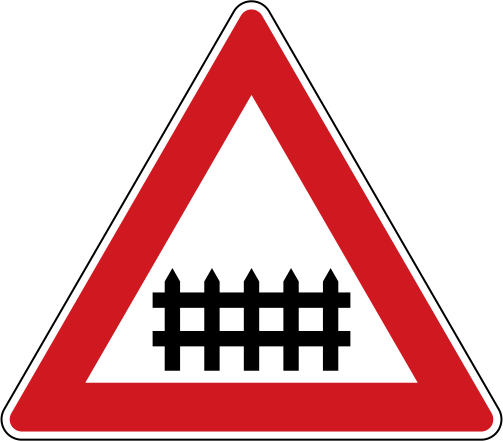 Warning for a railway crossing with barriers.
English • Traffic sign A 29 • Level crossing with barriers. The sign warns of a level crossing equipped with barriers.
Čeština • Dopravní značka A 29 • Železniční přejezd se závorami. Značka upozorňuje na železniční přejezd vybavený závorami.
Sources
🔗 Commons.wikimedia.org • 🔗
🔗 E-sbirka.gov.cz • Vyhláška č. 294/2015 Sb. • A 29 • znění účinné od 1. 7. 2025
SVG source: Government of the Czech Republic • Public domain • Original revision 2013-12-06. Wikimedia original unmodified.
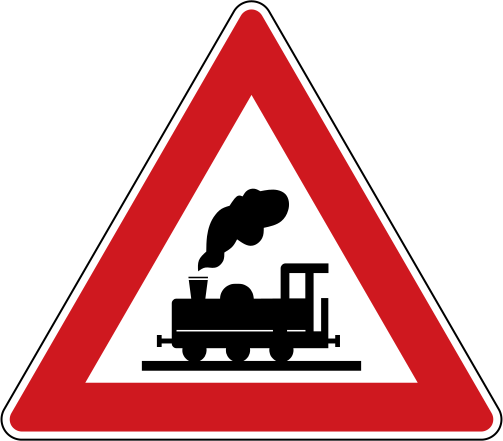 Warning for a railway crossing without barriers.
English • Traffic sign A 30 • Level crossing without barriers. The sign warns of a level crossing without barriers.
Čeština • Dopravní značka A 30 • Železniční přejezd bez závor. Značka upozorňuje na železniční přejezd nevybavený závorami.
Sources
🔗 Commons.wikimedia.org • 🔗
🔗 E-sbirka.gov.cz • Vyhláška č. 294/2015 Sb. • A 30 • znění účinné od 1. 7. 2025
SVG source: Government of the Czech Republic • Public domain • Original revision 2013-12-06. Wikimedia original unmodified.
Artwork verified against E-sbirka.gov.cz • official published diagram A 30.
 Warning for a railway crossing with one track.
English • Traffic sign A 32a • Crossbuck for a single-track level crossing. The sign warns of a single-track level crossing. If the driver is required to stop before the crossing, the vehicle must stop before this sign.
Čeština • Dopravní značka A 32a • Výstražný kříž pro železniční přejezd jednokolejný. Značka upozorňuje na jednokolejný železniční přejezd. Je-li řidič povinen před železničním přejezdem zastavit vozidlo, zastaví před touto značkou.
Sources
🔗 Commons.wikimedia.org • 🔗
🔗 E-sbirka.gov.cz • Vyhláška č. 294/2015 Sb. • A 32a • znění účinné od 1. 7. 2025
SVG source: Government of the Czech Republic • Public domain • Original revision 2013-12-06. Wikimedia original unmodified.
Artwork verified against E-sbirka.gov.cz • official published diagram A 32a.
 Warning for a railway crossing with two or more tracks.
English • Traffic sign A 32b • Crossbuck for a multiple-track level crossing. The sign warns of a multiple-track level crossing, where extra care is needed because trains may pass simultaneously in both directions. If the driver is required to stop before the crossing, the vehicle must stop before this sign.
Čeština • Dopravní značka A 32b • Výstražný kříž pro železniční přejezd vícekolejný. Značka upozorňuje na vícekolejný železniční přejezd, kde je potřeba dbát zvýšené opatrnosti pro případ současného průjezdu vlaků z obou směrů. Je-li řidič povinen před železničním přejezdem zastavit vozidlo, zastaví před touto značkou.
Sources
🔗 Commons.wikimedia.org • 🔗
🔗 E-sbirka.gov.cz • Vyhláška č. 294/2015 Sb. • A 32b • znění účinné od 1. 7. 2025
SVG source: Ministerstvo dopravy a spojů České republiky • Public domain • Original revision 2011-10-25. Wikimedia original unmodified.
Artwork verified against E-sbirka.gov.cz • official published diagram A 32b.
Must I stop at every unguarded railway crossing in Czechia?
Not merely because it has no barriers. Approach with special care and check that crossing is safe. A STOP sign requires stopping where you have a proper view of the track. Do not enter when an approaching train or any other condition in section 29 prohibits crossing, or when you cannot clear the crossing.
🔗 mze.gov.cz • Czech Ministry of Agriculture, Road Traffic Act 361/2000, section 28
What if road traffic is queued beyond a railway crossing in Czechia?
Wait before the tracks until there is room to take your entire vehicle off the crossing. Do not follow another vehicle onto the tracks without checking the exit. Keep the tracks clear even if no train is visible.
🔗 mze.gov.cz • Czech Ministry of Agriculture, Road Traffic Act 361/2000, section 29

27. School area
A school area is a road or group of roads near a school where large numbers of children may walk, cycle, cross the road or enter and leave vehicles. It may be identified by warning signs, zone signs, road markings, traffic-calming measures or flashing lights.
Special speed limits, parking restrictions or access rules may apply permanently or only during school arrival and departure times. Drivers should reduce speed, watch carefully for children and be prepared to stop.
Wikimedia.org • ŠJů • CC BY-SA
What speed rules apply around schools in Czechia?
Local 30 km/h restrictions and residential zones may operate near schools; their signs, rather than the presence of a school alone, establish the applicable limit.
🔗 e-sbirka.gov.cz • Czechia, Decree 294/2015 — current sign and marking descriptions, annexes 1–10
Does a school warning sign in Czechia automatically set the speed limit?
A children or school warning alerts you to a potential hazard; the enforceable numerical speed limit depends on the applicable law, regulatory signs and any time or variable display. Slow further if children are near the road.
🔗 e-sbirka.gov.cz • Czechia, Decree 294/2015 — current sign and marking descriptions, annexes 1–10
How should you pass a school entrance in Czechia?
Watch for children stepping out from between parked vehicles, obey crossings and any school patrol, and follow stopping or parking restrictions. Do not obstruct visibility near a crossing or school entrance; approach at a speed that permits a safe stop.
🔗 e-sbirka.gov.cz • Czechia, Decree 294/2015 — current sign and marking descriptions, annexes 1–10
28. Crossing animals
An animals-crossing warning indicates a place or road section where wild animals, livestock or ridden animals may enter or cross the road. Animals may appear suddenly, move unpredictably or be difficult to see in darkness, vegetation or poor weather.
Drivers should reduce speed, scan both sides of the road and remain prepared to stop. The warning sign does not itself give animals priority or impose a numerical speed limit, but drivers must avoid frightening, endangering or colliding with them.
Wikimedia.org • JAn Dudík • CC BY
Which animals might drivers encounter on roads in Czechia?
Depending on the locality, drivers may meet deer and wild boar along wooded and rural roads. Roadside animal-warning signs and local hazard information indicate where extra care may be needed; do not assume the hazard ends immediately after a sign.
🔗 e-sbirka.gov.cz • Czechia, Decree 294/2015 — current sign and marking descriptions, annexes 1–10
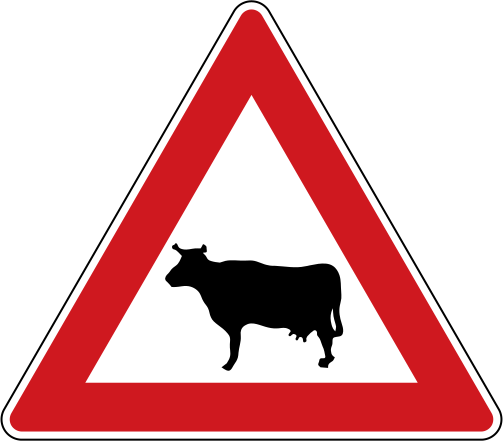 Warning for cattle on the road.
English • Traffic sign A 13 • Animals. The sign warns of a place or road section where domestic animals may frequently be present on the road. Another prescribed animal symbol may be used on the sign.
Čeština • Dopravní značka A 13 • Zvířata. Značka upozorňuje na místo nebo úsek pozemní komunikace, kde může docházet k častému výskytu domácích zvířat na pozemní komunikaci. Na značce může být použít i jiný určený symbol zvířete.
Sources
🔗 Commons.wikimedia.org • 🔗
🔗 E-sbirka.gov.cz • Vyhláška č. 294/2015 Sb. • A 13 • znění účinné od 1. 7. 2025
SVG source: Government of the Czech Republic • Public domain • Original revision 2013-12-06. Wikimedia original unmodified.
Artwork verified against E-sbirka.gov.cz • official published diagram A 13.
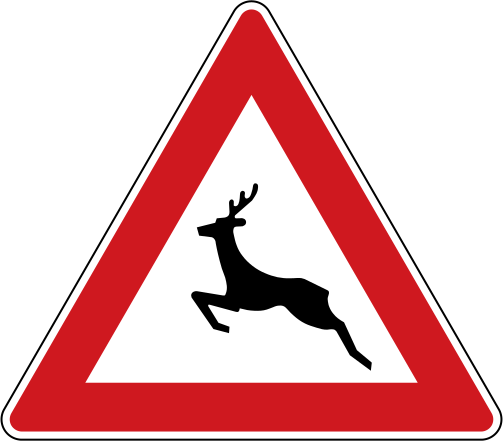 Warning for crossing deer.
English • Traffic sign A 14 • Wild animals. The sign warns of a place or road section where wild animals may frequently be present on the road. Another prescribed wild-animal symbol may be used on the sign.
Čeština • Dopravní značka A 14 • Zvěř. Značka upozorňuje na místo nebo úsek pozemní komunikace, kde může docházet k častému výskytu divoké zvěře na pozemní komunikaci. Na značce může být použít i jiný určený symbol volně žijícího živočicha.
Sources
🔗 Commons.wikimedia.org • 🔗
🔗 E-sbirka.gov.cz • Vyhláška č. 294/2015 Sb. • A 14 • znění účinné od 1. 7. 2025
SVG source: Government of the Czech Republic • Public domain • Original revision 2013-12-06. Wikimedia original unmodified.
Artwork verified against E-sbirka.gov.cz • official published diagram A 14.
Does an animal-crossing warning sign in Czechia set a new speed limit?
A warning of animals is not, by itself, a numerical speed-limit sign. Continue to obey the applicable speed limit, but slow down whenever animals could enter the road or visibility is poor. A separate regulatory speed sign must also be obeyed.
🔗 e-sbirka.gov.cz • Czechia, Decree 294/2015 — current sign and marking descriptions, annexes 1–10
What should you do if an animal enters the road in Czechia?
Ease off the accelerator, assess the traffic behind and brake smoothly if necessary. Avoid abrupt swerving into opposing traffic or off the road. Give farm animals and ridden animals room, avoid frightening them with unnecessary horn use, and be alert for more animals following.
🔗 e-sbirka.gov.cz • Czechia, Decree 294/2015 — current sign and marking descriptions, annexes 1–10
29. Slippery road
A slippery road has reduced tyre grip and can make steering, braking and acceleration less effective. Roads may become slippery because of rain, ice, snow, mud, oil, loose material or other substances on the surface. Drivers should reduce speed, increase their following distance and avoid sudden steering, braking or acceleration. Extra caution is needed in bends, on bridges and wherever the road surface changes unexpectedly.

Wikimedia.org • ŠJů • CC BY-SA
What can make roads slippery in Czechia?
Be prepared for snow, ice and frost during colder months. A surface can become slippery even if it looks clear, and different parts of the road may have very different grip.
🔗 e-sbirka.gov.cz • Czechia, Decree 294/2015 — current sign and marking descriptions, annexes 1–10
How should you drive on a slippery road in Czechia?
Reduce speed early, increase the gap to the vehicle ahead and use smooth steering, braking and acceleration. Do not rely on the posted maximum as a safe target when grip is poor.
🔗 e-sbirka.gov.cz • Czechia, Decree 294/2015 — current sign and marking descriptions, annexes 1–10
Are special winter tyres or equipment required in Czechia?
In Czechia, qualifying vehicles require winter tyres from 1 November to 31 March when wintry conditions are present or reasonably expected, with extra rules on signed roads. The driver must still adapt speed to actual conditions.
🔗 e-sbirka.gov.cz • Czechia, Decree 294/2015 — current sign and marking descriptions, annexes 1–10
30. Aircraft
An aircraft warning is a traffic warning indicating that aircraft may pass at low altitude above or close to the road, usually near an airport, airfield or flight path. The warning is intended to prepare drivers for the sudden appearance or noise of low-flying aircraft.
Drivers should remain focused on the road and avoid sudden braking or steering movements if an aircraft passes overhead. The design and use of aircraft warning signs vary between countries.

Wikimedia.org • Adam Rejha • CC BY-SA
Does an aircraft warning automatically reduce the speed limit in Czechia?
No, not by itself. A hazard warning is not a numerical speed-limit sign. Obey any separately displayed speed restriction and adjust speed if actual conditions make this necessary.
🔗 mze.gov.cz • Czech Act section 18 — safe speed and actual legal limits
🔗 mze.gov.cz • Czech Act section 27 — prohibited stopping/parking
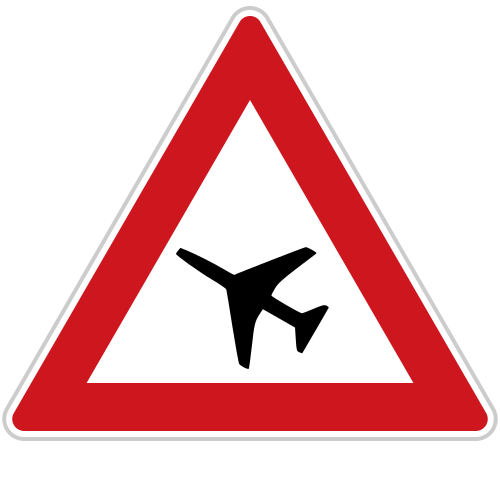 Warning for low-flying aircraft.
English • Traffic sign A 20 • Aircraft. The sign warns of a place where aircraft fly low over the road.
Čeština • Dopravní značka A 20 • Letadla. Značka upozorňuje na místo, kde v malé výšce nad pozemní komunikací přelétávají letadla.
Sources
🔗 Commons.wikimedia.org • 🔗
🔗 E-sbirka.gov.cz • Vyhláška č. 294/2015 Sb. • A 20 • znění účinné od 1. 7. 2025
SVG source: Life of Riley • CC BY-SA 3.0 • Original revision 2011-10-18. Wikimedia original unmodified.
Artwork verified against E-sbirka.gov.cz • official published diagram A 20.
What if a low-flying aircraft distracts you while driving in Czechia?
Keep your eyes on the road, maintain your lane and avoid sudden braking or steering simply to watch the aircraft. If you need to stop, find a safe and permitted stopping place.
🔗 mze.gov.cz • Czech Act section 18 — safe speed and actual legal limits
🔗 mze.gov.cz • Czech Act section 27 — prohibited stopping/parking
31. Curve
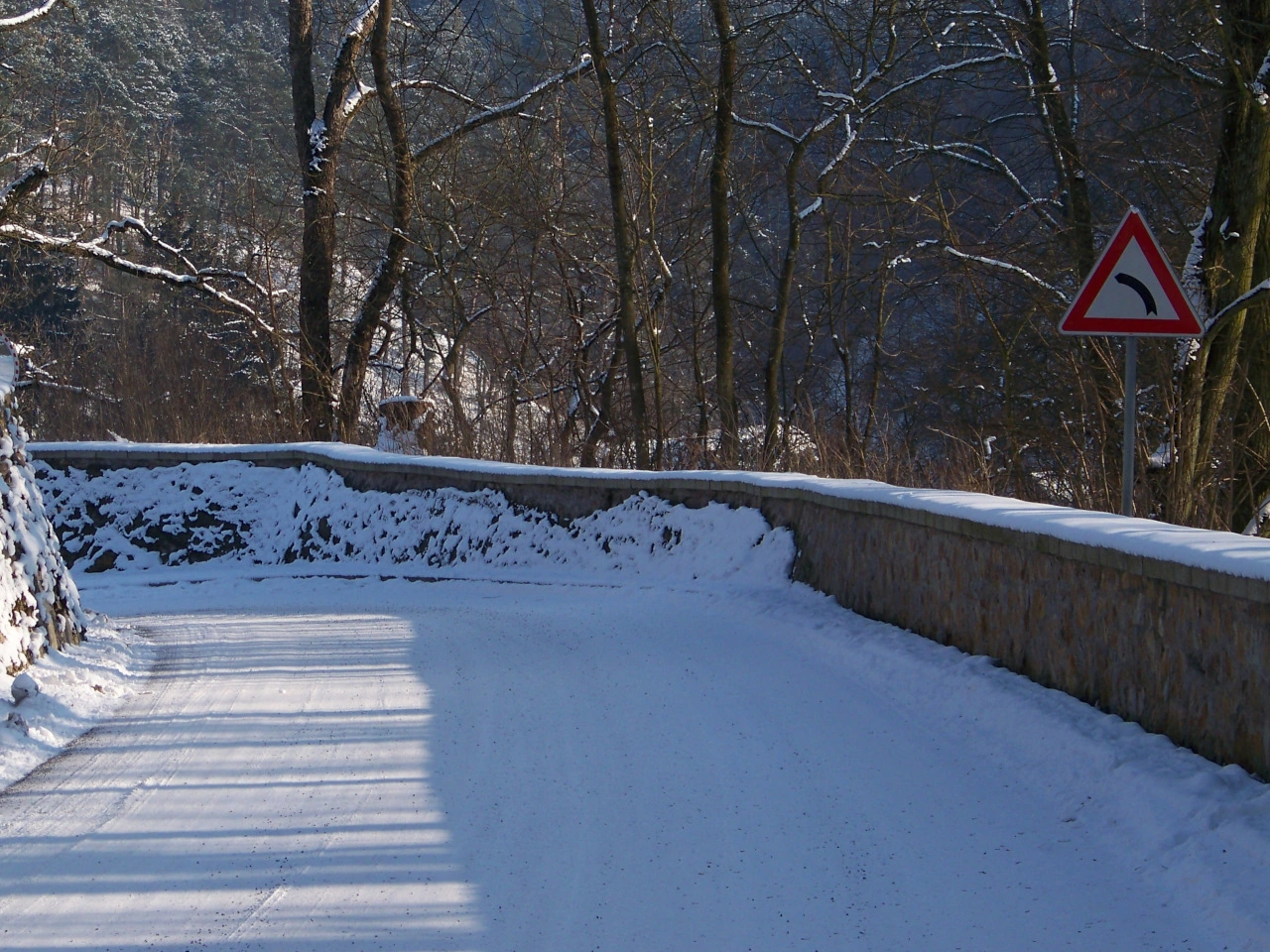
A curve is a section of road that changes direction to the left or right. A sharp, unexpected or poorly visible curve can reduce a driver’s view of approaching traffic, stopped vehicles, pedestrians and other hazards.
Drivers should reduce speed before entering the curve, remain within their lane and use smooth steering, braking and acceleration. Warning signs may indicate the direction of the first curve or a series of successive curves.
Wikimedia.org • ŠJů • CC BY-SA
What makes a bend dangerous in Czechia?
Curves shorten your view of the road ahead and can reduce the margin for correcting a mistake. Drivers may encounter rural bends and roads in higher areas that may become icy in winter; the safe speed can be well below the posted maximum. Watch for changing road surfaces and people or vehicles hidden beyond the curve.
🔗 e-sbirka.gov.cz • Czechia, Decree 294/2015 — current sign and marking descriptions, annexes 1–10
How should you approach a sharp curve in Czechia?
Slow down before the bend, select the correct lane position, look through the curve and steer smoothly. Keep enough grip and visible stopping distance for the road and weather conditions.
🔗 e-sbirka.gov.cz • Czechia, Decree 294/2015 — current sign and marking descriptions, annexes 1–10
Is overtaking safe on a blind bend in Czechia?
No. Do not start overtaking where your view of oncoming traffic is obstructed or where signs or road markings prohibit it. Wait until there is a lawful, clear and sufficiently long view ahead.
🔗 e-sbirka.gov.cz • Czechia, Decree 294/2015 — current sign and marking descriptions, annexes 1–10
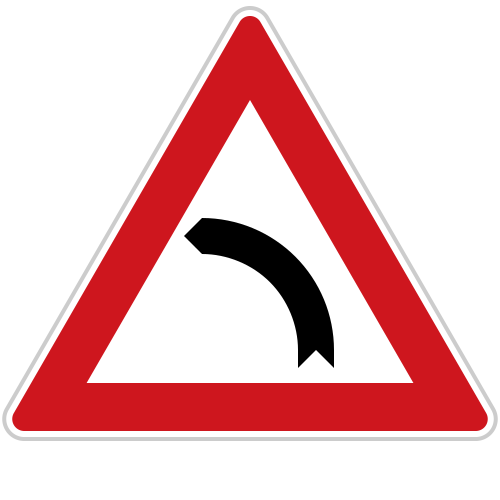 Warning for a curve to the left.
English • Traffic sign A 1b • Bend to the left. The sign warns of a left bend that requires a substantial reduction in speed to negotiate safely.
Čeština • Dopravní značka A 1b • Zatáčka vlevo. Značka upozorňuje na zatáčku (směrový oblouk) vlevo, jehož bezpečné projetí vyžaduje výrazné snížení rychlosti jízdy.
Sources
🔗 Commons.wikimedia.org • 🔗
🔗 E-sbirka.gov.cz • Vyhláška č. 294/2015 Sb. • A 1b • znění účinné od 1. 7. 2025
SVG source: Life of Riley • Public domain • Original revision 2011-10-18. Wikimedia original unmodified.
Artwork verified against E-sbirka.gov.cz • official published diagram A 1b.
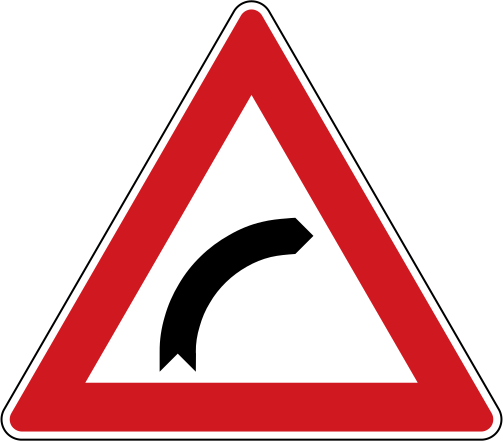 Warning for a curve to the right.
English • Traffic sign A 1a • Bend to the right. The sign warns of a right bend that requires a substantial reduction in speed to negotiate safely.
Čeština • Dopravní značka A 1a • Zatáčka vpravo. Značka upozorňuje na zatáčku (směrový oblouk) vpravo, jehož bezpečné projetí vyžaduje výrazné snížení rychlosti jízdy.
Sources
🔗 Commons.wikimedia.org • 🔗
🔗 E-sbirka.gov.cz • Vyhláška č. 294/2015 Sb. • A 1a • znění účinné od 1. 7. 2025
SVG source: Government of the Czech Republic • Public domain • Original revision 2013-12-06. Wikimedia original unmodified.
32. Chevron
A chevron is a V-shaped or arrow-shaped road marker used to show a sharp change in the direction of a road. Chevron boards are normally placed along the outside of a curve so that their points indicate the direction in which the road continues.
Chevrons improve the visibility and alignment of a curve, especially in darkness or poor weather. They do not normally impose a speed limit or determine priority, so drivers must reduce speed before the curve and follow all other signs and road markings.

Wikimedia.org • ŠJů • CC BY-SA
What is the purpose of chevron boards on a road in Czechia?
Chevron alignment boards help drivers see which way a sharp bend continues, especially in darkness or poor visibility. Their precise shape and colour depend on the local sign system; pay attention to the alignment shown rather than assuming one universal design.
🔗 e-sbirka.gov.cz • Czechia, Road Traffic Act 361/2000 — sections 4, 18; Decree Annex 10 Z3
🔗 e-sbirka.gov.cz • Czechia, Decree 294/2015 — current sign and marking descriptions, annexes 1–10
Do chevron boards give priority or order a turn at junctions in Czechia?
Not ordinary curve-alignment chevrons. They guide you around a bend. Give-way, no-entry, keep-direction and other mandatory traffic signs must be read separately; similar-looking arrows can have different legal meanings.
🔗 e-sbirka.gov.cz • Czechia, Road Traffic Act 361/2000 — sections 4, 18; Decree Annex 10 Z3
🔗 e-sbirka.gov.cz • Czechia, Decree 294/2015 — current sign and marking descriptions, annexes 1–10
Is the speed shown by a chevron in Czechia a compulsory maximum?
A chevron alone does not set a numerical maximum speed. If an advisory-speed panel or a regulatory speed-limit sign is displayed alongside it, identify which type it is and follow the binding speed rules.
🔗 e-sbirka.gov.cz • Czechia, Road Traffic Act 361/2000 — sections 4, 18; Decree Annex 10 Z3
🔗 e-sbirka.gov.cz • Czechia, Decree 294/2015 — current sign and marking descriptions, annexes 1–10
33. Wrong-way driving
Wrong-way driving occurs when a driver travels against the legally permitted direction of traffic. It may happen on a one-way road, divided road, motorway entrance or exit, or another road section reserved for traffic travelling in one direction.
Wrong-way driving creates an extreme risk of a head-on collision. Drivers must follow direction signs, no-entry signs, lane arrows and road markings. Anyone who accidentally enters a road in the wrong direction should slow down, warn other traffic, stop in the safest available place and contact the emergency services.

Wikimedia.org • ŠJů • CC BY-SA
How can you avoid driving the wrong way in Czechia?
Traffic normally keeps right here. Keep to the correct side of the road and use no-entry and one-way signs to identify prohibited approaches; do not enter an exit ramp against its permitted direction.
🔗 e-sbirka.gov.cz • Czechia, Decree 294/2015 — current sign and marking descriptions, annexes 1–10
What signs can prevent wrong-way driving in Czechia?
Read no-entry signs, one-way signs, lane arrows and temporary directions together; a wide road is not automatically two-way. Before entering a motorway, expressway, one-way street or slip road, check the permitted direction rather than relying only on a navigation app.
🔗 e-sbirka.gov.cz • Czechia, Decree 294/2015 — current sign and marking descriptions, annexes 1–10
What should you do if you enter a road against traffic in Czechia?
If this happens on a motorway, do not turn round or reverse. Stop as close as possible to the road edge without crossing traffic; Police guidance favours the shoulder beside the slowest lane where reachable safely. Switch on hazard lights, put on a reflective vest, move behind a safety barrier where possible, and call 158 with your location. Wait for the police.
34. Roadworks
Roadworks are construction, maintenance, repair or inspection activities carried out on or beside a road. They may temporarily change the road layout, lane widths, speed limits, priority, permitted directions and facilities for pedestrians or cyclists.
Drivers must follow the temporary signs, traffic lights, barriers, road markings and instructions from authorised personnel. They should reduce speed, increase their following distance and remain prepared for narrow lanes, stopped traffic, workers, machinery and sudden changes in the route.

Wikimedia.org • ŠJů • CC BY-SA
What should you watch for when approaching roadworks in Czechia?
Look for temporary warnings, cones, barriers, narrow lanes and construction vehicles. Road layouts can change temporarily, including lane shifts, traffic-light control and short one-way sections. Expect workers and slow or stationary traffic near the worksite.
🔗 e-sbirka.gov.cz • Czechia, Decree 294/2015 — current sign and marking descriptions, annexes 1–10
Is a temporary speed limit at roadworks binding in Czechia?
Where an authorised temporary regulatory speed limit is in force, you must obey it. A roadworks warning alone should not be mistaken for a new numerical limit, but conditions may require driving more slowly.
🔗 e-sbirka.gov.cz • Czechia, Decree 294/2015 — current sign and marking descriptions, annexes 1–10
What if only one lane remains open through roadworks in Czechia?
Follow the temporary signals, stop/go instructions, lane arrows and priority signs. Do not enter an opposing traffic lane until permitted, and give vulnerable road users and road workers extra room.
🔗 e-sbirka.gov.cz • Czechia, Decree 294/2015 — current sign and marking descriptions, annexes 1–10
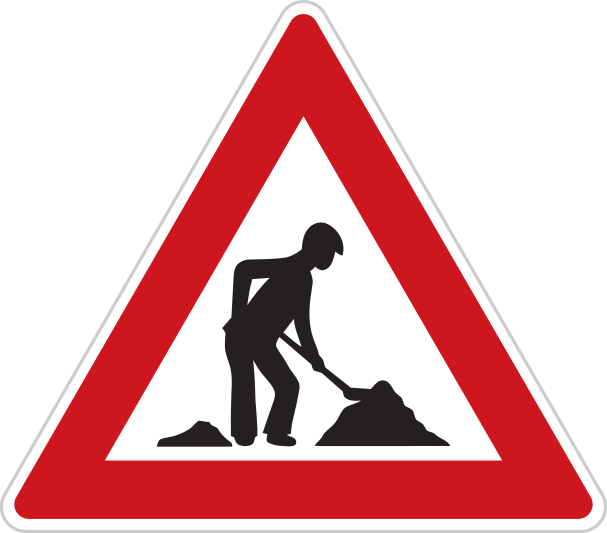 Warning for roadworks.
English • Traffic sign A 15 • Roadworks. The sign warns of work on or immediately beside the road that could endanger road traffic or expose the workers carrying it out to danger from traffic.
Čeština • Dopravní značka A 15 • Práce na silnici. Značka upozorňuje na práci na pozemní komunikaci nebo v jejím bezprostředním okolí, která by mohla ohrozit bezpečnost provozu na pozemních komunikacích nebo při níž by mohli být provozem ohroženi pracovníci tuto činnost vykonávající.
Sources
🔗 Commons.wikimedia.org • 🔗
🔗 E-sbirka.gov.cz • Vyhláška č. 294/2015 Sb. • A 15 • znění účinné od 1. 7. 2025
SVG source: Ministerstvo dopravy a spojů České republiky • Public domain • Original revision 2011-10-25. Wikimedia original unmodified.
35. Height limit
A height limit prohibits vehicles whose total height exceeds the value shown from entering or passing a road section, bridge, tunnel, gateway or other structure. The vehicle’s height includes its load and any equipment attached above it.
Drivers of high vehicles must know their exact height, observe advance warnings and use an alternative route when necessary. They should never rely only on visual judgement or attempt to pass beneath a structure when safe clearance is uncertain.
Wikimedia.org • ŠJů • CC BY
How should you read a low-bridge height restriction in Czechia?
Look for the locally prescribed height restriction or clearance warning near town-centre streets and rail bridges. The displayed clearance is normally in metres. A warning may describe a hazard ahead; a prohibitory sign indicates a route you cannot enter if your vehicle exceeds the limit.
🔗 e-sbirka.gov.cz • Czechia, Road Traffic Act 361/2000 — sections 4, 18; Decree Annex 3 B4, B13–B17
🔗 e-sbirka.gov.cz • Czechia, Decree 294/2015 — current sign and marking descriptions, annexes 1–10
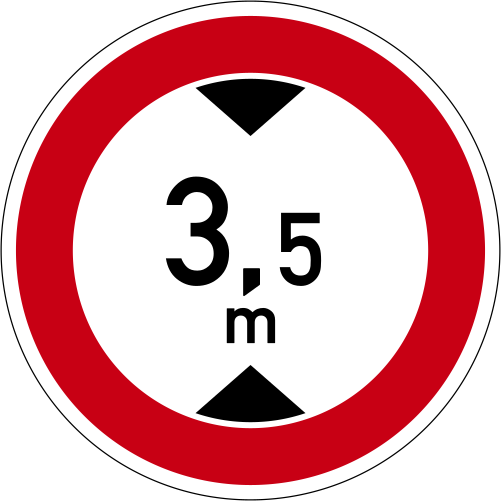 Vehicles higher than indicated prohibited.
English • Traffic sign B 16 • No vehicles higher than the indicated limit. The sign prohibits entry by vehicles whose actual height, including their load, exceeds the value shown.
Čeština • Dopravní značka B 16 • Zákaz vjezdu vozidel, jejichž výška přesahuje vyznačenou mez. Značka zakazuje vjezd vozidel, jejichž okamžitá výška včetně nákladu je vyšší než údaj uvedený na značce.
Sources
🔗 Commons.wikimedia.org • 🔗
🔗 E-sbirka.gov.cz • Vyhláška č. 294/2015 Sb. • B 16 • znění účinné od 1. 7. 2025
SVG source: มองโกเลีย๔๔ • Public domain • Original revision 2026-05-23. Wikimedia original unmodified.
Artwork verified against E-sbirka.gov.cz • official published diagram B 16.
Does a roof load count when checking vehicle height in Czechia?
Yes for practical clearance: measure the vehicle at its highest point with its load and fitted accessories, such as a roof box, bicycle or roof rack. Check the local legal measurement rules as well; an empty vehicle’s registered height is not enough when equipment has been added.
🔗 e-sbirka.gov.cz • Czechia, Road Traffic Act 361/2000 — sections 4, 18; Decree Annex 3 B4, B13–B17
🔗 e-sbirka.gov.cz • Czechia, Decree 294/2015 — current sign and marking descriptions, annexes 1–10
What should you do if your vehicle is too high for a bridge or tunnel in Czechia?
Do not try to squeeze under the structure. Use the signed alternative route and, if you are already close to the obstruction, stop where safe and seek traffic-control assistance rather than reversing unpredictably into moving traffic.
🔗 e-sbirka.gov.cz • Czechia, Road Traffic Act 361/2000 — sections 4, 18; Decree Annex 3 B4, B13–B17
🔗 e-sbirka.gov.cz • Czechia, Decree 294/2015 — current sign and marking descriptions, annexes 1–10
36. Weight limit
A weight limit prohibits vehicles or vehicle combinations whose mass exceeds the value shown from entering or passing a road section, bridge, tunnel or other structure. Depending on local law, the restriction may concern the vehicle’s actual loaded mass, maximum authorised mass or load on an individual axle.
Drivers must know which type of mass the sign refers to and must include the vehicle, passengers, cargo and any trailer where required. A vehicle that exceeds the limit must use another suitable route.
Wikimedia.org • ŠJů • CC BY
Does every weight-limit sign measure the same kind of vehicle weight in Czechia?
Czech B13 restricts actual loaded mass. For a combination, its number applies to each vehicle separately; a supplementary Jediné vozidlo plate has its own special combined-mass rule. B14 instead restricts actual axle load, while the goods-vehicle restriction B4 uses a different vehicle-category and authorised-mass framework. Read the exact sign and plate rather than treating all mass limits alike.
🔗 e-sbirka.gov.cz • Czechia, Road Traffic Act 361/2000 — sections 4, 18; Decree Annex 3 B4, B13–B17
🔗 e-sbirka.gov.cz • Czechia, Decree 294/2015 — current sign and marking descriptions, annexes 1–10
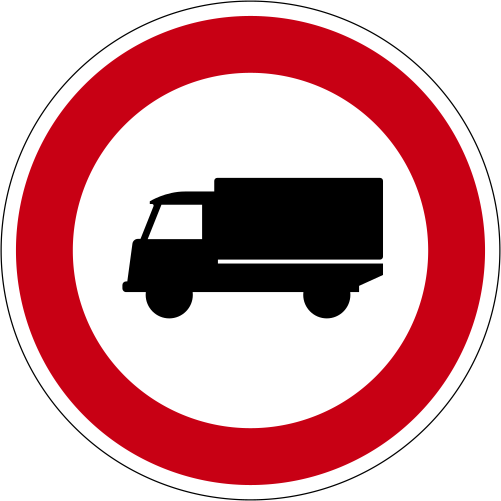 Trucks prohibited.
English • Traffic sign B 4 • No lorries. The sign prohibits entry by lorries and special-purpose vehicles. It also prohibits tractors whose maximum authorised mass exceeds 3500 kg and whose design speed is 80 km/h or more. It does not apply to motor caravans. If a maximum authorised mass is shown on a supplementary plate or below the lorry symbol on the sign, the prohibition applies to vehicles whose maximum authorised mass exceeds that value. For vehicle combinations, the sum of the maximum authorised masses of all vehicles in the combination is decisive.
Čeština • Dopravní značka B 4 • Zákaz vjezdu nákladních automobilů. Značka zakazuje vjezd nákladním automobilům a vozidlům zvláštního určení. Značka rovněž zakazuje vjezd traktorům, jejichž největší povolená hmotnost převyšuje 3500 kg a jejichž konstrukční rychlost je 80 km.h-1 nebo více. Značka neplatí pro obytné automobily. Je-li na dodatkové tabulce nebo na značce pod symbolem nákladního automobilu uvedena hodnota největší povolené hmotnosti, platí značka pro vozidla o největší povolené hmotnosti převyšující tuto hodnotu. U jízdní soupravy je rozhodný součet největších povolených hmotností všech vozidel soupravy.
Sources
🔗 Commons.wikimedia.org • 🔗
🔗 E-sbirka.gov.cz • Vyhláška č. 294/2015 Sb. • B 4 • znění účinné od 1. 7. 2025
SVG source: มองโกเลีย๔๔ • CC0 • Original revision 2026-05-20. Wikimedia original unmodified.
Artwork verified against E-sbirka.gov.cz • official published diagram B 4.
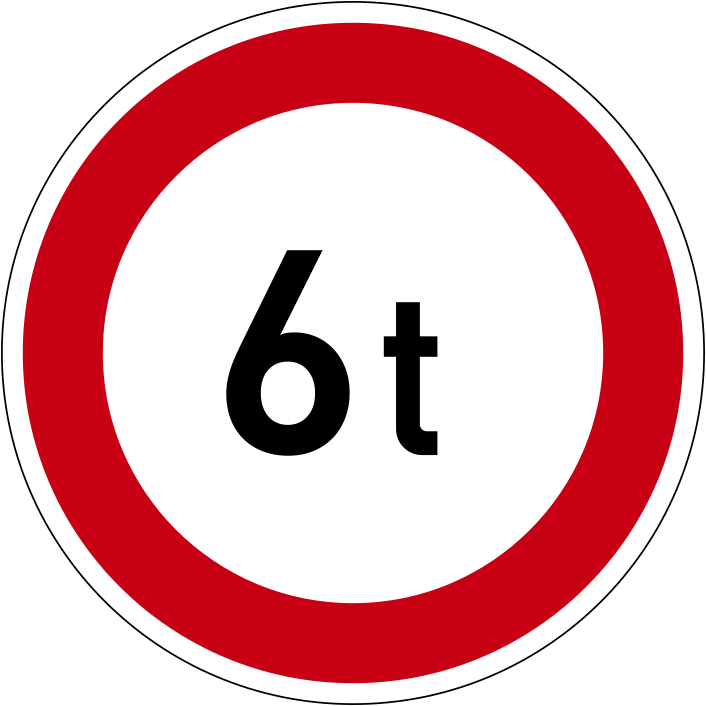 Vehicles heavier than indicated prohibited.
English • Traffic sign B 13 • No vehicles whose actual mass exceeds the indicated limit. The sign prohibits entry by vehicles whose actual mass exceeds the value shown. For a vehicle combination, the value applies separately to each vehicle in the combination. If a supplementary plate reads “Single vehicle ... t”, a vehicle may enter the section if its actual mass, or the combined actual mass of all vehicles in a combination, exceeds the value on the main sign but not the value on the supplementary plate.
Čeština • Dopravní značka B 13 • Zákaz vjezdu vozidel, jejichž okamžitá hmotnost přesahuje vyznačenou mez. Značka zakazuje vjezd vozidel, jejichž okamžitá hmotnost přesahuje údaj uvedený na značce. Jde-li o jízdní soupravu, vztahuje se tento údaj na každé vozidlo soupravy zvlášť. V případě, že je značka doplněna dodatkovou tabulkou s nápisem „Jediné vozidlo ... t“, smí do takto označeného úseku vjet vozidlo, jehož okamžitá hmotnost, a jde-li o jízdní soupravu, okamžitá hmotnost všech vozidel soupravy, sice přesahuje údaj na značce, nikoli však údaj na dodatkové tabulce.
Sources
🔗 Commons.wikimedia.org • 🔗
🔗 E-sbirka.gov.cz • Vyhláška č. 294/2015 Sb. • B 13 • znění účinné od 1. 7. 2025
SVG source: มองโกเลีย๔๔ • Public domain • Original revision 2026-05-19. Wikimedia original unmodified.
Artwork verified against E-sbirka.gov.cz • official published diagram B 13.
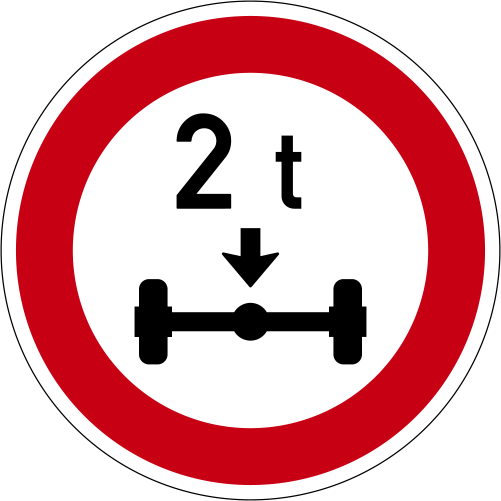 Vehicles exceeding the axle-load limit prohibited.
English • Traffic sign B 14 • No vehicles whose actual axle load exceeds the indicated limit. The sign prohibits entry by vehicles whose actual mass borne by an axle exceeds the value shown.
Čeština • Dopravní značka B 14 • Zákaz vjezdu vozidel, jejichž okamžitá hmotnost připadající na nápravu přesahuje vyznačenou mez. Značka zakazuje vjezd vozidel, jejichž okamžitá hmotnost připadající na nápravu přesahuje údaj uvedený na značce.
Sources
🔗 Commons.wikimedia.org • 🔗
🔗 E-sbirka.gov.cz • Vyhláška č. 294/2015 Sb. • B 14 • znění účinné od 1. 7. 2025
SVG source: มองโกเลีย๔๔ • Public domain • Original revision 2026-05-27. Wikimedia original unmodified.
Artwork verified against E-sbirka.gov.cz • official published diagram B 14.
Do cargo and trailers matter for a posted weight restriction in Czechia?
Yes, whenever the rule is based on actual loaded mass or the total mass of a combination. Cargo, passengers and the trailer affect that figure; weight on individual axles may be limited separately. If the sign instead uses authorised maximum mass, an empty vehicle may still be prohibited.
🔗 e-sbirka.gov.cz • Czechia, Road Traffic Act 361/2000 — sections 4, 18; Decree Annex 3 B4, B13–B17
🔗 e-sbirka.gov.cz • Czechia, Decree 294/2015 — current sign and marking descriptions, annexes 1–10
What should you do if your vehicle exceeds a bridge weight limit in Czechia?
Do not drive onto the bridge. Follow the signed alternative route and check the vehicle’s gross and axle loads as applicable. A general heavy-vehicle permit does not automatically authorise crossing every restricted bridge.
🔗 e-sbirka.gov.cz • Czechia, Road Traffic Act 361/2000 — sections 4, 18; Decree Annex 3 B4, B13–B17
🔗 e-sbirka.gov.cz • Czechia, Decree 294/2015 — current sign and marking descriptions, annexes 1–10
37. Radar speed sign
A radar speed sign warns drivers that vehicle speeds may be monitored by a fixed camera, mobile radar, lidar or average-speed enforcement system. It reminds drivers to check and respect the applicable speed limit.
The sign does not normally establish the speed limit itself. Drivers must follow the general, posted or variable speed limit applying to the road and must not brake suddenly merely because speed enforcement is indicated.

Wikimedia.org • ŠJů • CC BY-SA
What should a driver understand from a radar or speed-camera warning in Czechia?
It is an indication that speed may be checked or monitored at a point or along a section. Speed monitoring may use different equipment and signs, and any legal obligation to warn drivers depends on the authority and applicable law. It is not, by itself, a new numerical speed limit.
🔗 mze.gov.cz • Czech Act section 18 — safe speed and actual legal limits
🔗 mze.gov.cz • Czech Act section 27 — prohibited stopping/parking
🔗 mze.gov.cz • Czech Act section 79a — authorised speed measurement
Which speed limit applies when a radar warning is displayed in Czechia?
Follow the speed-limit sign, applicable speed zone or statutory road and vehicle limit. A camera symbol or enforcement notice must not be mistaken for a sign raising or ending that limit.
🔗 mze.gov.cz • Czech Act section 18 — safe speed and actual legal limits
🔗 mze.gov.cz • Czech Act section 27 — prohibited stopping/parking
🔗 mze.gov.cz • Czech Act section 79a — authorised speed measurement
Should you brake abruptly when you notice a radar sign in Czechia?
No. Adjust to the lawful and safe speed smoothly, leaving adequate space behind and ahead. Enforcement information does not authorise sudden unsafe manoeuvres or stopping to inspect the camera.
🔗 mze.gov.cz • Czech Act section 18 — safe speed and actual legal limits
🔗 mze.gov.cz • Czech Act section 27 — prohibited stopping/parking
🔗 mze.gov.cz • Czech Act section 79a — authorised speed measurement
38. Selective barriers
Selective barriers are physical access-control devices that allow certain road users or authorised vehicles to pass while restricting other traffic. They may include fixed, removable, folding or retractable bollards, gates, barriers and width-filtering installations.
The permitted users are determined by traffic signs, access conditions and local regulations, not by the barrier alone. Drivers should approach slowly, verify that they are authorised and wait until any moving barrier is fully open or retracted before continuing.

Wikimedia.org • ŠJů • CC BY-SA
What does a selective barrier control in Czechia?
A bollard, gate, bus filter or other physical access-control device can admit some users and exclude others. It is not a universal traffic-sign category. In Czechia, the relevant sign or local traffic order must be checked.
🔗 mze.gov.cz • Czech Act section 18 — safe speed and actual legal limits
🔗 mze.gov.cz • Czech Act section 27 — prohibited stopping/parking
May a cyclist or motorcycle rider use a gap beside a selective barrier in Czechia?
Only if the applicable access rule permits that road user and the opening is safe and intended for them. A gap designed for pedestrians or cyclists is not permission for an unauthorised motorcycle or car.
🔗 mze.gov.cz • Czech Act section 18 — safe speed and actual legal limits
🔗 mze.gov.cz • Czech Act section 27 — prohibited stopping/parking
Can you drive through a movable barrier while it is opening in Czechia?
Wait until the barrier is fully open or lowered and a permitted signal or authorisation allows movement. Do not follow an authorised bus or emergency vehicle through a closing gate.
🔗 mze.gov.cz • Czech Act section 18 — safe speed and actual legal limits
🔗 mze.gov.cz • Czech Act section 27 — prohibited stopping/parking
39. Priority at the next junction
Priority at the next junction means that drivers travelling on a particular road have priority over traffic entering from intersecting roads at the next junction. The priority arrangement is normally indicated by signs facing both the priority traffic and the traffic that must give way.
Unlike a continuing priority road, this priority applies only at the indicated intersection. Drivers must still approach cautiously and obey traffic lights, authorised officers, crossings, turning rules and other applicable signs.

Wikimedia.org • Janmanak • CC BY-SA
How is priority at the next junction determined in Czechia?
Czech priority signs P1–P6 apply to the next junction under Decree Section 3(5). P2 identifies the main road there, including within a large or complex junction; P3 announces that the road will no longer be the main road at the next junction. Check each junction’s signs and any route diagram, and obey traffic signals and the ordinary priority rules where applicable.
🔗 e-sbirka.gov.cz • Czechia, Decree 294/2015 — current sign and marking descriptions, annexes 1–10
 Stop and give way.
English • Traffic sign P 6 • Stop and give way! The sign requires the driver to stop where there is an adequate view of the junction and give way. It may also be used within a large or complex junction. It is also used before a level crossing together with a crossbuck when drivers must be instructed to stop.
Čeština • Dopravní značka P 6 • Stůj, dej přednost v jízdě! Značka přikazuje řidiči zastavit vozidlo na takovém místě, odkud má do křižovatky náležitý rozhled, a dát přednost v jízdě. Značku lze použít i uvnitř větší nebo složitější křižovatky. Značka se používá také před železničním přejezdem v kombinaci s výstražným křížem v případě, kdy je nutno přikázat řidiči zastavení vozidla.
Sources
🔗 Commons.wikimedia.org • 🔗
🔗 E-sbirka.gov.cz • Vyhláška č. 294/2015 Sb. • P 6 • znění účinné od 1. 7. 2025
SVG source: Government of the Czech Republic • Public domain • Original revision 2022-07-28. Wikimedia original unmodified.
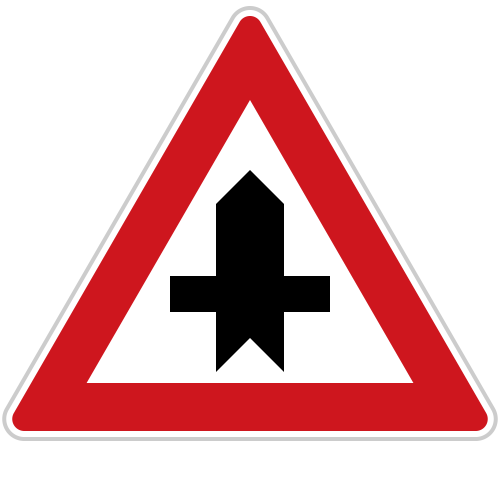 Priority at the junction.
English • Traffic sign P 1 • Junction with a minor road. Outside built-up areas, the sign warns of a junction and identifies the priority road. It may show only a left junction, right junction, oblique left junction, oblique right junction or a combination of these. At a more complex junction or where the priority road does not continue straight ahead, an appropriate supplementary plate showing the junction layout is placed below the sign.
Čeština • Dopravní značka P 1 • Křižovatka s vedlejší pozemní komunikací. Značka upozorňuje mimo obec na křižovatku a označuje hlavní pozemní komunikaci. Na značce může být znázorněno i jen levé připojení , pravé připojení , levé šikmé připojení , pravé šikmé připojení nebo jejich kombinace. V případě složitější křižovatky nebo křižovatky, kde hlavní pozemní komunikace neprobíhá v přímém směru, se pod touto značkou použije příslušná dodatková tabulka s vyznačením tvaru křižovatky.
Sources
🔗 Commons.wikimedia.org • 🔗
🔗 E-sbirka.gov.cz • Vyhláška č. 294/2015 Sb. • P 1 • znění účinné od 1. 7. 2025
SVG source: Ministerstvo dopravy a spojů České republiky • Public domain • Original revision 2011-10-18. Wikimedia original unmodified.
Artwork verified against E-sbirka.gov.cz • official published diagram P 1.
Does priority at one junction automatically continue along the entire road in Czechia?
Czech priority signs P1–P6 apply to the next junction under Decree Section 3(5). P2 identifies the main road there, including within a large or complex junction; P3 announces that the road will no longer be the main road at the next junction. Check each junction’s signs and any route diagram, and obey traffic signals and the ordinary priority rules where applicable.
🔗 e-sbirka.gov.cz • Czechia, Decree 294/2015 — current sign and marking descriptions, annexes 1–10
Stop and give way.
English • Traffic sign P 6 • Stop and give way! The sign requires the driver to stop where there is an adequate view of the junction and give way. It may also be used within a large or complex junction. It is also used before a level crossing together with a crossbuck when drivers must be instructed to stop.
Čeština • Dopravní značka P 6 • Stůj, dej přednost v jízdě! Značka přikazuje řidiči zastavit vozidlo na takovém místě, odkud má do křižovatky náležitý rozhled, a dát přednost v jízdě. Značku lze použít i uvnitř větší nebo složitější křižovatky. Značka se používá také před železničním přejezdem v kombinaci s výstražným křížem v případě, kdy je nutno přikázat řidiči zastavení vozidla.
Sources
🔗 Commons.wikimedia.org • 🔗
🔗 E-sbirka.gov.cz • Vyhláška č. 294/2015 Sb. • P 6 • znění účinné od 1. 7. 2025
SVG source: Government of the Czech Republic • Public domain • Original revision 2022-07-28. Wikimedia original unmodified.
Priority at the junction.
English • Traffic sign P 1 • Junction with a minor road. Outside built-up areas, the sign warns of a junction and identifies the priority road. It may show only a left junction, right junction, oblique left junction, oblique right junction or a combination of these. At a more complex junction or where the priority road does not continue straight ahead, an appropriate supplementary plate showing the junction layout is placed below the sign.
Čeština • Dopravní značka P 1 • Křižovatka s vedlejší pozemní komunikací. Značka upozorňuje mimo obec na křižovatku a označuje hlavní pozemní komunikaci. Na značce může být znázorněno i jen levé připojení , pravé připojení , levé šikmé připojení , pravé šikmé připojení nebo jejich kombinace. V případě složitější křižovatky nebo křižovatky, kde hlavní pozemní komunikace neprobíhá v přímém směru, se pod touto značkou použije příslušná dodatková tabulka s vyznačením tvaru křižovatky.
Sources
🔗 Commons.wikimedia.org • 🔗
🔗 E-sbirka.gov.cz • Vyhláška č. 294/2015 Sb. • P 1 • znění účinné od 1. 7. 2025
SVG source: Ministerstvo dopravy a spojů České republiky • Public domain • Original revision 2011-10-18. Wikimedia original unmodified.
Artwork verified against E-sbirka.gov.cz • official published diagram P 1.
May a driver with priority ignore pedestrians or another safety obligation at the next junction in Czechia?
No. Junction priority does not cancel duties towards pedestrians, traffic signals, emergency vehicles or other road users where the law gives them precedence. Approach at a speed allowing you to stop safely.
🔗 e-sbirka.gov.cz • Czechia, Decree 294/2015 — current sign and marking descriptions, annexes 1–10
40. Traffic lights
Traffic lights use coloured lights, arrows or symbols to regulate when road users may proceed, must prepare to stop or must remain stopped. Separate signals may apply to particular directions, lanes, pedestrians, cyclists or public-transport vehicles.
A green light permits movement only when the route is clear and the movement is otherwise legal. Road users must still follow priority rules, turning restrictions, lane markings and instructions from authorised traffic controllers.

Wikimedia.org • ŠJů • CC BY
What must a driver do at red, amber and green signals in Czechia?
Red means stop at the applicable line. Amber generally warns that the signal is changing and calls for a stop where it can be made safely; do not accelerate to beat it. Green allows movement only when the way is clear. Observe local arrow, flashing-signal and stop-line rules.
🔗 mze.gov.cz • Czechia, Road Traffic Act section 70(2)(a)-(g)
May you turn at a red traffic light in Czechia?
A red signal alone means stop. If a supplementary green arrow is lit with the red or amber signal, you may proceed only in the arrow’s direction. Give way to traffic moving in the permitted directions, and do not endanger or obstruct crossing pedestrians. An empty junction alone does not authorise a red-light turn.
🔗 mze.gov.cz • Czechia, Road Traffic Act section 70(2)(a)-(g)
Can a green light remove the need to give way to pedestrians in Czechia?
No. A green signal is not a guarantee that the junction is empty. Check for people already crossing, vehicles completing a movement and any separate pedestrian, bicycle or turning signals. Do not enter if you cannot clear the junction safely.
🔗 mze.gov.cz • Czechia, Road Traffic Act section 70(2)(a)-(g)
41. Traffic lights warning
A traffic lights warning is a warning sign that alerts drivers that traffic signals are located ahead. It is commonly used where the signals may be unexpected, difficult to see from a distance or located on a road where drivers need additional time to prepare to stop.
Drivers approaching a traffic lights warning should reduce speed when necessary, watch for the signals ahead and be prepared to stop if the traffic light changes or traffic is waiting at the intersection.

Wikimedia.org • ŠJů • CC BY-SA
How are traffic lights ahead warned of in Czechia?
The warning-sign system commonly uses a red-bordered triangular sign with a traffic-light symbol. The precise design and placement depend on the national traffic-sign schedule. This warns of a signal ahead; it is not itself a red traffic light.
🔗 e-sbirka.gov.cz • Czechia, Decree 294/2015 — current sign and marking descriptions, annexes 1–10
Does a traffic-lights-ahead warning require an immediate stop in Czechia?
No. A warning sign is not an automatic STOP instruction and does not create a new numerical speed limit. Reduce speed when necessary, look for a queue or a concealed signal, and obey the traffic lights and any separate speed or stop signs.
🔗 e-sbirka.gov.cz • Czechia, Decree 294/2015 — current sign and marking descriptions, annexes 1–10
What should you check if the next traffic lights are difficult to see in Czechia?
Allow enough distance to stop before the marked line, watch for vehicles braking suddenly and be ready for a pedestrian or cyclist crossing. If the signals are out of order or flashing, follow the applicable local failure and priority rules rather than guessing from the warning sign.
🔗 e-sbirka.gov.cz • Czechia, Decree 294/2015 — current sign and marking descriptions, annexes 1–10
42. Pedestrian lights
Pedestrian lights are traffic signals that regulate when pedestrians may begin crossing a road. They normally display a red standing figure to prohibit starting and a green walking figure to permit crossing.
A flashing signal or countdown may warn that the permitted crossing period is ending. Pedestrians should cross without unnecessary delay, while turning drivers must remain alert and allow pedestrians who entered lawfully to finish crossing safely.
Wikimedia.org • ŠJů • CC BY-SA
What do pedestrian traffic signals mean in Czechia?
Green permits you to start crossing; red means do not enter the carriageway. Even on green, check that approaching vehicles will actually stop. Follow the signal controlling your crossing.
🔗 besip.gov.cz • Czech Transport Ministry BESIP, crossing the road and pedestrian signals
What if the pedestrian signal changes while you are crossing in Czechia?
If the signal changes from green to red after you have entered the crossing, do not turn back. Czech Ministry of Transport guidance says to finish crossing as quickly and safely as possible.
🔗 besip.gov.cz • Czech Transport Ministry BESIP, crossing the road and pedestrian signals
May turning drivers ignore pedestrians on a signal-controlled crossing in Czechia?
No. Drivers must watch for pedestrians still on the crossing and obey the local rules on giving way when turning. A signal for vehicles does not justify driving into someone who has not yet reached a safe place.
🔗 mze.gov.cz • Czechia, Road Traffic Act section 70(2)(a)-(g)
43. Road markings
Road markings are lines, symbols, arrows, words or other markings applied to the road surface to regulate, guide or inform road users. They can separate traffic lanes and opposing directions, indicate where vehicles must stop or give way, mark pedestrian and cyclist crossings and identify areas reserved for particular road users.
Road users should observe the meaning of each road marking and combine it with the applicable traffic signs, signals and traffic rules. Colours, patterns and legal meanings can differ between countries.

Wikimedia.org • ŠJů • CC BY-SA
Which road markings are important to recognise in Czechia?
Recognise stop and give-way lines, lane-divider markings, continuous lines, directional arrows and pedestrian-crossing markings. Their colour, shape and exact legal effect come from the local traffic rules; do not assume an overseas convention applies unchanged.
🔗 e-sbirka.gov.cz • Czechia, Road Traffic Act 361/2000 — sections 4, 57, 70, 76; Decree Annexes 8–9
🔗 e-sbirka.gov.cz • Czechia, Decree 294/2015 — current sign and marking descriptions, annexes 1–10
May drivers cross a solid road line in Czechia?
Czech single solid line V1a may be crossed only where necessary to avoid an obstruction, overtake a cyclist, turn into off-road property or enter the road from such property. Double solid line V1b has only the obstruction-avoidance exception. For a mixed solid and broken line, follow the right-hand line when opposing lanes are separated, or the nearer line when lanes run in the same direction. Every manoeuvre must still be safe and otherwise lawful.
🔗 e-sbirka.gov.cz • Czechia, Road Traffic Act 361/2000 — sections 4, 57, 70, 76; Decree Annexes 8–9
🔗 e-sbirka.gov.cz • Czechia, Decree 294/2015 — current sign and marking descriptions, annexes 1–10
Can painted arrows or stop lines be ignored when signs are not obvious in Czechia?
No. Lane arrows, stop lines and give-way markings can direct where to wait or which movement a lane permits. Read them together with traffic lights, vertical signs and directions from authorised traffic controllers; temporary changes may also apply.
🔗 e-sbirka.gov.cz • Czechia, Road Traffic Act 361/2000 — sections 4, 57, 70, 76; Decree Annexes 8–9
🔗 e-sbirka.gov.cz • Czechia, Decree 294/2015 — current sign and marking descriptions, annexes 1–10
44. Junction layout
A junction layout is a schematic representation of the layout of an upcoming intersection or junction. It can show how roads branch, cross or continue and may help drivers understand which direction to follow before reaching the intersection.
Crossroad-shape diagrams are commonly used on advance direction signs. Depending on the country's sign system, the diagram may also distinguish the main road, side roads, route numbers or destinations.
Wikimedia.org • ŠJů • CC BY-SA
What can a junction-layout diagram tell you in Czechia?
Czech supplementary junction-layout panels can indicate how the priority road bends through the junction. Read the diagram with its accompanying priority or give-way sign.
🔗 e-sbirka.gov.cz • Czechia, Decree 294/2015 — current sign and marking descriptions, annexes 1–10
Does a junction-layout picture itself give priority at a junction in Czechia?
A supplementary diagram helps identify the course of the priority route, but its meaning depends on the accompanying priority sign and local rules. It does not cancel traffic signals or obligations to drive safely.
🔗 e-sbirka.gov.cz • Czechia, Decree 294/2015 — current sign and marking descriptions, annexes 1–10
Should the drawing be treated as an exact map of the junction in Czechia?
No. A schematic diagram can omit islands, turning lanes, cycle facilities and minor road details. Slow down, check the actual road layout, and follow lane arrows, signs and signals when you reach the intersection.
🔗 e-sbirka.gov.cz • Czechia, Decree 294/2015 — current sign and marking descriptions, annexes 1–10
45. Bike box
A bike box, also called an advanced stop area, is a marked space at a signal-controlled intersection where cyclists can wait ahead of motor vehicles while the traffic light is red. It is usually positioned between two stop lines and may display a bicycle symbol.
A bike box helps increase cyclist visibility and allows cyclists to position themselves clearly before traffic starts moving. The exact users, markings and traffic-light rules vary between countries.

Wikimedia.org • Petr Vilgus • CC BY-SA
What is a bike box or advanced stop area in Czechia?
Czech national marking V19, Prostor pro cyklisty, designates space for cyclists waiting for the green signal. Section 57 also addresses use of a provided cycle waiting space in the relevant direction, with its safety and traffic-flow exception. Motorists must respect the marked waiting area and their applicable stop line; the facility gives no permission to cross a red signal.
🔗 e-sbirka.gov.cz • Czechia, Road Traffic Act 361/2000 — sections 4, 57, 70, 76; Decree Annexes 8–9
🔗 e-sbirka.gov.cz • Czechia, Decree 294/2015 — current sign and marking descriptions, annexes 1–10
Where should a car wait when a marked bike box has a red light in Czechia?
Where the box is reserved for cyclists, stop at the motor-vehicle stop line before the box when the signal requires a stop. Follow any separate vehicle-category signals, local exceptions and direction from a traffic officer.
🔗 e-sbirka.gov.cz • Czechia, Road Traffic Act 361/2000 — sections 4, 57, 70, 76; Decree Annexes 8–9
🔗 e-sbirka.gov.cz • Czechia, Decree 294/2015 — current sign and marking descriptions, annexes 1–10
Does a bike box let cyclists ignore a red signal in Czechia?
No. A bike box is a positioning facility, not a general exemption from red traffic lights. Cyclists must obey their applicable lights and any specially authorised turn indications. Turning drivers must check for cyclists moving off when signals change.
🔗 e-sbirka.gov.cz • Czechia, Road Traffic Act 361/2000 — sections 4, 57, 70, 76; Decree Annexes 8–9
🔗 e-sbirka.gov.cz • Czechia, Decree 294/2015 — current sign and marking descriptions, annexes 1–10
46. Speed feedback
Speed feedback is a traffic-safety system that measures an approaching vehicle's speed and displays it back to the driver. The display may show the measured speed together with a message, colour or symbol indicating whether the vehicle is travelling within the applicable speed limit.
Speed feedback displays are intended primarily to make drivers aware of their speed and encourage them to slow down when necessary. They normally serve a preventive or educational purpose rather than establishing a new speed limit.

Wikimedia.org • Aktron • CC BY
What does a speed-feedback display show drivers in Czechia?
A roadside display may detect an approaching vehicle and show its measured speed in km/h, sometimes with a smiley, flashing message or warning colour. It is a driver-awareness device; its exact design and deployment depend on the road authority.
🔗 mze.gov.cz • National law — actual speed limits and safe driving duties
Does the number on a speed-feedback board set the legal speed limit in Czechia?
Normally no. A reading showing your measured speed is not itself a new regulatory limit. The limit comes from applicable laws and legally prescribed fixed or variable speed-limit signs; a separate enforceable speed sign must still be obeyed.
🔗 mze.gov.cz • National law — actual speed limits and safe driving duties
Is every speed-feedback board an enforcement camera in Czechia?
Not necessarily. A board showing your measured speed provides feedback; its presence does not establish whether an enforcement system is also operating. Follow the applicable legal speed limit and do not assume that the absence of an obvious camera means there is no enforcement.
🔗 mze.gov.cz • National law — actual speed limits and safe driving duties
47. Location marker
A location marker is a roadside reference showing a measured position along a road. It normally identifies a kilometre, mile or smaller interval measured from an established starting point on that route.
Kilometre and hectometre markers help road users, emergency services, road authorities and maintenance crews identify an exact section of road. They do not impose a speed limit, priority rule or access restriction.

Wikimedia.org • Raimond Spekking • CC BY-SA
What does a roadside location marker tell you in Czechia?
Czech IS18a and IS18b kilometre markers identify the distance from the beginning of the road. They may also identify the side of a divided road. IS18b includes an arrow towards the nearest emergency call point. These are road-position references, rather than distances to your destination.
🔗 e-sbirka.gov.cz • Czechia, Decree 294/2015 — current sign and marking descriptions, annexes 1–10
How can a location marker help in an emergency in Czechia?
If you can see a marker safely, give the emergency operator the route number or road name, travel direction and marker reading. Additional landmarks, exits and GPS position can help. Do not leave a safe place or enter traffic to read a post.
🔗 hzscr.gov.cz • Czech fire/rescue service June2026 emergency location guidance
Does a location marker set a speed limit or permit stopping in Czechia?
No. A location marker is for orientation and road management; it does not itself set a speed limit, change priority or permit parking. Follow the actual traffic signs and stop only where the law and safety allow.
🔗 e-sbirka.gov.cz • Czechia, Decree 294/2015 — current sign and marking descriptions, annexes 1–10
48. Countdown markers
Countdown markers are a sequence of roadside signs that indicate that a particular point, such as a motorway exit, junction or railway crossing, is getting closer. They commonly use a decreasing number of bars or other symbols so drivers can judge their progress toward the upcoming location.
The markers are normally positioned at successively shorter distances from the point ahead. Their design, spacing and meaning vary between countries, so drivers should not assume that each bar always represents the same distance.

Wikimedia.org • ŠJů • CC BY
What do countdown or exit-approach markers mean in Czechia?
Czech motorway signs may use advance warning and distance boards for exits and junctions.
🔗 e-sbirka.gov.cz • Czechia, Road Traffic Act 361/2000 — sections 4, 18, 22, 35–38; Decree Annex 5
🔗 e-sbirka.gov.cz • Czechia, Decree 294/2015 — current sign and marking descriptions, annexes 1–10
Does each countdown bar always represent the same distance in Czechia?
No universal distance can be assumed. Follow the local sign standard and any printed distance; bars used for an exit may not have the same spacing or function as markers approaching a railway crossing.
🔗 e-sbirka.gov.cz • Czechia, Road Traffic Act 361/2000 — sections 4, 18, 22, 35–38; Decree Annex 5
🔗 e-sbirka.gov.cz • Czechia, Decree 294/2015 — current sign and marking descriptions, annexes 1–10
What should you do if you are too late to take a motorway exit in Czechia?
Continue safely to the next lawful exit or junction. Do not stop, reverse, make a U-turn or cross the median to reach a missed exit. Plan lane changes early and follow any lane-control signals.
🔗 e-sbirka.gov.cz • Czechia, Road Traffic Act 361/2000 — sections 4, 18, 22, 35–38; Decree Annex 5
🔗 e-sbirka.gov.cz • Czechia, Decree 294/2015 — current sign and marking descriptions, annexes 1–10
49. Traffic mirror
A traffic mirror is a convex mirror installed near an intersection, driveway, bend or other location with restricted visibility. Its curved surface provides a wider view of approaching road users than an ordinary flat mirror.
A traffic mirror is only a visibility aid. It may distort distance, speed and direction and may be affected by darkness, weather, dirt or damage. Drivers must continue to observe the road directly, obey all priority rules and proceed only when it is safe.

Wikimedia.org • ŠJů • CC BY-SA
What is a traffic mirror?
A traffic mirror is a roadside visibility aid that can help users see around a blind corner or obstruction. It gives an indirect view, which may be restricted or distorted; it does not replace checking whether it is safe to proceed.
🔗 monmouthshire.gov.uk • Monmouthshire Council, roadside visibility mirrors
🔗 devon.gov.uk • Devon County Council, mirrors on the highway
Does a traffic mirror show an exact image?
No. The reflected image can be distorted, and glare, bad weather or dirt can restrict the view. Judging an approaching vehicle’s speed from a mirror can be difficult. Do not rely on the mirror alone.
🔗 monmouthshire.gov.uk • Monmouthshire Council, roadside visibility mirrors
🔗 devon.gov.uk • Devon County Council, mirrors on the highway
Does seeing an empty mirror mean the road is clear?
No. Another road user may be outside the reflected area, hidden by glare or too small to notice. Always check the road directly before proceeding.
🔗 monmouthshire.gov.uk • Monmouthshire Council, roadside visibility mirrors
🔗 devon.gov.uk • Devon County Council, mirrors on the highway
50. Emergency telephone
An emergency telephone is a dedicated roadside or tunnel telephone that connects road users directly with an emergency, traffic-control or roadside-assistance centre. Emergency telephones are commonly installed in tunnels, along motorways or at other locations where quickly reporting an accident, breakdown or fire is important. They can provide operators with useful information about the caller’s location and may remain available where mobile-phone reception is poor.

Wikimedia.org • ŠJů • CC BY-SA
What is an emergency telephone?
An emergency telephone is a dedicated telephone used to contact emergency services, a traffic-control centre or roadside assistance from the road.
🔗 gov.uk • Great Britain Highway Code, Rules 275–279; national guidance example
🔗 gov.uk • Great Britain Highway Code, Rules 270–274; national guidance example
Where are emergency telephones commonly found?
They are commonly installed in road tunnels, motorway emergency areas and other locations where rapid assistance may be needed.
🔗 gov.uk • Great Britain Highway Code, Rules 275–279; national guidance example
🔗 gov.uk • Great Britain Highway Code, Rules 270–274; national guidance example
When should you use an emergency telephone?
Use an emergency telephone to report situations such as a breakdown, accident, fire or other serious road emergency when assistance is required.
🔗 gov.uk • Great Britain Highway Code, Rules 275–279; national guidance example
🔗 gov.uk • Great Britain Highway Code, Rules 270–274; national guidance example