


ExpresswayDenmark
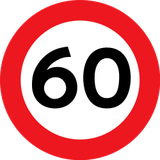 Traffic rules
 Denmark
1. Expressway
An expressway is a road intended to carry through traffic efficiently, usually at higher speeds than ordinary roads. Expressways often have limited access, multiple lanes, separated carriageways or grade-separated junctions, but their design and legal status vary between countries.
An expressway is not always a motorway. It may have intersections, traffic lights or direct access, and the permitted road users, speed limits and special rules depend on local signs and regulations.
How do people refer to an expressway in Denmark?
The Danish term is motortrafikvej. It is a road for motor traffic, separate from a motorway.
🔗 retsinformation.dk • Danish signing order BEK 425/2023 — operative sign and marking descriptions
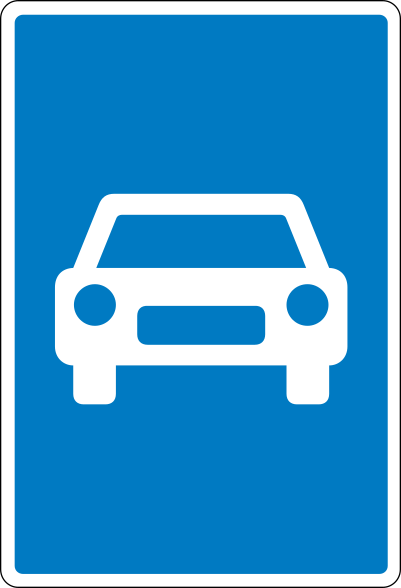 Start of an expressway.
English • Traffic sign E 43 • Expressway. Marks a section where the special expressway and expressway entry/exit-road rules apply under section 48 of the Road Traffic Act.
Dansk • Tavle E 43 • Motortrafikvej. Tavlen angiver vejstrækning, hvor de særlige regler om kørsel på motortrafikvej og til- og frakørselsveje til motortrafikvej gælder, jf. færdselslovens § 48.
Sources
🔗 Commons.wikimedia.org
🔗 Retsinformation.dk • Bekendtgørelse nr. 425/2023, § 27
SVG source: Gigillo83, drawn by original of Vejdirektoratet • Public domain • Original revision 2013-06-11. Wikimedia original unmodified.
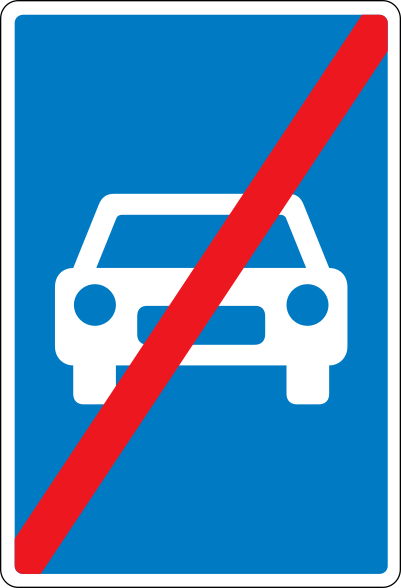 End of the expressway.
English • Traffic sign E 45 • End of expressway. Normally not used on roads crossing an expressway or where exit roads join the ordinary road network.
Dansk • Tavle E 45 • Motortrafikvej ophører. Tavlen anvendes normalt ikke på veje, der krydser motortrafikvej eller ved frakørslers tilslutning til det almindelige vejnet.
Sources
🔗 Commons.wikimedia.org
🔗 Retsinformation.dk • Bekendtgørelse nr. 425/2023, § 27
SVG source: Gigillo83, drawn by original of Vejdirektoratet • Public domain • Original revision 2013-06-11. Wikimedia original unmodified.
What speed limit applies to cars on an expressway in Denmark?
The normal car maximum on a road for motor traffic is 80 km/h. Suitable sections may be signed up to 100 km/h. The motorway maximum does not apply simply because the road has limited access.
🔗 retsinformation.dk • Danish signing order BEK 425/2023 — operative sign and marking descriptions
Who may use an expressway in Denmark?
Normally, only motor vehicles or combinations that can legally travel at at least 50 km/h on a level road may use the road and its access ramps. This is an admission condition, not a requirement to maintain that speed when unsafe.
🔗 retsinformation.dk • Danish signing order BEK 425/2023 — operative sign and marking descriptions
What should I do if I miss an expressway exit in Denmark?
Continue to the next exit and choose a safe onward route. Do not reverse, make a U-turn or cross the central reservation to reach a missed exit.
🔗 retsinformation.dk • Danish signing order BEK 425/2023 — operative sign and marking descriptions

