


ExpresswayPortugal
 Traffic rules
 Portugal
1. Expressway
An expressway is a road intended to carry through traffic efficiently, usually at higher speeds than ordinary roads. Expressways often have limited access, multiple lanes, separated carriageways or grade-separated junctions, but their design and legal status vary between countries.
An expressway is not always a motorway. It may have intersections, traffic lights or direct access, and the permitted road users, speed limits and special rules depend on local signs and regulations.
How do people refer to an expressway in Portugal?
The legal category is via reservada a automóveis e motociclos, meaning a road reserved for the legal automóvel category and motorcycles. The automóvel category includes more than passenger cars. The everyday expression via rápida should not replace checking the road’s legal designation.
🔗 pgdlisboa.pt • Portugal, Código da Estrada — articles 13, 24–28, 72–75; RST D8, H24–H25
🔗 ansr.pt • ANSR official RST — corrected 2019 republication, sign descriptions and markings
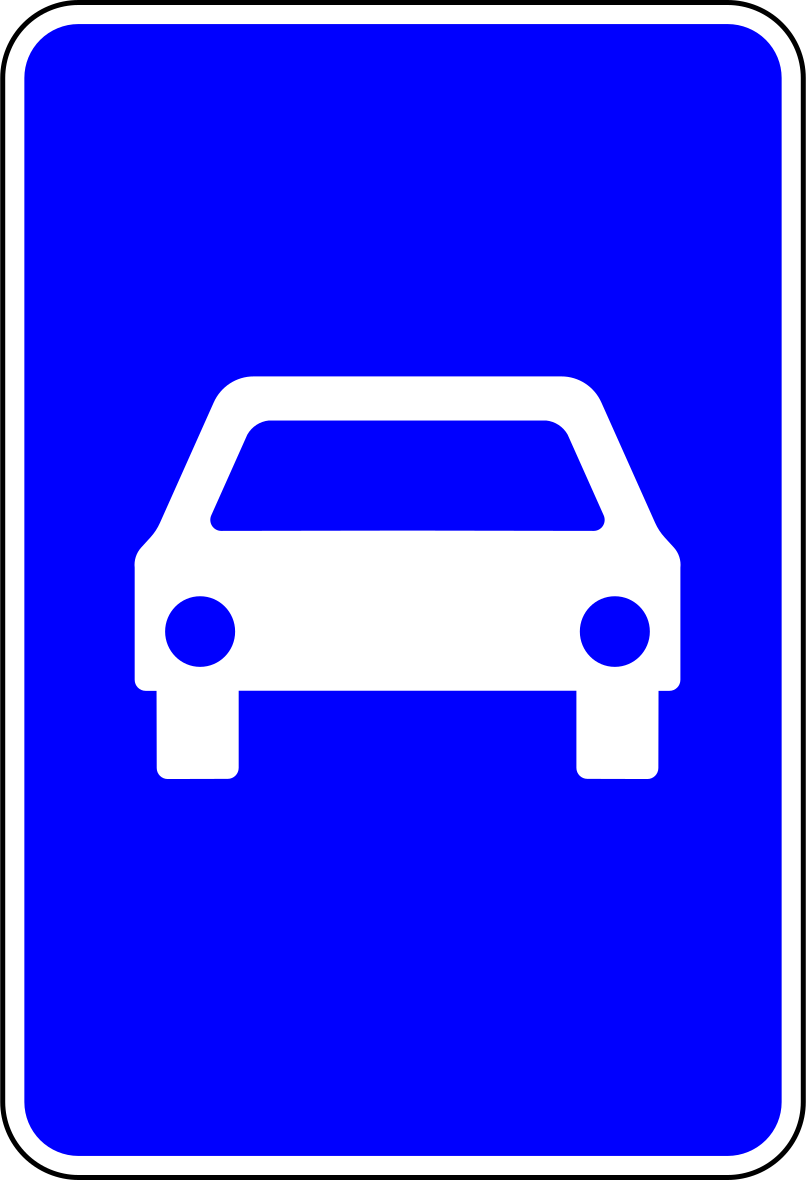 Start of an expressway.
English • Traffic sign H25 • Road reserved for motor vehicles and motorcycles. Marks entry to a reserved road, where the traffic rules specific to this road type apply.
Português • H25 • Via reservada a automóveis e motociclos. Indicação de entrada numa via reservada, vigorando na mesma, por consequência, as regras de trânsito especialmente destinadas a este tipo de vias.
Sources
🔗 Commons.wikimedia.org (Gigillo83 • CC BY-SA 4.0)
🔗 Diariodarepublica.pt • Regulamento de Sinalização do Trânsito • artigo 34.º • H25
🔗 Ansr.pt • Republicação oficial retificada • H25 • página 20
Image via Commons.wikimedia.org
Gigillo83 • CC BY-SA 4.0 • Source revision 2015-03-04. Wikimedia original unmodified.
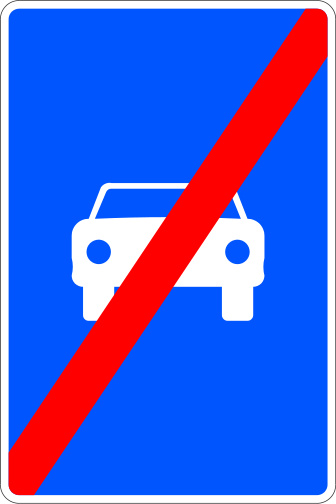 End of the expressway.
English • Traffic sign H39 • End of road reserved for motor vehicles and motorcycles. Marks the end of the reserved road.
Português • H39 • Fim de via reservada a automóveis e motociclos. Indicação de que terminou a via reservada a automóveis e motociclos.
Sources
🔗 Commons.wikimedia.org (Gigillo83 • CC BY-SA 4.0)
🔗 Diariodarepublica.pt • Regulamento de Sinalização do Trânsito • artigo 34.º • H39
🔗 Ansr.pt • Republicação oficial retificada • H39 • página 21
Replacement SVG: Commons.wikimedia.org • Wikimedia Commons original • Author not stated on source page • Public domain • Original revision 2026-01-11. Wikimedia original unmodified.
Artwork verified against Ansr.pt • official published diagram H39.
What speed limit applies to cars on an expressway in Portugal?
For an ordinary passenger car without a trailer, the general maximum is 100 km/h. Obey lower posted limits and slow down when traffic, weather or visibility requires it. Other vehicle classes can have lower limits.
🔗 pgdlisboa.pt • Portugal, Código da Estrada — articles 13, 24–28, 72–75; RST D8, H24–H25
🔗 ansr.pt • ANSR official RST — corrected 2019 republication, sign descriptions and markings
Who may use an expressway in Portugal?
The motorway access restrictions also apply to roads reserved for cars and motorcycles. Pedestrians, bicycles, mopeds, quadricycles, agricultural vehicles and certain other categories are excluded. Eligible motor vehicles must be capable and legally permitted to exceed 60 km/h.
🔗 pgdlisboa.pt • Portugal, Código da Estrada — articles 13, 24–28, 72–75; RST D8, H24–H25
🔗 ansr.pt • ANSR official RST — corrected 2019 republication, sign descriptions and markings
Who has priority when I enter a Portuguese expressway from an access ramp?
Give way to vehicles already on the road. Use the acceleration lane where provided and merge without endangering or obstructing traffic. This ramp-entry rule also applies to roads reserved for cars and motorcycles.
🔗 pgdlisboa.pt • Portugal, Código da Estrada — articles 13, 24–28, 72–75; RST D8, H24–H25
🔗 ansr.pt • ANSR official RST — corrected 2019 republication, sign descriptions and markings

