

Traffic signsWorldwide
 Traffic rules
 Worldwide
151. Ski route
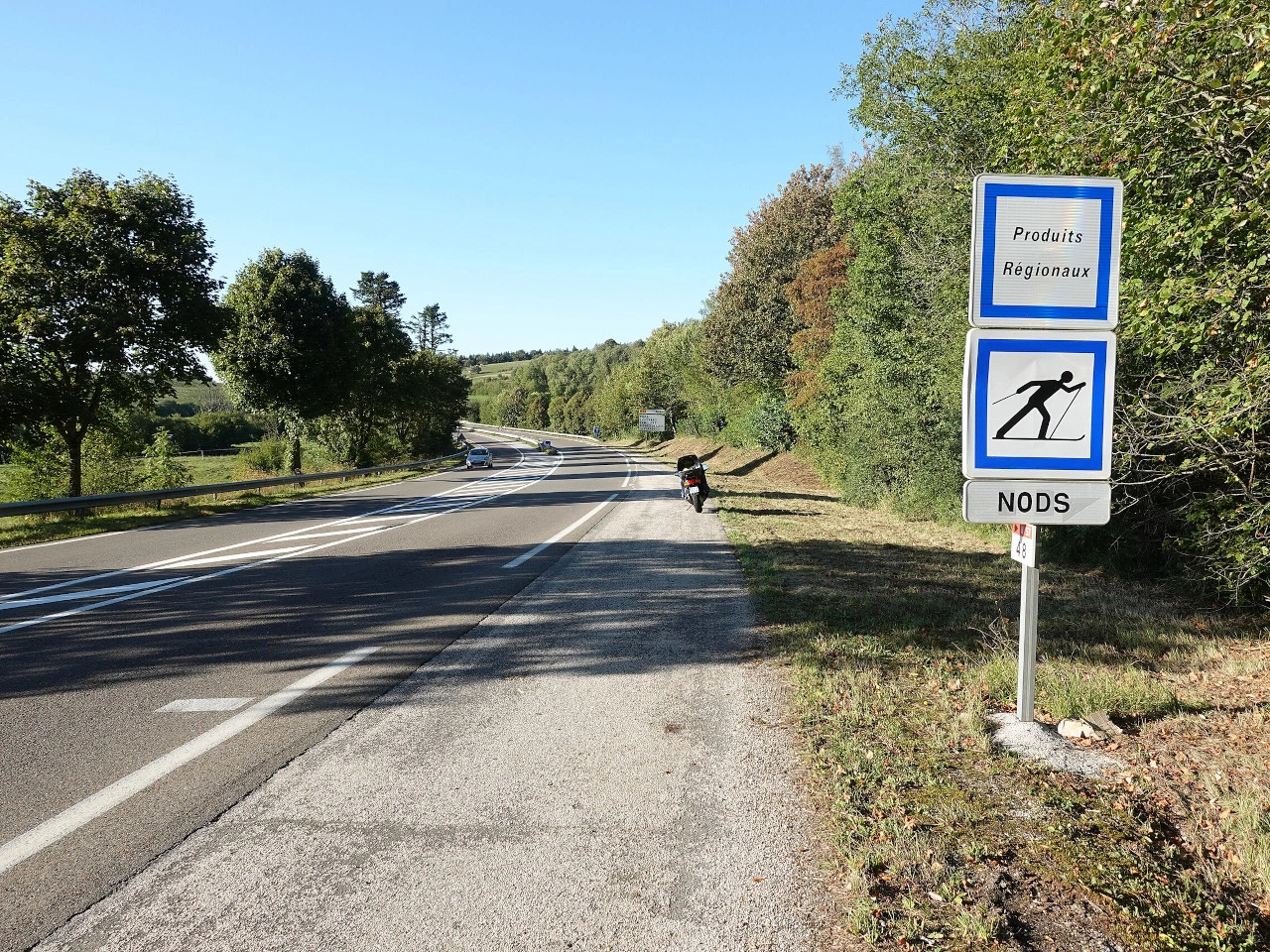
A ski route is a designated route intended for skiing, such as an alpine ski trail or cross-country skiing route. Ski routes are commonly found in winter-sports and mountain areas and may connect ski slopes, resorts, lifts or recreational trail networks.
Ski routes may be identified by coloured markers, symbols, route numbers or direction signs. Their difficulty classifications, permitted users and marking systems vary between countries and ski areas.
Wikimedia.org • Marc Mongenet • CC BY-SA
What is a ski route?
A ski route is a designated route intended for skiing, such as an alpine or cross-country skiing route.
How are ski routes marked?
They may be indicated by coloured markers, skiing symbols, arrows or route numbers. The marking system depends on the country and ski area.
Are ski-route signs traffic signs?
Not necessarily. Many ski-route markers form part of a recreational trail system rather than ordinary road-traffic regulation.

152. Winter equipment zone
A winter equipment zone is an area or section of road where vehicles may be required to use specified winter equipment because of snow, ice or other winter conditions. Required equipment can include winter tyres, snow chains or other approved traction devices, depending on the country's rules.
The beginning and end of such a zone may be indicated by traffic signs or temporary winter-condition signs. Drivers should check which vehicles are covered and whether the requirement applies permanently during a season or only when particular weather conditions exist.
Wikimedia.org • Marc Mongenet • CC BY-SA
What is a winter equipment zone?
A winter equipment zone is an area where vehicles may be required to use specified winter equipment such as winter tyres or snow chains.
What equipment can be required in a winter equipment zone?
Depending on the country and conditions, requirements may include winter tyres, snow chains or other approved traction equipment.
Does a winter equipment requirement always apply throughout winter?
Not necessarily. Some requirements apply during a fixed seasonal period, while others apply only when snow, ice or particular road conditions are present.
153. Tourist attraction
A tourist attraction is a place of interest that visitors may travel to for cultural, historical, recreational, natural or entertainment purposes. Examples include monuments, castles, museums, scenic sites, amusement parks and other notable destinations.
Tourist attractions may be indicated by tourist or direction signs that help travellers find the destination. The colours, symbols and types of attractions shown vary between countries.
Wikimedia.org • LutzBruno • CC BY
What is a tourist attraction?
A tourist attraction is a place that visitors travel to because of its cultural, historical, natural, recreational or entertainment value.
What are examples of tourist attractions?
Examples include monuments, castles, museums, scenic locations, cultural sites, amusement parks and recreational destinations.
Can tourist attractions be indicated by road signs?
Yes. Many countries use tourist or direction signs to guide travellers toward important attractions and places of interest.
154. Viewpoint
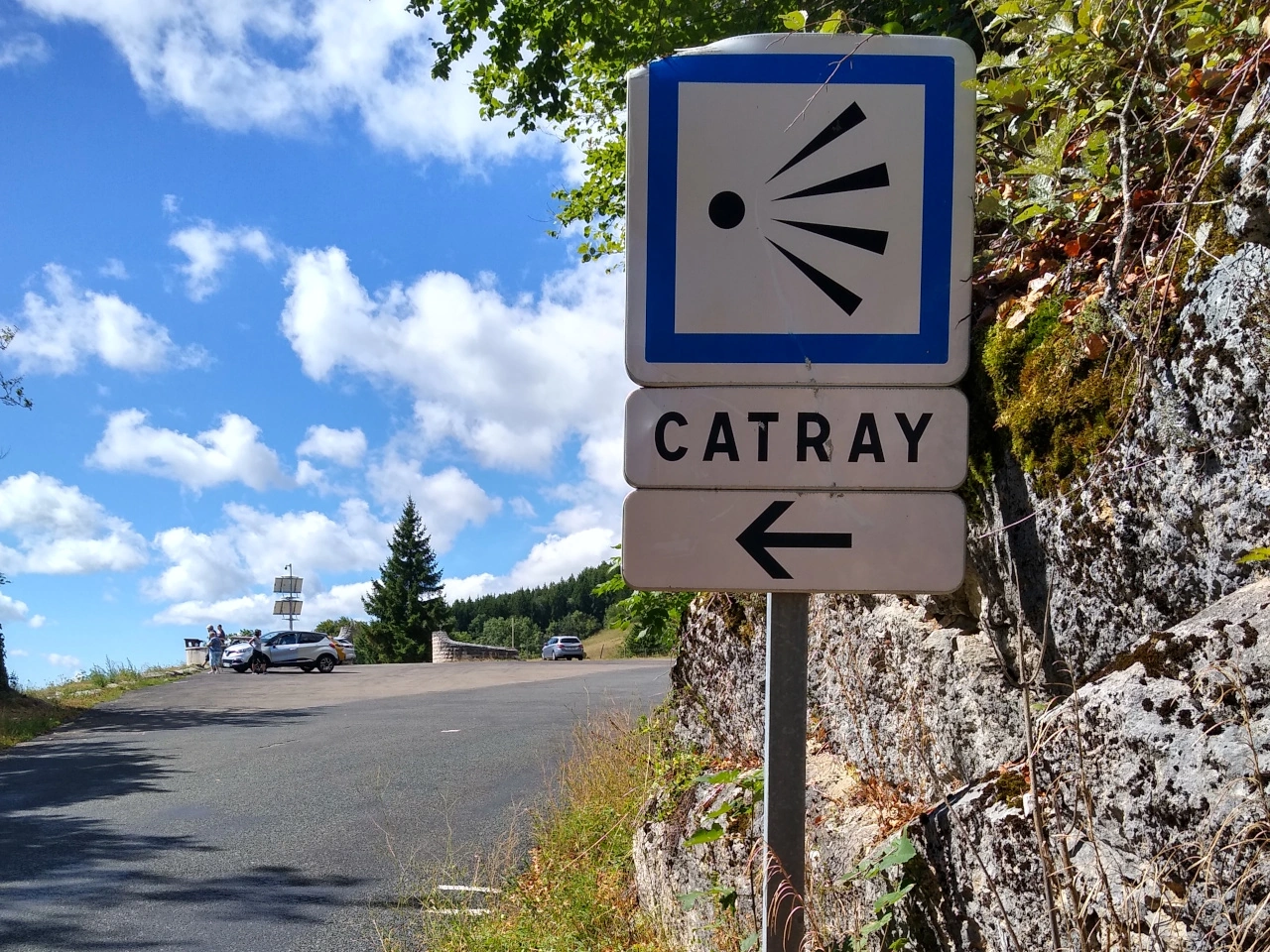
A viewpoint is a designated place where travellers can stop or visit to enjoy a scenic view of the surrounding landscape. Viewpoints are often located along mountain roads, coastal routes, river valleys or other areas of natural or cultural interest.
A viewpoint may include parking, a viewing platform, benches, information panels or other visitor facilities. Tourist or direction signs may be used to guide travellers toward the site.
Wikimedia.org • Marc Mongenet • CC BY-SA
What is a viewpoint?
A viewpoint is a designated location that provides visitors with a scenic or notable view of the surrounding landscape.
Where are viewpoints commonly located?
Viewpoints are commonly found along mountain roads, coastlines, valleys, scenic routes and other areas with notable landscapes.
Can viewpoints be indicated by road signs?
Yes. Tourist or direction signs may guide travellers toward scenic viewpoints, although the signs and symbols used vary between countries.
155. Horn
A horn is a sound-producing device used to warn other road users of danger or to attract their attention when necessary for safety. Most motor vehicles are equipped with an electric horn operated from the steering wheel. Traffic laws generally restrict unnecessary or excessive horn use, especially in built-up or residential areas. The horn should therefore be used as a warning device rather than as a way to express frustration or greet other road users.
Wikimedia.org • Marc Mongenet • CC BY-SA
What is a car horn?
A car horn is a sound-producing warning device used to alert other road users when their attention is needed for safety.
When should you use the horn?
The horn should generally be used when a sound warning is necessary to help prevent danger or an accident. The exact circumstances in which horn use is permitted depend on local traffic laws.
Can you use the horn to show annoyance?
Generally, no. A horn is intended as a safety warning device, and unnecessary or excessive use may be prohibited by local traffic rules.
Can you use the horn at night?
Rules for using the horn at night vary between countries. Some traffic laws restrict sound signals at night and require drivers to use their lights instead, except when there is immediate danger.
Can a vehicle horn be modified?
Vehicle horns may have to meet technical requirements for their sound and operation. Horns that imitate emergency-service sirens or otherwise fail applicable vehicle standards may be prohibited.
Is the horn checked during a vehicle inspection?
In countries with periodic technical inspections, the operation and condition of the horn may be checked as part of the vehicle's safety equipment.
156. Axle weight limit
An axle weight limit is the maximum permitted weight or load carried by a single axle of a vehicle. It limits how much force an axle and its wheels may transmit to the road, independently of the vehicle's total weight.
Axle weight limits help protect bridges and road surfaces from excessive loads and contribute to safe vehicle operation. A vehicle can comply with an overall weight limit while still exceeding an axle limit if its load is distributed incorrectly.
Wikimedia.org • François GOGLINS • CC BY-SA
What does an axle weight limit mean?
An axle weight limit specifies the maximum permitted load carried by an individual axle or axle group. A vehicle exceeding the indicated axle load may not use the restricted road or structure.
Is axle weight the same as total vehicle weight?
No. Total vehicle weight is the combined weight of the entire vehicle and its load, while axle weight is the portion of that weight supported by a particular axle. Both limits may apply at the same time.
Why are axle weight limits used?
They help prevent excessive stress on roads and structures such as bridges. They also ensure that vehicle loads are distributed safely between the axles.
157. Licence plate
A licence plate, also called a registration plate or number plate, is a plate displaying a unique registration identifier assigned to a vehicle by the competent registration authority. It allows the vehicle to be identified for purposes such as registration, traffic enforcement, taxation, insurance and parking control.
The appearance, format, placement and number of plates required vary between countries and vehicle categories. Drivers must ensure that required licence plates are correctly fitted, clearly visible and legible and must follow the local rules when a plate is lost, stolen, damaged or replaced.
Wikimedia.org • FrDr • CC BY-SA
What is a licence plate?
A licence plate is a plate displaying the registration identifier assigned to a vehicle. It allows authorities and other authorised systems to identify the vehicle's registration.
Is a licence plate the same as a registration plate?
Yes. Licence plate, registration plate and number plate are different terms commonly used for the plate displaying a vehicle's official registration number.
Does every vehicle need a licence plate?
Most motor vehicles used on public roads must display one or more registration plates, but requirements differ for motorcycles, trailers, agricultural vehicles and other special vehicle categories.
Do vehicles need both front and rear licence plates?
This depends on the country and vehicle type. Cars commonly require front and rear plates, while motorcycles and certain other vehicles may require only a rear plate.
Must a licence plate remain visible?
Yes. A required registration plate must normally remain clearly visible and readable. It should not be hidden by luggage, dirt, accessories or other objects.
Can you modify a licence plate?
Generally no. Changing the characters, colours, dimensions or appearance of an official plate may make it invalid or illegal. Plates and authorised reproductions must comply with local specifications.
What should you do if a licence plate is lost or stolen?
Follow the local reporting and replacement procedure. Many countries require the loss or theft to be reported to the police or vehicle-registration authority before a replacement plate can be issued.
Can you drive with a damaged licence plate?
A plate must remain legible and compliant with local requirements. If damage prevents it from being read or makes it invalid, it should be replaced according to the local registration procedure.
Can a licence plate be personalised?
Some countries allow motorists to request a personalised registration combination. The available characters, formats and prohibited combinations are determined by the registration authority.
Does a licence plate stay with the vehicle when it is sold?
This varies between countries. In some systems the plate remains with the vehicle, while in others it remains associated with the registered holder and may be retained or returned when the vehicle is sold.
158. Charging station
A charging station is a location equipped with one or more charging points where the battery of an electric or plug-in hybrid vehicle can be connected to an electricity supply and recharged. Charging stations may be located along public roads, in car parks, at service areas or on private property.
Charging spaces may be reserved for vehicles that are charging and can be subject to parking restrictions, time limits, payment requirements or other conditions. Drivers must follow the traffic signs, parking regulations and charging instructions applying at the location.
Wikimedia.org • Alexander Migl • CC BY-SA
What is a charging station?
A charging station is a location where electric vehicles can be connected to an electricity supply to recharge their batteries. A station may contain one or several individual charging points.
Who can use an electric-vehicle charging station?
Charging stations are intended for vehicles that can be externally charged, such as battery-electric vehicles and plug-in hybrid vehicles. The exact vehicle categories permitted may be indicated by local signs or operator conditions.
Is a charging space an ordinary parking space?
Not necessarily. A space beside a charger may be reserved for electric vehicles or vehicles that are charging. Drivers must check the signs and markings before parking there.
Can a petrol or diesel vehicle park at a charging station?
Not where the parking space is officially reserved for electric vehicles. An ordinary parking space located near a charger may be different, so the applicable signs and markings determine who may park there.
Can an electric vehicle park at a charging point without charging?
This depends on the local traffic and parking rules. Many charging spaces require the vehicle to be connected to the charger, even if the vehicle itself is electric.
Do you have to pay to use a charging station?
Charging may be free or subject to payment. The price and payment method are determined by the charging operator, while separate parking charges may also apply.
Can a charging station have a maximum parking time?
Yes. Traffic signs, parking regulations or charging conditions may establish a maximum duration to encourage drivers to move their vehicles and make the charger available to others.
Must you move the vehicle when charging is finished?
Follow the local parking rules and charging conditions. Some locations require vehicles to leave after charging or impose additional fees or time limits when the charging session has ended.
Does using a charger override ordinary parking restrictions?
No. A charging station does not allow a driver to ignore no-parking rules, reserved spaces, time limits or other traffic regulations. The vehicle must still be legally parked.
Are all charging stations equally fast?
No. Charging stations can provide different charging powers. Some are intended for longer parking periods, while high-power chargers can recharge compatible vehicles much more quickly.
159. Dangers
A general danger warning sign warns road users of a hazard ahead that is not represented by a more specific warning sign. The particular danger may be explained by a supplementary panel, text, symbol or other indication placed with the warning sign.
Drivers should increase their attention, observe the road ahead and adapt their speed to the nature of the hazard and surrounding conditions. The exact appearance of the sign and the way the danger is identified vary between countries, so road users must follow the local traffic signs and regulations.
Wikimedia.org • Marc Mongenet • CC BY-SA
What does a general danger warning sign mean?
A general danger warning sign indicates that there is a hazard ahead that is not represented by a more specific warning sign in the local traffic-sign system.
What kind of danger can the sign indicate?
It can be used for unusual or uncommon hazards for which no dedicated warning symbol exists. The nature of the danger may be explained by an additional panel, symbol or message.
How can you know what the danger is?
Look for a supplementary panel, text or symbol accompanying the warning sign. It may describe the hazard or provide information needed to understand the warning.
What should you do when you see a general danger warning sign?
Increase your attention, observe the road and surroundings carefully and adapt your speed where necessary so that you can respond safely to the hazard.
Does the sign impose a specific speed limit?
Not normally. A warning sign alerts road users to danger rather than establishing a numerical speed limit. A separate speed-limit sign may be provided where a specific maximum speed is required.
Why is a general warning sign used instead of a specific warning sign?
It is used when the traffic-sign system does not contain a specific symbol that accurately represents the particular hazard.
Can the danger be temporary?
Yes. A general warning sign may be used for either a temporary or continuing hazard, depending on local signing rules and the circumstances.
Can a supplementary panel indicate the distance to the danger?
Yes. Depending on the country's traffic-sign system, an additional panel may indicate the distance to the hazard, the length of the dangerous section or other useful information.
Does a general danger sign give anyone priority?
No. A danger warning sign does not by itself change the priority rules. Drivers must continue to follow traffic lights, priority signs and the normal right-of-way rules.
Does the warning end immediately after the sign?
Not necessarily. The sign normally warns of a hazard ahead of the sign, and the dangerous situation may extend over a section of road. Supplementary information may indicate its location or length.
160. Weather
Weather can have a major effect on driving conditions by reducing visibility, grip and vehicle control. Rain, fog, snow, ice, strong wind and bright sunlight can all increase the risk of an accident. Drivers should adapt their speed and following distance to the conditions, avoid sudden steering or braking on slippery roads and use the appropriate lights when visibility is reduced. Even when driving below the posted speed limit, a driver may still be travelling too fast for the weather and road conditions.
Wikimedia.org • Famartin • CC BY-SA
How does weather affect driving?
Weather can reduce visibility, tyre grip and vehicle control. Rain, snow, ice, fog, strong wind and bright sunlight may require drivers to reduce speed and increase their following distance.
Should you drive slower in bad weather?
Yes. Drivers should adapt their speed to the weather, visibility and road conditions. The posted speed limit is a maximum and may still be too fast in poor conditions.
Why should you increase the following distance in bad weather?
Wet, snowy or icy roads can increase stopping distances. A larger following distance gives the driver more time and space to react and stop safely.
What should you do when driving in heavy rain?
Reduce speed, increase your following distance, use the appropriate lights and avoid sudden steering or braking. Heavy rain can reduce visibility and increase the risk of aquaplaning.
What should you do when driving in fog?
Reduce speed, increase your following distance and use the appropriate lights. Avoid relying on the vehicle ahead as a guide and make sure you can stop within the distance you can clearly see.
What should you do when driving on snow or ice?
Drive slowly and smoothly, increase the following distance and avoid sudden acceleration, steering or braking. Tyre grip can be greatly reduced on snow and ice.
161. Flooding
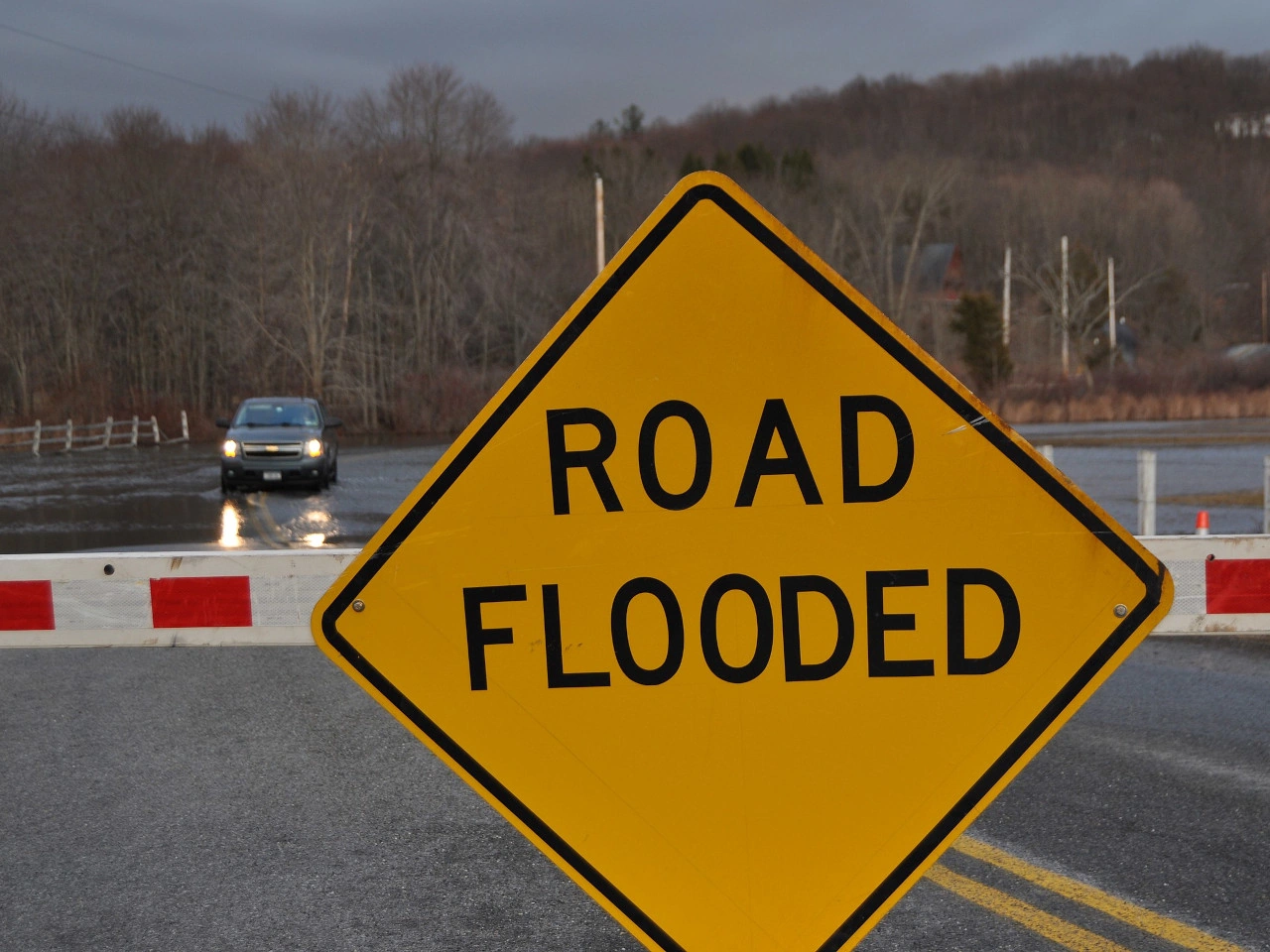
Flooding occurs when water covers or threatens a road because of heavy rain, overflowing rivers, poor drainage, storm surges or other causes. Flooded roads can become dangerous very quickly because water can reduce tyre grip, hide potholes or debris and make it difficult to judge the depth or strength of the current.
Drivers approaching flooding should slow down, assess the situation carefully and obey any warning signs or road closures. If the depth or condition of the water is uncertain, the safer option is to avoid entering the flooded section and use another route.
Wikimedia.org • Juliancolton • CC0
Why is flooding dangerous for road traffic?
Floodwater can reduce grip, hide damage or debris, affect vehicle control and make the actual depth of the water difficult to judge.
Should you drive through a flooded road?
Only when it is clearly safe and permitted. If the depth, current or road condition is uncertain, drivers should avoid entering the flooded section and find another route.
How can flooding be indicated to drivers?
Authorities may use warning signs, temporary traffic signs, barriers or road-closure signs to warn drivers or prevent access to a flooded road.
162. Blind summit
A blind summit is the crest of a hill where the road ahead cannot be seen clearly because the rising road surface blocks the driver's view. Vehicles, cyclists, pedestrians, bends or other hazards may therefore remain hidden until a driver reaches or passes the summit.
Drivers approaching a blind summit should reduce speed, remain in the correct road position and avoid overtaking when they cannot see far enough ahead. They should always be able to react safely to traffic or obstacles appearing beyond the crest.
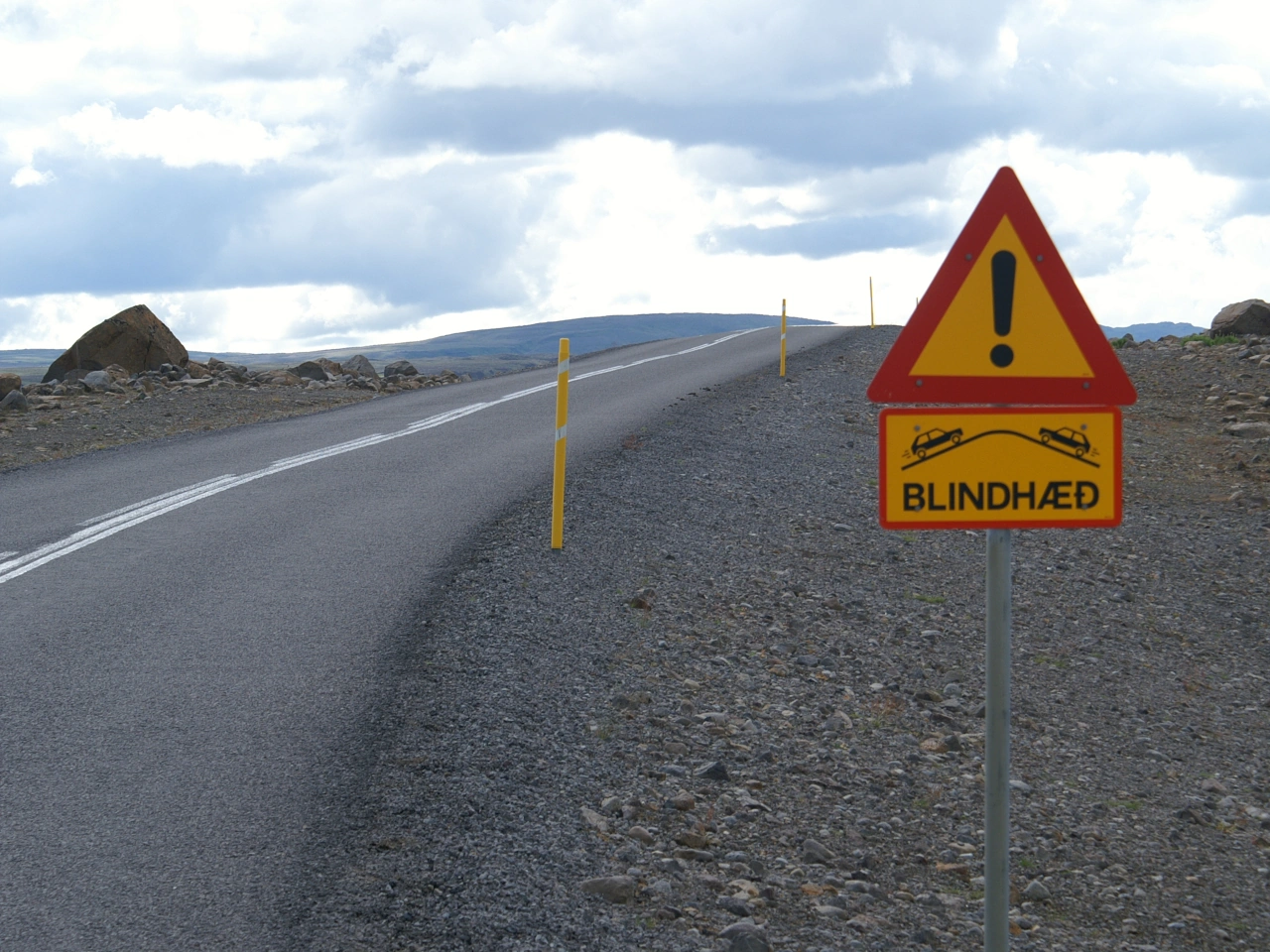
Wikimedia.org • Dickelbers • CC BY-SA
What is a blind summit?
A blind summit is the crest of a hill where the driver's view of the road beyond the summit is restricted.
Why is a blind summit dangerous?
Vehicles, pedestrians, cyclists, bends or obstacles may be hidden beyond the crest, leaving drivers less time to react.
Should you overtake near a blind summit?
Generally, no when visibility is insufficient. Drivers should avoid entering the path of opposing traffic unless they have a clear view and overtaking is permitted by the applicable traffic rules.
163. Tunnel category
A tunnel category is a classification used to determine which vehicles carrying dangerous goods may pass through a road tunnel. Under the ADR system, road tunnels can be classified from category A to category E according to the restrictions imposed on dangerous-goods transport.
Category A has no ADR tunnel restrictions, while categories B, C, D and E impose progressively broader restrictions according to the potential consequences of the dangerous goods being transported. Drivers carrying dangerous goods must compare the tunnel category with the tunnel restriction code applicable to their load.
Wikimedia.org • Marc Mongenet • CC BY-SA
What is an ADR tunnel category?
An ADR tunnel category determines which dangerous-goods transports are permitted or prohibited from passing through a particular road tunnel.
What do tunnel categories A to E mean?
Category A has no ADR tunnel restrictions. Categories B, C, D and E impose increasingly extensive restrictions on dangerous goods that could cause consequences such as explosions, toxic releases or major fires.
Do tunnel categories apply to ordinary passenger cars?
Normally, no. ADR tunnel categories specifically regulate vehicles carrying dangerous goods covered by the ADR rules. Other vehicles must still obey the normal traffic and tunnel regulations.
164. Temporary sign
A temporary sign is a traffic sign installed for a limited period to regulate, warn or guide road users because of temporary conditions. Temporary signs are commonly used for roadworks, accidents, events, diversions, lane closures or other situations where the normal traffic arrangement has changed.
Drivers must follow temporary signs and the traffic arrangement currently in force. Signs that are no longer relevant should normally be removed, covered or otherwise made ineffective so that road users are not given conflicting instructions.
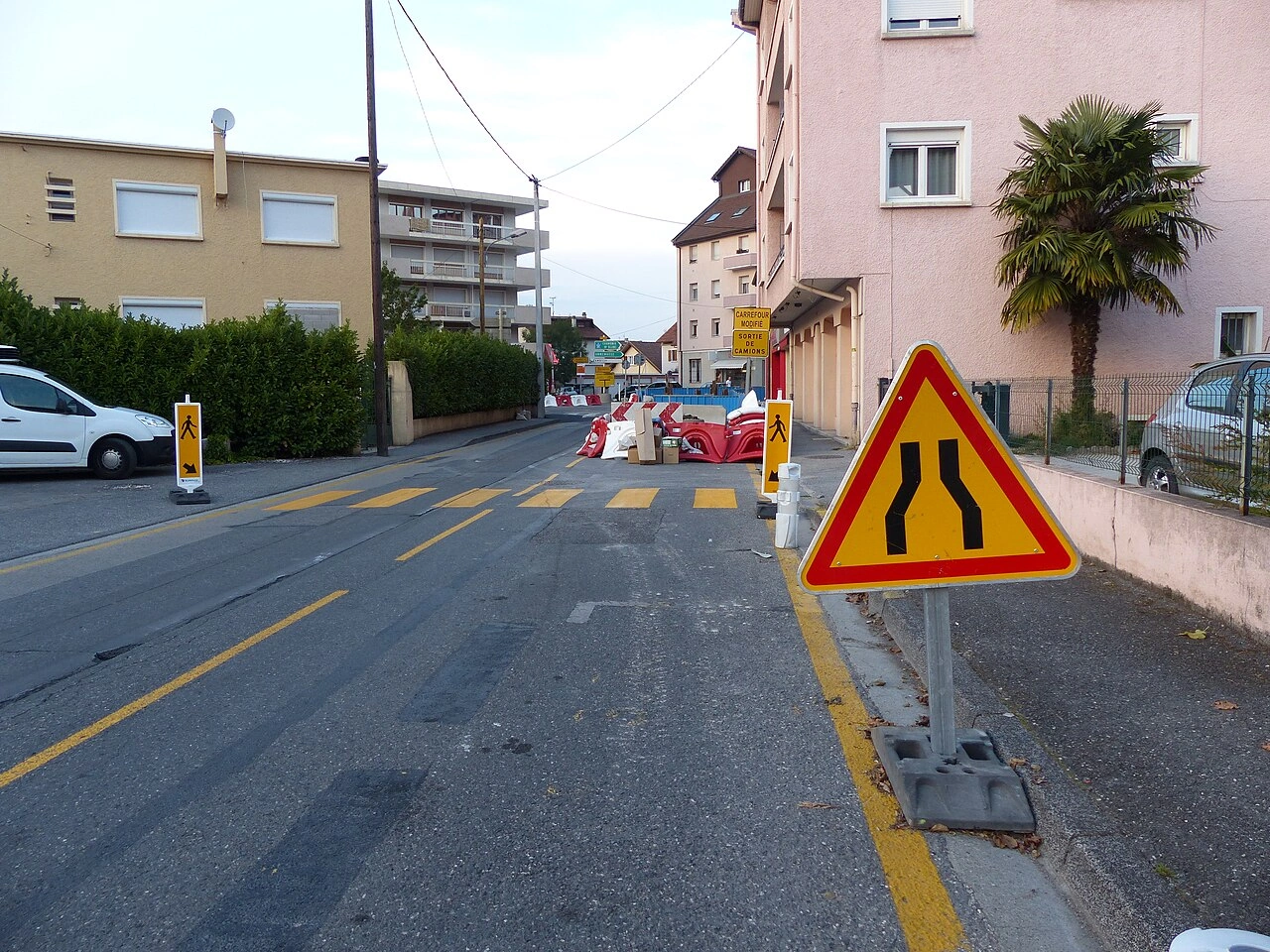
Wikimedia.org • Marc Mongenet • CC BY-SA
What is a temporary traffic sign?
A temporary traffic sign is a sign installed for a limited period to regulate, warn or direct traffic because of temporary road conditions.
Where are temporary signs commonly used?
They are commonly used at roadworks, accidents, temporary closures, diversions and special events.
What happens when a temporary sign is no longer needed?
It should normally be removed, covered or otherwise made ineffective so that it does not confuse road users or conflict with the normal traffic arrangement.
165. Overhanging trees
Overhanging trees are trees whose branches extend over a road, cycle path or footpath and may reduce the available clearance or create a hazard for road users. Low branches can be particularly dangerous for trucks, buses, cyclists and pedestrians and may also obstruct traffic signs, signals or visibility.
Drivers approaching low or overhanging branches should reduce speed, assess the available clearance and avoid sudden manoeuvres. Tall vehicles should take particular care where branches extend above the carriageway.
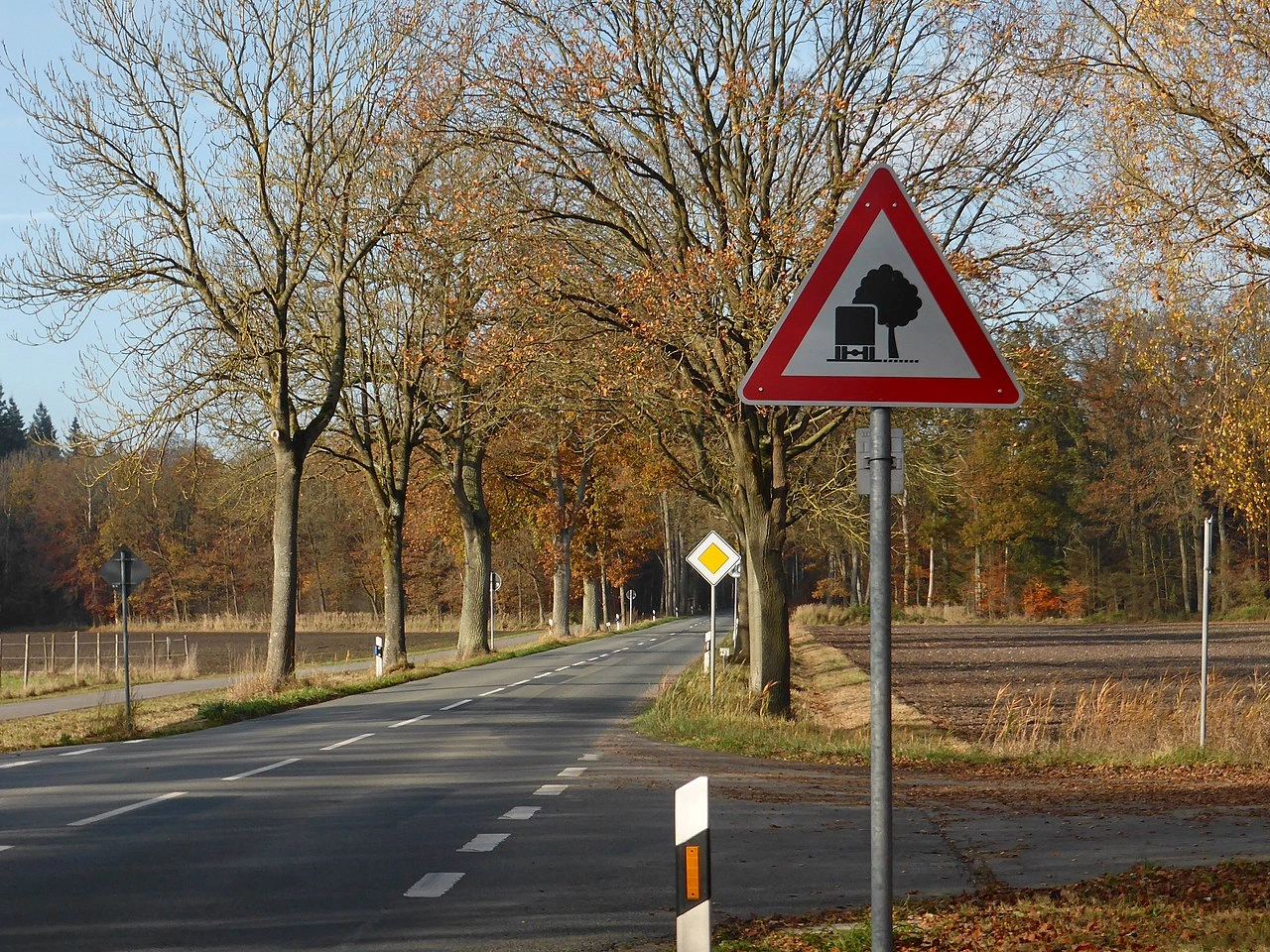
Wikimedia.org • Kirchenfan • CC0
What are hanging trees?
Hanging trees are trees or branches that extend over or toward a road, cycle path or footpath and may interfere with the safe passage of road users.
Why can overhanging branches be dangerous?
They can reduce vertical or lateral clearance, obstruct signs or signals and create a collision hazard, particularly for tall vehicles, cyclists and pedestrians.
What should drivers do near low overhanging branches?
Drivers should slow down, check the available clearance and pass only when it can be done safely. They should avoid swerving suddenly into another lane or toward other road users.
166. Dip
A dip is a low or sunken section of the road where the surface drops and then rises again over a relatively short distance. A dip can reduce visibility, affect vehicle stability and sometimes collect water, making it more difficult for drivers to judge the road ahead.
Drivers approaching a dip should reduce speed when necessary, maintain control and watch for hidden vehicles, pedestrians, cyclists or standing water beyond or within the depression.
Wikimedia.org • Alain Rouiller • CC BY-SA
What is a dip in the road?
A dip is a short depression in the road surface where the road falls and then rises again.
Why can a road dip be dangerous?
A dip can reduce visibility, affect vehicle stability and hide road users or obstacles. Water may also collect in the lowest part of the depression.
How should you drive through a dip?
Approach at a suitable speed, keep the vehicle under control and be prepared for hazards that may not be visible until you enter or leave the dip.
167. Turn on red
Turn on red is a traffic rule or signal arrangement that allows certain road users to proceed in a specified direction despite a red traffic light. It most commonly permits a turn after the driver has stopped or yielded, but the exact procedure varies between countries.
A turn on red is not universally permitted. It may be allowed generally, only when a specific sign or signal is present, or prohibited entirely. Drivers must always follow the local traffic lights, signs, priority rules and pedestrian or cyclist crossings before proceeding.
Wikimedia.org • Tabl-trai • CC BY-SA
What does turn on red mean?
Turn on red means that a road user may proceed in a specified turning direction despite a red traffic light when local law or a specific sign or signal permits it.
Is turning on red allowed everywhere?
No. Some countries permit certain turns on red, while others prohibit them unless a special sign or signal provides an exception.
Do you have to stop before turning on red?
This depends on the local traffic rules. In some jurisdictions a complete stop is required before turning, while other systems use a give-way rule or a separate signal that permits the movement.
Do you have priority when turning on red?
Usually no. A road user permitted to proceed against a red light generally has to give way to traffic, pedestrians and cyclists who are lawfully moving through the intersection.
Can pedestrians have priority over a vehicle turning on red?
Yes. Drivers must check pedestrian crossings carefully and give way where required before making the permitted turn.
Can cyclists be allowed to pass a red light when motorists cannot?
Yes. Some countries use special signs or bicycle signals that allow cyclists to turn or continue in a specified direction while the main traffic light remains red.
Does a green arrow beside a red light allow you to proceed?
Where the local signal system provides this arrangement, a green arrow may permit movement only in the direction indicated even though the main signal remains red. Applicable give-way rules must still be followed.
Can a sign prohibit turning on red?
Yes. In countries where turning on red is normally permitted, a specific sign may prohibit the manoeuvre at particular intersections.
Can you turn left on red?
This depends entirely on the country and road layout. Some jurisdictions permit particular left turns on red, while many do not. Never assume that a rule allowing a right turn also permits a left turn.
What should you do if you are unsure whether turning on red is allowed?
Remain stopped until a signal clearly permits you to proceed. Never pass a red light based only on what is permitted in another country.
168. High voltage
High voltage refers to electrical systems that operate at voltage levels high enough to present a serious risk of electric shock, burns or electrocution. High-voltage equipment may be found at substations, power lines, railway or tram infrastructure and other electrical installations.
Areas containing high-voltage equipment are commonly identified by electrical hazard warning signs. People should keep away from exposed electrical equipment, respect barriers and safety distances and never enter restricted electrical areas without authorisation.
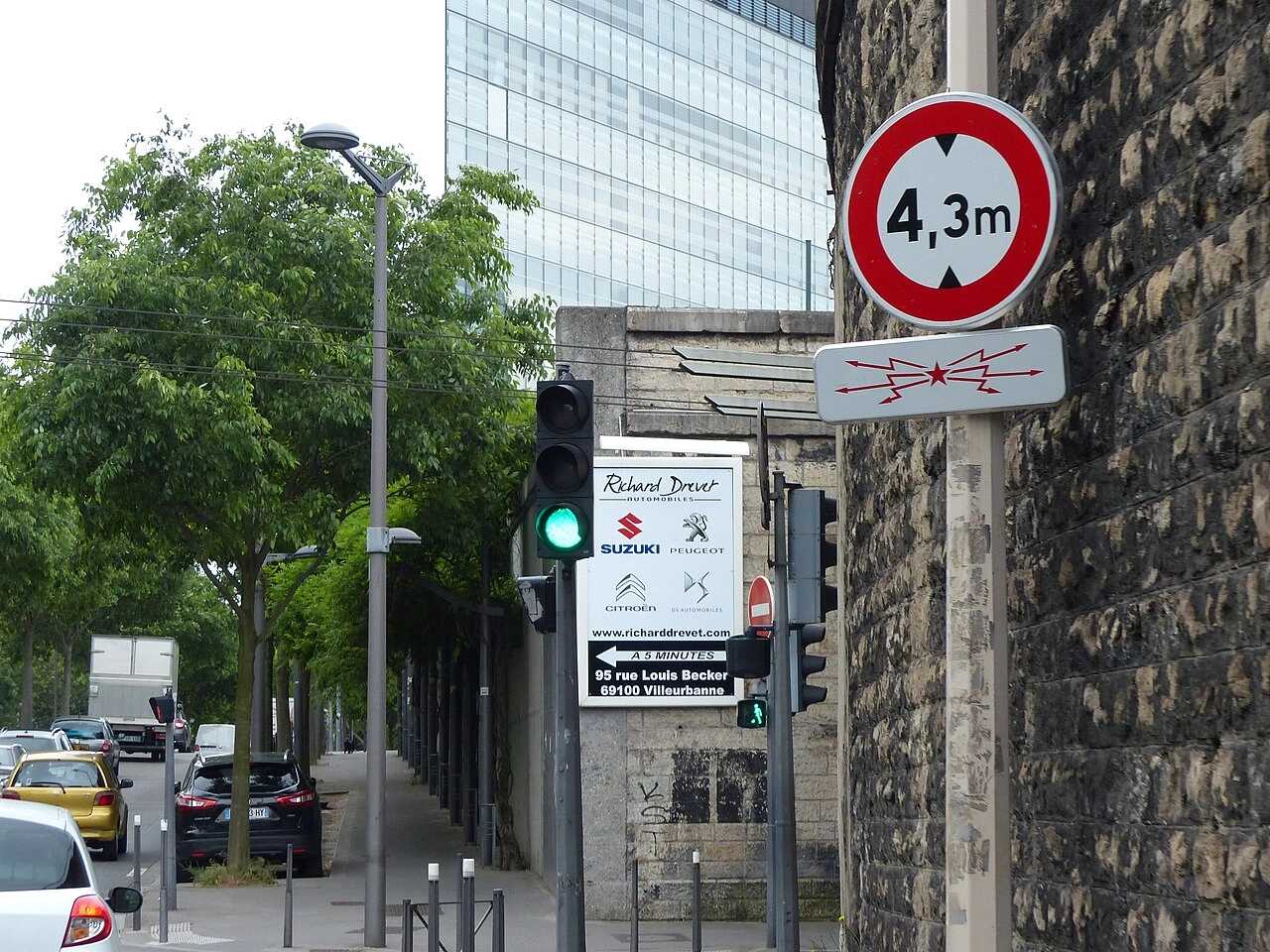
Wikimedia.org • Marc Mongenet • CC BY-SA
What does high voltage mean?
High voltage refers to electrical installations operating at voltage levels that can create a serious risk of electric shock, burns or electrocution.
Where can high-voltage equipment be found?
It may be found at power lines, substations, railway and tram infrastructure, industrial facilities and other electrical installations.
What should you do when you see a high-voltage warning?
Keep away from the electrical equipment, respect barriers and safety distances and do not enter restricted areas or touch electrical installations.
169. Tram lane
A tram lane is a part of the road or a separate track area intended primarily for trams. It may be physically separated from other traffic or form part of the roadway while remaining reserved for trams and, in some countries, certain other authorised vehicles.
Drivers should not enter or obstruct a tram lane unless the applicable signs, markings or traffic rules permit it. Because trams cannot steer around obstacles, particular care is required when crossing or driving near tram tracks.
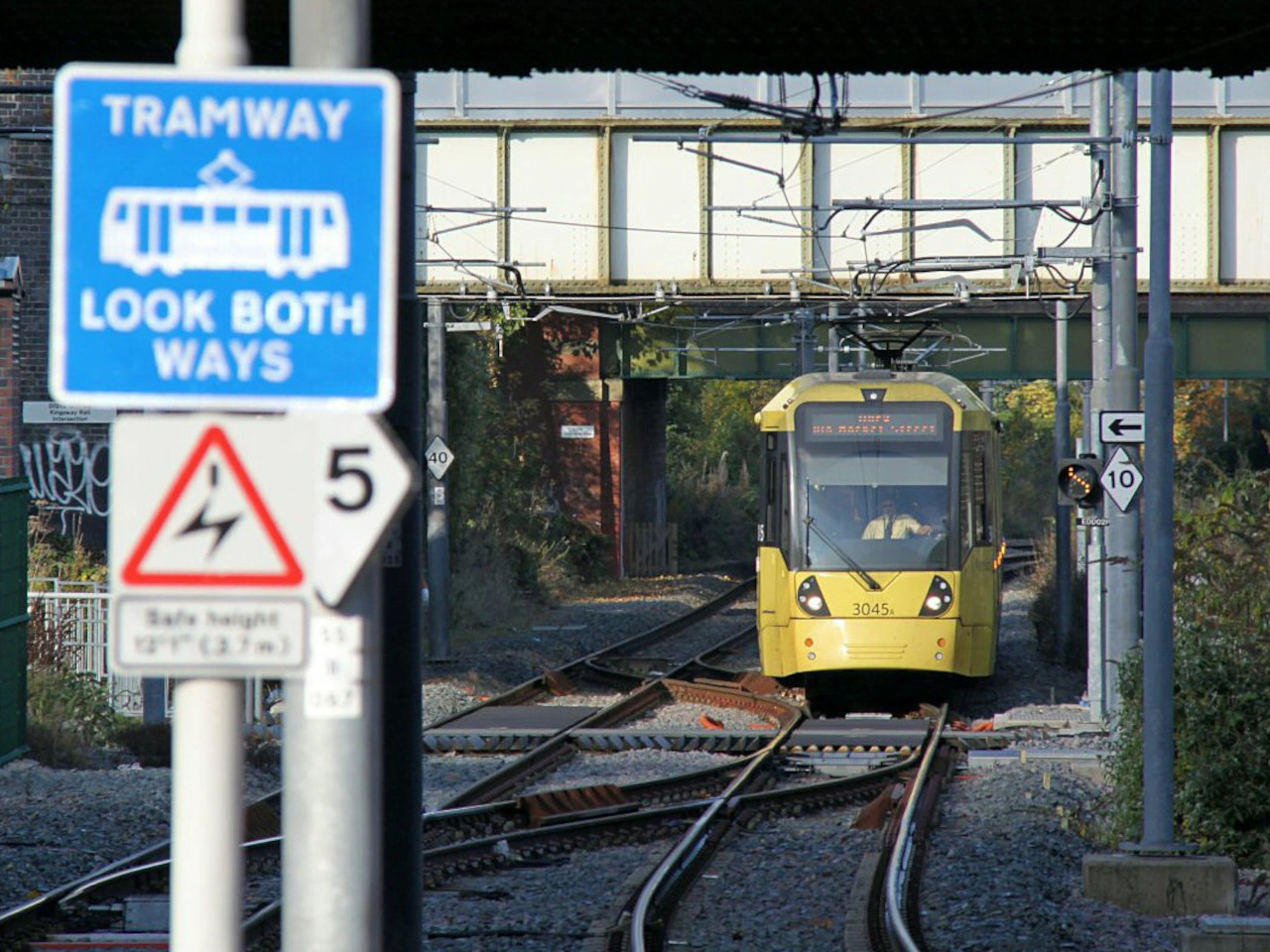
Wikimedia.org • Alan Murray-Rust • CC BY-SA
What is a tram lane?
A tram lane is a lane or track area intended primarily for trams and other authorised public-transport vehicles.
Can other vehicles use a tram lane?
It depends on the country and the signs provided. Some tram lanes are exclusively reserved for trams, while others may also be used by buses, taxis, cyclists or other authorised vehicles.
Can you cross a tram lane?
Usually, where permitted and necessary. Drivers may be allowed to cross tram tracks to turn, enter a property or cross an intersection, but they must follow the applicable signs and priority rules.
170. Rail safety
Rail safety refers to the rules, systems and precautions used to prevent accidents involving trains, railway infrastructure and people who interact with railways. It includes safe train operation, signalling, track protection, level-crossing safety and measures to prevent unauthorised access to railway tracks.
Road users should take particular care at railway crossings and obey barriers, warning lights, audible signals and traffic signs. Railway tracks should be crossed only at authorised locations and only when it is safe to clear them completely.
Wikimedia.org • Ingolf • CC BY-SA
What is rail safety?
Rail safety covers the rules, equipment and precautions intended to prevent accidents involving trains, railway infrastructure and people.
Why are railway crossings particularly important for rail safety?
Railway crossings bring road users and railway vehicles into the same location. Road users must therefore obey the warning systems and never enter when a train is approaching or the crossing cannot be cleared safely.
Can you walk along railway tracks?
Normally, no. Railway tracks are operational transport infrastructure and should be entered only at authorised crossing points or where access is specifically permitted.
171. Equestrian trail
An equestrian trail is a designated route intended primarily for horse riders. It may follow forest paths, rural tracks, bridleways or other routes where horseback riding is permitted or encouraged.
Equestrian trails may be identified by horse-rider symbols, direction markers or route signs. Other road users using or crossing the trail should take particular care around horses and avoid actions that could frighten them.
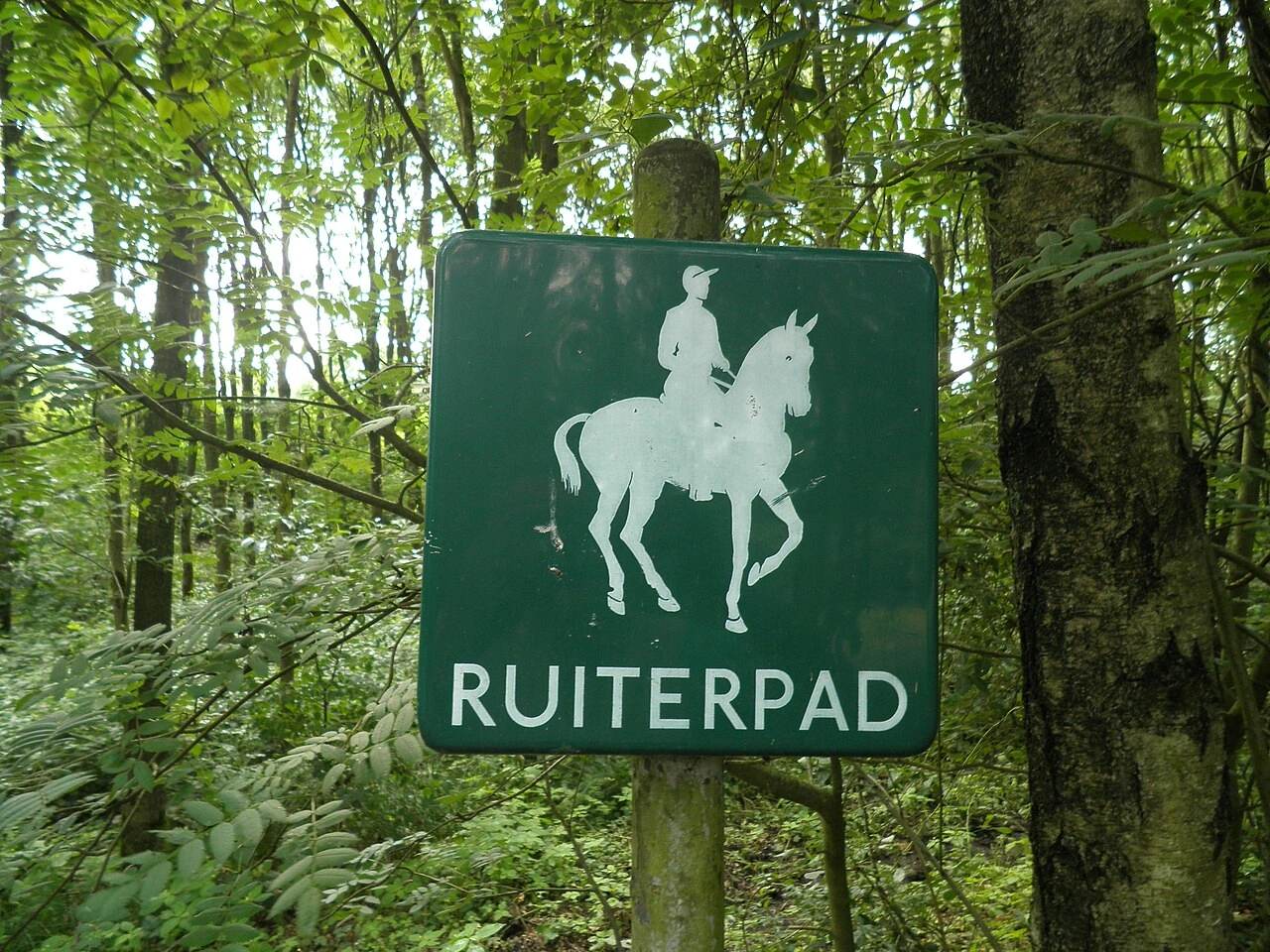
Wikimedia.org • Xavier66 • CC BY-SA
What is an equestrian trail?
An equestrian trail is a designated path or route intended primarily for people travelling on horseback.
Where are equestrian trails commonly found?
They are commonly found on forest paths, rural tracks, recreational routes and bridleways where horse riding is permitted.
Can other road users use an equestrian trail?
It depends on the route and local rules. Some trails are reserved for horse riders, while others are shared with pedestrians, cyclists or other authorised users.
172. Horse
A horse is a large domesticated animal that may be ridden, led or used to pull a carriage or other vehicle. Horses can appear on public roads, equestrian trails, rural routes and at crossings where riders or horse-drawn vehicles interact with other traffic.
Drivers approaching a horse should reduce speed, leave sufficient space and avoid sudden noise or movements that could frighten the animal. Riders and people controlling horses must also follow the traffic rules that apply to them.
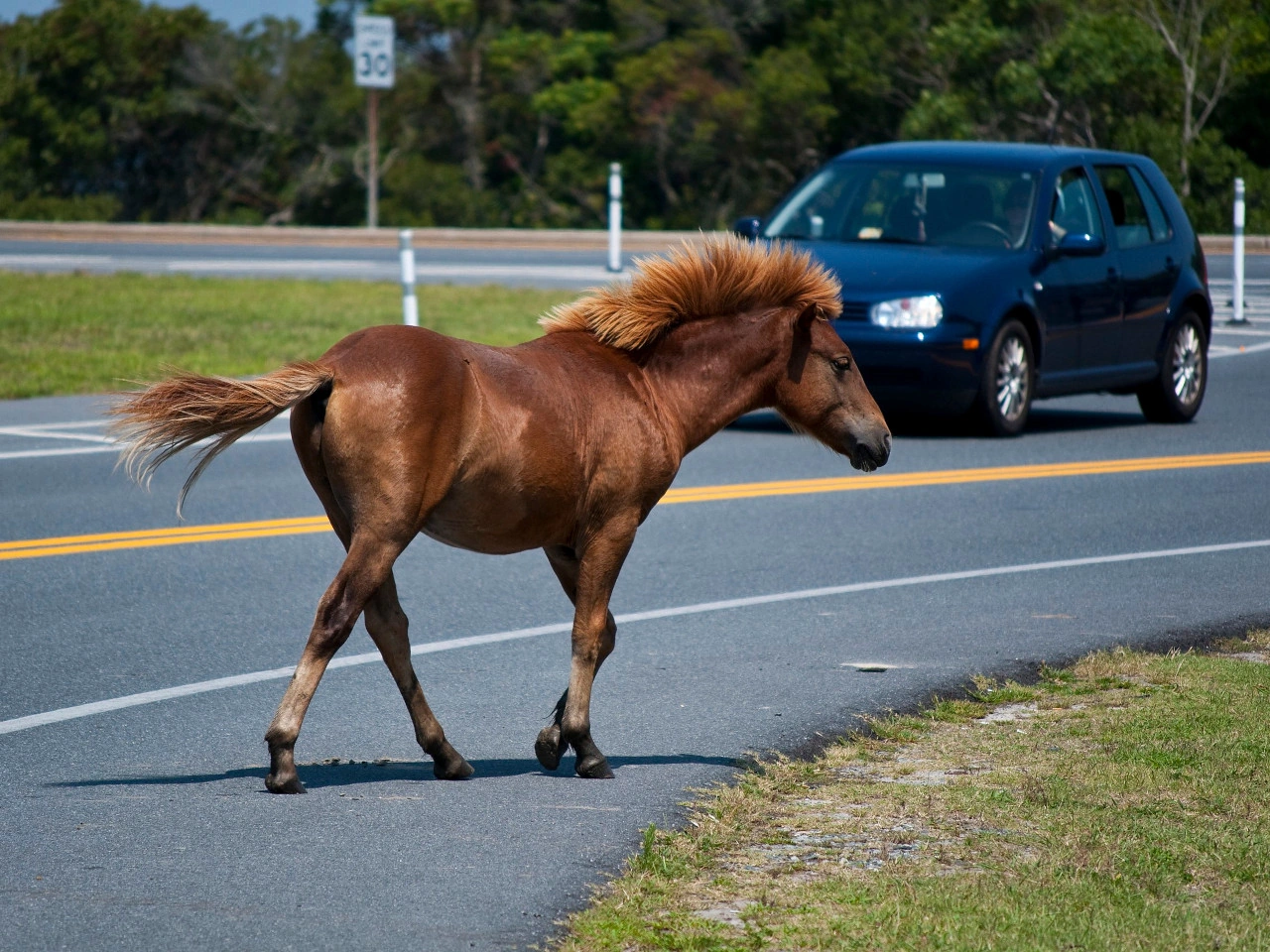
Wikimedia.org • Bill Price III • CC BY
Can horses use public roads?
Yes, where local traffic rules permit. Horses may be ridden, led or used with animal-drawn vehicles on public roads and designated routes.
How should drivers behave near a horse?
Drivers should slow down, leave plenty of space and pass calmly, avoiding unnecessary horn use, sudden acceleration or other actions that could frighten the horse.
Are horse riders considered road users?
Yes. Horse riders using a road are road users and must follow the traffic rules that apply to riders and animals in that country.
173. Identity card
An identity card is an official document used to prove a person's identity. It is normally issued by a government or another competent authority and contains identifying information such as the holder's name, date of birth, photograph and a unique document or identification number.
Identity cards may be required for identification checks, administrative procedures, travel or access to services. The obligation to possess or carry an identity card, the information it contains and whether it can be used as a travel document vary between countries.
Wikimedia.org • Argentina Government • CC BY
What is an identity card?
An identity card is an official document used to prove who a person is. It is normally issued by a government or other competent authority.
What information is shown on an identity card?
Identity cards commonly contain information such as the holder's name, photograph, date of birth and identification or document number. The exact information varies between countries.
Do you have to carry an identity card?
This depends on the country. Some countries require residents or citizens above a certain age to carry official identification, while others require identification only in particular circumstances.
Can police ask to see your identity card?
Yes, where permitted by local law. Police and other authorised officials may require a person to identify themselves in circumstances such as traffic enforcement, investigations or other official checks.
Is an identity card the same as a driving licence?
No. An identity card primarily proves a person's identity, while a driving licence proves that the holder is authorised to drive particular categories of motor vehicle. A country may require drivers to carry both documents.
Can an identity card replace a driving licence?
No. Proof of identity does not by itself give a person permission to drive. A driver must hold the appropriate valid driving licence when one is required.
Can an identity card be used for international travel?
Some identity cards are accepted as travel documents between certain countries, while other journeys require a passport. Travellers should check the entry requirements for their destination.
What should you do if your identity card is lost or stolen?
Report the loss or theft according to the procedure of the issuing country so that the document can be cancelled or blocked and a replacement can be requested.
Can you use an expired identity card?
An expired card may no longer be accepted as valid identification or as a travel document. The holder should renew the document according to the rules of the issuing authority.
Is an electronic identity card different from an ordinary identity card?
An electronic identity card contains an electronic chip in addition to the information visible on the card. Depending on the national system, the chip may allow secure electronic identification or access to online government services.
174. Fire risk
A fire risk sign warns road users that there is an increased danger of fire in or near the area. It may be used where dry vegetation, flammable materials or other conditions make fires particularly likely or where additional caution is required.
The appearance and legal status of fire-risk signs vary between countries. Drivers should avoid actions that could start a fire, obey any accompanying restrictions and remain alert for smoke, flames or emergency activity.
Wikimedia.org • Benoît Prieur • CC0
What does a fire risk sign mean?
It warns that conditions in or near the area create an increased risk of fire. Drivers should take extra care and avoid anything that could ignite vegetation, fuel or other flammable material.
Does a fire risk sign always prohibit access?
No. A warning sign by itself normally warns of a hazard rather than automatically closing the road. Access may nevertheless be restricted by additional signs, barriers or instructions when the fire danger is particularly high.
What should you do when you see a fire risk sign?
Remain alert, obey any accompanying restrictions and avoid actions that could cause a fire. If there is an active fire or smoke affecting the road, reduce your exposure to the danger and follow instructions from emergency services or road authorities.
175. Local traffic
Local traffic is traffic that needs access to a particular street or area because its journey begins, ends or requires a stop there, rather than simply passing through. Roads may be restricted to local traffic to reduce unnecessary through traffic.
The exact meaning of local traffic depends on national traffic rules. It commonly includes residents, visitors, deliveries and vehicles providing services within the restricted area.
Wikimedia.org • RegionVisitor90 • CC0
What does local traffic mean?
Local traffic generally means vehicles that have a legitimate reason to enter a particular street or area, such as reaching a home, business, delivery address or other destination located there.
Is local traffic the same as through traffic?
No. Through traffic passes through an area without having a destination or other necessary stop there. A restriction allowing only local traffic is normally intended to prevent this type of unnecessary through traffic.
Who may enter a road restricted to local traffic?
This depends on national rules and the signs in place. Residents, visitors, deliveries, emergency services and certain service vehicles are commonly permitted, but the precise categories vary between countries.