

Panneaux de signalisationPologne
 Règles de circulation
 Pologne
 Panneaux de priorité
 Panneaux de danger
 Panneaux d’interdiction
 Panneaux d’obligation
 Panneaux d’indication
 Panneaux additionnels
Panneaux de signalisation
Un panneau de signalisation est un symbole visuel standardisé placé le long des routes afin de guider, avertir ou réglementer les conducteurs, cyclistes et piétons. Ces panneaux fournissent des informations essentielles sur l’état de la route, les règles, les directions et les dangers potentiels, contribuant à la sécurité et à la fluidité du trafic. Ils existent sous différentes formes et couleurs, comme les panneaux triangulaires de danger, les panneaux circulaires d’interdiction ou d’obligation et les panneaux rectangulaires d’information, chacune étant conçue pour être rapidement reconnue et clairement comprise.

51. Remorques interdites
Ce panneau de signalisation indique que les remorques sont interdites. Cela signifie que les véhicules tractant une remorque ne sont pas autorisés au-delà de ce point. Tous les véhicules avec remorque sont interdits, y compris : Voitures tractant des remorques, fourgons ou camions tractant des remorques de chargement. Les véhicules seuls (voitures, motos, etc.) sans remorque peuvent être autorisés.
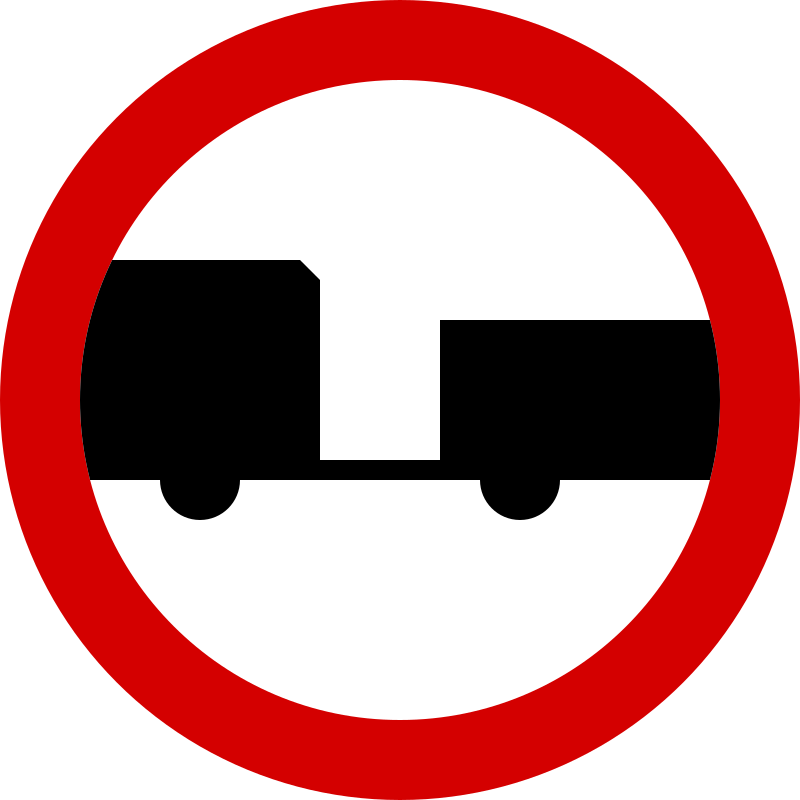
English • Traffic sign B-7 • No motor vehicles with trailers. Sign B-7 prohibits motor vehicles with one or more trailers, except vehicles with a single-axle trailer or semi-trailer.
Polski • B-7 • zakaz wjazdu pojazdów silnikowych z przyczepą. Znak B-7 „zakaz wjazdu pojazdów silnikowych z przyczepą” oznacza zakaz ruchu pojazdów silnikowych z przyczepą (przyczepami); zakaz nie dotyczy pojazdów z przyczepą jednoosiową lub naczepą.
Sources
🔗 Commons.wikimedia.org
🔗 Eli.gov.pl • § 18 ust. 7
SVG source: Commons.wikimedia.org • Original SVG
Szczepan dyskusja Mail 18:29, 31 December 2006 (UTC) • Public domain • Original revision 2025-09-28. Wikimedia original unmodified.
Artwork reviewed against the Polish official sign catalogue, Dz.U. 2019 poz. 2310: Eli.gov.pl • B-7, PDF page 42, with amendments 2021/433, 2021/2065, 2022/2372 and 2026/133 checked. Catalogue-equivalent illustration; intentional update from the previous PNG. This is an educational illustration, not a manufacturing specification.
52. Cyclistes et chariots à main interdits
Ce panneau de signalisation indique que les cyclistes et les chariots à main sont interdits. Ils ne peuvent pas entrer ni continuer au-delà du panneau. Les autres usagers peuvent rester autorisés sauf autre restriction.
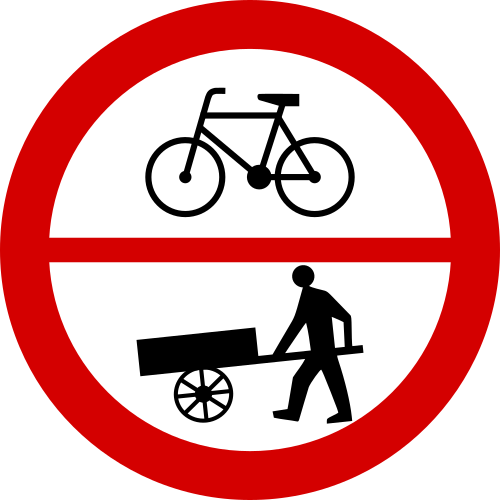
English • Traffic sign B-9 • No bicycles. Sign B-9 prohibits bicycles on the carriageway and shoulder. B-12 • No handcarts. Sign B-12 prohibits handcarts intended for use on the carriageway, whether guided, pulled or pushed, on the carriageway and shoulder.
Polski • B-9 • zakaz wjazdu rowerów. Znak B-9 „zakaz wjazdu rowerów” oznacza zakaz ruchu na jezdni i poboczu rowerów. B-12 • zakaz wjazdu wózków ręcznych. Znak B-12 „zakaz wjazdu wózków ręcznych” oznacza zakaz ruchu na jezdni i poboczu wózków ręcznych przeznaczonych do używania na jezdni, prowadzonych, ciągniętych lub pchanych.
Sources
🔗 Commons.wikimedia.org
🔗 Eli.gov.pl • § 18 ust. 10
🔗 Commons.wikimedia.org
🔗 Eli.gov.pl • § 18 ust. 13
SVG source: Pz • Public domain • Original revision 2012-04-05. Wikimedia original unmodified.
53. Interdiction de motos et de voitures
Ce panneau de signalisation indique que les motos et les voitures sont interdites. Cela signifie que les motos et les voitures particulières ne sont pas autorisées au-delà de ce point. Les autres usagers (comme les cyclomoteurs, vélos, piétons ou tracteurs) peuvent être autorisés sauf indication contraire.
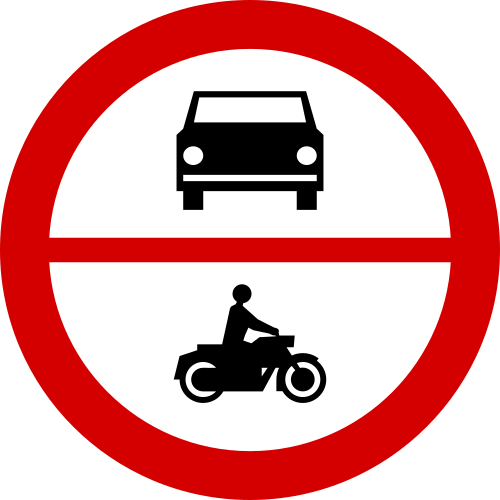
English • Traffic sign B-3 • No motor vehicles except single-track motorcycles. Sign B-3 prohibits motor vehicles, except single-track motorcycles. B-4 • No motorcycles. Sign B-4 prohibits motorcycles.
Polski • B-3 • zakaz wjazdu pojazdów silnikowych, z wyjątkiem motocykli jednośladowych. Znak B-3 „zakaz wjazdu pojazdów silnikowych, z wyjątkiem motocykli jednośladowych”, oznacza zakaz ruchu pojazdów silnikowych; zakaz nie dotyczy motocykli jednośladowych. B-4 • zakaz wjazdu motocykli. Znak B-4 „zakaz wjazdu motocykli” oznacza zakaz ruchu motocykli.
Sources
🔗 Commons.wikimedia.org
🔗 Eli.gov.pl • § 18 ust. 1
🔗 Commons.wikimedia.org
🔗 Eli.gov.pl • § 18 ust. 3
SVG source: Pz • Public domain • Original revision 2012-04-05. Wikimedia original unmodified.
54. Tracteurs et charrettes à cheval interdits
Ce panneau de signalisation indique que tracteurs et charrettes à cheval sont interdits. Cela signifie que les tracteurs agricoles ou forestiers et les véhicules à traction animale (comme les charrettes à cheval) ne sont pas autorisés au-delà de ce point. Les autres usagers (voitures, motos, vélos, piétons, etc.) peuvent être autorisés sauf indication contraire.
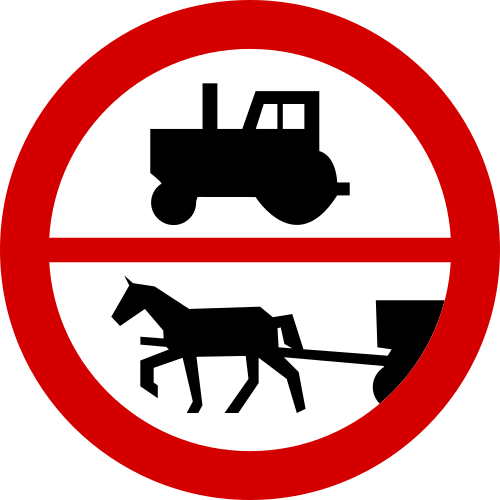
English • Traffic sign B-6 • No agricultural tractors. Sign B-6 prohibits agricultural tractors and slow-moving vehicles. B-8 • No animal-drawn vehicles. Sign B-8 prohibits animal-drawn vehicles and people riding or driving animals.
Polski • B-6 • zakaz wjazdu ciągników rolniczych. Znak B-6 „zakaz wjazdu ciągników rolniczych” oznacza zakaz ruchu ciągników rolniczych i pojazdów wolnobieżnych. B-8 • zakaz wjazdu pojazdów zaprzęgowych. Znak B-8 „zakaz wjazdu pojazdów zaprzęgowych” oznacza zakaz ruchu pojazdów zaprzęgowych oraz jeźdźców i poganiaczy.
Sources
🔗 Commons.wikimedia.org
🔗 Eli.gov.pl • § 18 ust. 6
🔗 Commons.wikimedia.org
🔗 Eli.gov.pl • § 18 ust. 9
SVG source: Pz • Public domain • Original revision 2012-04-05. Wikimedia original unmodified.
55. Cycles, charrettes à cheval et tracteurs interdits
Ce panneau de signalisation indique que les cyclistes, les charrettes à chevaux et les tracteurs sont interdits. Cela signifie que les vélos, les charrettes à chevaux et les tracteurs ne sont pas autorisés au-delà de ce panneau. Les autres véhicules motorisés (voitures, motos, etc.) peuvent être autorisés sauf restriction contraire.
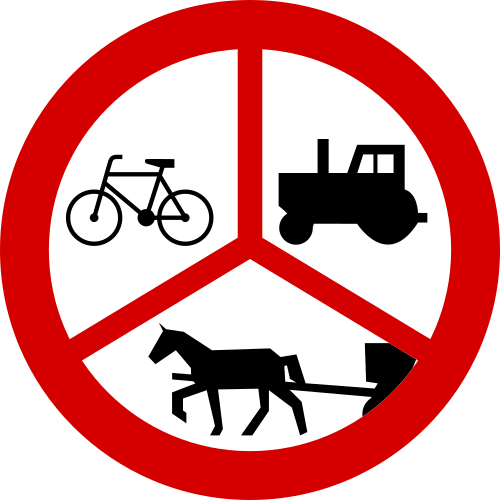
English • Traffic sign B-9 • No bicycles. Sign B-9 prohibits bicycles on the carriageway and shoulder. B-6 • No agricultural tractors. Sign B-6 prohibits agricultural tractors and slow-moving vehicles. B-8 • No animal-drawn vehicles. Sign B-8 prohibits animal-drawn vehicles and people riding or driving animals.
Polski • B-9 • zakaz wjazdu rowerów. Znak B-9 „zakaz wjazdu rowerów” oznacza zakaz ruchu na jezdni i poboczu rowerów. B-6 • zakaz wjazdu ciągników rolniczych. Znak B-6 „zakaz wjazdu ciągników rolniczych” oznacza zakaz ruchu ciągników rolniczych i pojazdów wolnobieżnych. B-8 • zakaz wjazdu pojazdów zaprzęgowych. Znak B-8 „zakaz wjazdu pojazdów zaprzęgowych” oznacza zakaz ruchu pojazdów zaprzęgowych oraz jeźdźców i poganiaczy.
Sources
🔗 Commons.wikimedia.org
🔗 Eli.gov.pl • § 18 ust. 10
🔗 Commons.wikimedia.org
🔗 Eli.gov.pl • § 18 ust. 6
🔗 Commons.wikimedia.org
🔗 Eli.gov.pl • § 18 ust. 9
SVG source: Pz • Public domain • Original revision 2012-04-05. Wikimedia original unmodified.
56. Véhicules transportant des matières dangereuses interdits
Ce panneau de signalisation indique que les véhicules transportant des matières dangereuses sont interdits. Cela signifie que les véhicules transportant des marchandises dangereuses ne sont pas autorisés à passer au-delà de ce panneau.
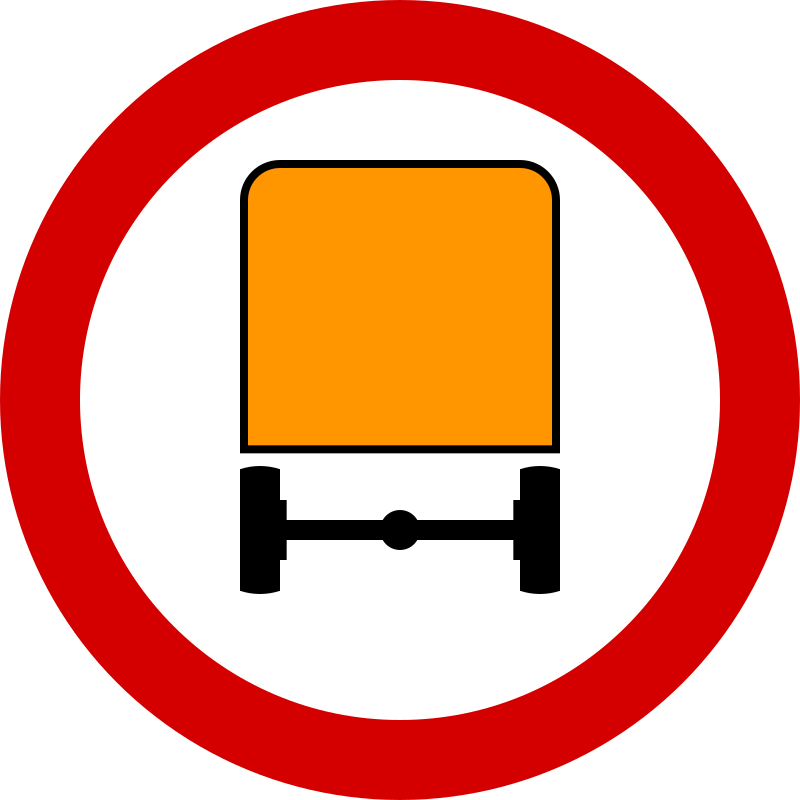
English • Traffic sign B-13a • No vehicles carrying dangerous goods. Sign B-13a prohibits vehicles carrying dangerous goods defined in road dangerous-goods transport regulations in quantities requiring orange warning plates. Plate T-31 below it, bearing a tunnel-category letter B, C, D or E, or a plate with appropriate wording, indicates that the prohibition applies only to particular classes or groups of dangerous goods or a particular method of carrying them.
Polski • B-13a • zakaz wjazdu pojazdów z towarami niebezpiecznymi. Znak B-13a „zakaz wjazdu pojazdów z towarami niebezpiecznymi” oznacza zakaz ruchu pojazdów przewożących, określone w przepisach o przewozie drogowym towarów niebezpiecznych, towary niebezpieczne w ilościach, dla których jest wymagane oznakowanie pojazdu tablicami ostrzegawczymi barwy pomarańczowej. Umieszczona pod znakiem tabliczka T-31 z literą B, C, D lub E oznaczającą kategorię tunelu lub tabliczka z odpowiednim napisem wskazuje, że zakaz dotyczy tylko określonych klas lub grup towarów niebezpiecznych lub określonego sposobu przewozu tych towarów.
Sources
🔗 Commons.wikimedia.org
🔗 Eli.gov.pl • § 19 ust. 2
SVG source: Commons.wikimedia.org • Original SVG
Szczepan dyskusja Mail 18:29, 31 December 2006 (UTC) • Public domain • Original revision 2025-09-28. Wikimedia original unmodified.
Artwork reviewed against the Polish official sign catalogue, Dz.U. 2019 poz. 2310: Eli.gov.pl • B-13a, PDF page 42, with amendments 2021/433, 2021/2065, 2022/2372 and 2026/133 checked. Catalogue-equivalent illustration; intentional update from the previous PNG. This is an educational illustration, not a manufacturing specification.
57. Véhicules transportant des explosifs interdits
Ce panneau de signalisation indique que les véhicules transportant des matières explosives sont interdits. Cela signifie que les véhicules transportant des substances explosives (comme des munitions, feux d’artifice ou explosifs) ne peuvent pas aller au-delà de ce point.
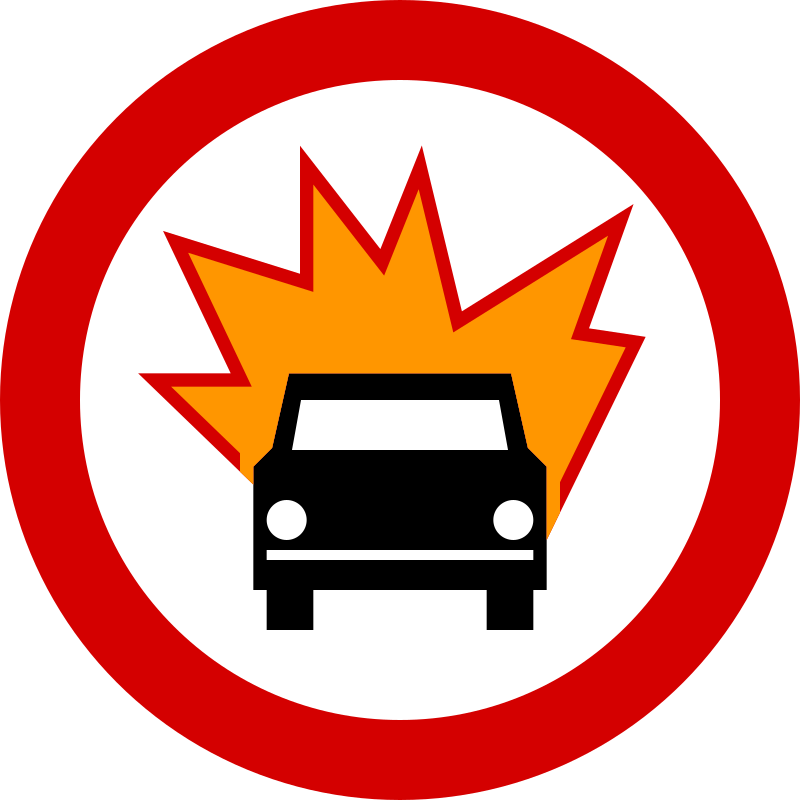
English • Traffic sign B-13 • No vehicles carrying explosives or highly flammable goods. Sign B-13 prohibits vehicles carrying dangerous goods defined in road dangerous-goods transport regulations in classes 1, 3, 4.1, 4.2, 4.3, 5.1 or 5.2, or flammable gases in class 2, in quantities requiring orange warning plates.
Polski • B-13 • zakaz wjazdu pojazdów z towarami wybuchowymi lub łatwo zapalnymi. Znak B-13 „zakaz wjazdu pojazdów z towarami wybuchowymi lub łatwo zapalnymi” oznacza zakaz ruchu pojazdów przewożących, określone w przepisach o przewozie drogowym towarów niebezpiecznych, towary niebezpieczne klas: 1, 3, 4.1, 4.2, 4.3, 5.1, 5.2 lub gazy palne klasy 2 w ilościach, dla których jest wymagane oznakowanie pojazdu tablicami ostrzegawczymi barwy pomarańczowej.
Sources
🔗 Commons.wikimedia.org
🔗 Eli.gov.pl • § 19 ust. 1
SVG source: Commons.wikimedia.org • Original SVG
Szczepan dyskusja Mail 18:29, 31 December 2006 (UTC) • Public domain • Original revision 2025-09-28. Wikimedia original unmodified.
Artwork reviewed against the Polish official sign catalogue, Dz.U. 2019 poz. 2310: Eli.gov.pl • B-13, PDF page 42, with amendments 2021/433, 2021/2065, 2022/2372 and 2026/133 checked. Catalogue-equivalent illustration; intentional update from the previous PNG. This is an educational illustration, not a manufacturing specification.
58. Véhicules transportant des liquides polluants interdits
Ce panneau de signalisation indique que les véhicules transportant des liquides polluants sont interdits. Cela signifie que les véhicules transportant des liquides polluants ou dangereux pour l'environnement ne peuvent pas passer au-delà de ce point. Les autres véhicules, transportant des marchandises non dangereuses, peuvent être autorisés sauf restriction contraire.
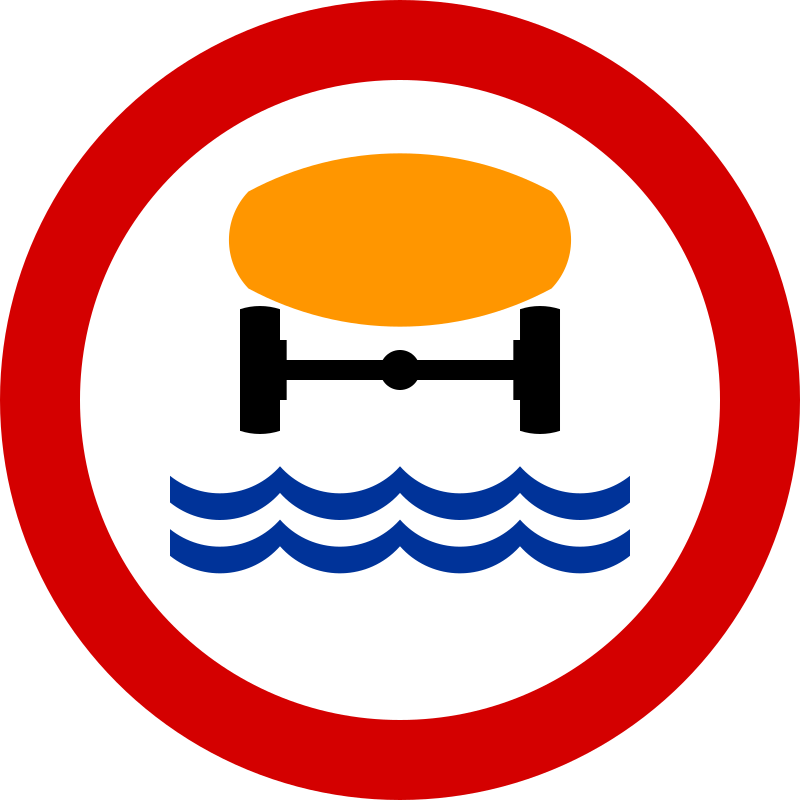
English • Traffic sign B-14 • No vehicles carrying goods that may contaminate water. Sign B-14 prohibits vehicles carrying dangerous goods defined in road dangerous-goods transport regulations in classes 3, 4.3, 6.1, 6.2 or 8; toxic or corrosive gases in class 2; or environmentally hazardous dangerous goods in class 9, in quantities requiring orange warning plates.
Polski • B-14 • zakaz wjazdu pojazdów z towarami, które mogą skazić wodę. Znak B-14 „zakaz wjazdu pojazdów z towarami, które mogą skazić wodę” oznacza zakaz ruchu pojazdów przewożących, określone w przepisach o przewozie drogowym towarów niebezpiecznych, towary niebezpieczne klas: 3,4.3, 6.1, 6.2, 8, gazy trujące lub gazy żrące klasy 2, lub towary niebezpieczne zagrażające środowisku klasy 9 w ilościach, dla których jest wymagane oznakowanie pojazdu tablicami ostrzegawczymi barwy pomarańczowej.
Sources
🔗 Commons.wikimedia.org
🔗 Eli.gov.pl • § 19 ust. 3
SVG source: Commons.wikimedia.org • Original SVG
Szczepan dyskusja Mail 18:29, 31 December 2006 (UTC) • Public domain • Original revision 2025-09-28. Wikimedia original unmodified.
Artwork reviewed against the Polish official sign catalogue, Dz.U. 2019 poz. 2310: Eli.gov.pl • B-14, PDF page 42, with amendments 2021/433, 2021/2065, 2022/2372 and 2026/133 checked. Catalogue-equivalent illustration; intentional update from the previous PNG. This is an educational illustration, not a manufacturing specification.
59. Véhicules de plus de la largeur indiquée interdits
Ce panneau indique que les véhicules plus larges que la limite indiquée sont interdits. Cela signifie que les véhicules dépassant la largeur spécifiée ne sont pas autorisés au-delà de ce point, généralement afin d'éviter un blocage ou des dommages dans des espaces étroits. Les véhicules d'une largeur égale ou inférieure à la limite sont autorisés. Courant dans : rues étroites, centres historiques, tunnels ou voies à gabarit réduit.
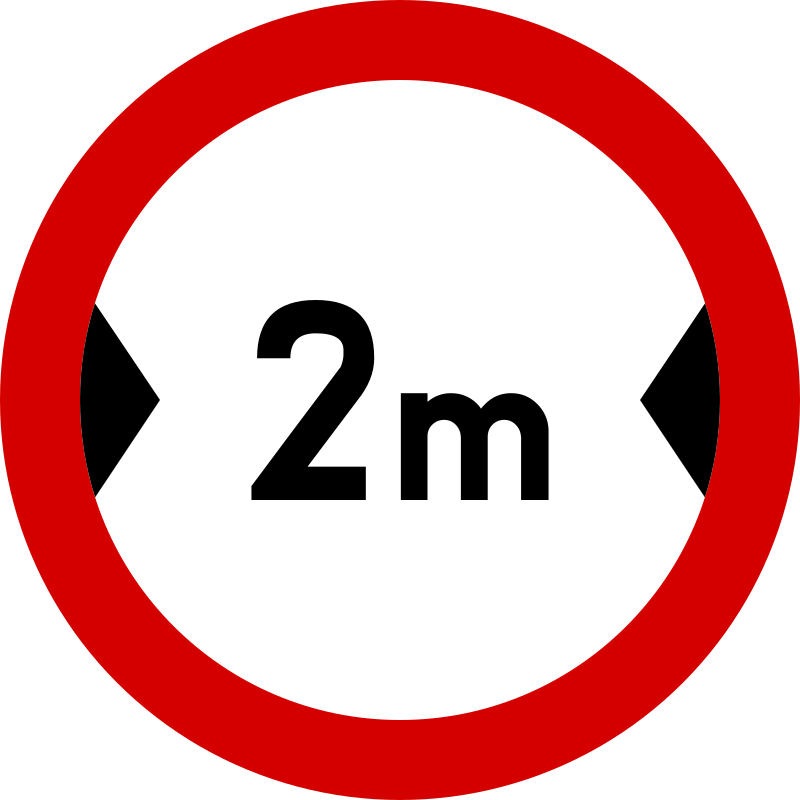
English • Traffic sign B-15 • Maximum width in metres. Sign B-15 prohibits vehicles whose width, including their load, exceeds the value shown.
Polski • B-15 • zakaz wjazdu pojazdów o szerokości ponad ... m. Znak B-15 „zakaz wjazdu pojazdów o szerokości ponad......m” oznacza zakaz ruchu pojazdów, których szerokość (również z ładunkiem) jest większa od wartości podanej na znaku.
Sources
🔗 Commons.wikimedia.org
🔗 Eli.gov.pl • § 20 ust. 1
SVG source: Commons.wikimedia.org • Original SVG
Szczepan dyskusja Mail 18:29, 31 December 2006 (UTC) • Public domain • Original revision 2025-10-01. Wikimedia original unmodified.
Artwork reviewed against the Polish official sign catalogue, Dz.U. 2019 poz. 2310: Eli.gov.pl • B-15, PDF page 42, with amendments 2021/433, 2021/2065, 2022/2372 and 2026/133 checked. Catalogue-equivalent illustration; intentional update from the previous PNG. This is an educational illustration, not a manufacturing specification.
60. Véhicules de plus de la hauteur indiquée interdits
Ce panneau de signalisation indique que les véhicules plus hauts que la hauteur indiquée sont interdits. Cela signifie que les véhicules dépassant la hauteur spécifiée ne peuvent pas passer au-delà de ce point en raison de limitations de hauteur, par exemple : ponts, tunnels, passages supérieurs ou autres structures basses. Les véhicules à hauteur égale ou inférieure à la limite sont autorisés.
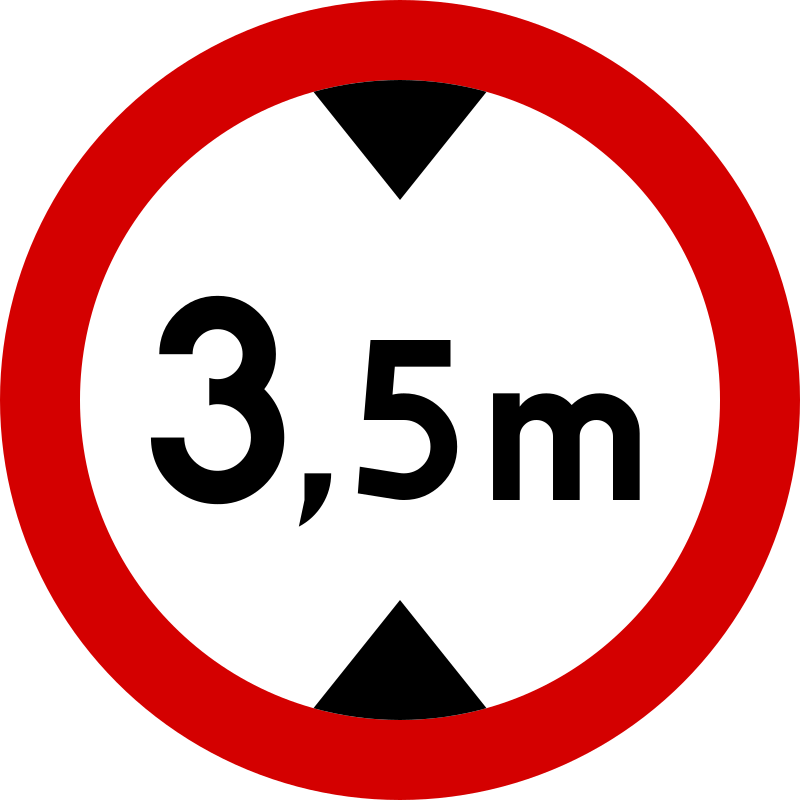
English • Traffic sign B-16 • Maximum height in metres. Sign B-16 prohibits vehicles whose height, including their load, exceeds the value shown.
Polski • B-16 • zakaz wjazdu pojazdów o wysokości ponad ... m. Znak B-16 „zakaz wjazdu pojazdów o wysokości ponad......m” oznacza zakaz ruchu pojazdów, których wysokość (również z ładunkiem) jest większa od wartości podanej na znaku.
Sources
🔗 Commons.wikimedia.org
🔗 Eli.gov.pl • § 20 ust. 2
SVG source: Commons.wikimedia.org • Original SVG
Szczepan dyskusja Mail 18:29, 31 December 2006 (UTC) • Public domain • Original revision 2025-10-01. Wikimedia original unmodified.
Artwork reviewed against the Polish official sign catalogue, Dz.U. 2019 poz. 2310: Eli.gov.pl • B-16, PDF page 42, with amendments 2021/433, 2021/2065, 2022/2372 and 2026/133 checked. Catalogue-equivalent illustration; intentional update from the previous PNG. This is an educational illustration, not a manufacturing specification.
61. Véhicules de plus de la longueur indiquée interdits
Ce panneau de signalisation indique que les véhicules plus longs que la longueur indiquée sont interdits. Cela signifie que les véhicules dépassant une certaine longueur ne peuvent pas continuer au-delà de ce point. Utilisé pour empêcher les véhicules trop longs d'entrer sur des routes inadaptées à leur rayon de braquage, à leur largeur ou à leurs exigences de sécurité. Les véhicules dont la longueur est égale ou inférieure à la limite peuvent circuler.
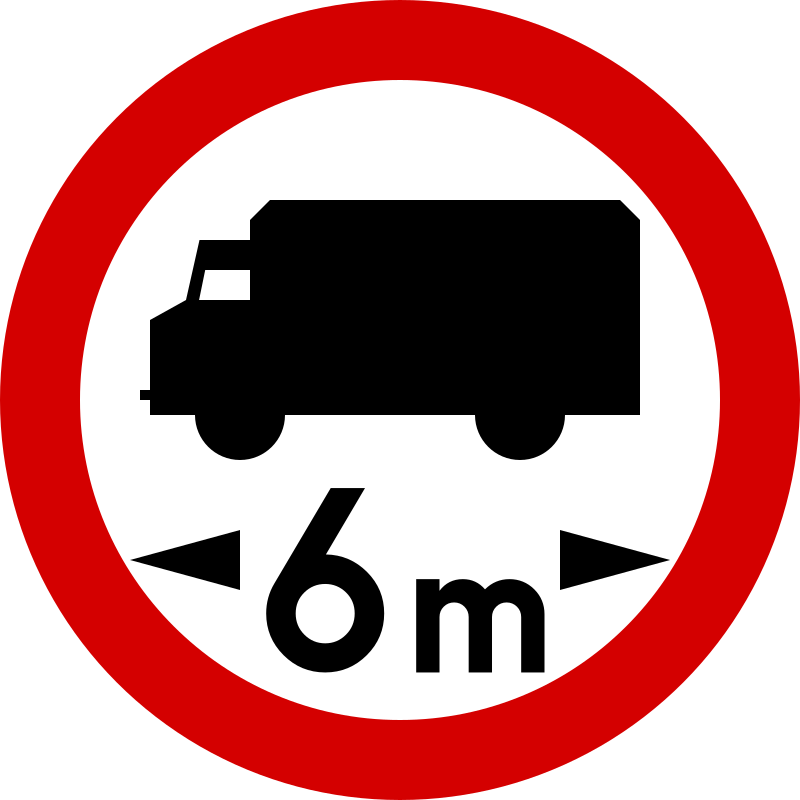
English • Traffic sign B-17 • Maximum length in metres. Sign B-17 prohibits vehicles or vehicle combinations whose length, including their load, exceeds the value shown.
Polski • B-17 • zakaz wjazdu pojazdów o długości ponad ... m. Znak B-17 „zakaz wjazdu pojazdów o długości ponad......m” oznacza zakaz ruchu pojazdów lub zespołów pojazdów, których długość (również z ładunkiem) jest większa od wartości podanej na znaku.
Sources
🔗 Commons.wikimedia.org
🔗 Eli.gov.pl • § 20 ust. 3
SVG source: Commons.wikimedia.org • Original SVG
Krzysztof Blachnicki • Public domain • Original revision 2025-10-01. Wikimedia original unmodified.
Artwork reviewed against the Polish official sign catalogue, Dz.U. 2019 poz. 2310: Eli.gov.pl • B-17, PDF page 42, with amendments 2021/433, 2021/2065, 2022/2372 and 2026/133 checked. Catalogue-equivalent illustration; intentional update from the previous PNG. This is an educational illustration, not a manufacturing specification.
62. Véhicules de plus du poids indiqué interdits
Ce panneau de signalisation indique que les véhicules plus lourds que le poids indiqué sont interdits. Cela signifie que tout véhicule dont le poids total dépasse la limite indiquée ne peut pas aller au-delà de ce point. Généralement utilisé aux ponts et autres structures qui ne peuvent supporter de lourdes charges ou pour restreindre les camions lourds sur certaines routes. Les véhicules plus légers (à la limite ou en dessous) sont autorisés.
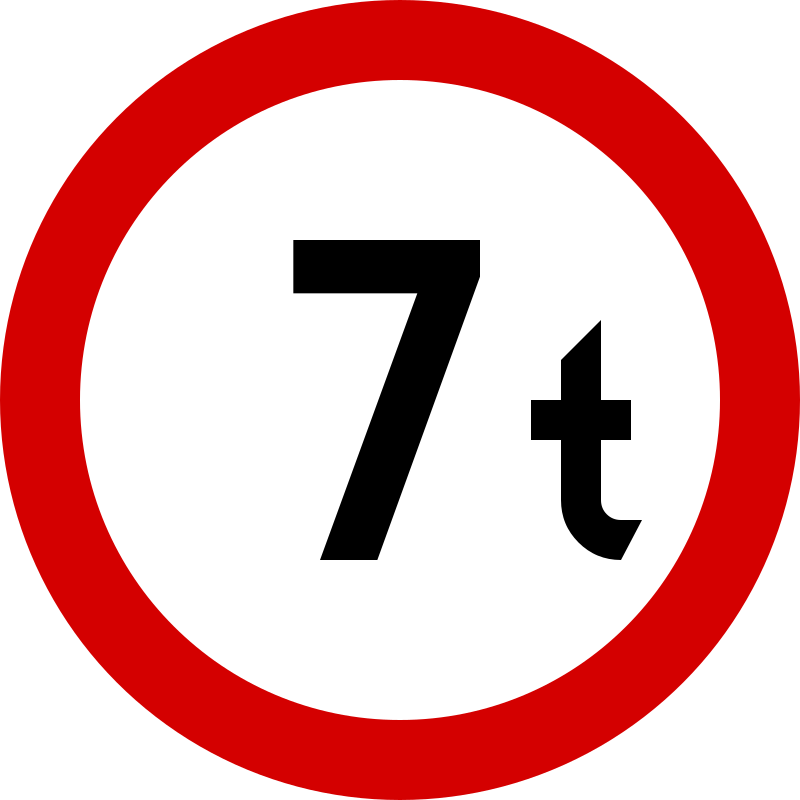
English • Traffic sign B-18 • Maximum actual total mass in tonnes. Sign B-18 prohibits vehicles whose actual total mass exceeds the value shown. For vehicle combinations, the prohibition applies to their combined mass.
Polski • B-18 • zakaz wjazdu pojazdów o rzeczywistej masie całkowitej ponad ... t. Znak B-18 „zakaz wjazdu pojazdów o rzeczywistej masie całkowitej ponad.....t” oznacza zakaz ruchu pojazdów, których rzeczywista masa całkowita jest większa od wartości podanej na znaku; w przypadku zespołu pojazdów zakaz dotyczy ich łącznej masy.
Sources
🔗 Commons.wikimedia.org
🔗 Eli.gov.pl • § 20 ust. 4
SVG source: Commons.wikimedia.org • Original SVG
Szczepan dyskusja Mail 18:29, 31 December 2006 (UTC) • Public domain • Original revision 2025-10-01. Wikimedia original unmodified.
Artwork reviewed against the Polish official sign catalogue, Dz.U. 2019 poz. 2310: Eli.gov.pl • B-18, PDF page 42, with amendments 2021/433, 2021/2065, 2022/2372 and 2026/133 checked. Catalogue-equivalent illustration; intentional update from the previous PNG. This is an educational illustration, not a manufacturing specification.
63. Charge par essieu supérieure interdite
Ce panneau de signalisation indique que les véhicules dont la charge à l’essieu est supérieure à la limite indiquée sont interdits. Cela signifie que tous les véhicules dont la charge à l'essieu dépasse la limite spécifiée ne sont pas autorisés à continuer au-delà de ce point. Les véhicules dont la charge à l’essieu est égale ou inférieure à la limite peuvent passer. Utilisé pour protéger routes, ponts ou tunnels des dommages structurels dus à des charges concentrées.
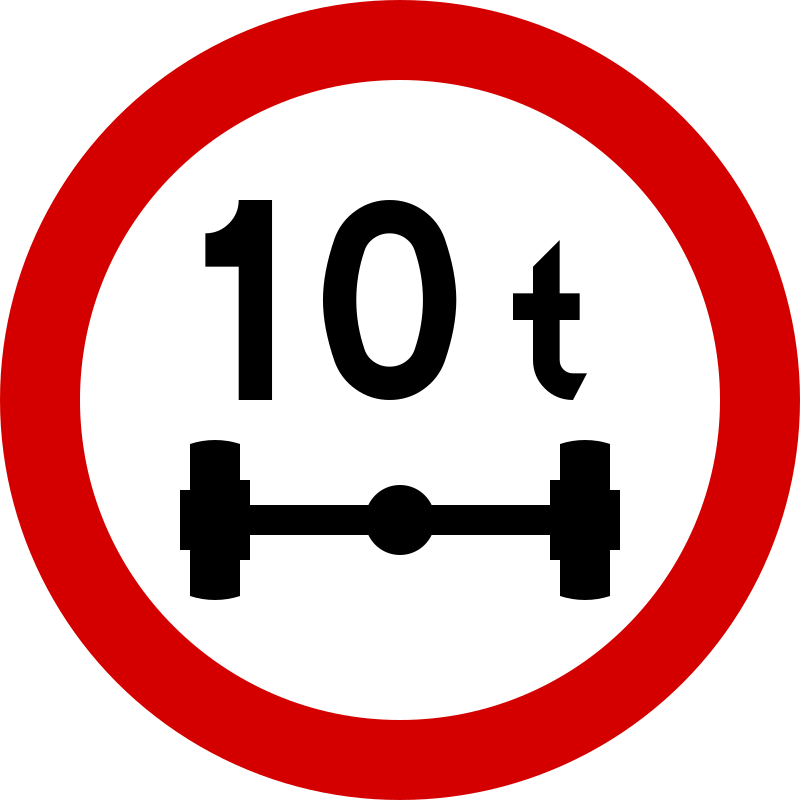
English • Traffic sign B-19 • Maximum single driven-axle load in tonnes. Sign B-19 prohibits vehicles whose single driven-axle load exceeds the permitted load corresponding to the mass shown. For an axle group, no individual axle may bear a load corresponding to more than 80% of the mass shown. If B-19 shows 8 t or 10 t, it permits a single driven-axle load corresponding to up to 8 t or 10 t and a correspondingly higher axle-group load under vehicle technical regulations. B-19 does not apply to buses; vehicles engaged in rescue operations or directly addressing the effects of natural disasters; vehicles of public road managers and contractors carrying out road maintenance duties on their behalf; vehicles carrying out the duties of the Police, Road Transport Inspectorate, State Protection Service, Internal Security Agency, Foreign Intelligence Agency, Military Counterintelligence Service, Military Intelligence Service, Central Anti-Corruption Bureau, Border Guard, Prison Service, National Revenue Administration as used by the Customs and Fiscal Service, or fire protection units; vehicles of the Polish Armed Forces and allied states; vehicles of the State Water Holding Polish Waters and entities carrying out tasks on its behalf under the Water Law Act of 20 July 2017 (Journal of Laws 2020, items 310, 284, 695, 782, 875 and 1378); or vehicles delivering hospital equipment and supplies necessary to combat infections and infectious diseases during an epidemic threat or epidemic declared under the Act of 5 December 2008 on preventing and combating human infections and infectious diseases (Journal of Laws 2020, items 1845, 2112 and 2401, and 2021, items 159, 180 and 255).
Polski • B-19 • zakaz wjazdu pojazdów o nacisku pojedynczej osi napędowej powyżej..... t. Znak B-19 „zakaz wjazdu pojazdów o nacisku pojedynczej osi napędowej powyżej..... t” oznacza zakaz ruchu pojazdów, których nacisk pojedynczej osi napędowej jest większy od dopuszczalnego nacisku odpowiadającego masie podanej na znaku; w przypadku grupy osi nacisk żadnej z osi składowych nie może odpowiadać masie większej niż 80% masy podanej na znaku. Jeżeli na znaku B-19 podano wartość 8 t lub 10 t, oznacza to dopuszczalny nacisk pojedynczej osi napędowej odpowiadający masie do 8 t lub 10 t, a grupy osi - odpowiednio większej masie, zgodnie z przepisami określającymi warunki techniczne pojazdów poruszających się po drogach. Znak B-19 nie dotyczy: autobusów; pojazdów biorących udział w akcjach ratowniczych oraz przy bezpośredniej likwidacji skutków klęsk żywiołowych; pojazdów zarządców dróg publicznych oraz podmiotów wykonujących obowiązki zarządcy drogi na jego rzecz z zakresu utrzymania dróg; pojazdów Policji, Inspekcji Transportu Drogowego, Służby Ochrony Państwa, Agencji Bezpieczeństwa Wewnętrznego, Agencji Wywiadu, Służby Kontrwywiadu Wojskowego, Służby Wywiadu Wojskowego, Centralnego Biura Antykorupcyjnego, Straży Granicznej, Służby Więziennej, Krajowej Administracji Skarbowej wykorzystywanych przez Służbę Celno-Skarbową oraz jednostek ochrony przeciwpożarowej, wykonujących zadania tych służb lub podmiotów; pojazdów Sił Zbrojnych Rzeczypospolitej Polskiej i państw sojuszniczych; pojazdów Państwowego Gospodarstwa Wodnego Wody Polskie oraz podmiotów wykonujących na jego rzecz zadania wynikające z ustawy z dnia 20 lipca 2017 r. - Prawo wodne (Dz. U. z 2020 r. poz. 310, 284, 695, 782, 875 i 1378); pojazdów dostarczających do szpitali wyposażenie i zaopatrzenie niezbędne do zwalczania zakażeń i chorób zakaźnych w okresie obowiązywania stanu zagrożenia epidemicznego lub stanu epidemii ogłoszonego na podstawie ustawy z dnia 5 grudnia 2008 r. o zapobieganiu oraz zwalczaniu zakażeń i chorób zakaźnych u ludzi (Dz. U. z 2020 r. poz. 1845, 2112 i 2401 oraz z 2021 r. poz. 159, 180 i 255).
Sources
🔗 Commons.wikimedia.org
🔗 Eli.gov.pl • § 20 ust. 5–7
Image via Commons.wikimedia.org
Szczepan dyskusja Mail 18:29, 31 December 2006 (UTC) • Public domain • Source revision 2025-10-01. Wikimedia original unmodified.
64. Remorques de plus de l'indication interdites
Ce panneau de signalisation indique que les remorques dépassant le poids indiqué sont interdites. Cela signifie que les remorques dont le poids total autorisé dépasse la valeur indiquée ne sont pas autorisées au-delà de ce point, quel que soit le véhicule tracteur. Les remorques égales ou inférieures à la limite sont autorisées. Utilisé couramment sur : routes de montagne, fortes pentes, itinéraires étroits ou fragiles.
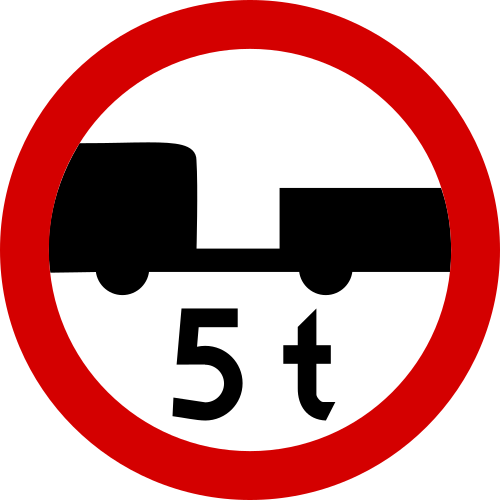
English • Traffic sign B-7 • No motor vehicles with trailers. Sign B-7 prohibits motor vehicles with one or more trailers, except vehicles with a single-axle trailer or semi-trailer.
Polski • B-7 • zakaz wjazdu pojazdów silnikowych z przyczepą. Znak B-7 „zakaz wjazdu pojazdów silnikowych z przyczepą” oznacza zakaz ruchu pojazdów silnikowych z przyczepą (przyczepami); zakaz nie dotyczy pojazdów z przyczepą jednoosiową lub naczepą.
Sources
🔗 Commons.wikimedia.org
🔗 Eli.gov.pl • § 18 ust. 7
SVG source: Pz • Public domain • Original revision 2012-04-05. Wikimedia original unmodified.
65. Camions plus lourds que l’indication interdits
Ce panneau de signalisation indique que les camions dépassant le poids indiqué sont interdits. Cela signifie que les camions dont le poids total autorisé en charge (PTAC) dépasse la limite spécifiée ne sont pas autorisés au-delà du panneau. Les camions plus légers et les autres véhicules (voitures, utilitaires, motos) sont autorisés sauf indication contraire. Utilisé pour protéger : routes fragiles, ponts, zones urbaines ou limiter le trafic de poids lourds en zone résidentielle ou sensible.
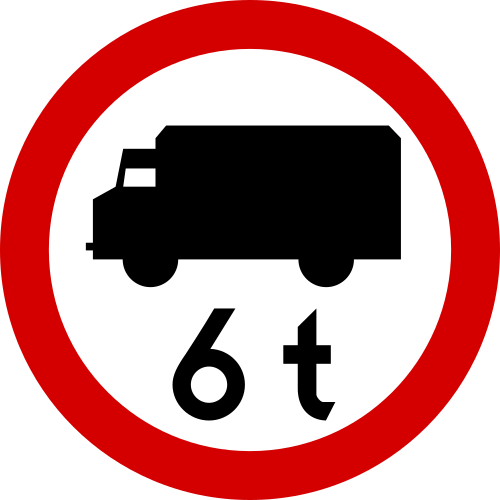
English • Traffic sign B-5 • No lorries. Sign B-5 prohibits lorries with a maximum authorised mass exceeding 3.5 t; tractor units; special vehicles and vehicles used for special purposes with a maximum authorised mass exceeding 3.5 t; agricultural tractors; and slow-moving vehicles.
Polski • B-5 • zakaz wjazdu samochodów ciężarowych. Znak B-5 „zakaz wjazdu samochodów ciężarowych” oznacza zakaz ruchu: samochodów ciężarowych o dopuszczalnej masie całkowitej przekraczającej 3,5 t; ciągników samochodowych; pojazdów specjalnych i używanych do celów specjalnych o dopuszczalnej masie całkowitej przekraczającej 3,5 t; ciągników rolniczych; pojazdów wolnobieżnych.
Sources
🔗 Commons.wikimedia.org
🔗 Eli.gov.pl • § 18 ust. 4
SVG source: Paweł Grzywocz • Public domain • Original revision 2012-04-05. Wikimedia original unmodified.
66. Rétrécissement : cédez le passage au trafic opposé
Ce panneau de signalisation indique un rétrécissement de la chaussée où vous devez céder le passage aux véhicules venant en sens inverse. Il signale un rétrécissement de la route où vous devez céder le passage à la circulation en sens opposé. Il est généralement utilisé lorsque la route devient trop étroite pour permettre à deux véhicules de se croiser simultanément.

English • Traffic sign B-31 • Priority for oncoming traffic. Sign B-31 prohibits entering or walking onto a narrow section if doing so would force drivers already on it or approaching from the opposite direction to stop.
Polski • B-31 • pierwszeństwo dla nadjeżdżających z przeciwka. Znak B-31 „pierwszeństwo dla nadjeżdżających z przeciwka” zabrania kierującym wjazdu lub wejścia na zwężony odcinek jezdni, jeżeli zmusiłoby to kierujących znajdujących się na tym odcinku lub zbliżających się do niego z przeciwnej strony do zatrzymania się.
Sources
🔗 Commons.wikimedia.org
🔗 Eli.gov.pl • § 25 ust.
SVG source: Commons.wikimedia.org • Original SVG
Szczepan dyskusja Mail 18:29, 31 December 2006 (UTC) • Public domain • Original revision 2025-09-28. Wikimedia original unmodified.
Artwork reviewed against the Polish official sign catalogue, Dz.U. 2019 poz. 2310: Eli.gov.pl • B-31, PDF page 42, with amendments 2021/433, 2021/2065, 2022/2372 and 2026/133 checked. Catalogue-equivalent illustration; intentional update from the previous PNG. This is an educational illustration, not a manufacturing specification.
67. Interdiction de tourner à gauche
Ce panneau de signalisation indique que le virage à gauche est interdit. Cela signifie que les virages à gauche ne sont pas autorisés à l’intersection ou au carrefour où le panneau est affiché. Aller tout droit ou tourner à droite peut être autorisé (sauf indication contraire).
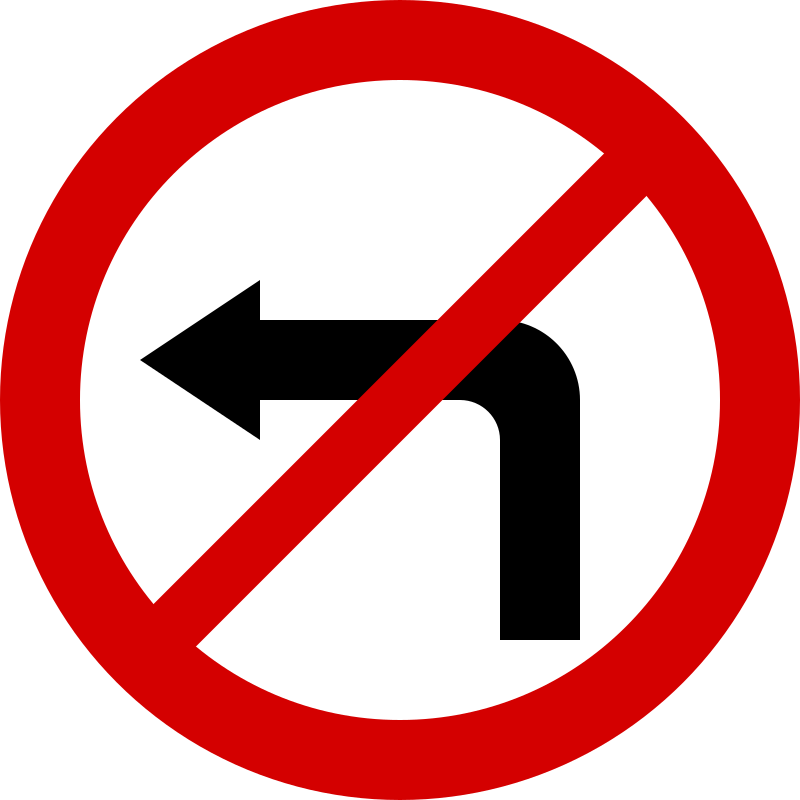
English • Traffic sign B-21 • No left turn. Signs B-21, No left turn, and B-22, No right turn, prohibit turning in the direction shown. B-21 also prohibits U-turns.
Polski • B-21 • zakaz skręcania w lewo. Znaki: B-21 „zakaz skręcania w lewo”, B-22 „zakaz skręcania w prawo” zabraniają skręcania w kierunku wskazanym na znaku; ponadto znak B-21 zabrania zawracania.
Sources
🔗 Commons.wikimedia.org
🔗 Eli.gov.pl • § 22 ust. 1
SVG source: Commons.wikimedia.org • Original SVG
Szczepan dyskusja Mail 18:29, 31 December 2006 (UTC) • Public domain • Original revision 2025-09-28. Wikimedia original unmodified.
Artwork reviewed against the Polish official sign catalogue, Dz.U. 2019 poz. 2310: Eli.gov.pl • B-21, PDF page 42, with amendments 2021/433, 2021/2065, 2022/2372 and 2026/133 checked. Catalogue-equivalent illustration; intentional update from the previous PNG. This is an educational illustration, not a manufacturing specification.
68. Interdiction de tourner à droite
Ce panneau de signalisation indique qu'il est interdit de tourner à droite. Cela signifie que les virages à droite ne sont pas autorisés au prochain carrefour ou à la prochaine intersection. Les conducteurs peuvent toujours aller tout droit ou tourner à gauche (sauf indication contraire).
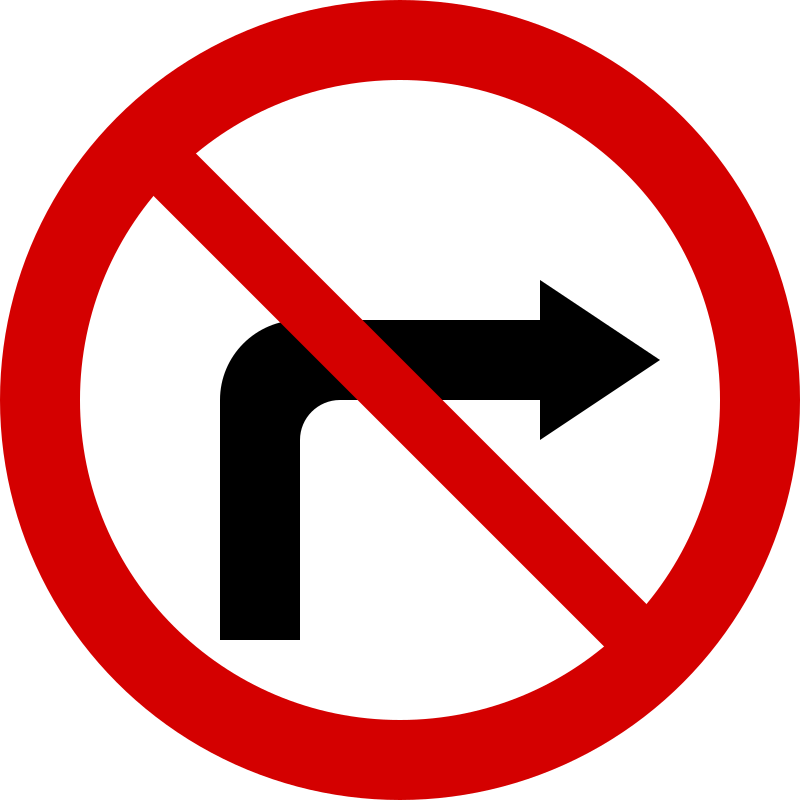
English • Traffic sign B-22 • No right turn. Signs B-21, No left turn, and B-22, No right turn, prohibit turning in the direction shown. B-21 also prohibits U-turns.
Polski • B-22 • zakaz skręcania w prawo. Znaki: B-21 „zakaz skręcania w lewo”, B-22 „zakaz skręcania w prawo” zabraniają skręcania w kierunku wskazanym na znaku; ponadto znak B-21 zabrania zawracania.
Sources
🔗 Commons.wikimedia.org
🔗 Eli.gov.pl • § 22 ust. 1
SVG source: Commons.wikimedia.org • Original SVG
Szczepan dyskusja Mail 18:29, 31 December 2006 (UTC) • Public domain • Original revision 2025-09-28. Wikimedia original unmodified.
Artwork reviewed against the Polish official sign catalogue, Dz.U. 2019 poz. 2310: Eli.gov.pl • B-22, PDF page 42, with amendments 2021/433, 2021/2065, 2022/2372 and 2026/133 checked. Catalogue-equivalent illustration; intentional update from the previous PNG. This is an educational illustration, not a manufacturing specification.
69. Demi-tour interdit
Ce panneau de signalisation indique que le demi-tour est interdit. Cela signifie que les demi-tours ne sont pas autorisés à hauteur ou au-delà de ce panneau. Vous pouvez encore être autorisé à tourner à gauche, à droite, ou à continuer tout droit (sauf restrictions complémentaires).

English • Traffic sign B-23 • No U-turn. Sign B-23 prohibits U-turns up to and including the next junction.
Polski • B-23 • zakaz zawracania. Znak B-23 „zakaz zawracania” zabrania kierującym zawracania do najbliższego skrzyżowania włącznie.
Sources
🔗 Commons.wikimedia.org
🔗 Eli.gov.pl • § 22 ust. 5
SVG source: Commons.wikimedia.org • Original SVG
Szczepan dyskusja Mail 18:29, 31 December 2006 (UTC) • Public domain • Original revision 2025-09-28. Wikimedia original unmodified.
Artwork reviewed against the Polish official sign catalogue, Dz.U. 2019 poz. 2310: Eli.gov.pl • B-23, PDF page 42, with amendments 2021/433, 2021/2065, 2022/2372 and 2026/133 checked. Catalogue-equivalent illustration; intentional update from the previous PNG. This is an educational illustration, not a manufacturing specification.
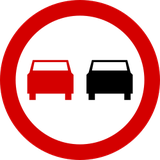
70. Dépassement interdit
Ce panneau de signalisation indique dépassement interdit. Cela signifie que le dépassement des véhicules à moteur à plus de deux roues est interdit. Vous pouvez toujours dépasser : vélos, cyclomoteurs, ...
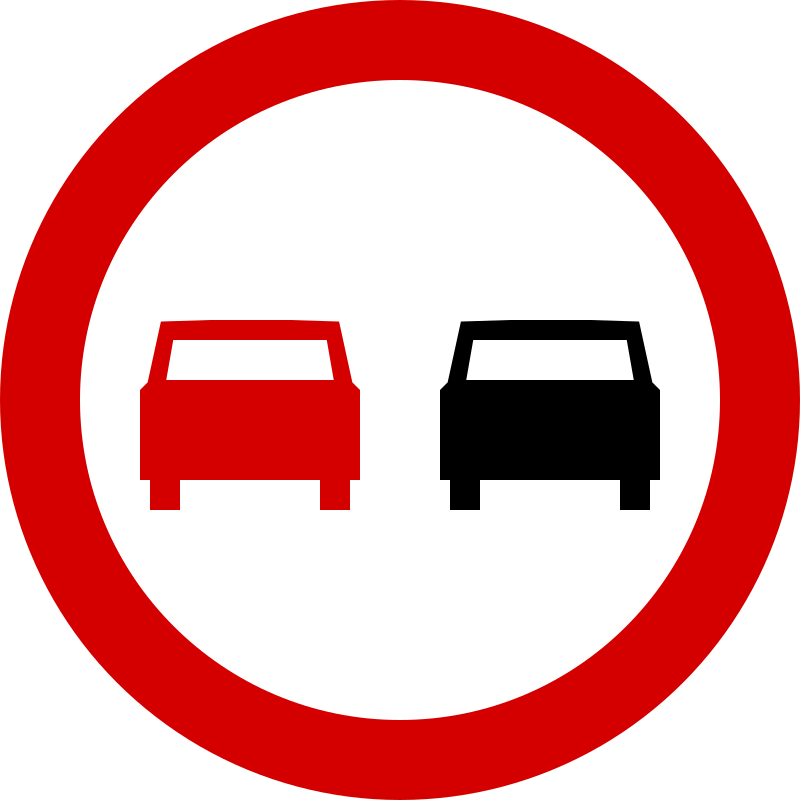
English • Traffic sign B-25 • No overtaking. Sign B-25 prohibits drivers of motor vehicles from overtaking multi-track motor vehicles.
Polski • B-25 • zakaz wyprzedzania. Znak B-25 „zakaz wyprzedzania” zabrania kierującym pojazdami silnikowymi wyprzedzania pojazdów silnikowych wielośladowych.
Sources
🔗 Commons.wikimedia.org
🔗 Eli.gov.pl • § 23 ust. 1
SVG source: Commons.wikimedia.org • Original SVG
Szczepan dyskusja Mail 18:29, 31 December 2006 (UTC) • Public domain • Original revision 2025-09-28. Wikimedia original unmodified.
Artwork reviewed against the Polish official sign catalogue, Dz.U. 2019 poz. 2310: Eli.gov.pl • B-25, PDF page 42, with amendments 2021/433, 2021/2065, 2022/2372 and 2026/133 checked. Catalogue-equivalent illustration; intentional update from the previous PNG. This is an educational illustration, not a manufacturing specification.
71. Fin de l'interdiction de dépassement
Ce panneau de signalisation indique la fin de l’interdiction de dépasser. Cela signifie que la zone d’interdiction de dépasser est terminée. Le dépassement est de nouveau autorisé, tant que cela reste sûr et légal.
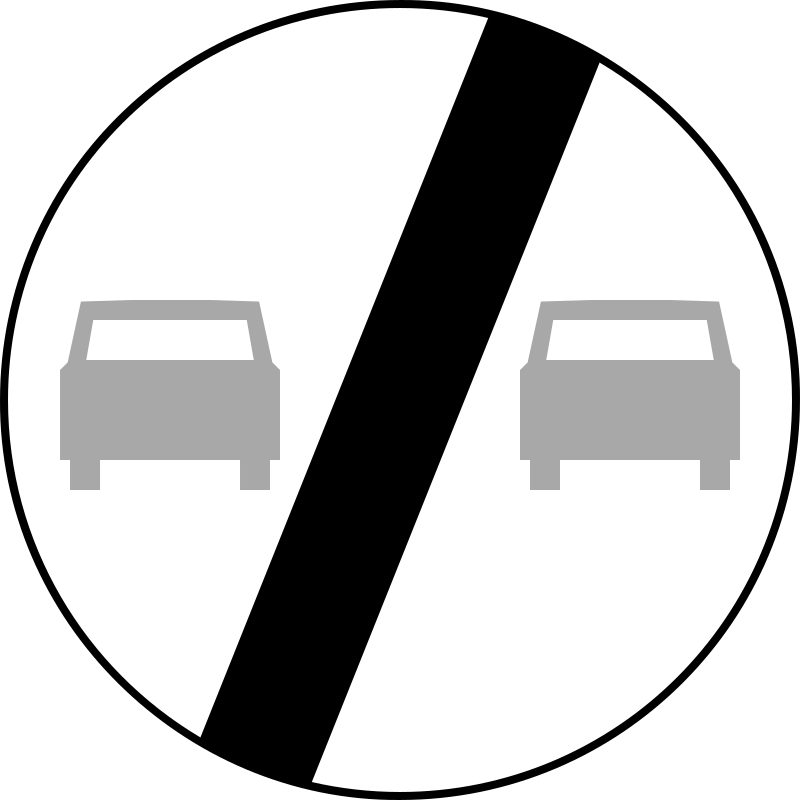
English • Traffic sign B-27 • End of the overtaking prohibition. Sign B-27 ends the prohibition imposed by B-25.
Polski • B-27 • koniec zakazu wyprzedzania. Znak B-27 „koniec zakazu wyprzedzania” oznacza koniec obowiązywania zakazu określonego znakiem B-25.
Sources
🔗 Commons.wikimedia.org
🔗 Eli.gov.pl • § 23 ust. 4
SVG source: Commons.wikimedia.org • Original SVG
Szczepan dyskusja Mail 18:29, 31 December 2006 (UTC) • Public domain • Original revision 2025-09-28. Wikimedia original unmodified.
Artwork reviewed against the Polish official sign catalogue, Dz.U. 2019 poz. 2310: Eli.gov.pl • B-27, PDF page 42, with amendments 2021/433, 2021/2065, 2022/2372 and 2026/133 checked. Catalogue-equivalent illustration; intentional update from the previous PNG. This is an educational illustration, not a manufacturing specification.
72. Dépassement interdit pour les camions
Ce panneau de signalisation indique interdiction de dépasser pour les camions. Cela signifie que les camions (véhicules de transport de marchandises) ne sont pas autorisés à dépasser d'autres véhicules au-delà de ce point. Les autres véhicules (voitures, motos, etc.) peuvent être autorisés à dépasser si cela est permis.
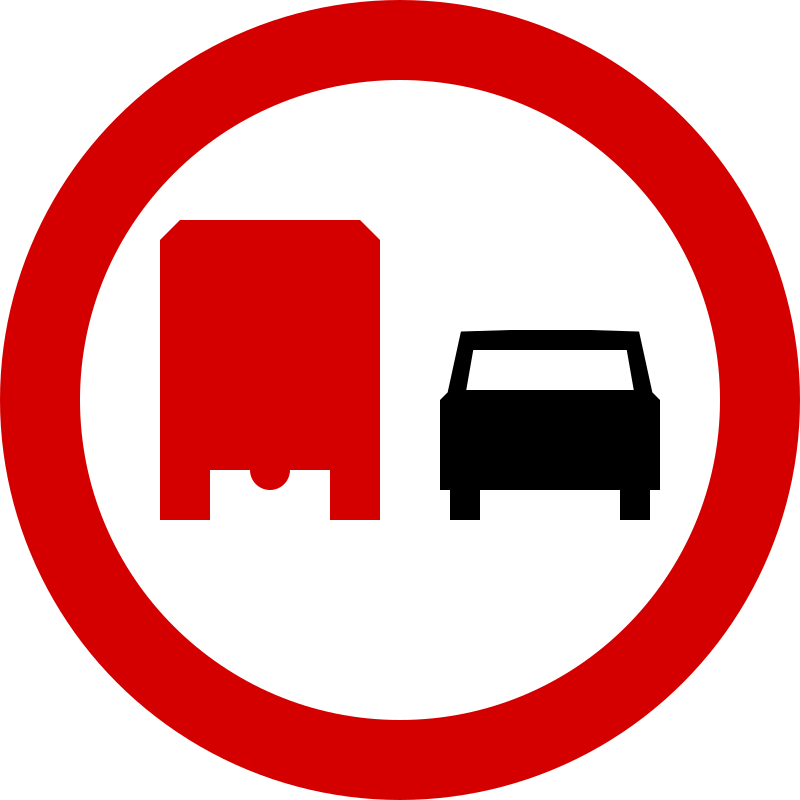
English • Traffic sign B-26 • No overtaking by lorries. Sign B-26 prohibits overtaking multi-track motor vehicles by drivers of lorries with a maximum authorised mass exceeding 3.5 t; tractor units; and special vehicles or vehicles used for special purposes with a maximum authorised mass exceeding 3.5 t.
Polski • B-26 • zakaz wyprzedzania przez samochody ciężarowe. Znak B-26 „zakaz wyprzedzania przez samochody ciężarowe” zabrania wyprzedzania pojazdów silnikowych wielośladowych kierującemu: samochodem ciężarowym o dopuszczalnej masie całkowitej przekraczającej 3,5 t; ciągnikiem samochodowym; pojazdem specjalnym lub używanym do celów specjalnych - o dopuszczalnej masie całkowitej przekraczającej 3,5 t.
Sources
🔗 Commons.wikimedia.org
🔗 Eli.gov.pl • § 23 ust. 3
SVG source: Commons.wikimedia.org • Original SVG
Szczepan dyskusja Mail 18:29, 31 December 2006 (UTC) • Public domain • Original revision 2025-09-28. Wikimedia original unmodified.
Artwork reviewed against the Polish official sign catalogue, Dz.U. 2019 poz. 2310: Eli.gov.pl • B-26, PDF page 42, with amendments 2021/433, 2021/2065, 2022/2372 and 2026/133 checked. Catalogue-equivalent illustration; intentional update from the previous PNG. This is an educational illustration, not a manufacturing specification.
73. Fin de l'interdiction de dépassement pour les camions
Ce panneau de signalisation indique la fin de l’interdiction de dépassement pour les camions. Cela signifie que l’interdiction de dépasser pour les camions est levée. Dès ce point, les camions peuvent de nouveau dépasser, sous réserve des règles générales de circulation.
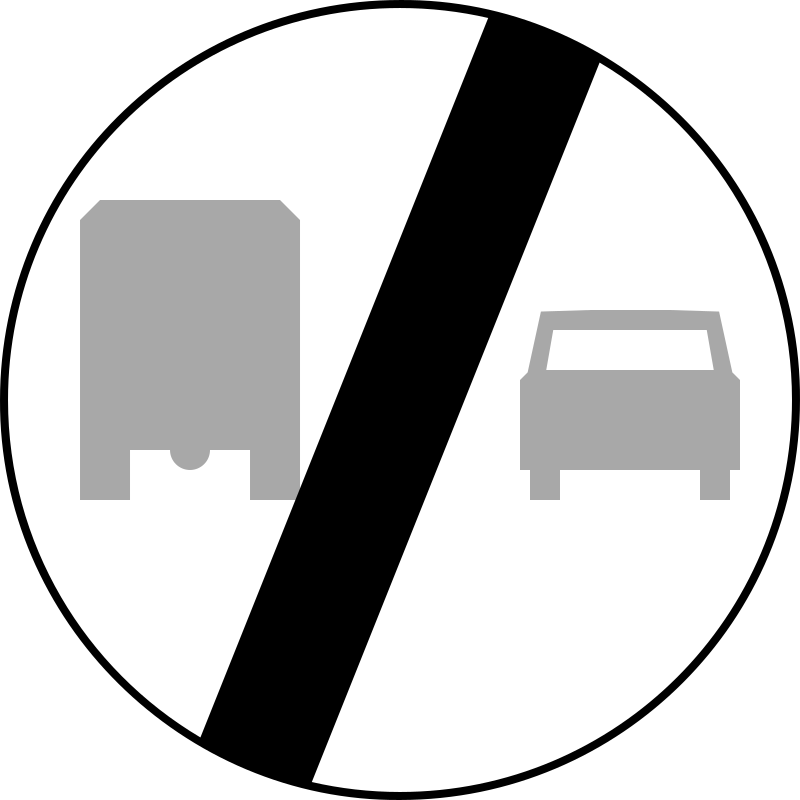
English • Traffic sign B-28 • End of the overtaking prohibition for lorries. Sign B-28 ends the prohibition imposed by B-26.
Polski • B-28 • koniec zakazu wyprzedzania przez samochody ciężarowe. Znak B-28 „koniec zakazu wyprzedzania przez samochody ciężarowe” oznacza koniec obowiązywania zakazu określonego znakiem B-26.
Sources
🔗 Commons.wikimedia.org
🔗 Eli.gov.pl • § 23 ust. 5
SVG source: Commons.wikimedia.org • Original SVG
Szczepan dyskusja Mail 18:29, 31 December 2006 (UTC) • Public domain • Original revision 2025-09-28. Wikimedia original unmodified.
Artwork reviewed against the Polish official sign catalogue, Dz.U. 2019 poz. 2310: Eli.gov.pl • B-28, PDF page 42, with amendments 2021/433, 2021/2065, 2022/2372 and 2026/133 checked. Catalogue-equivalent illustration; intentional update from the previous PNG. This is an educational illustration, not a manufacturing specification.
74. Début d'une limitation de vitesse
Ce panneau de signalisation indique le début d'une limitation de vitesse. Cela signifie le commencement d'une limitation de vitesse maximale que les usagers doivent respecter à partir de ce point, rouler plus vite est interdit. Cela s'applique jusqu'à l'apparition d'un nouveau panneau de limitation de vitesse ou d'un panneau « fin de limitation de vitesse ».
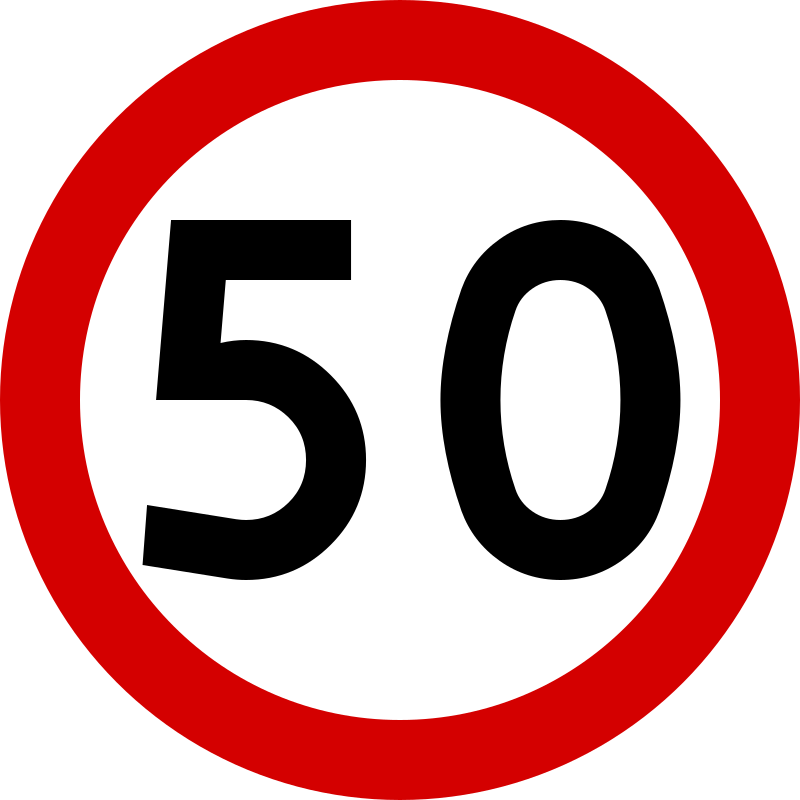
English • Traffic sign B-33 • Speed limit. Sign B-33 prohibits exceeding the speed shown in kilometres per hour. Subject to subsection 4 and section 32, the limit applies until another limit is introduced by B-33 or B-43; D-40 marks the beginning of a residential area; or signs mark the beginning or end of a built-up area as referred to in section 58(3) and section 114(1), points 1 and 2.
Polski • B-33 • ograniczenie prędkości. Znak B-33 „ograniczenie prędkości” oznacza zakaz przekraczania prędkości określonej na znaku liczbą kilometrów na godzinę. Dopuszczalna prędkość określona na znaku obowiązuje, z zastrzeżeniem ust. 4 i § 32, do miejsca: wprowadzenia innej dopuszczalnej prędkości znakiem B-33 lub B-43; umieszczenia znaku D-40 oznaczającego początek strefy zamieszkania; umieszczenia znaków oznaczających odpowiednio początek lub koniec obszaru zabudowanego, o których mowa w § 58 ust. 3 i w § 114 ust. 1 pkt 1 i 2.
Sources
🔗 Commons.wikimedia.org
🔗 Eli.gov.pl • § 27 ust. 1
SVG source: Commons.wikimedia.org • Original SVG
Miko101 • Public domain • Original revision 2026-03-30. Wikimedia original unmodified.
Artwork reviewed against the Polish official sign catalogue, Dz.U. 2019 poz. 2310: Eli.gov.pl • B-33, PDF page 42, with amendments 2021/433, 2021/2065, 2022/2372 and 2026/133 checked. Catalogue-equivalent illustration; intentional update from the previous PNG. This is an educational illustration, not a manufacturing specification.
75. Fin de la limitation de vitesse
Ce panneau de signalisation indique la fin de la limitation de vitesse. Cela marque la fin d’une limitation de vitesse maximale indiquée auparavant. À partir de ce point, les limitations de vitesse générales (par type de route et de véhicule) s’appliquent.
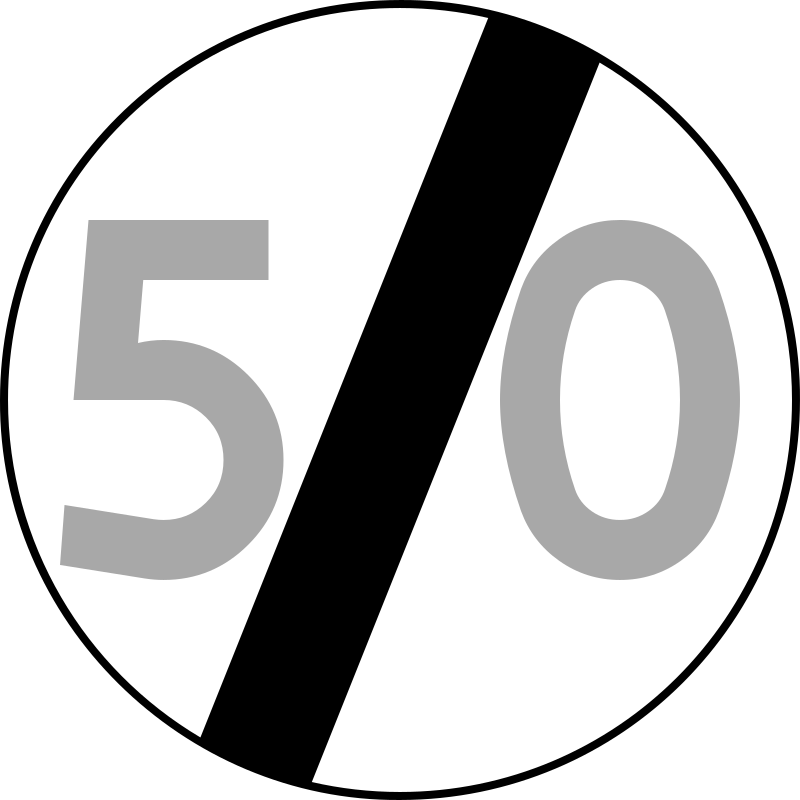
English • Traffic sign B-34 • End of the speed limit. Sign B-34 cancels the speed restriction introduced by B-33.
Polski • B-34 • koniec ograniczenia prędkości. Znak B-34 „koniec ograniczenia prędkości” oznacza odwołanie ograniczenia prędkości wprowadzonego znakiem B-33.
Sources
🔗 Commons.wikimedia.org
🔗 Eli.gov.pl • § 27 ust. 4
SVG source: Commons.wikimedia.org • Original SVG
Szczepan dyskusja Mail 18:29, 31 December 2006 (UTC) • Public domain • Original revision 2025-10-01. Wikimedia original unmodified.
Artwork reviewed against the Polish official sign catalogue, Dz.U. 2019 poz. 2310: Eli.gov.pl • B-34, PDF page 42, with amendments 2021/433, 2021/2065, 2022/2372 and 2026/133 checked. Catalogue-equivalent illustration; intentional update from the previous PNG. This is an educational illustration, not a manufacturing specification.
76. Début d'une zone à vitesse limitée
Ce panneau de signalisation indique le début d'une zone à limitation de vitesse. Cela signifie le commencement d'une zone (et non d'une simple portion de route) où une limitation de vitesse spécifique s'applique jusqu'à l'apparition d'un panneau de fin de zone. La limite reste en vigueur jusqu'à une signalisation explicite de fin de zone. Utilisé notamment dans : zones résidentielles, abords d'écoles, centres-villes ou zones apaisées.
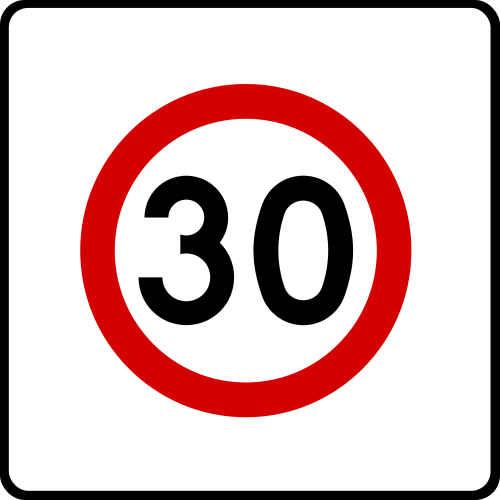
English • Traffic sign B-43 • Speed-limit zone. Sign B-43 marks entry to a zone where exceeding the speed shown in kilometres per hour is prohibited.
Polski • B-43 • strefa ograniczonej prędkości. Znak B-43 „strefa ograniczonej prędkości” oznacza wjazd do strefy, w której obowiązuje zakaz przekraczania prędkości określonej na znaku liczbą kilometrów na godzinę.
Sources
🔗 Commons.wikimedia.org
🔗 Eli.gov.pl • § 31 ust. 1
SVG source: Commons.wikimedia.org • Original SVG
Szczepan dyskusja Mail 18:29, 31 December 2006 (UTC) • Public domain • Original revision 2023-10-15. Wikimedia original unmodified.
Artwork reviewed against the Polish official sign catalogue, Dz.U. 2019 poz. 2310: Eli.gov.pl • B-43, PDF page 42, with amendments 2021/433, 2021/2065, 2022/2372 and 2026/133 checked. Catalogue-equivalent illustration; intentional update from the previous PNG. This is an educational illustration, not a manufacturing specification.
77. Fin de la zone avec limitation de vitesse
Ce panneau de signalisation indique la fin de la zone à limitation de vitesse. Cela marque la fin d’une zone où une limite de vitesse spécifique était en vigueur. À partir de ce point, les limitations de vitesse standards ou nouvellement affichées s’appliquent.

English • Traffic sign B-44 • End of the speed-limit zone. Sign B-44 marks the exit from a speed-limit zone.
Polski • B-44 • koniec strefy ograniczonej prędkości. Znak B-44 „koniec strefy ograniczonej prędkości” oznacza wyjazd ze strefy ograniczonej prędkości.
Sources
🔗 Commons.wikimedia.org
🔗 Eli.gov.pl • § 31 ust. 3
SVG source: Commons.wikimedia.org • Original SVG
Szczepan dyskusja Mail 18:29, 31 December 2006 (UTC) • Public domain • Original revision 2023-10-15. Wikimedia original unmodified.
Artwork reviewed against the Polish official sign catalogue, Dz.U. 2019 poz. 2310: Eli.gov.pl • B-44, PDF page 42, with amendments 2021/433, 2021/2065, 2022/2372 and 2026/133 checked. Catalogue-equivalent illustration; intentional update from the previous PNG. This is an educational illustration, not a manufacturing specification.
78. Klaxon interdit
Ce panneau de signalisation indique que l'usage du klaxon est interdit. Cela signifie que l'utilisation du klaxon (avertisseurs sonores) n'est pas autorisée au-delà de ce point, sauf en cas d'urgence.
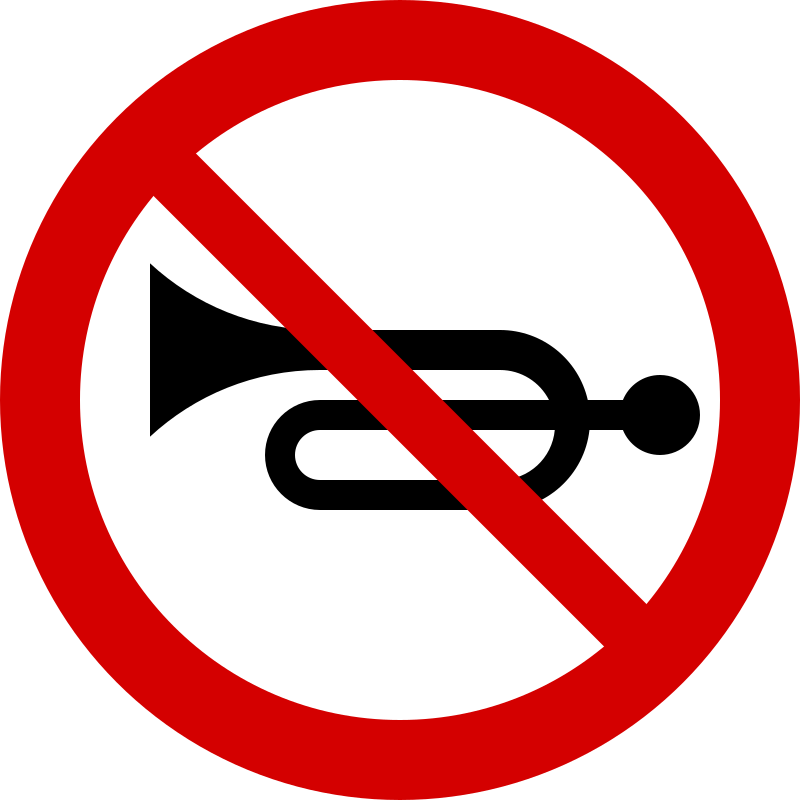
English • Traffic sign B-29 • No audible warning signals. Sign B-29 prohibits their use unless necessary to warn of an immediate danger to road safety.
Polski • B-29 • zakaz używania sygnałów dźwiękowych. Znak B-29 „zakaz używania sygnałów dźwiękowych” zabrania używania tych sygnałów, chyba że jest to konieczne w celu ostrzeżenia o bezpośrednim zagrożeniu bezpieczeństwa ruchu.
Sources
🔗 Commons.wikimedia.org
🔗 Eli.gov.pl • § 24 ust. 1
SVG source: Commons.wikimedia.org • Original SVG
Szczepan dyskusja Mail 18:29, 31 December 2006 (UTC) • Public domain • Original revision 2025-09-28. Wikimedia original unmodified.
Artwork reviewed against the Polish official sign catalogue, Dz.U. 2019 poz. 2310: Eli.gov.pl • B-29, PDF page 42, with amendments 2021/433, 2021/2065, 2022/2372 and 2026/133 checked. Catalogue-equivalent illustration; intentional update from the previous PNG. This is an educational illustration, not a manufacturing specification.
79. Fin de l'interdiction de klaxonner
Ce panneau de signalisation indique la fin de l’interdiction de klaxon. Ce panneau indique la fin de la zone où l’utilisation du klaxon était interdite. À partir de ce point, les règles habituelles concernant l’usage du klaxon s’appliquent de nouveau.
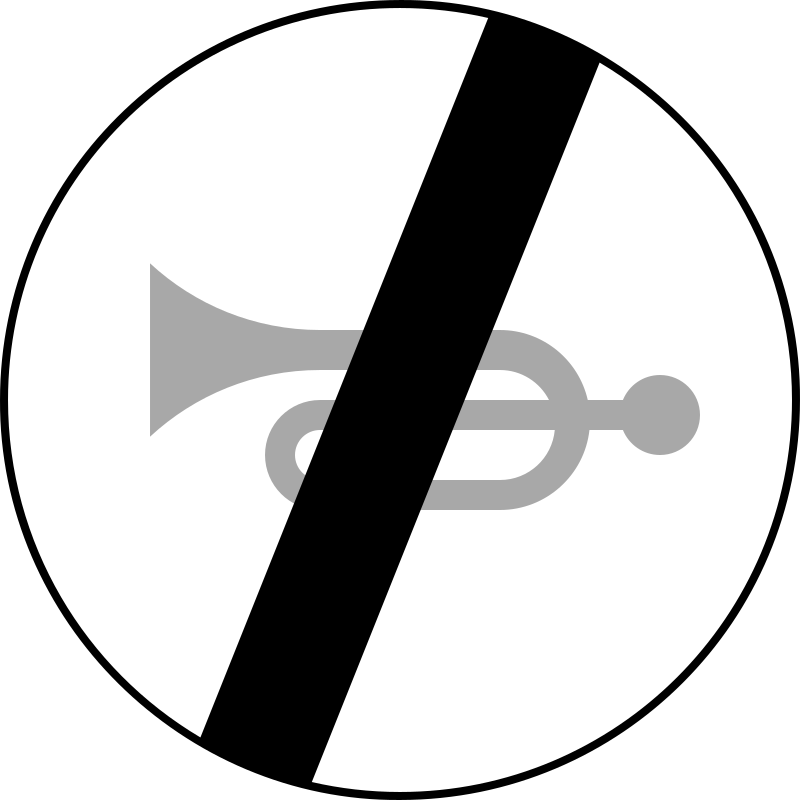
English • Traffic sign B-30 • End of the prohibition on audible warning signals. Sign B-30 ends the prohibition imposed by B-29.
Polski • B-30 • koniec zakazu używania sygnałów dźwiękowych. Znak B-30 „koniec zakazu używania sygnałów dźwiękowych” oznacza koniec obowiązywania zakazu określonego znakiem B-29.
Sources
🔗 Commons.wikimedia.org
🔗 Eli.gov.pl • § 24 ust. 2
SVG source: Commons.wikimedia.org • Original SVG
Szczepan dyskusja Mail 18:29, 31 December 2006 (UTC) • Public domain • Original revision 2025-09-28. Wikimedia original unmodified.
Artwork reviewed against the Polish official sign catalogue, Dz.U. 2019 poz. 2310: Eli.gov.pl • B-30, PDF page 42, with amendments 2021/433, 2021/2065, 2022/2372 and 2026/133 checked. Catalogue-equivalent illustration; intentional update from the previous PNG. This is an educational illustration, not a manufacturing specification.
80. Entrée interdite (point de contrôle)
Ce panneau de signalisation indique un poste de contrôle. Cela signifie que l’accès n’est pas autorisé à un poste de contrôle — par exemple : poste-frontière, douane, zone militaire ou zone à accès contrôlé. Accès interdit à tout véhicule et personne non autorisés. L’accès peut être possible uniquement sur autorisation, par exemple : carte d’identité ou passeport valide, documents de fret (pour la douane), accréditation de sécurité.
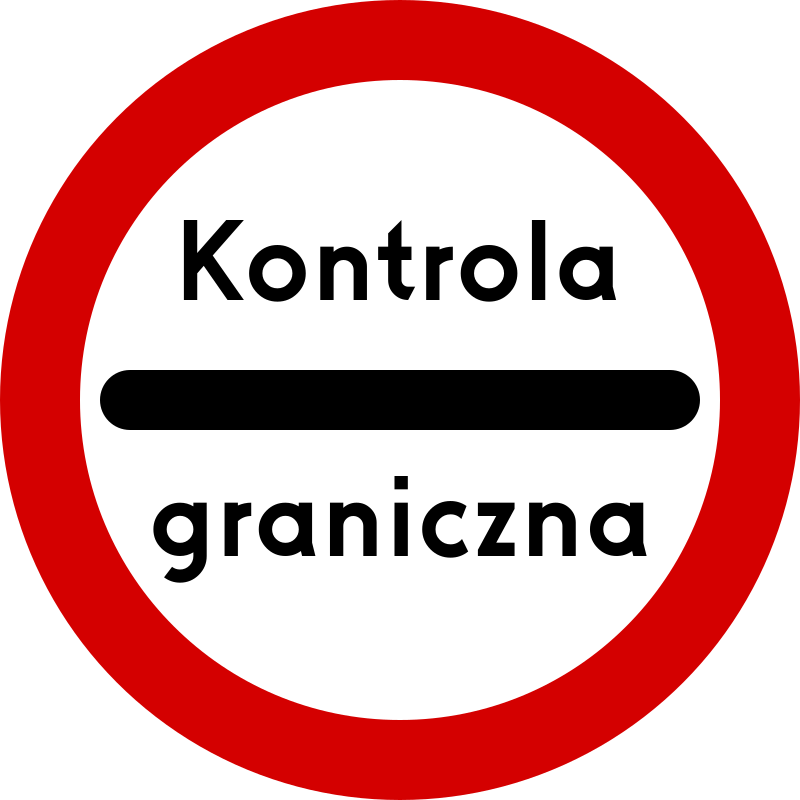
English • Traffic sign B-32 • Stop for customs control. Sign B-32 requires drivers to stop. Instead of “Cło-Zoll” (customs), the sign may read “Kontrola graniczna” (border control), “Rogatka uszkodzona” (barrier damaged), “Sygnalizacja uszkodzona” (signals defective), “Wjazd na prom” (ferry boarding), “Kontrola drogowa” (road check) or “Pobór opłat” (toll collection), according to the reason for stopping.
Polski • B-32 • stój – kontrola celna. Znak B-32 „stój - kontrola celna” oznacza obowiązek zatrzymania się. Zamiast napisu „Cło-Zoll” na znaku mogą być umieszczone napisy „Kontrola graniczna”, „Rogatka uszkodzona”, „Sygnalizacja uszkodzona”, „Wjazd na prom”, „Kontrola drogowa” lub „Pobór opłat” - odpowiednio do przyczyny zatrzymania.
Sources
🔗 Commons.wikimedia.org
🔗 Eli.gov.pl • § 26 ust. 1
SVG source: Commons.wikimedia.org • Original SVG
Pz • Public domain • Original revision 2025-10-01. Wikimedia original unmodified.
Artwork reviewed against the Polish official sign catalogue, Dz.U. 2019 poz. 2310: Eli.gov.pl • B-32, PDF page 42, with amendments 2021/433, 2021/2065, 2022/2372 and 2026/133 checked. Catalogue-equivalent illustration; intentional update from the previous PNG. This is an educational illustration, not a manufacturing specification.
81. Stationnement interdit
Ce panneau de signalisation indique que le stationnement est interdit. Cela signifie que le stationnement n’est pas autorisé dans la zone où le panneau est placé. Cela s’applique à tous les véhicules, sauf exceptions mentionnées. L’arrêt temporaire (sans quitter le véhicule) peut être autorisé.

English • Traffic sign B-35 • No parking. Sign B-35 prohibits parking. Any permitted stationary period longer than one minute is stated on the sign or a plate below it.
Polski • B-35 • zakaz postoju. Znak B-35 „zakaz postoju” oznacza zakaz postoju pojazdu; dopuszczalny czas unieruchomienia pojazdu dłuższy niż jedna minuta jest wskazany napisem na znaku albo na umieszczonej pod nim tabliczce.
Sources
🔗 Commons.wikimedia.org
🔗 Eli.gov.pl • § 28 ust. 1
SVG source: Commons.wikimedia.org • Original SVG
Szczepan dyskusja Mail 18:29, 31 December 2006 (UTC) • Public domain • Original revision 2025-09-29. Wikimedia original unmodified.
Artwork reviewed against the Polish official sign catalogue, Dz.U. 2019 poz. 2310: Eli.gov.pl • B-35, PDF page 42, with amendments 2021/433, 2021/2065, 2022/2372 and 2026/133 checked. Catalogue-equivalent illustration; intentional update from the previous PNG. This is an educational illustration, not a manufacturing specification.
82. Stationnement interdit les jours pairs
Ce panneau indique que le stationnement est interdit les dates paires du côté de la route concerné. Les heures de changement, exceptions et règles applicables au côté opposé dépendent de la réglementation locale.
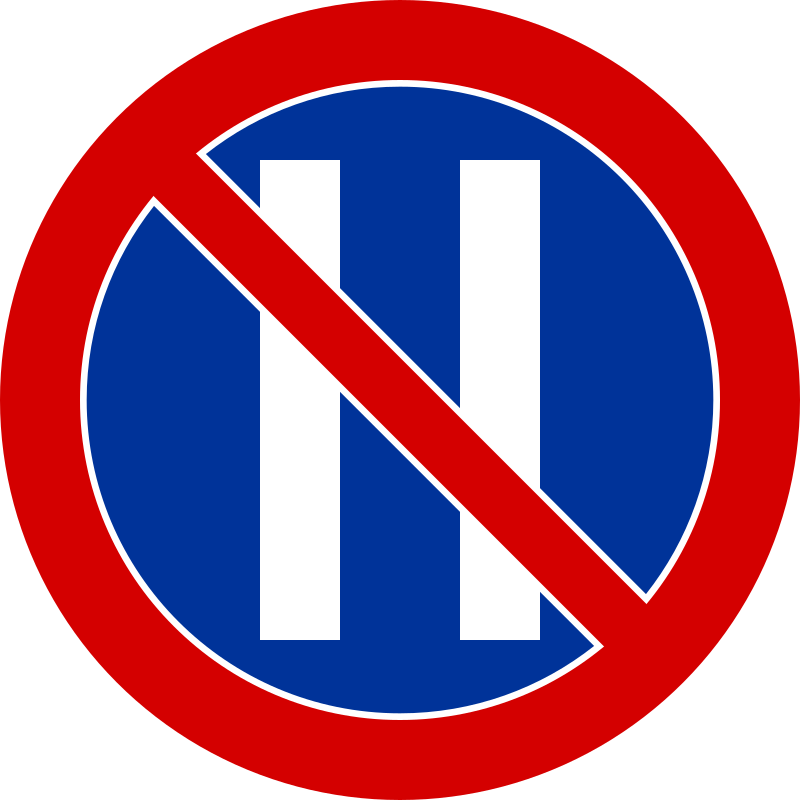
English • Traffic sign B-38 • No parking on even dates. Signs B-37, No parking on odd dates, and B-38, No parking on even dates, prohibit parking on the corresponding dates of the month. The prohibition does not apply from 21:00 to 24:00. Subsections 1 and 3–5 apply correspondingly.
Polski • B-38 • zakaz postoju w dni parzyste. Znaki: B-37 „zakaz postoju w dni nieparzyste”, B-38 „zakaz postoju w dni parzyste” oznaczają zakaz postoju pojazdów odpowiednio w nieparzyste lub parzyste dni miesiąca; zakaz nie obowiązuje od godziny 21 do 24; przepisy ust. 1 i 3-5 stosuje się odpowiednio do tych znaków.
Sources
🔗 Commons.wikimedia.org
🔗 Eli.gov.pl • § 28 ust. 6
SVG source: Commons.wikimedia.org • Original SVG
Szczepan dyskusja Mail 18:29, 31 December 2006 (UTC) • Public domain • Original revision 2025-09-29. Wikimedia original unmodified.
Artwork reviewed against the Polish official sign catalogue, Dz.U. 2019 poz. 2310: Eli.gov.pl • B-38, PDF page 42, with amendments 2021/433, 2021/2065, 2022/2372 and 2026/133 checked. Catalogue-equivalent illustration; intentional update from the previous PNG. This is an educational illustration, not a manufacturing specification.
83. Stationnement interdit les jours impairs
Ce panneau indique que le stationnement est interdit les dates impaires du côté de la route concerné. Les heures de changement, exceptions et règles applicables au côté opposé dépendent de la réglementation locale.
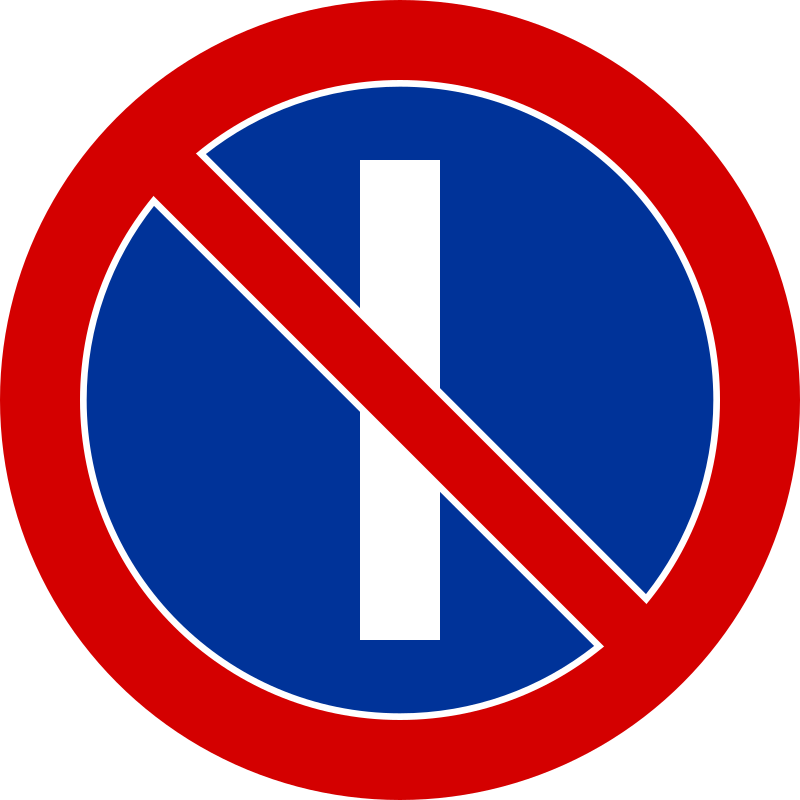
English • Traffic sign B-37 • No parking on odd dates. Signs B-37, No parking on odd dates, and B-38, No parking on even dates, prohibit parking on the corresponding dates of the month. The prohibition does not apply from 21:00 to 24:00. Subsections 1 and 3–5 apply correspondingly.
Polski • B-37 • zakaz postoju w dni nieparzyste. Znaki: B-37 „zakaz postoju w dni nieparzyste”, B-38 „zakaz postoju w dni parzyste” oznaczają zakaz postoju pojazdów odpowiednio w nieparzyste lub parzyste dni miesiąca; zakaz nie obowiązuje od godziny 21 do 24; przepisy ust. 1 i 3-5 stosuje się odpowiednio do tych znaków.
Sources
🔗 Commons.wikimedia.org
🔗 Eli.gov.pl • § 28 ust. 6
SVG source: Commons.wikimedia.org • Original SVG
Szczepan dyskusja Mail 18:29, 31 December 2006 (UTC) • Public domain • Original revision 2025-09-29. Wikimedia original unmodified.
Artwork reviewed against the Polish official sign catalogue, Dz.U. 2019 poz. 2310: Eli.gov.pl • B-37, PDF page 42, with amendments 2021/433, 2021/2065, 2022/2372 and 2026/133 checked. Catalogue-equivalent illustration; intentional update from the previous PNG. This is an educational illustration, not a manufacturing specification.
84. Arrêt et stationnement interdits
Ce panneau de signalisation indique que le stationnement et l’arrêt sont interdits. Cela signifie que le stationnement ainsi que l'arrêt du véhicule sont strictement interdits dans la zone où le panneau est placé. Arrêt interdit : il n’est même pas permis de s’arrêter brièvement, même pour déposer ou prendre des passagers. Stationnement interdit : il n’est pas autorisé non plus, car il inclut l’arrêt. Les infractions peuvent entraîner une amende ou une mise en fourrière.

English • Traffic sign B-36 • No stopping. Sign B-36 prohibits stopping a vehicle.
Polski • B-36 • zakaz zatrzymywania się. Znak B-36 „zakaz zatrzymywania się” oznacza zakaz zatrzymania pojazdu.
Sources
🔗 Commons.wikimedia.org
🔗 Eli.gov.pl • § 28 ust. 2
SVG source: Commons.wikimedia.org • Original SVG
Szczepan dyskusja Mail 18:29, 31 December 2006 (UTC) • Public domain • Original revision 2025-09-29. Wikimedia original unmodified.
Artwork reviewed against the Polish official sign catalogue, Dz.U. 2019 poz. 2310: Eli.gov.pl • B-36, PDF page 42, with amendments 2021/433, 2021/2065, 2022/2372 and 2026/133 checked. Catalogue-equivalent illustration; intentional update from the previous PNG. This is an educational illustration, not a manufacturing specification.
85. Début de zone où le stationnement est interdit
Ce panneau de signalisation indique une zone où le stationnement est interdit. Il marque le début d'une zone dans laquelle le stationnement est interdit, généralement sur toutes les voies publiques de cette zone, jusqu'à ce qu'un panneau de "fin de zone" soit affiché. L'arrêt temporaire (pour déposer ou prendre des passagers) reste autorisé.
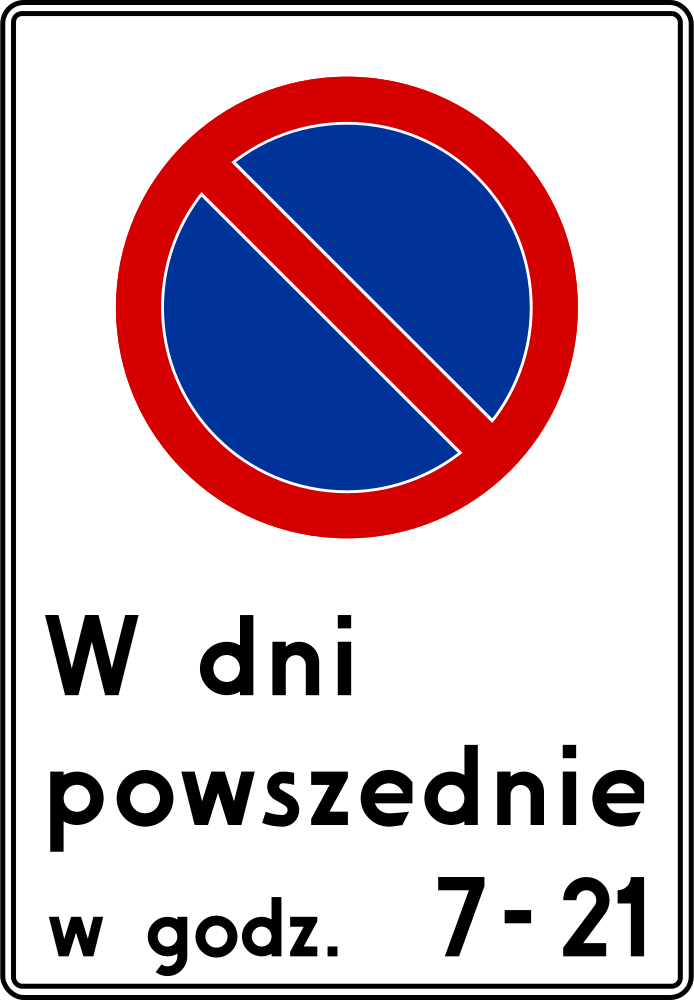
English • Traffic sign B-39 • Restricted-parking zone. Sign B-39 marks entry to a zone where parking is prohibited on all roads. Any permitted stationary period longer than one minute is stated on the sign.
Polski • B-39 • strefa ograniczonego postoju. Znak B-39 „strefa ograniczonego postoju” oznacza wjazd do strefy, w której obowiązuje zakaz postoju pojazdów na wszystkich drogach; dopuszczalny czas unieruchomienia pojazdu dłuższy niż jedna minuta jest wskazany napisem na znaku.
Sources
🔗 Commons.wikimedia.org
🔗 Eli.gov.pl • § 29 ust. 1
SVG source: Commons.wikimedia.org • Original SVG
Szczepan dyskusja Mail 18:29, 31 December 2006 (UTC) • Public domain • Original revision 2023-10-07. Wikimedia original unmodified.
Artwork reviewed against the Polish official sign catalogue, Dz.U. 2019 poz. 2310: Eli.gov.pl • B-39, PDF page 42, with amendments 2021/433, 2021/2065, 2022/2372 and 2026/133 checked. Catalogue-equivalent illustration; intentional update from the previous PNG. This is an educational illustration, not a manufacturing specification.
86. Fin de la zone où le stationnement est interdit
Ce panneau de signalisation indique la fin de la zone d’interdiction de stationner. Il marque la fin d’une zone où le stationnement était interdit. À partir de ce point, le stationnement est de nouveau autorisé, sauf indication contraire.

English • Traffic sign B-40 • End of the restricted-parking zone. Sign B-40 marks the exit from a restricted-parking zone.
Polski • B-40 • koniec strefy ograniczonego postoju. Znak B-40 „koniec strefy ograniczonego postoju” oznacza wyjazd ze strefy ograniczonego postoju.
Sources
🔗 Commons.wikimedia.org
🔗 Eli.gov.pl • § 29 ust. 3
SVG source: Commons.wikimedia.org • Original SVG
Szczepan dyskusja Mail 18:29, 31 December 2006 (UTC) • Public domain • Original revision 2023-10-07. Wikimedia original unmodified.
Artwork reviewed against the Polish official sign catalogue, Dz.U. 2019 poz. 2310: Eli.gov.pl • B-40, PDF page 42, with amendments 2021/433, 2021/2065, 2022/2372 and 2026/133 checked. Catalogue-equivalent illustration; intentional update from the previous PNG. This is an educational illustration, not a manufacturing specification.
87. Sens obligatoire du rond-point
Ce panneau de signalisation indique une obligation de suivre le sens du rond-point. Vous êtes tenu d’entrer et de circuler dans le rond-point dans le sens indiqué. Tourner à gauche, à droite ou aller tout droit sans suivre le rond-point est interdit.
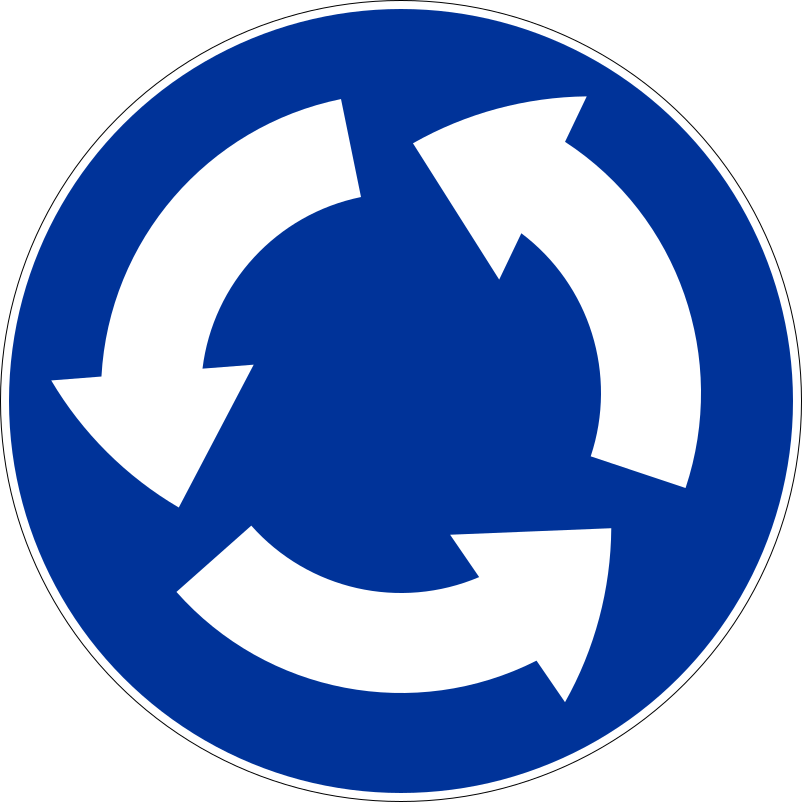
English • Traffic sign C-12 • Roundabout. Sign C-12 indicates that traffic at the junction circulates around an island or square in the direction shown.
Polski • C-12 • ruch okrężny. Znak C-12 „ruch okrężny” oznacza, że na skrzyżowaniu ruch odbywa się dookoła wyspy lub placu w kierunku wskazanym na znaku.
Sources
🔗 Commons.wikimedia.org
🔗 Eli.gov.pl • § 36 ust. 1
SVG source: Commons.wikimedia.org • Original SVG
Paweł Grzywocz • Public domain • Original revision 2025-09-26. Wikimedia original unmodified.
Artwork reviewed against the Polish official sign catalogue, Dz.U. 2019 poz. 2310: Eli.gov.pl • C-12, PDF page 43, with amendments 2021/433, 2021/2065, 2022/2372 and 2026/133 checked. Catalogue-equivalent illustration; intentional update from the previous PNG. This is an educational illustration, not a manufacturing specification.
88. Obligation de tourner à gauche
Ce panneau de signalisation indique que le virage à gauche est obligatoire. Cela signifie que toute la circulation doit tourner à gauche à la prochaine intersection ou carrefour. Aller tout droit ou tourner à droite est interdit. Cela permet d'assurer la circulation et la sécurité aux intersections.
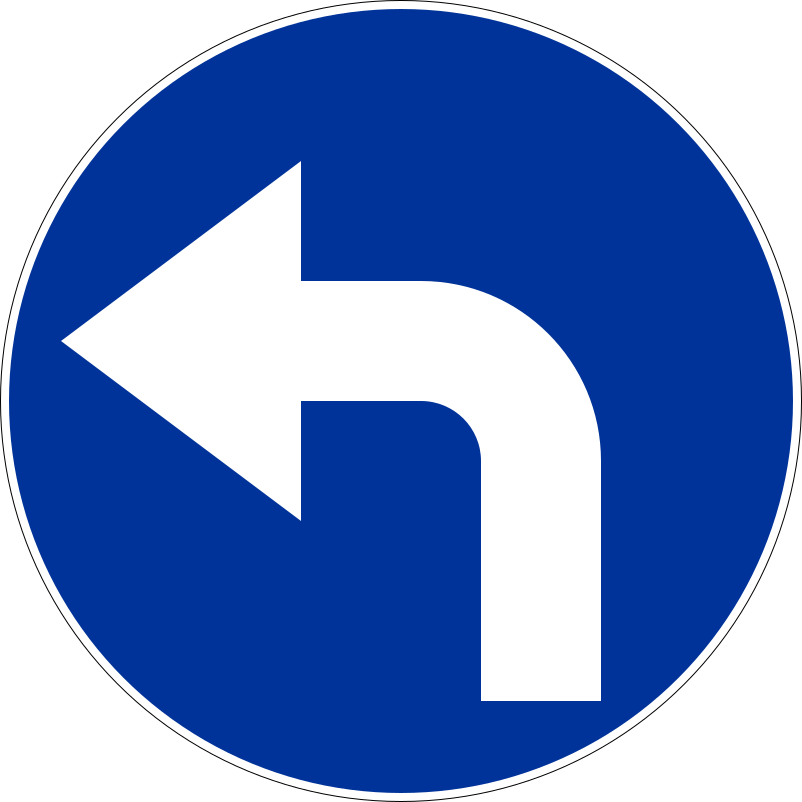
English • Traffic sign C-4 • Turn left after the sign. Signs C-1, Turn right before the sign; C-2, Turn right after the sign; C-3, Turn left before the sign; C-4, Turn left after the sign; C-5, Ahead only; C-6, Ahead or right only; C-7, Ahead or left only; C-8, Turn right or left; C-9, Pass to the right of the sign; C-10, Pass to the left of the sign; and C-11, Pass to either side of the sign, require drivers to follow the arrows. These signs may be installed in line with the road or carriageway centre line, or on the carriageway itself.
Polski • C-4 • nakaz jazdy w lewo za znakiem. Znaki: C-1 „nakaz jazdy w prawo przed znakiem”, C-2 „nakaz jazdy w prawo za znakiem”, C-3 „nakaz jazdy w lewo przed znakiem”, C-4 „nakaz jazdy w lewo za znakiem”, C-5 „nakaz jazdy prosto”, C-6 „nakaz jazdy prosto lub w prawo”, C-7 „nakaz jazdy prosto lub w lewo”, C-8 „nakaz jazdy w prawo lub w lewo”, C-9 „nakaz jazdy z prawej strony znaku”, C-10 „nakaz jazdy z lewej strony znaku”, C-11 „nakaz jazdy z prawej lub lewej strony znaku” zobowiązują kierującego do ruchu w kierunku zgodnym ze strzałkami; znaki te mogą być umieszczone na przedłużeniu osi drogi (jezdni) lub na samej jezdni.
Sources
🔗 Commons.wikimedia.org
🔗 Eli.gov.pl • § 35 ust. 1
SVG source: Commons.wikimedia.org • Original SVG
Paweł Grzywocz • Public domain • Original revision 2025-09-26. Wikimedia original unmodified.
Artwork reviewed against the Polish official sign catalogue, Dz.U. 2019 poz. 2310: Eli.gov.pl • C-4, PDF page 43, with amendments 2021/433, 2021/2065, 2022/2372 and 2026/133 checked. Catalogue-equivalent illustration; intentional update from the previous PNG. This is an educational illustration, not a manufacturing specification.
89. Obligation de tourner à gauche ou à droite
Ce panneau de signalisation indique qu'il est obligatoire de tourner à gauche ou à droite. Cela signifie que tous les véhicules doivent tourner à gauche ou à droite — il est interdit d'aller tout droit.
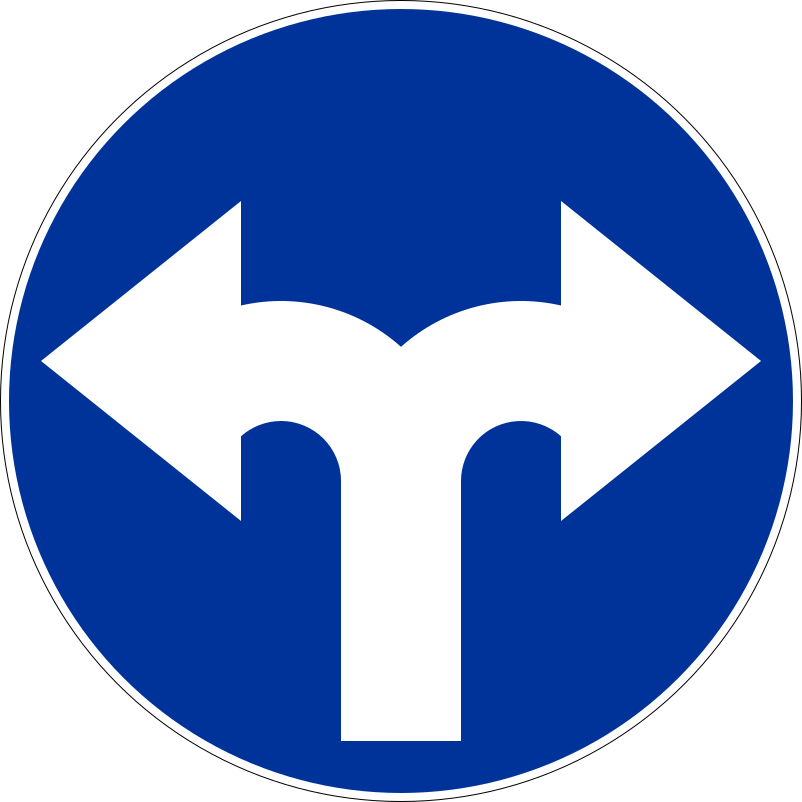
English • Traffic sign C-8 • Turn right or left. Signs C-1, Turn right before the sign; C-2, Turn right after the sign; C-3, Turn left before the sign; C-4, Turn left after the sign; C-5, Ahead only; C-6, Ahead or right only; C-7, Ahead or left only; C-8, Turn right or left; C-9, Pass to the right of the sign; C-10, Pass to the left of the sign; and C-11, Pass to either side of the sign, require drivers to follow the arrows. These signs may be installed in line with the road or carriageway centre line, or on the carriageway itself.
Polski • C-8 • nakaz jazdy w prawo lub w lewo. Znaki: C-1 „nakaz jazdy w prawo przed znakiem”, C-2 „nakaz jazdy w prawo za znakiem”, C-3 „nakaz jazdy w lewo przed znakiem”, C-4 „nakaz jazdy w lewo za znakiem”, C-5 „nakaz jazdy prosto”, C-6 „nakaz jazdy prosto lub w prawo”, C-7 „nakaz jazdy prosto lub w lewo”, C-8 „nakaz jazdy w prawo lub w lewo”, C-9 „nakaz jazdy z prawej strony znaku”, C-10 „nakaz jazdy z lewej strony znaku”, C-11 „nakaz jazdy z prawej lub lewej strony znaku” zobowiązują kierującego do ruchu w kierunku zgodnym ze strzałkami; znaki te mogą być umieszczone na przedłużeniu osi drogi (jezdni) lub na samej jezdni.
Sources
🔗 Commons.wikimedia.org
🔗 Eli.gov.pl • § 35 ust. 1
SVG source: Commons.wikimedia.org • Original SVG
Paweł Grzywocz • Public domain • Original revision 2025-09-26. Wikimedia original unmodified.
Artwork reviewed against the Polish official sign catalogue, Dz.U. 2019 poz. 2310: Eli.gov.pl • C-8, PDF page 43, with amendments 2021/433, 2021/2065, 2022/2372 and 2026/133 checked. Catalogue-equivalent illustration; intentional update from the previous PNG. This is an educational illustration, not a manufacturing specification.
90. Obligation de tourner à droite
Ce panneau de signalisation indique qu'il est obligatoire de tourner à droite. Cela signifie que tous les véhicules doivent tourner à droite à la prochaine intersection ou au carrefour. Aller tout droit ou à gauche n'est pas autorisé.

English • Traffic sign C-2 • Turn right after the sign. Signs C-1, Turn right before the sign; C-2, Turn right after the sign; C-3, Turn left before the sign; C-4, Turn left after the sign; C-5, Ahead only; C-6, Ahead or right only; C-7, Ahead or left only; C-8, Turn right or left; C-9, Pass to the right of the sign; C-10, Pass to the left of the sign; and C-11, Pass to either side of the sign, require drivers to follow the arrows. These signs may be installed in line with the road or carriageway centre line, or on the carriageway itself.
Polski • C-2 • nakaz jazdy w prawo za znakiem. Znaki: C-1 „nakaz jazdy w prawo przed znakiem”, C-2 „nakaz jazdy w prawo za znakiem”, C-3 „nakaz jazdy w lewo przed znakiem”, C-4 „nakaz jazdy w lewo za znakiem”, C-5 „nakaz jazdy prosto”, C-6 „nakaz jazdy prosto lub w prawo”, C-7 „nakaz jazdy prosto lub w lewo”, C-8 „nakaz jazdy w prawo lub w lewo”, C-9 „nakaz jazdy z prawej strony znaku”, C-10 „nakaz jazdy z lewej strony znaku”, C-11 „nakaz jazdy z prawej lub lewej strony znaku” zobowiązują kierującego do ruchu w kierunku zgodnym ze strzałkami; znaki te mogą być umieszczone na przedłużeniu osi drogi (jezdni) lub na samej jezdni.
Sources
🔗 Commons.wikimedia.org
🔗 Eli.gov.pl • § 35 ust. 1
SVG source: Commons.wikimedia.org • Original SVG
Paweł Grzywocz • Public domain • Original revision 2025-09-26. Wikimedia original unmodified.
Artwork reviewed against the Polish official sign catalogue, Dz.U. 2019 poz. 2310: Eli.gov.pl • C-2, PDF page 43, with amendments 2021/433, 2021/2065, 2022/2372 and 2026/133 checked. Catalogue-equivalent illustration; intentional update from the previous PNG. This is an educational illustration, not a manufacturing specification.
91. Contourner l'obstacle par la gauche
Ce panneau de signalisation indique que la circulation doit contourner l’obstacle par la gauche. Restez à gauche de l’obstacle et suivez les éventuels marquages ou panneaux complémentaires.

English • Traffic sign C-10 • Pass to the left of the sign. Signs C-1, Turn right before the sign; C-2, Turn right after the sign; C-3, Turn left before the sign; C-4, Turn left after the sign; C-5, Ahead only; C-6, Ahead or right only; C-7, Ahead or left only; C-8, Turn right or left; C-9, Pass to the right of the sign; C-10, Pass to the left of the sign; and C-11, Pass to either side of the sign, require drivers to follow the arrows. These signs may be installed in line with the road or carriageway centre line, or on the carriageway itself.
Polski • C-10 • nakaz jazdy z lewej strony znaku. Znaki: C-1 „nakaz jazdy w prawo przed znakiem”, C-2 „nakaz jazdy w prawo za znakiem”, C-3 „nakaz jazdy w lewo przed znakiem”, C-4 „nakaz jazdy w lewo za znakiem”, C-5 „nakaz jazdy prosto”, C-6 „nakaz jazdy prosto lub w prawo”, C-7 „nakaz jazdy prosto lub w lewo”, C-8 „nakaz jazdy w prawo lub w lewo”, C-9 „nakaz jazdy z prawej strony znaku”, C-10 „nakaz jazdy z lewej strony znaku”, C-11 „nakaz jazdy z prawej lub lewej strony znaku” zobowiązują kierującego do ruchu w kierunku zgodnym ze strzałkami; znaki te mogą być umieszczone na przedłużeniu osi drogi (jezdni) lub na samej jezdni.
Sources
🔗 Commons.wikimedia.org
🔗 Eli.gov.pl • § 35 ust. 1
SVG source: Commons.wikimedia.org • Original SVG
odder • CC BY-SA 2.5 • Original revision 2025-09-26. Wikimedia original unmodified.
Artwork reviewed against the Polish official sign catalogue, Dz.U. 2019 poz. 2310: Eli.gov.pl • C-10, PDF page 43, with amendments 2021/433, 2021/2065, 2022/2372 and 2026/133 checked. Catalogue-equivalent illustration; intentional update from the previous PNG. This is an educational illustration, not a manufacturing specification.
92. Contourner l'obstacle par la gauche ou la droite
Ce panneau de signalisation indique que la circulation doit contourner l’obstacle par la gauche ou par la droite. Utilisez l’un des côtés autorisés en suivant l’aménagement et la signalisation.
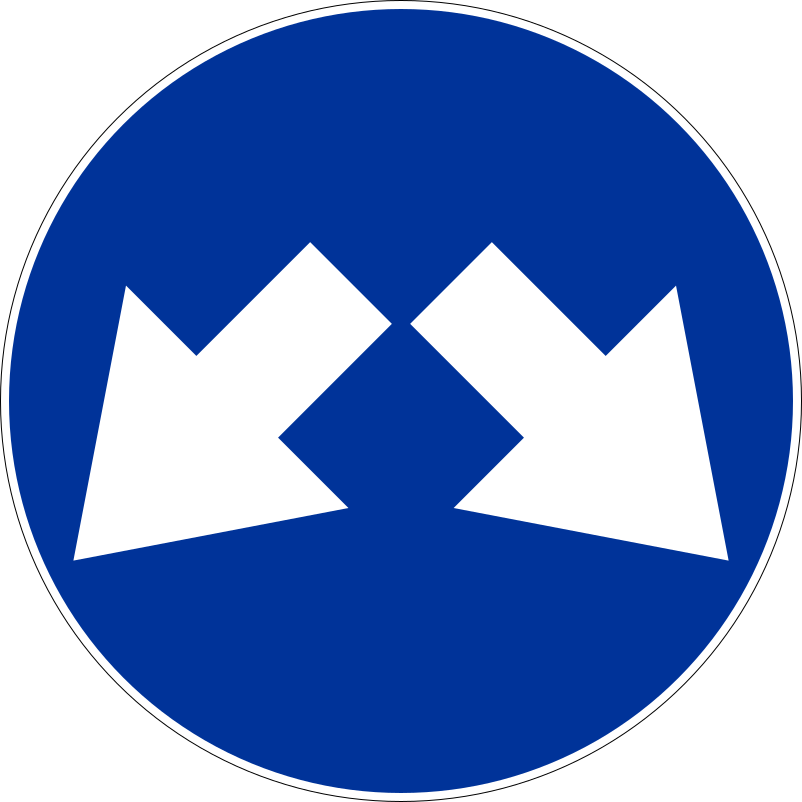
English • Traffic sign C-11 • Pass to either the right or left of the sign. Signs C-1, Turn right before the sign; C-2, Turn right after the sign; C-3, Turn left before the sign; C-4, Turn left after the sign; C-5, Ahead only; C-6, Ahead or right only; C-7, Ahead or left only; C-8, Turn right or left; C-9, Pass to the right of the sign; C-10, Pass to the left of the sign; and C-11, Pass to either side of the sign, require drivers to follow the arrows. These signs may be installed in line with the road or carriageway centre line, or on the carriageway itself.
Polski • C-11 • nakaz jazdy z prawej lub lewej strony znaku. Znaki: C-1 „nakaz jazdy w prawo przed znakiem”, C-2 „nakaz jazdy w prawo za znakiem”, C-3 „nakaz jazdy w lewo przed znakiem”, C-4 „nakaz jazdy w lewo za znakiem”, C-5 „nakaz jazdy prosto”, C-6 „nakaz jazdy prosto lub w prawo”, C-7 „nakaz jazdy prosto lub w lewo”, C-8 „nakaz jazdy w prawo lub w lewo”, C-9 „nakaz jazdy z prawej strony znaku”, C-10 „nakaz jazdy z lewej strony znaku”, C-11 „nakaz jazdy z prawej lub lewej strony znaku” zobowiązują kierującego do ruchu w kierunku zgodnym ze strzałkami; znaki te mogą być umieszczone na przedłużeniu osi drogi (jezdni) lub na samej jezdni.
Sources
🔗 Commons.wikimedia.org
🔗 Eli.gov.pl • § 35 ust. 1
SVG source: Commons.wikimedia.org • Original SVG
Paweł Grzywocz • Public domain • Original revision 2025-09-26. Wikimedia original unmodified.
Artwork reviewed against the Polish official sign catalogue, Dz.U. 2019 poz. 2310: Eli.gov.pl • C-11, PDF page 43, with amendments 2021/433, 2021/2065, 2022/2372 and 2026/133 checked. Catalogue-equivalent illustration; intentional update from the previous PNG. This is an educational illustration, not a manufacturing specification.
93. Contourner l'obstacle par la droite
Ce panneau de signalisation indique que la circulation doit contourner l’obstacle par la droite. Restez à droite de l’obstacle et suivez les éventuels marquages ou panneaux complémentaires.
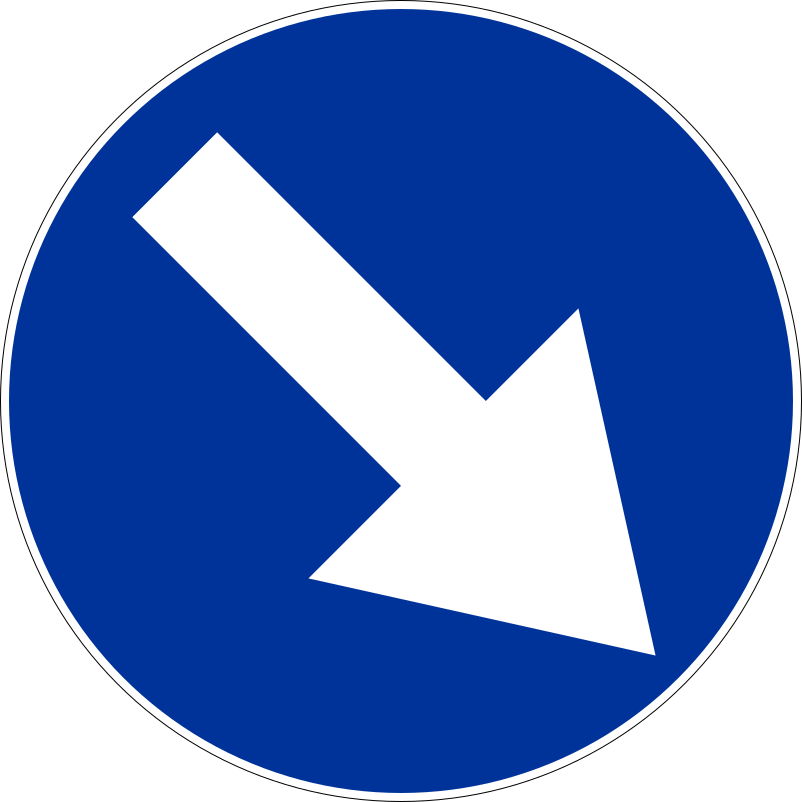
English • Traffic sign C-9 • Pass to the right of the sign. Signs C-1, Turn right before the sign; C-2, Turn right after the sign; C-3, Turn left before the sign; C-4, Turn left after the sign; C-5, Ahead only; C-6, Ahead or right only; C-7, Ahead or left only; C-8, Turn right or left; C-9, Pass to the right of the sign; C-10, Pass to the left of the sign; and C-11, Pass to either side of the sign, require drivers to follow the arrows. These signs may be installed in line with the road or carriageway centre line, or on the carriageway itself.
Polski • C-9 • nakaz jazdy z prawej strony znaku. Znaki: C-1 „nakaz jazdy w prawo przed znakiem”, C-2 „nakaz jazdy w prawo za znakiem”, C-3 „nakaz jazdy w lewo przed znakiem”, C-4 „nakaz jazdy w lewo za znakiem”, C-5 „nakaz jazdy prosto”, C-6 „nakaz jazdy prosto lub w prawo”, C-7 „nakaz jazdy prosto lub w lewo”, C-8 „nakaz jazdy w prawo lub w lewo”, C-9 „nakaz jazdy z prawej strony znaku”, C-10 „nakaz jazdy z lewej strony znaku”, C-11 „nakaz jazdy z prawej lub lewej strony znaku” zobowiązują kierującego do ruchu w kierunku zgodnym ze strzałkami; znaki te mogą być umieszczone na przedłużeniu osi drogi (jezdni) lub na samej jezdni.
Sources
🔗 Commons.wikimedia.org
🔗 Eli.gov.pl • § 35 ust. 1
SVG source: Commons.wikimedia.org • Original SVG
odder • CC BY-SA 2.5 • Original revision 2025-09-26. Wikimedia original unmodified.
Artwork reviewed against the Polish official sign catalogue, Dz.U. 2019 poz. 2310: Eli.gov.pl • C-9, PDF page 43, with amendments 2021/433, 2021/2065, 2022/2372 and 2026/133 checked. Catalogue-equivalent illustration; intentional update from the previous PNG. This is an educational illustration, not a manufacturing specification.
94. Circulation tout droit ou tourner à gauche obligatoire
Ce panneau de signalisation indique que rouler tout droit ou tourner à gauche est obligatoire. Cela signifie que la circulation ne peut aller que tout droit ou tourner à gauche — il est interdit de tourner à droite. Ce panneau est utilisé pour la gestion de la circulation dans les intersections complexes ou les zones restreintes.

English • Traffic sign C-7 • Ahead or left only. Signs C-1, Turn right before the sign; C-2, Turn right after the sign; C-3, Turn left before the sign; C-4, Turn left after the sign; C-5, Ahead only; C-6, Ahead or right only; C-7, Ahead or left only; C-8, Turn right or left; C-9, Pass to the right of the sign; C-10, Pass to the left of the sign; and C-11, Pass to either side of the sign, require drivers to follow the arrows. These signs may be installed in line with the road or carriageway centre line, or on the carriageway itself.
Polski • C-7 • nakaz jazdy prosto lub w lewo. Znaki: C-1 „nakaz jazdy w prawo przed znakiem”, C-2 „nakaz jazdy w prawo za znakiem”, C-3 „nakaz jazdy w lewo przed znakiem”, C-4 „nakaz jazdy w lewo za znakiem”, C-5 „nakaz jazdy prosto”, C-6 „nakaz jazdy prosto lub w prawo”, C-7 „nakaz jazdy prosto lub w lewo”, C-8 „nakaz jazdy w prawo lub w lewo”, C-9 „nakaz jazdy z prawej strony znaku”, C-10 „nakaz jazdy z lewej strony znaku”, C-11 „nakaz jazdy z prawej lub lewej strony znaku” zobowiązują kierującego do ruchu w kierunku zgodnym ze strzałkami; znaki te mogą być umieszczone na przedłużeniu osi drogi (jezdni) lub na samej jezdni.
Sources
🔗 Commons.wikimedia.org
🔗 Eli.gov.pl • § 35 ust. 1
SVG source: Commons.wikimedia.org • Original SVG
Patrol110 • CC BY-SA 2.5 • Original revision 2025-09-26. Wikimedia original unmodified.
Artwork reviewed against the Polish official sign catalogue, Dz.U. 2019 poz. 2310: Eli.gov.pl • C-7, PDF page 43, with amendments 2021/433, 2021/2065, 2022/2372 and 2026/133 checked. Catalogue-equivalent illustration; intentional update from the previous PNG. This is an educational illustration, not a manufacturing specification.
95. Circulation tout droit ou tourner à droite obligatoire
Ce panneau de signalisation indique que rouler tout droit ou tourner à droite est obligatoire. Cela signifie que la circulation ne peut aller que tout droit ou tourner à droite — il est interdit de tourner à gauche. Cela aide à réguler la circulation dans les intersections, notamment près des rues à sens unique ou zones à accès restreint.
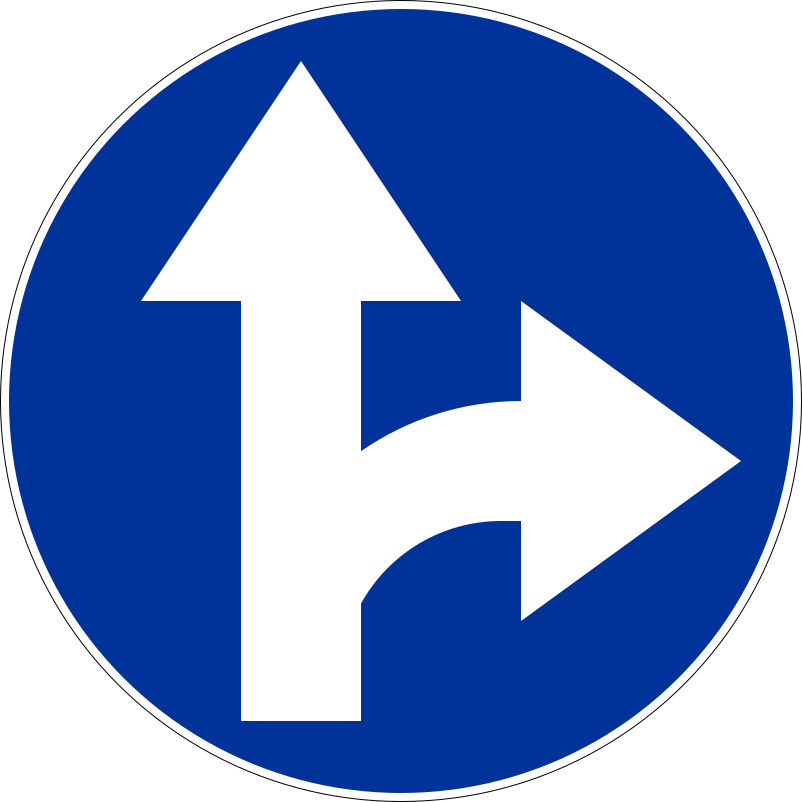
English • Traffic sign C-6 • Ahead or right only. Signs C-1, Turn right before the sign; C-2, Turn right after the sign; C-3, Turn left before the sign; C-4, Turn left after the sign; C-5, Ahead only; C-6, Ahead or right only; C-7, Ahead or left only; C-8, Turn right or left; C-9, Pass to the right of the sign; C-10, Pass to the left of the sign; and C-11, Pass to either side of the sign, require drivers to follow the arrows. These signs may be installed in line with the road or carriageway centre line, or on the carriageway itself.
Polski • C-6 • nakaz jazdy prosto lub w prawo. Znaki: C-1 „nakaz jazdy w prawo przed znakiem”, C-2 „nakaz jazdy w prawo za znakiem”, C-3 „nakaz jazdy w lewo przed znakiem”, C-4 „nakaz jazdy w lewo za znakiem”, C-5 „nakaz jazdy prosto”, C-6 „nakaz jazdy prosto lub w prawo”, C-7 „nakaz jazdy prosto lub w lewo”, C-8 „nakaz jazdy w prawo lub w lewo”, C-9 „nakaz jazdy z prawej strony znaku”, C-10 „nakaz jazdy z lewej strony znaku”, C-11 „nakaz jazdy z prawej lub lewej strony znaku” zobowiązują kierującego do ruchu w kierunku zgodnym ze strzałkami; znaki te mogą być umieszczone na przedłużeniu osi drogi (jezdni) lub na samej jezdni.
Sources
🔗 Commons.wikimedia.org
🔗 Eli.gov.pl • § 35 ust. 1
SVG source: Commons.wikimedia.org • Original SVG
odder • CC BY-SA 2.5 • Original revision 2025-09-26. Wikimedia original unmodified.
Artwork reviewed against the Polish official sign catalogue, Dz.U. 2019 poz. 2310: Eli.gov.pl • C-6, PDF page 43, with amendments 2021/433, 2021/2065, 2022/2372 and 2026/133 checked. Catalogue-equivalent illustration; intentional update from the previous PNG. This is an educational illustration, not a manufacturing specification.
96. Obligation de tourner à gauche
Ce panneau indique une obligation de tourner à gauche. Cela signifie que tous les véhicules doivent tourner à gauche à l'endroit où le panneau est situé. Aller tout droit ou tourner à droite est interdit.
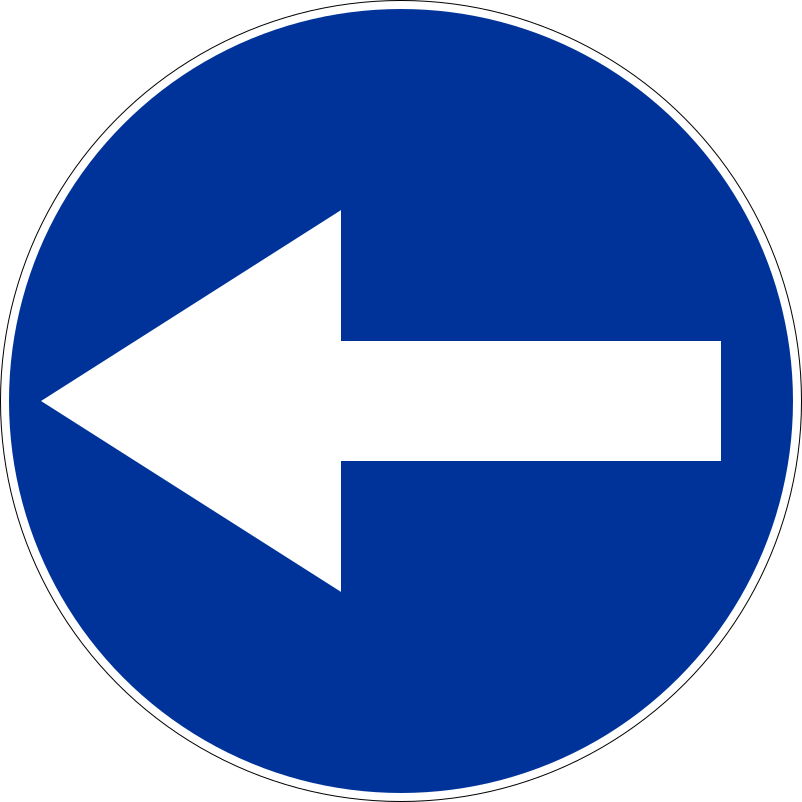
English • Traffic sign C-3 • Turn left before the sign. Signs C-1, Turn right before the sign; C-2, Turn right after the sign; C-3, Turn left before the sign; C-4, Turn left after the sign; C-5, Ahead only; C-6, Ahead or right only; C-7, Ahead or left only; C-8, Turn right or left; C-9, Pass to the right of the sign; C-10, Pass to the left of the sign; and C-11, Pass to either side of the sign, require drivers to follow the arrows. These signs may be installed in line with the road or carriageway centre line, or on the carriageway itself.
Polski • C-3 • nakaz jazdy w lewo przed znakiem. Znaki: C-1 „nakaz jazdy w prawo przed znakiem”, C-2 „nakaz jazdy w prawo za znakiem”, C-3 „nakaz jazdy w lewo przed znakiem”, C-4 „nakaz jazdy w lewo za znakiem”, C-5 „nakaz jazdy prosto”, C-6 „nakaz jazdy prosto lub w prawo”, C-7 „nakaz jazdy prosto lub w lewo”, C-8 „nakaz jazdy w prawo lub w lewo”, C-9 „nakaz jazdy z prawej strony znaku”, C-10 „nakaz jazdy z lewej strony znaku”, C-11 „nakaz jazdy z prawej lub lewej strony znaku” zobowiązują kierującego do ruchu w kierunku zgodnym ze strzałkami; znaki te mogą być umieszczone na przedłużeniu osi drogi (jezdni) lub na samej jezdni.
Sources
🔗 Commons.wikimedia.org
🔗 Eli.gov.pl • § 35 ust. 1
SVG source: Commons.wikimedia.org • Original SVG
odder • CC BY-SA 2.5 • Original revision 2025-09-26. Wikimedia original unmodified.
Artwork reviewed against the Polish official sign catalogue, Dz.U. 2019 poz. 2310: Eli.gov.pl • C-3, PDF page 43, with amendments 2021/433, 2021/2065, 2022/2372 and 2026/133 checked. Catalogue-equivalent illustration; intentional update from the previous PNG. This is an educational illustration, not a manufacturing specification.
97. Obligation de tourner à droite
Ce panneau de signalisation indique une obligation de tourner à droite. Cela signifie que tout le trafic doit tourner à droite à l'endroit où le panneau est placé. Aller tout droit ou tourner à gauche est interdit.
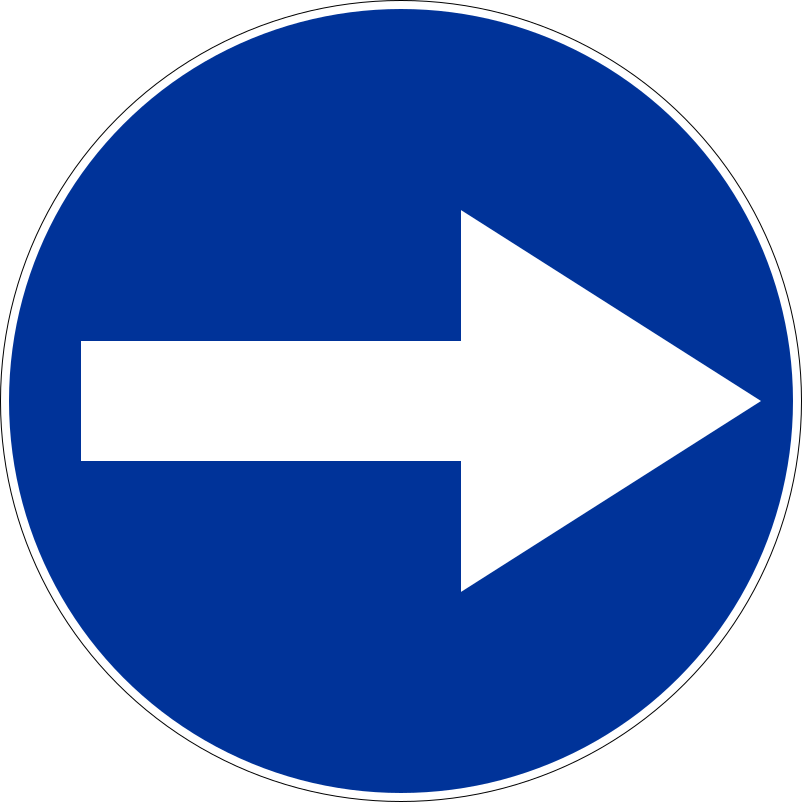
English • Traffic sign C-1 • Turn right before the sign. Signs C-1, Turn right before the sign; C-2, Turn right after the sign; C-3, Turn left before the sign; C-4, Turn left after the sign; C-5, Ahead only; C-6, Ahead or right only; C-7, Ahead or left only; C-8, Turn right or left; C-9, Pass to the right of the sign; C-10, Pass to the left of the sign; and C-11, Pass to either side of the sign, require drivers to follow the arrows. These signs may be installed in line with the road or carriageway centre line, or on the carriageway itself.
Polski • C-1 • nakaz jazdy w prawo przed znakiem. Znaki: C-1 „nakaz jazdy w prawo przed znakiem”, C-2 „nakaz jazdy w prawo za znakiem”, C-3 „nakaz jazdy w lewo przed znakiem”, C-4 „nakaz jazdy w lewo za znakiem”, C-5 „nakaz jazdy prosto”, C-6 „nakaz jazdy prosto lub w prawo”, C-7 „nakaz jazdy prosto lub w lewo”, C-8 „nakaz jazdy w prawo lub w lewo”, C-9 „nakaz jazdy z prawej strony znaku”, C-10 „nakaz jazdy z lewej strony znaku”, C-11 „nakaz jazdy z prawej lub lewej strony znaku” zobowiązują kierującego do ruchu w kierunku zgodnym ze strzałkami; znaki te mogą być umieszczone na przedłużeniu osi drogi (jezdni) lub na samej jezdni.
Sources
🔗 Commons.wikimedia.org
🔗 Eli.gov.pl • § 35 ust. 1
SVG source: Commons.wikimedia.org • Original SVG
odder • CC BY-SA 2.5 • Original revision 2025-09-26. Wikimedia original unmodified.
Artwork reviewed against the Polish official sign catalogue, Dz.U. 2019 poz. 2310: Eli.gov.pl • C-1, PDF page 43, with amendments 2021/433, 2021/2065, 2022/2372 and 2026/133 checked. Catalogue-equivalent illustration; intentional update from the previous PNG. This is an educational illustration, not a manufacturing specification.
98. Circulation tout droit obligatoire
Ce panneau de signalisation indique que rouler tout droit est obligatoire, il est interdit de tourner à gauche ou à droite. Cela signifie que les véhicules doivent continuer tout droit — il est interdit de tourner à gauche ou à droite.
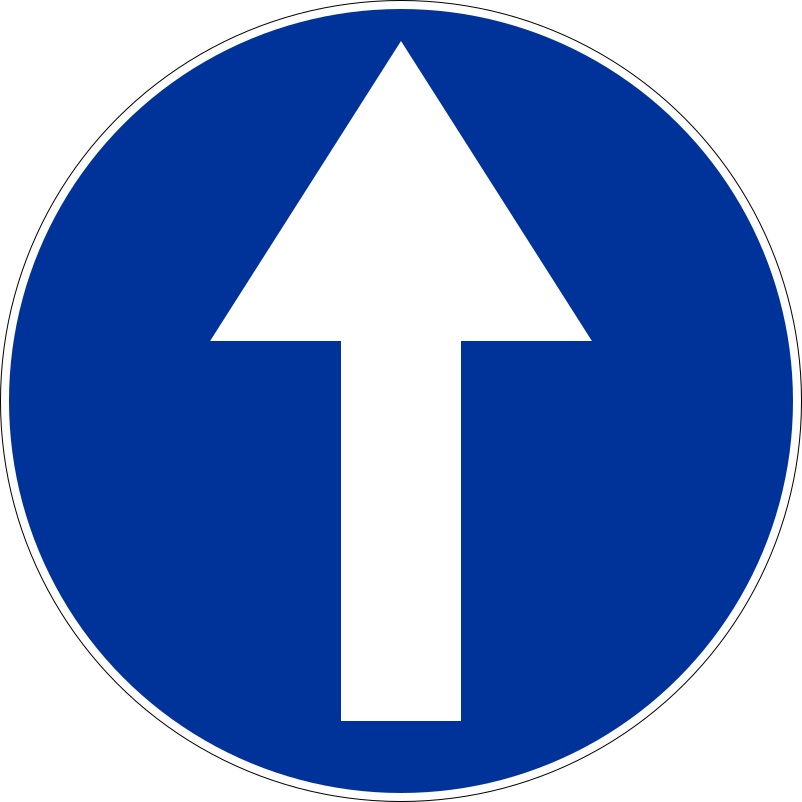
English • Traffic sign C-5 • Ahead only. Signs C-1, Turn right before the sign; C-2, Turn right after the sign; C-3, Turn left before the sign; C-4, Turn left after the sign; C-5, Ahead only; C-6, Ahead or right only; C-7, Ahead or left only; C-8, Turn right or left; C-9, Pass to the right of the sign; C-10, Pass to the left of the sign; and C-11, Pass to either side of the sign, require drivers to follow the arrows. These signs may be installed in line with the road or carriageway centre line, or on the carriageway itself.
Polski • C-5 • nakaz jazdy prosto. Znaki: C-1 „nakaz jazdy w prawo przed znakiem”, C-2 „nakaz jazdy w prawo za znakiem”, C-3 „nakaz jazdy w lewo przed znakiem”, C-4 „nakaz jazdy w lewo za znakiem”, C-5 „nakaz jazdy prosto”, C-6 „nakaz jazdy prosto lub w prawo”, C-7 „nakaz jazdy prosto lub w lewo”, C-8 „nakaz jazdy w prawo lub w lewo”, C-9 „nakaz jazdy z prawej strony znaku”, C-10 „nakaz jazdy z lewej strony znaku”, C-11 „nakaz jazdy z prawej lub lewej strony znaku” zobowiązują kierującego do ruchu w kierunku zgodnym ze strzałkami; znaki te mogą być umieszczone na przedłużeniu osi drogi (jezdni) lub na samej jezdni.
Sources
🔗 Commons.wikimedia.org
🔗 Eli.gov.pl • § 35 ust. 1
SVG source: Commons.wikimedia.org • Original SVG
odder • CC BY-SA 2.5 • Original revision 2025-09-26. Wikimedia original unmodified.
Artwork reviewed against the Polish official sign catalogue, Dz.U. 2019 poz. 2310: Eli.gov.pl • C-5, PDF page 43, with amendments 2021/433, 2021/2065, 2022/2372 and 2026/133 checked. Catalogue-equivalent illustration; intentional update from the previous PNG. This is an educational illustration, not a manufacturing specification.
99. Chemin obligatoire pour les piétons
Ce panneau de signalisation indique le début d’un chemin pour piétons. Cela signifie que les piétons doivent utiliser le chemin désigné (trottoir ou sentier), et ne peuvent pas marcher sur la route adjacente ou dans d’autres zones. Les autres usagers (vélos, cyclomoteurs, etc.) ne sont pas autorisés, sauf indication contraire. Emplacements courants : trottoirs urbains, zones scolaires, parcs, passages souterrains.
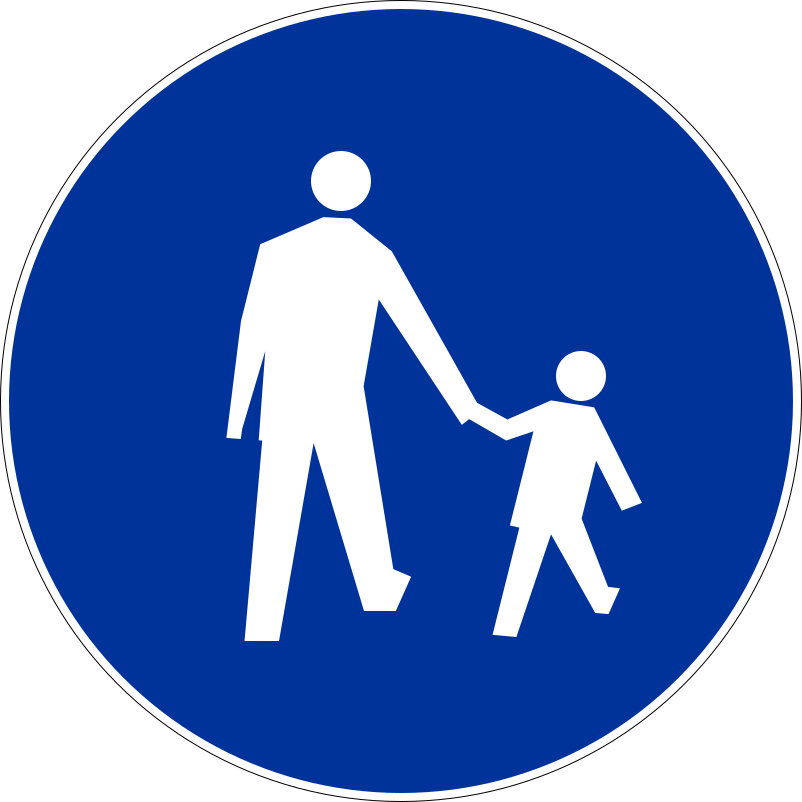
English • Traffic sign C-16 • Pedestrian route. Sign C-16 identifies a road or part of it intended for pedestrians, who must use it. Under subsection 1a, the requirement applies until cancelled or until sign B-41, C-13 or D-40.
Polski • C-16 • droga dla pieszych. Znak C-16 „droga dla pieszych” oznacza drogę lub jej część przeznaczoną dla pieszych, którzy są obowiązani z niej korzystać. 1a. Nakaz wyrażony znakiem C-16 obowiązuje do odwołania albo do miejsca umieszczenia znaku B-41, C-13 albo D-40.
Sources
🔗 Commons.wikimedia.org
🔗 Eli.gov.pl • § 39 ust. 1
SVG source: Commons.wikimedia.org • Original SVG
Paweł Grzywocz • Public domain • Original revision 2025-09-26. Wikimedia original unmodified.
Artwork reviewed against the Polish official sign catalogue, Dz.U. 2019 poz. 2310: Eli.gov.pl • C-16, PDF page 43, with amendments 2021/433, 2021/2065, 2022/2372 and 2026/133 checked. Catalogue-equivalent illustration; intentional update from the previous PNG. This is an educational illustration, not a manufacturing specification.
100. Fin du chemin piétonnier
Ce panneau de signalisation indique la fin du chemin pour piétons. Cela signifie que le chemin piétonnier désigné se termine ici. Ce panneau est souvent utilisé à la fin des trottoirs, sentiers ou zones piétonnes.
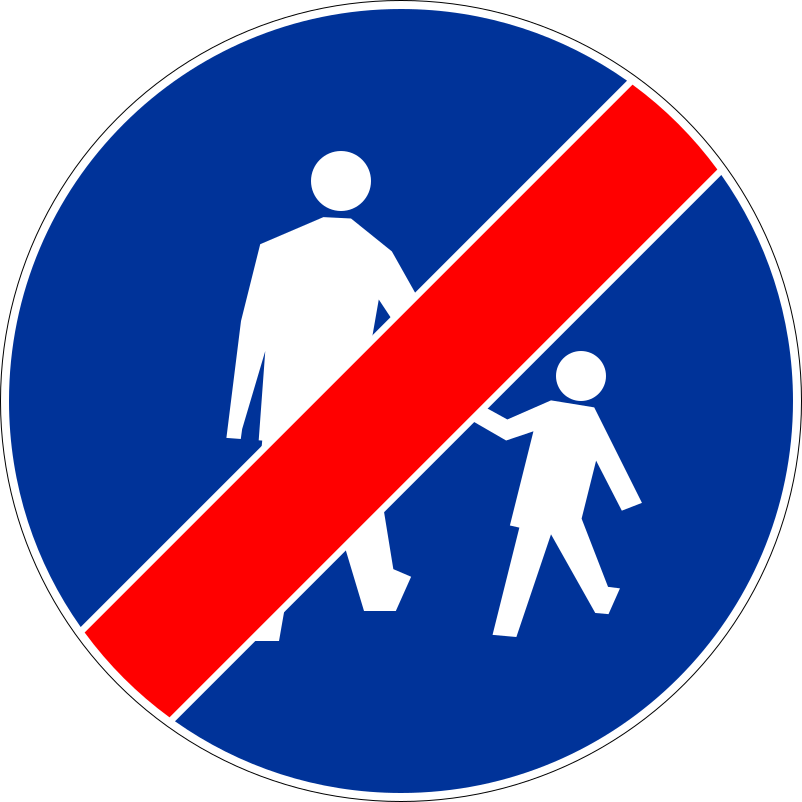
English • Traffic sign C-16a • End of the pedestrian route. Sign C-16a marks the end of a road intended for pedestrians.
Polski • C-16a • koniec drogi dla pieszych. Znak C-16a „koniec drogi dla pieszych” oznacza koniec drogi przeznaczonej dla pieszych.
Sources
🔗 Commons.wikimedia.org
🔗 Eli.gov.pl • § 39 ust. 2
SVG source: Commons.wikimedia.org • Original SVG
Paweł Grzywocz • Public domain • Original revision 2025-09-26. Wikimedia original unmodified.
Artwork reviewed against the Polish official sign catalogue, Dz.U. 2019 poz. 2310: Eli.gov.pl • C-16a, PDF page 43, with amendments 2021/433, 2021/2065, 2022/2372 and 2026/133 checked. Catalogue-equivalent illustration; intentional update from the previous PNG. This is an educational illustration, not a manufacturing specification.