


Dead endAustralia
 Traffic rules
 Australia
1. Dead end
A dead-end road is a road that does not provide a through route for some or all vehicles. It may end completely, terminate at a barrier or continue as a path that only certain road users may use.
Drivers may normally enter a dead-end road to reach homes, businesses, parking places or other destinations, but they must be prepared to turn around or leave by the same route. Signs may indicate that pedestrians or cyclists can continue beyond the point where motor traffic cannot.
What does a dead-end indication mean in Australia?
Australian signs and rules vary by jurisdiction. In New South Wales, dead-end or No through road information describes the route; a separate entry restriction must be read on its own terms.
🔗 nsw.gov.au • Australia, NSW official road-user guidance — dead-end
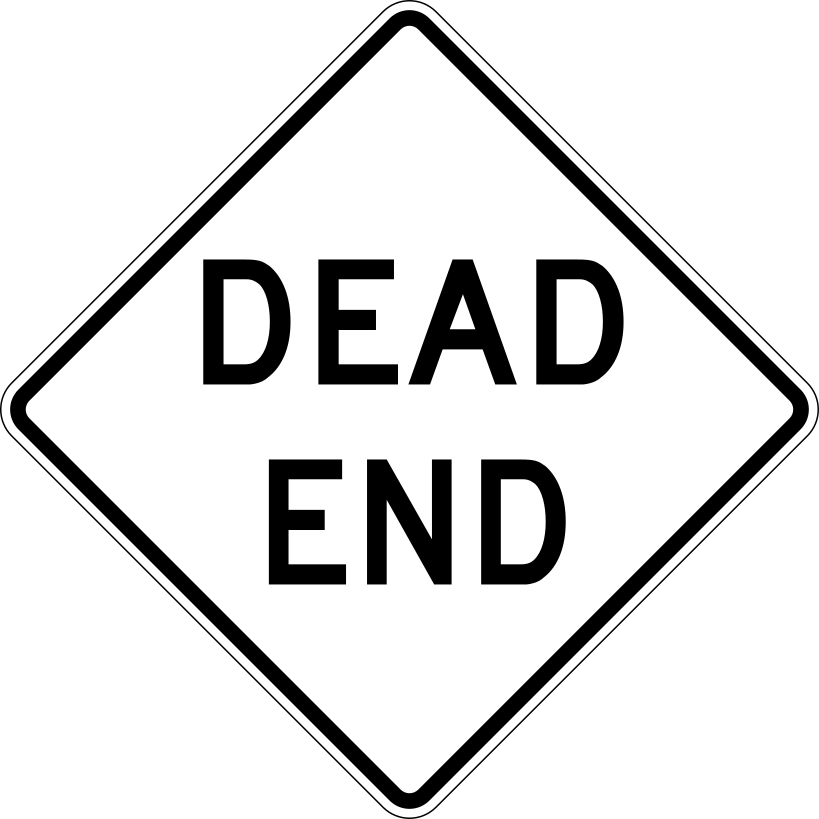 Dead end street.
English • Queensland driver handbook • sign illustration • Dead end. The road has no through route. Be prepared to turn back safely. Illustration identified by its sign family or meaning; the exact current prescribed design has not been confirmed.
Sources
🔗 Commons.wikimedia.org
🔗 Publications.qld.gov.au • Queensland Government • Your Keys to Driving • dead-end sign
SVG source: Dead_End_sign.svg: Ltljltlj / *derivative work: Fry1989 • Public domain • Original revision 2012-06-16. Wikimedia original unmodified.
Can pedestrians or cyclists continue beyond a motor-traffic dead end in Australia?
Check a walking or cycling connection and its actual signs. The motor-vehicle route may end while a lawful path continues, but a path is not automatically open to every vehicle.
🔗 nsw.gov.au • Australia, NSW official road-user guidance — dead-end
Does a dead-end indication change speed or priority rules in Australia?
In the New South Wales example, the no-through information itself does not assign junction priority or a numerical speed limit. Continue to obey the actual speed, access, parking and priority controls. If you need to turn around, use a suitable lawful place, check for pedestrians and cyclists, and do not obstruct the space needed for other vehicles to turn.
🔗 nsw.gov.au • Australia, NSW official road-user guidance — dead-end

