

Residential areaUnited Kingdom
 Traffic rules
 United Kingdom
1. Residential area
A residential area is a street or group of streets where housing and access to local properties are the main functions. Drivers should expect pedestrians, cyclists, children, parked vehicles and vehicles entering or leaving driveways.
Some countries identify particular residential areas with traffic signs and apply special low-speed and residential-area rules. The speed limit, pedestrian rights, parking rules and permitted road users therefore depend on local signs and regulations.
How do people refer to a residential area in the United Kingdom?
In Great Britain, UK guidance uses residential area and Home Zone. A Home Zone is an area where people may use the road for activities other than driving; follow its signs and any separate speed limit.
🔗 gov.uk • Great Britain Highway Code: Rules 206,218; parking Rules 242–244
🔗 gov.uk • DfT Know Your Traffic Signs: traffic calming (Great Britain)
🔗 gov.uk • GOV.UK: national speed limits, including the Welsh default
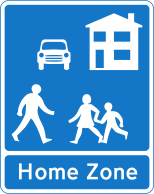 Start of a residential area.
English • GB diagram 881 • Home Zone. You are entering a designated Home Zone: a residential street designed to be shared by pedestrians, cyclists and motor vehicles. Expect people using the street and drive with particular care. The sign alone does not set a universal 20 mph speed limit.
Sources
🔗 Commons.wikimedia.org (UK Government • Crown copyright • OGL v1.0)
🔗 Legislation.gov.uk • Traffic Signs Regulations and General Directions • Great Britain
🔗 Gov.uk • Department for Transport • Know your traffic signs
SVG source: UK Government • OGL v1.0 • Original revision 2023-01-19. Wikimedia original unmodified. © Crown copyright. Traffic signs are Crown copyright. You may reproduce traffic signs free of charge and without having to seek permission, but you must reproduce them accurately and not in a misleading context (e.g. not on roadside billboards where they could mislead drivers). (ref [1])
Artwork verified against Gov.uk • official published diagram 881A.
Current design and permitted variants verified against Legislation.gov.uk • TSRGD, current text.
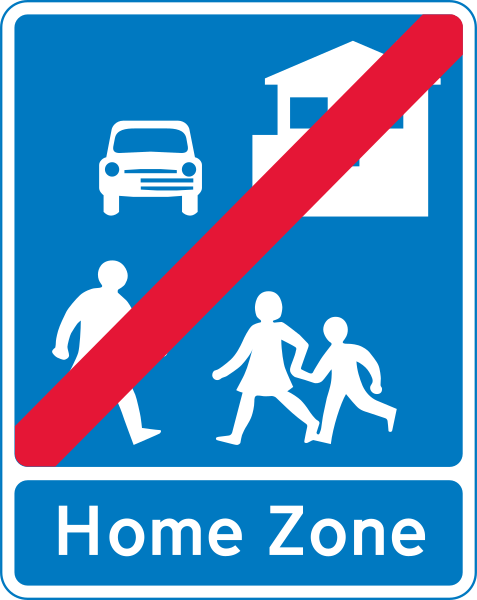 End of the residential area.
Sources
🔗 Commons.wikimedia.org (UK Government • Crown copyright • OGL v1.0)
Image via Commons.wikimedia.org
UK Government • OGL v1.0 • Source revision 2011-11-29. Wikimedia original unmodified.
What speed limit applies in a residential area in the United Kingdom?
On restricted roads, usually identified by street lighting, the default is 30 mph in England, Scotland and Northern Ireland and 20 mph in Wales, unless signed otherwise. Local 20 mph limits and zones also occur elsewhere in the UK.
🔗 gov.uk • Great Britain Highway Code: Rules 206,218; parking Rules 242–244
🔗 gov.uk • DfT Know Your Traffic Signs: traffic calming (Great Britain)
🔗 gov.uk • GOV.UK: national speed limits, including the Welsh default
How should I drive where children may be playing in a UK residential area?
In Great Britain, drive carefully and slowly, look for people emerging between parked vehicles and be ready to stop. In a Home Zone, be prepared for the whole road to be used by people and allow them time to move safely.
🔗 gov.uk • Great Britain Highway Code: Rules 206,218; parking Rules 242–244
🔗 gov.uk • DfT Know Your Traffic Signs: traffic calming (Great Britain)
🔗 gov.uk • GOV.UK: national speed limits, including the Welsh default
Where may I park in a residential area in the United Kingdom?
In Great Britain, obey local restrictions and keep dropped kerbs, crossings and driveways clear. Do not park where you would obstruct or endanger road users. Resident-permit rules do not give permission to ignore other restrictions.
🔗 gov.uk • Great Britain Highway Code: Rules 206,218; parking Rules 242–244
🔗 gov.uk • DfT Know Your Traffic Signs: traffic calming (Great Britain)
🔗 gov.uk • GOV.UK: national speed limits, including the Welsh default

