
Traffic rulesUnited Kingdom
Learn the traffic rules of United Kingdom with lots of pictures, clear traffic signs and interactive quizzes. Simple, visual and easy to follow.




The driving-licence systems in the United Kingdom
Is there one driving-licence authority for the whole United Kingdom?
No. The Driver and Vehicle Licensing Agency (DVLA) licenses drivers in England, Scotland and Wales, collectively called Great Britain. The Driver & Vehicle Agency (DVA) licenses drivers in Northern Ireland.
Who conducts driving tests in Great Britain?
The Driver and Vehicle Standards Agency (DVSA) conducts theory and practical driving tests in England, Scotland and Wales.
Who conducts driving tests in Northern Ireland?
The DVA conducts and administers theory and practical driving tests in Northern Ireland.
Is a Great Britain licence valid in Northern Ireland?
Yes. A valid Great Britain licence is recognised in Northern Ireland, subject to its categories, restrictions and current legal status.
Is a Northern Ireland licence valid in Great Britain?
Yes. A valid Northern Ireland licence is recognised in England, Scotland and Wales.
Is a UK licence recognised abroad?
Recognition depends on the destination. Many countries recognise a valid UK licence for visits, while others require an International Driving Permit or local exchange.
Can one person hold both a Great Britain and Northern Ireland licence?
No. A driver should hold only one current UK driving licence record and must exchange the licence when the applicable residence rules require it.
Can drivers view their licence information online?
Yes. Great Britain drivers can use the DVLA view-or-share service, while Northern Ireland drivers use the corresponding DVA online service.
Is a public digital driving licence available on 4 August 2026?
No. The GOV.UK digital driving licence remained in testing and was not yet generally available for public download on 4 August 2026.
Why must Great Britain and Northern Ireland rules be distinguished?
The two systems share many principles, but provisional applications, learner speed rules, restricted-driver plates, test administration, licence exchange and planned reforms differ.
Eligibility and provisional licences
What is the ordinary minimum age for learning to drive a car?
The normal minimum age is 17 in both Great Britain and Northern Ireland.
Can some disabled applicants drive from age 16?
Yes. A person receiving the qualifying enhanced mobility benefit may be able to obtain car entitlement from age 16.
When can a Great Britain provisional licence be applied for?
A first provisional licence can normally be applied for from age 15 years and 9 months, although car entitlement does not normally become usable until age 17.
When can a Northern Ireland provisional car licence be applied for?
It can normally be applied for up to two months before the seventeenth birthday, but it does not become valid for car driving before age 17.
Which authority issues a Great Britain provisional licence?
The DVLA.
Which authority issues a Northern Ireland provisional licence?
The DVA.
What identity evidence is normally required?
The applicant must provide acceptable identity information, a photograph where required, residential details and the declarations requested by the licensing authority.
What residence rule applies to Great Britain tests?
A candidate must normally have lived in England, Scotland or Wales for at least 185 days during the preceding 12 months.
What residence rule applies to Northern Ireland tests?
The candidate must normally be resident in Northern Ireland. Special proof is required where a Great Britain provisional holder seeks to test there.
Must an applicant meet the eyesight standard?
Yes. The applicant must be able to read a number plate at the prescribed distance and satisfy any additional medical vision requirements.
Can a person apply while disqualified?
No. A current driving disqualification or revoked entitlement must be resolved before lawful driving or testing can resume.
Does a provisional licence allow unsupervised car driving?
No. The learner must comply with supervision, insurance, plate and vehicle conditions until the practical test has been passed.
Medical fitness, eyesight and disability
Must every ordinary car applicant have a medical examination?
No. Most Group 1 applicants make medical declarations rather than undergoing a routine examination.
Must health conditions be reported?
Yes. A driver or applicant must notify DVLA or DVA of a notifiable medical condition or disability that may affect safe driving.
Which conditions may need to be reported?
Examples include epilepsy, loss of consciousness, serious visual impairment, neurological disease, certain heart conditions, diabetes complications, sleep disorders and substance dependence.
Does a diagnosis automatically end the right to drive?
No. The licensing authority assesses the individual facts and may grant, retain, restrict, shorten or revoke the licence.
Can glasses or contact lenses be required?
Yes. A restriction code is recorded when corrective lenses must be worn while driving.
Can an adapted vehicle be required?
Yes. Codes may require hand controls, an automatic transmission, modified pedals or another adaptation.
Can a disabled candidate take the test in an adapted vehicle?
Yes. The candidate should notify the test authority and use a vehicle that meets the technical and insurance requirements.
Are medical standards stricter for lorry and bus drivers?
Yes. Group 2 licence holders and applicants must satisfy stricter medical standards and provide periodic medical reports.
What happens when a driver develops a condition after licensing?
The driver should stop driving where medically necessary, seek professional advice and notify the licensing authority when the condition is reportable.
Can driving continue while a medical application is pending?
Sometimes, under statutory continuation provisions, but only when all legal conditions are satisfied and the person remains medically fit. The driver should verify the individual position with DVLA or DVA.
Learning, supervision and practice
Is professional driving instruction compulsory?
No fixed number of lessons with an instructor is legally required for an ordinary car licence, but professional tuition is strongly recommended.
Can a learner practise with family or friends?
Yes, if the learner, supervisor, vehicle and insurance satisfy all legal requirements.
How old must a private supervisor be?
The supervisor must be at least 21 years old.
How long must the supervisor have held a full licence?
At least three years for the relevant vehicle and transmission type.
Which licences can qualify a supervisor in Great Britain?
A qualifying full licence from the UK, EU, Switzerland, Norway, Iceland or Liechtenstein can satisfy the supervision rule.
Where must the supervisor sit?
The supervisor must sit in the front passenger seat and remain capable of properly supervising the learner.
Must the learner vehicle display plates?
Yes. Red L plates must be clearly displayed at the front and rear; a red D plate may be used instead in Wales.
Can a learner drive at night?
Yes. There is no general prohibition on learning at night, provided all learner conditions are met.
Can a Great Britain learner drive on a motorway?
Only with an approved driving instructor in a dual-controlled car displaying L plates.
Can a Northern Ireland learner drive on a motorway on 4 August 2026?
No. The current Northern Ireland learner rules prohibit motorway driving.
What speed limit applies to a Northern Ireland learner vehicle?
A vehicle displaying L plates is generally limited to 45 mph, including when another person is driving it, subject to specified vehicle exceptions.
Must the practice vehicle be insured for the learner?
Yes. The learner must be correctly insured, and the vehicle must be taxed, roadworthy and hold a valid MOT where one is required.
The car theory test
Must the theory test be passed before the practical test?
Yes. A valid car theory-test pass is required before the practical test can be booked or taken.
How many multiple-choice questions are in the car theory test?
There are 50 questions.
How many correct answers are required?
At least 43 out of 50.
How long is allowed for the multiple-choice section?
The ordinary time is 57 minutes.
What is the hazard-perception test?
It uses video clips in which the candidate identifies developing hazards by responding at the appropriate time.
What is the hazard-perception pass mark?
At least 44 points out of 75.
Must both theory-test parts be passed in the same sitting?
Yes. A car candidate must pass both multiple choice and hazard perception in the same test appointment.
What happens after failing one part?
The candidate must retake the complete car theory test, even if the other part was passed.
How soon can a failed test be retaken?
The candidate must wait at least three working days.
How long is a theory-test pass valid?
It is valid for two years.
Are the Great Britain and Northern Ireland car theory standards similar?
Yes. Both use 50 multiple-choice questions, a 43-point pass mark and a 44-out-of-75 hazard-perception pass mark.
Can reasonable adjustments be requested?
Yes. Candidates should declare reading difficulties, disabilities or health conditions when booking so that authorised support can be arranged.
The practical car test
What are the main parts of the Great Britain car test?
They are an eyesight check, vehicle-safety questions, general driving including independent driving, and a reversing exercise.
How long does the Great Britain test normally last?
It normally lasts about 40 minutes, with at least 30 minutes of on-road driving.
What is independent driving?
The candidate follows a sat-nav route, traffic signs or a combination without continuous turn-by-turn instructions from the examiner.
How long can independent driving last under the current Great Britain test?
It may last approximately 20 to 35 minutes, depending on the route and examiner’s test plan.
What are the show-me and tell-me questions?
The candidate answers one vehicle-safety question before driving and demonstrates another safety task while driving.
How are faults classified in Great Britain?
They are recorded as driving faults, serious faults or dangerous faults.
How many driving faults are allowed?
A candidate can pass with no more than 15 driving faults, provided there is no serious or dangerous fault.
Can one serious or dangerous fault cause failure?
Yes.
Can the candidate use their own car?
Yes, if it satisfies the test authority’s insurance, roadworthiness, equipment, visibility and identification requirements.
Can a passed candidate drive immediately?
Yes. The test-pass certificate permits driving while the full licence is processed, provided the driver is properly insured and the entitlement has not otherwise been restricted.
New drivers and Northern Ireland restricted drivers
How long does the New Drivers Act probationary period last?
It lasts two years from passing the first driving test.
What happens after receiving six or more points during that period?
The licence is revoked and the person must obtain a new provisional licence and pass the theory and practical tests again.
Do points received before passing count?
Yes. Unexpired points on the provisional licence carry over and can contribute to revocation after the test.
Does the United Kingdom require a general P plate after passing?
No. Green P plates are optional in Great Britain, while Northern Ireland currently requires R plates.
What is the current Northern Ireland R-plate period?
A new car or motorcycle driver must display amber R plates for one year after passing.
What speed restriction applies to a current Northern Ireland restricted car driver?
A car displaying R plates is limited to 45 mph.
Does the current Northern Ireland R restriction apply in Great Britain?
The R-plate rule is a Northern Ireland licensing restriction; a driver should nevertheless carry the correct licence and follow the law of the place being driven.
What Northern Ireland reform is planned for 1 October 2026?
Graduated Driver Licensing is planned to begin, including a six-month minimum learning period, a programme of training and logbook and a two-year new-driver plate period.
When is the new Northern Ireland practical test planned to begin?
On 1 April 2027, after the first learners complete the six-month minimum period.
What passenger restriction is planned for some new Northern Ireland drivers?
For the first six months, new drivers up to age 24 are planned to be limited to one passenger aged 14 to 20 between 23:00 and 06:00, subject to family and qualified-supervisor exemptions.
Will the future Northern Ireland R plate retain the 45 mph restriction?
No. The planned two-year R-plate system will identify new drivers without imposing the current 45 mph restriction.
Do the planned October 2026 rules apply on 4 August 2026?
No. They are future rules and remain dependent on the required subordinate legislation and commencement arrangements.
Vehicle categories and towing
What does category AM cover?
It covers mopeds and light quadricycles within the statutory speed, engine and power limits.
What does category A1 cover?
It covers light motorcycles up to 125 cm³, 11 kW and the prescribed power-to-weight limit.
What does category A2 cover?
It covers motorcycles up to 35 kW with the prescribed power-to-weight and derivation restrictions.
What does category A cover?
It covers unrestricted motorcycles, subject to direct-access or staged-access age and testing rules.
What does category B cover?
It covers vehicles up to 3,500 kg maximum authorised mass with no more than eight passenger seats in addition to the driver.
What trailer entitlement follows a Great Britain category B test?
A driver who passes category B receives full BE entitlement and may tow a trailer up to 3,500 kg MAM within the vehicle and combination limits.
Are Northern Ireland towing entitlements identical?
No. Northern Ireland retains its own category B and BE rules, so drivers should check the categories and valid-from dates shown in the DVA record.
What does category C1 cover?
It covers medium-sized vehicles above 3,500 kg and up to 7,500 kg, normally with a trailer up to 750 kg.
What does category C cover?
It covers large goods vehicles above 3,500 kg, normally with a trailer up to 750 kg.
What do categories D1 and D cover?
D1 covers minibuses within its seat and length limits; D covers buses with more than eight passenger seats.
Do pre-1997 car licences include broader entitlements?
Many drivers who passed before 1 January 1997 retain C1 and D1 entitlements, subject to restriction codes and renewal at age 70.
Does an automatic car test allow manual driving?
No. A licence restricted to automatic category B vehicles must be upgraded through the applicable manual practical test procedure.
Commercial and professional driving
Is the correct lorry or bus category enough for professional work?
Not always. Many professional drivers also need a valid Driver Certificate of Professional Competence (Driver CPC).
What is the initial Driver CPC?
It is the qualification process for new professional lorry, bus and coach drivers, combining licence tests with professional competence modules.
Is periodic Driver CPC training required?
Yes. A qualified driver normally completes 35 hours every five years.
What is National Driver CPC?
It is a qualification route for professional driving within the United Kingdom.
What is International Driver CPC?
It is the qualification required when the professional driving activity must remain valid for both the UK and relevant international operations.
Do lorry and bus licence holders need medical reports?
Yes. Group 2 provisional applications and renewals require medical evidence at the prescribed ages and intervals.
Can category B alone authorise taxi work?
No. Taxi and private-hire drivers also need the local licensing authority’s driver licence and must satisfy its medical, criminal-record and conduct standards.
Does Northern Ireland use the same taxi licensing authority as Great Britain?
No. Taxi licensing and professional procedures are administered under Northern Ireland’s own transport system.
Are professional drivers subject to drivers-hours and tachograph rules?
Many goods and passenger operations are subject to domestic or retained international rules on driving time, breaks, rest and tachographs.
Can serious conduct affect a vocational licence even without a court ban?
Yes. Traffic commissioners in Great Britain and the corresponding Northern Ireland authorities can take action against professional driving entitlement or conduct.
Validity, renewal, replacement and records
How often must a Great Britain photocard be renewed?
The photocard must normally be renewed every 10 years.
Does the ten-year photocard expiry always end the underlying car entitlement?
No. The card and photograph expire, while ordinary Group 1 entitlement normally continues until age 70 unless medically limited, revoked or disqualified.
What happens at age 70 in Great Britain?
The driver must renew the entitlement and then renew every three years.
What happens at age 70 in Northern Ireland?
A renewed licence is normally issued for up to three years, subject to medical and category conditions.
Do lorry and bus categories have shorter renewal periods?
Yes. Group 2 categories require periodic renewal and medical reports, with more frequent review from age 45.
What should a driver do after changing address?
Notify DVLA or DVA promptly and request an updated licence using the applicable service.
What should a driver do after changing name?
Apply for an updated licence and provide the documentary evidence required by the licensing authority.
Can a lost, stolen or damaged licence be replaced?
Yes. The driver can apply for a replacement through DVLA or DVA.
Does a replacement restore a revoked or disqualified entitlement?
No. The electronic driver record determines whether the person may drive.
Can an employer check a driver’s entitlement?
Yes, with the driver’s permission or a valid share code through the official online services.
Foreign licences and International Driving Permits
Can an EEA licence be used in Great Britain?
Yes. A valid EEA licence can generally be used without the ordinary 12-month new-resident restriction, subject to age, validity and category rules.
Can an EEA licence be used in Northern Ireland?
Yes. A valid EEA licence is generally recognised under Northern Ireland’s applicable residence and age rules.
How long can an ordinary non-EEA licence normally be used after becoming resident?
It can generally be used for up to 12 months for the authorised small-vehicle categories.
Can a designated-country licence be exchanged?
Yes. Eligible licences from designated countries or territories can be exchanged within the applicable period and category conditions.
How long does a Great Britain resident normally have to exchange an exchangeable foreign licence?
The exchange application can normally be made within five years after becoming resident, although the ordinary right to drive may end earlier.
What if the foreign licence is not exchangeable?
The resident must obtain a provisional licence and pass the required UK theory and practical tests before the foreign-licence driving period ends.
Must a foreign licence be translated?
An official translation or International Driving Permit may be needed when the licence is not readily understandable in English or does not use a recognised format.
Who issues International Driving Permits in the UK?
Participating PayPoint stores issue the relevant permit to eligible UK licence holders.
How long is an International Driving Permit valid?
Validity depends on the convention type and destination; common UK-issued permits are valid for one or three years.
Does an International Driving Permit replace the UK licence?
No. It must be used together with the valid physical UK driving licence.
Penalty points, alcohol, drugs and disqualification
How many points normally trigger a totting-up disqualification?
A driver reaching 12 or more points within three years can be disqualified by a court.
How long is the usual first totting-up ban?
Normally at least six months, although the court considers the individual case.
How long do endorsements remain on the record?
They normally remain for four or eleven years, depending on the offence.
What alcohol limit applies in England, Wales and Northern Ireland?
The prescribed blood limit is 80 milligrams of alcohol per 100 millilitres of blood.
What alcohol limit applies in Scotland?
The prescribed blood limit is 50 milligrams per 100 millilitres of blood.
Can a driver be convicted below the numerical limit?
Yes. Driving while unfit through drink or drugs can be an offence regardless of the measured concentration.
Are drug-driving limits set for specified substances?
Yes. It is illegal to drive with certain drugs above prescribed limits or while impaired, including some prescription medicines.
Can refusing a lawful specimen request be an offence?
Yes. Failure to provide a required specimen without a reasonable excuse is a criminal offence.
Can one serious offence cause immediate disqualification?
Yes. Dangerous driving, serious drink- or drug-driving, high-speed offences and other conduct can lead to a direct court ban.
What happens after a disqualification of 56 days or more?
The driver must apply for a new licence before driving again and may be ordered to take an extended test in specified cases.
Sources and methodology
How was this FAQ prepared?
This FAQ was prepared from current GOV.UK, DVLA, DVSA, nidirect and Northern Ireland Department for Infrastructure guidance.
Which source explains the Great Britain provisional licence?
GOV.UK: apply for a first provisional driving licenceWhich source explains Great Britain learner rules?
GOV.UK: driving lessons and learning to driveWhich source explains the theory test?
GOV.UK: car theory testWhich source explains the Great Britain practical test?
GOV.UK: car driving testWhich source explains new-driver revocation?
GOV.UK: penalty points for new driversWhich source explains Northern Ireland learner and R-driver rules?
nidirect: learner and restricted-driver requirementsWhich source explains the planned Northern Ireland reforms?
Department for Infrastructure: Graduated Driver Licensing FAQsWhen was this FAQ reviewed?
Last reviewed: 4 August 2026.
Is this website affiliated with a UK authority?
This website is an independent educational resource and is not affiliated with DVLA, DVSA, DVA, the Department for Infrastructure, a court, test centre or driving school.
Official legislation and instructions from the competent authority always take precedence.
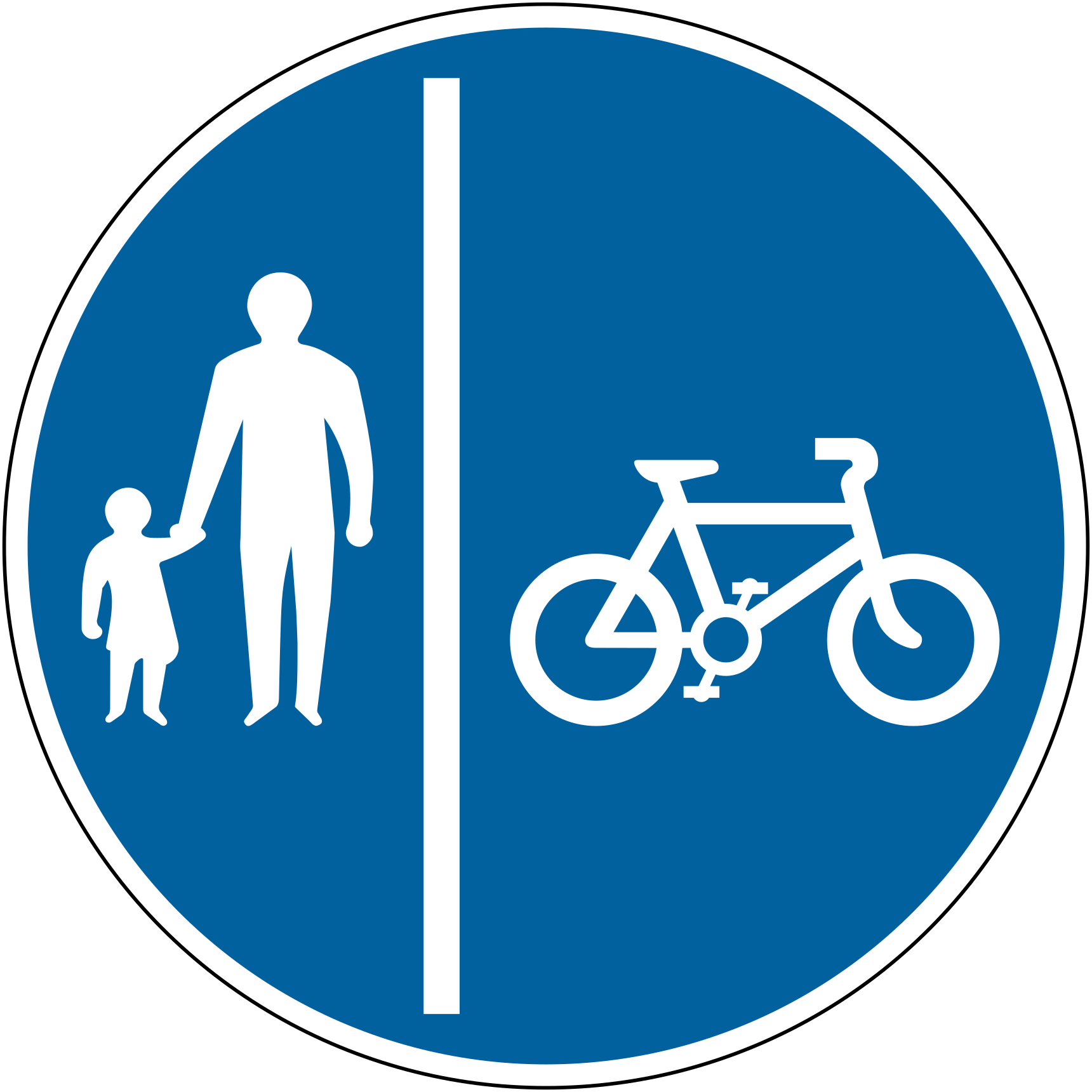
1. What does this traffic sign mean?
This traffic sign indicates a mandatory divided path for pedestrians and cyclists. Pedestrians and cyclists must use the section designated for them. Other road users may use the path only where the applicable signs or local rules permit them to do so.
English • GB diagram 957 • Segregated pedestrian and cycle route. Use the side shown for your class of traffic: pedestrians on the left and cycles on the right. In Great Britain, permitted trial electric scooters use the cycle side where applicable.
Sources
🔗 Commons.wikimedia.org (Government of the United Kingdom – Department for Transport • Crown copyright • OGL v1.0)
🔗 Legislation.gov.uk • Traffic Signs Regulations and General Directions • Great Britain
🔗 Gov.uk • Department for Transport • Know your traffic signs
SVG source: Government of the United Kingdom – Department for Transport • OGL v1.0 • Original revision 2021-08-02. Wikimedia original unmodified. © Crown copyright. Traffic signs are Crown copyright. You may reproduce traffic signs free of charge and without having to seek permission, but you must reproduce them accurately and not in a misleading context (e.g. not on roadside billboards where they could mislead drivers). (ref [1])
Artwork verified against Gov.uk • official published diagram 957R.
Current design and permitted variants verified against Legislation.gov.uk • TSRGD, current text.
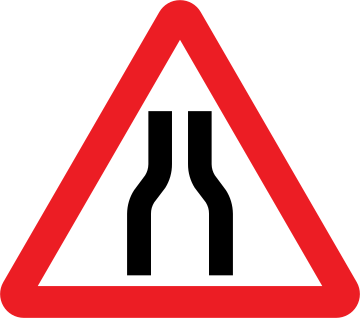
2. What does this traffic sign mean?
This traffic sign indicates a warning for a road narrowing. The available width of the road or carriageway decreases ahead. Reduce speed, maintain sufficient lateral clearance and watch carefully for approaching or adjacent traffic.
English • GB diagram 516 • Road narrows on both sides. The carriageway narrows on both sides ahead.
Sources
🔗 Commons.wikimedia.org
🔗 Legislation.gov.uk • Traffic Signs Regulations and General Directions • Great Britain
🔗 Gov.uk • Department for Transport • Know your traffic signs
SVG source: UK Government • Public domain • Original revision 2014-07-24. Wikimedia original unmodified.
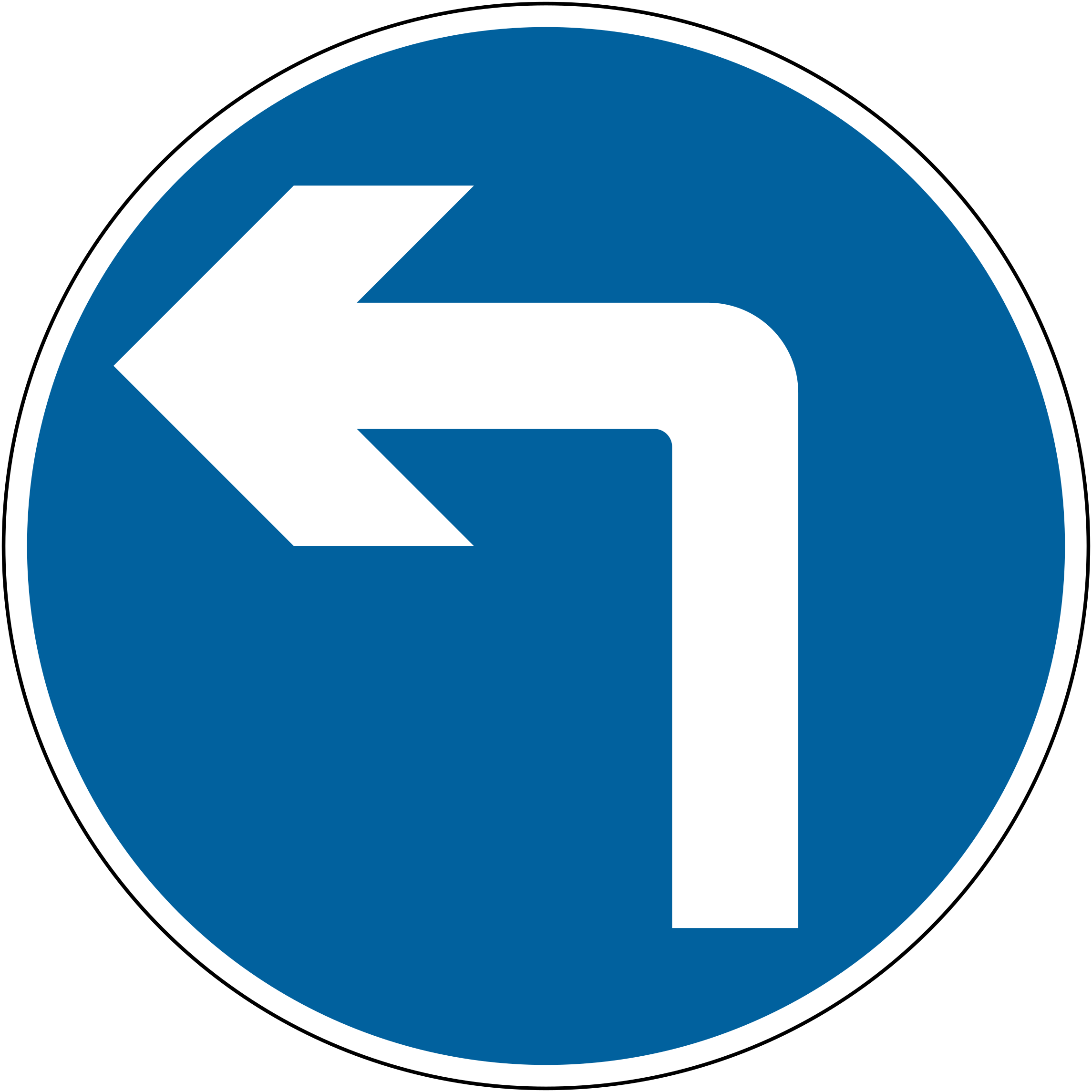
3. What does this traffic sign mean?
This traffic sign indicates that turning left is mandatory at the junction ahead. Traffic must turn left and may not continue straight ahead or turn right.
English • GB diagram 609 • Turn left ahead. Vehicular traffic must turn left ahead, subject to any signed exemption.
Sources
🔗 Commons.wikimedia.org (Government of the United Kingdom – Department for Transport • Crown copyright • OGL v1.0)
🔗 Legislation.gov.uk • Traffic Signs Regulations and General Directions • Great Britain
🔗 Gov.uk • Department for Transport • Know your traffic signs
SVG source: Government of the United Kingdom – Department for Transport • OGL v1.0 • Original revision 2021-12-18. Wikimedia original unmodified. © Crown copyright. Traffic signs are Crown copyright. You may reproduce traffic signs free of charge and without having to seek permission, but you must reproduce them accurately and not in a misleading context (e.g. not on roadside billboards where they could mislead drivers). (ref [1])
Artwork verified against Gov.uk • official published diagram 609.
Current design and permitted variants verified against Legislation.gov.uk • TSRGD, current text.
4. What does this traffic sign mean?
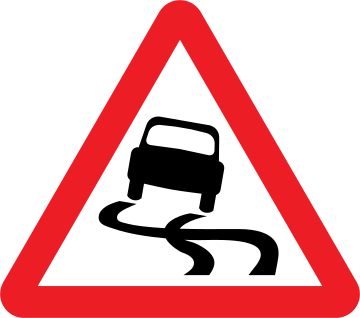
This traffic sign indicates a warning for a slippery road surface. The road ahead may provide reduced tyre grip because of water, ice, mud, oil or another surface condition. Reduce speed and avoid sudden braking, acceleration or steering movements.
English • GB diagram 557 • Slippery road. The road ahead may be slippery. Avoid sudden braking, acceleration or steering.
Sources
🔗 Commons.wikimedia.org
🔗 Legislation.gov.uk • Traffic Signs Regulations and General Directions • Great Britain
🔗 Gov.uk • Department for Transport • Know your traffic signs
SVG source: UK Government • Public domain • Original revision 2014-07-27. Wikimedia original unmodified.
5. What does this traffic sign mean?
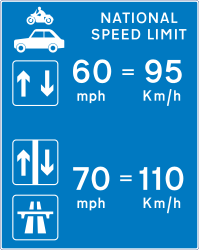
This traffic sign indicates the national speed limits. The applicable default maximum speeds depend on the road type, vehicle category and local traffic rules when no different speed limit is indicated.
6. What does this traffic sign mean?
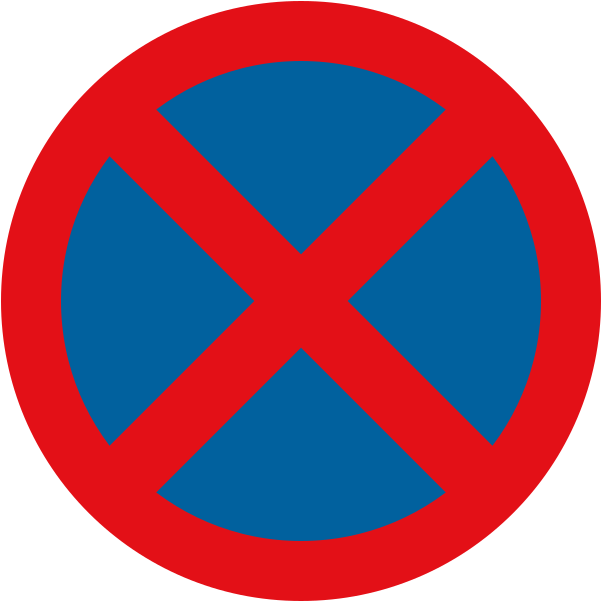
This traffic sign indicates that parking and stopping are prohibited. Vehicles may not stop or park voluntarily where the restriction applies, except where an applicable rule provides an exemption or stopping is required by traffic conditions.
English • GB diagram 642 • No stopping on the main carriageway. This is a clearway restriction: stopping on the main carriageway is prohibited. Observe its signed extent and any statutory exceptions.
Sources
🔗 Commons.wikimedia.org (Government of the United Kingdom – Department for Transport • Crown copyright • OGL v1.0)
🔗 Legislation.gov.uk • Traffic Signs Regulations and General Directions • Great Britain
🔗 Gov.uk • Department for Transport • Know your traffic signs
SVG source: Government of the United Kingdom – Department for Transport • OGL v1.0 • Original revision 2022-01-23. Wikimedia original unmodified. © Crown copyright. Traffic signs are Crown copyright. You may reproduce traffic signs free of charge and without having to seek permission, but you must reproduce them accurately and not in a misleading context (e.g. not on roadside billboards where they could mislead drivers). (ref [1])
Artwork verified against Gov.uk • official published diagram 642.
Current design and permitted variants verified against Legislation.gov.uk • TSRGD, current text.
7. What does this traffic sign mean?
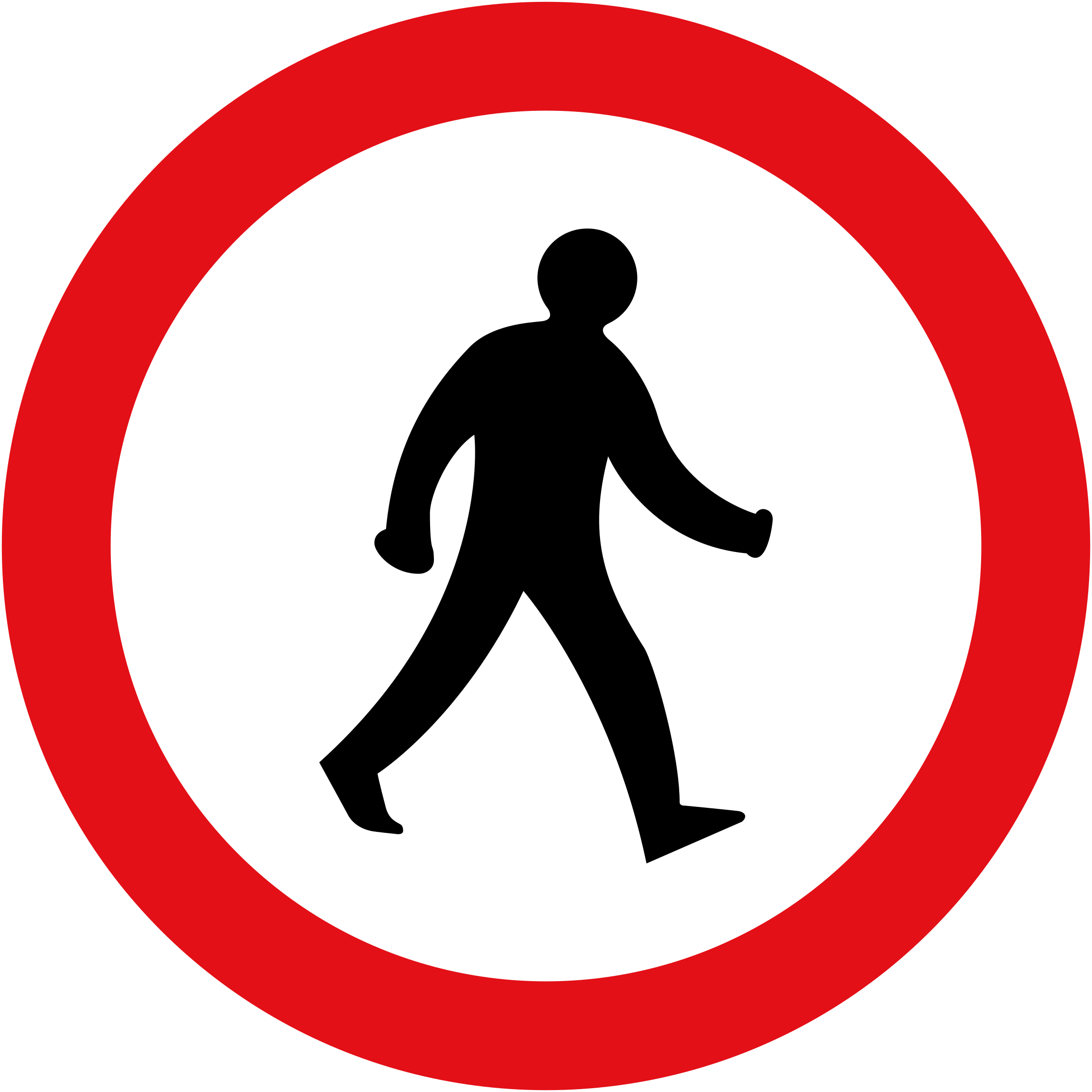
This traffic sign indicates that pedestrians are prohibited. Pedestrians may not enter or continue beyond the sign. Other road users may still be permitted unless another restriction applies.
English • GB diagram 625.1 • No pedestrians. Pedestrians must not use the route indicated by this sign.
Sources
🔗 Commons.wikimedia.org (Government of the United Kingdom – Department for Transport • Crown copyright • OGL v1.0)
🔗 Legislation.gov.uk • Traffic Signs Regulations and General Directions • Great Britain
🔗 Gov.uk • Department for Transport • Know your traffic signs
SVG source: Government of the United Kingdom – Department for Transport • OGL v1.0 • Original revision 2021-11-26. Wikimedia original unmodified. © Crown copyright. Traffic signs are Crown copyright. You may reproduce traffic signs free of charge and without having to seek permission, but you must reproduce them accurately and not in a misleading context (e.g. not on roadside billboards where they could mislead drivers). (ref [1])
Artwork verified against Gov.uk • official published diagram 625.1.
Current design and permitted variants verified against Legislation.gov.uk • TSRGD, current text.
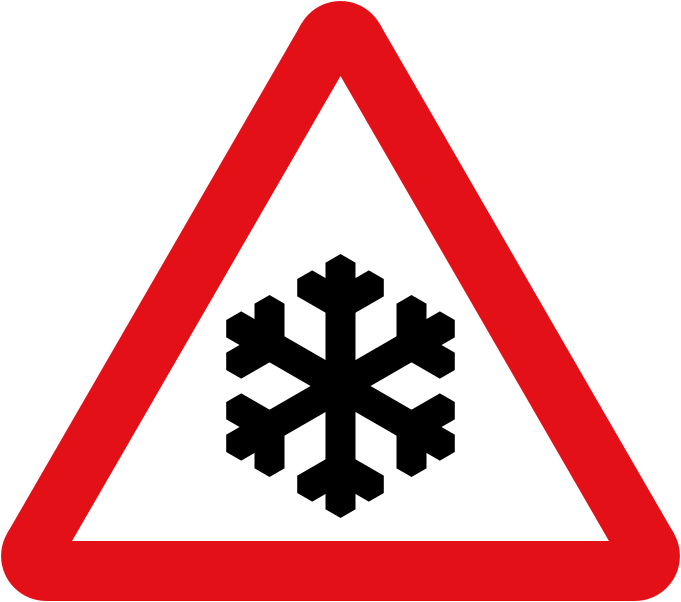
8. What does this traffic sign mean?
This traffic sign indicates a warning for snow or sleet. Snow, sleet or ice may reduce tyre grip, increase stopping distances and impair visibility. Reduce speed, increase your following distance and use any winter equipment required by the applicable rules or road conditions.
English • GB diagram 554.2 • Risk of ice or packed snow. There is a risk of ice or packed snow ahead. Adjust your speed and following distance.
Sources
🔗 Commons.wikimedia.org (Government of the United Kingdom – Department for Transport • Crown copyright • OGL v1.0)
🔗 Legislation.gov.uk • Traffic Signs Regulations and General Directions • Great Britain
🔗 Gov.uk • Department for Transport • Know your traffic signs
SVG source: Government of the United Kingdom – Department for Transport • OGL v1.0 • Original revision 2022-02-23. Wikimedia original unmodified. © Crown copyright. Traffic signs are Crown copyright. You may reproduce traffic signs free of charge and without having to seek permission, but you must reproduce them accurately and not in a misleading context (e.g. not on roadside billboards where they could mislead drivers). (ref [1])
Artwork verified against Gov.uk • official published diagram 554.2.
Current design and permitted variants verified against Legislation.gov.uk • TSRGD, current text.
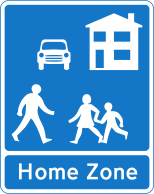
9. What does this traffic sign mean?
This traffic sign indicates the start of a residential area. Special traffic rules apply within the area according to the applicable signs and local regulations. These rules may affect speed, parking and how different road users use the road.
English • GB diagram 881 • Home Zone. You are entering a designated Home Zone: a residential street designed to be shared by pedestrians, cyclists and motor vehicles. Expect people using the street and drive with particular care. The sign alone does not set a universal 20 mph speed limit.
Sources
🔗 Commons.wikimedia.org (UK Government • Crown copyright • OGL v1.0)
🔗 Legislation.gov.uk • Traffic Signs Regulations and General Directions • Great Britain
🔗 Gov.uk • Department for Transport • Know your traffic signs
SVG source: UK Government • OGL v1.0 • Original revision 2023-01-19. Wikimedia original unmodified. © Crown copyright. Traffic signs are Crown copyright. You may reproduce traffic signs free of charge and without having to seek permission, but you must reproduce them accurately and not in a misleading context (e.g. not on roadside billboards where they could mislead drivers). (ref [1])
Artwork verified against Gov.uk • official published diagram 881A.
Current design and permitted variants verified against Legislation.gov.uk • TSRGD, current text.
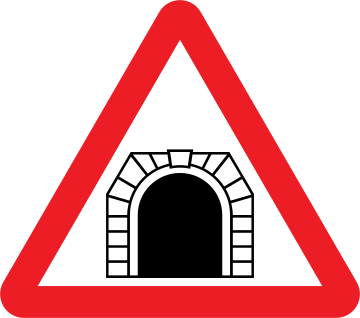
10. What does this traffic sign mean?
This traffic sign indicates a warning for a tunnel. Driving conditions may change at the tunnel entrance because of reduced light, limited visibility or restricted space. Reduce speed when necessary and follow the applicable rules for vehicle lighting, stopping, overtaking and lane use.
English • GB diagram 529.1 • Tunnel ahead. A tunnel is ahead. Observe its restrictions and keep a safe distance from other traffic.
Sources
🔗 Commons.wikimedia.org
🔗 Legislation.gov.uk • Traffic Signs Regulations and General Directions • Great Britain
🔗 Gov.uk • Department for Transport • Know your traffic signs
SVG source: UK Government • Public domain • Original revision 2014-07-17. Wikimedia original unmodified.
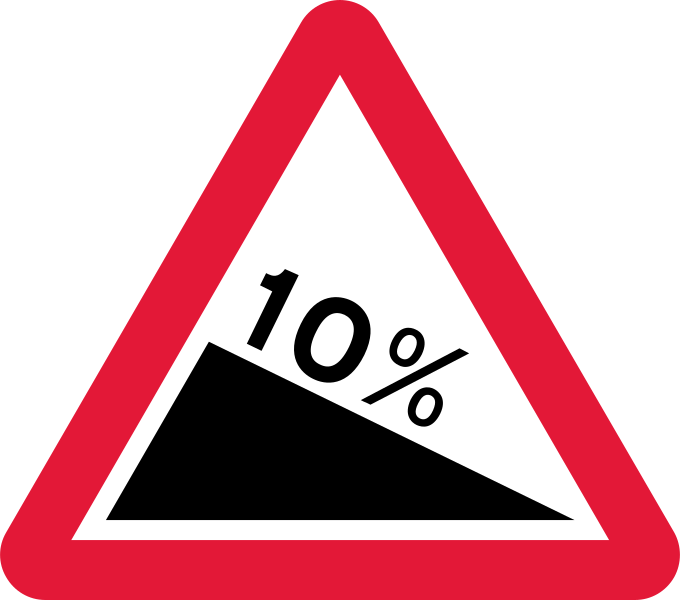
11. What does this traffic sign mean?
This traffic sign indicates a warning for a steep descent. A steep downhill gradient lies ahead and the vehicle may gain speed quickly. Reduce speed before the descent, select a suitable gear and use engine braking where appropriate. Allow extra distance for heavy or towing vehicles.
English • GB diagram 523.1 • Steep hill downwards. A steep downhill gradient is ahead; the example shows 10%. Select a suitable gear and control your speed.
Sources
🔗 Commons.wikimedia.org
🔗 Legislation.gov.uk • Traffic Signs Regulations and General Directions • Great Britain
🔗 Gov.uk • Department for Transport • Know your traffic signs
SVG source: UK Government • Public domain • Original revision 2019-05-22. Wikimedia original unmodified.
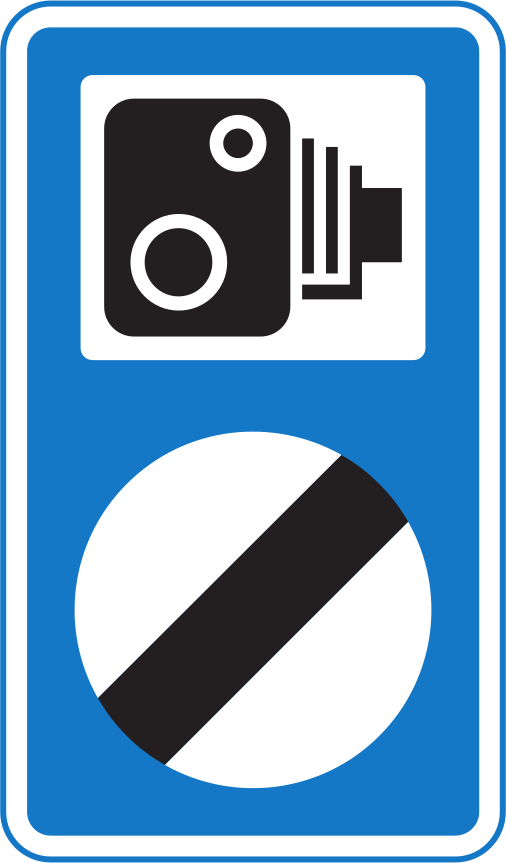
12. What does this traffic sign mean?
This traffic sign indicates the end of the section control. The section over which average speed is measured ends at this point.
English • GB diagram 880.1 • Speed camera and national speed limit reminder. A speed camera is ahead on an unlit road subject to the national speed limit. The limit depends on the road and vehicle type. This is not an average-speed enforcement end sign.
Sources
🔗 Commons.wikimedia.org (United Kingdom - Department for Transport • Crown copyright • OGL v1.0)
🔗 Legislation.gov.uk • Traffic Signs Regulations and General Directions • Great Britain
🔗 Gov.uk • Department for Transport • Know your traffic signs
SVG source: United Kingdom - Department for Transport • OGL v1.0 • Original revision 2014-05-01. Wikimedia original unmodified. © Crown copyright. Traffic signs are Crown copyright. You may reproduce traffic signs free of charge and without having to seek permission, but you must reproduce them accurately and not in a misleading context (e.g. not on roadside billboards where they could mislead drivers). (ref [1])
Artwork verified against Legislation.gov.uk • official published diagram 880.1.
Current design and permitted variants verified against Legislation.gov.uk • TSRGD, current text.
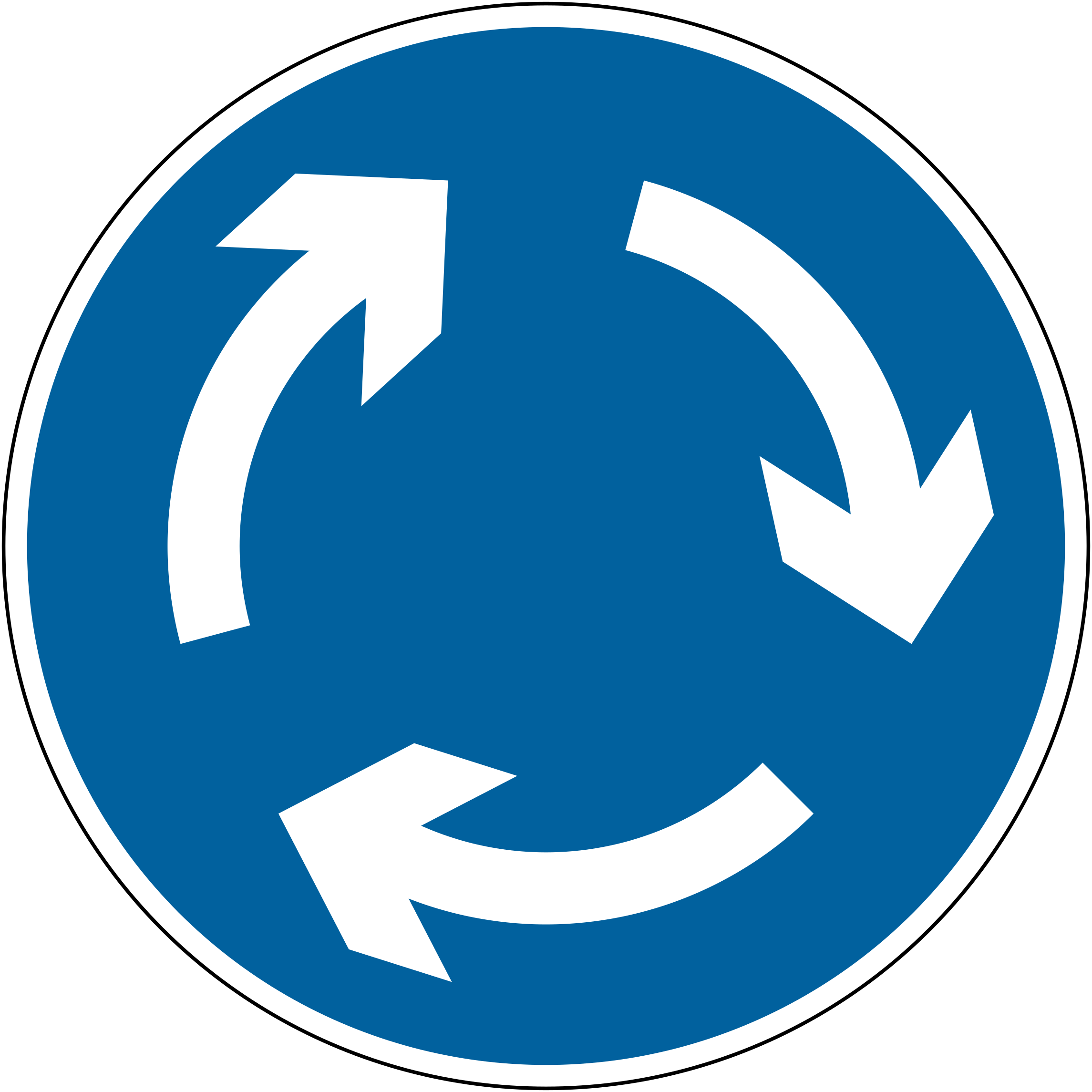
13. What does this traffic sign mean?
This traffic sign indicates the mandatory direction around a roundabout. Traffic must circulate in the direction shown by the arrows. The sign does not itself determine priority; follow the applicable priority signs, traffic signals and local rules.
English • GB diagram 611.1 • Mini-roundabout. Give priority to traffic from the right at the give-way markings. Pass to the left of the central white circle and circulate clockwise, unless the size of the vehicle or layout makes passing to the left impracticable.
Sources
🔗 Commons.wikimedia.org (Government of the United Kingdom – Department for Transport • Crown copyright • OGL v1.0)
🔗 Legislation.gov.uk • Traffic Signs Regulations and General Directions • Great Britain
🔗 Gov.uk • Department for Transport • Know your traffic signs
SVG source: Government of the United Kingdom – Department for Transport • OGL v1.0 • Original revision 2021-12-21. Wikimedia original unmodified. © Crown copyright. Traffic signs are Crown copyright. You may reproduce traffic signs free of charge and without having to seek permission, but you must reproduce them accurately and not in a misleading context (e.g. not on roadside billboards where they could mislead drivers). (ref [1])
Artwork verified against Gov.uk • official published diagram 611.1.
Current design and permitted variants verified against Legislation.gov.uk • TSRGD, current text.
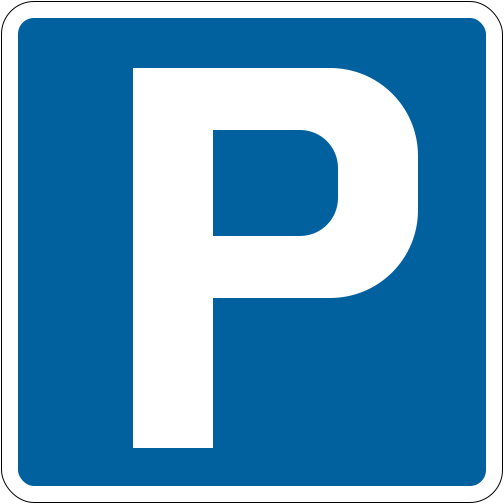
14. What does this traffic sign mean?
This traffic sign indicates that parking is allowed. Vehicles may be parked in the area covered by the sign subject to any indicated conditions, restrictions or local parking rules.
English • GB diagram 801 • Parking place. A parking place is available. Observe any conditions, charges, time limits and vehicle restrictions shown on accompanying signs.
Sources
🔗 Commons.wikimedia.org (Government of the United Kingdom – Department for Transport • Crown copyright • OGL v1.0)
🔗 Legislation.gov.uk • Traffic Signs Regulations and General Directions • Great Britain
🔗 Gov.uk • Department for Transport • Know your traffic signs
SVG source: Government of the United Kingdom – Department for Transport • OGL v1.0 • Original revision 2026-06-06. Wikimedia original unmodified. © Crown copyright. Traffic signs are Crown copyright. You may reproduce traffic signs free of charge and without having to seek permission, but you must reproduce them accurately and not in a misleading context (e.g. not on roadside billboards where they could mislead drivers). (ref [1])
Artwork verified against Gov.uk • official published diagram 801.
Current design and permitted variants verified against Legislation.gov.uk • TSRGD, current text.
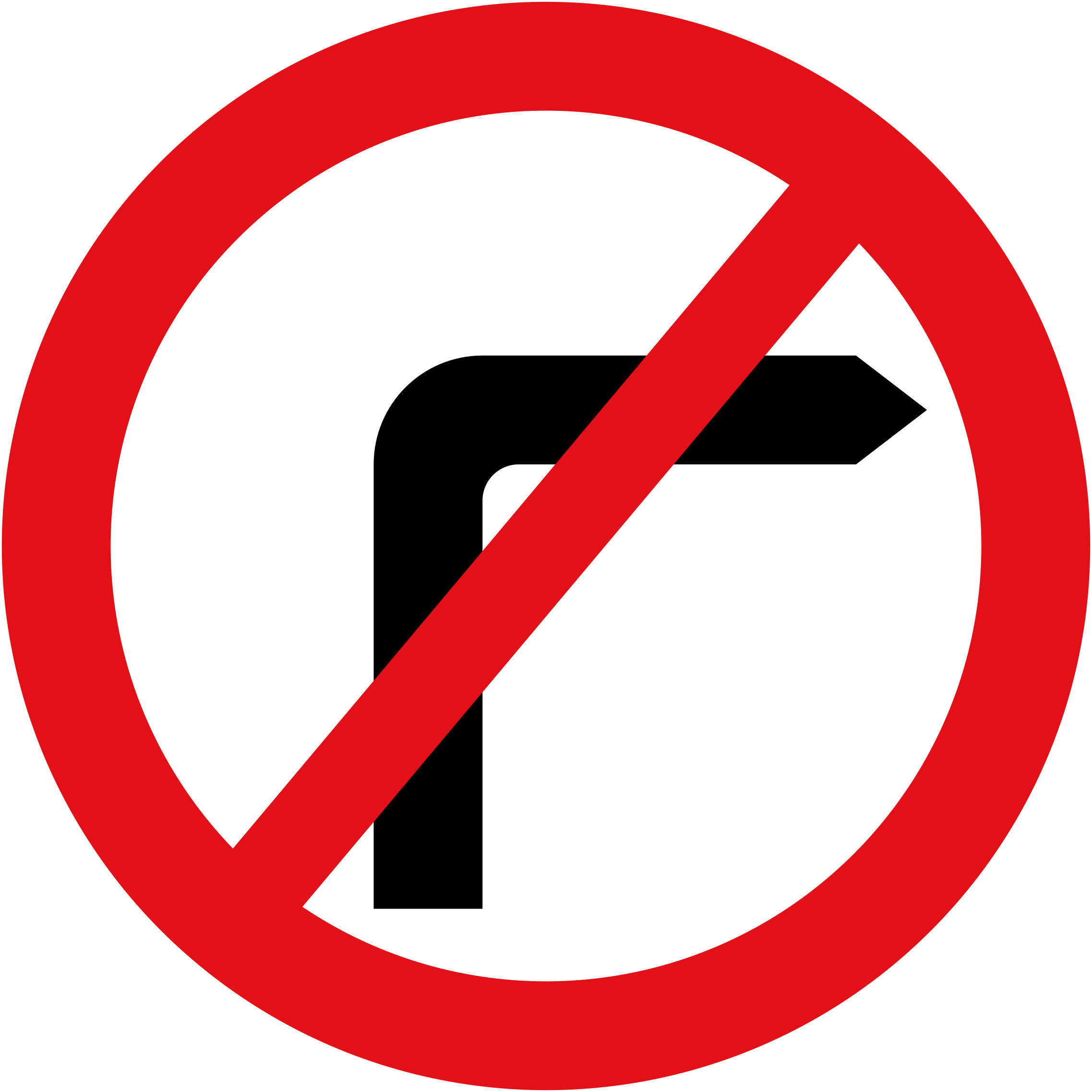
15. What does this traffic sign mean?
This traffic sign indicates that turning right is prohibited. A right turn may not be made where the sign applies. Other movements may still be permitted unless another restriction applies.
English • GB diagram 612 • No right turn. Vehicular traffic must not turn right at the junction, subject to any signed exemption.
Sources
🔗 Commons.wikimedia.org (Government of the United Kingdom – Department for Transport • Crown copyright • OGL v1.0)
🔗 Legislation.gov.uk • Traffic Signs Regulations and General Directions • Great Britain
🔗 Gov.uk • Department for Transport • Know your traffic signs
SVG source: Government of the United Kingdom – Department for Transport • OGL v1.0 • Original revision 2021-07-06. Wikimedia original unmodified. © Crown copyright. Traffic signs are Crown copyright. You may reproduce traffic signs free of charge and without having to seek permission, but you must reproduce them accurately and not in a misleading context (e.g. not on roadside billboards where they could mislead drivers). (ref [1])
Artwork verified against Gov.uk • official published diagram 612.
Current design and permitted variants verified against Legislation.gov.uk • TSRGD, current text.
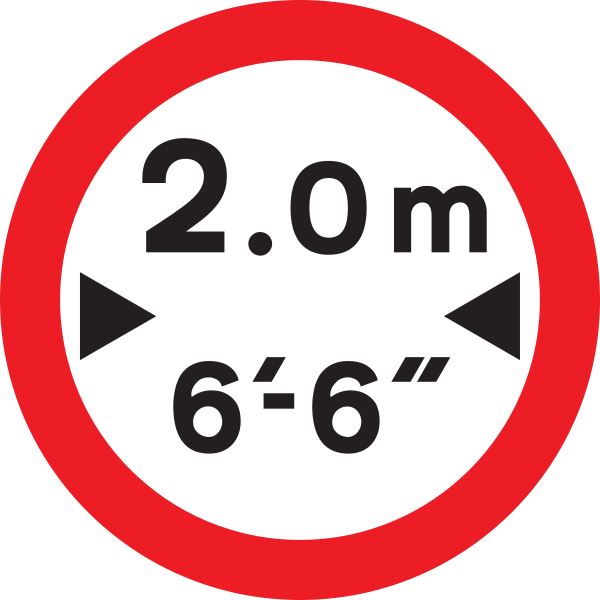
16. What does this traffic sign mean?
This traffic sign indicates that vehicles wider than indicated are prohibited. A vehicle or vehicle combination whose overall width, including its load, exceeds the displayed limit may not continue beyond the sign.
English • GB diagram 629A • Maximum width. Vehicles wider than the stated 2.0 m / 6 ft 6 in must not proceed. Include the load when checking width.
Sources
🔗 Commons.wikimedia.org
🔗 Legislation.gov.uk • Traffic Signs Regulations and General Directions • Great Britain
🔗 Gov.uk • Department for Transport • Know your traffic signs
SVG source: UK Government • Public domain • Original revision 2011-12-10. Wikimedia original unmodified.
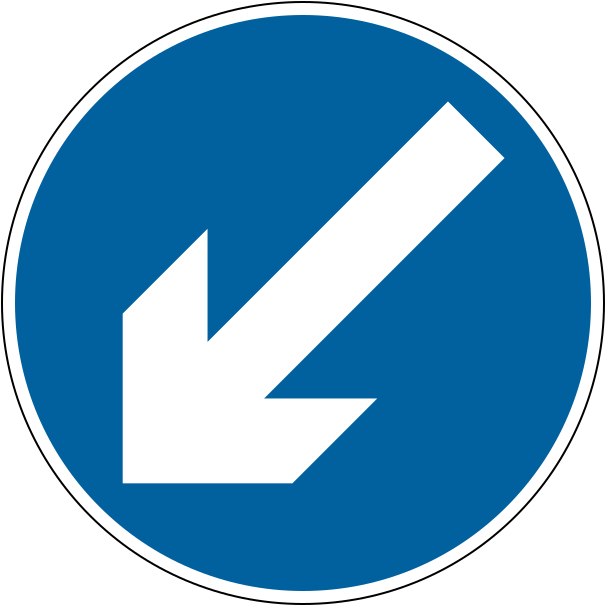
17. What does this traffic sign mean?
This traffic sign indicates that traffic must pass an obstacle on the left. Keep to the left of the obstacle and follow any accompanying signs or road markings.
English • GB diagram 610 • Keep left. Traffic must pass to the left of the sign or obstruction, following the arrow.
Sources
🔗 Commons.wikimedia.org (Government of the United Kingdom – Department for Transport • Crown copyright • OGL v1.0)
🔗 Legislation.gov.uk • Traffic Signs Regulations and General Directions • Great Britain
🔗 Gov.uk • Department for Transport • Know your traffic signs
SVG source: Government of the United Kingdom – Department for Transport • OGL v1.0 • Original revision 2022-01-17. Wikimedia original unmodified. © Crown copyright. Traffic signs are Crown copyright. You may reproduce traffic signs free of charge and without having to seek permission, but you must reproduce them accurately and not in a misleading context (e.g. not on roadside billboards where they could mislead drivers). (ref [1])
Artwork verified against Gov.uk • official published diagram 610.
Current design and permitted variants verified against Legislation.gov.uk • TSRGD, current text.
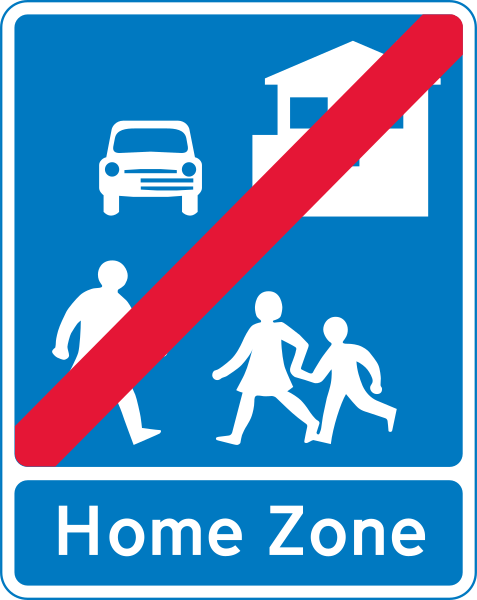
18. What does this traffic sign mean?
This traffic sign indicates the end of the residential area. The special traffic rules associated with the residential area end at this point. Follow the traffic signs and rules that apply beyond the area.
Sources
🔗 Commons.wikimedia.org (UK Government • Crown copyright • OGL v1.0)
Image via Commons.wikimedia.org
UK Government • OGL v1.0 • Source revision 2011-11-29. Wikimedia original unmodified.
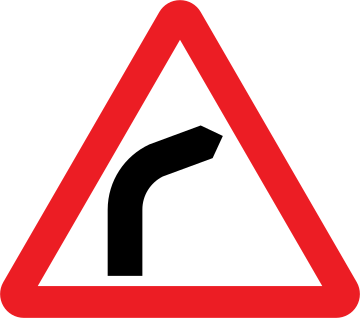
19. What does this traffic sign mean?
This traffic sign indicates a warning for a curve to the right. A right-hand bend lies ahead. Reduce speed before entering the curve, maintain your lane position and use smooth steering.
English • GB diagram 512 • Bend ahead. A bend to the right is ahead. Adjust your speed to the bend and visibility.
Sources
🔗 Commons.wikimedia.org
🔗 Legislation.gov.uk • Traffic Signs Regulations and General Directions • Great Britain
🔗 Gov.uk • Department for Transport • Know your traffic signs
SVG source: UK Government • Public domain • Original revision 2013-12-13. Wikimedia original unmodified.
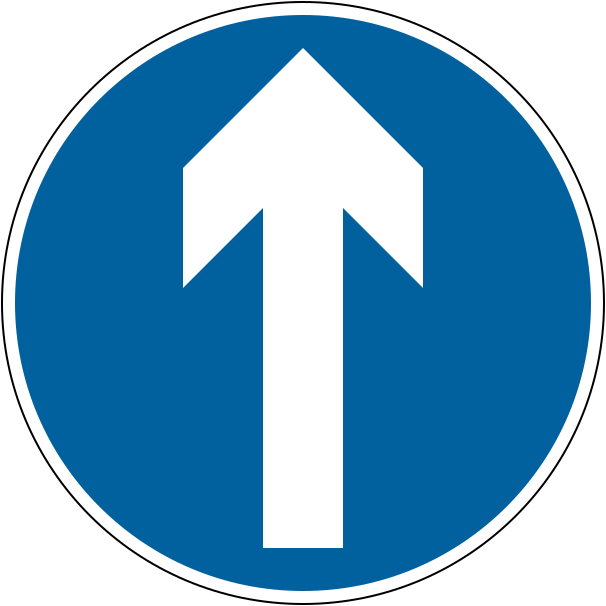
20. What does this traffic sign mean?
This traffic sign indicates that driving straight ahead is mandatory. Traffic must continue straight ahead and may not turn left or right at the location to which the sign applies.
English • GB diagram 606 • Ahead only. Vehicular traffic must proceed straight ahead, subject to any signed exemption. This circular sign gives an instruction at its location.
Sources
🔗 Commons.wikimedia.org (Government of the United Kingdom – Department for Transport • Crown copyright • OGL v1.0)
🔗 Legislation.gov.uk • Traffic Signs Regulations and General Directions • Great Britain
🔗 Gov.uk • Department for Transport • Know your traffic signs
SVG source: Government of the United Kingdom – Department for Transport • OGL v1.0 • Original revision 2022-01-14. Wikimedia original unmodified. © Crown copyright. Traffic signs are Crown copyright. You may reproduce traffic signs free of charge and without having to seek permission, but you must reproduce them accurately and not in a misleading context (e.g. not on roadside billboards where they could mislead drivers). (ref [1])
Artwork verified against Gov.uk • official published diagram 606.
Current design and permitted variants verified against Legislation.gov.uk • TSRGD, current text.
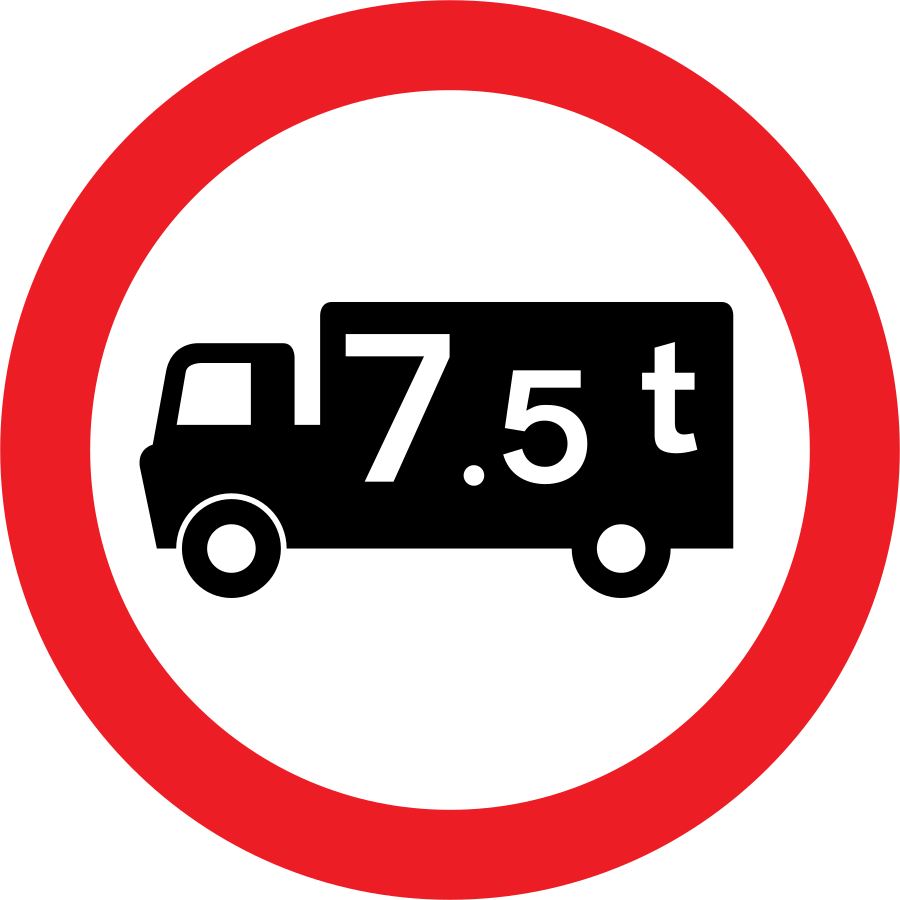
21. What does this traffic sign mean?
This traffic sign indicates that trucks heavier than indicated are prohibited. Trucks covered by the sign may not continue if they exceed the displayed mass limit. The legally relevant mass is determined by the applicable local rules.
English • GB diagram 622.1A • Goods vehicle weight restriction. Goods vehicles with a maximum gross weight exceeding 7.5 tonnes are prohibited. Read any accompanying exemption, such as access or loading.
Sources
🔗 Commons.wikimedia.org (Martinvl • Crown copyright • OGL v1.0)
🔗 Legislation.gov.uk • Traffic Signs Regulations and General Directions • Great Britain
🔗 Gov.uk • Department for Transport • Know your traffic signs
SVG source: Martinvl • OGL v1.0 • Original revision 2015-01-05. Wikimedia original unmodified. © Crown copyright. Traffic signs are Crown copyright. You may reproduce traffic signs free of charge and without having to seek permission, but you must reproduce them accurately and not in a misleading context (e.g. not on roadside billboards where they could mislead drivers). (ref )
Artwork verified against Gov.uk • official published diagram 622.1A.
Current design and permitted variants verified against Legislation.gov.uk • TSRGD, current text.
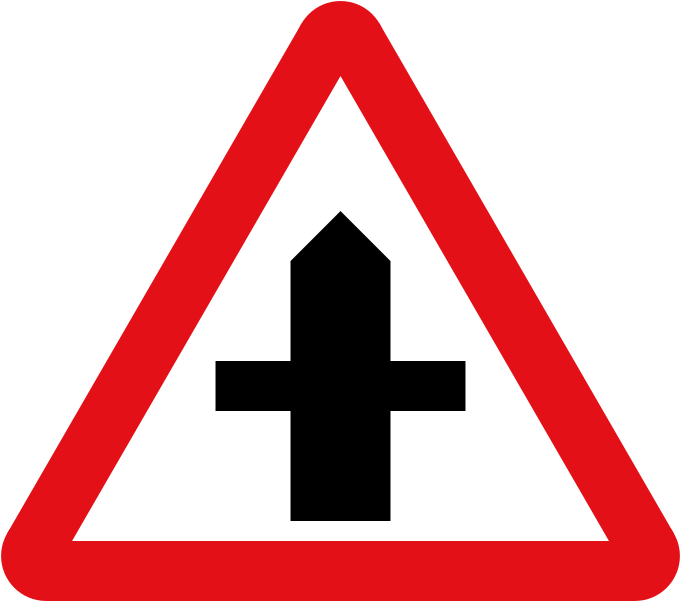
22. What does this traffic sign mean?
This traffic sign indicates that you have priority at the next intersection. Side roads join from the left and right, and traffic entering from those side roads must give way.
English • GB diagram 504.1 • Crossroads ahead. A crossroads is ahead. The broad line represents the main route through the junction.
Sources
🔗 Commons.wikimedia.org (Government of the United Kingdom – Department for Transport • Crown copyright • OGL v1.0)
🔗 Legislation.gov.uk • Traffic Signs Regulations and General Directions • Great Britain
🔗 Gov.uk • Department for Transport • Know your traffic signs
SVG source: Government of the United Kingdom – Department for Transport • OGL v1.0 • Original revision 2022-02-12. Wikimedia original unmodified. © Crown copyright. Traffic signs are Crown copyright. You may reproduce traffic signs free of charge and without having to seek permission, but you must reproduce them accurately and not in a misleading context (e.g. not on roadside billboards where they could mislead drivers). (ref [1])
Artwork verified against Gov.uk • official published diagram 504.1.
Current design and permitted variants verified against Legislation.gov.uk • TSRGD, current text.
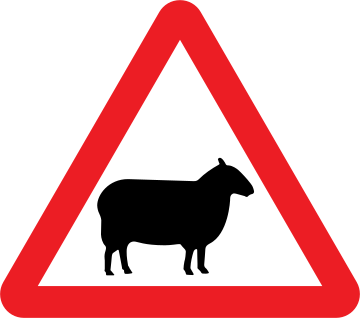
23. What does this traffic sign mean?
This traffic sign indicates a warning for sheep. Sheep may be grazing beside the road, crossing it or moving along it, sometimes in groups. Reduce speed, remain alert and be prepared to stop without startling the animals.
English • GB diagram 549 • Sheep. Sheep are likely to be in the road ahead.
Sources
🔗 Commons.wikimedia.org
🔗 Legislation.gov.uk • Traffic Signs Regulations and General Directions • Great Britain
🔗 Gov.uk • Department for Transport • Know your traffic signs
SVG source: UK Government • Public domain • Original revision 2014-07-18. Wikimedia original unmodified.
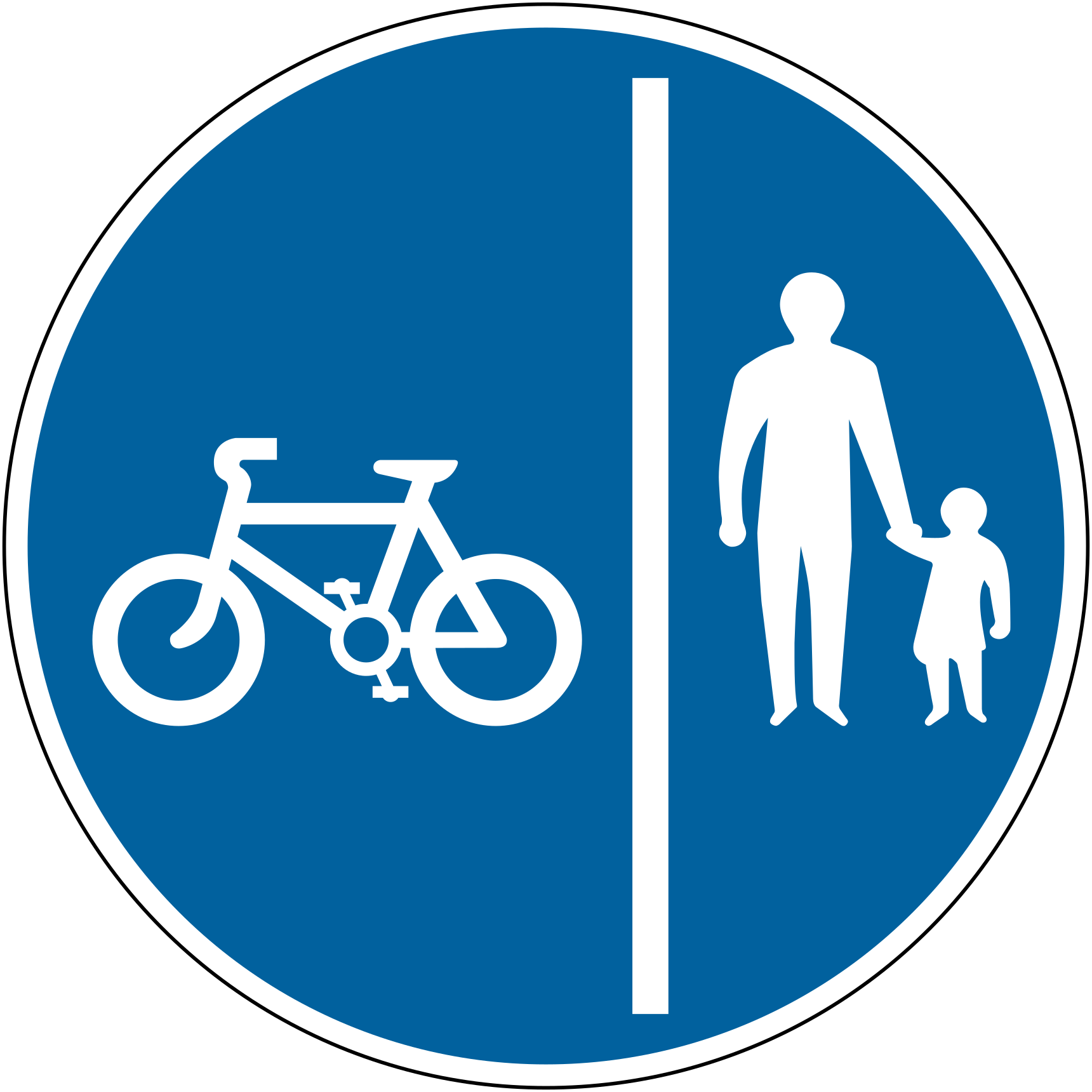
24. What does this traffic sign mean?
This traffic sign indicates a mandatory divided path for pedestrians and cyclists. Pedestrians and cyclists must use the section designated for them. Other road users may use the path only where the applicable signs or local rules permit them to do so.
English • GB diagram 957 • Segregated pedestrian and cycle route. Use the side shown for your class of traffic: cycles on the left and pedestrians on the right. In Great Britain, permitted trial electric scooters use the cycle side where applicable.
Sources
🔗 Commons.wikimedia.org (Government of the United Kingdom – Department for Transport • Crown copyright • OGL v1.0)
🔗 Legislation.gov.uk • Traffic Signs Regulations and General Directions • Great Britain
🔗 Gov.uk • Department for Transport • Know your traffic signs
SVG source: Government of the United Kingdom – Department for Transport • OGL v1.0 • Original revision 2021-08-02. Wikimedia original unmodified. © Crown copyright. Traffic signs are Crown copyright. You may reproduce traffic signs free of charge and without having to seek permission, but you must reproduce them accurately and not in a misleading context (e.g. not on roadside billboards where they could mislead drivers). (ref [1])
Artwork verified against Gov.uk • official published diagram 957.
Current design and permitted variants verified against Legislation.gov.uk • TSRGD, current text.
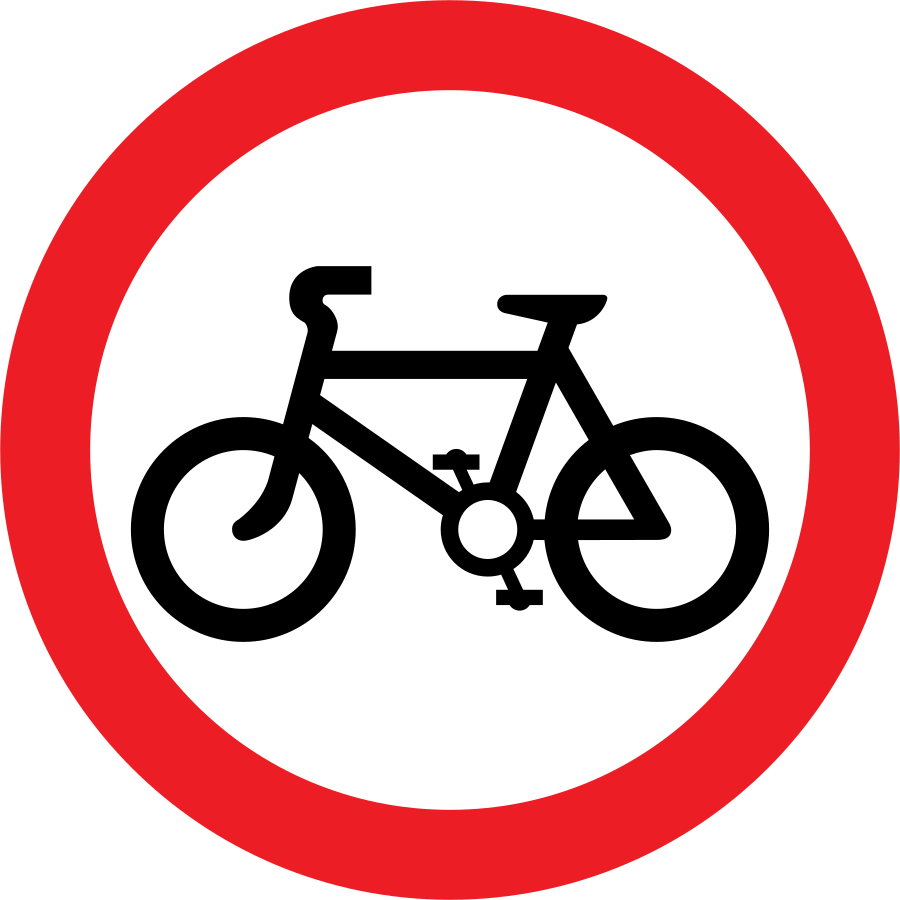
25. What does this traffic sign mean?
This traffic sign indicates that cyclists are prohibited. Cyclists may not enter or continue beyond the sign. Other road users may still be permitted unless another restriction applies.
English • GB diagram 951 • No cycling. Riding pedal cycles is prohibited. In Great Britain, the current rule also covers electric scooters used in authorised trials where applicable.
Sources
🔗 Commons.wikimedia.org (UK Government • Crown copyright • OGL v1.0)
🔗 Legislation.gov.uk • Traffic Signs Regulations and General Directions • Great Britain
🔗 Gov.uk • Department for Transport • Know your traffic signs
SVG source: UK Government • OGL v1.0 • Original revision 2014-09-26. Wikimedia original unmodified. © Crown copyright. Traffic signs are Crown copyright. You may reproduce traffic signs free of charge and without having to seek permission, but you must reproduce them accurately and not in a misleading context (e.g. not on roadside billboards where they could mislead drivers). (ref [1])
Artwork verified against Gov.uk • official published diagram 951.
Current design and permitted variants verified against Legislation.gov.uk • TSRGD, current text.
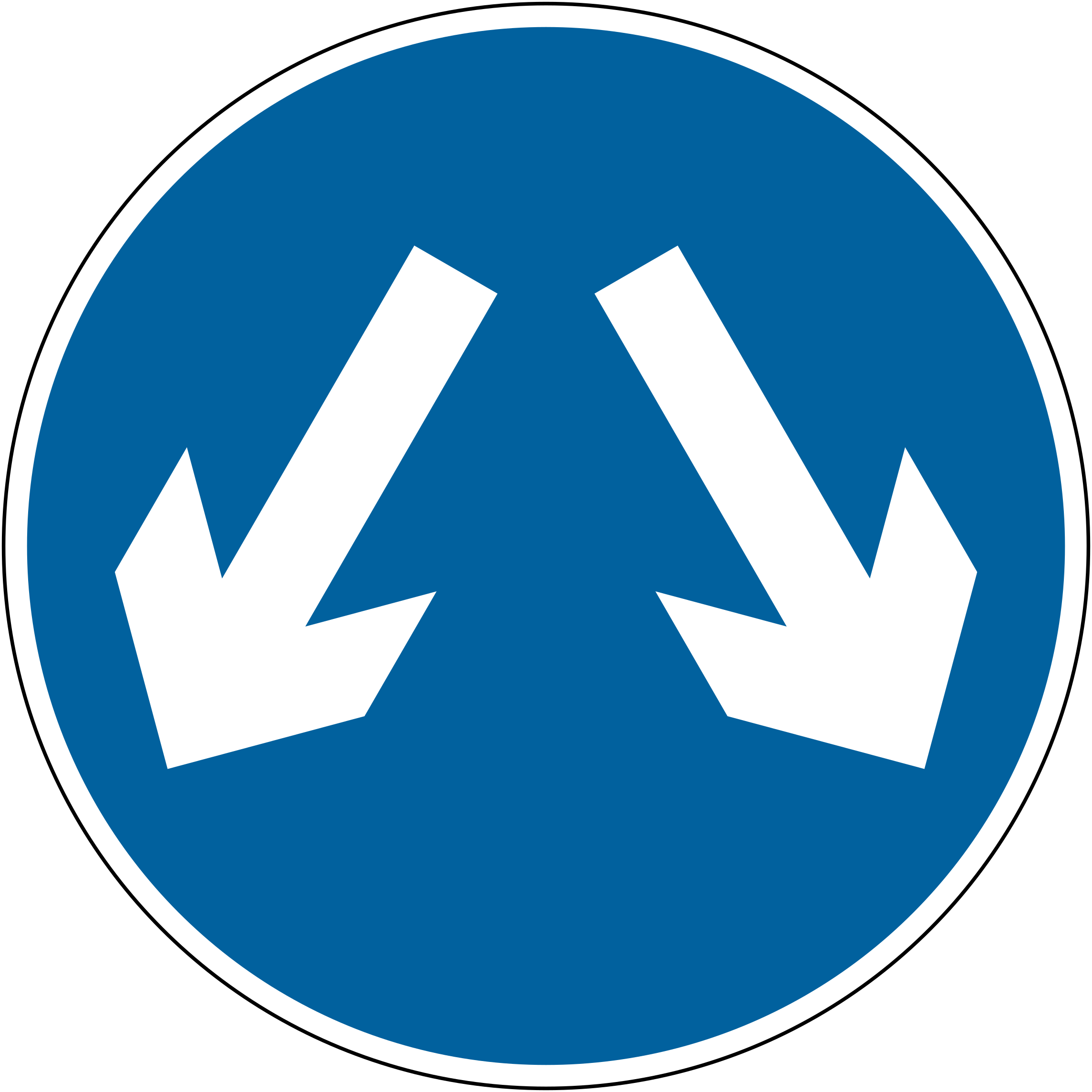
26. What does this traffic sign mean?
This traffic sign indicates that traffic must pass an obstacle on either the left or the right. Use either permitted side while following the road layout and any accompanying signs or markings.
English • GB diagram 611 • Pass either side. Traffic may pass either side of the sign to reach the same destination.
Sources
🔗 Commons.wikimedia.org (Government of the United Kingdom – Department for Transport • Crown copyright • OGL v1.0)
🔗 Legislation.gov.uk • Traffic Signs Regulations and General Directions • Great Britain
🔗 Gov.uk • Department for Transport • Know your traffic signs
SVG source: Government of the United Kingdom – Department for Transport • OGL v1.0 • Original revision 2021-12-19. Wikimedia original unmodified. © Crown copyright. Traffic signs are Crown copyright. You may reproduce traffic signs free of charge and without having to seek permission, but you must reproduce them accurately and not in a misleading context (e.g. not on roadside billboards where they could mislead drivers). (ref [1])
Artwork verified against Gov.uk • official published diagram 611.
Current design and permitted variants verified against Legislation.gov.uk • TSRGD, current text.
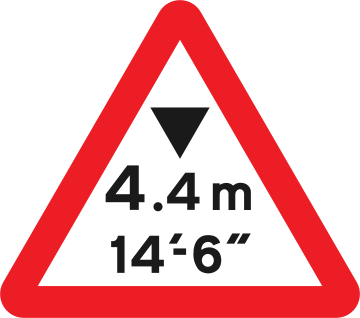
27. What does this traffic sign mean?
This traffic sign indicates a warning for a height restriction. The available clearance ahead is limited, for example at a bridge, tunnel or other overhead structure. Drivers of tall vehicles should check their vehicle height and use another route if the vehicle cannot pass safely.
English • GB diagram 530A • Maximum headroom at a hazard. The available headroom is indicated as 4.4 m / 14 ft 6 in. This triangular sign warns of restricted clearance; check your vehicle and load height before proceeding.
Sources
🔗 Commons.wikimedia.org (Government of the United Kingdom • Crown copyright • OGL v1.0)
🔗 Legislation.gov.uk • Traffic Signs Regulations and General Directions • Great Britain
🔗 Gov.uk • Department for Transport • Know your traffic signs
SVG source: Government of the United Kingdom • OGL v1.0 • Original revision 2015-09-04. Wikimedia original unmodified. © Crown copyright. Traffic signs are Crown copyright. You may reproduce traffic signs free of charge and without having to seek permission, but you must reproduce them accurately and not in a misleading context (e.g. not on roadside billboards where they could mislead drivers). (ref [1])
Artwork verified against Gov.uk • official published diagram 530A.
Current design and permitted variants verified against Legislation.gov.uk • TSRGD, current text.
28. What does this traffic sign mean?
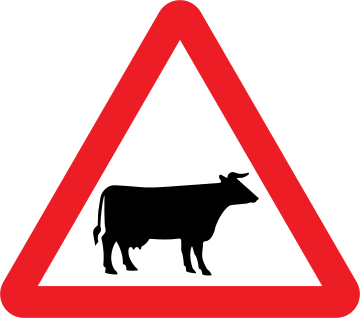
This traffic sign indicates a warning for cattle. Cattle or other livestock may be crossing, walking along or standing near the road. Reduce speed, be prepared to stop and avoid sudden movements or unnecessary use of the horn that could startle the animals.
English • GB diagram 548 • Cattle. Cattle are likely to be in the road ahead.
Sources
🔗 Commons.wikimedia.org
🔗 Legislation.gov.uk • Traffic Signs Regulations and General Directions • Great Britain
🔗 Gov.uk • Department for Transport • Know your traffic signs
SVG source: UK Government • Public domain • Original revision 2014-07-18. Wikimedia original unmodified.
29. What does this traffic sign mean?
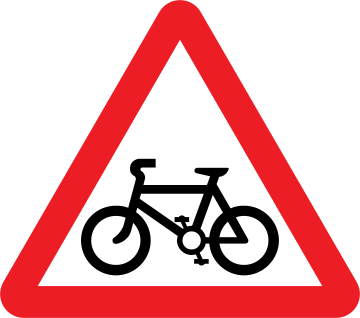
This traffic sign indicates a warning for cyclists. Cyclists may be riding along or crossing the road ahead. Reduce speed, watch carefully for cyclists and maintain the passing distance required by the applicable local rules.
English • GB diagram 950 • Cycle route ahead. A pedal cycle route crosses or joins the road ahead. Watch for cyclists.
Sources
🔗 Commons.wikimedia.org (UK Government • Crown copyright • OGL v1.0)
🔗 Legislation.gov.uk • Traffic Signs Regulations and General Directions • Great Britain
🔗 Gov.uk • Department for Transport • Know your traffic signs
SVG source: UK Government • OGL v1.0 • Original revision 2024-11-10. Wikimedia original unmodified. © Crown copyright. Traffic signs are Crown copyright. You may reproduce traffic signs free of charge and without having to seek permission, but you must reproduce them accurately and not in a misleading context (e.g. not on roadside billboards where they could mislead drivers). (ref [1])
Artwork verified against Gov.uk • official published diagram 950.
Current design and permitted variants verified against Legislation.gov.uk • TSRGD, current text.
30. What does this traffic sign mean?
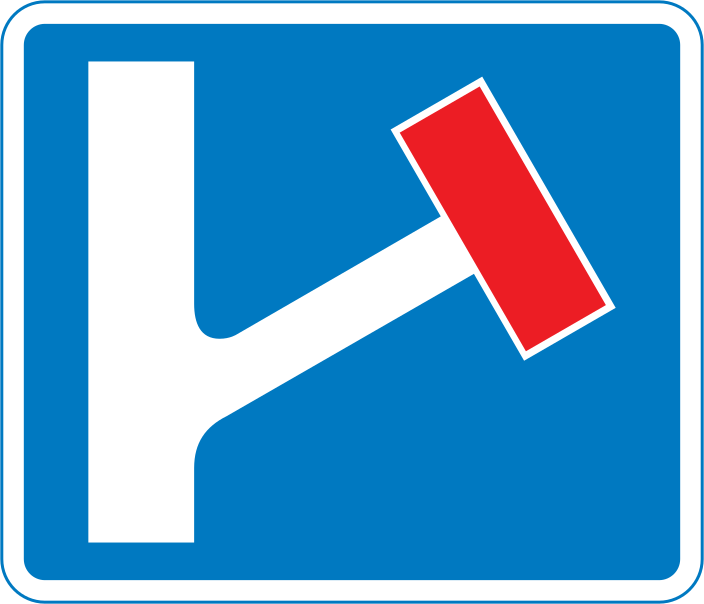
This traffic sign indicates a dead end street. The road has no through route for vehicles, although access to properties or other destinations along the road may still be possible.
English • GB diagram 816 • No through road. The road indicated is a no-through road; the pictured arrangement shows a side road that does not continue through.
Sources
🔗 Commons.wikimedia.org (UK Government • Crown copyright • OGL v1.0)
🔗 Legislation.gov.uk • Traffic Signs Regulations and General Directions • Great Britain
🔗 Gov.uk • Department for Transport • Know your traffic signs
SVG source: UK Government • OGL v1.0 • Original revision 2014-08-11. Wikimedia original unmodified. © Crown copyright. Traffic signs are Crown copyright. You may reproduce traffic signs free of charge and without having to seek permission, but you must reproduce them accurately and not in a misleading context (e.g. not on roadside billboards where they could mislead drivers). (ref [1])
Artwork verified against Gov.uk • official published diagram 817R.
Current design and permitted variants verified against Legislation.gov.uk • TSRGD, current text.
31. What does this traffic sign mean?
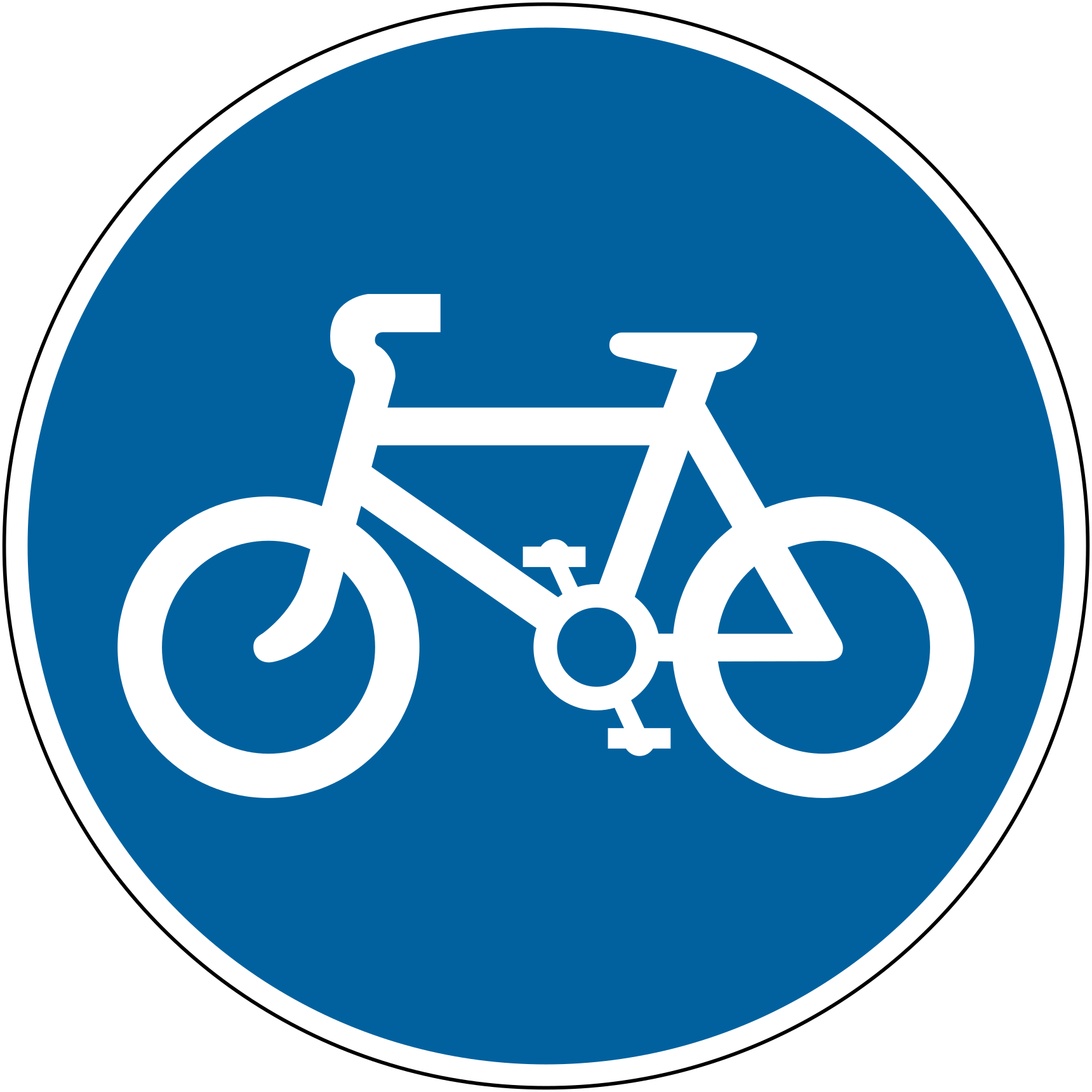
This traffic sign indicates a mandatory path for cyclists. Cyclists must use the designated path where the sign applies. Other road users may use the path only where the applicable signs or local rules permit them to do so.
English • GB diagram 955 • Route for pedal cycles. This route is for pedal cycles only. In Great Britain, permitted trial electric scooters are also included where applicable.
Sources
🔗 Commons.wikimedia.org (Government of the United Kingdom – Department for Transport • Crown copyright • OGL v1.0)
🔗 Legislation.gov.uk • Traffic Signs Regulations and General Directions • Great Britain
🔗 Gov.uk • Department for Transport • Know your traffic signs
SVG source: Government of the United Kingdom – Department for Transport • OGL v1.0 • Original revision 2021-08-02. Wikimedia original unmodified. © Crown copyright. Traffic signs are Crown copyright. You may reproduce traffic signs free of charge and without having to seek permission, but you must reproduce them accurately and not in a misleading context (e.g. not on roadside billboards where they could mislead drivers). (ref [1])
Artwork verified against Gov.uk • official published diagram 955.
Current design and permitted variants verified against Legislation.gov.uk • TSRGD, current text.
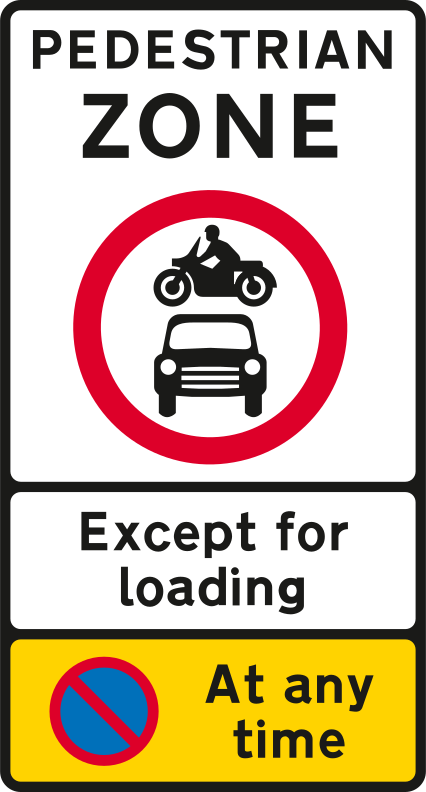
32. What does this traffic sign mean?
This traffic sign indicates the start of a pedestrian zone. Pedestrians are the principal road users within the zone, while access by vehicles and other road users is subject to the applicable traffic signs and local rules.
English • GB diagram 618.3 (legacy) • Pedestrian zone. Motor vehicles are prohibited in the pedestrian zone except for loading as shown. Waiting is prohibited at any time. This is an older pedestrian-zone sign; the motor-vehicle symbol does not prohibit pedal cycles.
Sources
🔗 Commons.wikimedia.org
🔗 Legislation.gov.uk • Traffic Signs Regulations and General Directions • Great Britain
🔗 Gov.uk • Department for Transport • Know your traffic signs
🔗 Legislation.gov.uk • Retention of existing signs • regulation 14
🔗 Legislation.gov.uk • Earlier prescribed signs • TSRGD 2002
Image via Commons.wikimedia.org
UK Government • Public domain • Source revision 2011-11-29. Wikimedia original unmodified.
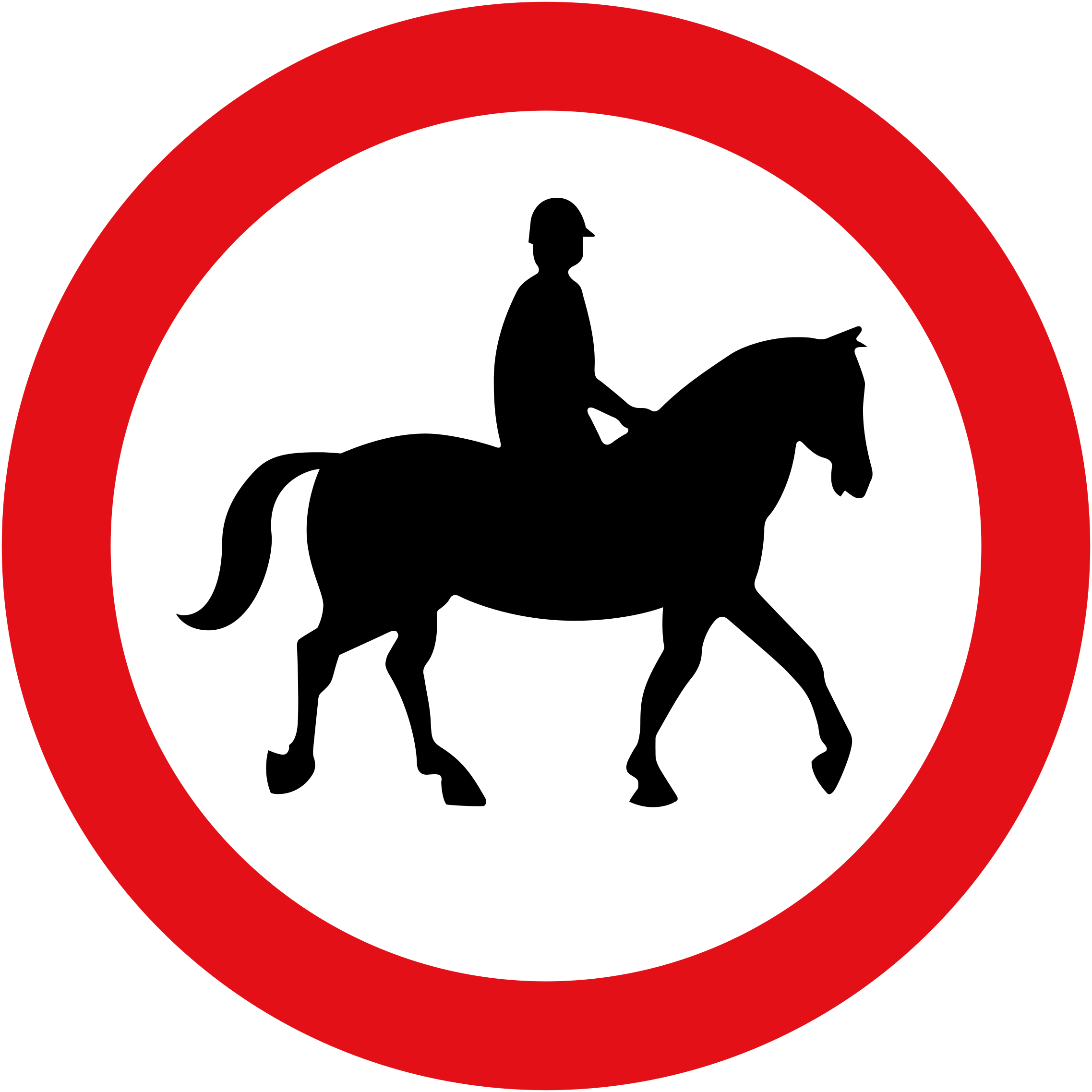
33. What does this traffic sign mean?
This traffic sign indicates that equestrians are prohibited. Equestrians may not enter or continue beyond the sign. Other road users may still be permitted unless another restriction applies.
English • GB diagram 622.6 • No ridden or accompanied horses. Ridden or accompanied horses are prohibited.
Sources
🔗 Commons.wikimedia.org (Government of the United Kingdom – Department for Transport • Crown copyright • OGL v1.0)
🔗 Legislation.gov.uk • Traffic Signs Regulations and General Directions • Great Britain
🔗 Gov.uk • Department for Transport • Know your traffic signs
SVG source: Government of the United Kingdom – Department for Transport • OGL v1.0 • Original revision 2021-07-14. Wikimedia original unmodified. © Crown copyright. Traffic signs are Crown copyright. You may reproduce traffic signs free of charge and without having to seek permission, but you must reproduce them accurately and not in a misleading context (e.g. not on roadside billboards where they could mislead drivers). (ref [1])
Artwork verified against Gov.uk • official published diagram 622.6.
Current design and permitted variants verified against Legislation.gov.uk • TSRGD, current text.
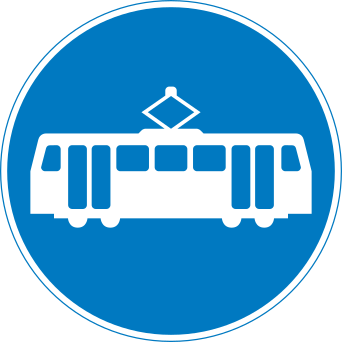
34. What does this traffic sign mean?
This traffic sign indicates a mandatory lane for buses. Buses must use the designated lane where the sign applies. Other road users may use the lane only where the applicable signs or local rules permit them to do so.
English • GB diagram 953.1 • Tramcars only. This route is for tramcars only, subject to any authorised and signed exception.
Sources
🔗 Commons.wikimedia.org (UK Government • Crown copyright • OGL v1.0)
🔗 Legislation.gov.uk • Traffic Signs Regulations and General Directions • Great Britain
🔗 Gov.uk • Department for Transport • Know your traffic signs
SVG source: UK Government • OGL v1.0 • Original revision 2011-11-13. Wikimedia original unmodified. © Crown copyright. Traffic signs are Crown copyright. You may reproduce traffic signs free of charge and without having to seek permission, but you must reproduce them accurately and not in a misleading context (e.g. not on roadside billboards where they could mislead drivers). (ref [1])
Artwork verified against Gov.uk • official published diagram 953.1.
Current design and permitted variants verified against Legislation.gov.uk • TSRGD, current text.
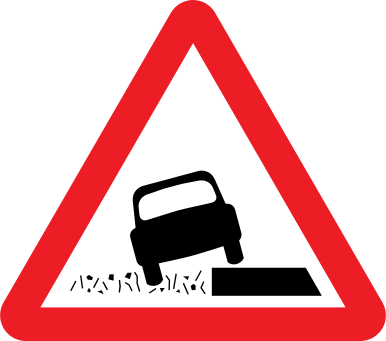
35. What does this traffic sign mean?
This traffic sign indicates a warning for a soft or unstable verge. The edge of the road may provide less grip or support than the roadway and can affect steering or vehicle stability. Avoid driving onto the verge unless necessary and reduce speed if you must use it.
English • GB diagram 556.1 • Soft verges. The verges ahead may be too soft to support a vehicle safely.
Sources
🔗 Commons.wikimedia.org
🔗 Legislation.gov.uk • Traffic Signs Regulations and General Directions • Great Britain
🔗 Gov.uk • Department for Transport • Know your traffic signs
SVG source: UK Government • Public domain • Original revision 2011-11-12. Wikimedia original unmodified.
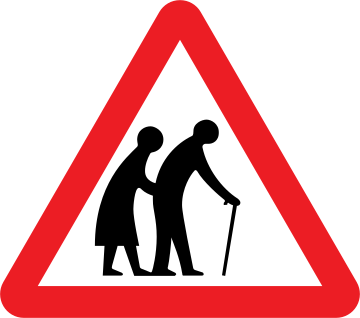
36. What does this traffic sign mean?
This traffic sign indicates a warning for elderly pedestrians. Elderly pedestrians may be walking near or crossing the road and may require more time to cross safely. Reduce speed, watch carefully and be prepared to stop.
English • GB diagram 544.2 • Frail or disabled pedestrians. Frail or disabled pedestrians are likely to cross the road ahead. Allow sufficient time and space.
Sources
🔗 Commons.wikimedia.org
🔗 Legislation.gov.uk • Traffic Signs Regulations and General Directions • Great Britain
🔗 Gov.uk • Department for Transport • Know your traffic signs
SVG source: UK Government • Public domain • Original revision 2014-07-17. Wikimedia original unmodified.
37. What does this traffic sign mean?
This traffic sign indicates that drivers may not enter the road from either direction.
English • GB diagram 617 • All vehicles prohibited. All vehicles are prohibited, apart from non-mechanically propelled vehicles pushed by pedestrians. Any signed exemptions also apply.
Sources
🔗 Commons.wikimedia.org (Government of the United Kingdom – Department for Transport • Crown copyright • OGL v1.0)
🔗 Legislation.gov.uk • Traffic Signs Regulations and General Directions • Great Britain
🔗 Gov.uk • Department for Transport • Know your traffic signs
SVG source: Government of the United Kingdom – Department for Transport • OGL v1.0 • Original revision 2022-01-19. Wikimedia original unmodified. © Crown copyright. Traffic signs are Crown copyright. You may reproduce traffic signs free of charge and without having to seek permission, but you must reproduce them accurately and not in a misleading context (e.g. not on roadside billboards where they could mislead drivers). (ref [1])
Artwork verified against Gov.uk • official published diagram 617.
Current design and permitted variants verified against Legislation.gov.uk • TSRGD, current text.
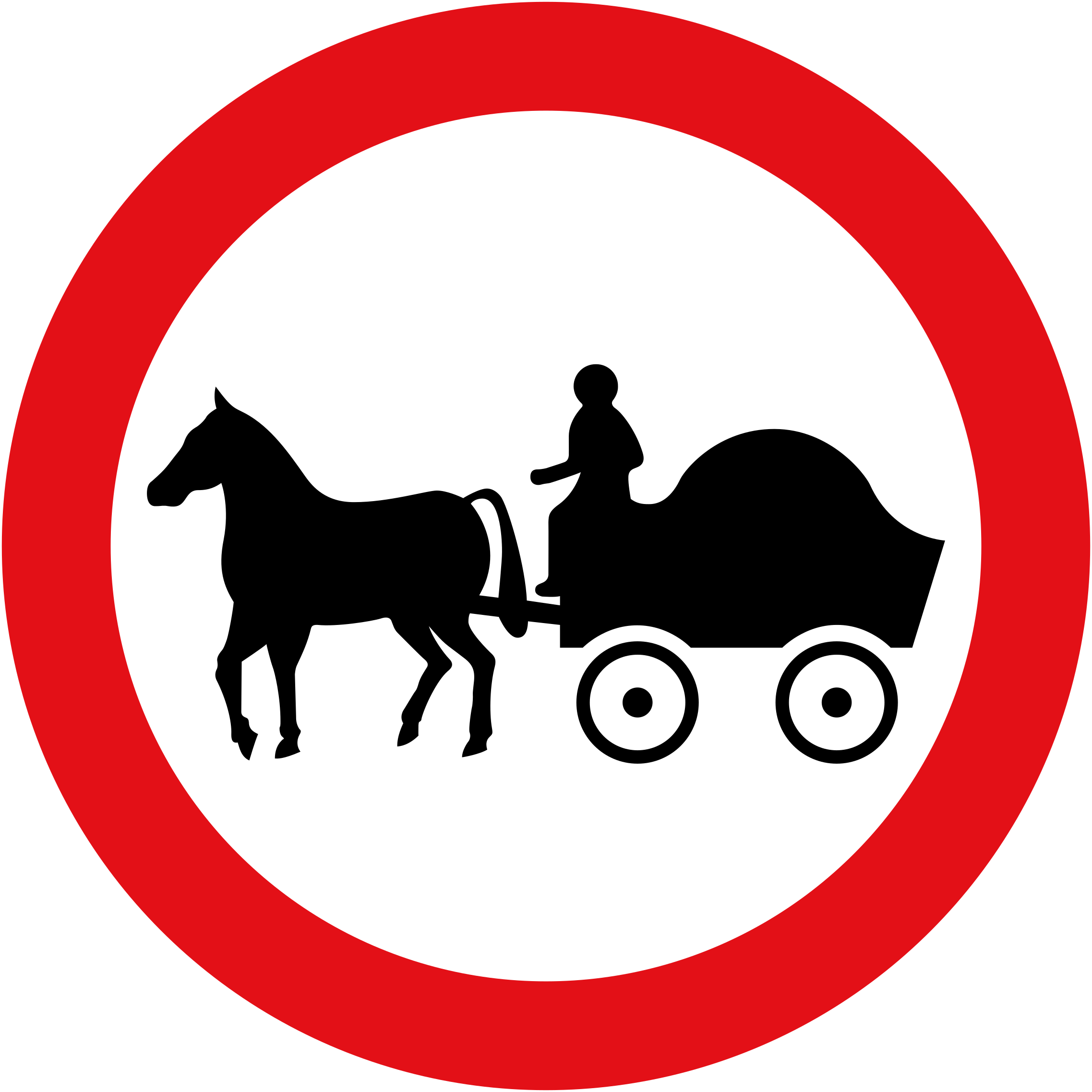
38. What does this traffic sign mean?
This traffic sign indicates that horsecarts are prohibited. Horse-drawn vehicles may not enter or continue beyond the sign. Other road users may still be permitted unless another restriction applies.
English • GB diagram 622.5 • No horse-drawn vehicles. Horse-drawn vehicles are prohibited.
Sources
🔗 Commons.wikimedia.org (Government of the United Kingdom – Department for Transport • Crown copyright • OGL v1.0)
🔗 Legislation.gov.uk • Traffic Signs Regulations and General Directions • Great Britain
🔗 Gov.uk • Department for Transport • Know your traffic signs
SVG source: Government of the United Kingdom – Department for Transport • OGL v1.0 • Original revision 2021-07-15. Wikimedia original unmodified. © Crown copyright. Traffic signs are Crown copyright. You may reproduce traffic signs free of charge and without having to seek permission, but you must reproduce them accurately and not in a misleading context (e.g. not on roadside billboards where they could mislead drivers). (ref [1])
Artwork verified against Gov.uk • official published diagram 622.5.
Current design and permitted variants verified against Legislation.gov.uk • TSRGD, current text.
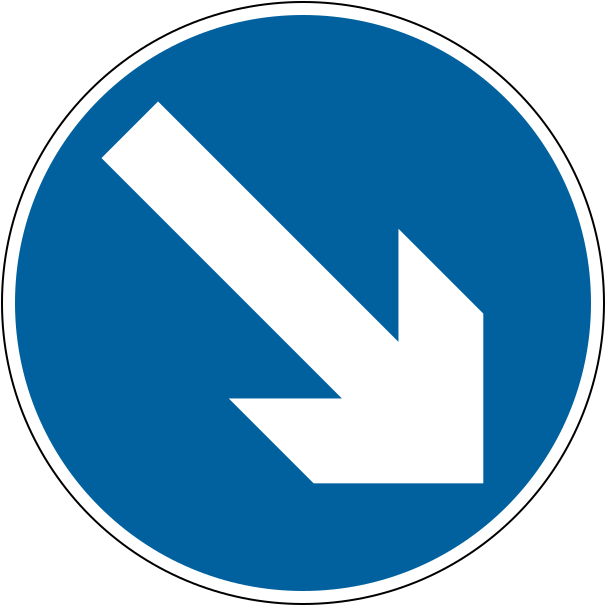
39. What does this traffic sign mean?
This traffic sign indicates that traffic must pass an obstacle on the right. Keep to the right of the obstacle and follow any accompanying signs or road markings.
English • GB diagram 610 • Keep right. Traffic must pass to the right of the sign or obstruction, following the arrow.
Sources
🔗 Commons.wikimedia.org (Government of the United Kingdom – Department for Transport • Crown copyright • OGL v1.0)
🔗 Legislation.gov.uk • Traffic Signs Regulations and General Directions • Great Britain
🔗 Gov.uk • Department for Transport • Know your traffic signs
SVG source: Government of the United Kingdom – Department for Transport • OGL v1.0 • Original revision 2022-01-17. Wikimedia original unmodified. © Crown copyright. Traffic signs are Crown copyright. You may reproduce traffic signs free of charge and without having to seek permission, but you must reproduce them accurately and not in a misleading context (e.g. not on roadside billboards where they could mislead drivers). (ref [1])
Artwork verified against Gov.uk • official published diagram 610.
Current design and permitted variants verified against Legislation.gov.uk • TSRGD, current text.
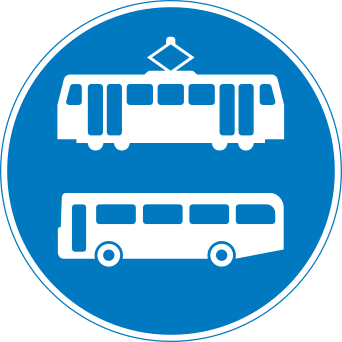
40. What does this traffic sign mean?
This traffic sign indicates a mandatory lane for buses and trams. Buses and trams must use the designated lane or track where the sign applies. Other road users may use it only where the applicable signs or local rules permit them to do so.
English • GB diagram 953.1 variant • Tramcars and buses only. This route is for tramcars and buses only, subject to any authorised and signed exception.
Sources
🔗 Commons.wikimedia.org (UK Government • Crown copyright • OGL v1.0)
🔗 Legislation.gov.uk • Traffic Signs Regulations and General Directions • Great Britain
🔗 Gov.uk • Department for Transport • Know your traffic signs
SVG source: UK Government • OGL v1.0 • Original revision 2011-11-13. Wikimedia original unmodified. © Crown copyright. Traffic signs are Crown copyright. You may reproduce traffic signs free of charge and without having to seek permission, but you must reproduce them accurately and not in a misleading context (e.g. not on roadside billboards where they could mislead drivers). (ref [1])
Artwork verified against Gov.uk • official published diagram 953.1V.
Current design and permitted variants verified against Legislation.gov.uk • TSRGD, current text.
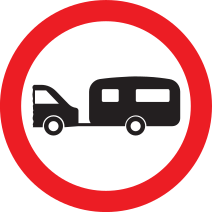
41. What does this traffic sign mean?
This traffic sign indicates that caravans are prohibited. Vehicles towing a caravan may not enter or continue beyond the sign. Other road users may still be permitted unless another restriction applies.
English • GB diagram 622.7 • No towed caravans. Towed caravans are prohibited; this symbol does not prohibit every vehicle with a trailer.
Sources
🔗 Commons.wikimedia.org
🔗 Legislation.gov.uk • Traffic Signs Regulations and General Directions • Great Britain
🔗 Gov.uk • Department for Transport • Know your traffic signs
SVG source: UK Government • Public domain • Original revision 2011-11-12. Wikimedia original unmodified.
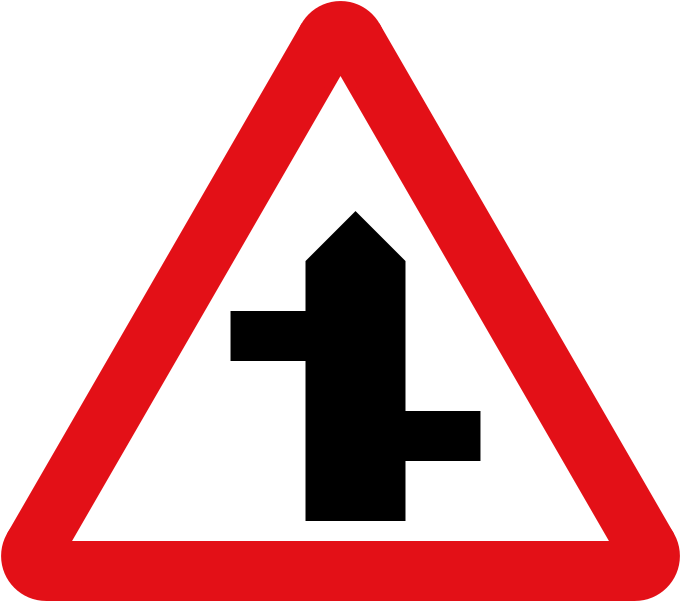
42. What does this traffic sign mean?
This traffic sign indicates a warning for a staggered junction. Side roads join the main road at different points rather than directly opposite each other. Reduce speed and watch carefully for vehicles entering, leaving or crossing the main road.
English • GB diagram 507.1 • Staggered junction ahead. Side roads join first from the right and then from the left, when approaching from the bottom of the diagram.
Sources
🔗 Commons.wikimedia.org (Government of the United Kingdom – Department for Transport • Crown copyright • OGL v1.0)
🔗 Legislation.gov.uk • Traffic Signs Regulations and General Directions • Great Britain
🔗 Gov.uk • Department for Transport • Know your traffic signs
SVG source: Government of the United Kingdom – Department for Transport • OGL v1.0 • Original revision 2022-02-17. Wikimedia original unmodified. © Crown copyright. Traffic signs are Crown copyright. You may reproduce traffic signs free of charge and without having to seek permission, but you must reproduce them accurately and not in a misleading context (e.g. not on roadside billboards where they could mislead drivers). (ref [1])
Artwork verified against Gov.uk • official published diagram 507.1.
Current design and permitted variants verified against Legislation.gov.uk • TSRGD, current text.
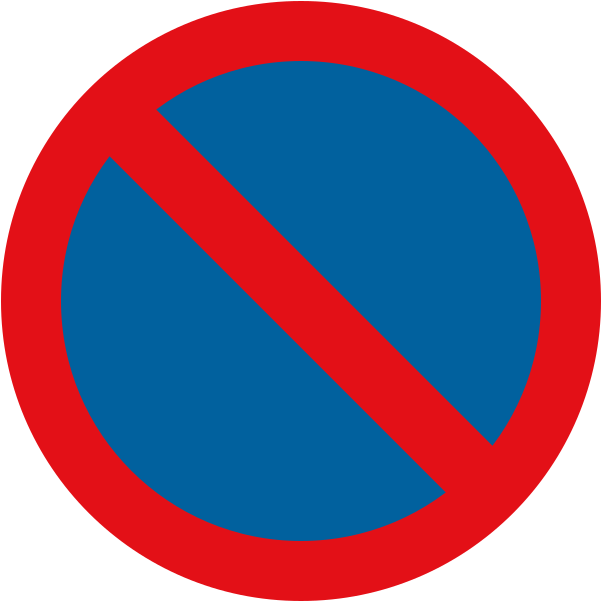
43. What does this traffic sign mean?
This traffic sign indicates that parking is prohibited. Vehicles may not be parked in the area covered by the sign unless an exception applies. Brief stopping to pick up or drop off passengers or to load or unload goods may still be permitted where local rules allow it.
English • TSRGD S4 • No waiting symbol. Waiting is prohibited during the indicated times. Read the accompanying time plate, zone signs and road markings to determine its extent; any loading restriction is separate.
Sources
🔗 Commons.wikimedia.org (Government of the United Kingdom – Department for Transport • Crown copyright • OGL v1.0)
🔗 Legislation.gov.uk • Traffic Signs Regulations and General Directions • Great Britain
🔗 Gov.uk • Department for Transport • Know your traffic signs
SVG source: Government of the United Kingdom – Department for Transport • OGL v1.0 • Original revision 2022-01-23. Wikimedia original unmodified. © Crown copyright. Traffic signs are Crown copyright. You may reproduce traffic signs free of charge and without having to seek permission, but you must reproduce them accurately and not in a misleading context (e.g. not on roadside billboards where they could mislead drivers). (ref [1])
Artwork verified against Legislation.gov.uk • official published diagram 636.
Current design and permitted variants verified against Legislation.gov.uk • TSRGD, current text.
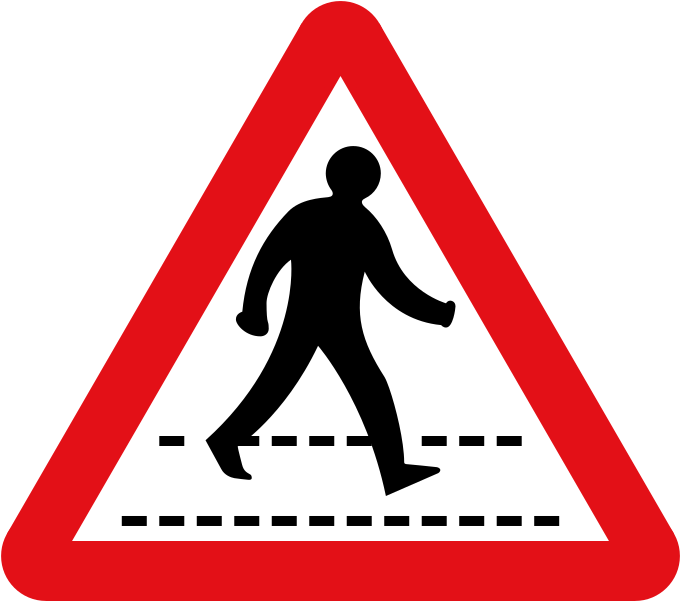
44. What does this traffic sign mean?
This traffic sign indicates a warning for a pedestrian crossing. A designated pedestrian crossing lies ahead. Reduce speed when necessary, watch carefully for pedestrians and be prepared to give way or stop according to the applicable local priority rules.
English • GB diagram 544 • Zebra or parallel crossing ahead. A zebra or parallel crossing is ahead. Reduce speed and prepare to give way to crossing users as required.
Sources
🔗 Commons.wikimedia.org (Government of the United Kingdom – Department for Transport • Crown copyright • OGL v1.0)
🔗 Legislation.gov.uk • Traffic Signs Regulations and General Directions • Great Britain
🔗 Gov.uk • Department for Transport • Know your traffic signs
SVG source: Government of the United Kingdom – Department for Transport • OGL v1.0 • Original revision 2022-02-17. Wikimedia original unmodified. © Crown copyright. Traffic signs are Crown copyright. You may reproduce traffic signs free of charge and without having to seek permission, but you must reproduce them accurately and not in a misleading context (e.g. not on roadside billboards where they could mislead drivers). (ref [1])
Artwork verified against Gov.uk • official published diagram 544.
Current design and permitted variants verified against Legislation.gov.uk • TSRGD, current text.
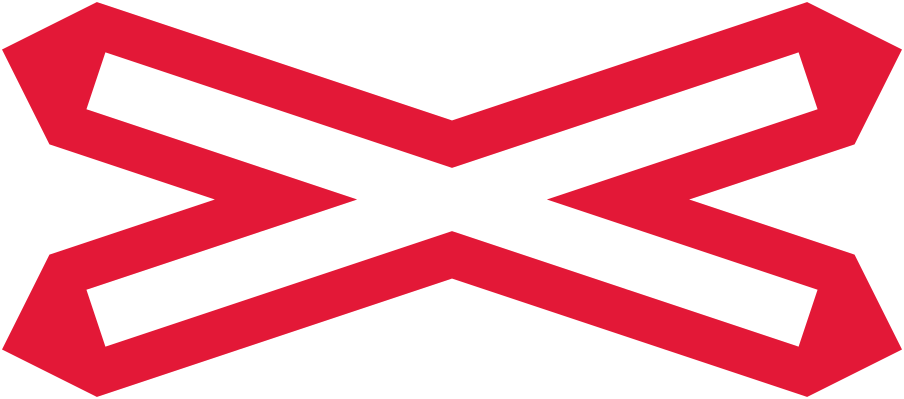
45. What does this traffic sign mean?
This traffic sign indicates a warning for a railway crossing with one track. It alerts drivers to a level crossing where a single railway track crosses the road. Drivers should approach with caution and be prepared to stop, even if no barriers or warning lights are active.
English • GB diagram 774 • Level crossing without a gate or barrier. This sign marks the location of a railway or tramway level crossing without gates or barriers. It does not indicate a specific number of tracks.
Sources
🔗 Commons.wikimedia.org
🔗 Legislation.gov.uk • Traffic Signs Regulations and General Directions • Great Britain
🔗 Gov.uk • Department for Transport • Know your traffic signs
SVG source: UK Government • Public domain • Original revision 2024-11-10. Wikimedia original unmodified.
Artwork verified against Legislation.gov.uk • official published diagram 774.
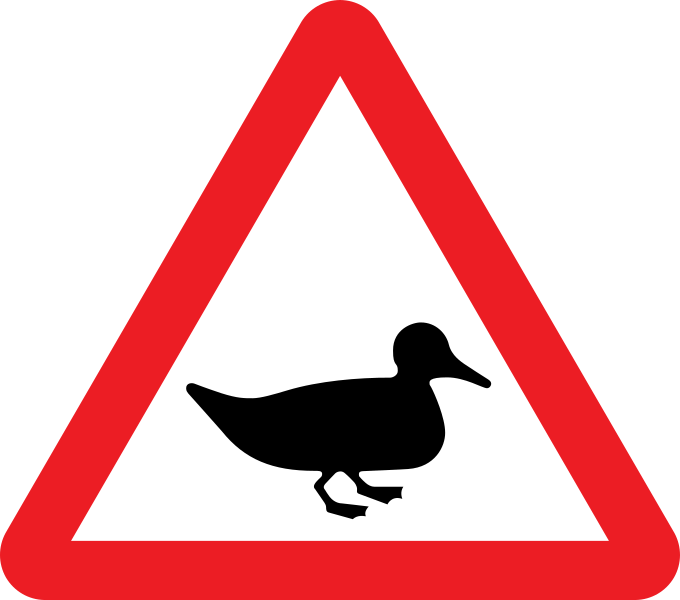
46. What does this traffic sign mean?
This traffic sign indicates a warning for ducks or other waterfowl. Ducks, sometimes accompanied by ducklings, may cross the road unexpectedly. Reduce speed and be prepared to stop safely if animals are on or near the roadway.
English • GB diagram 551.2 • Wild fowl. Wild fowl are likely to be in the road ahead.
Sources
🔗 Commons.wikimedia.org
🔗 Legislation.gov.uk • Traffic Signs Regulations and General Directions • Great Britain
🔗 Gov.uk • Department for Transport • Know your traffic signs
SVG source: UK Government • Public domain • Original revision 2011-01-24. Wikimedia original unmodified.
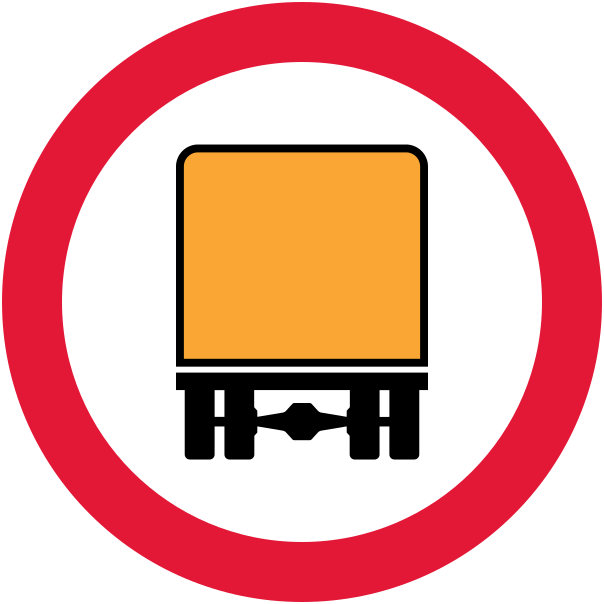
47. What does this traffic sign mean?
This traffic sign indicates that vehicles carrying dangerous goods are prohibited. Vehicles carrying the dangerous goods covered by the sign may not enter or continue beyond it.
Sources
SVG source: UK Government • Public domain • Original revision 2023-10-09. Wikimedia original unmodified.
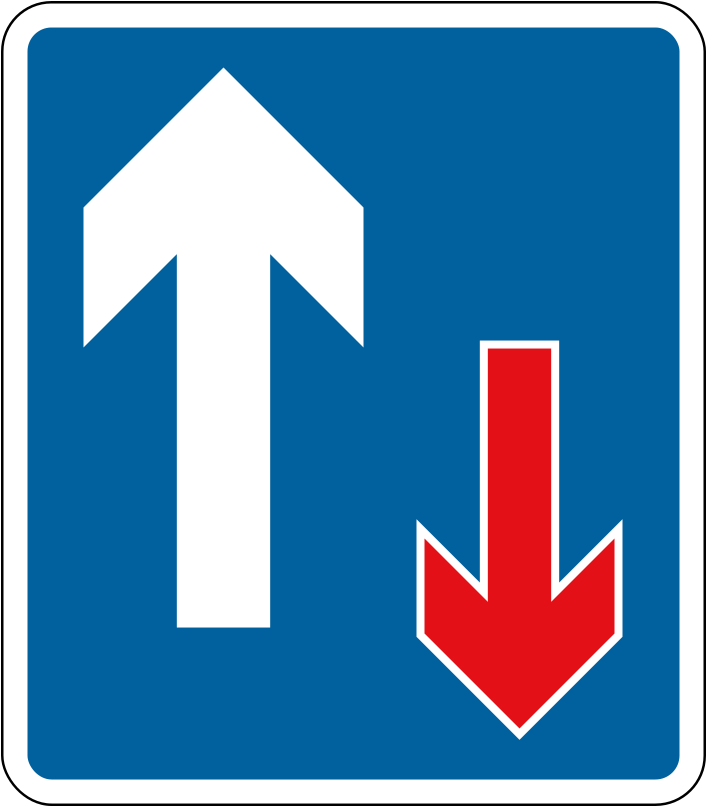
48. What does this traffic sign mean?
This traffic sign indicates a road narrowing where oncoming drivers have to give way.
English • GB diagram 811A • Priority over oncoming vehicles. You have priority over vehicles approaching from the opposite direction at the narrow section. Proceed only when it is safe.
Sources
🔗 Commons.wikimedia.org (Government of the United Kingdom – Department for Transport • Crown copyright • OGL v1.0)
🔗 Legislation.gov.uk • Traffic Signs Regulations and General Directions • Great Britain
🔗 Gov.uk • Department for Transport • Know your traffic signs
SVG source: Government of the United Kingdom – Department for Transport • OGL v1.0 • Original revision 2022-01-10. Wikimedia original unmodified. © Crown copyright. Traffic signs are Crown copyright. You may reproduce traffic signs free of charge and without having to seek permission, but you must reproduce them accurately and not in a misleading context (e.g. not on roadside billboards where they could mislead drivers). (ref [1])
Artwork verified against Gov.uk • official published diagram 811.
Current design and permitted variants verified against Legislation.gov.uk • TSRGD, current text.
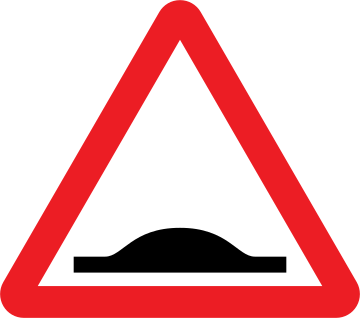
49. What does this traffic sign mean?
This traffic sign indicates a warning for a speed bump. A raised traffic-calming feature lies ahead. Reduce speed before reaching it to maintain vehicle control and avoid damage or discomfort.
English • GB diagram 557.1 • Road humps. A road hump or series of road humps is ahead. Reduce speed; an accompanying plate may show their extent or direction.
Sources
🔗 Commons.wikimedia.org
🔗 Legislation.gov.uk • Traffic Signs Regulations and General Directions • Great Britain
🔗 Gov.uk • Department for Transport • Know your traffic signs
SVG source: UK Government • Public domain • Original revision 2014-08-03. Wikimedia original unmodified.
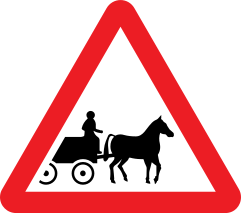
50. What does this traffic sign mean?
This traffic sign indicates a warning for horse-drawn vehicles. Horse-drawn vehicles may be travelling along or crossing the road ahead and can move considerably more slowly than motor traffic. Reduce speed, allow plenty of space and overtake only where it is permitted and clearly safe.
English • GB diagram 550.2 • Horse-drawn vehicles. Horse-drawn vehicles are likely to be in the road ahead.
Sources
🔗 Commons.wikimedia.org
🔗 Legislation.gov.uk • Traffic Signs Regulations and General Directions • Great Britain
🔗 Gov.uk • Department for Transport • Know your traffic signs
SVG source: UK Government • Public domain • Original revision 2011-11-12. Wikimedia original unmodified.