


Dead endNepal
 Traffic rules
 Nepal
1. Dead end
A dead-end road is a road that does not provide a through route for some or all vehicles. It may end completely, terminate at a barrier or continue as a path that only certain road users may use.
Drivers may normally enter a dead-end road to reach homes, businesses, parking places or other destinations, but they must be prepared to turn around or leave by the same route. Signs may indicate that pedestrians or cyclists can continue beyond the point where motor traffic cannot.
What does a dead-end indication mean in Nepal?
The Department of Roads manual identifies C1, No through road: a blue square with a white stem and red crossbar. It means the road ahead is not a through route. This information sign is different from a No entry restriction.
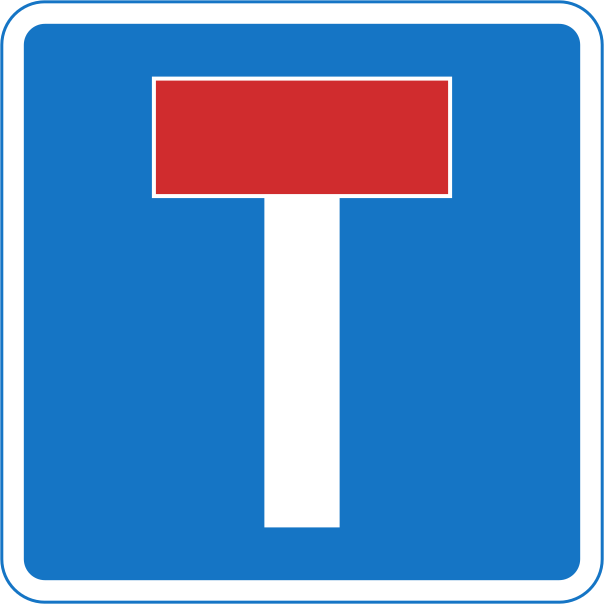 Dead end street.
English • Traffic sign C1 • Dead end. This road ends ahead and does not provide a route to another road.
नेपाली • C1 • अगाडि सडक बन्द छ। यो सडक अगाडि समाप्त हुन्छ र अर्को सडकसम्म जाने मार्ग छैन।
Sources
🔗 Commons.wikimedia.org
🔗 Dor.gov.np • सडक विभाग • Traffic Signs Manual, 1997 • C1 • PDF पृष्ठ 129
SVG source: Nepali Department of Roads • Public domain • Original revision 2014-08-17. Wikimedia original unmodified.
Can pedestrians or cyclists continue beyond a motor-traffic dead end in Nepal?
Check any pedestrian or cycle continuation and follow its own controls. A car’s lack of a through route does not establish that a lawful walking path also ends.
Does a dead-end indication change speed or priority rules in Nepal?
The no-through information itself does not assign junction priority or a numerical speed limit. Continue to obey the actual speed, access, parking and priority controls. If you need to turn around, use a suitable lawful place, check for pedestrians and cyclists, and do not obstruct the space needed for other vehicles to turn.

