


Cycling streetPeru
 Traffic rules
 Peru
1. Cycling street
A cycling street is a street designed or legally designated to give cyclists a prominent position in mixed traffic. Motor vehicles may usually enter, but they must adapt their speed and driving behaviour to the presence of cyclists.
Depending on the country, cyclists may be permitted to use more of the carriageway and motor vehicles may be prohibited from overtaking them. The speed limit, priority rules, permitted vehicles and beginning and end of the street depend on local traffic signs and regulations.
How should I interpret a cycling-priority street in Peru?
National rules define a ciclovía as cycling space and exclude motor vehicles from that facility. Distinguish it from an ordinary mixed street carrying a cycling route; the route’s signs determine its actual restrictions.
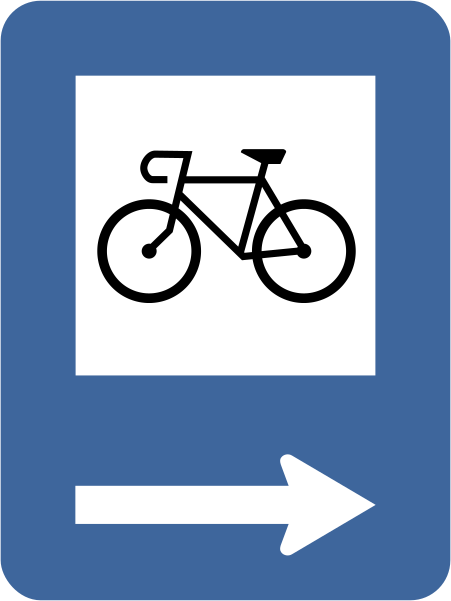 Lane for cyclists.
English • Traffic sign I-22 · historical • Direction to cycleway. Points towards a cycleway, to the right in this drawing. Historical design identified in the manual approved by R.M. No. 210-2000-MTC/15.02. This drawing is explained without presenting it as the current 2024 design. Current code I-22 refers to an information service; that meaning is not assigned to this drawing.
Español • I-22 · histórico • Dirección hacia ciclovía. Indica la dirección hacia una ciclovía, a la derecha en este dibujo. Diseño histórico identificado en el manual aprobado por R.M. N.º 210-2000-MTC/15.02. Se explica este dibujo, sin presentarlo como el diseño vigente de 2024. El código I-22 del manual vigente corresponde a servicio de información; no se atribuye ese significado a este dibujo.
Sources
🔗 Commons.wikimedia.org
🔗 Sutran.gob.pe • MTC: manual histórico, página PDF 186
🔗 Sutran.gob.pe • Manual histórico: dibujo de referencia, página PDF 193
Image via Commons.wikimedia.org
Ministerio de Transportes y Comunicaciones del República del Perú • Public domain • Source revision 2023-01-03. Wikimedia original unmodified.
Which driving rules matter on a mixed cycling street in Peru?
On a designated ciclocarril, motor vehicles must not exceed 30 km/h. Apply the national cyclist-protection and safe-passing requirements and the street’s actual access signs. An ordinary street carrying a cycling route is different; route branding alone does not establish that limit or a blanket motor-vehicle overtaking ban.
Which priority rules apply on cycling streets in Peru?
Cyclists must obey junction controls. A cycling route does not remove stop or signal requirements; the priority rules for the actual facility and manoeuvre must still be applied.

