Panel direccionalMéxico

Aprende normas de tráfico con explicaciones claras y ejemplos visuales en nuestro libro ilustrado, diseñado para que estudiar sea sencillo y ameno.


12. Panel direccional

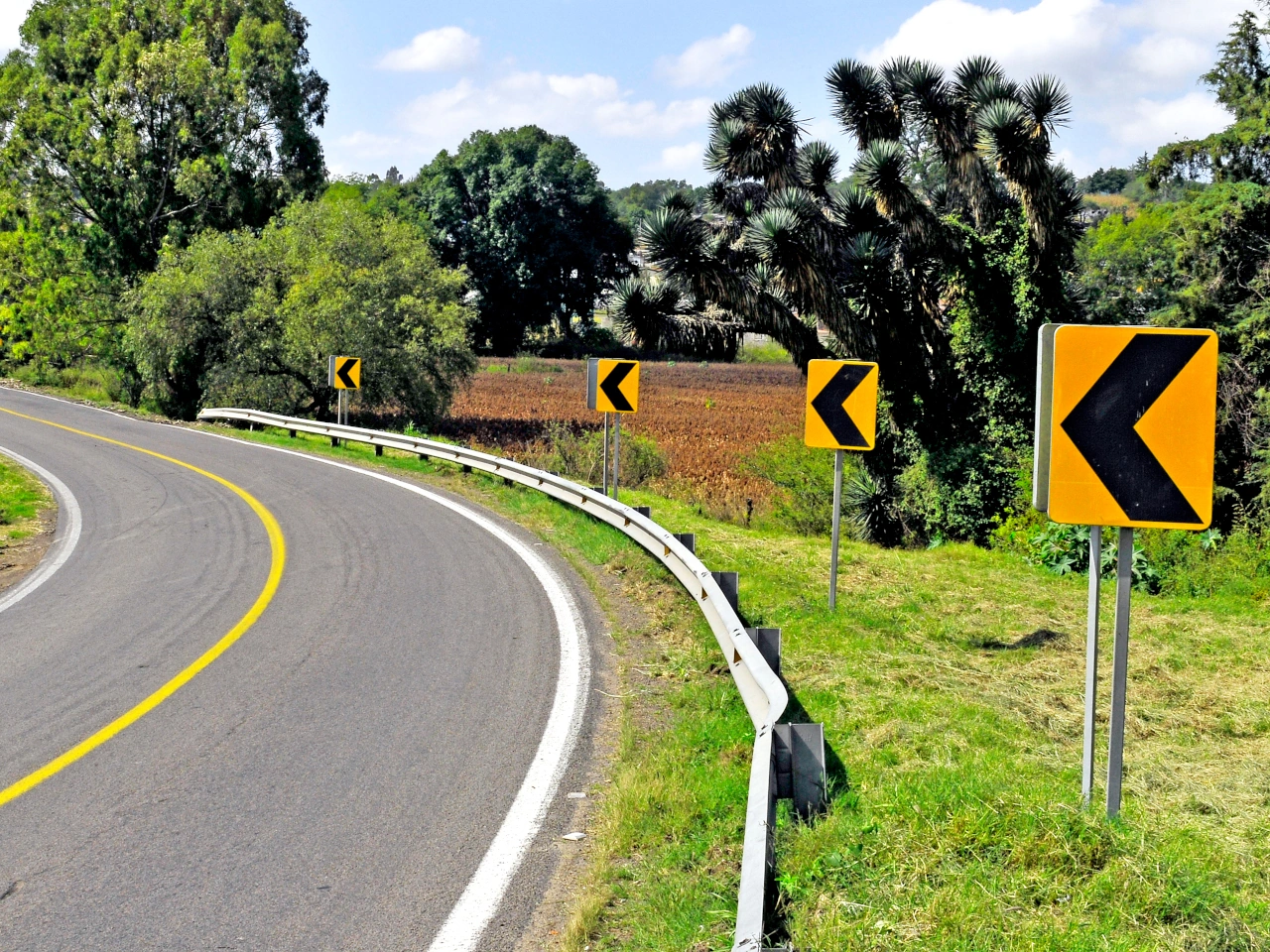
Un panel direccional es un marcador vial en forma de V o flecha utilizado para mostrar un cambio pronunciado en la dirección de una carretera. Los paneles suelen colocarse a lo largo del exterior de una curva de modo que sus puntas indiquen la dirección en la que continúa la vía.

Estos paneles mejoran la visibilidad y alineación de una curva, especialmente de noche o con mal tiempo. Normalmente no imponen un límite de velocidad ni determinan la prioridad, por lo que los conductores deben reducir la velocidad antes de la curva y respetar todas las demás señales y marcas viales.
Panel direccional
What is a road chevron?

A road chevron is a V-shaped or arrow-shaped marker used to guide drivers through a curve or another sharp change in road direction.

How can you recognise a chevron?

It is normally displayed on a rectangular board using strongly contrasting colours. Several chevrons may be placed in sequence around a curve.

Which direction does a chevron indicate?

The point of the chevron indicates the direction in which the road continues. A chevron pointing left guides traffic through a left curve, while one pointing right guides traffic through a right curve.

Where are chevrons normally placed?

They are generally placed along the outside of a curve, facing approaching traffic so that drivers can clearly see the road alignment.

What is the purpose of a series of chevrons?

A series of chevrons visually traces the curve and helps drivers judge its direction, length and changing alignment.

Is a chevron the same as a curve-warning sign?

No. A curve-warning sign normally warns drivers before the curve. Chevron boards are usually positioned within or around the curve to guide drivers through it.

Does a chevron impose a speed limit?

No. It guides drivers through the change in direction but does not normally introduce a numerical speed limit.

Does a chevron show a recommended speed?

Not by itself. A separate advisory-speed or speed-limit sign may indicate an appropriate or legally required speed.

Does a chevron determine priority?

No. Traffic lights, priority signs and the ordinary priority rules remain applicable.

Does a chevron mean the curve is dangerous?

It normally indicates that the curve requires additional visual guidance. Drivers should expect a noticeable or potentially sharp change in direction.

Does the number of chevrons show how sharp the curve is?

Not directly. The number and spacing depend on the length, radius and design of the curve and on the road authority’s signing standards.

Does a larger chevron mean a sharper curve?

Not necessarily. Larger boards may be used where approach speeds are higher or where greater visibility is needed.

How should you approach chevrons?

Reduce speed before the curve, observe the direction of the boards and remain within your traffic lane.

Should you brake heavily after reaching the chevrons?

No. Complete most braking before entering the curve and use smooth steering, braking and acceleration while following it.

May you drive towards the chevron boards?

No. The boards normally mark the outside edge of the curve. Follow the road around them rather than steering towards them.

May you cut across the centre line to straighten the curve?

No. Remain within your lane and do not enter the path of oncoming traffic.

May you overtake beside chevrons?

The chevrons do not automatically prohibit overtaking, but overtaking is unsafe when the curve restricts visibility or available road width.

Why are chevrons reflective?

Reflective material makes the boards easier to see in darkness and poor weather when illuminated by vehicle headlights.

Can chevrons be illuminated?

Yes. Some high-risk curves use illuminated or flashing chevrons to make the change in direction more conspicuous.

Can chevrons have different colours?

Yes. Their colours and design vary between countries, but contrasting colours are used to make the direction clearly visible.

What should motorcyclists consider?

Reduce speed before the curve, choose a stable path and look through the turn. Do not focus exclusively on the chevrons or allow the motorcycle to cross the centre line while leaning.

Does the absence of chevrons mean a curve is safe at the speed limit?

No. Drivers must assess every curve and select a safe speed whether or not chevron boards are installed.

1 México 2 Zona 3 Límite de velocidad 4 Advertencia de peatones 5 Resalto 6 Señal de STOP 7 Ceda el paso 8 Paso a nivel 9 Zona escolar 10 Desprendimiento de rocas 11 Curva 12 Panel direccional 13 Semáforos 14 Permiso de conducir 15 Marcha atrás 16 Matrícula 17 Autobús 18 Policía 19 Ambulancia 20 Bache 21 Camino 22 Partículas 23 Contaminación del aire 24 Hora punta 25 Código de circulación 26 Canaleta de la calle 27 Bicicleta de carga 28 Vehículo forestal 29 Vehículo de construcción 30 Camión articulado 31 Trolebús 32 Speed pedelec 33 Vehículo de reparto 34 Motor al ralentí 35 Grúa 36 Tracción a las cuatro ruedas 37 Usuarios de la vía 38 Bicicleta 39 Equipamiento de motocicleta 40 Vía férrea 41 Caravana 42 Remolque 43 Enganche de remolque 44 Camión de bomberos 45 Sirena 46 Convoy 47 Luces de vehículos de emergencia 48 Maquinaria agrícola 49 Bicicleta eléctrica 50 Vehículo eléctrico 51 Pedelec 52 Cuadriciclo 53 Microcoche 54 Vehículo todoterreno 55 Furgoneta 56 Vehículo recreativo 57 Scooter 58 Trikke 59 Vehículo de movilidad personal 60 Monopatín 61 Segway 62 Patinete 63 Patines 64 Cartero 65 Autoestopista 66 Niño pequeño 67 Niño 68 Discapacidad 69 Tren para automóviles 70 km/h 71 mph 72 Velocímetro 73 Altura libre del vehículo 74 Camino de tierra 75 Conducción 76 Sistema start-stop 77 Cambio manual 78 Cambio automático 79 Acelerador 80 Cuentarrevoluciones 81 Volante 82 Dirección asistida 83 Exploración visual 84 Espejo 85 Combustible 86 Indicador de combustible 87 Gasolina 88 Diésel 89 Líquido de escape diésel 90 Seguro de automóvil 91 Botiquín de primeros auxilios 92 Extintor 93 Ropa de alta visibilidad 94 Primeros auxilios 95 Barrera escalonada de hormigón 96 Barreras 97 Luces del vehículo 98 Alumbrado público 99 Luces de cruce 100 Luces de carretera ...