

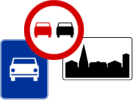
ImpassePologne
 Règles de circulation
 Pologne
22. Impasse
Une impasse est une route qui ne constitue pas un itinéraire de transit pour certains ou tous les véhicules. Elle peut se terminer complètement, aboutir à une barrière ou se poursuivre sous forme de chemin accessible uniquement à certains usagers.
Les conducteurs peuvent normalement entrer dans une impasse pour accéder à des habitations, commerces, places de stationnement ou autres destinations, mais ils doivent être prêts à faire demi-tour ou ressortir par le même itinéraire. Des panneaux peuvent indiquer que les piétons ou cyclistes peuvent continuer au-delà du point où les véhicules à moteur ne le peuvent pas.

What is a dead-end road?
A dead-end road is a road that provides no through route for some or all vehicles. Traffic entering it normally has to return by the same route.
How can you recognise a dead end?
A dead end may be indicated by a blue rectangular sign showing a road blocked at one end. The exact colour, design and symbol vary between countries.
Does a dead-end sign prohibit entry?
Normally not. It generally provides information rather than prohibiting access. Drivers may enter to reach a destination unless another sign restricts entry.
Is a dead-end sign the same as a no-entry sign?
No. A dead-end sign warns that the road does not continue as a through route. A no-entry sign prohibits drivers from entering in the indicated direction.
Does a dead-end road always physically end?
No. It may end at a wall, gate, turning area or private property, or it may continue as a narrower path that motor vehicles cannot use.
Can pedestrians continue through a dead end?
Sometimes. A separate symbol, sign or visible path may indicate that pedestrians can continue beyond the point where motor traffic ends.
Can cyclists continue through a dead end?
Sometimes. A sign may indicate a through route for cyclists, but cyclists must still follow any access, direction and path-use rules that apply.
Does a dead-end sign change the speed limit?
No. The normal road, zonal or posted speed limit remains applicable. Drivers should nevertheless reduce speed when space, visibility or nearby pedestrians require it.
Does a dead-end road have different priority rules?
No. Traffic lights, priority signs and the ordinary intersection rules continue to apply.
Does traffic leaving a dead-end road have to give way?
Not solely because the road is a dead end. Priority depends on the signs, road surface, road category and local priority rules.
May you make a U-turn in a dead-end road?
A driver may turn around where the manoeuvre is legal, safe and does not obstruct other road users. Local signs or road markings may prohibit it.
May you reverse in a dead-end road?
Reverse only when necessary and when the route is clear. Give way to all other road users and avoid reversing for a long distance where a safer turning place is available.
Who has priority while a vehicle is turning around?
A driver performing a turning or reversing manoeuvre must normally give way to other road users.
May you park in a dead-end road?
The dead-end sign itself does not normally prohibit parking. Drivers must follow the ordinary parking rules and must not block entrances, pedestrian routes, emergency access or turning areas.
May you park in the turning area?
Only where parking is permitted and sufficient room remains for other vehicles to turn. Blocking the turning area can force vehicles to reverse for an unsafe distance.
Why should large vehicles avoid some dead-end roads?
Trucks, buses and vehicles towing trailers may not have enough space to turn around. Drivers should check the route and any length, width, weight or access restrictions before entering.
Can emergency vehicles enter a dead-end road?
Yes. Emergency and service vehicles may need access to properties within it. Other vehicles should not block the road or its turning space.
What should you do after entering a dead end by mistake?
Continue cautiously to a suitable turning place. Turn around or reverse only after checking carefully for pedestrians, cyclists, vehicles and other obstacles.
Does the absence of a dead-end sign guarantee a through route?
No. Temporary closures, private access, gates, roadworks or outdated navigation information may still prevent passage. Drivers must observe the actual road and signs.


