

VerkehrszeichenPolen
 Verkehrsregeln
 Polen
 Vorfahrtzeichen
 Warnzeichen
 Verbotszeichen
 Gebotszeichen
 Hinweiszeichen
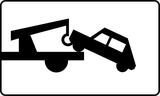 Zusatzzeichen
Verkehrszeichen
Ein Verkehrszeichen ist ein standardisiertes visuelles Zeichen entlang einer Straße, das Fahrer, Radfahrer und Fußgänger leitet, warnt oder ihr Verhalten regelt. Verkehrszeichen vermitteln wichtige Informationen über Straßenverhältnisse, Vorschriften, Richtungen und mögliche Gefahren und tragen damit zu Sicherheit und einem geordneten Verkehrsablauf bei. Sie besitzen unterschiedliche Formen und Farben, etwa dreieckige Warnzeichen, runde Verbots- oder Gebotszeichen und rechteckige Hinweiszeichen, die jeweils auf schnelle Erkennbarkeit und eindeutiges Verständnis ausgelegt sind.

51. Anhänger verboten
Dieses Verkehrszeichen zeigt an, dass Anhänger verboten sind. Fahrzeuge mit vom Zeichen erfassten Anhängern dürfen nicht einfahren oder weiterfahren. Fahrzeuge ohne Anhänger können weiterhin zugelassen sein, sofern keine weitere Beschränkung gilt.
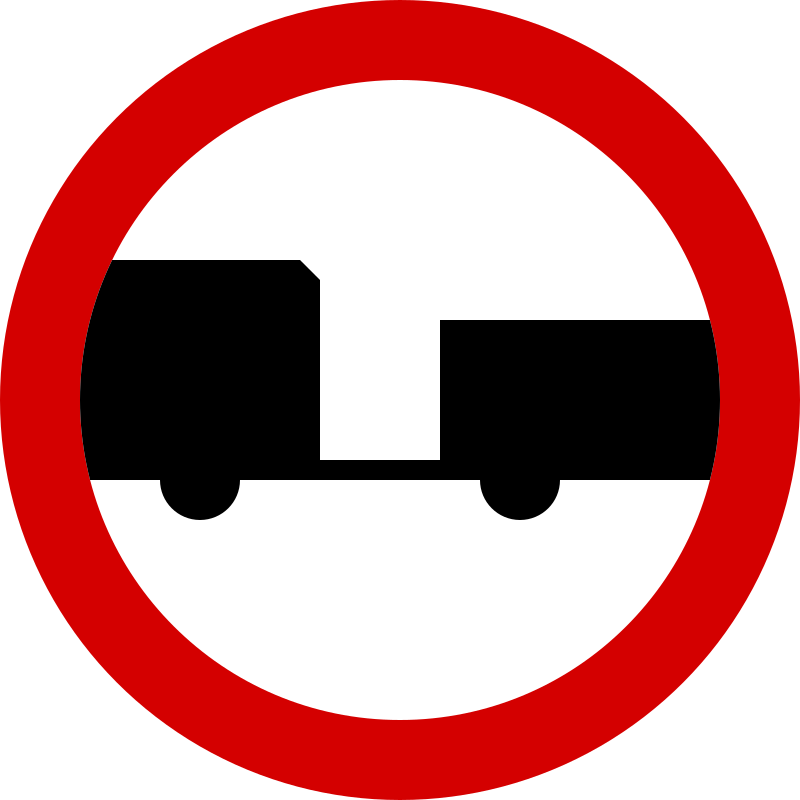
English • Traffic sign B-7 • No motor vehicles with trailers. Sign B-7 prohibits motor vehicles with one or more trailers, except vehicles with a single-axle trailer or semi-trailer.
Polski • B-7 • zakaz wjazdu pojazdów silnikowych z przyczepą. Znak B-7 „zakaz wjazdu pojazdów silnikowych z przyczepą” oznacza zakaz ruchu pojazdów silnikowych z przyczepą (przyczepami); zakaz nie dotyczy pojazdów z przyczepą jednoosiową lub naczepą.
Quellen
🔗 Commons.wikimedia.org
🔗 Eli.gov.pl • § 18 ust. 7
SVG source: Commons.wikimedia.org • Original SVG
Szczepan dyskusja Mail 18:29, 31 December 2006 (UTC) • Public domain • Original revision 2025-09-28. Wikimedia original unmodified.
Artwork reviewed against the Polish official sign catalogue, Dz.U. 2019 poz. 2310: Eli.gov.pl • B-7, PDF page 42, with amendments 2021/433, 2021/2065, 2022/2372 and 2026/133 checked. Catalogue-equivalent illustration; intentional update from the previous PNG. This is an educational illustration, not a manufacturing specification.
52. Radfahrer und Handkarren verboten
Dieses Verkehrszeichen zeigt an, dass Radfahrer und Handkarren verboten sind. Radfahrer und Personen mit Handkarren dürfen nicht einfahren oder weiterfahren. Andere Verkehrsteilnehmer können weiterhin zugelassen sein, sofern keine weitere Beschränkung gilt.
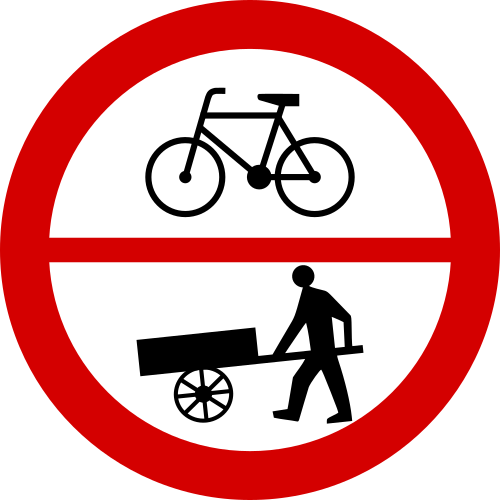
English • Traffic sign B-9 • No bicycles. Sign B-9 prohibits bicycles on the carriageway and shoulder. B-12 • No handcarts. Sign B-12 prohibits handcarts intended for use on the carriageway, whether guided, pulled or pushed, on the carriageway and shoulder.
Polski • B-9 • zakaz wjazdu rowerów. Znak B-9 „zakaz wjazdu rowerów” oznacza zakaz ruchu na jezdni i poboczu rowerów. B-12 • zakaz wjazdu wózków ręcznych. Znak B-12 „zakaz wjazdu wózków ręcznych” oznacza zakaz ruchu na jezdni i poboczu wózków ręcznych przeznaczonych do używania na jezdni, prowadzonych, ciągniętych lub pchanych.
Quellen
🔗 Commons.wikimedia.org
🔗 Eli.gov.pl • § 18 ust. 10
🔗 Commons.wikimedia.org
🔗 Eli.gov.pl • § 18 ust. 13
SVG source: Pz • Public domain • Original revision 2012-04-05. Wikimedia original unmodified.
53. Motorräder und Pkw verboten
Dieses Verkehrszeichen zeigt an, dass Motorräder und Pkw verboten sind. Motorräder und Pkw dürfen nicht einfahren oder weiterfahren. Andere Verkehrsteilnehmer können weiterhin zugelassen sein, sofern keine weitere Beschränkung gilt.
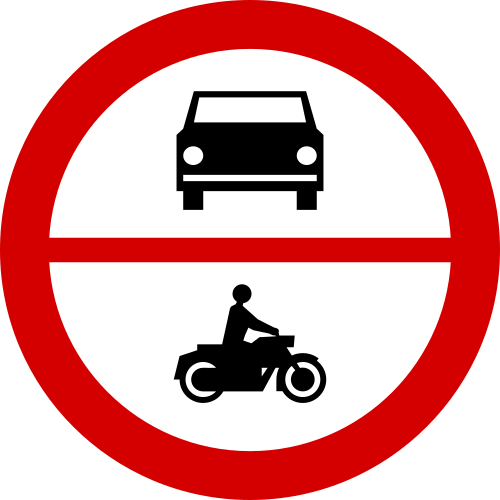
English • Traffic sign B-3 • No motor vehicles except single-track motorcycles. Sign B-3 prohibits motor vehicles, except single-track motorcycles. B-4 • No motorcycles. Sign B-4 prohibits motorcycles.
Polski • B-3 • zakaz wjazdu pojazdów silnikowych, z wyjątkiem motocykli jednośladowych. Znak B-3 „zakaz wjazdu pojazdów silnikowych, z wyjątkiem motocykli jednośladowych”, oznacza zakaz ruchu pojazdów silnikowych; zakaz nie dotyczy motocykli jednośladowych. B-4 • zakaz wjazdu motocykli. Znak B-4 „zakaz wjazdu motocykli” oznacza zakaz ruchu motocykli.
Quellen
🔗 Commons.wikimedia.org
🔗 Eli.gov.pl • § 18 ust. 1
🔗 Commons.wikimedia.org
🔗 Eli.gov.pl • § 18 ust. 3
SVG source: Pz • Public domain • Original revision 2012-04-05. Wikimedia original unmodified.
54. Traktoren und Pferdefuhrwerke verboten
Dieses Verkehrszeichen zeigt an, dass Traktoren und Pferdefuhrwerke verboten sind. Traktoren und pferdegezogene Fahrzeuge dürfen nicht einfahren oder weiterfahren. Andere Verkehrsteilnehmer können weiterhin zugelassen sein, sofern keine weitere Beschränkung gilt.
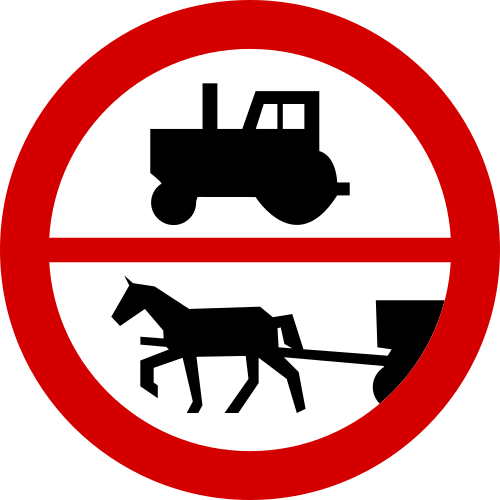
English • Traffic sign B-6 • No agricultural tractors. Sign B-6 prohibits agricultural tractors and slow-moving vehicles. B-8 • No animal-drawn vehicles. Sign B-8 prohibits animal-drawn vehicles and people riding or driving animals.
Polski • B-6 • zakaz wjazdu ciągników rolniczych. Znak B-6 „zakaz wjazdu ciągników rolniczych” oznacza zakaz ruchu ciągników rolniczych i pojazdów wolnobieżnych. B-8 • zakaz wjazdu pojazdów zaprzęgowych. Znak B-8 „zakaz wjazdu pojazdów zaprzęgowych” oznacza zakaz ruchu pojazdów zaprzęgowych oraz jeźdźców i poganiaczy.
Quellen
🔗 Commons.wikimedia.org
🔗 Eli.gov.pl • § 18 ust. 6
🔗 Commons.wikimedia.org
🔗 Eli.gov.pl • § 18 ust. 9
SVG source: Pz • Public domain • Original revision 2012-04-05. Wikimedia original unmodified.
55. Radfahrer, Pferdefuhrwerke und Traktoren verboten
Dieses Verkehrszeichen zeigt an, dass Radfahrer, Pferdefuhrwerke und Traktoren verboten sind. Radfahrer, pferdegezogene Fahrzeuge und Traktoren dürfen nicht einfahren oder weiterfahren. Andere Verkehrsteilnehmer können weiterhin zugelassen sein, sofern keine weitere Beschränkung gilt.
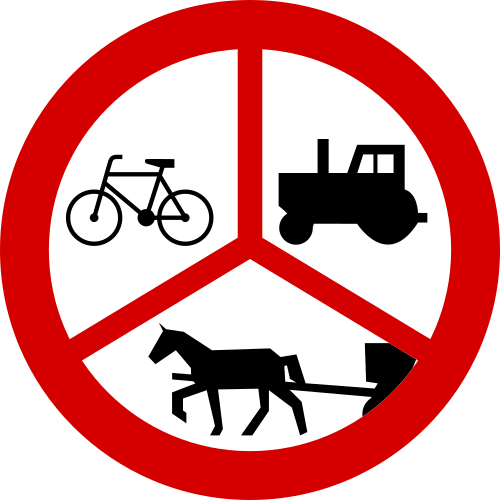
English • Traffic sign B-9 • No bicycles. Sign B-9 prohibits bicycles on the carriageway and shoulder. B-6 • No agricultural tractors. Sign B-6 prohibits agricultural tractors and slow-moving vehicles. B-8 • No animal-drawn vehicles. Sign B-8 prohibits animal-drawn vehicles and people riding or driving animals.
Polski • B-9 • zakaz wjazdu rowerów. Znak B-9 „zakaz wjazdu rowerów” oznacza zakaz ruchu na jezdni i poboczu rowerów. B-6 • zakaz wjazdu ciągników rolniczych. Znak B-6 „zakaz wjazdu ciągników rolniczych” oznacza zakaz ruchu ciągników rolniczych i pojazdów wolnobieżnych. B-8 • zakaz wjazdu pojazdów zaprzęgowych. Znak B-8 „zakaz wjazdu pojazdów zaprzęgowych” oznacza zakaz ruchu pojazdów zaprzęgowych oraz jeźdźców i poganiaczy.
Quellen
🔗 Commons.wikimedia.org
🔗 Eli.gov.pl • § 18 ust. 10
🔗 Commons.wikimedia.org
🔗 Eli.gov.pl • § 18 ust. 6
🔗 Commons.wikimedia.org
🔗 Eli.gov.pl • § 18 ust. 9
SVG source: Pz • Public domain • Original revision 2012-04-05. Wikimedia original unmodified.
56. Fahrzeuge mit gefährlichen Gütern verboten
Dieses Verkehrszeichen zeigt an, dass Fahrzeuge mit gefährlichen Gütern verboten sind. Fahrzeuge, die die vom Zeichen erfassten gefährlichen Güter befördern, dürfen nicht einfahren oder weiterfahren.
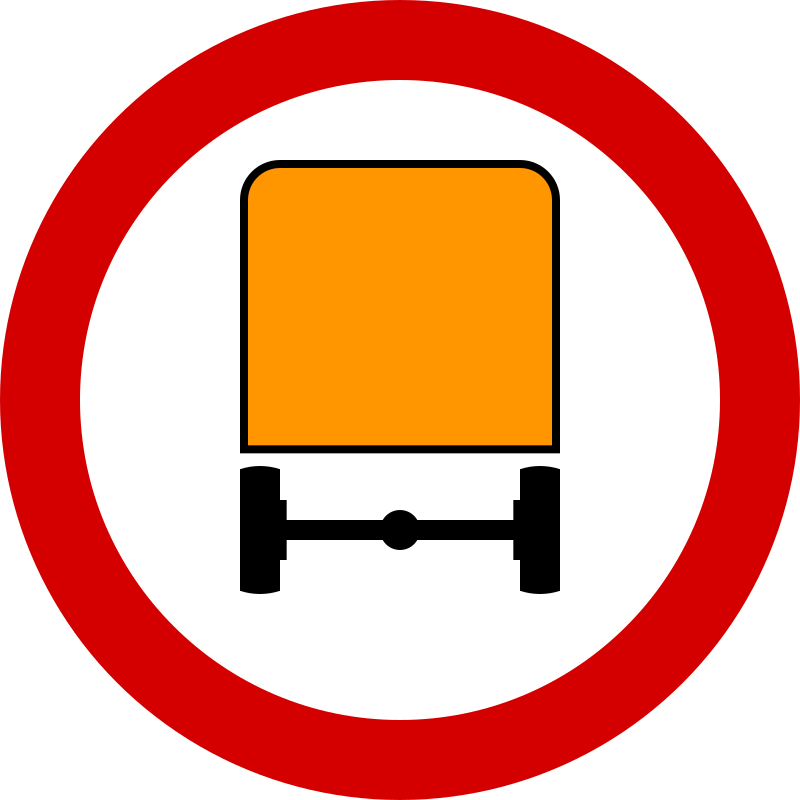
English • Traffic sign B-13a • No vehicles carrying dangerous goods. Sign B-13a prohibits vehicles carrying dangerous goods defined in road dangerous-goods transport regulations in quantities requiring orange warning plates. Plate T-31 below it, bearing a tunnel-category letter B, C, D or E, or a plate with appropriate wording, indicates that the prohibition applies only to particular classes or groups of dangerous goods or a particular method of carrying them.
Polski • B-13a • zakaz wjazdu pojazdów z towarami niebezpiecznymi. Znak B-13a „zakaz wjazdu pojazdów z towarami niebezpiecznymi” oznacza zakaz ruchu pojazdów przewożących, określone w przepisach o przewozie drogowym towarów niebezpiecznych, towary niebezpieczne w ilościach, dla których jest wymagane oznakowanie pojazdu tablicami ostrzegawczymi barwy pomarańczowej. Umieszczona pod znakiem tabliczka T-31 z literą B, C, D lub E oznaczającą kategorię tunelu lub tabliczka z odpowiednim napisem wskazuje, że zakaz dotyczy tylko określonych klas lub grup towarów niebezpiecznych lub określonego sposobu przewozu tych towarów.
Quellen
🔗 Commons.wikimedia.org
🔗 Eli.gov.pl • § 19 ust. 2
SVG source: Commons.wikimedia.org • Original SVG
Szczepan dyskusja Mail 18:29, 31 December 2006 (UTC) • Public domain • Original revision 2025-09-28. Wikimedia original unmodified.
Artwork reviewed against the Polish official sign catalogue, Dz.U. 2019 poz. 2310: Eli.gov.pl • B-13a, PDF page 42, with amendments 2021/433, 2021/2065, 2022/2372 and 2026/133 checked. Catalogue-equivalent illustration; intentional update from the previous PNG. This is an educational illustration, not a manufacturing specification.
57. Entzündliche oder explosive Stoffe verboten
Dieses Verkehrszeichen zeigt an, dass Fahrzeuge mit entzündlichen oder explosiven Stoffen verboten sind. Fahrzeuge, die die vom Zeichen erfassten Stoffe befördern, dürfen nicht einfahren oder weiterfahren.
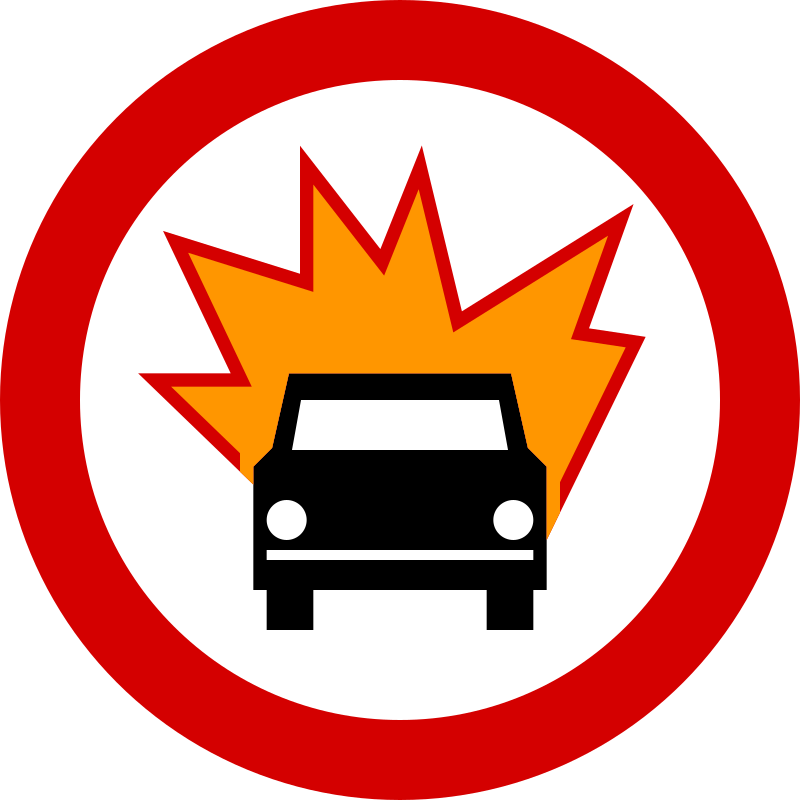
English • Traffic sign B-13 • No vehicles carrying explosives or highly flammable goods. Sign B-13 prohibits vehicles carrying dangerous goods defined in road dangerous-goods transport regulations in classes 1, 3, 4.1, 4.2, 4.3, 5.1 or 5.2, or flammable gases in class 2, in quantities requiring orange warning plates.
Polski • B-13 • zakaz wjazdu pojazdów z towarami wybuchowymi lub łatwo zapalnymi. Znak B-13 „zakaz wjazdu pojazdów z towarami wybuchowymi lub łatwo zapalnymi” oznacza zakaz ruchu pojazdów przewożących, określone w przepisach o przewozie drogowym towarów niebezpiecznych, towary niebezpieczne klas: 1, 3, 4.1, 4.2, 4.3, 5.1, 5.2 lub gazy palne klasy 2 w ilościach, dla których jest wymagane oznakowanie pojazdu tablicami ostrzegawczymi barwy pomarańczowej.
Quellen
🔗 Commons.wikimedia.org
🔗 Eli.gov.pl • § 19 ust. 1
SVG source: Commons.wikimedia.org • Original SVG
Szczepan dyskusja Mail 18:29, 31 December 2006 (UTC) • Public domain • Original revision 2025-09-28. Wikimedia original unmodified.
Artwork reviewed against the Polish official sign catalogue, Dz.U. 2019 poz. 2310: Eli.gov.pl • B-13, PDF page 42, with amendments 2021/433, 2021/2065, 2022/2372 and 2026/133 checked. Catalogue-equivalent illustration; intentional update from the previous PNG. This is an educational illustration, not a manufacturing specification.
58. Fahrzeuge mit wassergefährdenden Stoffen verboten
Dieses Verkehrszeichen zeigt an, dass Fahrzeuge mit wassergefährdenden Stoffen verboten sind. Fahrzeuge, die die vom Zeichen erfassten Stoffe befördern, dürfen nicht einfahren oder weiterfahren.
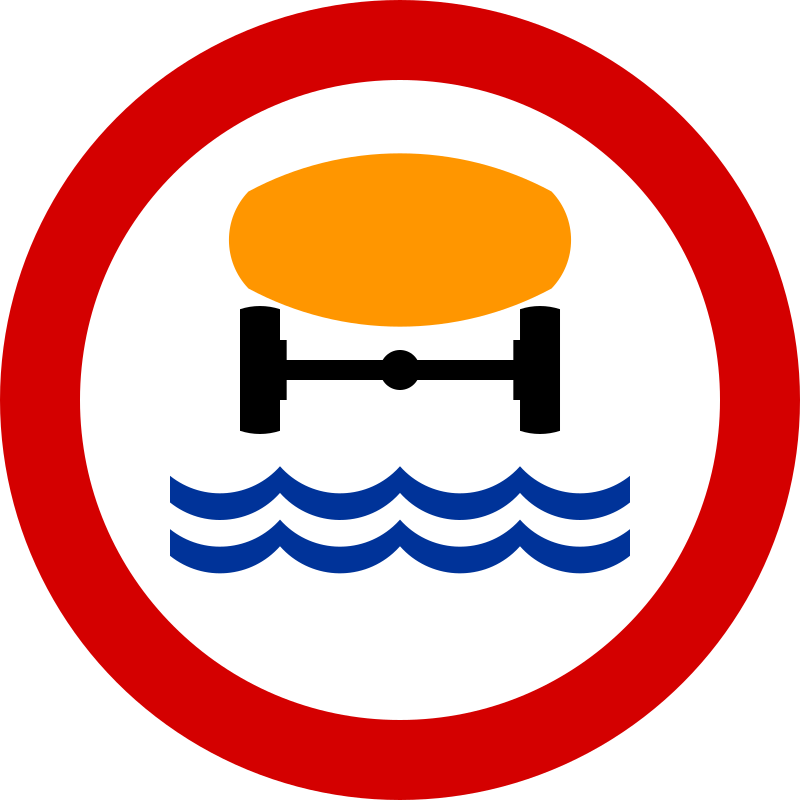
English • Traffic sign B-14 • No vehicles carrying goods that may contaminate water. Sign B-14 prohibits vehicles carrying dangerous goods defined in road dangerous-goods transport regulations in classes 3, 4.3, 6.1, 6.2 or 8; toxic or corrosive gases in class 2; or environmentally hazardous dangerous goods in class 9, in quantities requiring orange warning plates.
Polski • B-14 • zakaz wjazdu pojazdów z towarami, które mogą skazić wodę. Znak B-14 „zakaz wjazdu pojazdów z towarami, które mogą skazić wodę” oznacza zakaz ruchu pojazdów przewożących, określone w przepisach o przewozie drogowym towarów niebezpiecznych, towary niebezpieczne klas: 3,4.3, 6.1, 6.2, 8, gazy trujące lub gazy żrące klasy 2, lub towary niebezpieczne zagrażające środowisku klasy 9 w ilościach, dla których jest wymagane oznakowanie pojazdu tablicami ostrzegawczymi barwy pomarańczowej.
Quellen
🔗 Commons.wikimedia.org
🔗 Eli.gov.pl • § 19 ust. 3
SVG source: Commons.wikimedia.org • Original SVG
Szczepan dyskusja Mail 18:29, 31 December 2006 (UTC) • Public domain • Original revision 2025-09-28. Wikimedia original unmodified.
Artwork reviewed against the Polish official sign catalogue, Dz.U. 2019 poz. 2310: Eli.gov.pl • B-14, PDF page 42, with amendments 2021/433, 2021/2065, 2022/2372 and 2026/133 checked. Catalogue-equivalent illustration; intentional update from the previous PNG. This is an educational illustration, not a manufacturing specification.
59. Fahrzeuge über angegebener Breite verboten
Dieses Verkehrszeichen zeigt an, dass Fahrzeuge über der angegebenen Breite verboten sind. Ein Fahrzeug oder eine Fahrzeugkombination, deren Gesamtbreite einschließlich Ladung den angezeigten Grenzwert überschreitet, darf nicht weiterfahren.
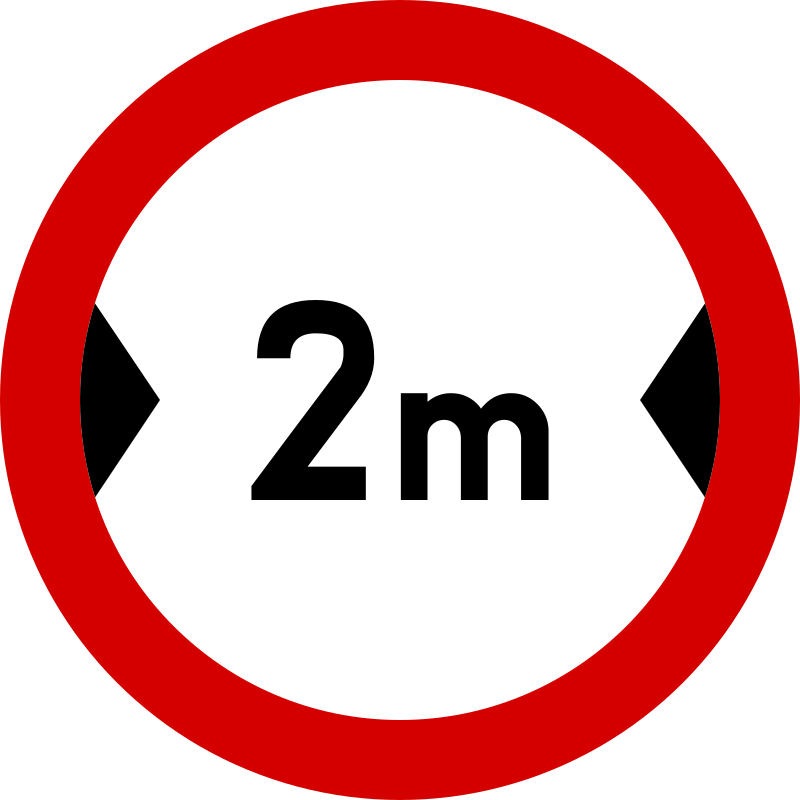
English • Traffic sign B-15 • Maximum width in metres. Sign B-15 prohibits vehicles whose width, including their load, exceeds the value shown.
Polski • B-15 • zakaz wjazdu pojazdów o szerokości ponad ... m. Znak B-15 „zakaz wjazdu pojazdów o szerokości ponad......m” oznacza zakaz ruchu pojazdów, których szerokość (również z ładunkiem) jest większa od wartości podanej na znaku.
Quellen
🔗 Commons.wikimedia.org
🔗 Eli.gov.pl • § 20 ust. 1
SVG source: Commons.wikimedia.org • Original SVG
Szczepan dyskusja Mail 18:29, 31 December 2006 (UTC) • Public domain • Original revision 2025-10-01. Wikimedia original unmodified.
Artwork reviewed against the Polish official sign catalogue, Dz.U. 2019 poz. 2310: Eli.gov.pl • B-15, PDF page 42, with amendments 2021/433, 2021/2065, 2022/2372 and 2026/133 checked. Catalogue-equivalent illustration; intentional update from the previous PNG. This is an educational illustration, not a manufacturing specification.
60. Fahrzeuge über angegebener Höhe verboten
Dieses Verkehrszeichen zeigt an, dass Fahrzeuge über der angegebenen Höhe verboten sind. Ein Fahrzeug oder eine Fahrzeugkombination, deren Gesamthöhe einschließlich Ladung den angezeigten Grenzwert überschreitet, darf nicht weiterfahren.
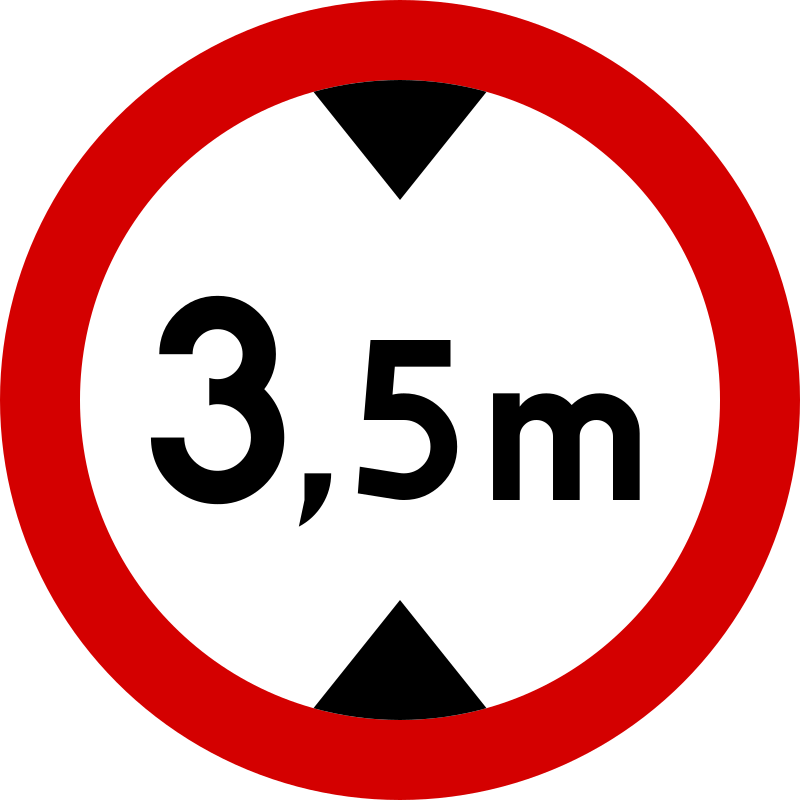
English • Traffic sign B-16 • Maximum height in metres. Sign B-16 prohibits vehicles whose height, including their load, exceeds the value shown.
Polski • B-16 • zakaz wjazdu pojazdów o wysokości ponad ... m. Znak B-16 „zakaz wjazdu pojazdów o wysokości ponad......m” oznacza zakaz ruchu pojazdów, których wysokość (również z ładunkiem) jest większa od wartości podanej na znaku.
Quellen
🔗 Commons.wikimedia.org
🔗 Eli.gov.pl • § 20 ust. 2
SVG source: Commons.wikimedia.org • Original SVG
Szczepan dyskusja Mail 18:29, 31 December 2006 (UTC) • Public domain • Original revision 2025-10-01. Wikimedia original unmodified.
Artwork reviewed against the Polish official sign catalogue, Dz.U. 2019 poz. 2310: Eli.gov.pl • B-16, PDF page 42, with amendments 2021/433, 2021/2065, 2022/2372 and 2026/133 checked. Catalogue-equivalent illustration; intentional update from the previous PNG. This is an educational illustration, not a manufacturing specification.
61. Fahrzeuge über angegebener Länge verboten
Dieses Verkehrszeichen zeigt an, dass Fahrzeuge über der angegebenen Länge verboten sind. Ein Fahrzeug oder eine Fahrzeugkombination, deren Gesamtlänge einschließlich Ladung den angezeigten Grenzwert überschreitet, darf nicht weiterfahren.
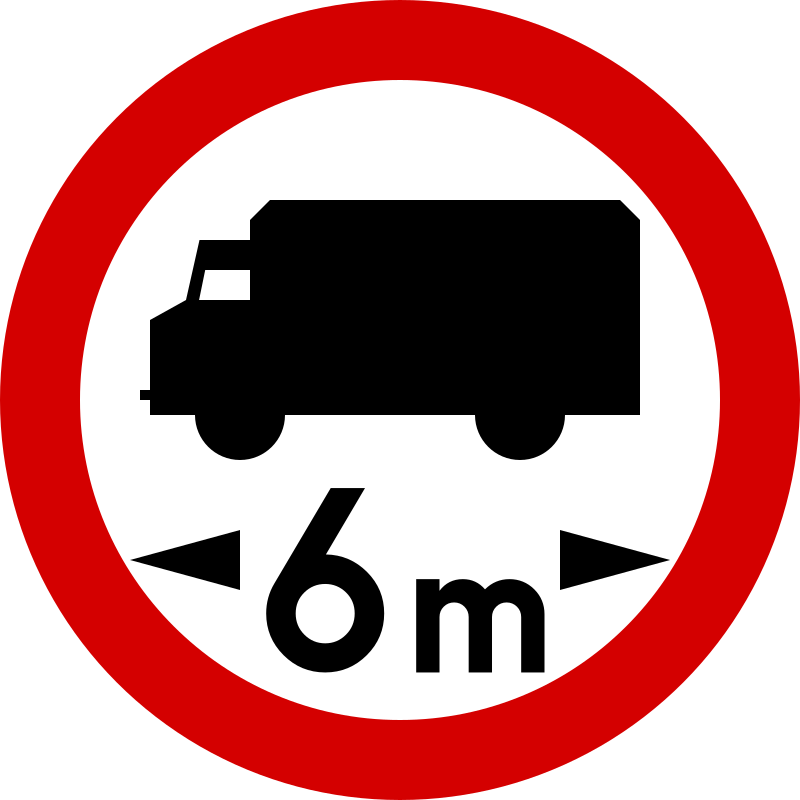
English • Traffic sign B-17 • Maximum length in metres. Sign B-17 prohibits vehicles or vehicle combinations whose length, including their load, exceeds the value shown.
Polski • B-17 • zakaz wjazdu pojazdów o długości ponad ... m. Znak B-17 „zakaz wjazdu pojazdów o długości ponad......m” oznacza zakaz ruchu pojazdów lub zespołów pojazdów, których długość (również z ładunkiem) jest większa od wartości podanej na znaku.
Quellen
🔗 Commons.wikimedia.org
🔗 Eli.gov.pl • § 20 ust. 3
SVG source: Commons.wikimedia.org • Original SVG
Krzysztof Blachnicki • Public domain • Original revision 2025-10-01. Wikimedia original unmodified.
Artwork reviewed against the Polish official sign catalogue, Dz.U. 2019 poz. 2310: Eli.gov.pl • B-17, PDF page 42, with amendments 2021/433, 2021/2065, 2022/2372 and 2026/133 checked. Catalogue-equivalent illustration; intentional update from the previous PNG. This is an educational illustration, not a manufacturing specification.
62. Fahrzeuge über angegebener Masse verboten
Dieses Verkehrszeichen zeigt an, dass Fahrzeuge über der angegebenen Masse verboten sind. Fahrzeuge oder Fahrzeugkombinationen, die die angezeigte Massengrenze überschreiten, dürfen nicht weiterfahren. Welche Masse rechtlich maßgeblich ist, richtet sich nach den örtlich geltenden Regeln.
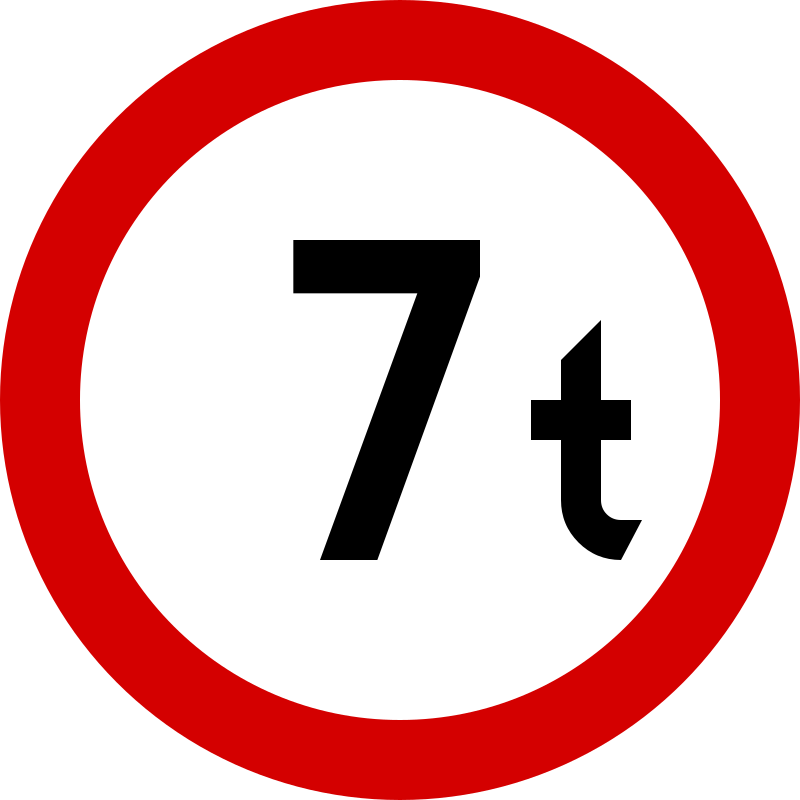
English • Traffic sign B-18 • Maximum actual total mass in tonnes. Sign B-18 prohibits vehicles whose actual total mass exceeds the value shown. For vehicle combinations, the prohibition applies to their combined mass.
Polski • B-18 • zakaz wjazdu pojazdów o rzeczywistej masie całkowitej ponad ... t. Znak B-18 „zakaz wjazdu pojazdów o rzeczywistej masie całkowitej ponad.....t” oznacza zakaz ruchu pojazdów, których rzeczywista masa całkowita jest większa od wartości podanej na znaku; w przypadku zespołu pojazdów zakaz dotyczy ich łącznej masy.
Quellen
🔗 Commons.wikimedia.org
🔗 Eli.gov.pl • § 20 ust. 4
SVG source: Commons.wikimedia.org • Original SVG
Szczepan dyskusja Mail 18:29, 31 December 2006 (UTC) • Public domain • Original revision 2025-10-01. Wikimedia original unmodified.
Artwork reviewed against the Polish official sign catalogue, Dz.U. 2019 poz. 2310: Eli.gov.pl • B-18, PDF page 42, with amendments 2021/433, 2021/2065, 2022/2372 and 2026/133 checked. Catalogue-equivalent illustration; intentional update from the previous PNG. This is an educational illustration, not a manufacturing specification.
63. Fahrzeuge über zulässiger Achslast verboten
Dieses Verkehrszeichen zeigt an, dass Fahrzeuge über der angegebenen Achslastgrenze verboten sind. Ein Fahrzeug, dessen Last auf einer Achse den angezeigten Grenzwert überschreitet, darf nicht weiterfahren.
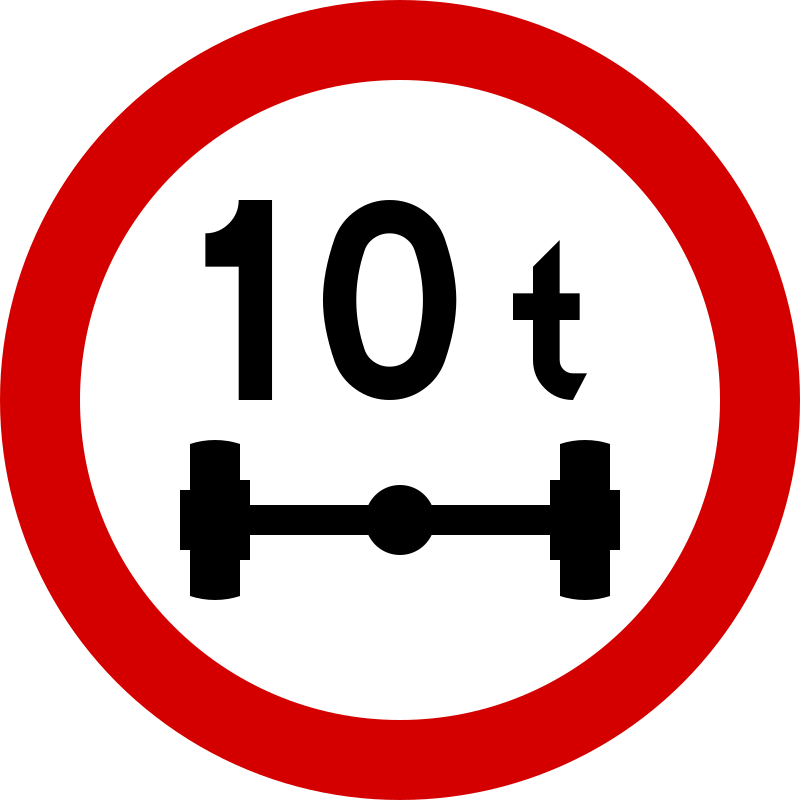
English • Traffic sign B-19 • Maximum single driven-axle load in tonnes. Sign B-19 prohibits vehicles whose single driven-axle load exceeds the permitted load corresponding to the mass shown. For an axle group, no individual axle may bear a load corresponding to more than 80% of the mass shown. If B-19 shows 8 t or 10 t, it permits a single driven-axle load corresponding to up to 8 t or 10 t and a correspondingly higher axle-group load under vehicle technical regulations. B-19 does not apply to buses; vehicles engaged in rescue operations or directly addressing the effects of natural disasters; vehicles of public road managers and contractors carrying out road maintenance duties on their behalf; vehicles carrying out the duties of the Police, Road Transport Inspectorate, State Protection Service, Internal Security Agency, Foreign Intelligence Agency, Military Counterintelligence Service, Military Intelligence Service, Central Anti-Corruption Bureau, Border Guard, Prison Service, National Revenue Administration as used by the Customs and Fiscal Service, or fire protection units; vehicles of the Polish Armed Forces and allied states; vehicles of the State Water Holding Polish Waters and entities carrying out tasks on its behalf under the Water Law Act of 20 July 2017 (Journal of Laws 2020, items 310, 284, 695, 782, 875 and 1378); or vehicles delivering hospital equipment and supplies necessary to combat infections and infectious diseases during an epidemic threat or epidemic declared under the Act of 5 December 2008 on preventing and combating human infections and infectious diseases (Journal of Laws 2020, items 1845, 2112 and 2401, and 2021, items 159, 180 and 255).
Polski • B-19 • zakaz wjazdu pojazdów o nacisku pojedynczej osi napędowej powyżej..... t. Znak B-19 „zakaz wjazdu pojazdów o nacisku pojedynczej osi napędowej powyżej..... t” oznacza zakaz ruchu pojazdów, których nacisk pojedynczej osi napędowej jest większy od dopuszczalnego nacisku odpowiadającego masie podanej na znaku; w przypadku grupy osi nacisk żadnej z osi składowych nie może odpowiadać masie większej niż 80% masy podanej na znaku. Jeżeli na znaku B-19 podano wartość 8 t lub 10 t, oznacza to dopuszczalny nacisk pojedynczej osi napędowej odpowiadający masie do 8 t lub 10 t, a grupy osi - odpowiednio większej masie, zgodnie z przepisami określającymi warunki techniczne pojazdów poruszających się po drogach. Znak B-19 nie dotyczy: autobusów; pojazdów biorących udział w akcjach ratowniczych oraz przy bezpośredniej likwidacji skutków klęsk żywiołowych; pojazdów zarządców dróg publicznych oraz podmiotów wykonujących obowiązki zarządcy drogi na jego rzecz z zakresu utrzymania dróg; pojazdów Policji, Inspekcji Transportu Drogowego, Służby Ochrony Państwa, Agencji Bezpieczeństwa Wewnętrznego, Agencji Wywiadu, Służby Kontrwywiadu Wojskowego, Służby Wywiadu Wojskowego, Centralnego Biura Antykorupcyjnego, Straży Granicznej, Służby Więziennej, Krajowej Administracji Skarbowej wykorzystywanych przez Służbę Celno-Skarbową oraz jednostek ochrony przeciwpożarowej, wykonujących zadania tych służb lub podmiotów; pojazdów Sił Zbrojnych Rzeczypospolitej Polskiej i państw sojuszniczych; pojazdów Państwowego Gospodarstwa Wodnego Wody Polskie oraz podmiotów wykonujących na jego rzecz zadania wynikające z ustawy z dnia 20 lipca 2017 r. - Prawo wodne (Dz. U. z 2020 r. poz. 310, 284, 695, 782, 875 i 1378); pojazdów dostarczających do szpitali wyposażenie i zaopatrzenie niezbędne do zwalczania zakażeń i chorób zakaźnych w okresie obowiązywania stanu zagrożenia epidemicznego lub stanu epidemii ogłoszonego na podstawie ustawy z dnia 5 grudnia 2008 r. o zapobieganiu oraz zwalczaniu zakażeń i chorób zakaźnych u ludzi (Dz. U. z 2020 r. poz. 1845, 2112 i 2401 oraz z 2021 r. poz. 159, 180 i 255).
Quellen
🔗 Commons.wikimedia.org
🔗 Eli.gov.pl • § 20 ust. 5–7
Image via Commons.wikimedia.org
Szczepan dyskusja Mail 18:29, 31 December 2006 (UTC) • Public domain • Source revision 2025-10-01. Wikimedia original unmodified.
64. Anhänger über angegebener Masse verboten
Dieses Verkehrszeichen zeigt an, dass Anhänger über der angegebenen Masse verboten sind. Anhänger, die die angezeigte Massengrenze überschreiten, dürfen nicht weiterfahren. Welche Anhängermasse rechtlich maßgeblich ist, richtet sich nach den örtlich geltenden Regeln.
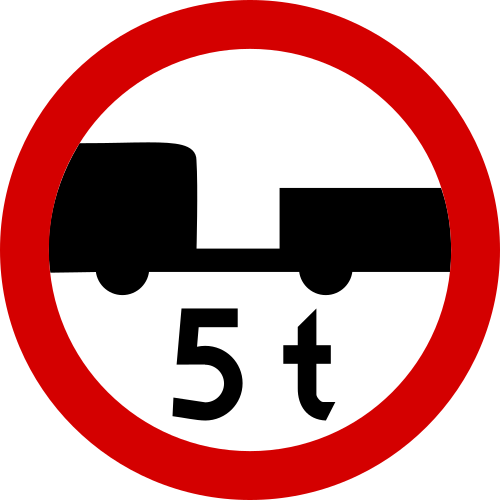
English • Traffic sign B-7 • No motor vehicles with trailers. Sign B-7 prohibits motor vehicles with one or more trailers, except vehicles with a single-axle trailer or semi-trailer.
Polski • B-7 • zakaz wjazdu pojazdów silnikowych z przyczepą. Znak B-7 „zakaz wjazdu pojazdów silnikowych z przyczepą” oznacza zakaz ruchu pojazdów silnikowych z przyczepą (przyczepami); zakaz nie dotyczy pojazdów z przyczepą jednoosiową lub naczepą.
Quellen
🔗 Commons.wikimedia.org
🔗 Eli.gov.pl • § 18 ust. 7
SVG source: Pz • Public domain • Original revision 2012-04-05. Wikimedia original unmodified.
65. Lastwagen über angegebener Masse verboten
Dieses Verkehrszeichen zeigt an, dass Lastwagen über der angegebenen Masse verboten sind. Vom Zeichen erfasste Lastwagen dürfen nicht weiterfahren, wenn sie die angezeigte Massengrenze überschreiten. Welche Masse rechtlich maßgeblich ist, richtet sich nach den örtlich geltenden Regeln.
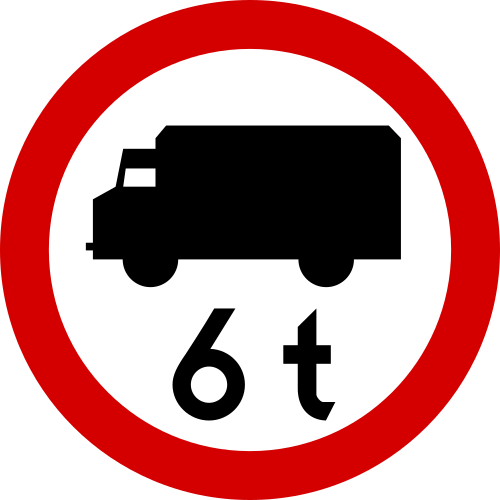
English • Traffic sign B-5 • No lorries. Sign B-5 prohibits lorries with a maximum authorised mass exceeding 3.5 t; tractor units; special vehicles and vehicles used for special purposes with a maximum authorised mass exceeding 3.5 t; agricultural tractors; and slow-moving vehicles.
Polski • B-5 • zakaz wjazdu samochodów ciężarowych. Znak B-5 „zakaz wjazdu samochodów ciężarowych” oznacza zakaz ruchu: samochodów ciężarowych o dopuszczalnej masie całkowitej przekraczającej 3,5 t; ciągników samochodowych; pojazdów specjalnych i używanych do celów specjalnych o dopuszczalnej masie całkowitej przekraczającej 3,5 t; ciągników rolniczych; pojazdów wolnobieżnych.
Quellen
🔗 Commons.wikimedia.org
🔗 Eli.gov.pl • § 18 ust. 4
SVG source: Paweł Grzywocz • Public domain • Original revision 2012-04-05. Wikimedia original unmodified.
66. Fahrbahnverengung, Gegenverkehr Vorfahrt gewähren
Dieses Verkehrszeichen weist auf eine Fahrbahnverengung hin, an der Sie dem Gegenverkehr Vorfahrt gewähren müssen. Lassen Sie entgegenkommenden Verkehr passieren, bevor Sie in den engen Abschnitt einfahren oder darin weiterfahren, wenn dies erforderlich ist.

English • Traffic sign B-31 • Priority for oncoming traffic. Sign B-31 prohibits entering or walking onto a narrow section if doing so would force drivers already on it or approaching from the opposite direction to stop.
Polski • B-31 • pierwszeństwo dla nadjeżdżających z przeciwka. Znak B-31 „pierwszeństwo dla nadjeżdżających z przeciwka” zabrania kierującym wjazdu lub wejścia na zwężony odcinek jezdni, jeżeli zmusiłoby to kierujących znajdujących się na tym odcinku lub zbliżających się do niego z przeciwnej strony do zatrzymania się.
Quellen
🔗 Commons.wikimedia.org
🔗 Eli.gov.pl • § 25 ust.
SVG source: Commons.wikimedia.org • Original SVG
Szczepan dyskusja Mail 18:29, 31 December 2006 (UTC) • Public domain • Original revision 2025-09-28. Wikimedia original unmodified.
Artwork reviewed against the Polish official sign catalogue, Dz.U. 2019 poz. 2310: Eli.gov.pl • B-31, PDF page 42, with amendments 2021/433, 2021/2065, 2022/2372 and 2026/133 checked. Catalogue-equivalent illustration; intentional update from the previous PNG. This is an educational illustration, not a manufacturing specification.
67. Linksabbiegen verboten
Dieses Verkehrszeichen zeigt an, dass Linksabbiegen verboten ist. Wo das Zeichen gilt, darf nicht nach links abgebogen werden. Andere Fahrbewegungen können weiterhin erlaubt sein, sofern keine weitere Beschränkung gilt.
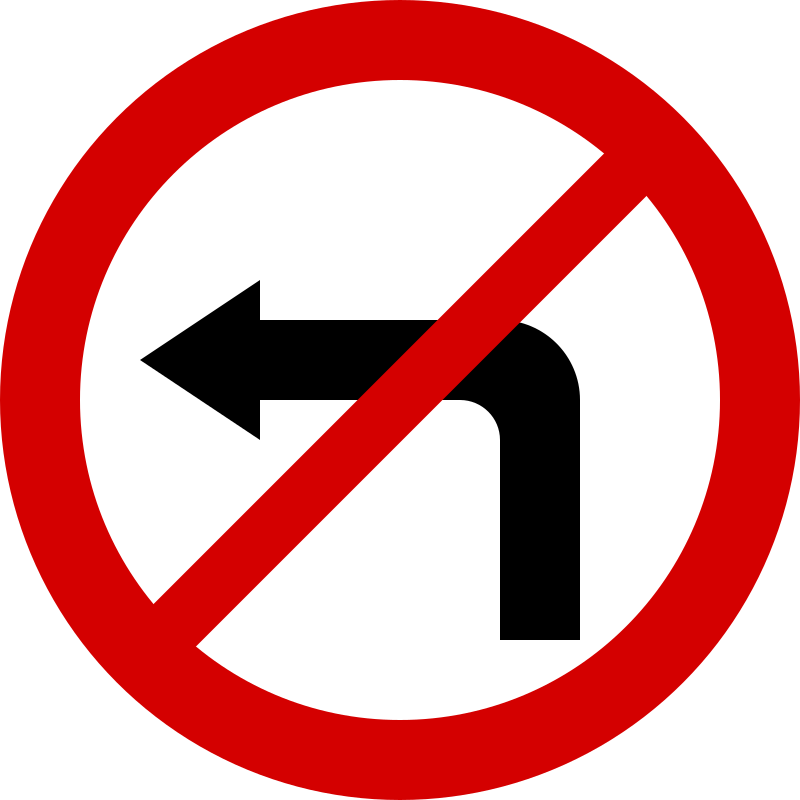
English • Traffic sign B-21 • No left turn. Signs B-21, No left turn, and B-22, No right turn, prohibit turning in the direction shown. B-21 also prohibits U-turns.
Polski • B-21 • zakaz skręcania w lewo. Znaki: B-21 „zakaz skręcania w lewo”, B-22 „zakaz skręcania w prawo” zabraniają skręcania w kierunku wskazanym na znaku; ponadto znak B-21 zabrania zawracania.
Quellen
🔗 Commons.wikimedia.org
🔗 Eli.gov.pl • § 22 ust. 1
SVG source: Commons.wikimedia.org • Original SVG
Szczepan dyskusja Mail 18:29, 31 December 2006 (UTC) • Public domain • Original revision 2025-09-28. Wikimedia original unmodified.
Artwork reviewed against the Polish official sign catalogue, Dz.U. 2019 poz. 2310: Eli.gov.pl • B-21, PDF page 42, with amendments 2021/433, 2021/2065, 2022/2372 and 2026/133 checked. Catalogue-equivalent illustration; intentional update from the previous PNG. This is an educational illustration, not a manufacturing specification.
68. Rechtsabbiegen verboten
Dieses Verkehrszeichen zeigt an, dass Rechtsabbiegen verboten ist. Wo das Zeichen gilt, darf nicht nach rechts abgebogen werden. Andere Fahrbewegungen können weiterhin erlaubt sein, sofern keine weitere Beschränkung gilt.
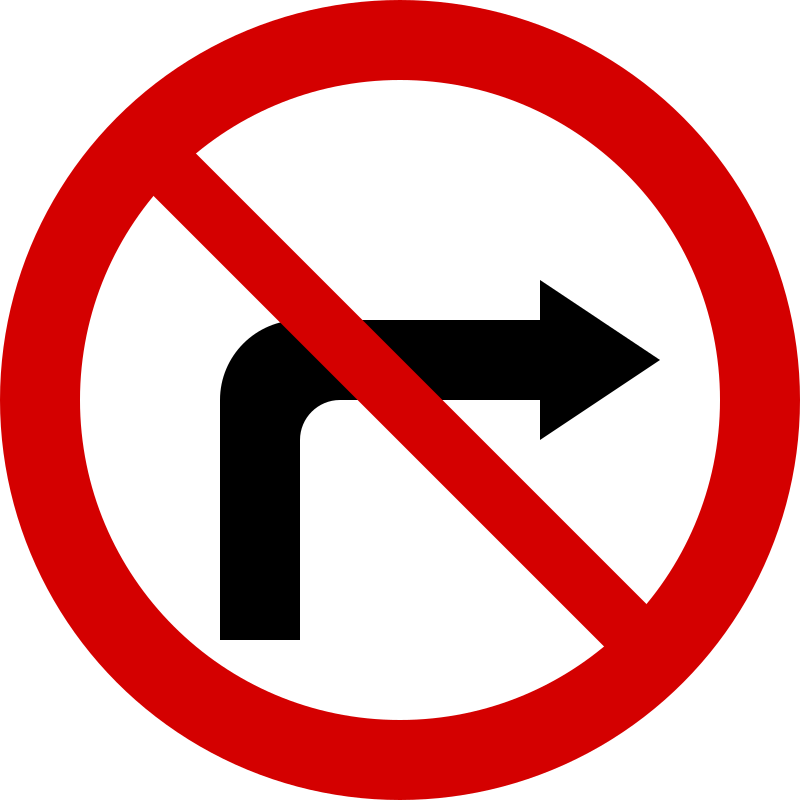
English • Traffic sign B-22 • No right turn. Signs B-21, No left turn, and B-22, No right turn, prohibit turning in the direction shown. B-21 also prohibits U-turns.
Polski • B-22 • zakaz skręcania w prawo. Znaki: B-21 „zakaz skręcania w lewo”, B-22 „zakaz skręcania w prawo” zabraniają skręcania w kierunku wskazanym na znaku; ponadto znak B-21 zabrania zawracania.
Quellen
🔗 Commons.wikimedia.org
🔗 Eli.gov.pl • § 22 ust. 1
SVG source: Commons.wikimedia.org • Original SVG
Szczepan dyskusja Mail 18:29, 31 December 2006 (UTC) • Public domain • Original revision 2025-09-28. Wikimedia original unmodified.
Artwork reviewed against the Polish official sign catalogue, Dz.U. 2019 poz. 2310: Eli.gov.pl • B-22, PDF page 42, with amendments 2021/433, 2021/2065, 2022/2372 and 2026/133 checked. Catalogue-equivalent illustration; intentional update from the previous PNG. This is an educational illustration, not a manufacturing specification.
69. Wenden verboten
Dieses Verkehrszeichen zeigt an, dass Wenden verboten ist. Wo das Verbot gilt, darf kein Wendemanöver durchgeführt werden. Andere Fahrbewegungen können weiterhin erlaubt sein, sofern keine weitere Beschränkung gilt.

English • Traffic sign B-23 • No U-turn. Sign B-23 prohibits U-turns up to and including the next junction.
Polski • B-23 • zakaz zawracania. Znak B-23 „zakaz zawracania” zabrania kierującym zawracania do najbliższego skrzyżowania włącznie.
Quellen
🔗 Commons.wikimedia.org
🔗 Eli.gov.pl • § 22 ust. 5
SVG source: Commons.wikimedia.org • Original SVG
Szczepan dyskusja Mail 18:29, 31 December 2006 (UTC) • Public domain • Original revision 2025-09-28. Wikimedia original unmodified.
Artwork reviewed against the Polish official sign catalogue, Dz.U. 2019 poz. 2310: Eli.gov.pl • B-23, PDF page 42, with amendments 2021/433, 2021/2065, 2022/2372 and 2026/133 checked. Catalogue-equivalent illustration; intentional update from the previous PNG. This is an educational illustration, not a manufacturing specification.
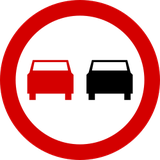
70. Überholen verboten
Dieses Verkehrszeichen zeigt an, dass Überholen verboten ist. Welche Fahrzeuge vom Verbot betroffen sind und welche Fahrzeugkategorien gegebenenfalls weiterhin überholt werden dürfen, richtet sich nach den örtlich geltenden Regeln.
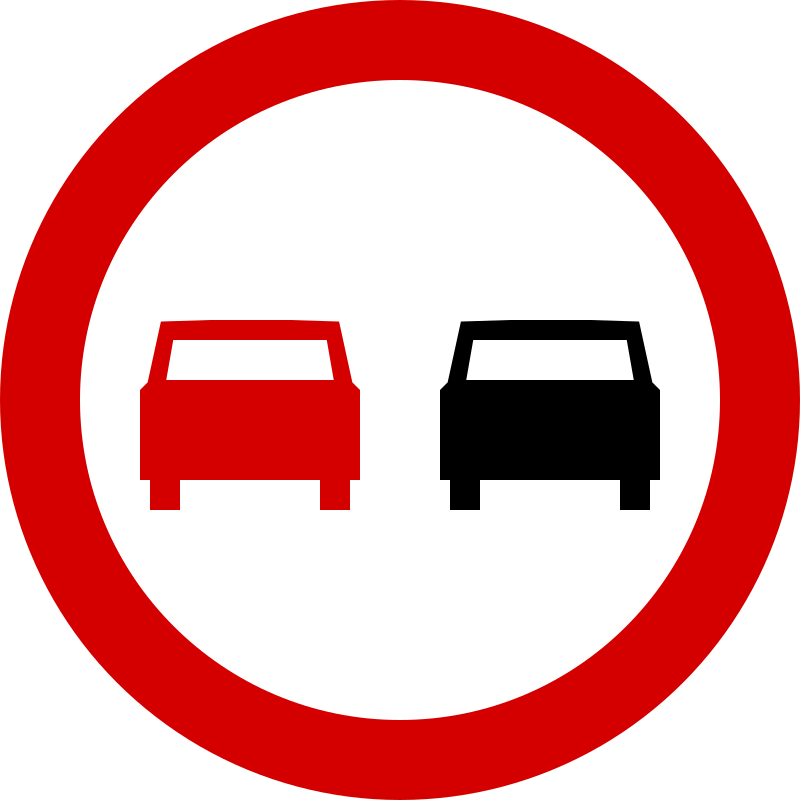
English • Traffic sign B-25 • No overtaking. Sign B-25 prohibits drivers of motor vehicles from overtaking multi-track motor vehicles.
Polski • B-25 • zakaz wyprzedzania. Znak B-25 „zakaz wyprzedzania” zabrania kierującym pojazdami silnikowymi wyprzedzania pojazdów silnikowych wielośladowych.
Quellen
🔗 Commons.wikimedia.org
🔗 Eli.gov.pl • § 23 ust. 1
SVG source: Commons.wikimedia.org • Original SVG
Szczepan dyskusja Mail 18:29, 31 December 2006 (UTC) • Public domain • Original revision 2025-09-28. Wikimedia original unmodified.
Artwork reviewed against the Polish official sign catalogue, Dz.U. 2019 poz. 2310: Eli.gov.pl • B-25, PDF page 42, with amendments 2021/433, 2021/2065, 2022/2372 and 2026/133 checked. Catalogue-equivalent illustration; intentional update from the previous PNG. This is an educational illustration, not a manufacturing specification.
71. Ende des Überholverbots
Dieses Verkehrszeichen kennzeichnet das Ende des Überholverbots. Die zuvor geltende Überholbeschränkung endet an dieser Stelle. Für das Überholen gelten weiterhin die allgemeinen Verkehrsregeln und sonstige Beschränkungen.
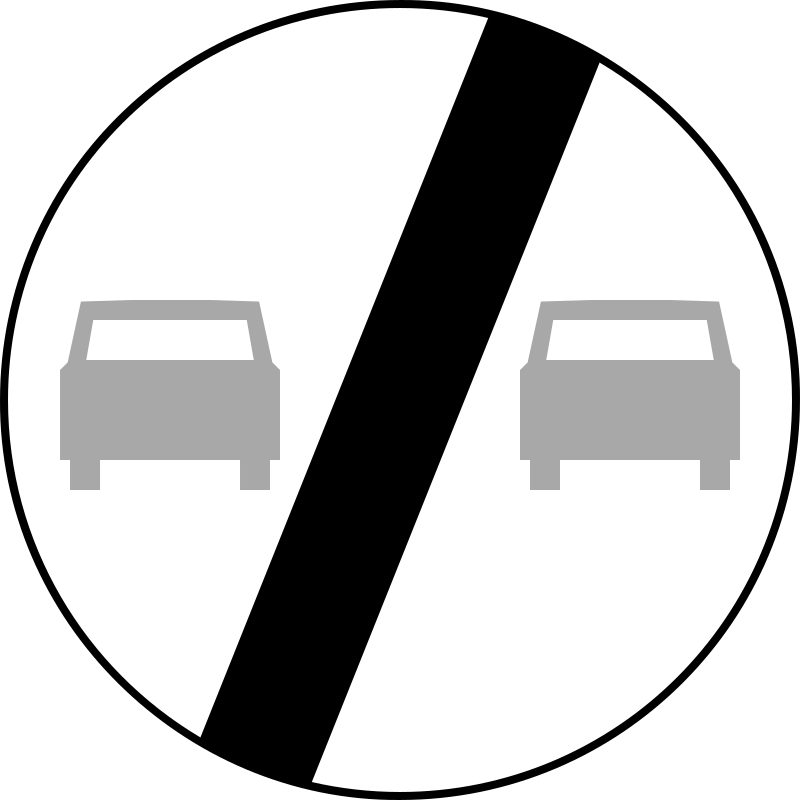
English • Traffic sign B-27 • End of the overtaking prohibition. Sign B-27 ends the prohibition imposed by B-25.
Polski • B-27 • koniec zakazu wyprzedzania. Znak B-27 „koniec zakazu wyprzedzania” oznacza koniec obowiązywania zakazu określonego znakiem B-25.
Quellen
🔗 Commons.wikimedia.org
🔗 Eli.gov.pl • § 23 ust. 4
SVG source: Commons.wikimedia.org • Original SVG
Szczepan dyskusja Mail 18:29, 31 December 2006 (UTC) • Public domain • Original revision 2025-09-28. Wikimedia original unmodified.
Artwork reviewed against the Polish official sign catalogue, Dz.U. 2019 poz. 2310: Eli.gov.pl • B-27, PDF page 42, with amendments 2021/433, 2021/2065, 2022/2372 and 2026/133 checked. Catalogue-equivalent illustration; intentional update from the previous PNG. This is an educational illustration, not a manufacturing specification.
72. Überholen für Lastwagen verboten
Dieses Verkehrszeichen zeigt an, dass Überholen für Lastwagen verboten ist. Vom Zeichen erfasste Lastwagen dürfen dort, wo das Verbot gilt, nicht überholen. Welche Lastwagenkategorien betroffen sind und welche Ausnahmen gelten, richtet sich nach den örtlichen Regeln.
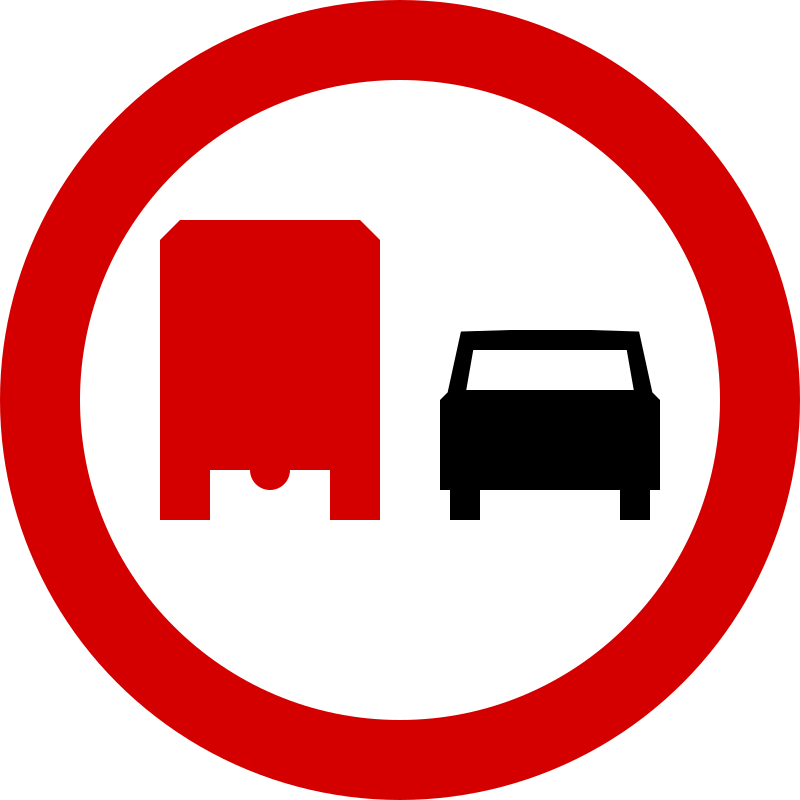
English • Traffic sign B-26 • No overtaking by lorries. Sign B-26 prohibits overtaking multi-track motor vehicles by drivers of lorries with a maximum authorised mass exceeding 3.5 t; tractor units; and special vehicles or vehicles used for special purposes with a maximum authorised mass exceeding 3.5 t.
Polski • B-26 • zakaz wyprzedzania przez samochody ciężarowe. Znak B-26 „zakaz wyprzedzania przez samochody ciężarowe” zabrania wyprzedzania pojazdów silnikowych wielośladowych kierującemu: samochodem ciężarowym o dopuszczalnej masie całkowitej przekraczającej 3,5 t; ciągnikiem samochodowym; pojazdem specjalnym lub używanym do celów specjalnych - o dopuszczalnej masie całkowitej przekraczającej 3,5 t.
Quellen
🔗 Commons.wikimedia.org
🔗 Eli.gov.pl • § 23 ust. 3
SVG source: Commons.wikimedia.org • Original SVG
Szczepan dyskusja Mail 18:29, 31 December 2006 (UTC) • Public domain • Original revision 2025-09-28. Wikimedia original unmodified.
Artwork reviewed against the Polish official sign catalogue, Dz.U. 2019 poz. 2310: Eli.gov.pl • B-26, PDF page 42, with amendments 2021/433, 2021/2065, 2022/2372 and 2026/133 checked. Catalogue-equivalent illustration; intentional update from the previous PNG. This is an educational illustration, not a manufacturing specification.
73. Ende des Überholverbots für Lastwagen
Dieses Verkehrszeichen kennzeichnet das Ende des Überholverbots für Lastwagen. Die zuvor geltende Überholbeschränkung für Lastwagen endet an dieser Stelle. Andere Überholregeln und Beschränkungen können weiterhin gelten.
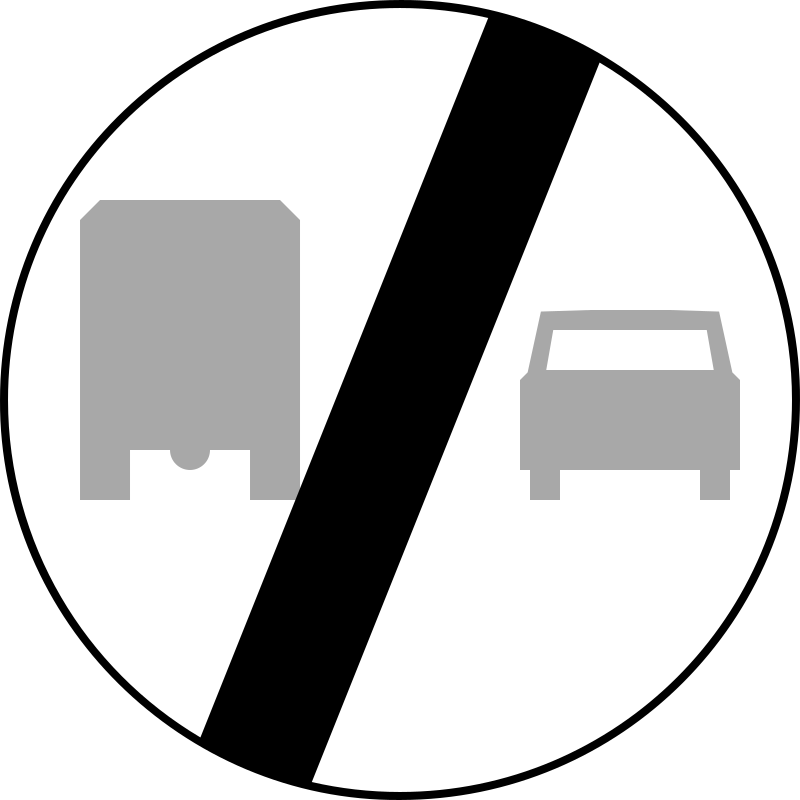
English • Traffic sign B-28 • End of the overtaking prohibition for lorries. Sign B-28 ends the prohibition imposed by B-26.
Polski • B-28 • koniec zakazu wyprzedzania przez samochody ciężarowe. Znak B-28 „koniec zakazu wyprzedzania przez samochody ciężarowe” oznacza koniec obowiązywania zakazu określonego znakiem B-26.
Quellen
🔗 Commons.wikimedia.org
🔗 Eli.gov.pl • § 23 ust. 5
SVG source: Commons.wikimedia.org • Original SVG
Szczepan dyskusja Mail 18:29, 31 December 2006 (UTC) • Public domain • Original revision 2025-09-28. Wikimedia original unmodified.
Artwork reviewed against the Polish official sign catalogue, Dz.U. 2019 poz. 2310: Eli.gov.pl • B-28, PDF page 42, with amendments 2021/433, 2021/2065, 2022/2372 and 2026/133 checked. Catalogue-equivalent illustration; intentional update from the previous PNG. This is an educational illustration, not a manufacturing specification.
74. Beginn einer Geschwindigkeitsbegrenzung
Dieses Verkehrszeichen kennzeichnet den Beginn einer Geschwindigkeitsbegrenzung. Der angezeigte Wert ist ab dieser Stelle die zulässige Höchstgeschwindigkeit. Die Begrenzung gilt, bis sie nach den geltenden Verkehrszeichen und örtlichen Regeln endet oder ersetzt wird.
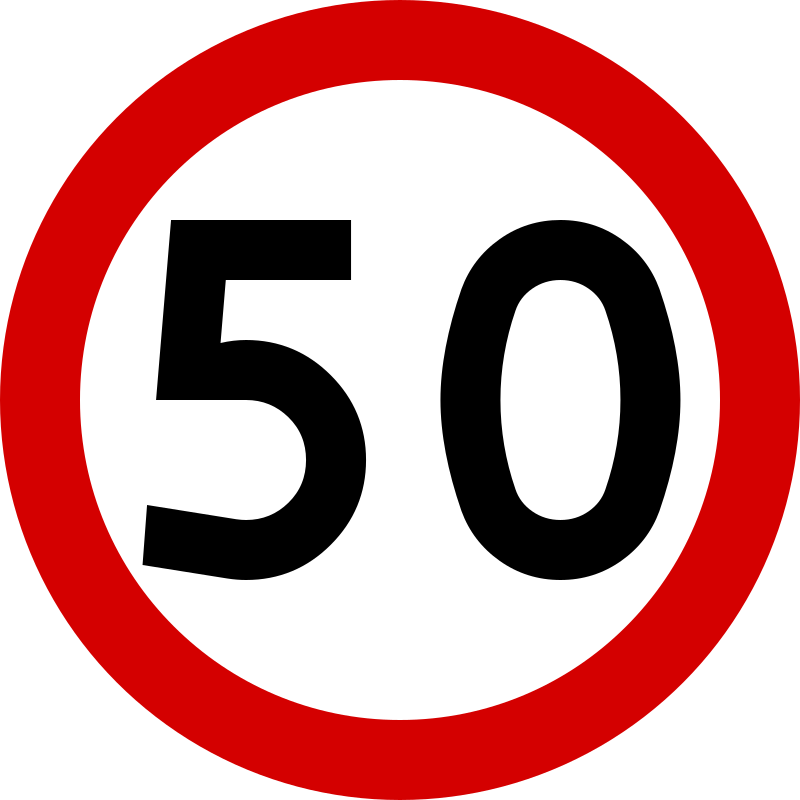
English • Traffic sign B-33 • Speed limit. Sign B-33 prohibits exceeding the speed shown in kilometres per hour. Subject to subsection 4 and section 32, the limit applies until another limit is introduced by B-33 or B-43; D-40 marks the beginning of a residential area; or signs mark the beginning or end of a built-up area as referred to in section 58(3) and section 114(1), points 1 and 2.
Polski • B-33 • ograniczenie prędkości. Znak B-33 „ograniczenie prędkości” oznacza zakaz przekraczania prędkości określonej na znaku liczbą kilometrów na godzinę. Dopuszczalna prędkość określona na znaku obowiązuje, z zastrzeżeniem ust. 4 i § 32, do miejsca: wprowadzenia innej dopuszczalnej prędkości znakiem B-33 lub B-43; umieszczenia znaku D-40 oznaczającego początek strefy zamieszkania; umieszczenia znaków oznaczających odpowiednio początek lub koniec obszaru zabudowanego, o których mowa w § 58 ust. 3 i w § 114 ust. 1 pkt 1 i 2.
Quellen
🔗 Commons.wikimedia.org
🔗 Eli.gov.pl • § 27 ust. 1
SVG source: Commons.wikimedia.org • Original SVG
Miko101 • Public domain • Original revision 2026-03-30. Wikimedia original unmodified.
Artwork reviewed against the Polish official sign catalogue, Dz.U. 2019 poz. 2310: Eli.gov.pl • B-33, PDF page 42, with amendments 2021/433, 2021/2065, 2022/2372 and 2026/133 checked. Catalogue-equivalent illustration; intentional update from the previous PNG. This is an educational illustration, not a manufacturing specification.
75. Ende der Geschwindigkeitsbegrenzung
Dieses Verkehrszeichen kennzeichnet das Ende der zuvor angegebenen Geschwindigkeitsbegrenzung. Ab dieser Stelle gilt eine neu angezeigte Begrenzung oder die allgemeine Geschwindigkeitsregel für Straße und Fahrzeugkategorie.
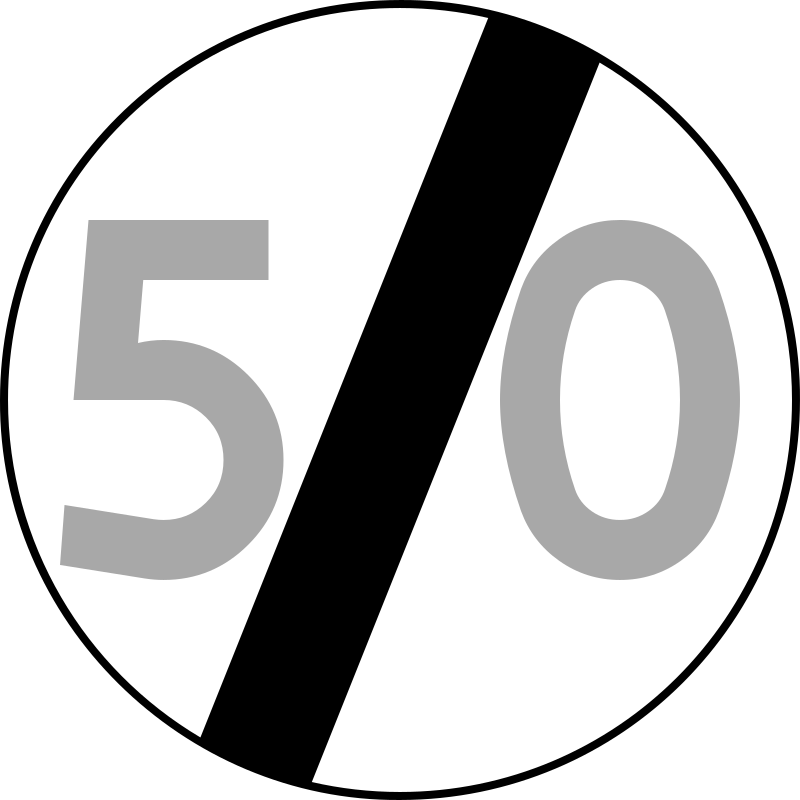
English • Traffic sign B-34 • End of the speed limit. Sign B-34 cancels the speed restriction introduced by B-33.
Polski • B-34 • koniec ograniczenia prędkości. Znak B-34 „koniec ograniczenia prędkości” oznacza odwołanie ograniczenia prędkości wprowadzonego znakiem B-33.
Quellen
🔗 Commons.wikimedia.org
🔗 Eli.gov.pl • § 27 ust. 4
SVG source: Commons.wikimedia.org • Original SVG
Szczepan dyskusja Mail 18:29, 31 December 2006 (UTC) • Public domain • Original revision 2025-10-01. Wikimedia original unmodified.
Artwork reviewed against the Polish official sign catalogue, Dz.U. 2019 poz. 2310: Eli.gov.pl • B-34, PDF page 42, with amendments 2021/433, 2021/2065, 2022/2372 and 2026/133 checked. Catalogue-equivalent illustration; intentional update from the previous PNG. This is an educational illustration, not a manufacturing specification.
76. Beginn einer Geschwindigkeitszone
Dieses Verkehrszeichen kennzeichnet den Beginn einer Geschwindigkeitszone. Die angezeigte Geschwindigkeitsbegrenzung gilt nach den anwendbaren Zonenregeln im gesamten Bereich, bis die Zone endet oder eine andere Regel sie ersetzt.
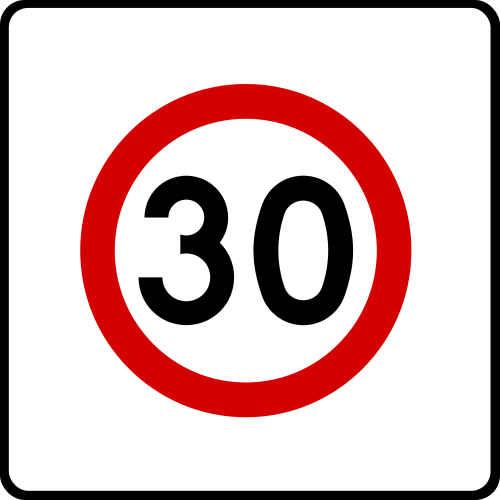
English • Traffic sign B-43 • Speed-limit zone. Sign B-43 marks entry to a zone where exceeding the speed shown in kilometres per hour is prohibited.
Polski • B-43 • strefa ograniczonej prędkości. Znak B-43 „strefa ograniczonej prędkości” oznacza wjazd do strefy, w której obowiązuje zakaz przekraczania prędkości określonej na znaku liczbą kilometrów na godzinę.
Quellen
🔗 Commons.wikimedia.org
🔗 Eli.gov.pl • § 31 ust. 1
SVG source: Commons.wikimedia.org • Original SVG
Szczepan dyskusja Mail 18:29, 31 December 2006 (UTC) • Public domain • Original revision 2023-10-15. Wikimedia original unmodified.
Artwork reviewed against the Polish official sign catalogue, Dz.U. 2019 poz. 2310: Eli.gov.pl • B-43, PDF page 42, with amendments 2021/433, 2021/2065, 2022/2372 and 2026/133 checked. Catalogue-equivalent illustration; intentional update from the previous PNG. This is an educational illustration, not a manufacturing specification.
77. Ende der Geschwindigkeitszone
Dieses Verkehrszeichen kennzeichnet das Ende der Geschwindigkeitszone. Die zonale Geschwindigkeitsbegrenzung endet an dieser Stelle. Beachten Sie eine neu angezeigte Begrenzung oder die geltenden allgemeinen Geschwindigkeitsregeln.

English • Traffic sign B-44 • End of the speed-limit zone. Sign B-44 marks the exit from a speed-limit zone.
Polski • B-44 • koniec strefy ograniczonej prędkości. Znak B-44 „koniec strefy ograniczonej prędkości” oznacza wyjazd ze strefy ograniczonej prędkości.
Quellen
🔗 Commons.wikimedia.org
🔗 Eli.gov.pl • § 31 ust. 3
SVG source: Commons.wikimedia.org • Original SVG
Szczepan dyskusja Mail 18:29, 31 December 2006 (UTC) • Public domain • Original revision 2023-10-15. Wikimedia original unmodified.
Artwork reviewed against the Polish official sign catalogue, Dz.U. 2019 poz. 2310: Eli.gov.pl • B-44, PDF page 42, with amendments 2021/433, 2021/2065, 2022/2372 and 2026/133 checked. Catalogue-equivalent illustration; intentional update from the previous PNG. This is an educational illustration, not a manufacturing specification.
78. Hupen verboten
Dieses Verkehrszeichen zeigt an, dass Hupen verboten ist. Die Hupe oder andere akustische Warneinrichtungen dürfen dort, wo das Verbot gilt, nicht benutzt werden, außer wenn eine örtliche Regel dies erlaubt oder verlangt.
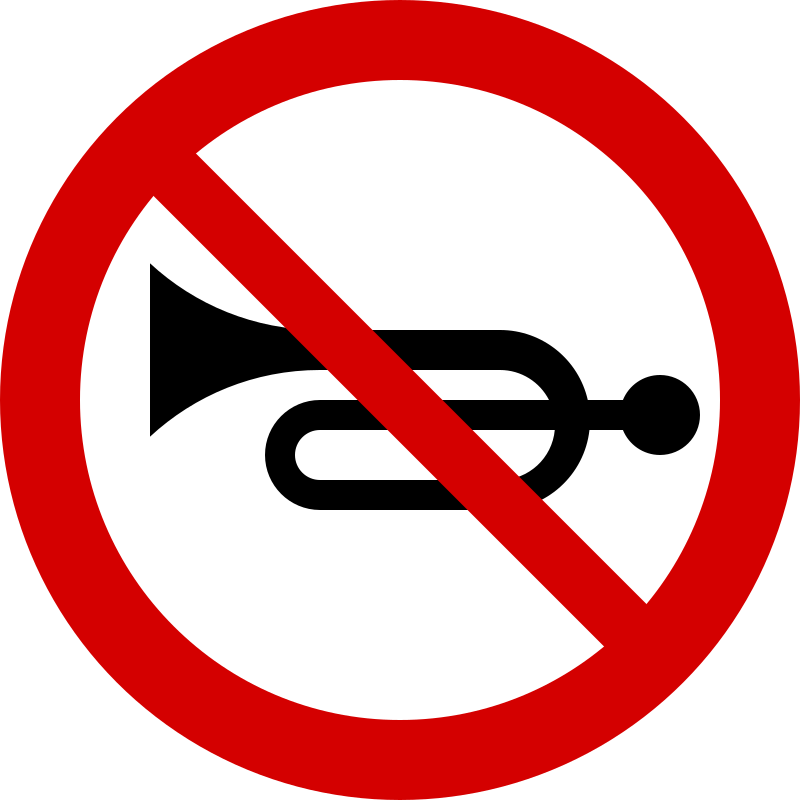
English • Traffic sign B-29 • No audible warning signals. Sign B-29 prohibits their use unless necessary to warn of an immediate danger to road safety.
Polski • B-29 • zakaz używania sygnałów dźwiękowych. Znak B-29 „zakaz używania sygnałów dźwiękowych” zabrania używania tych sygnałów, chyba że jest to konieczne w celu ostrzeżenia o bezpośrednim zagrożeniu bezpieczeństwa ruchu.
Quellen
🔗 Commons.wikimedia.org
🔗 Eli.gov.pl • § 24 ust. 1
SVG source: Commons.wikimedia.org • Original SVG
Szczepan dyskusja Mail 18:29, 31 December 2006 (UTC) • Public domain • Original revision 2025-09-28. Wikimedia original unmodified.
Artwork reviewed against the Polish official sign catalogue, Dz.U. 2019 poz. 2310: Eli.gov.pl • B-29, PDF page 42, with amendments 2021/433, 2021/2065, 2022/2372 and 2026/133 checked. Catalogue-equivalent illustration; intentional update from the previous PNG. This is an educational illustration, not a manufacturing specification.
79. Ende des Hupverbots
Dieses Verkehrszeichen kennzeichnet das Ende des Hupverbots. Die durch das vorherige Hupverbot auferlegte Beschränkung endet an dieser Stelle. Ab hier gelten wieder die normalen Regeln für die Benutzung der Hupe.
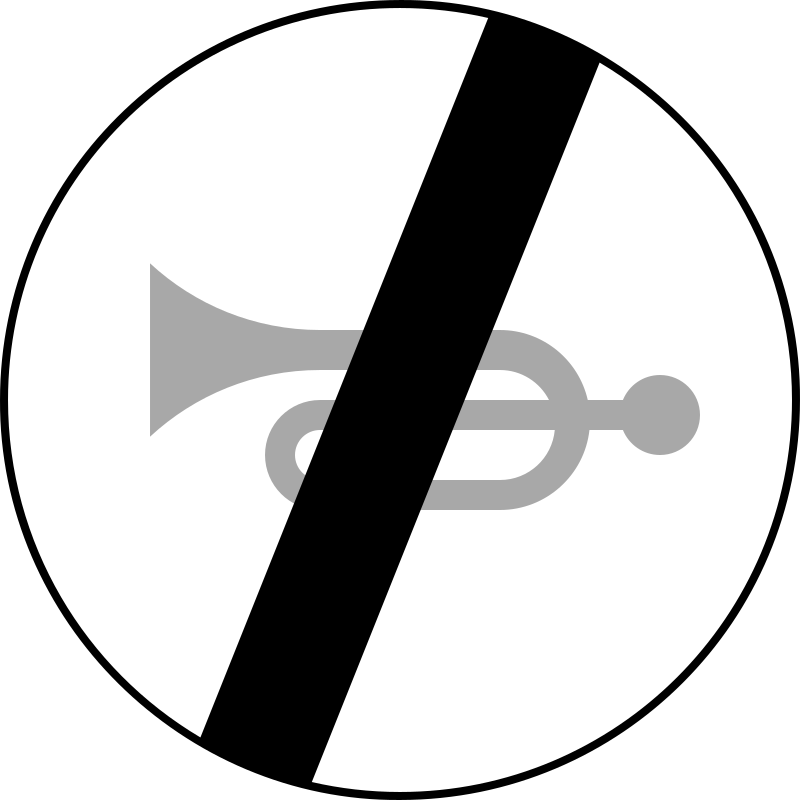
English • Traffic sign B-30 • End of the prohibition on audible warning signals. Sign B-30 ends the prohibition imposed by B-29.
Polski • B-30 • koniec zakazu używania sygnałów dźwiękowych. Znak B-30 „koniec zakazu używania sygnałów dźwiękowych” oznacza koniec obowiązywania zakazu określonego znakiem B-29.
Quellen
🔗 Commons.wikimedia.org
🔗 Eli.gov.pl • § 24 ust. 2
SVG source: Commons.wikimedia.org • Original SVG
Szczepan dyskusja Mail 18:29, 31 December 2006 (UTC) • Public domain • Original revision 2025-09-28. Wikimedia original unmodified.
Artwork reviewed against the Polish official sign catalogue, Dz.U. 2019 poz. 2310: Eli.gov.pl • B-30, PDF page 42, with amendments 2021/433, 2021/2065, 2022/2372 and 2026/133 checked. Catalogue-equivalent illustration; intentional update from the previous PNG. This is an educational illustration, not a manufacturing specification.
80. Einfahrt verboten (Kontrollstelle)
Dieses Verkehrszeichen weist auf eine Kontrollstelle mit beschränkter Durchfahrt hin. Verkehrsteilnehmer dürfen die Kontrollstelle nur passieren, wenn sie nach den geltenden Regeln und Anweisungen dazu berechtigt sind.
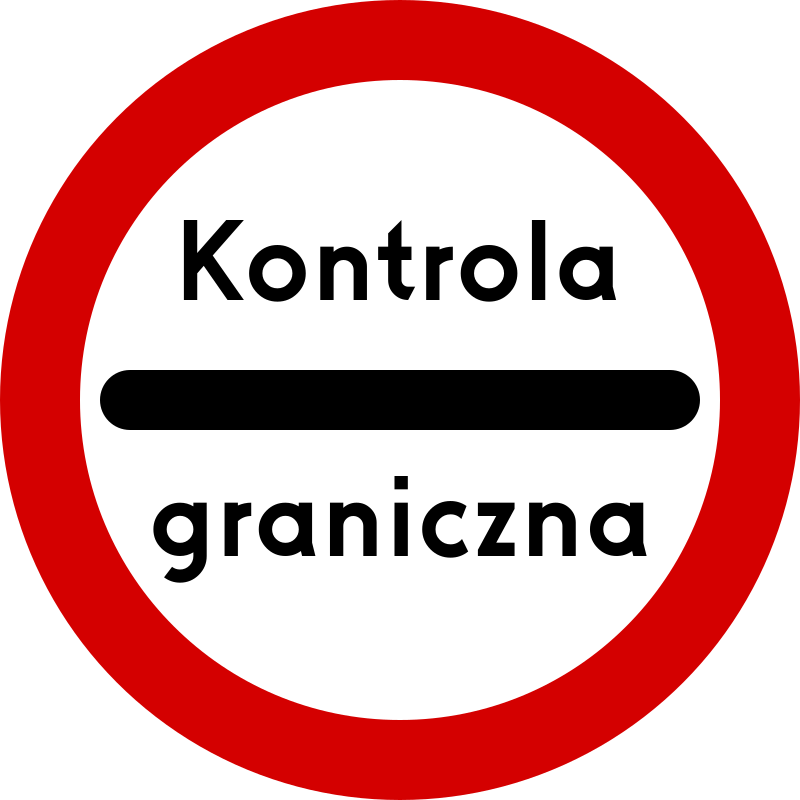
English • Traffic sign B-32 • Stop for customs control. Sign B-32 requires drivers to stop. Instead of “Cło-Zoll” (customs), the sign may read “Kontrola graniczna” (border control), “Rogatka uszkodzona” (barrier damaged), “Sygnalizacja uszkodzona” (signals defective), “Wjazd na prom” (ferry boarding), “Kontrola drogowa” (road check) or “Pobór opłat” (toll collection), according to the reason for stopping.
Polski • B-32 • stój – kontrola celna. Znak B-32 „stój - kontrola celna” oznacza obowiązek zatrzymania się. Zamiast napisu „Cło-Zoll” na znaku mogą być umieszczone napisy „Kontrola graniczna”, „Rogatka uszkodzona”, „Sygnalizacja uszkodzona”, „Wjazd na prom”, „Kontrola drogowa” lub „Pobór opłat” - odpowiednio do przyczyny zatrzymania.
Quellen
🔗 Commons.wikimedia.org
🔗 Eli.gov.pl • § 26 ust. 1
SVG source: Commons.wikimedia.org • Original SVG
Pz • Public domain • Original revision 2025-10-01. Wikimedia original unmodified.
Artwork reviewed against the Polish official sign catalogue, Dz.U. 2019 poz. 2310: Eli.gov.pl • B-32, PDF page 42, with amendments 2021/433, 2021/2065, 2022/2372 and 2026/133 checked. Catalogue-equivalent illustration; intentional update from the previous PNG. This is an educational illustration, not a manufacturing specification.
81. Parken verboten
Dieses Verkehrszeichen zeigt an, dass Parken verboten ist. Fahrzeuge dürfen im Geltungsbereich des Zeichens nicht geparkt werden, sofern keine Ausnahme gilt. Kurzes Halten zum Ein- oder Aussteigen oder zum Be- und Entladen kann erlaubt sein, wenn die örtlichen Regeln dies zulassen.

English • Traffic sign B-35 • No parking. Sign B-35 prohibits parking. Any permitted stationary period longer than one minute is stated on the sign or a plate below it.
Polski • B-35 • zakaz postoju. Znak B-35 „zakaz postoju” oznacza zakaz postoju pojazdu; dopuszczalny czas unieruchomienia pojazdu dłuższy niż jedna minuta jest wskazany napisem na znaku albo na umieszczonej pod nim tabliczce.
Quellen
🔗 Commons.wikimedia.org
🔗 Eli.gov.pl • § 28 ust. 1
SVG source: Commons.wikimedia.org • Original SVG
Szczepan dyskusja Mail 18:29, 31 December 2006 (UTC) • Public domain • Original revision 2025-09-29. Wikimedia original unmodified.
Artwork reviewed against the Polish official sign catalogue, Dz.U. 2019 poz. 2310: Eli.gov.pl • B-35, PDF page 42, with amendments 2021/433, 2021/2065, 2022/2372 and 2026/133 checked. Catalogue-equivalent illustration; intentional update from the previous PNG. This is an educational illustration, not a manufacturing specification.
82. Parken an geraden Tagen verboten
Dieses Verkehrszeichen zeigt an, dass Parken an geraden Kalendertagen verboten ist auf der Straßenseite, für die das Zeichen gilt. Wechselzeiten, Ausnahmen und die Regeln für die gegenüberliegende Straßenseite richten sich nach den örtlichen Vorschriften.
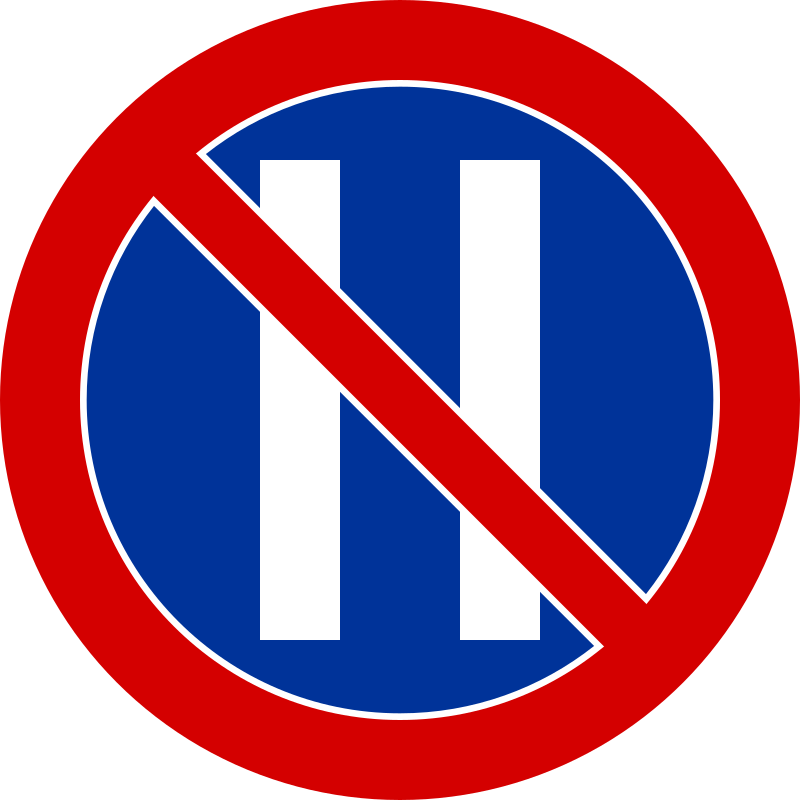
English • Traffic sign B-38 • No parking on even dates. Signs B-37, No parking on odd dates, and B-38, No parking on even dates, prohibit parking on the corresponding dates of the month. The prohibition does not apply from 21:00 to 24:00. Subsections 1 and 3–5 apply correspondingly.
Polski • B-38 • zakaz postoju w dni parzyste. Znaki: B-37 „zakaz postoju w dni nieparzyste”, B-38 „zakaz postoju w dni parzyste” oznaczają zakaz postoju pojazdów odpowiednio w nieparzyste lub parzyste dni miesiąca; zakaz nie obowiązuje od godziny 21 do 24; przepisy ust. 1 i 3-5 stosuje się odpowiednio do tych znaków.
Quellen
🔗 Commons.wikimedia.org
🔗 Eli.gov.pl • § 28 ust. 6
SVG source: Commons.wikimedia.org • Original SVG
Szczepan dyskusja Mail 18:29, 31 December 2006 (UTC) • Public domain • Original revision 2025-09-29. Wikimedia original unmodified.
Artwork reviewed against the Polish official sign catalogue, Dz.U. 2019 poz. 2310: Eli.gov.pl • B-38, PDF page 42, with amendments 2021/433, 2021/2065, 2022/2372 and 2026/133 checked. Catalogue-equivalent illustration; intentional update from the previous PNG. This is an educational illustration, not a manufacturing specification.
83. Parken an ungeraden Tagen verboten
Dieses Verkehrszeichen zeigt an, dass Parken an ungeraden Kalendertagen verboten ist auf der Straßenseite, für die das Zeichen gilt. Wechselzeiten, Ausnahmen und die Regeln für die gegenüberliegende Straßenseite richten sich nach den örtlichen Vorschriften.
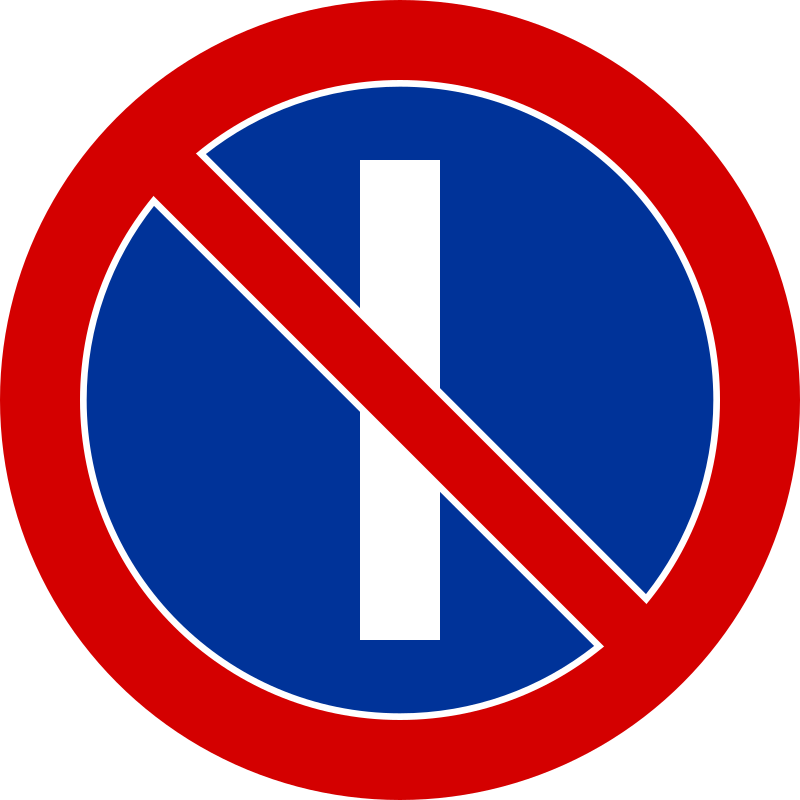
English • Traffic sign B-37 • No parking on odd dates. Signs B-37, No parking on odd dates, and B-38, No parking on even dates, prohibit parking on the corresponding dates of the month. The prohibition does not apply from 21:00 to 24:00. Subsections 1 and 3–5 apply correspondingly.
Polski • B-37 • zakaz postoju w dni nieparzyste. Znaki: B-37 „zakaz postoju w dni nieparzyste”, B-38 „zakaz postoju w dni parzyste” oznaczają zakaz postoju pojazdów odpowiednio w nieparzyste lub parzyste dni miesiąca; zakaz nie obowiązuje od godziny 21 do 24; przepisy ust. 1 i 3-5 stosuje się odpowiednio do tych znaków.
Quellen
🔗 Commons.wikimedia.org
🔗 Eli.gov.pl • § 28 ust. 6
SVG source: Commons.wikimedia.org • Original SVG
Szczepan dyskusja Mail 18:29, 31 December 2006 (UTC) • Public domain • Original revision 2025-09-29. Wikimedia original unmodified.
Artwork reviewed against the Polish official sign catalogue, Dz.U. 2019 poz. 2310: Eli.gov.pl • B-37, PDF page 42, with amendments 2021/433, 2021/2065, 2022/2372 and 2026/133 checked. Catalogue-equivalent illustration; intentional update from the previous PNG. This is an educational illustration, not a manufacturing specification.
84. Halten und Parken verboten
Dieses Verkehrszeichen zeigt an, dass Halten und Parken verboten sind. Fahrzeuge dürfen dort, wo die Beschränkung gilt, nicht freiwillig halten oder parken, außer wenn eine geltende Regel eine Ausnahme vorsieht oder das Halten durch die Verkehrslage erforderlich ist.

English • Traffic sign B-36 • No stopping. Sign B-36 prohibits stopping a vehicle.
Polski • B-36 • zakaz zatrzymywania się. Znak B-36 „zakaz zatrzymywania się” oznacza zakaz zatrzymania pojazdu.
Quellen
🔗 Commons.wikimedia.org
🔗 Eli.gov.pl • § 28 ust. 2
SVG source: Commons.wikimedia.org • Original SVG
Szczepan dyskusja Mail 18:29, 31 December 2006 (UTC) • Public domain • Original revision 2025-09-29. Wikimedia original unmodified.
Artwork reviewed against the Polish official sign catalogue, Dz.U. 2019 poz. 2310: Eli.gov.pl • B-36, PDF page 42, with amendments 2021/433, 2021/2065, 2022/2372 and 2026/133 checked. Catalogue-equivalent illustration; intentional update from the previous PNG. This is an educational illustration, not a manufacturing specification.
85. Beginn einer Parkverbotszone
Dieses Verkehrszeichen kennzeichnet den Beginn einer Parkverbotszone. Das Parkverbot gilt nach den anwendbaren Zonenregeln im gesamten Bereich, bis die Zone endet oder eine andere Regel es ersetzt.
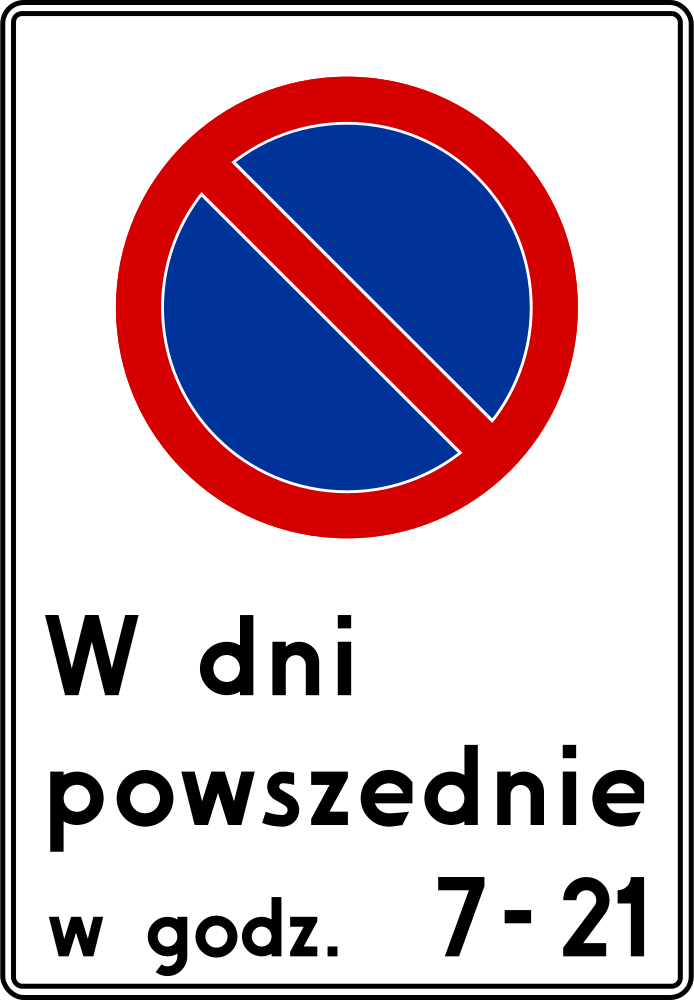
English • Traffic sign B-39 • Restricted-parking zone. Sign B-39 marks entry to a zone where parking is prohibited on all roads. Any permitted stationary period longer than one minute is stated on the sign.
Polski • B-39 • strefa ograniczonego postoju. Znak B-39 „strefa ograniczonego postoju” oznacza wjazd do strefy, w której obowiązuje zakaz postoju pojazdów na wszystkich drogach; dopuszczalny czas unieruchomienia pojazdu dłuższy niż jedna minuta jest wskazany napisem na znaku.
Quellen
🔗 Commons.wikimedia.org
🔗 Eli.gov.pl • § 29 ust. 1
SVG source: Commons.wikimedia.org • Original SVG
Szczepan dyskusja Mail 18:29, 31 December 2006 (UTC) • Public domain • Original revision 2023-10-07. Wikimedia original unmodified.
Artwork reviewed against the Polish official sign catalogue, Dz.U. 2019 poz. 2310: Eli.gov.pl • B-39, PDF page 42, with amendments 2021/433, 2021/2065, 2022/2372 and 2026/133 checked. Catalogue-equivalent illustration; intentional update from the previous PNG. This is an educational illustration, not a manufacturing specification.
86. Ende der Parkverbotszone
Dieses Verkehrszeichen kennzeichnet das Ende der Parkverbotszone. Das zonale Parkverbot endet an dieser Stelle. Andere Parkbeschränkungen oder -bedingungen können weiterhin gelten.

English • Traffic sign B-40 • End of the restricted-parking zone. Sign B-40 marks the exit from a restricted-parking zone.
Polski • B-40 • koniec strefy ograniczonego postoju. Znak B-40 „koniec strefy ograniczonego postoju” oznacza wyjazd ze strefy ograniczonego postoju.
Quellen
🔗 Commons.wikimedia.org
🔗 Eli.gov.pl • § 29 ust. 3
SVG source: Commons.wikimedia.org • Original SVG
Szczepan dyskusja Mail 18:29, 31 December 2006 (UTC) • Public domain • Original revision 2023-10-07. Wikimedia original unmodified.
Artwork reviewed against the Polish official sign catalogue, Dz.U. 2019 poz. 2310: Eli.gov.pl • B-40, PDF page 42, with amendments 2021/433, 2021/2065, 2022/2372 and 2026/133 checked. Catalogue-equivalent illustration; intentional update from the previous PNG. This is an educational illustration, not a manufacturing specification.
87. Vorgeschriebene Fahrtrichtung im Kreisverkehr
Dieses Verkehrszeichen gibt die vorgeschriebene Fahrtrichtung im Kreisverkehr an. Der Verkehr muss in der durch die Pfeile angezeigten Richtung fahren. Das Zeichen regelt die Vorfahrt nicht selbst; beachten Sie die geltenden Vorfahrtzeichen, Ampeln und örtlichen Regeln.
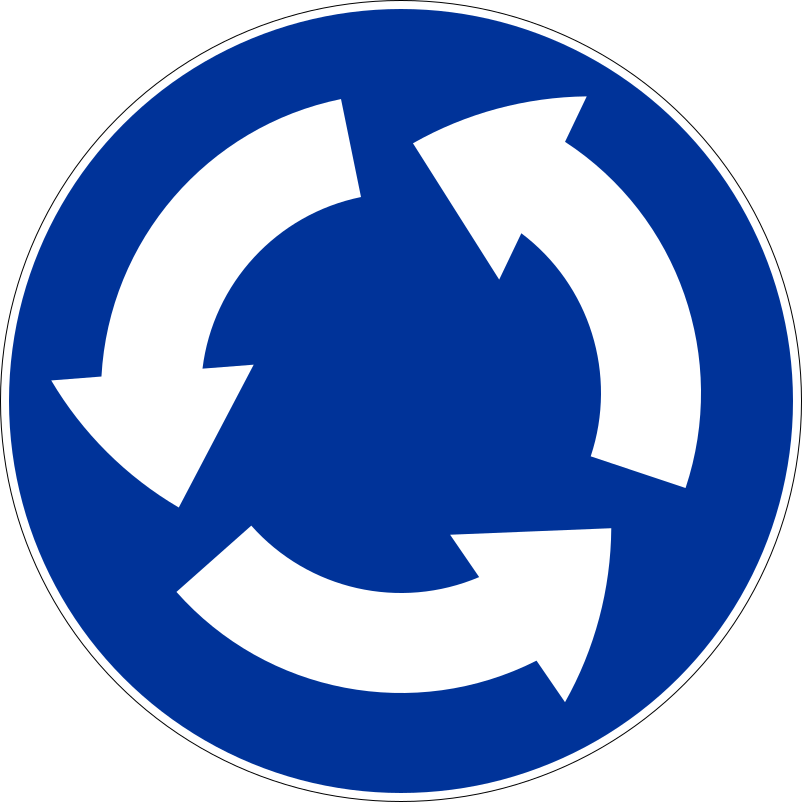
English • Traffic sign C-12 • Roundabout. Sign C-12 indicates that traffic at the junction circulates around an island or square in the direction shown.
Polski • C-12 • ruch okrężny. Znak C-12 „ruch okrężny” oznacza, że na skrzyżowaniu ruch odbywa się dookoła wyspy lub placu w kierunku wskazanym na znaku.
Quellen
🔗 Commons.wikimedia.org
🔗 Eli.gov.pl • § 36 ust. 1
SVG source: Commons.wikimedia.org • Original SVG
Paweł Grzywocz • Public domain • Original revision 2025-09-26. Wikimedia original unmodified.
Artwork reviewed against the Polish official sign catalogue, Dz.U. 2019 poz. 2310: Eli.gov.pl • C-12, PDF page 43, with amendments 2021/433, 2021/2065, 2022/2372 and 2026/133 checked. Catalogue-equivalent illustration; intentional update from the previous PNG. This is an educational illustration, not a manufacturing specification.
88. Linksabbiegen vorgeschrieben
Dieses Verkehrszeichen zeigt an, dass Linksabbiegen an der vorausliegenden Kreuzung vorgeschrieben ist. Der Verkehr muss nach links abbiegen und darf weder geradeaus weiterfahren noch nach rechts abbiegen.
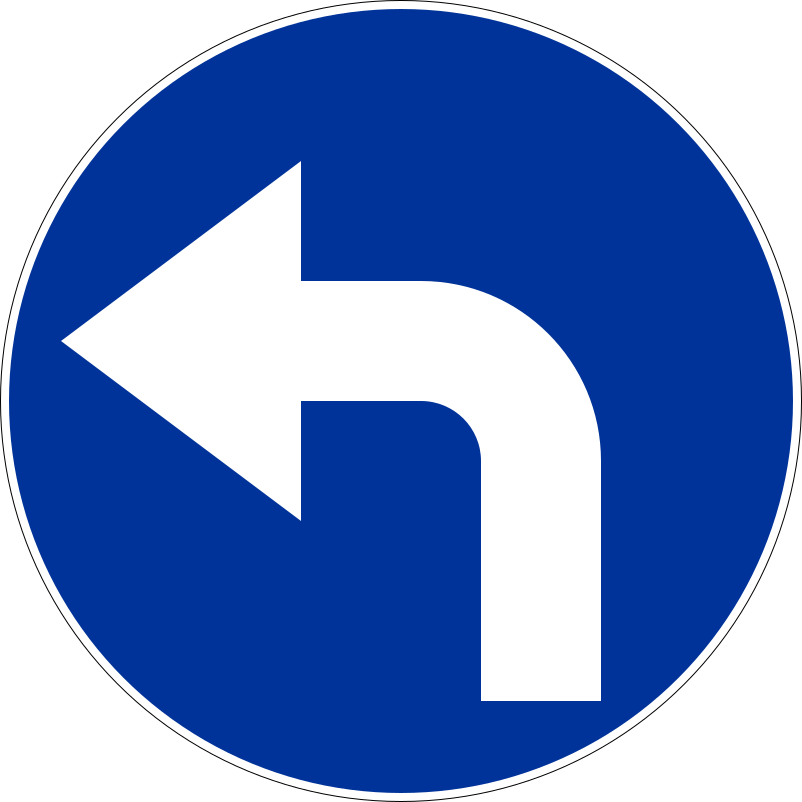
English • Traffic sign C-4 • Turn left after the sign. Signs C-1, Turn right before the sign; C-2, Turn right after the sign; C-3, Turn left before the sign; C-4, Turn left after the sign; C-5, Ahead only; C-6, Ahead or right only; C-7, Ahead or left only; C-8, Turn right or left; C-9, Pass to the right of the sign; C-10, Pass to the left of the sign; and C-11, Pass to either side of the sign, require drivers to follow the arrows. These signs may be installed in line with the road or carriageway centre line, or on the carriageway itself.
Polski • C-4 • nakaz jazdy w lewo za znakiem. Znaki: C-1 „nakaz jazdy w prawo przed znakiem”, C-2 „nakaz jazdy w prawo za znakiem”, C-3 „nakaz jazdy w lewo przed znakiem”, C-4 „nakaz jazdy w lewo za znakiem”, C-5 „nakaz jazdy prosto”, C-6 „nakaz jazdy prosto lub w prawo”, C-7 „nakaz jazdy prosto lub w lewo”, C-8 „nakaz jazdy w prawo lub w lewo”, C-9 „nakaz jazdy z prawej strony znaku”, C-10 „nakaz jazdy z lewej strony znaku”, C-11 „nakaz jazdy z prawej lub lewej strony znaku” zobowiązują kierującego do ruchu w kierunku zgodnym ze strzałkami; znaki te mogą być umieszczone na przedłużeniu osi drogi (jezdni) lub na samej jezdni.
Quellen
🔗 Commons.wikimedia.org
🔗 Eli.gov.pl • § 35 ust. 1
SVG source: Commons.wikimedia.org • Original SVG
Paweł Grzywocz • Public domain • Original revision 2025-09-26. Wikimedia original unmodified.
Artwork reviewed against the Polish official sign catalogue, Dz.U. 2019 poz. 2310: Eli.gov.pl • C-4, PDF page 43, with amendments 2021/433, 2021/2065, 2022/2372 and 2026/133 checked. Catalogue-equivalent illustration; intentional update from the previous PNG. This is an educational illustration, not a manufacturing specification.
89. Links- oder Rechtsabbiegen vorgeschrieben
Dieses Verkehrszeichen zeigt an, dass Links- oder Rechtsabbiegen an der vorausliegenden Kreuzung vorgeschrieben ist. Der Verkehr darf nach links oder rechts abbiegen, aber nicht geradeaus weiterfahren.

English • Traffic sign C-8 • Turn right or left. Signs C-1, Turn right before the sign; C-2, Turn right after the sign; C-3, Turn left before the sign; C-4, Turn left after the sign; C-5, Ahead only; C-6, Ahead or right only; C-7, Ahead or left only; C-8, Turn right or left; C-9, Pass to the right of the sign; C-10, Pass to the left of the sign; and C-11, Pass to either side of the sign, require drivers to follow the arrows. These signs may be installed in line with the road or carriageway centre line, or on the carriageway itself.
Polski • C-8 • nakaz jazdy w prawo lub w lewo. Znaki: C-1 „nakaz jazdy w prawo przed znakiem”, C-2 „nakaz jazdy w prawo za znakiem”, C-3 „nakaz jazdy w lewo przed znakiem”, C-4 „nakaz jazdy w lewo za znakiem”, C-5 „nakaz jazdy prosto”, C-6 „nakaz jazdy prosto lub w prawo”, C-7 „nakaz jazdy prosto lub w lewo”, C-8 „nakaz jazdy w prawo lub w lewo”, C-9 „nakaz jazdy z prawej strony znaku”, C-10 „nakaz jazdy z lewej strony znaku”, C-11 „nakaz jazdy z prawej lub lewej strony znaku” zobowiązują kierującego do ruchu w kierunku zgodnym ze strzałkami; znaki te mogą być umieszczone na przedłużeniu osi drogi (jezdni) lub na samej jezdni.
Quellen
🔗 Commons.wikimedia.org
🔗 Eli.gov.pl • § 35 ust. 1
SVG source: Commons.wikimedia.org • Original SVG
Paweł Grzywocz • Public domain • Original revision 2025-09-26. Wikimedia original unmodified.
Artwork reviewed against the Polish official sign catalogue, Dz.U. 2019 poz. 2310: Eli.gov.pl • C-8, PDF page 43, with amendments 2021/433, 2021/2065, 2022/2372 and 2026/133 checked. Catalogue-equivalent illustration; intentional update from the previous PNG. This is an educational illustration, not a manufacturing specification.
90. Rechtsabbiegen vorgeschrieben
Dieses Verkehrszeichen zeigt an, dass Rechtsabbiegen an der vorausliegenden Kreuzung vorgeschrieben ist. Der Verkehr muss nach rechts abbiegen und darf weder geradeaus weiterfahren noch nach links abbiegen.

English • Traffic sign C-2 • Turn right after the sign. Signs C-1, Turn right before the sign; C-2, Turn right after the sign; C-3, Turn left before the sign; C-4, Turn left after the sign; C-5, Ahead only; C-6, Ahead or right only; C-7, Ahead or left only; C-8, Turn right or left; C-9, Pass to the right of the sign; C-10, Pass to the left of the sign; and C-11, Pass to either side of the sign, require drivers to follow the arrows. These signs may be installed in line with the road or carriageway centre line, or on the carriageway itself.
Polski • C-2 • nakaz jazdy w prawo za znakiem. Znaki: C-1 „nakaz jazdy w prawo przed znakiem”, C-2 „nakaz jazdy w prawo za znakiem”, C-3 „nakaz jazdy w lewo przed znakiem”, C-4 „nakaz jazdy w lewo za znakiem”, C-5 „nakaz jazdy prosto”, C-6 „nakaz jazdy prosto lub w prawo”, C-7 „nakaz jazdy prosto lub w lewo”, C-8 „nakaz jazdy w prawo lub w lewo”, C-9 „nakaz jazdy z prawej strony znaku”, C-10 „nakaz jazdy z lewej strony znaku”, C-11 „nakaz jazdy z prawej lub lewej strony znaku” zobowiązują kierującego do ruchu w kierunku zgodnym ze strzałkami; znaki te mogą być umieszczone na przedłużeniu osi drogi (jezdni) lub na samej jezdni.
Quellen
🔗 Commons.wikimedia.org
🔗 Eli.gov.pl • § 35 ust. 1
SVG source: Commons.wikimedia.org • Original SVG
Paweł Grzywocz • Public domain • Original revision 2025-09-26. Wikimedia original unmodified.
Artwork reviewed against the Polish official sign catalogue, Dz.U. 2019 poz. 2310: Eli.gov.pl • C-2, PDF page 43, with amendments 2021/433, 2021/2065, 2022/2372 and 2026/133 checked. Catalogue-equivalent illustration; intentional update from the previous PNG. This is an educational illustration, not a manufacturing specification.
91. Hindernis links passieren
Dieses Verkehrszeichen zeigt an, dass der Verkehr ein Hindernis links passieren muss. Halten Sie sich links vom Hindernis und beachten Sie begleitende Verkehrszeichen oder Fahrbahnmarkierungen.

English • Traffic sign C-10 • Pass to the left of the sign. Signs C-1, Turn right before the sign; C-2, Turn right after the sign; C-3, Turn left before the sign; C-4, Turn left after the sign; C-5, Ahead only; C-6, Ahead or right only; C-7, Ahead or left only; C-8, Turn right or left; C-9, Pass to the right of the sign; C-10, Pass to the left of the sign; and C-11, Pass to either side of the sign, require drivers to follow the arrows. These signs may be installed in line with the road or carriageway centre line, or on the carriageway itself.
Polski • C-10 • nakaz jazdy z lewej strony znaku. Znaki: C-1 „nakaz jazdy w prawo przed znakiem”, C-2 „nakaz jazdy w prawo za znakiem”, C-3 „nakaz jazdy w lewo przed znakiem”, C-4 „nakaz jazdy w lewo za znakiem”, C-5 „nakaz jazdy prosto”, C-6 „nakaz jazdy prosto lub w prawo”, C-7 „nakaz jazdy prosto lub w lewo”, C-8 „nakaz jazdy w prawo lub w lewo”, C-9 „nakaz jazdy z prawej strony znaku”, C-10 „nakaz jazdy z lewej strony znaku”, C-11 „nakaz jazdy z prawej lub lewej strony znaku” zobowiązują kierującego do ruchu w kierunku zgodnym ze strzałkami; znaki te mogą być umieszczone na przedłużeniu osi drogi (jezdni) lub na samej jezdni.
Quellen
🔗 Commons.wikimedia.org
🔗 Eli.gov.pl • § 35 ust. 1
SVG source: Commons.wikimedia.org • Original SVG
odder • CC BY-SA 2.5 • Original revision 2025-09-26. Wikimedia original unmodified.
Artwork reviewed against the Polish official sign catalogue, Dz.U. 2019 poz. 2310: Eli.gov.pl • C-10, PDF page 43, with amendments 2021/433, 2021/2065, 2022/2372 and 2026/133 checked. Catalogue-equivalent illustration; intentional update from the previous PNG. This is an educational illustration, not a manufacturing specification.
92. Hindernis links oder rechts passieren
Dieses Verkehrszeichen zeigt an, dass der Verkehr ein Hindernis links oder rechts passieren muss. Benutzen Sie eine der zulässigen Seiten und beachten Sie die Straßenführung sowie begleitende Verkehrszeichen oder Markierungen.
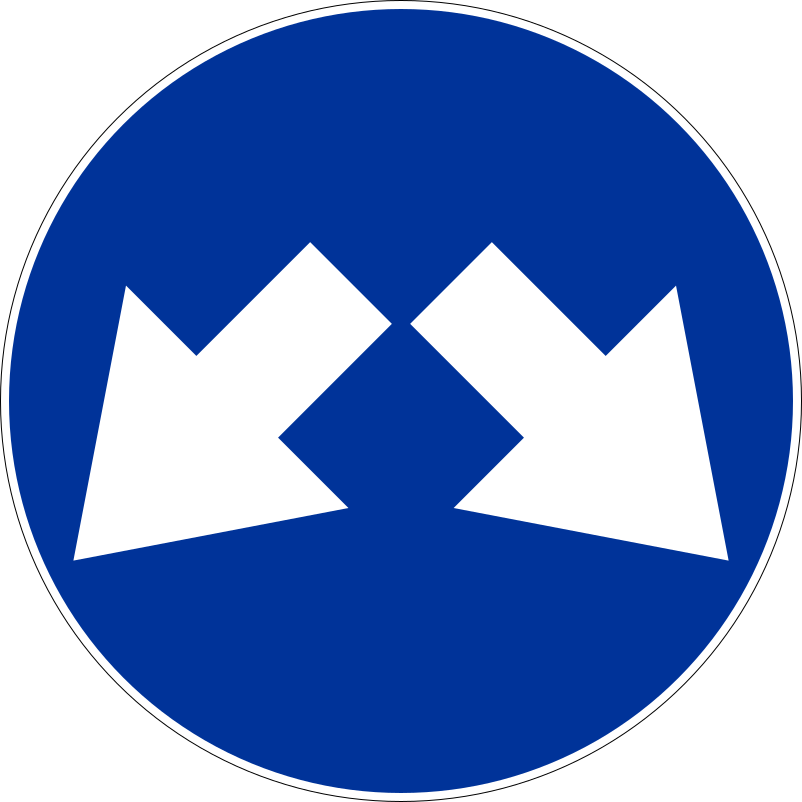
English • Traffic sign C-11 • Pass to either the right or left of the sign. Signs C-1, Turn right before the sign; C-2, Turn right after the sign; C-3, Turn left before the sign; C-4, Turn left after the sign; C-5, Ahead only; C-6, Ahead or right only; C-7, Ahead or left only; C-8, Turn right or left; C-9, Pass to the right of the sign; C-10, Pass to the left of the sign; and C-11, Pass to either side of the sign, require drivers to follow the arrows. These signs may be installed in line with the road or carriageway centre line, or on the carriageway itself.
Polski • C-11 • nakaz jazdy z prawej lub lewej strony znaku. Znaki: C-1 „nakaz jazdy w prawo przed znakiem”, C-2 „nakaz jazdy w prawo za znakiem”, C-3 „nakaz jazdy w lewo przed znakiem”, C-4 „nakaz jazdy w lewo za znakiem”, C-5 „nakaz jazdy prosto”, C-6 „nakaz jazdy prosto lub w prawo”, C-7 „nakaz jazdy prosto lub w lewo”, C-8 „nakaz jazdy w prawo lub w lewo”, C-9 „nakaz jazdy z prawej strony znaku”, C-10 „nakaz jazdy z lewej strony znaku”, C-11 „nakaz jazdy z prawej lub lewej strony znaku” zobowiązują kierującego do ruchu w kierunku zgodnym ze strzałkami; znaki te mogą być umieszczone na przedłużeniu osi drogi (jezdni) lub na samej jezdni.
Quellen
🔗 Commons.wikimedia.org
🔗 Eli.gov.pl • § 35 ust. 1
SVG source: Commons.wikimedia.org • Original SVG
Paweł Grzywocz • Public domain • Original revision 2025-09-26. Wikimedia original unmodified.
Artwork reviewed against the Polish official sign catalogue, Dz.U. 2019 poz. 2310: Eli.gov.pl • C-11, PDF page 43, with amendments 2021/433, 2021/2065, 2022/2372 and 2026/133 checked. Catalogue-equivalent illustration; intentional update from the previous PNG. This is an educational illustration, not a manufacturing specification.
93. Hindernis rechts passieren
Dieses Verkehrszeichen zeigt an, dass der Verkehr ein Hindernis rechts passieren muss. Halten Sie sich rechts vom Hindernis und beachten Sie begleitende Verkehrszeichen oder Fahrbahnmarkierungen.
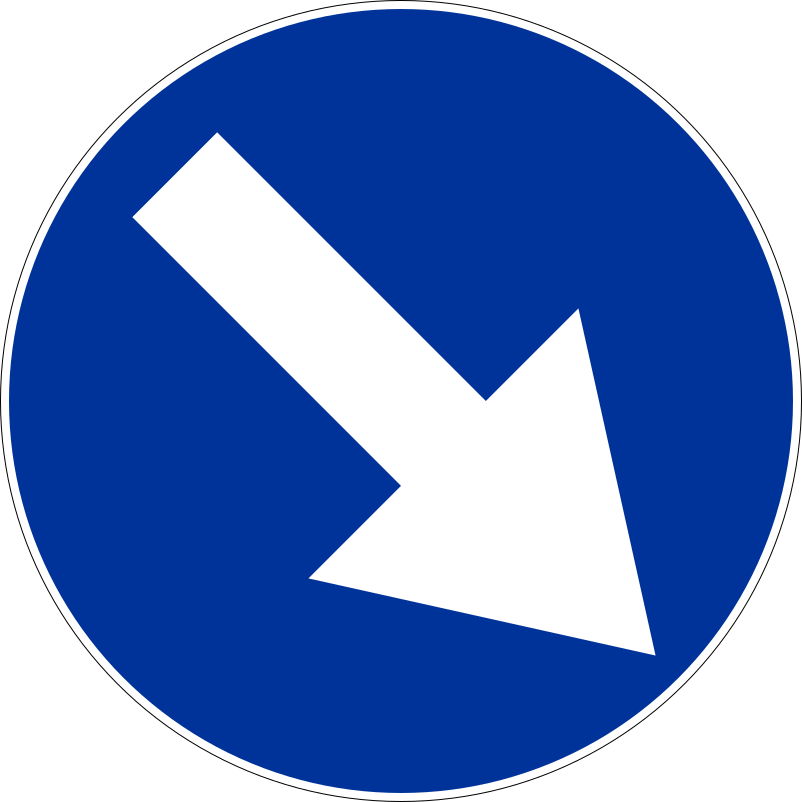
English • Traffic sign C-9 • Pass to the right of the sign. Signs C-1, Turn right before the sign; C-2, Turn right after the sign; C-3, Turn left before the sign; C-4, Turn left after the sign; C-5, Ahead only; C-6, Ahead or right only; C-7, Ahead or left only; C-8, Turn right or left; C-9, Pass to the right of the sign; C-10, Pass to the left of the sign; and C-11, Pass to either side of the sign, require drivers to follow the arrows. These signs may be installed in line with the road or carriageway centre line, or on the carriageway itself.
Polski • C-9 • nakaz jazdy z prawej strony znaku. Znaki: C-1 „nakaz jazdy w prawo przed znakiem”, C-2 „nakaz jazdy w prawo za znakiem”, C-3 „nakaz jazdy w lewo przed znakiem”, C-4 „nakaz jazdy w lewo za znakiem”, C-5 „nakaz jazdy prosto”, C-6 „nakaz jazdy prosto lub w prawo”, C-7 „nakaz jazdy prosto lub w lewo”, C-8 „nakaz jazdy w prawo lub w lewo”, C-9 „nakaz jazdy z prawej strony znaku”, C-10 „nakaz jazdy z lewej strony znaku”, C-11 „nakaz jazdy z prawej lub lewej strony znaku” zobowiązują kierującego do ruchu w kierunku zgodnym ze strzałkami; znaki te mogą być umieszczone na przedłużeniu osi drogi (jezdni) lub na samej jezdni.
Quellen
🔗 Commons.wikimedia.org
🔗 Eli.gov.pl • § 35 ust. 1
SVG source: Commons.wikimedia.org • Original SVG
odder • CC BY-SA 2.5 • Original revision 2025-09-26. Wikimedia original unmodified.
Artwork reviewed against the Polish official sign catalogue, Dz.U. 2019 poz. 2310: Eli.gov.pl • C-9, PDF page 43, with amendments 2021/433, 2021/2065, 2022/2372 and 2026/133 checked. Catalogue-equivalent illustration; intentional update from the previous PNG. This is an educational illustration, not a manufacturing specification.
94. Geradeausfahren oder Linksabbiegen vorgeschrieben
Dieses Verkehrszeichen zeigt an, dass der Verkehr geradeaus weiterfahren oder links abbiegen muss. Eine der angegebenen Richtungen muss gewählt werden; Rechtsabbiegen ist verboten.

English • Traffic sign C-7 • Ahead or left only. Signs C-1, Turn right before the sign; C-2, Turn right after the sign; C-3, Turn left before the sign; C-4, Turn left after the sign; C-5, Ahead only; C-6, Ahead or right only; C-7, Ahead or left only; C-8, Turn right or left; C-9, Pass to the right of the sign; C-10, Pass to the left of the sign; and C-11, Pass to either side of the sign, require drivers to follow the arrows. These signs may be installed in line with the road or carriageway centre line, or on the carriageway itself.
Polski • C-7 • nakaz jazdy prosto lub w lewo. Znaki: C-1 „nakaz jazdy w prawo przed znakiem”, C-2 „nakaz jazdy w prawo za znakiem”, C-3 „nakaz jazdy w lewo przed znakiem”, C-4 „nakaz jazdy w lewo za znakiem”, C-5 „nakaz jazdy prosto”, C-6 „nakaz jazdy prosto lub w prawo”, C-7 „nakaz jazdy prosto lub w lewo”, C-8 „nakaz jazdy w prawo lub w lewo”, C-9 „nakaz jazdy z prawej strony znaku”, C-10 „nakaz jazdy z lewej strony znaku”, C-11 „nakaz jazdy z prawej lub lewej strony znaku” zobowiązują kierującego do ruchu w kierunku zgodnym ze strzałkami; znaki te mogą być umieszczone na przedłużeniu osi drogi (jezdni) lub na samej jezdni.
Quellen
🔗 Commons.wikimedia.org
🔗 Eli.gov.pl • § 35 ust. 1
SVG source: Commons.wikimedia.org • Original SVG
Patrol110 • CC BY-SA 2.5 • Original revision 2025-09-26. Wikimedia original unmodified.
Artwork reviewed against the Polish official sign catalogue, Dz.U. 2019 poz. 2310: Eli.gov.pl • C-7, PDF page 43, with amendments 2021/433, 2021/2065, 2022/2372 and 2026/133 checked. Catalogue-equivalent illustration; intentional update from the previous PNG. This is an educational illustration, not a manufacturing specification.
95. Geradeausfahren oder Rechtsabbiegen vorgeschrieben
Dieses Verkehrszeichen zeigt an, dass der Verkehr geradeaus weiterfahren oder rechts abbiegen muss. Eine der angegebenen Richtungen muss gewählt werden; Linksabbiegen ist verboten.

English • Traffic sign C-6 • Ahead or right only. Signs C-1, Turn right before the sign; C-2, Turn right after the sign; C-3, Turn left before the sign; C-4, Turn left after the sign; C-5, Ahead only; C-6, Ahead or right only; C-7, Ahead or left only; C-8, Turn right or left; C-9, Pass to the right of the sign; C-10, Pass to the left of the sign; and C-11, Pass to either side of the sign, require drivers to follow the arrows. These signs may be installed in line with the road or carriageway centre line, or on the carriageway itself.
Polski • C-6 • nakaz jazdy prosto lub w prawo. Znaki: C-1 „nakaz jazdy w prawo przed znakiem”, C-2 „nakaz jazdy w prawo za znakiem”, C-3 „nakaz jazdy w lewo przed znakiem”, C-4 „nakaz jazdy w lewo za znakiem”, C-5 „nakaz jazdy prosto”, C-6 „nakaz jazdy prosto lub w prawo”, C-7 „nakaz jazdy prosto lub w lewo”, C-8 „nakaz jazdy w prawo lub w lewo”, C-9 „nakaz jazdy z prawej strony znaku”, C-10 „nakaz jazdy z lewej strony znaku”, C-11 „nakaz jazdy z prawej lub lewej strony znaku” zobowiązują kierującego do ruchu w kierunku zgodnym ze strzałkami; znaki te mogą być umieszczone na przedłużeniu osi drogi (jezdni) lub na samej jezdni.
Quellen
🔗 Commons.wikimedia.org
🔗 Eli.gov.pl • § 35 ust. 1
SVG source: Commons.wikimedia.org • Original SVG
odder • CC BY-SA 2.5 • Original revision 2025-09-26. Wikimedia original unmodified.
Artwork reviewed against the Polish official sign catalogue, Dz.U. 2019 poz. 2310: Eli.gov.pl • C-6, PDF page 43, with amendments 2021/433, 2021/2065, 2022/2372 and 2026/133 checked. Catalogue-equivalent illustration; intentional update from the previous PNG. This is an educational illustration, not a manufacturing specification.
96. Links fahren vorgeschrieben
Dieses Verkehrszeichen gibt eine vorgeschriebene Fahrtrichtung nach links an. Der Verkehr muss am Zeichen nach links fahren und darf weder geradeaus noch nach rechts weiterfahren.
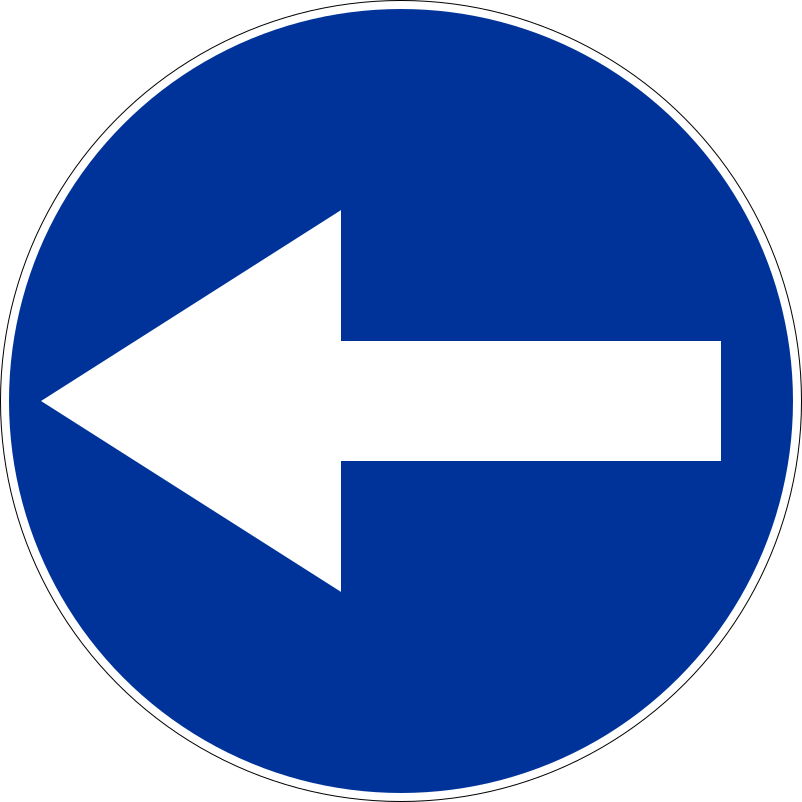
English • Traffic sign C-3 • Turn left before the sign. Signs C-1, Turn right before the sign; C-2, Turn right after the sign; C-3, Turn left before the sign; C-4, Turn left after the sign; C-5, Ahead only; C-6, Ahead or right only; C-7, Ahead or left only; C-8, Turn right or left; C-9, Pass to the right of the sign; C-10, Pass to the left of the sign; and C-11, Pass to either side of the sign, require drivers to follow the arrows. These signs may be installed in line with the road or carriageway centre line, or on the carriageway itself.
Polski • C-3 • nakaz jazdy w lewo przed znakiem. Znaki: C-1 „nakaz jazdy w prawo przed znakiem”, C-2 „nakaz jazdy w prawo za znakiem”, C-3 „nakaz jazdy w lewo przed znakiem”, C-4 „nakaz jazdy w lewo za znakiem”, C-5 „nakaz jazdy prosto”, C-6 „nakaz jazdy prosto lub w prawo”, C-7 „nakaz jazdy prosto lub w lewo”, C-8 „nakaz jazdy w prawo lub w lewo”, C-9 „nakaz jazdy z prawej strony znaku”, C-10 „nakaz jazdy z lewej strony znaku”, C-11 „nakaz jazdy z prawej lub lewej strony znaku” zobowiązują kierującego do ruchu w kierunku zgodnym ze strzałkami; znaki te mogą być umieszczone na przedłużeniu osi drogi (jezdni) lub na samej jezdni.
Quellen
🔗 Commons.wikimedia.org
🔗 Eli.gov.pl • § 35 ust. 1
SVG source: Commons.wikimedia.org • Original SVG
odder • CC BY-SA 2.5 • Original revision 2025-09-26. Wikimedia original unmodified.
Artwork reviewed against the Polish official sign catalogue, Dz.U. 2019 poz. 2310: Eli.gov.pl • C-3, PDF page 43, with amendments 2021/433, 2021/2065, 2022/2372 and 2026/133 checked. Catalogue-equivalent illustration; intentional update from the previous PNG. This is an educational illustration, not a manufacturing specification.
97. Rechts fahren vorgeschrieben
Dieses Verkehrszeichen gibt eine vorgeschriebene Fahrtrichtung nach rechts an. Der Verkehr muss am Zeichen nach rechts fahren und darf weder geradeaus noch nach links weiterfahren.
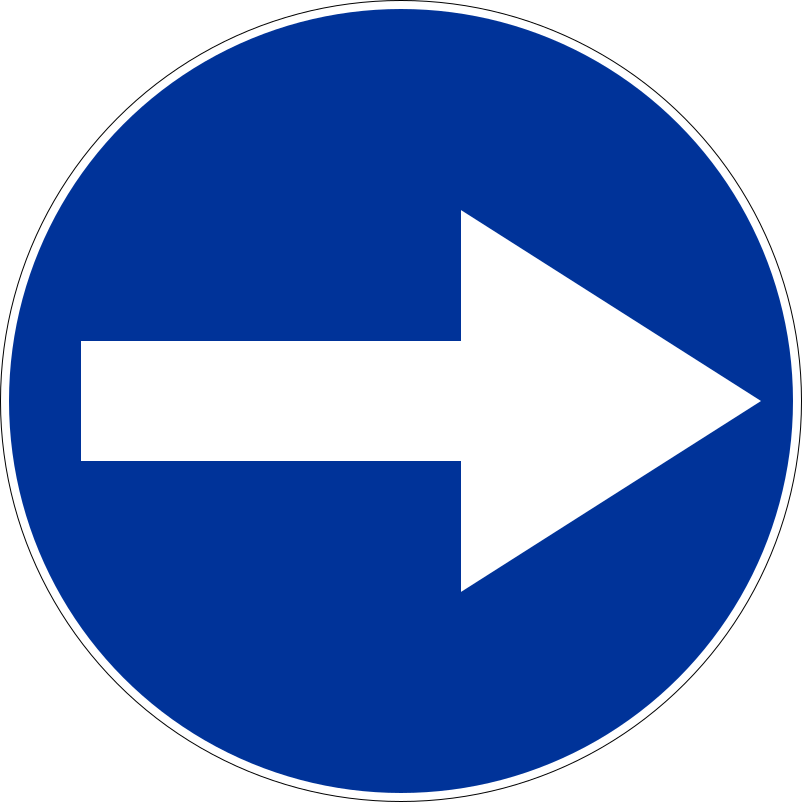
English • Traffic sign C-1 • Turn right before the sign. Signs C-1, Turn right before the sign; C-2, Turn right after the sign; C-3, Turn left before the sign; C-4, Turn left after the sign; C-5, Ahead only; C-6, Ahead or right only; C-7, Ahead or left only; C-8, Turn right or left; C-9, Pass to the right of the sign; C-10, Pass to the left of the sign; and C-11, Pass to either side of the sign, require drivers to follow the arrows. These signs may be installed in line with the road or carriageway centre line, or on the carriageway itself.
Polski • C-1 • nakaz jazdy w prawo przed znakiem. Znaki: C-1 „nakaz jazdy w prawo przed znakiem”, C-2 „nakaz jazdy w prawo za znakiem”, C-3 „nakaz jazdy w lewo przed znakiem”, C-4 „nakaz jazdy w lewo za znakiem”, C-5 „nakaz jazdy prosto”, C-6 „nakaz jazdy prosto lub w prawo”, C-7 „nakaz jazdy prosto lub w lewo”, C-8 „nakaz jazdy w prawo lub w lewo”, C-9 „nakaz jazdy z prawej strony znaku”, C-10 „nakaz jazdy z lewej strony znaku”, C-11 „nakaz jazdy z prawej lub lewej strony znaku” zobowiązują kierującego do ruchu w kierunku zgodnym ze strzałkami; znaki te mogą być umieszczone na przedłużeniu osi drogi (jezdni) lub na samej jezdni.
Quellen
🔗 Commons.wikimedia.org
🔗 Eli.gov.pl • § 35 ust. 1
SVG source: Commons.wikimedia.org • Original SVG
odder • CC BY-SA 2.5 • Original revision 2025-09-26. Wikimedia original unmodified.
Artwork reviewed against the Polish official sign catalogue, Dz.U. 2019 poz. 2310: Eli.gov.pl • C-1, PDF page 43, with amendments 2021/433, 2021/2065, 2022/2372 and 2026/133 checked. Catalogue-equivalent illustration; intentional update from the previous PNG. This is an educational illustration, not a manufacturing specification.
98. Geradeausfahren vorgeschrieben
Dieses Verkehrszeichen zeigt an, dass Geradeausfahren vorgeschrieben ist. Der Verkehr muss geradeaus weiterfahren und darf an der Stelle, für die das Zeichen gilt, weder links noch rechts abbiegen.

English • Traffic sign C-5 • Ahead only. Signs C-1, Turn right before the sign; C-2, Turn right after the sign; C-3, Turn left before the sign; C-4, Turn left after the sign; C-5, Ahead only; C-6, Ahead or right only; C-7, Ahead or left only; C-8, Turn right or left; C-9, Pass to the right of the sign; C-10, Pass to the left of the sign; and C-11, Pass to either side of the sign, require drivers to follow the arrows. These signs may be installed in line with the road or carriageway centre line, or on the carriageway itself.
Polski • C-5 • nakaz jazdy prosto. Znaki: C-1 „nakaz jazdy w prawo przed znakiem”, C-2 „nakaz jazdy w prawo za znakiem”, C-3 „nakaz jazdy w lewo przed znakiem”, C-4 „nakaz jazdy w lewo za znakiem”, C-5 „nakaz jazdy prosto”, C-6 „nakaz jazdy prosto lub w prawo”, C-7 „nakaz jazdy prosto lub w lewo”, C-8 „nakaz jazdy w prawo lub w lewo”, C-9 „nakaz jazdy z prawej strony znaku”, C-10 „nakaz jazdy z lewej strony znaku”, C-11 „nakaz jazdy z prawej lub lewej strony znaku” zobowiązują kierującego do ruchu w kierunku zgodnym ze strzałkami; znaki te mogą być umieszczone na przedłużeniu osi drogi (jezdni) lub na samej jezdni.
Quellen
🔗 Commons.wikimedia.org
🔗 Eli.gov.pl • § 35 ust. 1
SVG source: Commons.wikimedia.org • Original SVG
odder • CC BY-SA 2.5 • Original revision 2025-09-26. Wikimedia original unmodified.
Artwork reviewed against the Polish official sign catalogue, Dz.U. 2019 poz. 2310: Eli.gov.pl • C-5, PDF page 43, with amendments 2021/433, 2021/2065, 2022/2372 and 2026/133 checked. Catalogue-equivalent illustration; intentional update from the previous PNG. This is an educational illustration, not a manufacturing specification.
99. Vorgeschriebener Gehweg
Dieses Verkehrszeichen kennzeichnet den Beginn eines vorgeschriebenen Gehwegs. Fußgänger müssen den gekennzeichneten Weg benutzen; andere Verkehrsteilnehmer dürfen ihn nur benutzen, wenn dies durch Verkehrszeichen oder örtliche Regeln erlaubt ist.
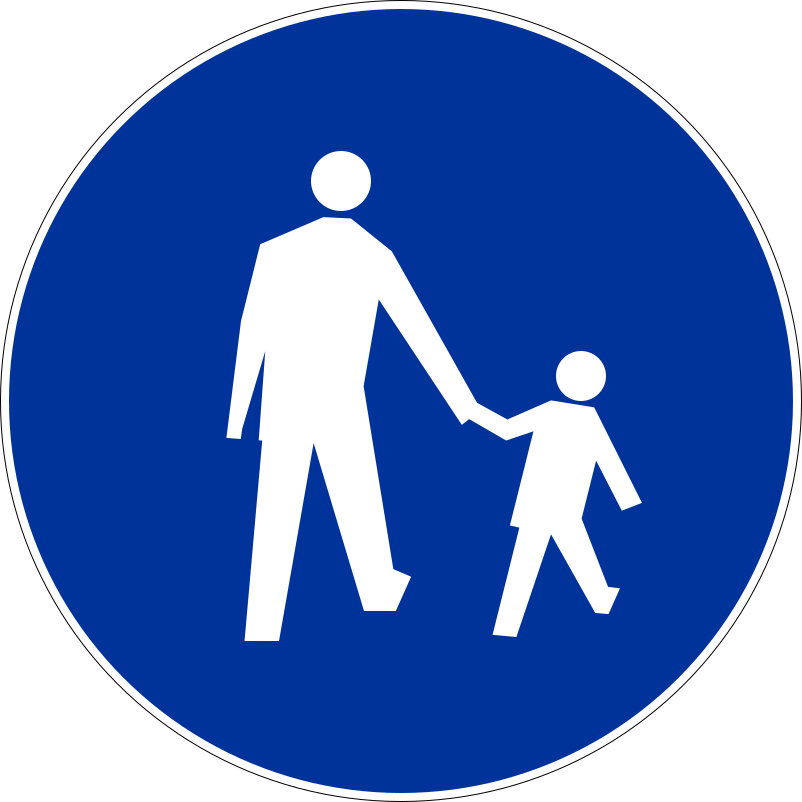
English • Traffic sign C-16 • Pedestrian route. Sign C-16 identifies a road or part of it intended for pedestrians, who must use it. Under subsection 1a, the requirement applies until cancelled or until sign B-41, C-13 or D-40.
Polski • C-16 • droga dla pieszych. Znak C-16 „droga dla pieszych” oznacza drogę lub jej część przeznaczoną dla pieszych, którzy są obowiązani z niej korzystać. 1a. Nakaz wyrażony znakiem C-16 obowiązuje do odwołania albo do miejsca umieszczenia znaku B-41, C-13 albo D-40.
Quellen
🔗 Commons.wikimedia.org
🔗 Eli.gov.pl • § 39 ust. 1
SVG source: Commons.wikimedia.org • Original SVG
Paweł Grzywocz • Public domain • Original revision 2025-09-26. Wikimedia original unmodified.
Artwork reviewed against the Polish official sign catalogue, Dz.U. 2019 poz. 2310: Eli.gov.pl • C-16, PDF page 43, with amendments 2021/433, 2021/2065, 2022/2372 and 2026/133 checked. Catalogue-equivalent illustration; intentional update from the previous PNG. This is an educational illustration, not a manufacturing specification.
100. Ende des vorgeschriebenen Gehwegs
Dieses Verkehrszeichen kennzeichnet das Ende des vorgeschriebenen Gehwegs. Die Benutzungspflicht endet an dieser Stelle. Fußgänger müssen entsprechend dem anschließenden Weg- oder Straßenverlauf und den örtlich geltenden Regeln weitergehen.
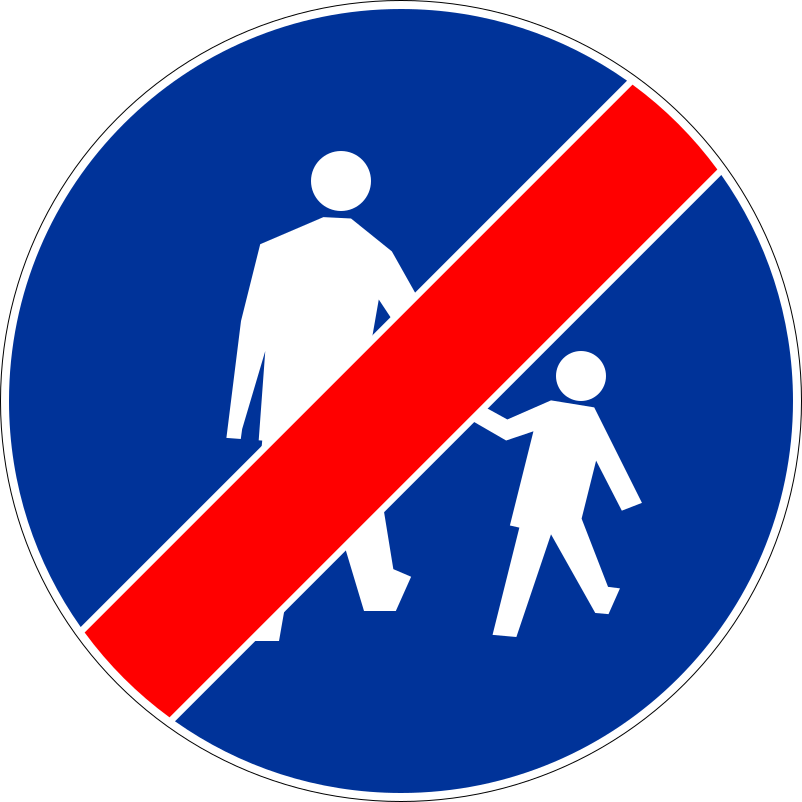
English • Traffic sign C-16a • End of the pedestrian route. Sign C-16a marks the end of a road intended for pedestrians.
Polski • C-16a • koniec drogi dla pieszych. Znak C-16a „koniec drogi dla pieszych” oznacza koniec drogi przeznaczonej dla pieszych.
Quellen
🔗 Commons.wikimedia.org
🔗 Eli.gov.pl • § 39 ust. 2
SVG source: Commons.wikimedia.org • Original SVG
Paweł Grzywocz • Public domain • Original revision 2025-09-26. Wikimedia original unmodified.
Artwork reviewed against the Polish official sign catalogue, Dz.U. 2019 poz. 2310: Eli.gov.pl • C-16a, PDF page 43, with amendments 2021/433, 2021/2065, 2022/2372 and 2026/133 checked. Catalogue-equivalent illustration; intentional update from the previous PNG. This is an educational illustration, not a manufacturing specification.