


Priority signsArgentina
 Traffic rules
 Argentina
 Priority signs
 Warning signs
 Prohibitory signs
 Mandatory signs
 Information signs
Priority signs
A priority sign is a traffic sign that indicates the order in which vehicles shall pass intersection points. Vehicles often come into conflict with other vehicles and pedestrians because their intended courses of travel intersect, and thus interfere with each other's routes. The general principle that establishes who has the right to go first is called 'right of way' or 'priority'. It establishes who has the right to use the conflicting part of the road and who has to wait until the other does so. The vehicle that does not need to wait is said to 'have the right of way' or to 'have priority.'

What should I know about priority signs in Argentina?
PARE and CEDA EL PASO are distinct controls. PARE requires stopping; yielding remains necessary before proceeding.
Must you always stop when giving way in Argentina?
No. A give-way control requires stopping when necessary to yield or obtain a safe view. A stop sign requires a complete stop even if the road appears empty.

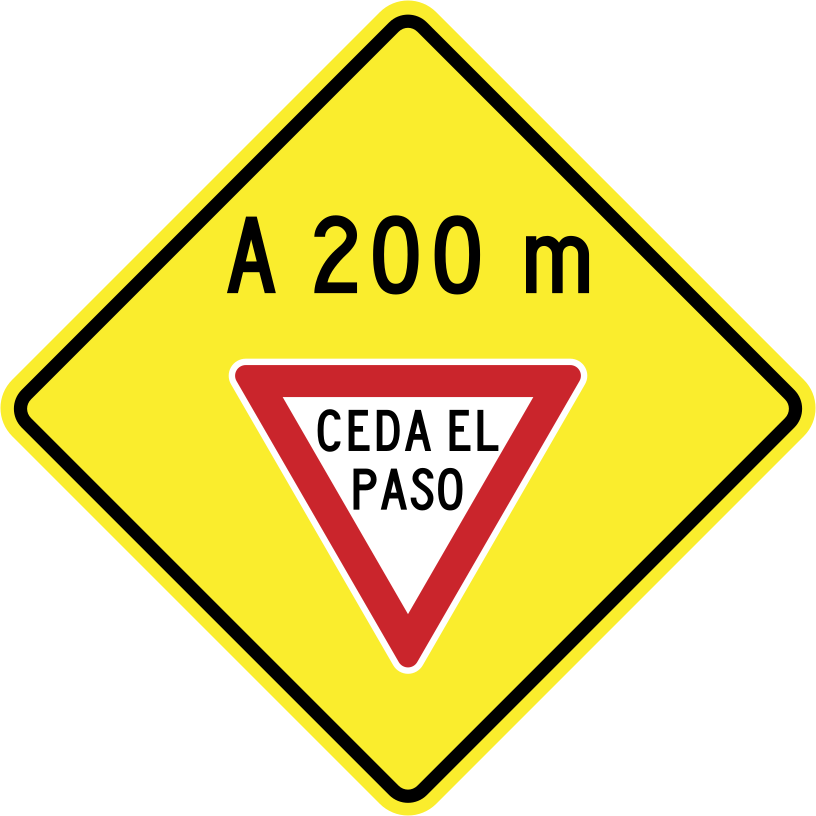
1. Give way ahead
This traffic sign indicates give way ahead. A give-way requirement applies at the location ahead. Reduce speed in good time and be prepared to stop if necessary.
English • Traffic sign P-33(b) · family • Give way in 200 m. Prepare to give priority to traffic on the intersecting road. The drawing matches the DNV 2017 manual, which includes the Give way wording. The text of Annex L replaced in 2025 describes the advance version without that wording.
Español • P-33(b) · familia • Ceda el paso a 200 m. Advierte que a 200 metros hay una señal Ceda el paso. Prepárate para ceder la prioridad al tránsito de la vía transversal. El dibujo coincide con el manual DNV de 2017, que incluye la leyenda Ceda el paso. El texto del Anexo L sustituido en 2025 describe la variante anticipada sin esa leyenda.
Sources
🔗 Commons.wikimedia.org (มองโกเลีย๔๔ • CC BY-SA 4.0)
🔗 Servicios.infoleg.gob.ar • Anexo L vigente, sustituido por Decreto 196/2025, P.33
🔗 Servicios.infoleg.gob.ar • Anexo L 2025, lámina 08 • ANSV, manual de señales, PDF p. 10
🔗 Argentina.gob.ar • DNV, Manual de Señalamiento Vertical 2017, PDF p. 206
SVG source: มองโกเลีย๔๔ • CC BY-SA 4.0 • Original revision 2023-09-13. Wikimedia original unmodified.
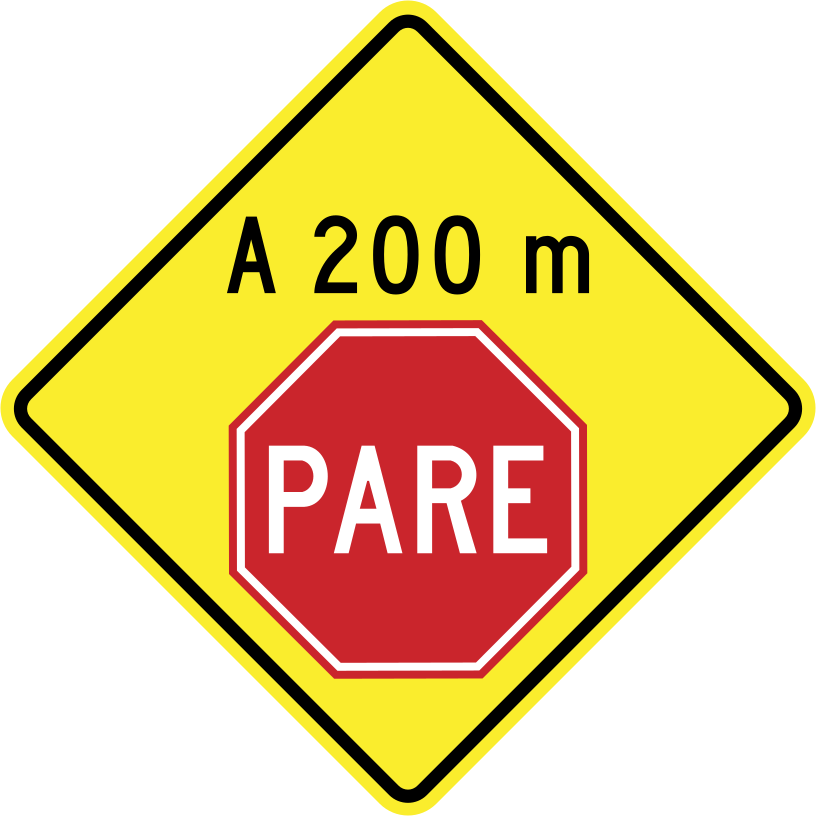
2. Stop and give way ahead
This traffic sign indicates stop and give way ahead. A stop sign applies at the location ahead. Reduce speed in good time and be prepared to come to a complete stop.
English • Traffic sign P-33(a) • Stop in 200 m. Prepare to stop the vehicle completely at that sign.
Español • P-33(a) • Pare a 200 m. Advierte que a 200 metros hay una señal Pare. Prepárate para detener completamente el vehículo ante esa señal.
Sources
🔗 Commons.wikimedia.org (มองโกเลีย๔๔ • CC BY-SA 4.0)
🔗 Servicios.infoleg.gob.ar • Anexo L vigente, sustituido por Decreto 196/2025, P.33
🔗 Servicios.infoleg.gob.ar • Anexo L 2025, lámina 08 • ANSV, manual de señales, PDF p. 10
SVG source: มองโกเลีย๔๔ • CC BY-SA 4.0 • Original revision 2023-09-13. Wikimedia original unmodified.
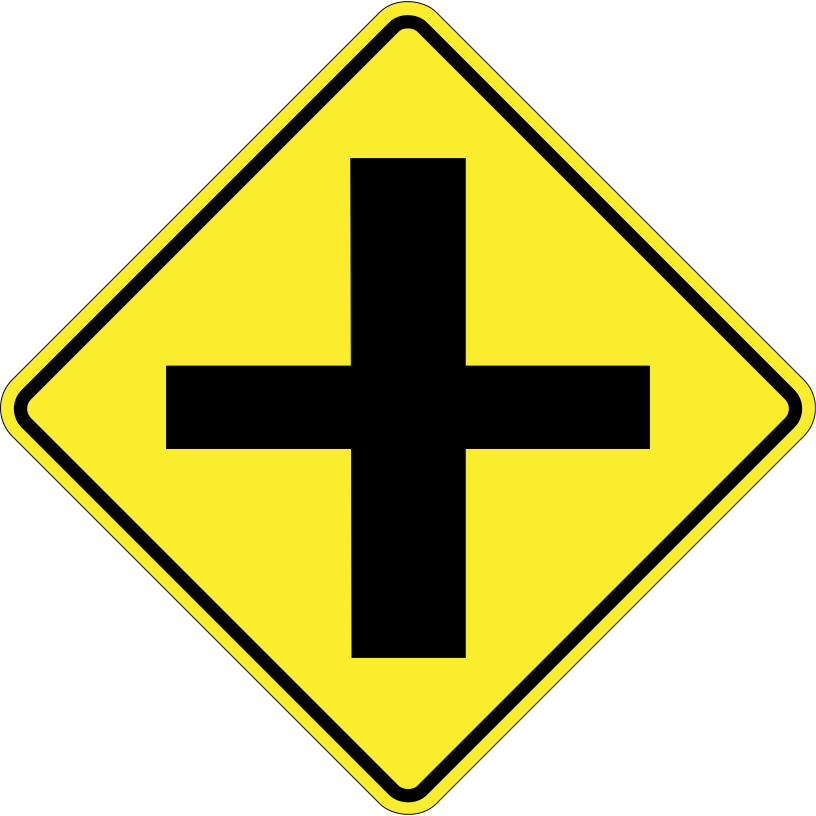
3. Warning for an uncontrolled crossroad
This traffic sign indicates a warning for an uncontrolled crossroad. An intersection without traffic signals or signs assigning priority lies ahead. Reduce speed, watch for traffic approaching from other directions and follow the applicable local priority rules.
English • Traffic sign P-24(a) • Crossroads. Warns of a four-arm junction. Reduce speed and watch crossing traffic.
Español • P-24(a) • Encrucijada: cruce. Advierte una intersección de cuatro ramales. Reduce la velocidad y observa el tránsito transversal.
Sources
🔗 Commons.wikimedia.org
🔗 Servicios.infoleg.gob.ar • Anexo L vigente, sustituido por Decreto 196/2025, P.24
🔗 Servicios.infoleg.gob.ar • Anexo L 2025, lámina 07 • ANSV, manual de señales, PDF p. 8
SVG source: Original: Vialidad Nacional - Ministerio de Transporte - Presidencia de la Nación Vectorization: Civitas13 • Public domain • Original revision 2020-01-14. Wikimedia original unmodified.
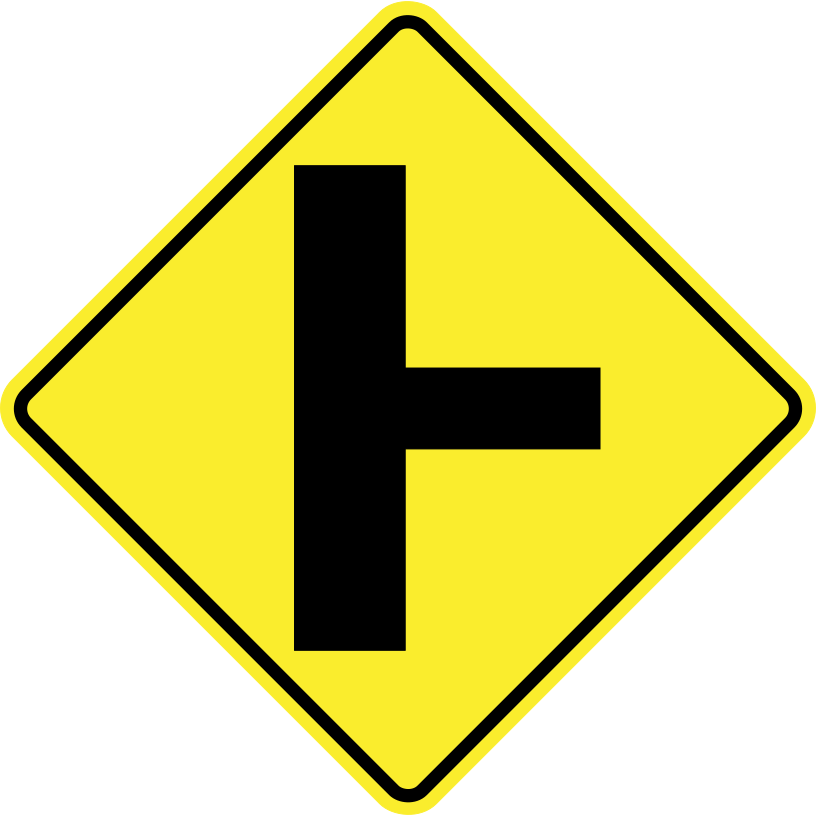
4. Warning for a side road from the right
This traffic sign indicates a warning for a side road from the right. A side road joins the road ahead from the right at an uncontrolled junction. Reduce speed, watch for traffic entering from the side road and follow the applicable default priority rules.
English • Traffic sign P-24(b) • Junction — side road on the right. Watch for traffic entering from that side.
Español • P-24(b) • Encrucijada: empalme por la derecha. Advierte que una vía lateral se une por la derecha. Presta atención al tránsito que puede ingresar desde ese lado.
Sources
🔗 Commons.wikimedia.org
🔗 Servicios.infoleg.gob.ar • Anexo L vigente, sustituido por Decreto 196/2025, P.24
🔗 Servicios.infoleg.gob.ar • Anexo L 2025, lámina 07 • ANSV, manual de señales, PDF p. 8
SVG source: Original: Vialidad Nacional - Ministerio de Transporte - Presidencia de la Nación Vectorization: Civitas13 • Public domain • Original revision 2020-01-14. Wikimedia original unmodified.
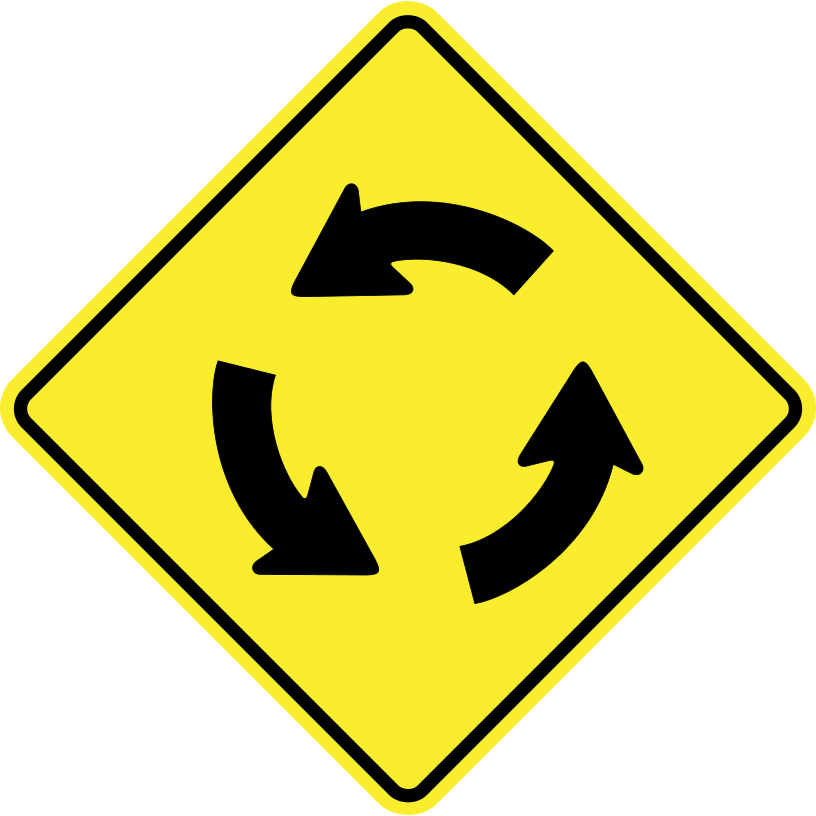
5. Warning for a roundabout
This traffic sign indicates a warning for a roundabout. A roundabout lies ahead. Reduce speed and follow the applicable priority signs, traffic signals and local roundabout rules when approaching and entering it.
English • Traffic sign P-21 • Roundabout. Keep the centre on your left and observe the applicable priorities.
Español • P-21 • Rotonda. Advierte la proximidad de una rotonda. Circula dejando la parte central a tu izquierda y respeta las prioridades aplicables.
Sources
🔗 Commons.wikimedia.org
🔗 Servicios.infoleg.gob.ar • Anexo L vigente, sustituido por Decreto 196/2025, P.21
🔗 Servicios.infoleg.gob.ar • Anexo L 2025, lámina 07 • ANSV, manual de señales, PDF p. 8
SVG source: Original: Vialidad Nacional - Ministerio de Transporte - Presidencia de la Nación Vectorization: Civitas13 • Public domain • Original revision 2022-08-06. Wikimedia original unmodified.
6. Road narrowing, give way to oncoming drivers
This traffic sign indicates a road narrowing where you must give way to oncoming traffic. Allow approaching traffic to pass before entering or continuing through the narrow section when required.
English • Traffic sign R-26 • Two-way traffic begins. From the signed junction onwards, traffic travels both ways. Stay on your side of the carriageway.
Español • R-26 • Comienzo de doble mano. A partir de la encrucijada señalizada, la vía tiene circulación en ambos sentidos. Mantente en tu lado de la calzada.
Sources
🔗 Commons.wikimedia.org
🔗 Servicios.infoleg.gob.ar • Anexo L vigente, sustituido por Decreto 196/2025, R.26
🔗 Servicios.infoleg.gob.ar • Anexo L 2025, lámina 04 • ANSV, manual de señales, PDF p. 4
SVG source: Commons.wikimedia.org • Original SVG
Gobierno de la República Argentina • Public domain • Original revision 2014-10-26. Wikimedia original unmodified.
Artwork individually reviewed against current Argentinian Argentina.gob.ar • Annex L, substituted by Decreto 196/2025:
🔗 Argentina.gob.ar • Annex III plate 04, R-26. Supporting ANSV manual, PDF page 4. Intentional educational illustration update from the previous PNG; original SVG unmodified.
