


Shared-use pathCanada
 Traffic rules
 Canada
1. Shared-use path
A shared-use path is a path or part of a road intended for use by both pedestrians and cyclists. Unlike facilities where pedestrians and cyclists have clearly separated sections, users of a shared-use path normally travel within the same general space.
Because users may travel at very different speeds, cyclists should approach pedestrians carefully, adapt their speed and leave sufficient space when passing. The permitted users, priority rules and any speed restrictions depend on the local traffic signs and regulations.
Does Canada have one cycling rule for every shared park path?
Check the applicable province, municipality and park controls. For example, Toronto’s Parks Code prohibits bicycle use where signs prohibit it and sets conduct and speed rules. These municipal rules should not be treated as a single rule for every Canadian trail.
🔗 toronto.ca • Toronto By-law1482-2025 — parks amendments
🔗 toronto.ca • Toronto By-law1150-2026 — offences/fines amendment effective1September2026
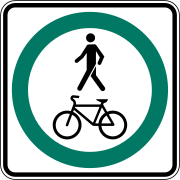 Mandatory shared pedestrian and cycle path.
English • Québec P-120-11 • Compulsory shared route for pedestrians and cyclists. Pedestrians and cyclists must use the indicated shared route together. There is no left/right separation shown.
Sources
🔗 Commons.wikimedia.org
🔗 Rsr.transports.gouv.qc.ca • Québec MTMD · Road sign directory, indexed sign description
SVG source: Transports Québec • Public domain • Original revision 2013-09-26. Wikimedia original unmodified.
How must cyclists treat walkers on shared routes in Toronto parks?
The Parks Code prohibits riding in a way that obstructs, inconveniences or endangers other park users. A shared route remains available to walkers. Adjust your riding to the people present, rather than relying only on the maximum speed.
🔗 toronto.ca • Toronto By-law1482-2025 — parks amendments
🔗 toronto.ca • Toronto By-law1150-2026 — offences/fines amendment effective1September2026
What is the maximum cycling speed in Toronto parks?
The Parks Code sets a maximum of 20 km/h for bicycles and the other listed vehicles and devices. This is a Toronto park rule, not a Canada-wide shared-path limit. Conditions and other users can require a lower speed.
🔗 toronto.ca • Toronto By-law1482-2025 — parks amendments
🔗 toronto.ca • Toronto By-law1150-2026 — offences/fines amendment effective1September2026

