


Traffic rulesIceland
 Traffic rules
 Iceland
1. Iceland
Iceland is a Nordic island country in the North Atlantic, close to the Arctic Circle and geographically separated from mainland Europe. Traffic drives on the right, but driving conditions can change quickly because of strong winds, snow, ice and rapidly changing weather. Outside Reykjavík and other towns, drivers may encounter long stretches of open road, gravel surfaces, narrow roads and single-lane bridges. The mountainous interior is reached by seasonal highland routes, including rough F-roads that may require four-wheel-drive vehicles and can remain closed well into summer.
Icelandic is the official language and is used for place names and most text on road signs. The Icelandic alphabet includes distinctive letters such as ð, þ and æ, which foreign drivers may notice on destination signs. Two rules are particularly important when exploring the country: legally required driving lights must remain on whenever a motor vehicle is being driven, and driving away from authorised roads or tracks is generally prohibited because off-road driving can cause lasting damage to Iceland's fragile landscape.
AI-generated by Rijbewijs-online.be • WCIT • CC BY-SA
Which side of the road do you drive on in Iceland?
Drive on the right and normally overtake on the left.
Which emergency number should you call in Iceland?
Call 112 for police, ambulance, fire, search-and-rescue or other emergency assistance.
What is the legal alcohol limit for drivers in Iceland?
Icelandic traffic law considers a driver with a blood-alcohol concentration of 0.2‰ (0.2 g/l) or more unable to drive safely. The safest rule is therefore not to drink any alcohol before driving.
What is the general speed limit in Icelandic built-up areas?
The general maximum speed in built-up areas is 50 km/h, unless signs indicate another limit. Lower limits are common in residential areas.
What is the general speed limit on gravel roads outside built-up areas in Iceland?
The general maximum speed on gravel roads outside built-up areas is 80 km/h, unless signs indicate another limit.
What is the general speed limit on paved roads outside built-up areas in Iceland?
The general maximum speed on paved roads outside built-up areas is 90 km/h, unless signs indicate another limit. Icelandic law allows higher signed limits of up to 110 km/h on suitable roads where opposing traffic directions are separated.
Do you need a motorway vignette or pay road tolls in Iceland?
Iceland has no nationwide motorway vignette and most roads are toll-free. The Vaðlaheiði Tunnel is tolled, and the Ring Road through Hornafjörður has also been subject to a toll since 1 September 2026.
Must cars use lights during the day in Iceland?
Yes. The legally required driving lights must always be switched on while a motor vehicle is being driven, including during daylight.
When may studded tyres be used in Iceland?
Studded tyres are generally permitted from 1 November to 15 April. They may also be used outside that period when road conditions require them. Drivers are responsible for ensuring that their vehicle and tyres are suitable for the conditions.
Are seat belts mandatory in Iceland?
Seat belts are mandatory for everyone occupying a seat equipped with one while the vehicle is moving.
When must children use a child restraint in Iceland?
A child shorter than 135 cm must use an approved child seat, booster or other suitable restraint appropriate for the child's size.
Can a child sit in front of an active airbag in Iceland?
A child shorter than 150 cm may not sit in a front seat with an active frontal airbag. The airbag must be deactivated before the child may use that seat.
Who must wear a helmet in Iceland?
Motorcycle and off-road-vehicle riders and passengers must wear an approved protective helmet. Children younger than 16 must also wear a helmet when cycling or using a small powered personal vehicle.
Can you use a mobile phone while driving in Iceland?
A driver may not use a mobile phone, smart device or other distracting electronic equipment while driving without hands-free equipment.
When must you give way to traffic approaching from the right in Iceland?
At an intersection where priority is not otherwise regulated, a driver must generally give way to traffic approaching from the right. Signs and other specific priority rules can override this rule.
Who has priority at roundabouts in Iceland?
Drivers entering a roundabout must give way to traffic already circulating. In a two-lane roundabout, a driver taking the first exit should use the outer lane, and a driver in the outer lane must give way to a driver leaving the roundabout from the inner lane. Drivers may not change between the inner and outer lanes while circulating in the roundabout.
What must drivers do at pedestrian crossings in Iceland?
At an uncontrolled pedestrian crossing, drivers must give pedestrians who are on or entering the crossing the opportunity to cross safely and must stop when necessary.
How much space must drivers leave when overtaking cyclists in Iceland?
When overtaking a cyclist or light moped, drivers must leave a lateral distance of at least 1.5 metres.
What is the speed limit in an Icelandic residential street?
In a designated vistgata, or residential traffic-calmed street, the maximum speed is 15 km/h. Drivers must give particular consideration and priority to pedestrians.
Who has priority on a narrow Icelandic road or single-lane bridge?
Where a road is too narrow for two vehicles to pass safely, the driver who arrives first generally has priority. The later-arriving driver should stop, pull aside or reverse where possible. Drivers should still follow any signs controlling priority at a particular bridge or narrow section.
Can you drive an ordinary car on Icelandic F-roads?
It depends on the road. Some highland routes can be used by general traffic during summer, but many are extremely rough and may include unbridged rivers. Roads classified as F2 require suitable four-wheel-drive vehicles, while F3 routes are intended only for large, well-equipped four-wheel-drive vehicles or superjeeps. Always check current road conditions and vehicle-rental restrictions before entering the highlands.
When do Icelandic highland roads open?
There is no fixed opening date. Mountain roads remain closed until snow, thawing ground and other conditions allow them to carry traffic without damage. Some routes do not open until late June or July and may be accessible for only a short part of the year.
Is off-road driving allowed in Iceland?
Driving off authorised roads and tracks is generally prohibited. Iceland's vegetation and volcanic surfaces can be extremely fragile, and vehicle tracks may cause long-lasting damage.
What do red and amber traffic lights mean in Iceland?
Red means stop. A steady amber light also means stop unless the vehicle is already so close to the signal that stopping would create a danger.
What should you do if your vehicle breaks down on an Icelandic road?
If a vehicle stops involuntarily on the carriageway, use the hazard warning lights where possible and always place a warning triangle to warn approaching traffic.

2. Motorway
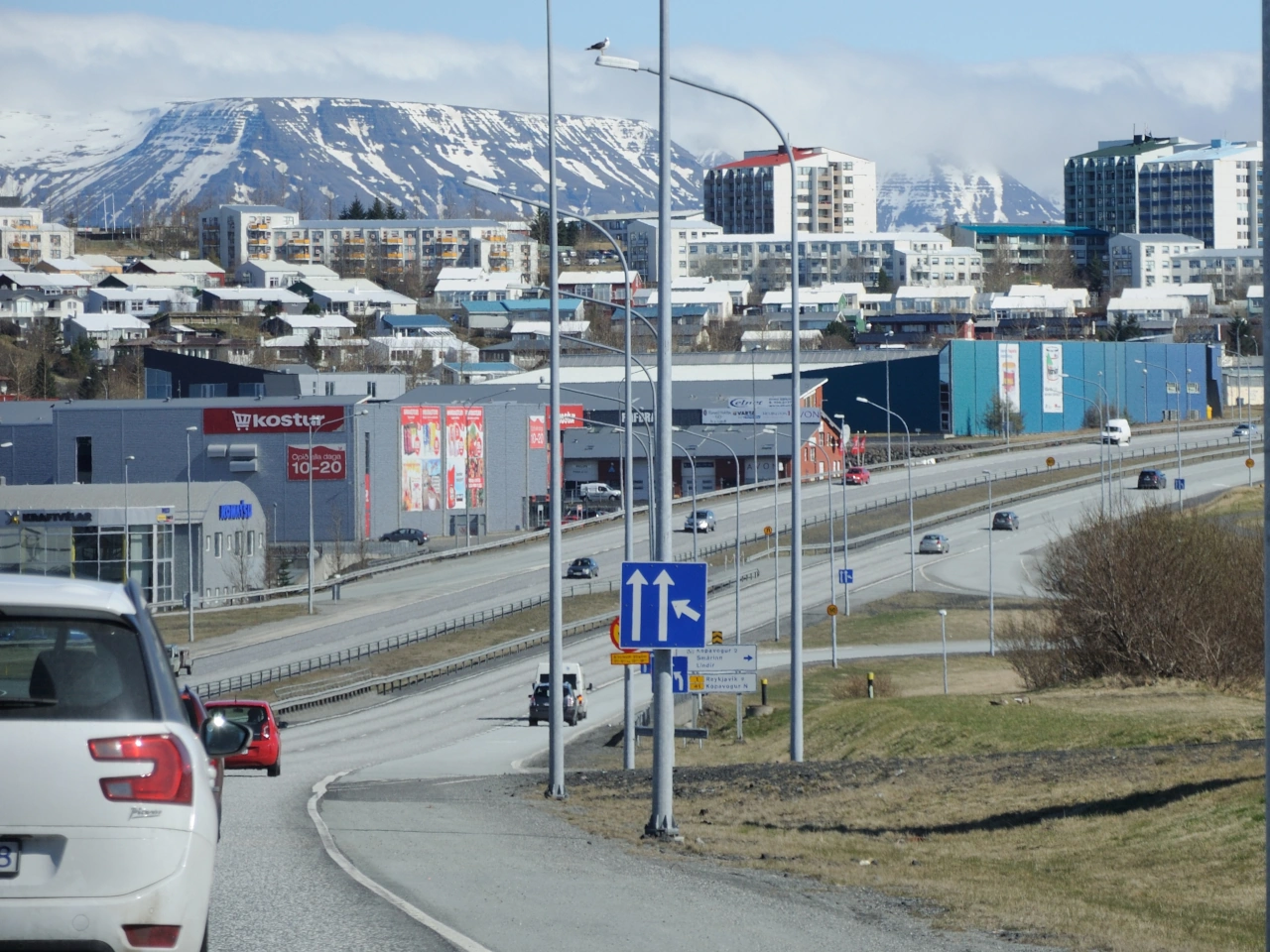
A motorway is a road specially designed and signposted for motor traffic. Motorways normally have separate carriageways for opposing traffic, controlled access through designated entrances and exits, no direct access to neighbouring properties, and no level crossings with other roads, railways or paths.
Special traffic rules apply on motorways. The permitted road users, speed limits, lane rules, tolls and emergency procedures vary between countries, so drivers must follow the local traffic signs and regulations.
Wikimedia.org • Hansueli Krapf • CC BY-SA
How can you recognise a motorway?
A motorway is normally identified by a special motorway sign at its entrance. It commonly has separate carriageways, controlled entrances and exits, and no ordinary intersections or direct access to neighbouring properties.
Who may use a motorway?
Motorways are primarily intended for motor vehicles capable of travelling safely at motorway speeds. Pedestrians, cyclists, animals and certain slow vehicles are generally prohibited, but the exact access requirements differ between countries.
What is the speed limit on a motorway?
There is no universal motorway speed limit. The applicable limit depends on the country, road section, vehicle category and driving conditions. Posted or variable speed-limit signs may replace the general national limit.
How should you enter a motorway?
Use the entrance or acceleration lane to observe motorway traffic and adjust your speed where possible. Enter only when there is a safe gap and follow the local priority and merging rules.
How should you leave a motorway?
Move into the correct lane in good time and signal when required. Enter the exit or deceleration lane before reducing your speed, unless traffic, signs or road conditions require you to slow down earlier.
Which lane should you use on a motorway?
Follow the local keep-left or keep-right rule and any lane-direction signs. Lanes closer to the centre of the motorway are commonly used for overtaking, but lane-use rules differ between countries and vehicle categories.
Can you stop on a motorway?
Voluntary stopping and parking are normally permitted only in designated parking or service areas. Drivers may still have to stop because of congestion, an emergency or another unavoidable situation.
Can you reverse or make a U-turn on a motorway?
Reversing, making a U-turn and driving against the direction of traffic are generally prohibited. If you miss an exit, continue to the next suitable exit.
What should you do if your vehicle breaks down?
Move the vehicle out of the traffic lanes when this can be done safely, activate the hazard warning lights and follow the local breakdown procedures. Leave the vehicle safely, keep away from moving traffic and use a warning triangle or safety vest where required by local law.
What is the difference between a motorway and an expressway?
A motorway normally has the highest level of access control and is governed by specific motorway rules. An expressway may have similar characteristics but may permit different road users or contain lower-standard junctions. The legal distinction varies between countries.
3. Speed limit
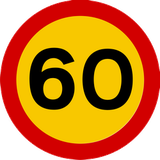
A speed limit is the maximum legal speed permitted on a road, lane or within a designated area. It may be established by general traffic law or indicated by fixed, variable or temporary traffic signs.
A speed limit is a maximum, not a target speed. Drivers must travel more slowly whenever traffic, visibility, weather, road conditions, vulnerable road users or the condition of the vehicle make the maximum permitted speed unsafe.
Wikimedia.org • ArséniureDeGallium • CC BY-SA
What is a speed limit?
A speed limit is the maximum legal speed permitted on a road, lane or within a designated area. It does not require drivers to travel at that speed.
How can you recognise a speed limit?
A speed limit is commonly displayed as a number on a regulatory traffic sign. General limits may also apply automatically because of the country, road category, vehicle type or surrounding area, even when no speed-limit sign is present.
Is the speed limit a recommended driving speed?
No. It is the highest speed legally permitted under suitable conditions. Drivers must reduce their speed whenever travelling at the limit would be unsafe.
Can you drive more slowly than the speed limit?
Yes. Drivers should travel more slowly when required by traffic, weather, visibility, road conditions or nearby vulnerable road users. Driving unnecessarily slowly may nevertheless be prohibited when it obstructs normal traffic.
Does the same speed limit apply to every vehicle?
Not always. Lower limits may apply to heavy vehicles, buses, vehicles towing trailers, novice drivers or other vehicle categories. The lowest applicable limit must be respected.
What is a default speed limit?
A default speed limit applies automatically to a particular road type or area when no traffic sign indicates another limit. Examples include general limits for motorways, built-up areas or roads outside built-up areas.
Does a posted speed limit replace the default limit?
Usually, yes. A legally placed speed-limit sign normally introduces another maximum speed, although lower vehicle-specific or special-road limits may continue to apply.
When does a speed-limit sign take effect?
A speed restriction normally begins at the location of the sign. Drivers should reduce their speed before passing the sign so that they are already travelling within the limit when it takes effect.
When does a speed limit end?
A signed limit may end at an intersection, an end-of-limit sign, another speed-limit sign or the beginning or end of a legally defined area. The exact rule differs between countries.
Does an intersection end a speed limit?
This depends on local law. An ordinary speed restriction may end at an intersection in some countries, while a zonal speed limit normally continues across intersections until an end-of-zone sign.
What is a speed zone?
A speed zone is an area in which the displayed maximum speed applies throughout all included roads. The limit normally remains in force until the corresponding end-of-zone sign.
What is a variable speed limit?
A variable speed limit is displayed on an electronic or changeable sign and may be adjusted according to congestion, weather, incidents or roadworks. When activated, it has the same legal importance as another applicable regulatory speed sign.
Can different lanes have different speed limits?
Yes. Signs positioned above individual lanes may impose different limits on those lanes. Drivers must observe the limit applying to the lane they use.
Can a temporary speed limit apply?
Yes. Temporary limits may be introduced near roadworks, collisions, hazards or special events. Drivers must follow the temporary traffic signs and instructions that are legally in force.
May you exceed the speed limit while overtaking?
No. Overtaking does not normally permit a driver to exceed the applicable maximum speed. The manoeuvre must be completed safely while respecting the speed limit.
Do poor conditions change the legal speed limit?
Some countries impose specific lower limits in rain, snow or other conditions. Even where the numerical limit does not change, drivers must reduce their speed sufficiently for the conditions.
4. Bridge
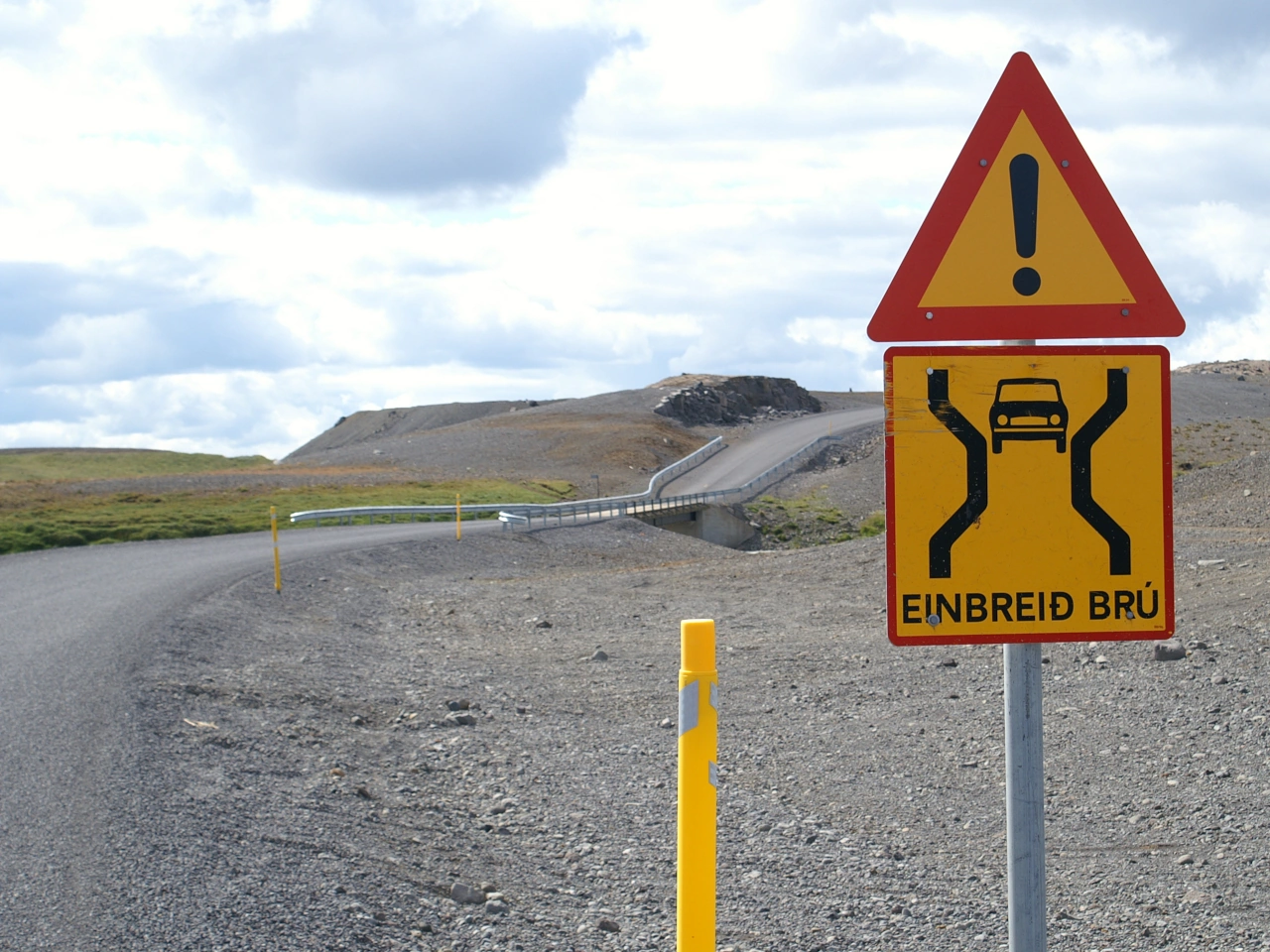
A bridge is a structure that carries a road, path or railway over an obstacle such as a river, valley, railway line or another road. A road bridge may carry one or more roadways together with pedestrian or cycling facilities.
Drivers should follow any speed, weight, height, width or vehicle-access restrictions applying to the bridge. Particular care may be necessary on narrow, exposed or movable bridges and when weather conditions such as wind, rain or ice affect the road surface.
Wikimedia.org • Dickelbers • CC BY-SA
What is a bridge?
A bridge is a structure that carries a road, path or railway over an obstacle such as a river, valley, railway or another road.
Can a bridge carry several traffic lanes?
Yes. Road bridges may carry one or several traffic lanes and can also contain pavements, cycle facilities or public-transport infrastructure.
Can a bridge have a weight limit?
Yes. A bridge may have restrictions on the maximum vehicle mass or axle load that it can safely accommodate. Drivers of heavy vehicles must obey the applicable signs.
Can a bridge have a width or height restriction?
Yes. Narrow bridges or structures forming part of a bridge can have width, height or other dimensional restrictions indicated by traffic signs.
What is a movable bridge?
A movable bridge is a bridge that can open, lift, swing or otherwise move to allow ships or other traffic to pass beneath or through it.
What should you do when a movable bridge is opening?
Stop when required by the traffic lights, barriers or other signals and remain behind the designated stopping point until the crossing is reopened.
Can bridges become slippery?
Yes. Bridge surfaces can become wet, icy or slippery and may sometimes cool differently from the surrounding road. Drivers should adapt their speed to the actual conditions.
Can strong winds be dangerous on a bridge?
Yes. Exposed bridges can be affected by crosswinds, particularly for motorcycles, bicycles, high-sided vehicles and vehicles towing trailers.
Can you stop or park on a bridge?
This depends on the local traffic rules, road layout and signs. Stopping or parking may be prohibited where it would create danger, obstruct traffic or reduce the available road width.
Can pedestrians and cyclists use a bridge?
Yes, where permitted. Bridges may provide pavements, cycle paths or shared facilities, while high-speed or restricted bridges may prohibit certain road users.
Can traffic be restricted to one direction on a narrow bridge?
Yes. Priority signs, traffic lights or other traffic-management measures may control which direction passes first where two-way traffic cannot safely meet.
Should you overtake on a narrow bridge?
Only when overtaking is legal and clearly safe. Limited width or visibility can make overtaking inappropriate even where no specific prohibition is shown.
5. Give way
A give-way sign requires drivers to allow traffic with priority to proceed before entering, crossing or joining a road. Drivers must reduce speed, observe approaching traffic and stop when necessary.
Unlike a stop sign, a give-way sign does not always require a complete stop. The driver may continue without stopping only when the route is clearly safe and no road user with priority is forced to change speed or direction.
Wikimedia.org • CC0
What does a give-way sign mean?
A give-way sign requires drivers to allow traffic with priority to proceed first. The driver must slow down and stop when necessary.
How can you recognise a give-way sign?
It is commonly an inverted triangular sign with a red border and a light-coloured centre. In some countries, it is called a yield sign.
Must you always stop at a give-way sign?
No. You must stop only when necessary to give way or obtain a sufficiently clear view. You may continue slowly when the road is clearly free.
What does giving way mean?
Giving way means allowing another road user to continue without being forced to brake, accelerate, stop or change direction because of your movement.
Where should you stop when necessary?
Stop before the give-way line where one is provided. Without a line, stop before entering the intersection or priority road at a position where you can observe traffic safely.
May you cross the give-way line before stopping?
You may move beyond the line only when this does not interfere with traffic that has priority. Where visibility is limited, first slow or stop at the line and then move forward cautiously.
What is the difference between give way and stop?
A stop sign always requires a complete stop. A give-way sign permits the driver to continue without stopping when the road is clearly free and it is safe to proceed.
Does slowing down satisfy the give-way requirement?
Only when slowing down is sufficient to let all priority traffic proceed safely. If another road user would be hindered, the driver must slow further or stop.
Who must you give way to?
Give way to traffic travelling on the road being entered or crossed and to any pedestrians, cyclists or other road users who have priority under the applicable rules.
Does giving way apply only to vehicles approaching from one direction?
No. Check every direction from which lawful traffic may approach, including cycle paths, one-way roads with authorised contraflow traffic and separate carriageways.
Does a give-way sign give the other road permanent priority?
The sign determines priority at the particular location. The priority arrangement at later intersections may be different unless the road is separately identified as a priority road.
Does giving way give you priority afterwards?
No. You may proceed only when it is safe. Another driver’s hesitation or courtesy does not remove your responsibility to avoid danger.
Must every vehicle in a queue give way separately?
Yes. Each driver must observe the road and make an individual decision. You may not follow another vehicle through without checking that the way remains clear.
Does a give-way sign apply to cyclists?
Normally, yes. Cyclists are generally treated as drivers and must obey the sign unless a supplementary sign or local rule provides otherwise.
Can a give-way sign apply only to cyclists?
Yes. Some countries use supplementary signs or path-specific signs to require cyclists to give way while other traffic follows a different priority arrangement.
Does a give-way sign change the speed limit?
No. It regulates priority rather than speed. Drivers must still approach slowly enough to observe traffic and stop when necessary.
Does a give-way sign change turning rules?
No. Drivers must still obey traffic lights, lane arrows, mandatory-direction signs and turning prohibitions.
How does give way work at a roundabout?
Many roundabout entrances have give-way signs requiring entering traffic to yield to vehicles already circulating. Drivers must follow the actual signs because roundabout priority rules differ between countries.
Do traffic lights override a give-way sign?
Functioning traffic lights commonly take precedence over priority signs controlling the same movement. The give-way sign may apply again when the lights are switched off or flashing, depending on local law.
Do police instructions override a give-way sign?
Yes. Instructions from an authorised traffic officer normally take precedence over traffic signs and ordinary priority rules.
What should you do when visibility is limited?
Reduce speed substantially and stop when necessary. Move forward cautiously only after giving way and checking that the road can be entered without danger.
6. Priority road
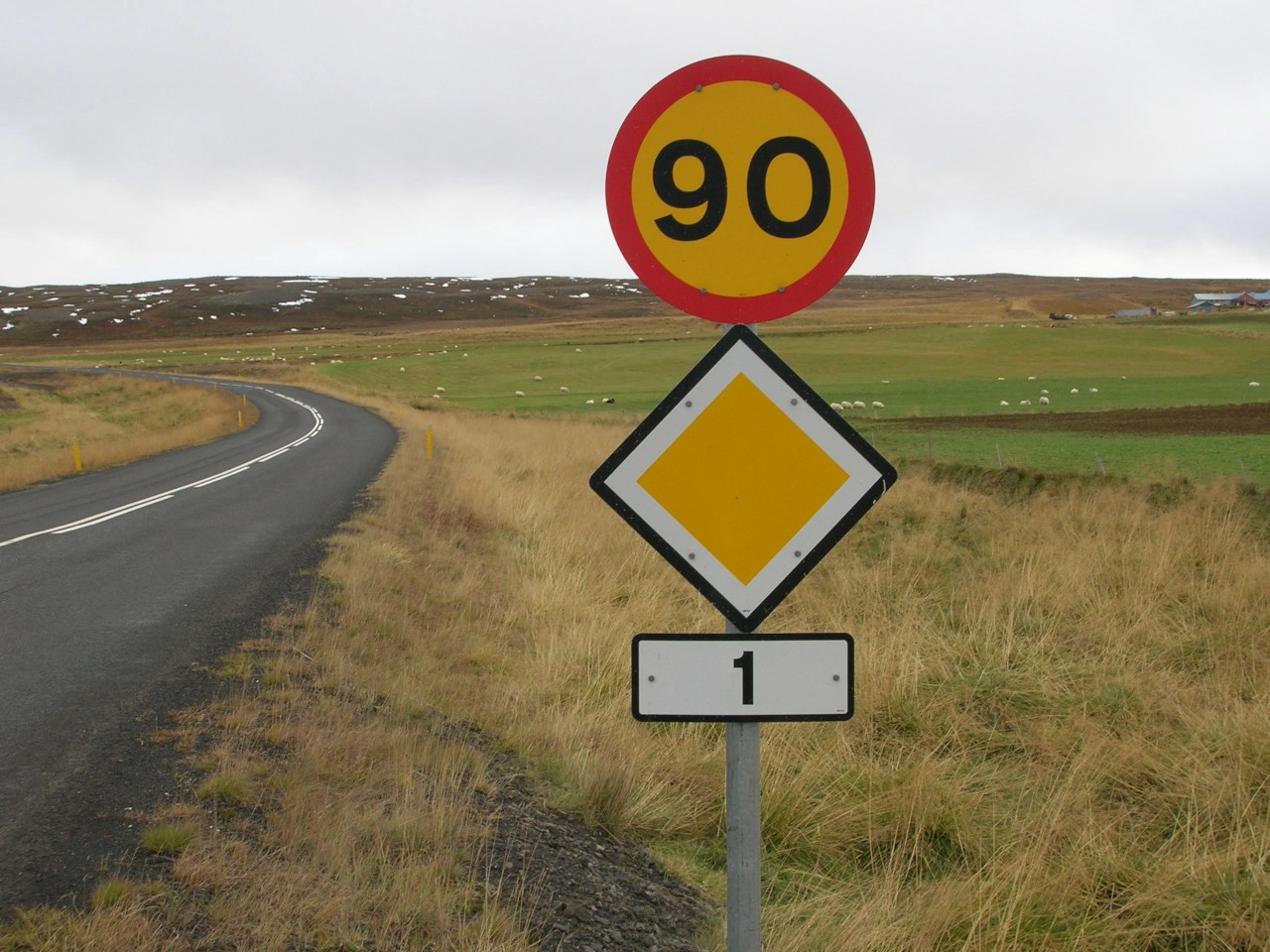
A priority road is a road whose traffic is given priority over traffic entering from intersecting roads. It is normally identified by a priority-road sign, while an end sign indicates where that continuing priority status stops.
Drivers on a priority road must still obey traffic lights, authorised officers, speed limits, crossings and turning rules. Having priority never allows a driver to proceed when doing so would create danger or block an intersection.
Wikimedia.org • CS • CC0
What is a priority road?
A priority road is a road on which drivers normally have priority over traffic entering from intersecting side roads.
How can you recognise a priority road?
It is normally indicated by a priority-road sign at or near its beginning. A corresponding end sign indicates where its continuing priority status stops.
Does a priority road have priority at every intersection?
Normally, yes, while the priority-road designation remains in force. Drivers must still observe traffic lights, authorised officers and any signs applying at a particular intersection.
Does an intersection end a priority road?
Not necessarily. A priority road commonly continues across successive intersections until an end sign or another legally defined change in priority.
Must side roads have give-way or stop signs?
Side roads are commonly controlled by give-way or stop signs, but sign placement and legal requirements differ between countries.
Does traffic from both the left and right have to give way?
Where the priority-road signs apply, drivers entering from intersecting side roads must normally give way regardless of whether they approach from the left or right.
Is a priority road the same as having priority at one intersection?
No. A priority-road sign normally creates continuing priority across several intersections. Another sign may grant priority only at the next intersection.
Does a priority road always continue straight ahead?
No. The priority route may turn at an intersection. A supplementary diagram may show which branch retains priority.
Must you signal when the priority road bends?
Priority does not remove the duty to signal. Use the direction indicators whenever following or leaving the priority route involves a change of direction or lateral movement.
Does having priority mean you may enter without slowing down?
No. Approach every intersection at a safe speed and remain prepared for another road user to fail to give way.
Does a priority road have a special speed limit?
No. The applicable general, zonal or posted speed limit remains in force.
Do traffic lights override priority-road signs?
Functioning traffic lights normally control the intersection instead of the priority signs. Local rules determine what applies when the lights are switched off or flashing.
Do police instructions override priority-road signs?
Yes. Instructions from an authorised traffic officer normally take precedence over traffic signs and ordinary priority rules.
Do pedestrians still have priority at crossings?
Yes, where the applicable crossing rules give them priority. Priority over side-road traffic does not remove duties towards pedestrians.
Must you give way when turning off a priority road?
You must still give way to oncoming traffic, pedestrians, cyclists and other road users where the normal turning rules require it.
Do cyclists on a priority road have priority?
Cyclists using the road or a continuing bike path may have priority over entering or turning traffic, depending on signs, markings and local law.
Does a priority road give priority at a roundabout?
Not automatically. Roundabout priority is determined by its own signs, signals and local rules.
May you overtake on a priority road?
Priority-road status does not itself permit or prohibit overtaking. Drivers must follow the ordinary overtaking rules, markings and visibility requirements.
May you stop or park on a priority road?
This depends on local law and signs. Some countries prohibit parking on priority roads outside built-up areas, while other parking rules may apply inside towns and cities.
Does a vehicle leaving a property have priority?
No. A driver entering the road from a property, parking place or other off-road location normally performs a manoeuvre and must give way to road users already present.
May you enter a blocked intersection when you have priority?
No. Do not enter when congestion would force you to stop inside the intersection and obstruct crossing traffic.
How does a priority road end?
Its continuing priority normally ends at an end-of-priority-road sign. Drivers must then follow the signs or ordinary priority rule applying at the next intersection.
7. Overtaking
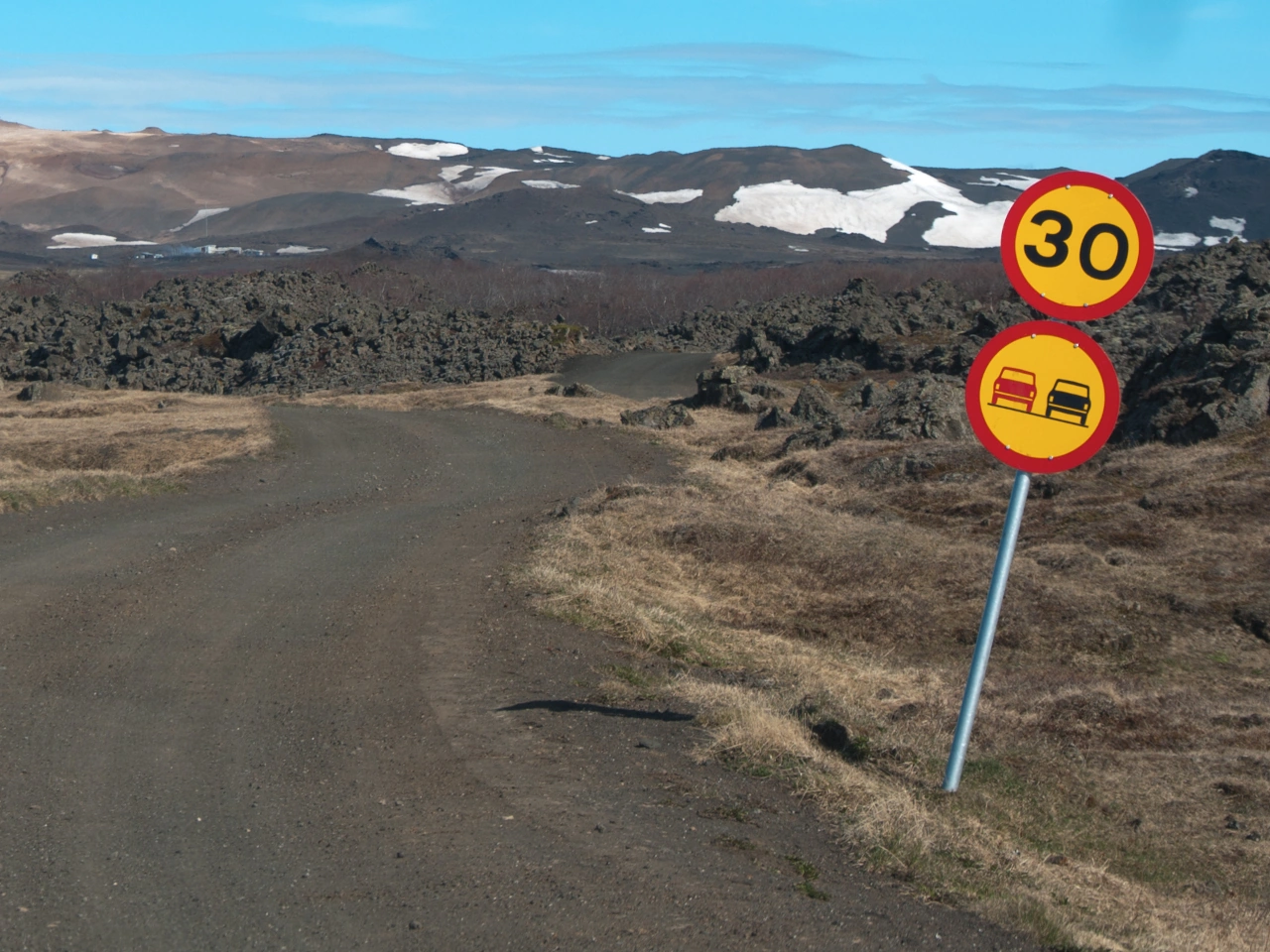
Overtaking is the act of passing another road user travelling in the same direction. It normally involves moving to another position or lane, passing the slower road user and returning to the appropriate position when it is safe.
Before overtaking, a driver should make sure there is sufficient visibility and space, check mirrors and blind spots, signal when required and ensure that no other road user is already overtaking. The manoeuvre must be completed without exceeding the speed limit or endangering other road users.
Wikimedia.org • Hansueli Krapf • CC BY-SA
On which side should you overtake?
In right-hand traffic countries, overtaking normally takes place on the left. In left-hand traffic countries, it normally takes place on the right. National rules can provide exceptions in particular situations.
What should you check before overtaking?
Make sure there is sufficient visibility and space, check mirrors and blind spots, ensure that nobody behind has already started overtaking and confirm that you can safely return to your normal position after passing.
When should you not overtake?
Do not overtake where signs or road markings prohibit it or where visibility, approaching traffic, intersections, crossings, bends, hills or other conditions make the manoeuvre unsafe.
8. Crossing animals
An animals-crossing warning indicates a place or road section where wild animals, livestock or ridden animals may enter or cross the road. Animals may appear suddenly, move unpredictably or be difficult to see in darkness, vegetation or poor weather.
Drivers should reduce speed, scan both sides of the road and remain prepared to stop. The warning sign does not itself give animals priority or impose a numerical speed limit, but drivers must avoid frightening, endangering or colliding with them.
Wikimedia.org • Christoph Strässler • CC BY-SA
What does an animals-crossing sign mean?
It warns that animals may enter or cross the road in the area ahead.
Which animals may the sign refer to?
Depending on the symbol and local conditions, it may refer to deer, cattle, horses, sheep, goats, wild boar or other animals.
How can you recognise an animals-crossing sign?
It is commonly a triangular warning sign displaying the silhouette of an animal. The species shown may indicate the type of animal most likely to be encountered.
Does the sign mean animals are always present?
No. It indicates an increased likelihood of animals crossing, not that animals will be present every time.
Does the sign impose a speed limit?
No. The normal posted or general speed limit remains applicable, but drivers must reduce speed when necessary to react safely.
Do animals have priority because of the sign?
No automatic priority is created by the warning sign. Drivers must nevertheless avoid danger and allow animals already on the road to pass safely.
How should you approach an animal-crossing area?
Reduce speed, increase your following distance and scan the road, verges, fields and vegetation for movement or reflected eyes.
When are wild animals most likely to appear?
Animal activity is often greater around dawn, dusk and darkness, although animals may cross at any time.
Why should you expect more than one animal?
Many animals travel in groups. When one animal crosses, others may follow immediately from the same direction.
Should you sound the horn?
Avoid unnecessary horn use or engine revving because it may frighten an animal and make its movement less predictable. Use a warning only when reasonably necessary to prevent danger.
Should you use full-beam headlights?
Use the appropriate lights without dazzling other road users. When an animal is visible, reduce speed and avoid relying on full beam to make it move away.
What should you do when an animal is on the road?
Slow down smoothly, stop when necessary and allow it enough time and space to leave. Avoid sudden acceleration or aggressive steering.
Should you swerve to avoid an animal?
Avoid an uncontrolled swerve that could cause a collision with another vehicle, tree, barrier, cyclist or pedestrian. Brake firmly while maintaining control and steer only when a safe escape path is clearly available.
How should you pass livestock?
Pass only when the animals and their handlers have sufficient space. Drive slowly, avoid noise and be prepared for an animal to change direction unexpectedly.
How should you pass a horse and rider?
Reduce speed, leave a large lateral distance and pass quietly. Avoid sounding the horn, accelerating sharply or passing when oncoming traffic prevents sufficient clearance.
Must you follow instructions from an animal handler?
Follow lawful instructions from an authorised person and cooperate with handlers controlling animals on or across the road.
May you overtake near an animal crossing?
The warning sign does not necessarily prohibit overtaking, but overtaking should be avoided when animals, limited visibility or approaching traffic make the manoeuvre unsafe.
What if an animal appears behind another vehicle?
Maintain enough following distance to see beyond the vehicle ahead. Be prepared for it to brake suddenly when an animal enters the road.
What should motorcyclists and cyclists do?
Reduce speed, keep both hands firmly in control and avoid sudden movements. Animals may react unexpectedly to quiet or fast-approaching two-wheeled vehicles.
What should you do after hitting an animal?
Stop safely, activate the hazard warning lights and check for injured people. Contact the emergency services or police when necessary and do not approach a wounded wild animal, which may defend itself.
Should you move an injured or dead wild animal?
Normally not. Keep a safe distance and allow the police, wildlife authorities or an animal-rescue service to handle it.
Can animals be present without a warning sign?
Yes. Drivers remain responsible for observing the road and adjusting their speed even where no animal warning sign is displayed.
9. Curve
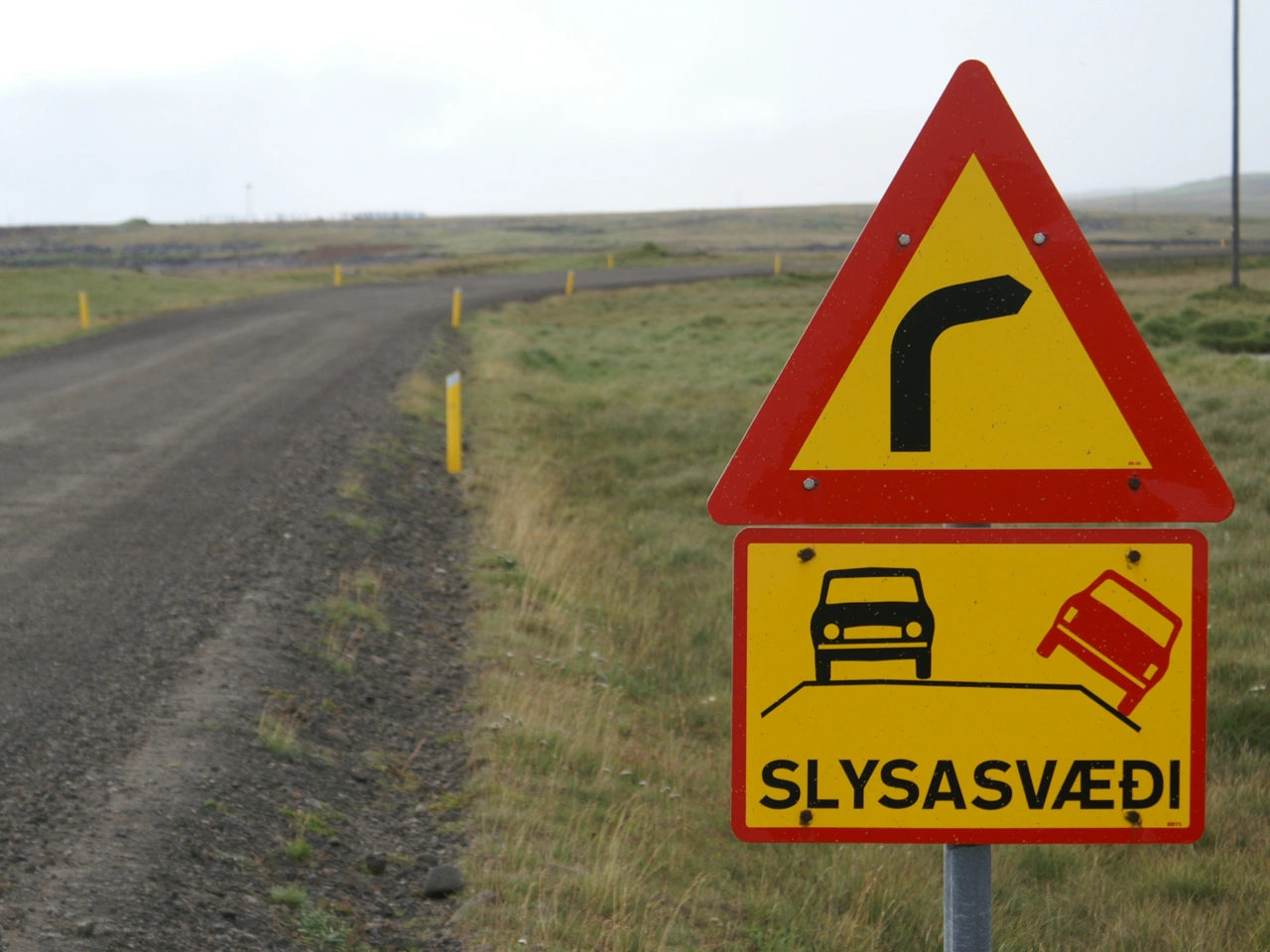
A curve is a section of road that changes direction to the left or right. A sharp, unexpected or poorly visible curve can reduce a driver’s view of approaching traffic, stopped vehicles, pedestrians and other hazards.
Drivers should reduce speed before entering the curve, remain within their lane and use smooth steering, braking and acceleration. Warning signs may indicate the direction of the first curve or a series of successive curves.
Wikimedia.org • Dickelbers • CC BY-SA
What is a road curve?
A road curve is a section where the road changes direction to the left or right.
How can you recognise a dangerous curve?
It may be indicated by a triangular warning sign showing a curved line. The symbol normally indicates whether the first curve turns left or right.
What is a double curve?
A double curve consists of two curves in opposite directions. The warning sign normally shows the direction of the first curve.
Can a sign warn of more than two curves?
Yes. A double-curve symbol may also warn of a longer sequence of successive curves. A supplementary panel may indicate the length of the winding section.
Does a curve-warning sign impose a speed limit?
No. It normally warns of danger rather than setting a numerical limit. Drivers must still reduce speed when the permitted maximum would be unsafe.
When should you reduce speed for a curve?
Reduce speed before entering the curve, while the vehicle is travelling straight and has maximum stability.
Should you brake heavily while cornering?
No. Harsh braking in a curve can reduce stability and grip. Complete most braking beforehand and use smooth adjustments where necessary.
Should you accelerate through a curve?
Maintain a controlled speed through the curve. Accelerate smoothly only when the exit becomes visible and the vehicle is stable.
Where should you look while driving through a curve?
Look towards the path you intend to follow and the visible exit of the curve. Continue checking the road surface, lane position and nearby traffic.
Must you remain in your lane?
Yes. Do not cross the centre line or cut across another lane, even when this would make the curve appear easier to negotiate.
Why is visibility limited in a curve?
Buildings, vegetation, slopes, barriers and the road alignment may hide oncoming traffic, cyclists, pedestrians, stopped vehicles or debris.
How fast should you drive through a curve?
Choose a speed that allows you to remain in your lane and stop within the distance you can see to be clear. The safe speed may be far below the legal maximum.
What is an advisory speed for a curve?
An advisory speed is a recommended safe speed for negotiating the curve under suitable conditions. It is not necessarily the legal maximum speed.
How do rain, snow or ice affect a curve?
They reduce tyre grip and increase the risk of skidding. Reduce speed earlier, use smooth controls and leave additional distance from other vehicles.
What should you do if gravel or debris is present?
Avoid sudden braking or steering. Reduce speed smoothly and follow a clear path without entering another traffic lane.
May you overtake in a curve?
Do not overtake when visibility is insufficient to see approaching traffic and complete the manoeuvre safely. Local law, signs and continuous road markings may also prohibit overtaking.
May you stop or park in a curve?
Only where it is permitted and the vehicle remains clearly visible. Stopping or parking in a poorly visible curve may create a serious hazard and is often prohibited.
Should you follow another vehicle closely through a curve?
No. Leave enough distance to react if the vehicle ahead brakes for a hidden obstruction or a sharper part of the curve.
Why should motorcyclists take extra care?
Motorcycles require grip for both cornering and braking. Riders should reduce speed before the curve, choose a stable line and avoid painted markings, gravel and slippery surfaces.
How can a curve affect a trailer or caravan?
A trailer may sway, track closer to the inside of the curve or become unstable when speed and steering inputs are excessive. Enter slowly and steer smoothly.
Why do large vehicles need more space?
Buses and trucks may move closer to lane boundaries because of their length and width. Other drivers should avoid travelling beside them through a tight curve.
What should you do if an oncoming vehicle crosses the centre line?
Reduce speed, move safely towards your side of the road and avoid a sudden manoeuvre that could cause another collision. Sound a warning only when reasonably necessary.
Does the absence of a warning sign mean every curve is safe at the speed limit?
No. Drivers must assess every curve and adapt their speed even when no warning sign is displayed.
10. Traffic lights
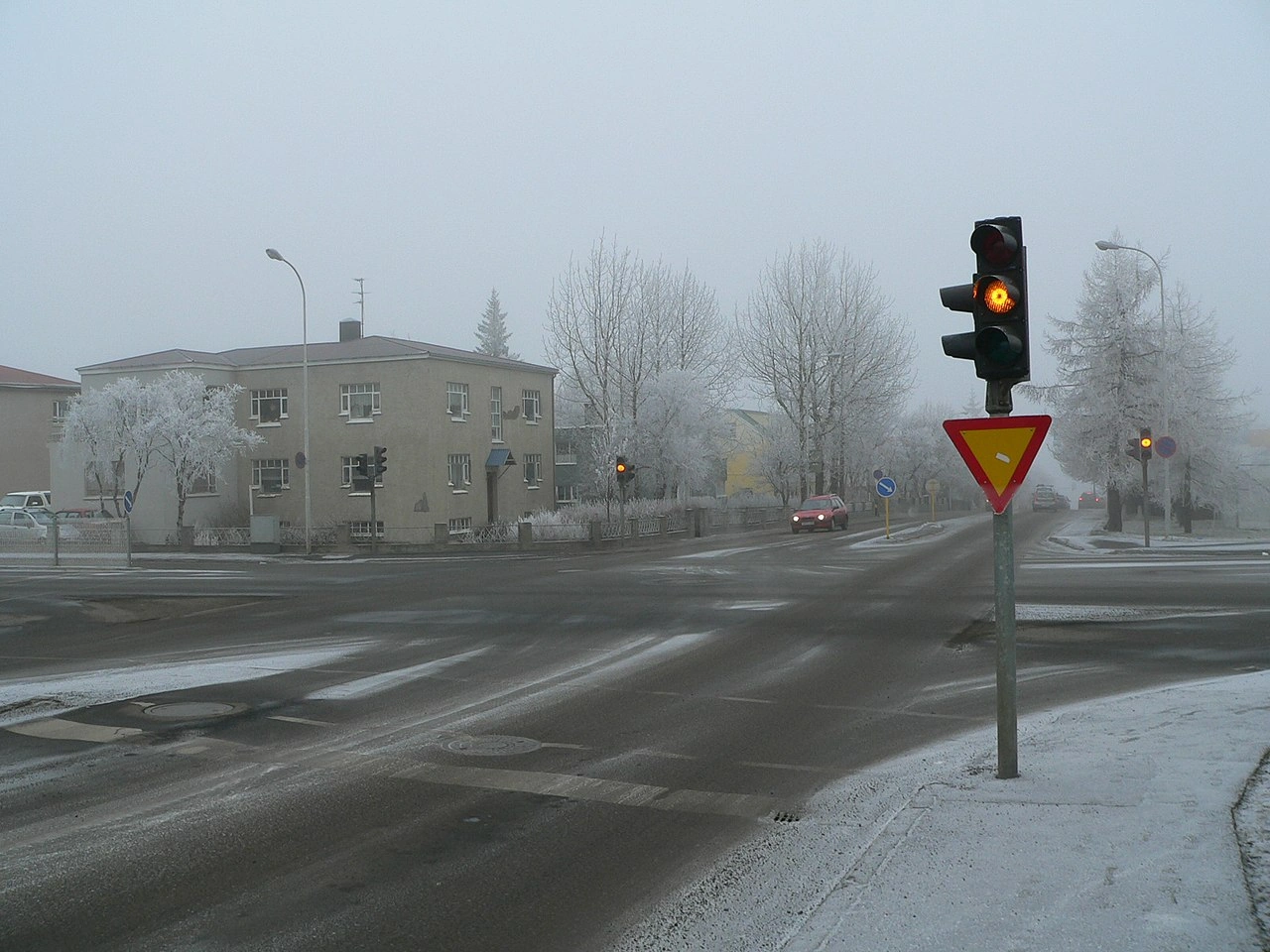
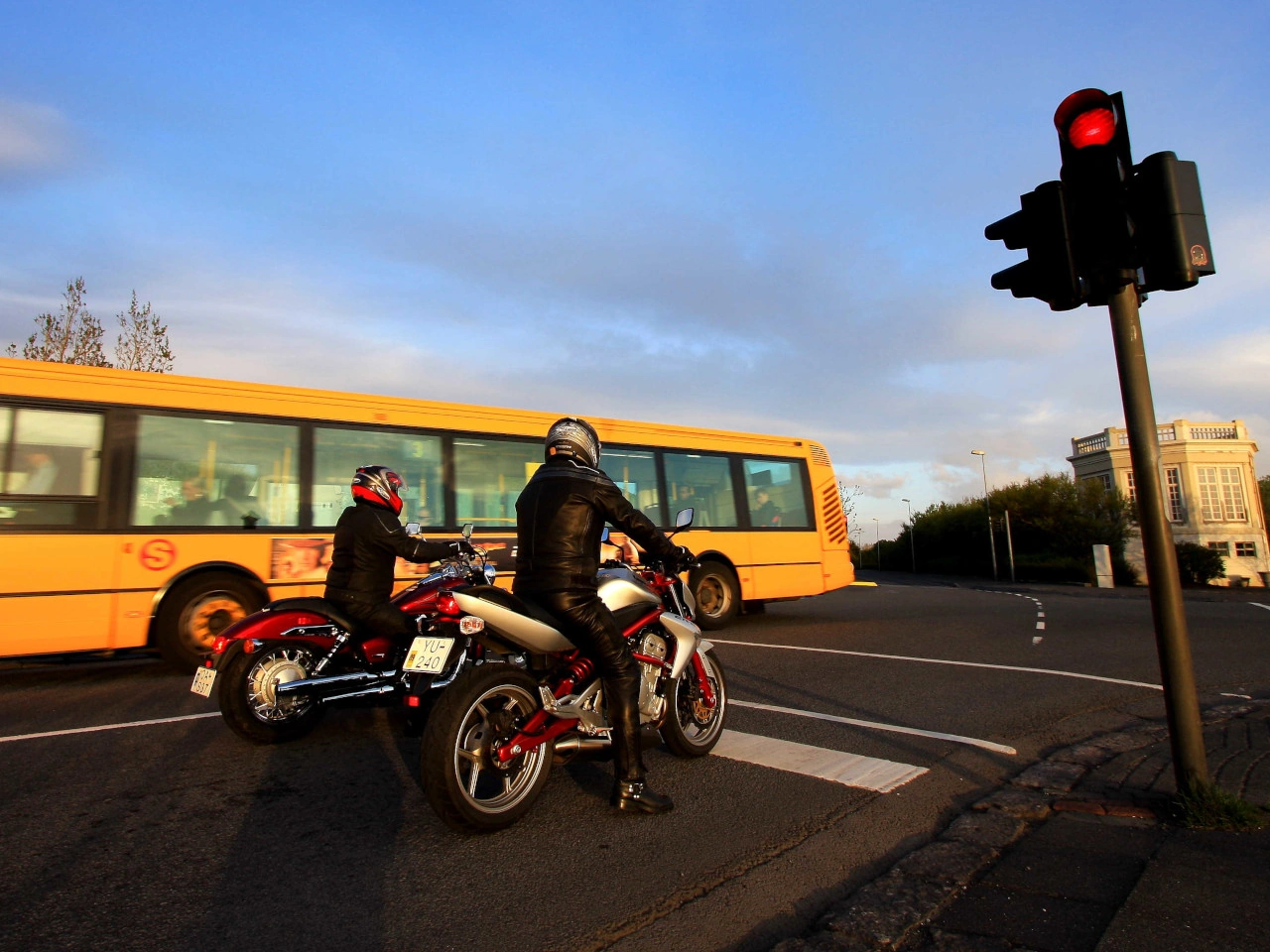
Traffic lights use coloured lights, arrows or symbols to regulate when road users may proceed, must prepare to stop or must remain stopped. Separate signals may apply to particular directions, lanes, pedestrians, cyclists or public-transport vehicles.
A green light permits movement only when the route is clear and the movement is otherwise legal. Road users must still follow priority rules, turning restrictions, lane markings and instructions from authorised traffic controllers.
Wikimedia.org • Helgi Halldórsson • CC BY-SA
What are traffic lights?
Traffic lights are signals that use coloured lights, arrows or road-user symbols to regulate traffic movements.
What does a red traffic light mean?
A red light requires road users to stop before the stop line or signal and remain stopped until movement is permitted.
What does a steady amber light mean?
A steady amber light normally requires drivers to stop unless they are already too close to stop safely. It warns that the signal is changing to red.
What does a green traffic light mean?
A green light permits road users to pass the signal, but only when the route is clear and the intended movement is otherwise legal.
Does green mean that you have priority over everyone?
No. You may still have to give way to pedestrians, cyclists, oncoming traffic or other road users when turning or following a conditional arrow.
May you enter a blocked intersection on green?
No. Do not enter when congestion is likely to leave you stopped inside the intersection and obstructing crossing traffic.
Where should you stop at a red light?
Stop before the stop line. When no stop line is provided, stop before the traffic light or at another legally prescribed position.
May you cross the stop line and then stop?
No. The required stop must normally be completed before the stop line. Do not stop on a pedestrian or cycle crossing.
What if the light changes to amber while you are approaching?
Stop when this can be done safely. Continue only when you are already too close to stop without creating danger.
Should you accelerate to pass an amber light?
No. Do not accelerate to avoid stopping. Maintain control and stop unless doing so safely is no longer possible.
What do arrow-shaped traffic lights mean?
They have the same general meaning as circular lights, but the prohibition or permission applies only to the direction shown by the arrow.
What does a green arrow displayed with a red light mean?
It may permit travel in the indicated direction while other movements remain prohibited. Drivers may still have to give way to conflicting traffic and pedestrians.
Does a green arrow override a no-turn sign?
Not universally. Drivers must follow the complete local sign arrangement. A traffic signal does not necessarily cancel a separate regulatory prohibition.
May you turn right on red?
Only where local law or a specific sign or signal expressly permits it. There is no universal right to turn on red.
What does a flashing amber light mean?
It warns of a potential hazard and normally allows cautious passage. The ordinary priority arrangement remains applicable.
What should you do when the normal lights are flashing amber?
Reduce speed, observe the intersection carefully and follow the applicable priority signs or default priority rules.
What does a flashing red light mean?
Its meaning depends on local law. At railway crossings and some movable bridges, flashing red lights normally require road users to stop.
What do lane-control signals mean?
A red cross normally closes the lane, a green downward arrow opens it and an amber diagonal arrow instructs drivers to leave the lane in the indicated direction.
May you continue beneath a red lane-control cross?
No. Move out of the lane safely before reaching the red cross unless an authorised person or emergency rule directs otherwise.
What does an amber diagonal lane arrow mean?
It warns that the lane is closing or unavailable ahead. Drivers must move into the adjacent lane indicated by the arrow when safe.
Can separate lights apply to cyclists?
Yes. A signal displaying a bicycle symbol applies to the road users legally covered by that signal rather than to general motor traffic.
Can separate lights apply to pedestrians?
Yes. Pedestrian lights normally use red and green human figures to indicate whether pedestrians may begin crossing.
What does a flashing green pedestrian light mean?
It normally warns that the crossing period is about to end. Pedestrians who have not started should wait for the next green signal.
What if the pedestrian signal changes while someone is crossing?
A person who entered lawfully should continue without unnecessary delay. Turning drivers must allow the crossing to be completed safely.
Can buses and trams have separate traffic lights?
Yes. Public-transport signals may use bars, circles, triangles or other symbols that apply only to authorised service vehicles.
Do functioning traffic lights override priority signs?
They commonly replace the priority arrangement at that location. Priority signs may apply again when the normal signals are inactive or flashing.
Do instructions from a police officer override traffic lights?
Yes. Instructions from an authorised traffic controller normally take precedence over lights, signs, markings and ordinary rules.
What should you do when the lights are not working?
Reduce speed and follow the priority signs, temporary signals, authorised personnel or default priority rules that apply.
May you clear an intersection after the light turns red?
Yes, when you entered lawfully and must leave the intersection. Complete the movement cautiously without endangering other road users.
Does a green light impose a minimum speed?
No. Drivers may proceed but must continue at a safe and legal speed.
May you use a handheld phone while waiting at red?
This depends on local law. In many countries, a driver temporarily stopped in traffic is still considered to be driving and may not use a handheld device.
11. Driving licence
A driving licence is an official document authorising a person to drive one or more specified categories of motor vehicle. It may contain conditions, restrictions, category codes and expiry dates that determine which vehicles the holder may drive.
Drivers must hold a licence that is valid for the vehicle category and jurisdiction concerned. A licence may be provisional, full, restricted, suspended or withdrawn, and additional qualifications may be required for professional driving.
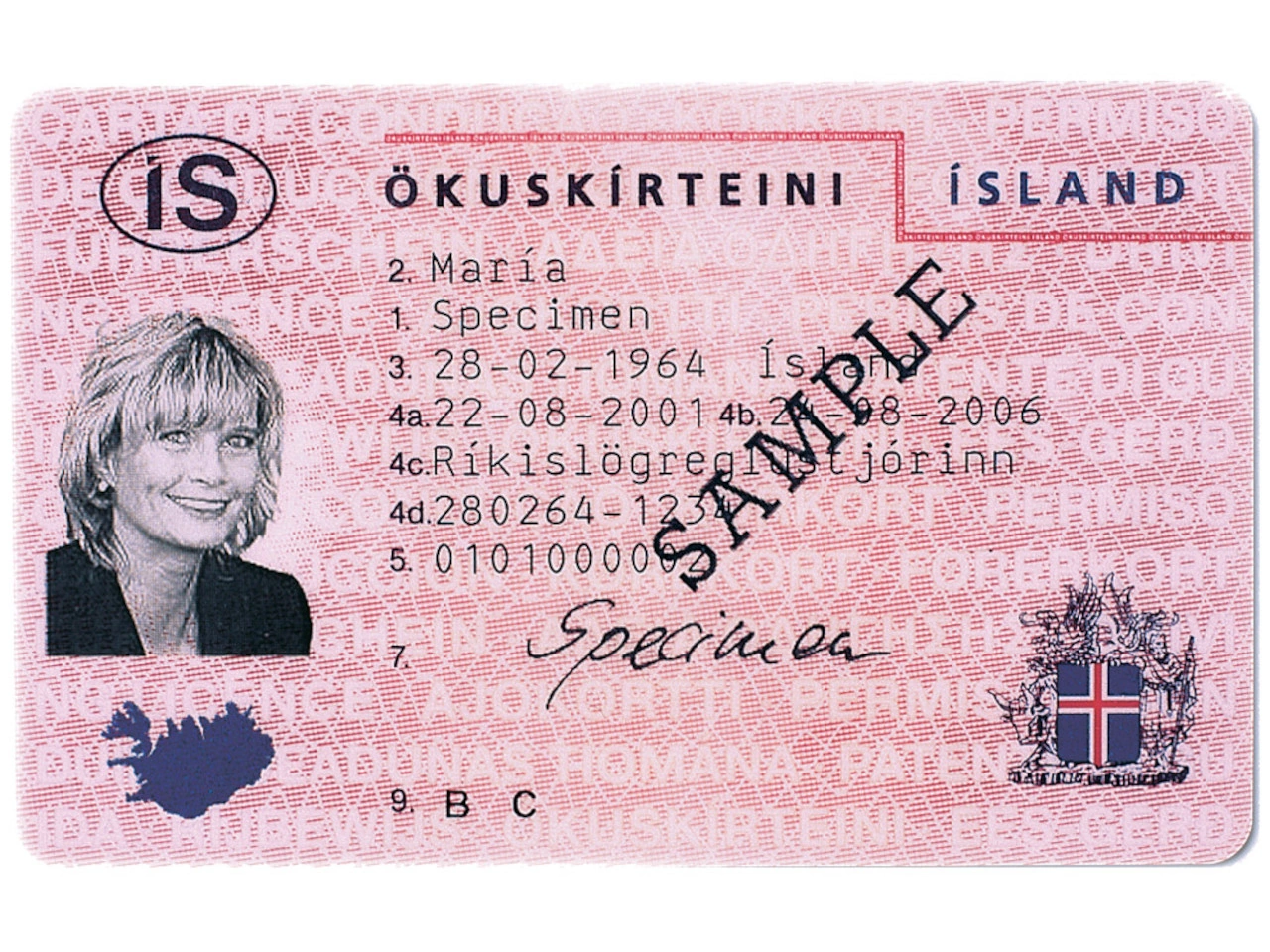
Wikimedia.org • CC0
What is a driving licence?
A driving licence is an official authorisation to drive specified categories of motor vehicle.
Is a driving licence the same as a driving permit?
The terms may refer to the same document, depending on the country. Some countries use permit specifically for learners or temporary authorisations.
What is a provisional driving licence?
A provisional or learner licence allows a person to practise driving under specified restrictions before obtaining a full licence.
What is a full driving licence?
A full licence is issued after the holder has completed the required tests or training. Restrictions may still apply because of age, vehicle type, medical fitness or licence codes.
Does one licence allow you to drive every vehicle?
No. Driving licences are divided into categories for motorcycles, cars, buses, trucks, trailers and other vehicles.
What is a licence category?
A licence category identifies the type and size of vehicle the holder is authorised to drive.
Must the licence be valid for the vehicle being driven?
Yes. Holding a licence for one category does not normally authorise driving a vehicle belonging to another category.
Can a licence contain restrictions?
Yes. Codes may restrict the holder to an automatic transmission, corrective lenses, an adapted vehicle or another specified condition.
What is the difference between an automatic and manual licence?
In some countries, passing the test in an automatic vehicle restricts the holder to automatic vehicles until an additional test or procedure is completed.
Does a driving licence expire?
Usually, yes. The document, individual categories or medical authorisation may have expiry dates and require renewal.
May you drive with an expired licence?
No. The licence and the category required for the vehicle must remain valid.
Must you carry your driving licence?
This depends on local law. Many countries require drivers to carry the original licence and present it to an authorised officer when requested.
Is a photograph or copy of the licence sufficient?
Not normally. A photograph, scan or photocopy is not generally a substitute for the original document unless an official digital-licence system is legally recognised.
Does a driving licence prove that you own the vehicle?
No. It proves driving authorisation, not ownership, registration or insurance.
What tests are required to obtain a licence?
Requirements may include a theory test, eyesight test, practical driving test, medical examination or compulsory training.
Is there a universal minimum driving age?
No. Minimum ages differ between countries and vehicle categories.
Can a learner drive without supervision?
Only where the provisional-licence system permits independent driving. Other learners must be accompanied by an approved supervisor or instructor.
Can a learner drive in another country?
Often not. Provisional and learner licences are frequently valid only in the country or region that issued them.
What is an international driving permit?
An international driving permit is a standardised translation of a valid national licence intended to help authorities interpret it abroad.
Does an international driving permit replace a national licence?
No. It normally has legal value only when presented together with the valid national driving licence on which it is based.
Is a national licence valid abroad?
This depends on the destination, length of stay, residence status and agreements between the countries concerned. An exchange or international permit may be required.
Can a foreign licence be exchanged?
Some countries exchange recognised foreign licences without new tests, while others require theory, practical or medical examinations.
Can medical fitness affect a licence?
Yes. A medical condition may require an assessment, shorter validity period, adapted vehicle or licence restriction.
Must changes in medical fitness be reported?
This depends on local law. Drivers remain responsible for ensuring that they are physically and mentally fit to drive safely.
Do professional drivers need additional qualifications?
Often, yes. Drivers of trucks, buses, taxis or vehicles used commercially may require professional competence, medical examinations or periodic training.
What happens when a licence is suspended?
The holder may not drive during the suspension period, even if the physical document remains in their possession.
What is disqualification from driving?
Disqualification is a legal prohibition on driving, usually imposed by a court or competent authority for a specified period or until conditions are fulfilled.
What should you do if the licence is lost or stolen?
Report it where required and apply for a replacement through the competent licensing authority. Do not continue driving when local law requires the original document to be carried.
What should you do if the licence is damaged?
Request a replacement when the document is unreadable, damaged or no longer allows the holder to be identified reliably.
Does changing address require a new licence?
This depends on the country and whether the address appears on the licence. Drivers must follow the local notification and replacement procedure.
12. Reversing
Reversing means driving a vehicle backwards. It is commonly used when parking, leaving a confined space or repositioning a vehicle where forward movement is not practical.
Before reversing, the driver should check mirrors and blind spots, look carefully around the vehicle and make sure the area behind is clear. Reversing should be performed slowly and only for as long as necessary because visibility behind the vehicle is often limited.

Wikimedia.org • Kārlis Dambrāns • CC BY
What should you check before reversing?
Check behind and around the vehicle for pedestrians, cyclists, other vehicles and obstacles. Use mirrors and cameras where available, but also look directly because monitoring systems can have blind spots.
Who has priority when a vehicle is reversing?
In many countries, reversing is treated as a manoeuvre and the reversing driver must give way to other road users. The exact legal requirements depend on national traffic rules.
Should you reverse for a long distance?
No. Reversing should normally be limited to the distance necessary to complete the manoeuvre safely. Driving forward generally provides better visibility and vehicle control.
13. Licence plate
A licence plate, also called a registration plate or number plate, is a plate displaying a unique registration identifier assigned to a vehicle by the competent registration authority. It allows the vehicle to be identified for purposes such as registration, traffic enforcement, taxation, insurance and parking control.
The appearance, format, placement and number of plates required vary between countries and vehicle categories. Drivers must ensure that required licence plates are correctly fitted, clearly visible and legible and must follow the local rules when a plate is lost, stolen, damaged or replaced.
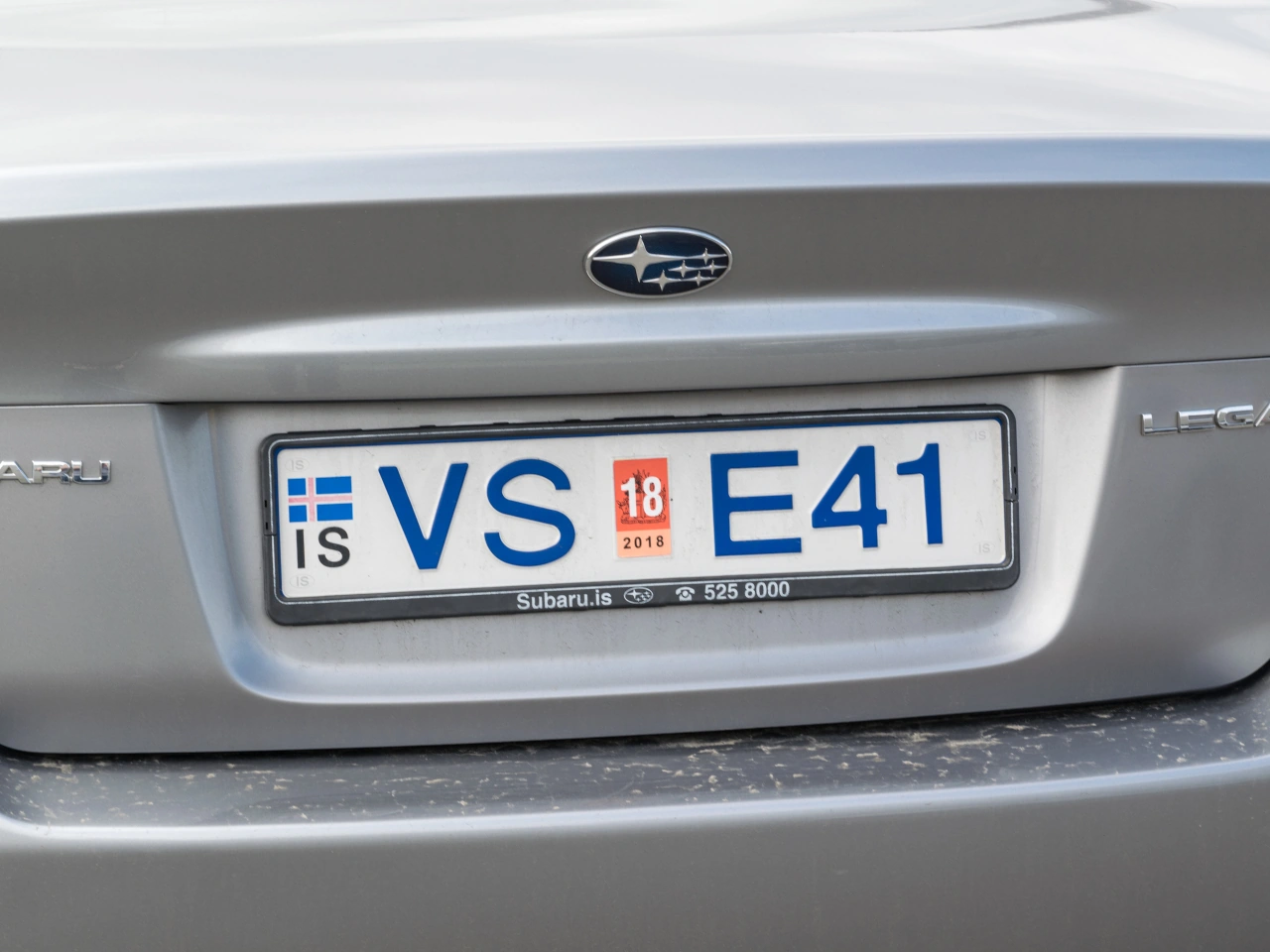
Wikimedia.org • Ralf_Roletschek • GFDL
What is a licence plate?
A licence plate is a plate displaying the registration identifier assigned to a vehicle. It allows authorities and other authorised systems to identify the vehicle's registration.
Is a licence plate the same as a registration plate?
Yes. Licence plate, registration plate and number plate are different terms commonly used for the plate displaying a vehicle's official registration number.
Does every vehicle need a licence plate?
Most motor vehicles used on public roads must display one or more registration plates, but requirements differ for motorcycles, trailers, agricultural vehicles and other special vehicle categories.
Do vehicles need both front and rear licence plates?
This depends on the country and vehicle type. Cars commonly require front and rear plates, while motorcycles and certain other vehicles may require only a rear plate.
Must a licence plate remain visible?
Yes. A required registration plate must normally remain clearly visible and readable. It should not be hidden by luggage, dirt, accessories or other objects.
Can you modify a licence plate?
Generally no. Changing the characters, colours, dimensions or appearance of an official plate may make it invalid or illegal. Plates and authorised reproductions must comply with local specifications.
What should you do if a licence plate is lost or stolen?
Follow the local reporting and replacement procedure. Many countries require the loss or theft to be reported to the police or vehicle-registration authority before a replacement plate can be issued.
Can you drive with a damaged licence plate?
A plate must remain legible and compliant with local requirements. If damage prevents it from being read or makes it invalid, it should be replaced according to the local registration procedure.
Can a licence plate be personalised?
Some countries allow motorists to request a personalised registration combination. The available characters, formats and prohibited combinations are determined by the registration authority.
Does a licence plate stay with the vehicle when it is sold?
This varies between countries. In some systems the plate remains with the vehicle, while in others it remains associated with the registered holder and may be retained or returned when the vehicle is sold.
14. Dangers
A general danger warning sign warns road users of a hazard ahead that is not represented by a more specific warning sign. The particular danger may be explained by a supplementary panel, text, symbol or other indication placed with the warning sign.
Drivers should increase their attention, observe the road ahead and adapt their speed to the nature of the hazard and surrounding conditions. The exact appearance of the sign and the way the danger is identified vary between countries, so road users must follow the local traffic signs and regulations.
Wikimedia.org • Reinhard_Dietrich • CC0
What does a general danger warning sign mean?
A general danger warning sign indicates that there is a hazard ahead that is not represented by a more specific warning sign in the local traffic-sign system.
What kind of danger can the sign indicate?
It can be used for unusual or uncommon hazards for which no dedicated warning symbol exists. The nature of the danger may be explained by an additional panel, symbol or message.
How can you know what the danger is?
Look for a supplementary panel, text or symbol accompanying the warning sign. It may describe the hazard or provide information needed to understand the warning.
What should you do when you see a general danger warning sign?
Increase your attention, observe the road and surroundings carefully and adapt your speed where necessary so that you can respond safely to the hazard.
Does the sign impose a specific speed limit?
Not normally. A warning sign alerts road users to danger rather than establishing a numerical speed limit. A separate speed-limit sign may be provided where a specific maximum speed is required.
Why is a general warning sign used instead of a specific warning sign?
It is used when the traffic-sign system does not contain a specific symbol that accurately represents the particular hazard.
Can the danger be temporary?
Yes. A general warning sign may be used for either a temporary or continuing hazard, depending on local signing rules and the circumstances.
Can a supplementary panel indicate the distance to the danger?
Yes. Depending on the country's traffic-sign system, an additional panel may indicate the distance to the hazard, the length of the dangerous section or other useful information.
Does a general danger sign give anyone priority?
No. A danger warning sign does not by itself change the priority rules. Drivers must continue to follow traffic lights, priority signs and the normal right-of-way rules.
Does the warning end immediately after the sign?
Not necessarily. The sign normally warns of a hazard ahead of the sign, and the dangerous situation may extend over a section of road. Supplementary information may indicate its location or length.
15. Blind summit
A blind summit is the crest of a hill where the road ahead cannot be seen clearly because the rising road surface blocks the driver's view. Vehicles, cyclists, pedestrians, bends or other hazards may therefore remain hidden until a driver reaches or passes the summit.
Drivers approaching a blind summit should reduce speed, remain in the correct road position and avoid overtaking when they cannot see far enough ahead. They should always be able to react safely to traffic or obstacles appearing beyond the crest.
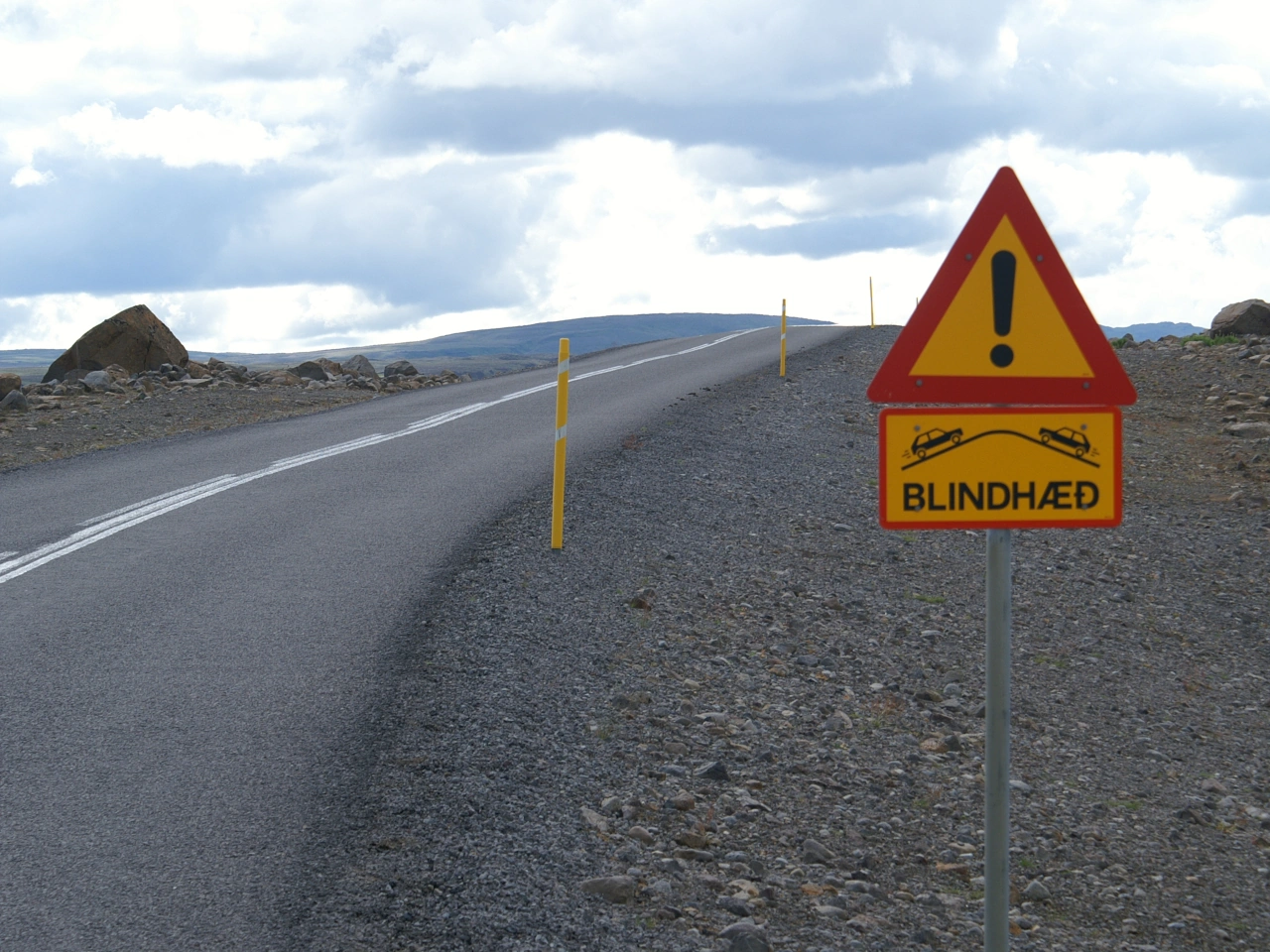
Wikimedia.org • Dickelbers • CC BY-SA
What is a blind summit?
A blind summit is the crest of a hill where the driver's view of the road beyond the summit is restricted.
Why is a blind summit dangerous?
Vehicles, pedestrians, cyclists, bends or obstacles may be hidden beyond the crest, leaving drivers less time to react.
Should you overtake near a blind summit?
Generally, no when visibility is insufficient. Drivers should avoid entering the path of opposing traffic unless they have a clear view and overtaking is permitted by the applicable traffic rules.
16. Bus
A bus is a motor vehicle designed to transport multiple passengers, usually along roads as part of public transport, school transport, private transport or another passenger service. Buses generally have more passenger capacity than cars and may be designed to carry seated passengers, standing passengers or both.
Special rules may apply to buses concerning the driving licence, passenger capacity, speed limits, seat belts, bus lanes, stops and passenger boarding. The legal classification of buses and coaches and the rules applying to them vary between countries, so drivers and passengers must follow the local traffic regulations.
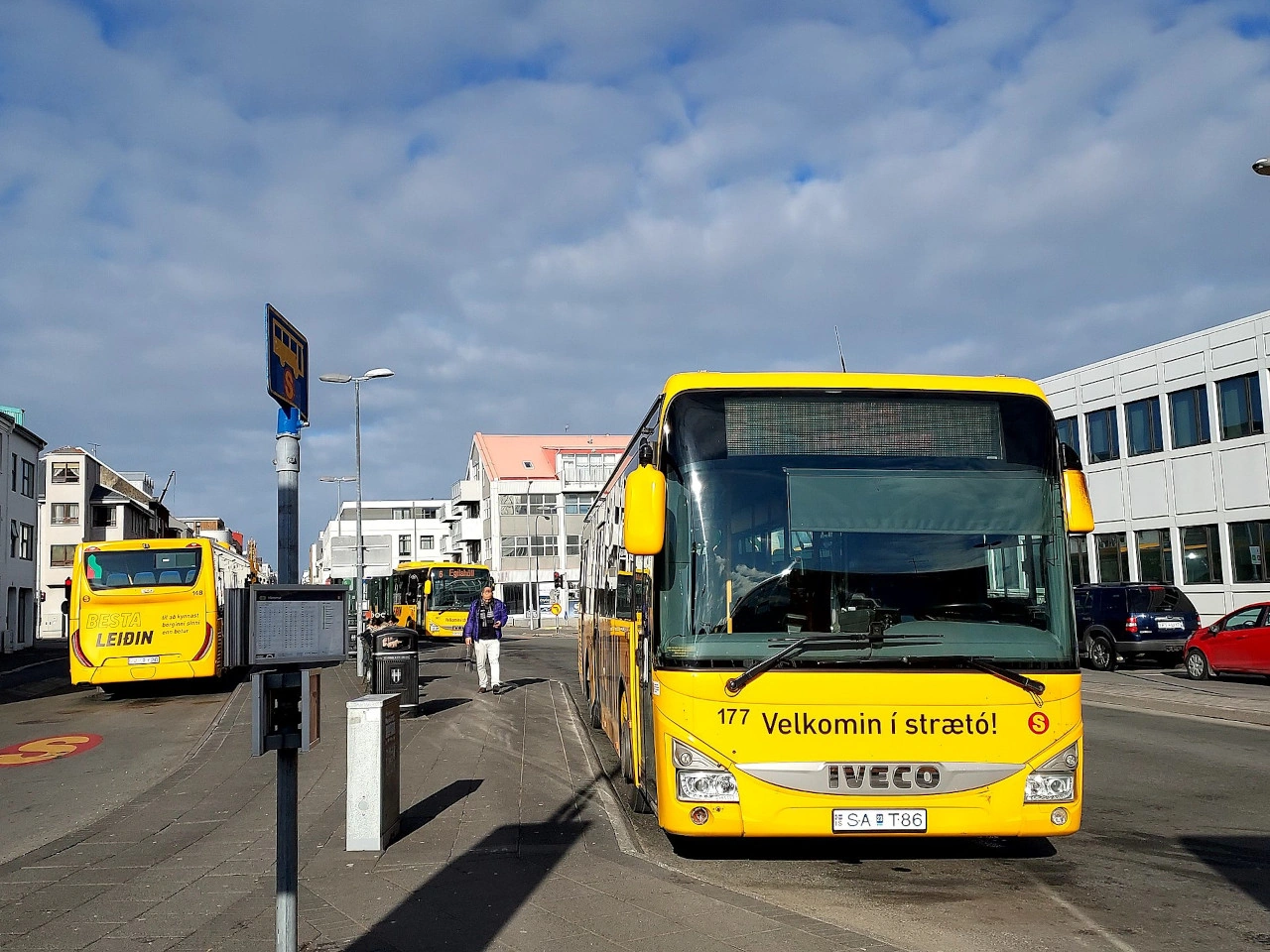
Wikimedia.org • Jonathan Dann • CC BY-SA
What is a bus?
A bus is a motor vehicle designed to transport a relatively large number of passengers. It may be used for public transport, school transport, private services or other passenger transport.
What is the difference between a bus and a coach?
A bus is commonly designed for frequent passenger boarding and may allow standing passengers, while a coach is generally designed for longer journeys with passengers seated. Exact legal definitions vary between countries.
Do you need a special driving licence to drive a bus?
Yes. Driving a vehicle designed to carry more than a specified number of passengers normally requires a dedicated bus or passenger-vehicle driving licence.
Can passengers stand on a bus?
Only when the vehicle is designed and approved to carry standing passengers. Coaches and other vehicles designed exclusively for seated passengers must not be used beyond their approved passenger configuration.
Must bus passengers wear seat belts?
Where seat belts are provided and local law requires their use, passengers must wear them correctly. Urban buses designed for standing passengers may have seating positions or operating conditions that differ from coaches.
Can buses use bus lanes?
Yes, where permitted. Bus lanes are commonly reserved for public transport buses, although local signs may also allow taxis, bicycles or other specified vehicles to use them.
Do buses always have priority when leaving a bus stop?
No. Some countries require other drivers to give way to buses leaving designated stops, particularly in urban areas, while others apply the normal merging rules.
Should you take extra care near a stopped bus?
Yes. Passengers may be boarding, leaving or crossing the road near the bus. Reduce speed where necessary and watch carefully for pedestrians emerging from behind or in front of the vehicle.
Do buses have special speed limits?
They can. Some countries impose lower maximum speeds on buses than on passenger cars, particularly on high-speed roads. Different limits may apply to buses and coaches.
Can a bus use a motorway?
Yes, normally. Buses that satisfy the applicable construction and access requirements may use motorways, but they must obey any vehicle-specific speed limits, lane restrictions and other local rules.
17. Police
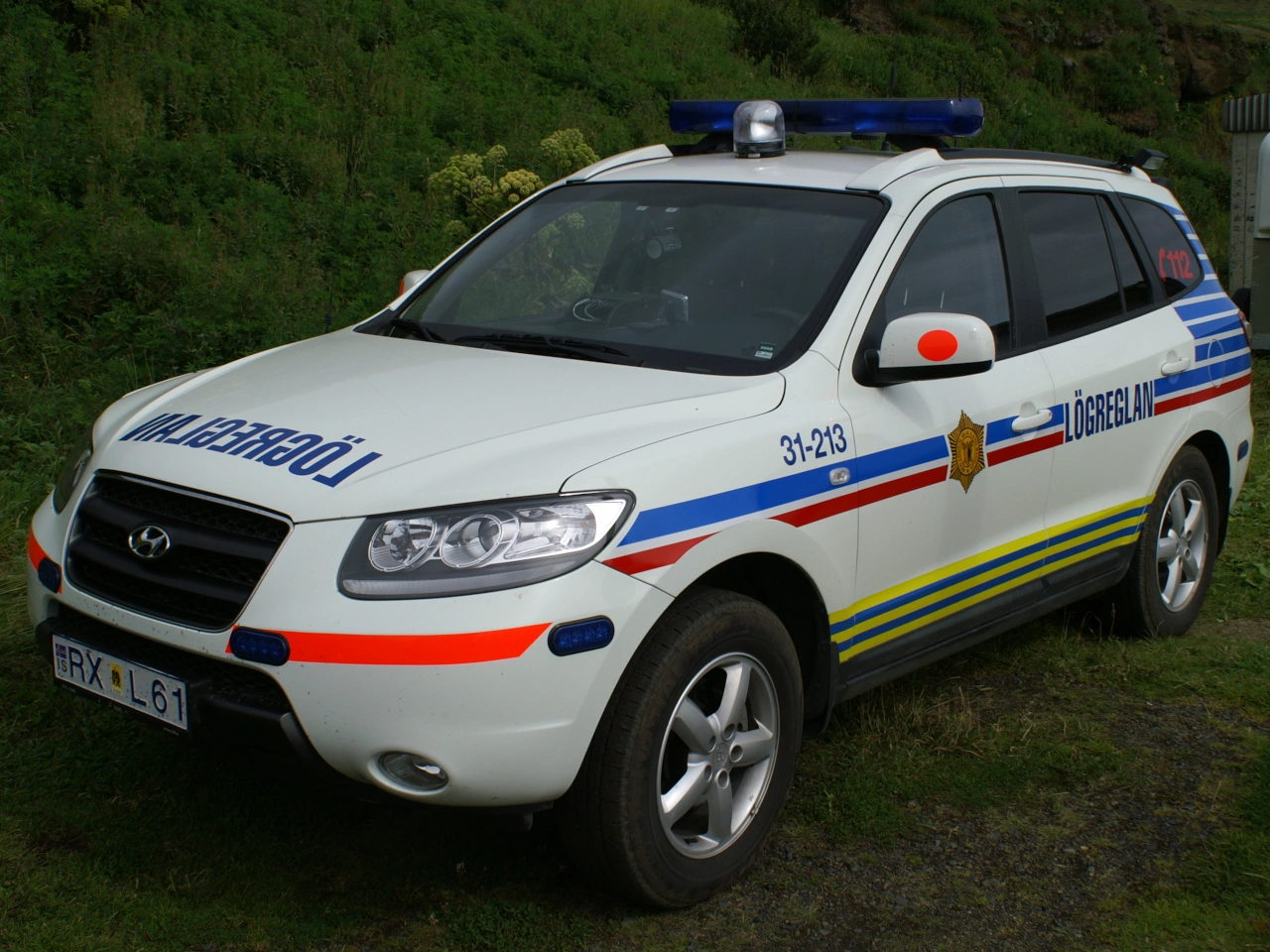
Police are public authorities responsible for enforcing laws, maintaining public safety and managing situations that may affect road traffic. In traffic, police officers may control vehicles, enforce traffic rules, investigate collisions, direct traffic and respond to emergencies.
Road users must follow lawful instructions given by police officers or other authorised traffic-control personnel. Police directions may temporarily override traffic lights, road signs or normal traffic arrangements, depending on local law.
Wikimedia.org • Dickelbers • CC BY-SA
What is the role of police in road traffic?
Police help enforce traffic laws, manage traffic, investigate collisions and respond to dangerous situations. They may also carry out roadside checks and direct road users.
Must you obey a police officer directing traffic?
Yes. Lawful directions given by an authorised police officer must be followed. In many countries, those directions take precedence over traffic lights, road signs and normal priority rules.
What should you do if police signal you to stop?
Slow down, follow the officer's directions and stop at a safe location as instructed. Do not make sudden movements or continue driving unless directed to do so.
Can police direct you through a red traffic light?
Yes, where authorised by local law. A police officer controlling traffic may instruct road users to proceed even when a traffic light or sign would normally require them to stop.
Can police check your driving documents?
Yes. Police may require drivers to provide documents such as a driving licence, vehicle registration, identification or proof of insurance according to local law.
Can police carry out alcohol or drug checks?
Yes. Traffic police may conduct legally authorised alcohol and drug checks using procedures such as breath, saliva or other approved tests.
Can police temporarily close a road?
Yes. Roads or lanes may be temporarily closed or traffic diverted because of collisions, emergencies, investigations, public events or other safety concerns.
What should you do near police controlling an accident scene?
Reduce speed, remain alert and follow all directions. Do not enter a closed area or interfere with emergency personnel, and leave sufficient space for emergency vehicles.
What should you do when a police vehicle approaches with emergency signals?
Follow the local rules for priority vehicles. Drivers generally have to make sufficient space, give way and stop where necessary so that the emergency vehicle can pass safely.
Can police order a parked vehicle to be moved?
Yes, where local law permits it. Police or another authorised authority may require a vehicle to be moved when it obstructs traffic, creates danger or must be removed for operational reasons.
18. Ambulance
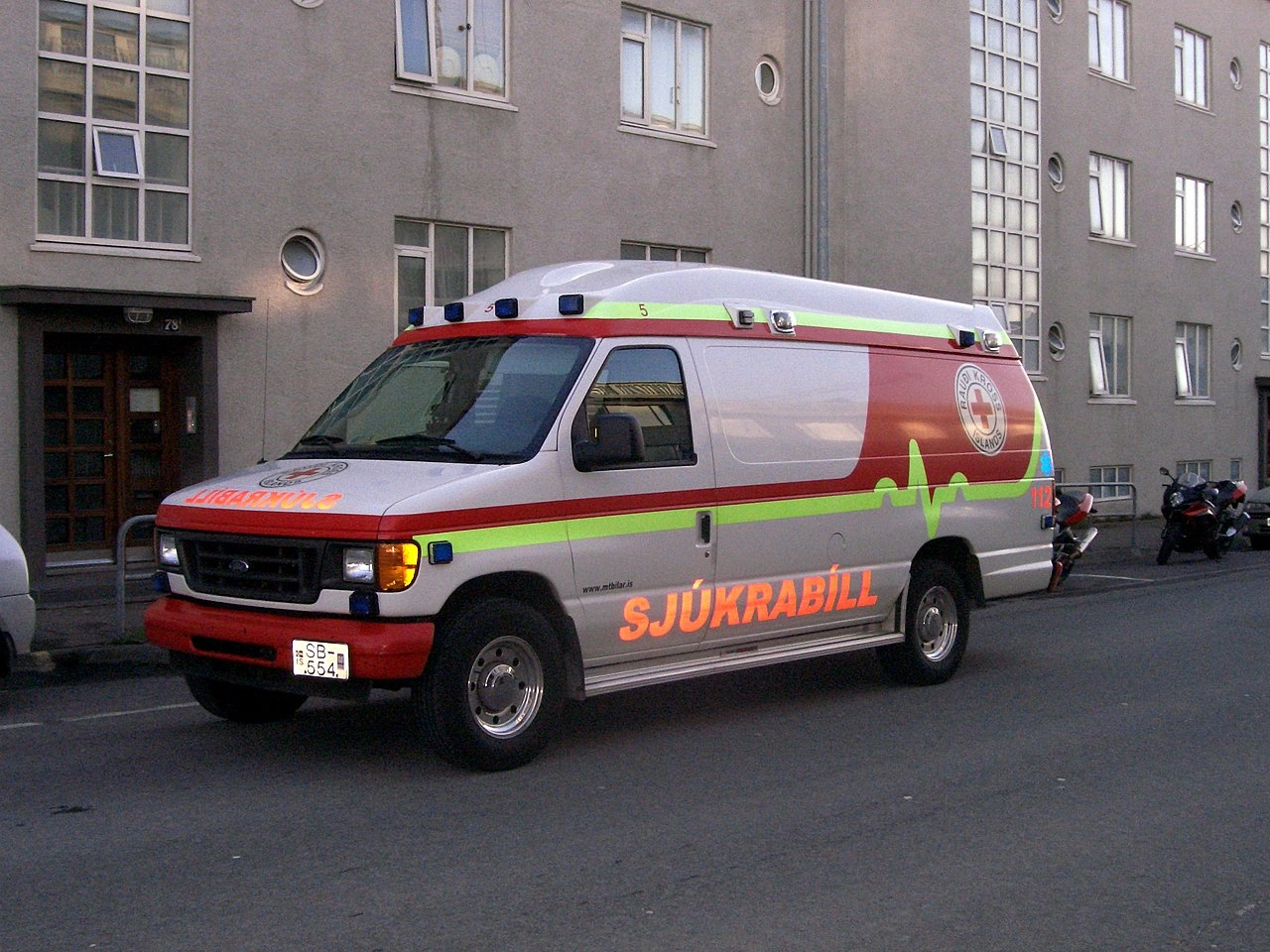
An ambulance is a vehicle equipped and used to provide emergency medical assistance or transport patients to or between healthcare facilities. Ambulances may carry medical equipment and trained personnel who can provide treatment during transport.
During an emergency response, an ambulance may use warning lights and a siren and may receive special priority or exemptions from certain traffic rules. Other road users must follow the local rules for emergency vehicles, make sufficient space and avoid obstructing their passage.
Wikimedia.org • Eysteinn Guðni Guðnason • CC BY-SA
What is an ambulance?
An ambulance is a specially equipped vehicle used to provide emergency medical assistance and transport sick or injured people.
When does an ambulance have priority?
This depends on the local traffic rules and warning signals being used. Ambulances responding to emergencies commonly use flashing lights and a siren to indicate that other road users must make way.
What should you do when an ambulance approaches?
Remain calm and make sufficient space for it to pass. Slow down or stop where necessary, but avoid sudden or dangerous manoeuvres.
Should you stop immediately when you hear an ambulance siren?
Not necessarily in your exact position. Move or stop in a way that creates a safe passage without blocking an intersection, pedestrian crossing or another part of the road needed by the ambulance.
Can an ambulance pass a red traffic light?
Emergency vehicles may be allowed to pass a red light during an urgent response under special legal conditions. The precise rules differ between countries, and the ambulance driver must still take appropriate precautions.
Can an ambulance exceed the speed limit?
Many countries permit emergency vehicles to depart from certain normal speed rules during an urgent mission, subject to safety requirements and national legislation.
Can an ambulance drive through a traffic queue?
Yes, when responding to an emergency and legally permitted to do so. Other road users should create space and keep emergency corridors or access routes clear where required.
Can you follow an ambulance through traffic?
You should not use the passage created for an ambulance as a way to bypass congestion. Maintain a safe distance and continue to obey the normal traffic rules.
Do ambulances always use their sirens?
No. The use of warning lights and sirens depends on the urgency of the mission and local regulations. An ambulance transporting a patient does not necessarily need to use emergency signals throughout the journey.
What should you do near a stationary ambulance?
Reduce speed and remain alert. Medical personnel, patients or other emergency workers may be entering the road, and the ambulance may need to move unexpectedly.
19. European emission standard
A European emission standard, commonly called a Euro standard, is a European vehicle classification based on limits for pollutants emitted by vehicles and their engines. Successive standards, such as Euro 4, Euro 5 and Euro 6, introduced progressively stricter requirements for pollutants such as nitrogen oxides, particulate matter, carbon monoxide and hydrocarbons.
A vehicle's Euro standard is determined as part of its type approval and depends on factors including the vehicle category, fuel type and applicable emissions legislation when it was approved. Euro standards may also be used by authorities to determine access to low-emission zones, but local access rules vary between countries and cities.

Wikimedia.org • Rfeba • CC0
What is a European emission standard?
A European emission standard, or Euro standard, classifies vehicles according to the emissions requirements they had to satisfy when approved for use in the European market.
What do Euro 4, Euro 5 and Euro 6 mean?
They are successive generations of European emission requirements. In general, a higher Euro number represents a newer and stricter emissions standard, although the exact limits differ according to vehicle and fuel type.
Which pollutants do Euro standards regulate?
Depending on the vehicle and standard, limits apply to pollutants such as nitrogen oxides, particulate matter, carbon monoxide and hydrocarbons. Newer standards also regulate additional environmental aspects.
Is the Euro standard the same as a vehicle's CO2 emissions?
No. Euro standards primarily regulate harmful air pollutants from vehicles. Carbon-dioxide emissions and fuel or energy consumption are subject to separate measurements and regulatory requirements.
How can you find a vehicle's Euro standard?
The Euro standard may appear on the vehicle registration certificate, certificate of conformity or other official vehicle documentation. Its location and format vary between countries.
Does the year of a vehicle determine its Euro standard?
The date of first registration can provide an indication, but it does not always determine the standard with certainty. The official vehicle documents or type-approval information provide the more reliable classification.
Can petrol and diesel vehicles with the same Euro number have different emission limits?
Yes. The applicable emission limits and testing requirements can differ according to the vehicle category, engine and fuel type even when vehicles belong to the same general Euro generation.
Can the Euro standard affect access to a low-emission zone?
Yes. Many low-emission zones use the vehicle's Euro standard together with factors such as fuel type and vehicle category to determine whether it may enter.
Does installing a particulate filter automatically change the Euro standard?
Not normally. The official Euro standard is linked to the vehicle's approved emissions classification. Retrofitting emission-control equipment does not necessarily result in a different official Euro classification.
What is Euro 7?
Euro 7 is the latest European emissions framework for road vehicles. It builds on earlier Euro standards and also introduces requirements covering areas such as non-exhaust particle emissions and battery durability.
20. Pothole
A pothole is a hole or depression in the road surface caused by wear, weather, water, repeated traffic loads or deterioration of the pavement. Potholes can vary greatly in size and depth and may develop gradually or become worse after freezing, heavy rain or repeated vehicle traffic.
Potholes can affect steering, braking and vehicle stability and may damage tyres, wheels or suspension components. Drivers and riders should observe the road ahead, adapt their speed and avoid sudden or dangerous manoeuvres when encountering damaged road surfaces.

Wikimedia.org • State Farm • CC BY
What is a pothole?
A pothole is a hole or depression that develops in a road surface when the pavement becomes damaged or deteriorates.
How do potholes form?
Potholes can develop through a combination of water, temperature changes, traffic loads and deterioration of the road material. Cracks can gradually expand until pieces of the surface break away.
Why are potholes dangerous?
A pothole can cause a vehicle to change direction suddenly, lose stability or suffer tyre, wheel or suspension damage. Deep potholes can present a particularly serious hazard at higher speeds.
What should you do when you see a pothole?
Reduce speed when necessary, maintain control of the vehicle and avoid abrupt steering or braking. Only move around the pothole when this can be done safely without endangering other road users.
Should you brake while driving through a pothole?
If possible, reduce your speed before reaching the pothole. Sudden heavy braking or steering while passing over a damaged surface can make the vehicle less stable.
Are potholes particularly dangerous for motorcycles?
Yes. A pothole can disturb the steering or balance of a motorcycle and may cause the rider to lose control.
Are potholes dangerous for cyclists?
Yes. Bicycle wheels can be strongly affected by deep holes or sharp edges, particularly when the cyclist has little time or space to avoid the hazard.
Can a pothole damage a car?
Yes. Severe impacts can damage tyres, wheel rims, suspension components, steering parts or wheel alignment.
Should you swerve suddenly to avoid a pothole?
No. A sudden evasive movement may create a greater danger by bringing the vehicle into conflict with cyclists, pedestrians, oncoming traffic or vehicles in another lane.
Can a warning sign indicate potholes ahead?
Yes. Depending on the country's traffic-sign system, an uneven-road or general-danger warning sign may be used where poor road conditions create a significant hazard.
21. Path
A path is a relatively narrow route intended for pedestrians and, where permitted, other road users or small vehicles. Paths may run through urban areas, countryside, parks, forests or between other roads and can be surfaced or unsurfaced.
A path is not necessarily the same as a footpath or cycle path. The road users permitted to use it depend on its legal status, width, traffic signs and local regulations.

Wikimedia.org • Tangopaso • CC0
What is a path?
A path is a relatively narrow route intended primarily for pedestrians and, where permitted, other road users or small vehicles.
Is a path the same as a footpath?
Not necessarily. A footpath is specifically intended for pedestrians, while a path may also permit cyclists or other users according to local rules.
Is a path the same as a cycle path?
No. A cycle path is specifically designated for bicycles and other permitted users. An ordinary path does not automatically have that legal status.
Can cyclists use a path?
This depends on the legal status, width and signs applying to the path. Some paths permit cyclists, while others are reserved for pedestrians or particular users.
Can motor vehicles use a path?
This depends on local law. Some paths prohibit motor vehicles entirely, while narrow vehicles may be permitted on other paths unless traffic signs restrict access.
Can a path be part of the public-road network?
Yes. A narrow path can legally form part of the public-road network even when it is unsuitable for ordinary cars.
Does a path need to be paved?
No. Paths can be paved, gravelled, compacted or unsurfaced depending on their location and purpose.
Can traffic signs restrict access to a path?
Yes. Signs can reserve a path for particular road users or prohibit certain vehicles, regardless of whether they could physically fit on it.
Who has priority when a path joins a larger road?
The applicable local priority rules determine who must give way. Special rules often apply when a minor path joins an ordinary road.
Can pedestrians and cyclists share a path?
Yes, where both are permitted. Faster users should adapt their speed and avoid endangering or unnecessarily obstructing pedestrians.
Can a path cross another road?
Yes. At the crossing, users must follow the applicable priority signs, traffic lights, road markings and general right-of-way rules.
Is every narrow route legally a path?
No. Its legal classification depends on the definitions and regulations of the country concerned. A narrow route might instead be a footpath, cycle path, private access road or another type of facility.
22. Particulates
Particulates, or particulate matter (PM), are tiny solid particles or liquid droplets suspended in the air. In road traffic, particulate emissions can come from vehicle exhaust, brake wear, tyre wear and road-surface wear, as well as dust that is disturbed by passing traffic.
Particulate matter is commonly classified by particle size. PM10 refers to particles with a diameter of up to approximately 10 micrometres, while PM2.5 refers to finer particles of up to approximately 2.5 micrometres. Vehicle emission standards, particulate filters and air-quality measures are used to reduce exposure to these pollutants.

Wikimedia.org • wili hybrid • CC BY
What are particulates?
Particulates, or particulate matter, are very small solid particles or liquid droplets suspended in the air.
What are PM10 and PM2.5?
PM10 refers to particles with a diameter of up to approximately 10 micrometres. PM2.5 refers to finer particles with a diameter of up to approximately 2.5 micrometres.
Where do traffic particulates come from?
Road traffic can produce particles through engine exhaust, brake wear, tyre wear and road-surface wear. Passing traffic can also resuspend dust already present on the road.
Are diesel vehicles a source of particulates?
Yes. Combustion in diesel engines can produce very small soot particles. Modern diesel vehicles commonly use particulate filters to capture a large proportion of these exhaust particles.
What is a particulate filter?
A particulate filter is an exhaust-treatment device designed to trap particulate matter produced by an engine. Diesel particulate filters are commonly known as DPFs.
Do petrol engines produce particulates?
Yes. Petrol engines can also produce particulate emissions, particularly certain direct-injection engines. Appropriate emission-control systems may therefore include particulate filters.
Do electric vehicles produce particulates?
Fully electric vehicles produce no exhaust particulates from a combustion engine, but particles can still result from tyre wear, road wear and braking.
Are brake and tyre particles regulated?
Vehicle-emission regulation is increasingly addressing non-exhaust emissions. The European Euro 7 framework includes requirements concerning brake-particle emissions and tyre abrasion.
Is particulate matter the same as CO2?
No. Particulate matter consists of tiny airborne particles, while carbon dioxide is a gas. They are different types of vehicle emissions and are regulated for different environmental reasons.
How can vehicle particulate emissions be reduced?
Measures include effective particulate filters, cleaner vehicle technologies, correctly maintained emission-control systems and reductions in brake, tyre and road-wear emissions.
23. Air pollution
Air pollution is the presence of gases, particles or other substances in the air at concentrations that can harm human health, the environment or ecosystems. Road traffic contributes to air pollution through exhaust emissions and through non-exhaust sources such as brake wear, tyre wear and road dust.
Important traffic-related pollutants include nitrogen oxides, particulate matter, carbon monoxide and volatile organic compounds. Some pollutants are emitted directly by vehicles, while others can form in the atmosphere through chemical reactions. Vehicle-emission standards, cleaner technologies and traffic-management measures are used to reduce these emissions.

Wikimedia.org • Emmanuelkwizera • CC BY-SA
What is air pollution?
Air pollution is contamination of the air by gases, particles or other substances that can adversely affect human health, the environment or ecosystems.
How does road traffic cause air pollution?
Vehicles produce pollutants through fuel combustion, exhaust systems, brake wear, tyre wear and road-surface interaction. Moving traffic can also resuspend dust already present on the road.
Which air pollutants are associated with road traffic?
Important traffic-related pollutants include nitrogen oxides, particulate matter, carbon monoxide and volatile organic compounds. Their relative importance depends on the vehicle, fuel and driving conditions.
What is nitrogen dioxide?
Nitrogen dioxide (NO2) is an air pollutant associated particularly with combustion processes and road traffic. High concentrations are commonly found near busy roads and densely trafficked urban areas.
What is particulate matter?
Particulate matter consists of tiny solid particles or liquid droplets suspended in the air. Road traffic can produce particles from exhaust, brakes, tyres and road surfaces.
Is CO2 the same as ordinary air pollution?
No. Carbon dioxide is primarily regulated as a greenhouse gas because of its contribution to climate change. Local air-quality pollution generally focuses on substances such as nitrogen dioxide, particulate matter, ozone and other pollutants that directly affect air quality and health.
Do electric vehicles cause air pollution?
Fully electric vehicles produce no combustion-engine exhaust emissions while driving, but they can still contribute to non-exhaust particulate emissions through tyres, brakes and road wear.
Can air pollution be worse near busy roads?
Yes. Concentrations of traffic-related pollutants can be higher close to heavily trafficked roads because many emissions occur close to ground level and near where people live and travel.
What is a low-emission zone?
A low-emission zone is an area where access by more polluting vehicles is restricted in order to reduce traffic-related air pollution. Access criteria may depend on factors such as fuel type, vehicle category and emission standard.
How can traffic-related air pollution be reduced?
Measures include cleaner vehicles, stricter emission standards, effective emission-control equipment, low-emission zones, public transport, cycling and walking, as well as traffic-management measures that reduce unnecessary congestion and emissions.
24. Rush hour
Rush hour is a period when roads and public transport networks experience particularly high demand, commonly because large numbers of people are travelling to or from work, school or other regular destinations. It usually occurs during the morning and late afternoon or evening on working days.
Rush-hour traffic can result in congestion, slower speeds, longer journeys and frequent stopping. Drivers should maintain a safe following distance, remain patient, anticipate changing traffic conditions and follow any temporary or dynamic traffic-management measures.

Wikimedia.org • MDRX • CC BY-SA
What is rush hour?
Rush hour is a period when unusually large numbers of people travel at the same time, resulting in increased traffic and often congestion.
When does rush hour occur?
Rush hour commonly occurs during the morning and late afternoon or evening on working days, but the exact times vary according to the city, road and local travel patterns.
Does rush hour always last one hour?
No. The term does not mean that congestion lasts exactly one hour. In busy urban areas, peak traffic conditions may continue for several hours.
Why does traffic become congested during rush hour?
Congestion develops when traffic demand approaches or exceeds the available road capacity. Intersections, merging traffic, collisions, roadworks and weather can make the congestion worse.
Should you increase your following distance in rush-hour traffic?
Yes. Leave sufficient distance to react to sudden braking and frequent changes in traffic speed. Avoid following another vehicle too closely even when traffic is moving slowly.
Should you frequently change lanes during congestion?
Unnecessary lane changes can create additional conflicts and may not significantly reduce journey time. Choose an appropriate lane, observe surrounding traffic and change lane only when it can be done safely.
Can speed limits change during rush hour?
Yes. Roads equipped with variable traffic management may display lower speed limits during congestion. Drivers must follow the speed limit currently indicated.
What is a rush-hour lane?
A rush-hour lane is an additional traffic lane that can be opened during busy periods to increase road capacity. It may use a lane or shoulder that is closed to normal traffic at other times.
Can you use a rush-hour lane whenever traffic is congested?
No. Such a lane may only be used when traffic signals or signs indicate that it is open. Never assume that congestion alone permits its use.
How can you prepare for a journey during rush hour?
Check current traffic conditions and expected journey times, allow additional travel time and consider an alternative route, departure time or mode of transport where appropriate.
25. Road code
A road code is a collection of laws and traffic rules that regulate how people use public roads. It establishes rules for drivers, cyclists, pedestrians and other road users and covers subjects such as priority, speed, overtaking, parking, traffic lights, road signs and road markings.
Road codes differ between countries and sometimes between regions. Every road user is expected to know and follow the rules that apply where they are travelling, even when those rules differ from those in their home country.
What is a road code?
A road code is the body of traffic rules and regulations governing how road users must behave on public roads.
What does a road code regulate?
A road code can regulate subjects such as priority, speed, overtaking, turning, parking, traffic signals, road signs and road markings, as well as the responsibilities of different road users.
Are road codes the same in every country?
No. Although many traffic rules and signs are similar internationally, each country establishes its own traffic legislation and may apply different rules, signs, speed limits and requirements.