


Traffic signsJapan
 Traffic rules
 Japan
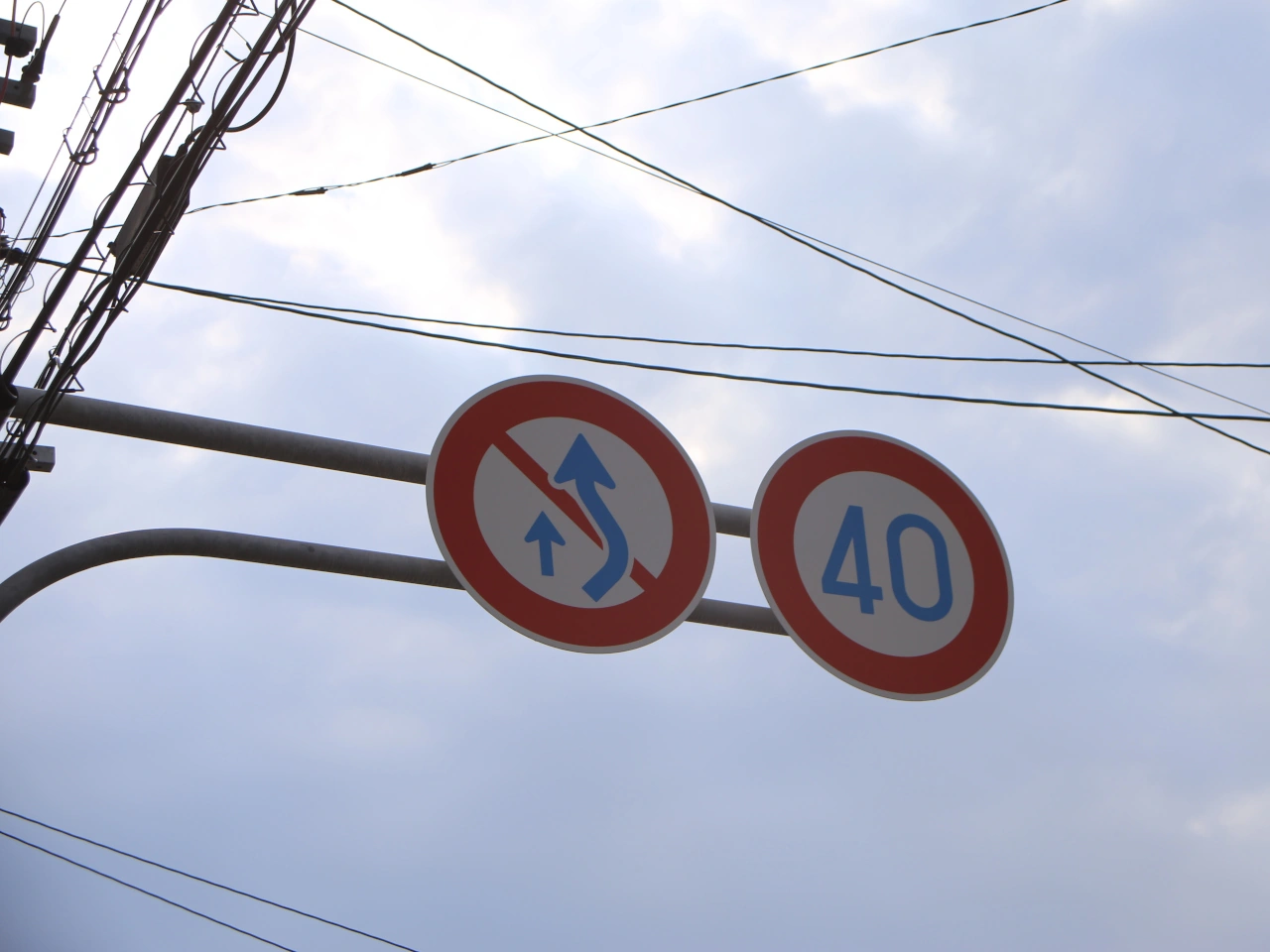
26. Overtaking
Overtaking is the act of passing another road user travelling in the same direction. It normally involves moving to another position or lane, passing the slower road user and returning to the appropriate position when it is safe.
Before overtaking, a driver should make sure there is sufficient visibility and space, check mirrors and blind spots, signal when required and ensure that no other road user is already overtaking. The manoeuvre must be completed without exceeding the speed limit or endangering other road users.
Wikimedia.org • 円周率3パーセント • CC BY-SA
On which side do drivers normally overtake in Japan?
As traffic normally keeps left, drivers ordinarily overtake on the right. This is the general rule, not permission to pass wherever a lane is available; exceptions and restrictions depend on the local law.
🔗 laws.e-gov.go.jp • Japan Road Traffic Act — Articles 18, 28–30
🔗 laws.e-gov.go.jp • e-Gov — current enforced Road Traffic Act, revision metadata and full text
🔗 npa.go.jp • NPA — current 2026 bicycle rulebook; facility allocation and passing duties
When should you avoid overtaking in Japan?
Do not begin if approaching traffic, restricted visibility, road markings, an intersection, a crossing or another road user makes the manoeuvre unsafe or unlawful. Check behind and ahead, allow enough space and never exceed the speed limit to complete the pass.
🔗 laws.e-gov.go.jp • Japan Road Traffic Act — Articles 18, 28–30
🔗 laws.e-gov.go.jp • e-Gov — current enforced Road Traffic Act, revision metadata and full text
🔗 npa.go.jp • NPA — current 2026 bicycle rulebook; facility allocation and passing duties
What extra care is needed when overtaking slower road users in Japan?
When overtaking, comply with Article 28 and allow safe clearance for the speed and circumstances. Separately, from 1 April 2026, Article 18(3) requires a safe speed appropriate to the available gap when a motor vehicle passes to the right of a same-direction bicycle or specified small motorised bicycle, outside an overtaking manoeuvre, without sufficient clearance. Do not treat guidance distances as a fixed statutory minimum for every pass. Wait if you cannot pass safely; Article 18(2) separately protects pedestrians through safe clearance or slow travel.
🔗 laws.e-gov.go.jp • Japan Road Traffic Act — Articles 18, 28–30
🔗 laws.e-gov.go.jp • e-Gov — current enforced Road Traffic Act, revision metadata and full text
🔗 npa.go.jp • NPA — current 2026 bicycle rulebook; facility allocation and passing duties

27. Crossing animals
An animals-crossing warning indicates a place or road section where wild animals, livestock or ridden animals may enter or cross the road. Animals may appear suddenly, move unpredictably or be difficult to see in darkness, vegetation or poor weather.
Drivers should reduce speed, scan both sides of the road and remain prepared to stop. The warning sign does not itself give animals priority or impose a numerical speed limit, but drivers must avoid frightening, endangering or colliding with them.
Wikimedia.org • Muramasa • CC BY-SA
Which animals might drivers encounter on roads in Japan?
An animal-warning sign identifies a risk of animals entering the road. Read the actual pictogram, any supplementary information and local warnings. Slow when animals may be present, leave space and watch for more animals following; the sign does not establish that the hazard ends immediately beyond it.
🔗 laws.e-gov.go.jp • e-Gov — current enforced Road Traffic Act, revision metadata and full text
🔗 npa.go.jp • NPA — Traffic Lights and Road Signs, official English definitions
🔗 npa.go.jp • NPA — traffic instruction handbook, sign groups and road use; read with current Act
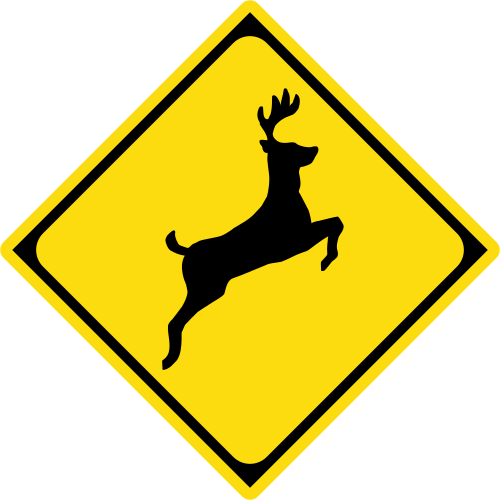 Warning for crossing deer.
English • Traffic sign 214の2 • Animals may emerge. Deer or other animals may suddenly enter the road. Check the surroundings and be prepared.
日本語 • 214の2 • 動物が飛び出すおそれあり。 この先ではシカなどの動物が道路に飛び出すおそれがあります。周囲を確認し、急な出現に備えてください。
Sources
🔗 Commons.wikimedia.org
🔗 Laws.e-gov.go.jp • 道路標識、区画線及び道路標示に関する命令、別表第一・第二
🔗 Mlit.go.jp • 国土交通省、道路標識一覧
SVG source: Monaneko • Public domain • Original revision 2013-06-19. Wikimedia original unmodified.
Does an animal-crossing warning sign in Japan set a new speed limit?
A warning of animals is not, by itself, a numerical speed-limit sign. Continue to obey the applicable speed limit, but slow down whenever animals could enter the road or visibility is poor. A separate regulatory speed sign must also be obeyed.
🔗 laws.e-gov.go.jp • e-Gov — current enforced Road Traffic Act, revision metadata and full text
🔗 npa.go.jp • NPA — Traffic Lights and Road Signs, official English definitions
🔗 npa.go.jp • NPA — traffic instruction handbook, sign groups and road use; read with current Act
What should you do if an animal enters the road in Japan?
Ease off the accelerator, assess the traffic behind and brake smoothly if necessary. Avoid abrupt swerving into opposing traffic or off the road. Give farm animals and ridden animals room, avoid frightening them with unnecessary horn use, and be alert for more animals following.
🔗 laws.e-gov.go.jp • e-Gov — current enforced Road Traffic Act, revision metadata and full text
🔗 npa.go.jp • NPA — Traffic Lights and Road Signs, official English definitions
🔗 npa.go.jp • NPA — traffic instruction handbook, sign groups and road use; read with current Act
28. Slippery road
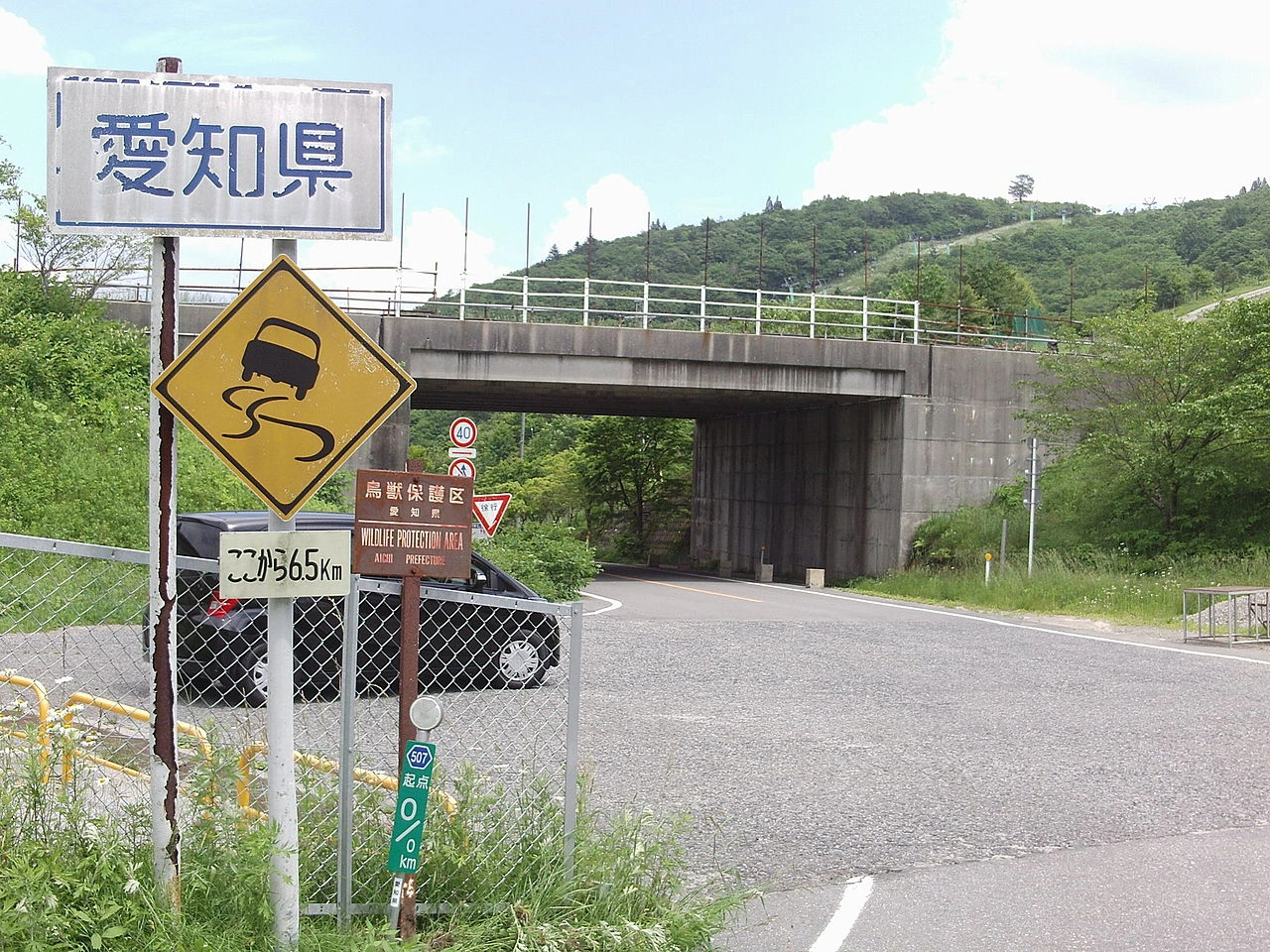
A slippery road has reduced tyre grip and can make steering, braking and acceleration less effective. Roads may become slippery because of rain, ice, snow, mud, oil, loose material or other substances on the surface. Drivers should reduce speed, increase their following distance and avoid sudden steering, braking or acceleration. Extra caution is needed in bends, on bridges and wherever the road surface changes unexpectedly.
Wikimedia.org • Charidri • CC0
What can make roads slippery in Japan?
Water, ice, mud, oil or other surface contamination can reduce grip where present. Conditions may change along the road, and a surface that looks clear can still be slippery. Reduce speed for the actual grip and visibility and make smooth steering, braking and acceleration inputs.
🔗 laws.e-gov.go.jp • e-Gov — current enforced Road Traffic Act, revision metadata and full text
🔗 npa.go.jp • NPA — Traffic Lights and Road Signs, official English definitions
🔗 npa.go.jp • NPA — traffic instruction handbook, sign groups and road use; read with current Act
How should you drive on a slippery road in Japan?
Reduce speed early, increase the gap to the vehicle ahead and use smooth steering, braking and acceleration. Do not rely on the posted maximum as a safe target when grip is poor.
🔗 laws.e-gov.go.jp • e-Gov — current enforced Road Traffic Act, revision metadata and full text
🔗 npa.go.jp • NPA — Traffic Lights and Road Signs, official English definitions
🔗 npa.go.jp • NPA — traffic instruction handbook, sign groups and road use; read with current Act
Does a slippery-road warning sign in Japan automatically impose a lower number?
The warning sign highlights a reduced-grip risk; it normally does not itself prescribe a new numerical speed limit. A separate speed-limit sign, temporary restriction or local condition may still apply. Travel below the legal maximum when necessary for safety.
🔗 laws.e-gov.go.jp • e-Gov — current enforced Road Traffic Act, revision metadata and full text
🔗 npa.go.jp • NPA — Traffic Lights and Road Signs, official English definitions
🔗 npa.go.jp • NPA — traffic instruction handbook, sign groups and road use; read with current Act
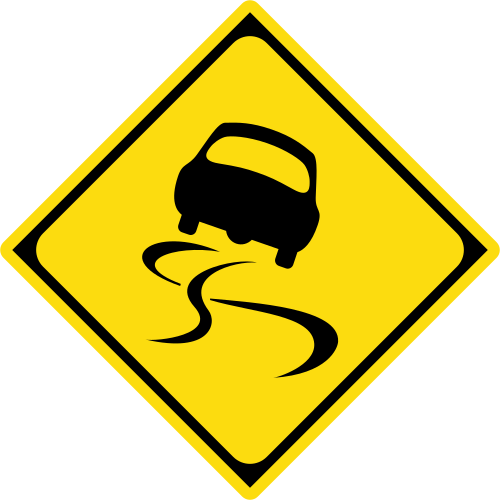 Warning for a slippery road surface.
English • Traffic sign 209 • Slippery surface. Avoid harsh braking or sudden steering.
日本語 • 209 • すべりやすい。 この先は路面がすべりやすい場所です。急ブレーキや急なハンドル操作を避けてください。
Sources
🔗 Commons.wikimedia.org
🔗 Laws.e-gov.go.jp • 道路標識、区画線及び道路標示に関する命令、別表第一・第二
🔗 Mlit.go.jp • 国土交通省、道路標識一覧
SVG source: Monaneko • Public domain • Original revision 2013-06-19. Wikimedia original unmodified.
29. Rockfall
A rockfall warning indicates a road section where rocks or stones may fall from a cliff, cutting or steep slope, or where fallen material may already be present on the road. The danger may affect the full carriageway and can appear suddenly.
Drivers should reduce speed, scan the road and slopes ahead, increase their following distance and remain prepared to stop. They should avoid unnecessary stopping in the exposed section and never attempt to move unstable rocks themselves.
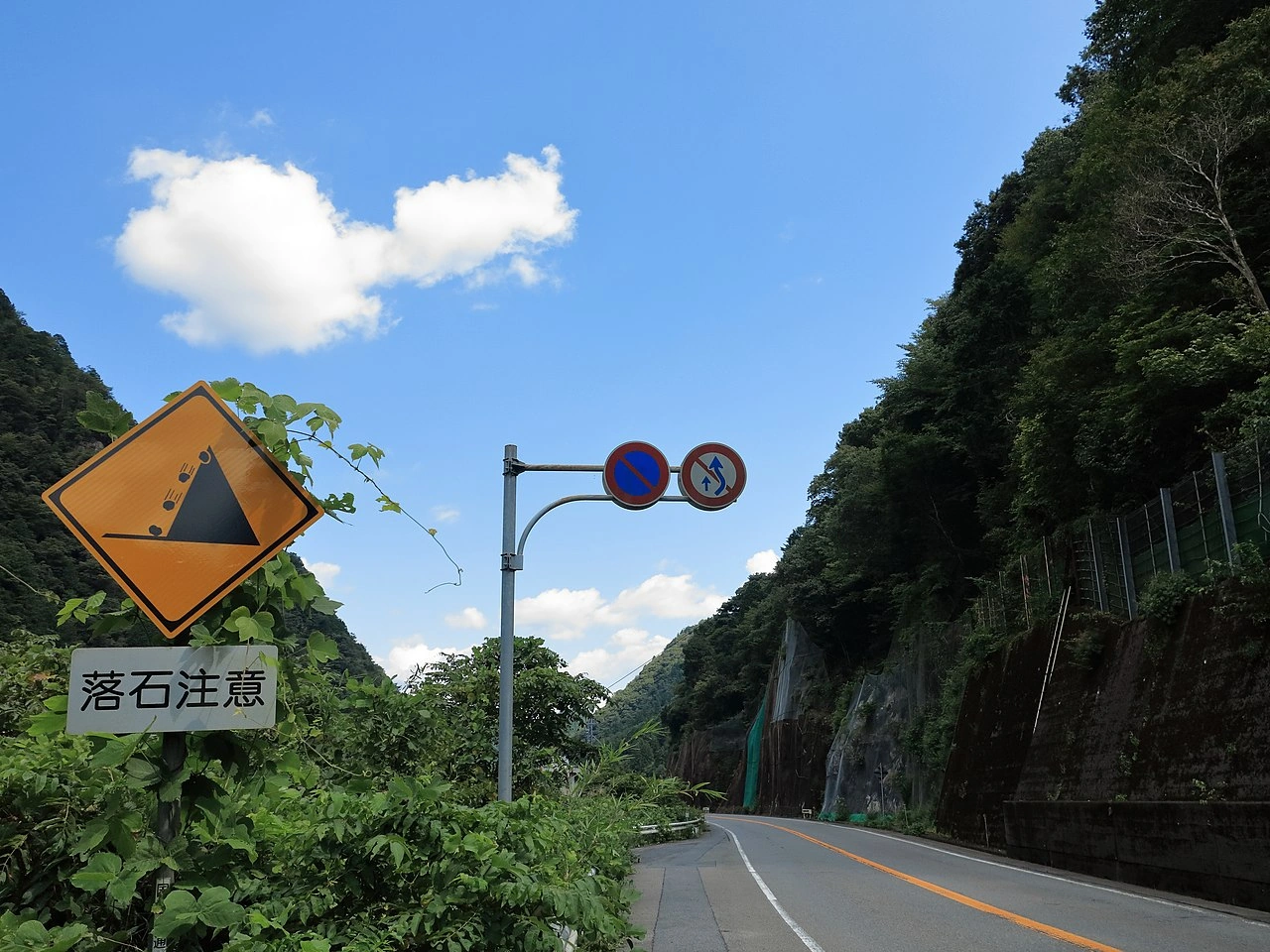
Wikimedia.org • Zeamonde • CC BY-SA
Where might falling rocks be a hazard on roads in Japan?
A falling-rocks warning identifies a slope-related hazard ahead. Watch for debris already on the carriageway and follow any closure or traffic-control instruction. The warning does not guarantee a clear road or provide a fixed safe speed; avoid stopping beneath an exposed slope unnecessarily.
🔗 laws.e-gov.go.jp • e-Gov — current enforced Road Traffic Act, revision metadata and full text
🔗 npa.go.jp • NPA — Traffic Lights and Road Signs, official English definitions
🔗 npa.go.jp • NPA — traffic instruction handbook, sign groups and road use; read with current Act
Does a falling-rocks warning sign in Japan impose a speed limit?
A falling-rocks sign is a hazard warning, not normally a numerical speed-limit sign. Follow any separate speed or closure signs, slow down to match visibility and conditions, and watch for material already on the road.
🔗 laws.e-gov.go.jp • e-Gov — current enforced Road Traffic Act, revision metadata and full text
🔗 npa.go.jp • NPA — Traffic Lights and Road Signs, official English definitions
🔗 npa.go.jp • NPA — traffic instruction handbook, sign groups and road use; read with current Act
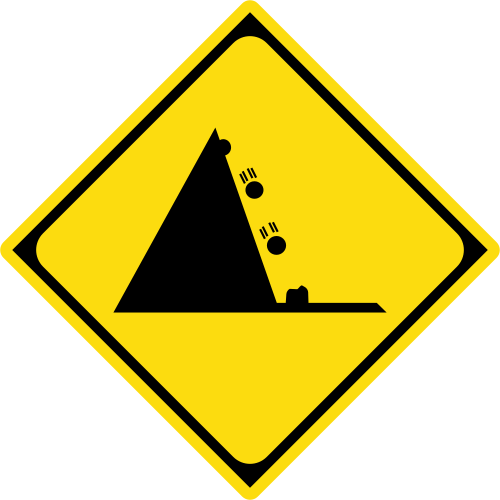 Warning for falling rocks.
English • Traffic sign 209の2 • Falling rocks. Check the surroundings and surface for falling rocks or stones already on the road.
日本語 • 209の2 • 落石のおそれあり。 この先では落石や路面に落ちている石に注意が必要です。周囲と路面をよく確認してください。
Sources
🔗 Commons.wikimedia.org
🔗 Laws.e-gov.go.jp • 道路標識、区画線及び道路標示に関する命令、別表第一・第二
🔗 Mlit.go.jp • 国土交通省、道路標識一覧
SVG source: Monaneko • Public domain • Original revision 2015-05-27. Wikimedia original unmodified.
What should you do if rocks are blocking the road in Japan?
Slow or stop in a safe place away from the exposed slope if possible. Do not drive over unstable debris or stop beneath a cliff unnecessarily. Follow any closure or traffic-control instructions and report a dangerous obstruction through the appropriate road authority or emergency channel.
🔗 laws.e-gov.go.jp • e-Gov — current enforced Road Traffic Act, revision metadata and full text
🔗 npa.go.jp • NPA — Traffic Lights and Road Signs, official English definitions
🔗 npa.go.jp • NPA — traffic instruction handbook, sign groups and road use; read with current Act
30. Curve
A curve is a section of road that changes direction to the left or right. A sharp, unexpected or poorly visible curve can reduce a driver’s view of approaching traffic, stopped vehicles, pedestrians and other hazards.
Drivers should reduce speed before entering the curve, remain within their lane and use smooth steering, braking and acceleration. Warning signs may indicate the direction of the first curve or a series of successive curves.
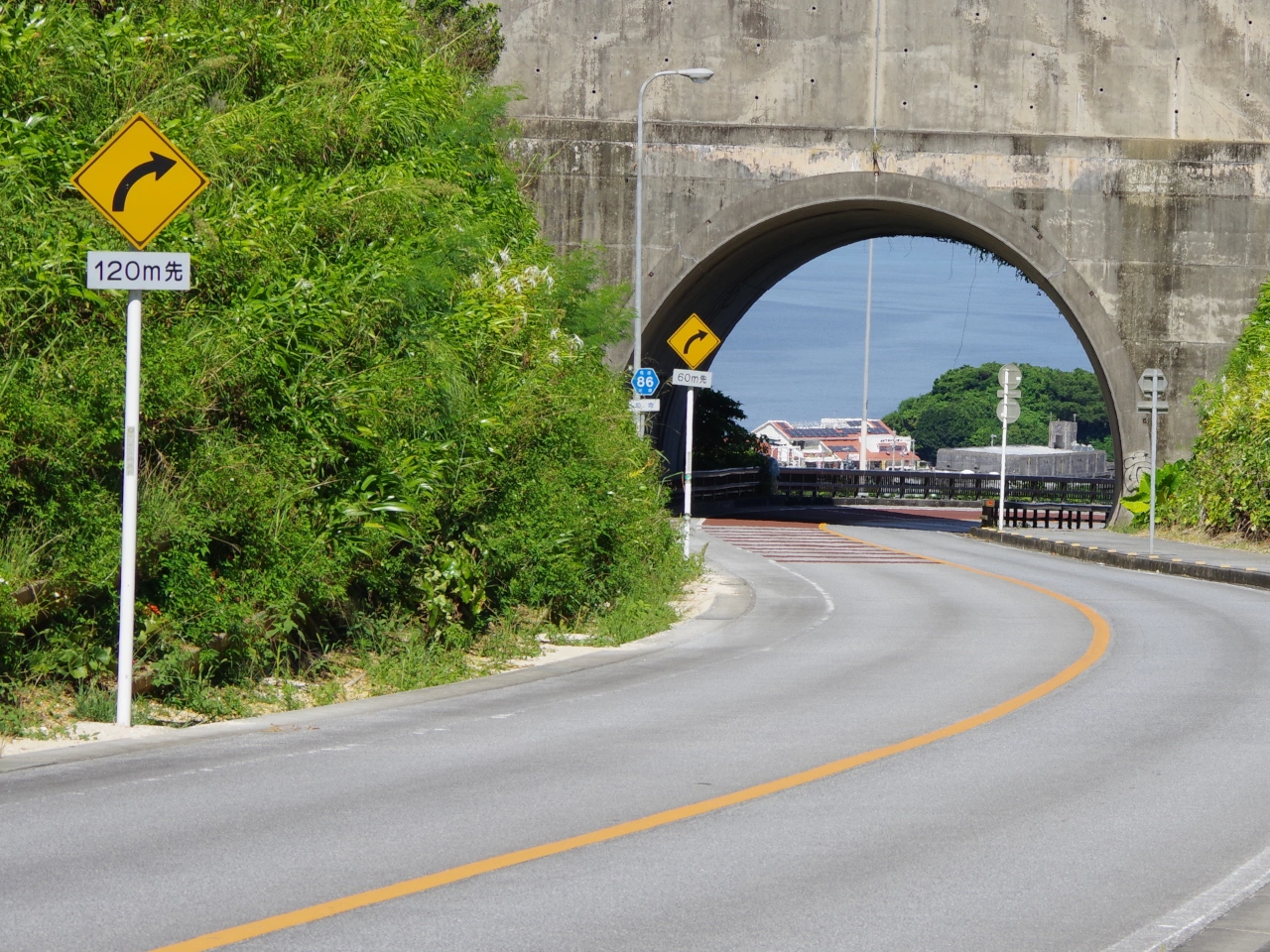
Wikimedia.org • Kugel • CC BY-SA
What makes a bend dangerous in Japan?
A bend can shorten the visible road and reduce the margin for correcting an error. Slow before entering and maintain control within the distance you can see to be clear. Grip, camber, traffic and hidden road users can require a speed well below the posted maximum.
🔗 laws.e-gov.go.jp • e-Gov — current enforced Road Traffic Act, revision metadata and full text
🔗 npa.go.jp • NPA — Traffic Lights and Road Signs, official English definitions
🔗 npa.go.jp • NPA — traffic instruction handbook, sign groups and road use; read with current Act
How should you approach a sharp curve in Japan?
Slow down before the bend, select the correct lane position, look through the curve and steer smoothly. Keep enough grip and visible stopping distance for the road and weather conditions.
🔗 laws.e-gov.go.jp • e-Gov — current enforced Road Traffic Act, revision metadata and full text
🔗 npa.go.jp • NPA — Traffic Lights and Road Signs, official English definitions
🔗 npa.go.jp • NPA — traffic instruction handbook, sign groups and road use; read with current Act
Is overtaking safe on a blind bend in Japan?
No. Do not start overtaking where your view of oncoming traffic is obstructed or where signs or road markings prohibit it. Wait until there is a lawful, clear and sufficiently long view ahead.
🔗 laws.e-gov.go.jp • e-Gov — current enforced Road Traffic Act, revision metadata and full text
🔗 npa.go.jp • NPA — Traffic Lights and Road Signs, official English definitions
🔗 npa.go.jp • NPA — traffic instruction handbook, sign groups and road use; read with current Act
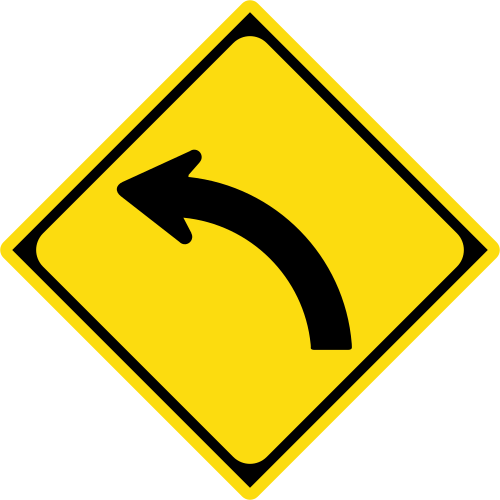 Warning for a curve to the left.
English • Traffic sign 202 • Left-hand bend. Adjust speed before entering.
日本語 • 202 • 左方屈曲あり。 この先に左カーブがあります。カーブに入る前に速度を調整してください。
Sources
🔗 Commons.wikimedia.org
🔗 Laws.e-gov.go.jp • 道路標識、区画線及び道路標示に関する命令、別表第一・第二
🔗 Mlit.go.jp • 国土交通省、道路標識一覧
SVG source: Monaneko • Public domain • Original revision 2013-06-20. Wikimedia original unmodified.
31. Wrong-way driving
Wrong-way driving occurs when a driver travels against the legally permitted direction of traffic. It may happen on a one-way road, divided road, motorway entrance or exit, or another road section reserved for traffic travelling in one direction.
Wrong-way driving creates an extreme risk of a head-on collision. Drivers must follow direction signs, no-entry signs, lane arrows and road markings. Anyone who accidentally enters a road in the wrong direction should slow down, warn other traffic, stop in the safest available place and contact the emergency services.
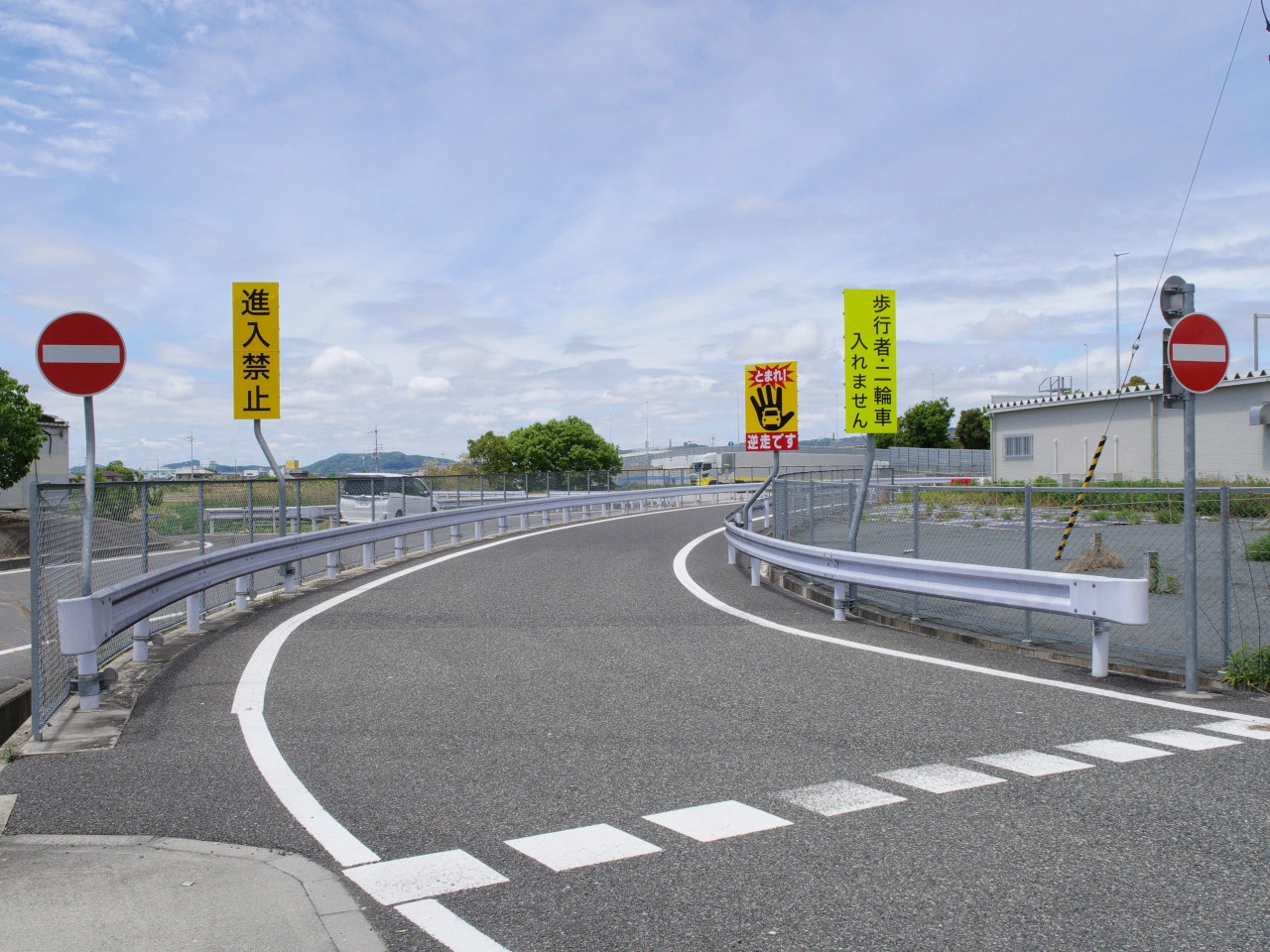
Wikimedia.org • Gohachiyasu1214 • CC BY-SA
How can you avoid driving the wrong way in Japan?
Traffic normally keeps left here. Keep to the correct side of the road and use no-entry and one-way signs to identify prohibited approaches; do not enter an exit ramp against its permitted direction.
🔗 laws.e-gov.go.jp • e-Gov — current enforced Road Traffic Act, revision metadata and full text
🔗 npa.go.jp • NPA — Traffic Lights and Road Signs, official English definitions
🔗 npa.go.jp • NPA — traffic instruction handbook, sign groups and road use; read with current Act
What signs can prevent wrong-way driving in Japan?
Read no-entry signs, one-way signs, lane arrows and temporary directions together; a wide road is not automatically two-way. Before entering a motorway, expressway, one-way street or slip road, check the permitted direction rather than relying only on a navigation app.
🔗 laws.e-gov.go.jp • e-Gov — current enforced Road Traffic Act, revision metadata and full text
🔗 npa.go.jp • NPA — Traffic Lights and Road Signs, official English definitions
🔗 npa.go.jp • NPA — traffic instruction handbook, sign groups and road use; read with current Act
What should you do if you enter a road against traffic in Japan?
Do not continue along the wrong-way lane or try to reverse or make a U-turn across a high-speed road. Reduce speed, warn other traffic if safe, get to a protected stopping place away from moving traffic when possible and contact the police or road operator for assistance.
🔗 laws.e-gov.go.jp • e-Gov — current enforced Road Traffic Act, revision metadata and full text
🔗 npa.go.jp • NPA — Traffic Lights and Road Signs, official English definitions
🔗 npa.go.jp • NPA — traffic instruction handbook, sign groups and road use; read with current Act
32. Roadworks
Roadworks are construction, maintenance, repair or inspection activities carried out on or beside a road. They may temporarily change the road layout, lane widths, speed limits, priority, permitted directions and facilities for pedestrians or cyclists.
Drivers must follow the temporary signs, traffic lights, barriers, road markings and instructions from authorised personnel. They should reduce speed, increase their following distance and remain prepared for narrow lanes, stopped traffic, workers, machinery and sudden changes in the route.
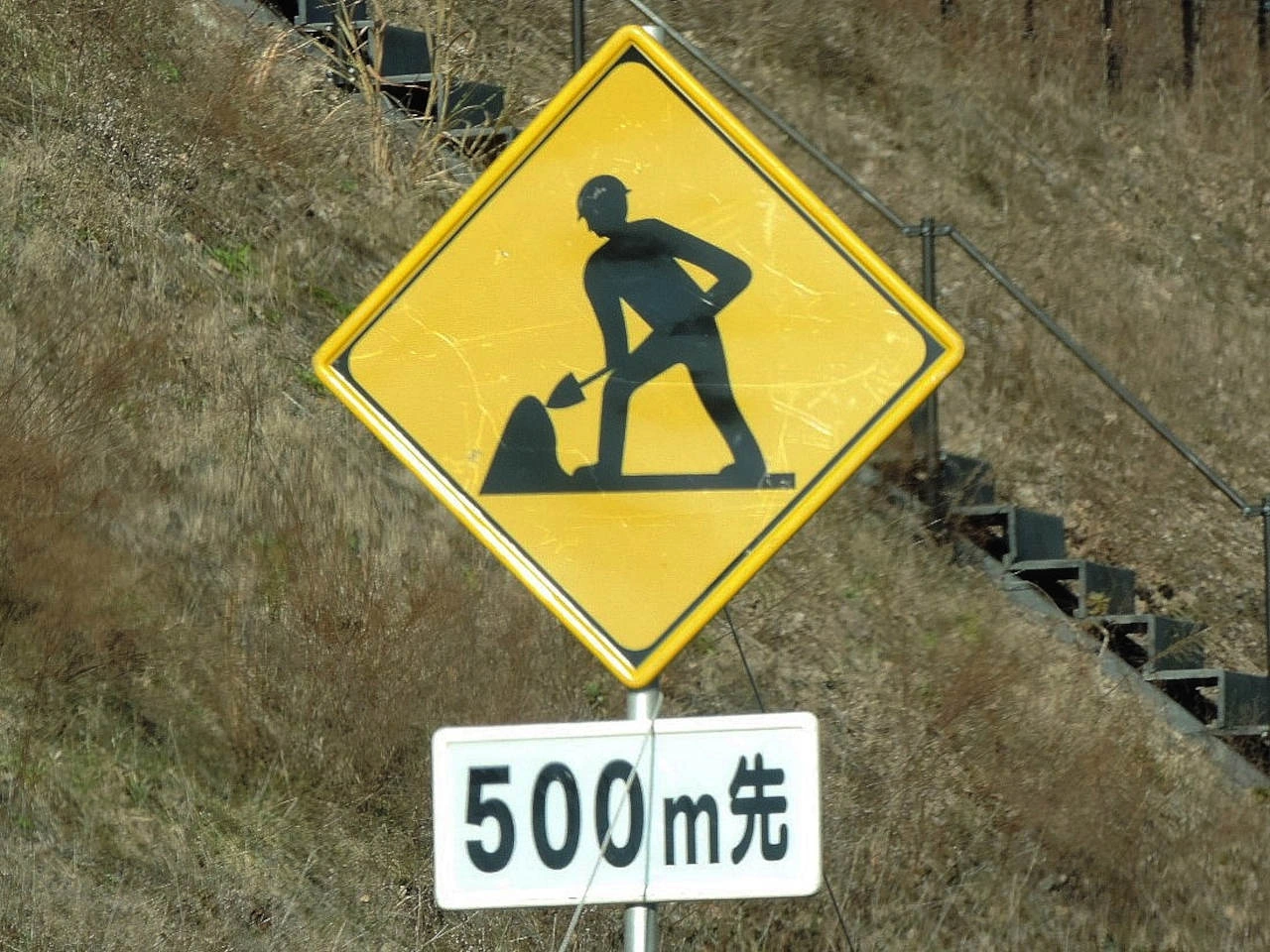
Wikimedia.org • 運動会プロテインパワー • CC BY-SA
What should you watch for when approaching roadworks in Japan?
Look for temporary warnings, cones, barriers, narrow lanes and construction vehicles. Road layouts can change temporarily, including lane shifts, traffic-light control and short one-way sections. Expect workers and slow or stationary traffic near the worksite.
🔗 laws.e-gov.go.jp • e-Gov — current enforced Road Traffic Act, revision metadata and full text
Is a temporary speed limit at roadworks binding in Japan?
Where an authorised temporary regulatory speed limit is in force, you must obey it. A roadworks warning alone should not be mistaken for a new numerical limit, but conditions may require driving more slowly.
🔗 laws.e-gov.go.jp • e-Gov — current enforced Road Traffic Act, revision metadata and full text
What if only one lane remains open through roadworks in Japan?
Follow the temporary signals, stop/go instructions, lane arrows and priority signs. Do not enter an opposing traffic lane until permitted, and give vulnerable road users and road workers extra room.
🔗 laws.e-gov.go.jp • e-Gov — current enforced Road Traffic Act, revision metadata and full text
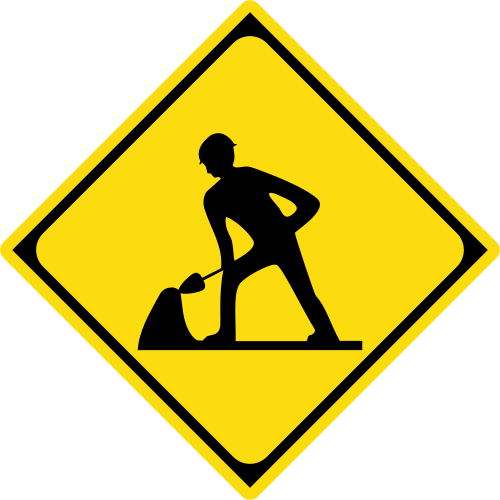 Warning for roadworks.
English • Traffic sign 213 • Roadworks. Watch workers, construction vehicles and changes to traffic arrangements.
日本語 • 213 • 道路工事中。 この先で道路工事や作業が行われています。作業員、工事車両、通行方法の変更に注意してください。
Sources
🔗 Commons.wikimedia.org
🔗 Laws.e-gov.go.jp • 道路標識、区画線及び道路標示に関する命令、別表第一・第二
🔗 Mlit.go.jp • 国土交通省、道路標識一覧
SVG source: Monaneko • Public domain • Original revision 2021-10-09. Wikimedia original unmodified.
33. Crosswind
Crosswind is wind blowing across the direction of travel and can push a vehicle sideways or affect its stability. Strong or sudden gusts are especially dangerous for motorcycles, bicycles, caravans, trailers and high-sided vehicles. Drivers should reduce speed, keep a firm but relaxed grip on the steering wheel and allow extra space from other road users. Particular care is needed on bridges, exposed roads and when passing large vehicles or leaving sheltered areas, where a sudden change in wind force can move the vehicle unexpectedly.
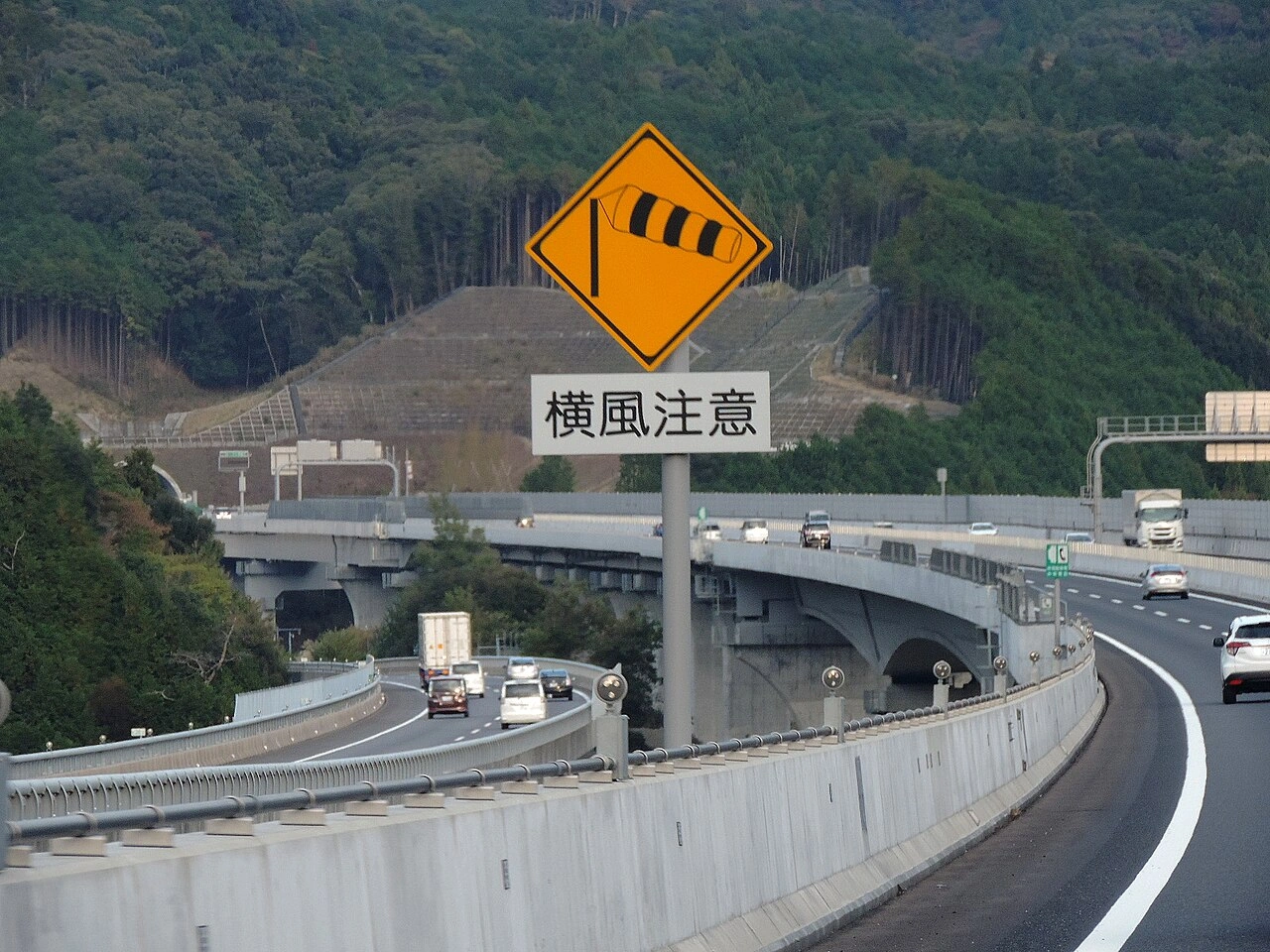
Wikimedia.org • 運動会プロテインパワー • CC BY-SA
Where can crosswinds be especially hazardous in Japan?
Exposed roads, bridges and the transition out of shelter can leave a vehicle vulnerable to sudden gusts. Allow for a change in steering force, especially beside a large vehicle. Follow actual wind warnings, closures and vehicle restrictions, and reduce speed smoothly when conditions require it.
🔗 laws.e-gov.go.jp • e-Gov — current enforced Road Traffic Act, revision metadata and full text
Does a crosswind warning automatically impose a speed limit in Japan?
A crosswind warning does not itself set a numerical speed limit. Obey any separate speed restriction or electronic message, and choose a lower speed whenever gusts could affect control.
🔗 laws.e-gov.go.jp • e-Gov — current enforced Road Traffic Act, revision metadata and full text
How should you drive a motorcycle, van or vehicle towing a caravan in strong winds in Japan?
These vehicles may react sharply to gusts. Reduce speed smoothly, leave more room from traffic, hold the controls steadily and take extra care when passing a lorry or emerging from shelter. Follow any temporary restriction for high-sided vehicles.
🔗 laws.e-gov.go.jp • e-Gov — current enforced Road Traffic Act, revision metadata and full text
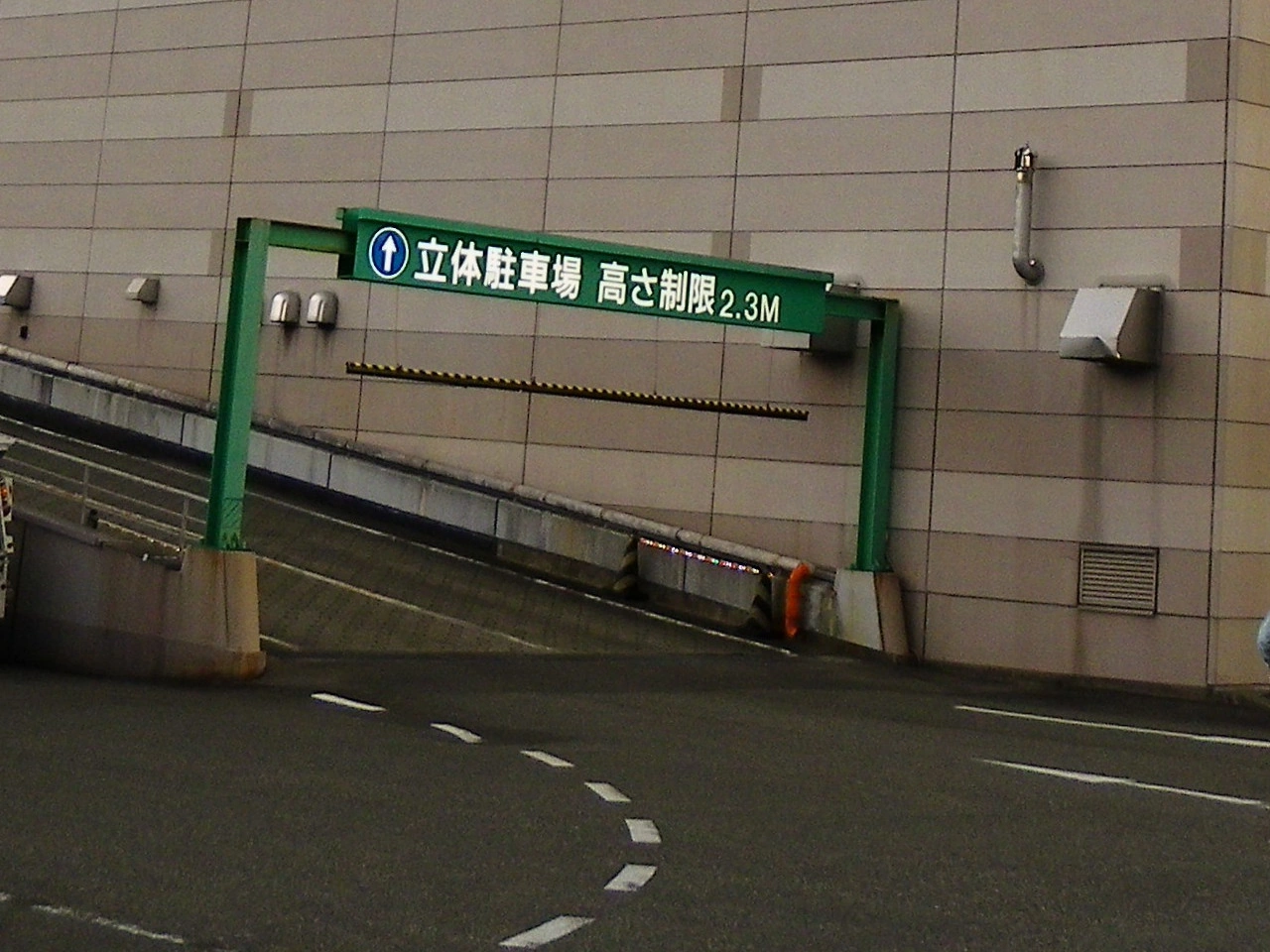
34. Height limit
A height limit prohibits vehicles whose total height exceeds the value shown from entering or passing a road section, bridge, tunnel, gateway or other structure. The vehicle’s height includes its load and any equipment attached above it.
Drivers of high vehicles must know their exact height, observe advance warnings and use an alternative route when necessary. They should never rely only on visual judgement or attempt to pass beneath a structure when safe clearance is uncertain.
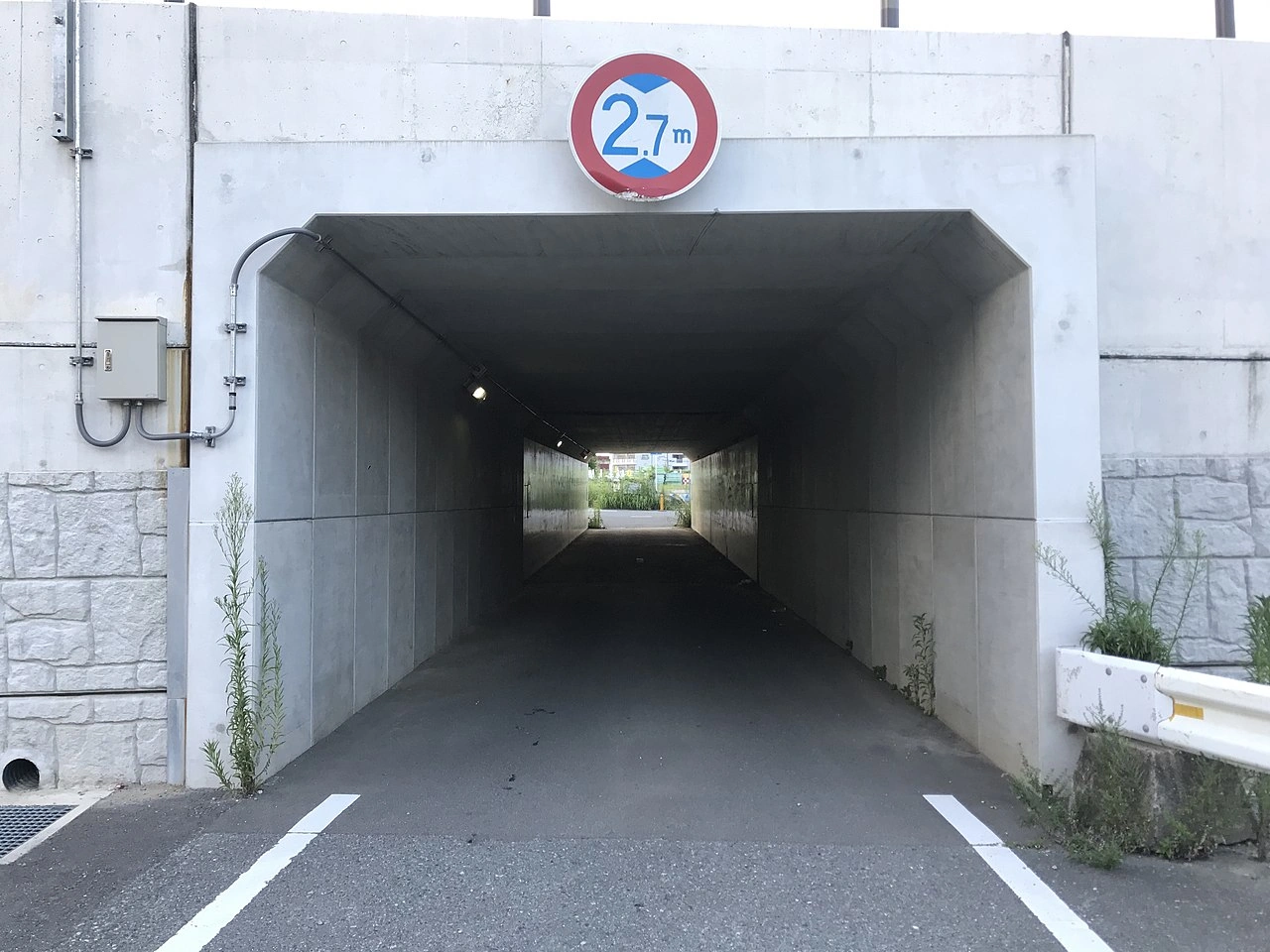
Wikimedia.org • そらみみ • CC BY-SA
How should you read a low-bridge height restriction in Japan?
Identify the actual height restriction and any separate advance-clearance warning, and read the measurement and supplementary information. Check the vehicle at its highest point with its load and fitted equipment before entering. A warning describes a hazard; a regulatory restriction controls entry. Use a permitted alternative if the vehicle cannot pass safely and lawfully.
🔗 laws.e-gov.go.jp • e-Gov — current enforced Road Traffic Act, revision metadata and full text
🔗 npa.go.jp • NPA — Traffic Lights and Road Signs, official English definitions
🔗 npa.go.jp • NPA — traffic instruction handbook, sign groups and road use; read with current Act
Does a roof load count when checking vehicle height in Japan?
Yes for practical clearance: measure the vehicle at its highest point with its load and fitted accessories, such as a roof box, bicycle or roof rack. Check the local legal measurement rules as well; an empty vehicle’s registered height is not enough when equipment has been added.
🔗 laws.e-gov.go.jp • e-Gov — current enforced Road Traffic Act, revision metadata and full text
🔗 npa.go.jp • NPA — Traffic Lights and Road Signs, official English definitions
🔗 npa.go.jp • NPA — traffic instruction handbook, sign groups and road use; read with current Act
What should you do if your vehicle is too high for a bridge or tunnel in Japan?
Do not try to squeeze under the structure. Use the signed alternative route and, if you are already close to the obstruction, stop where safe and seek traffic-control assistance rather than reversing unpredictably into moving traffic.
🔗 laws.e-gov.go.jp • e-Gov — current enforced Road Traffic Act, revision metadata and full text
🔗 npa.go.jp • NPA — Traffic Lights and Road Signs, official English definitions
🔗 npa.go.jp • NPA — traffic instruction handbook, sign groups and road use; read with current Act
35. Width limit
A width limit prohibits vehicles or vehicle combinations whose total width exceeds the value shown from entering or passing a road section, bridge, tunnel, gateway or other narrow passage. The width includes the vehicle’s load and any equipment or objects extending from its sides.
Drivers must know the maximum travelling width of their vehicle and load, observe advance warnings and use an alternative route when necessary. They should never enter when sufficient lateral clearance is uncertain.
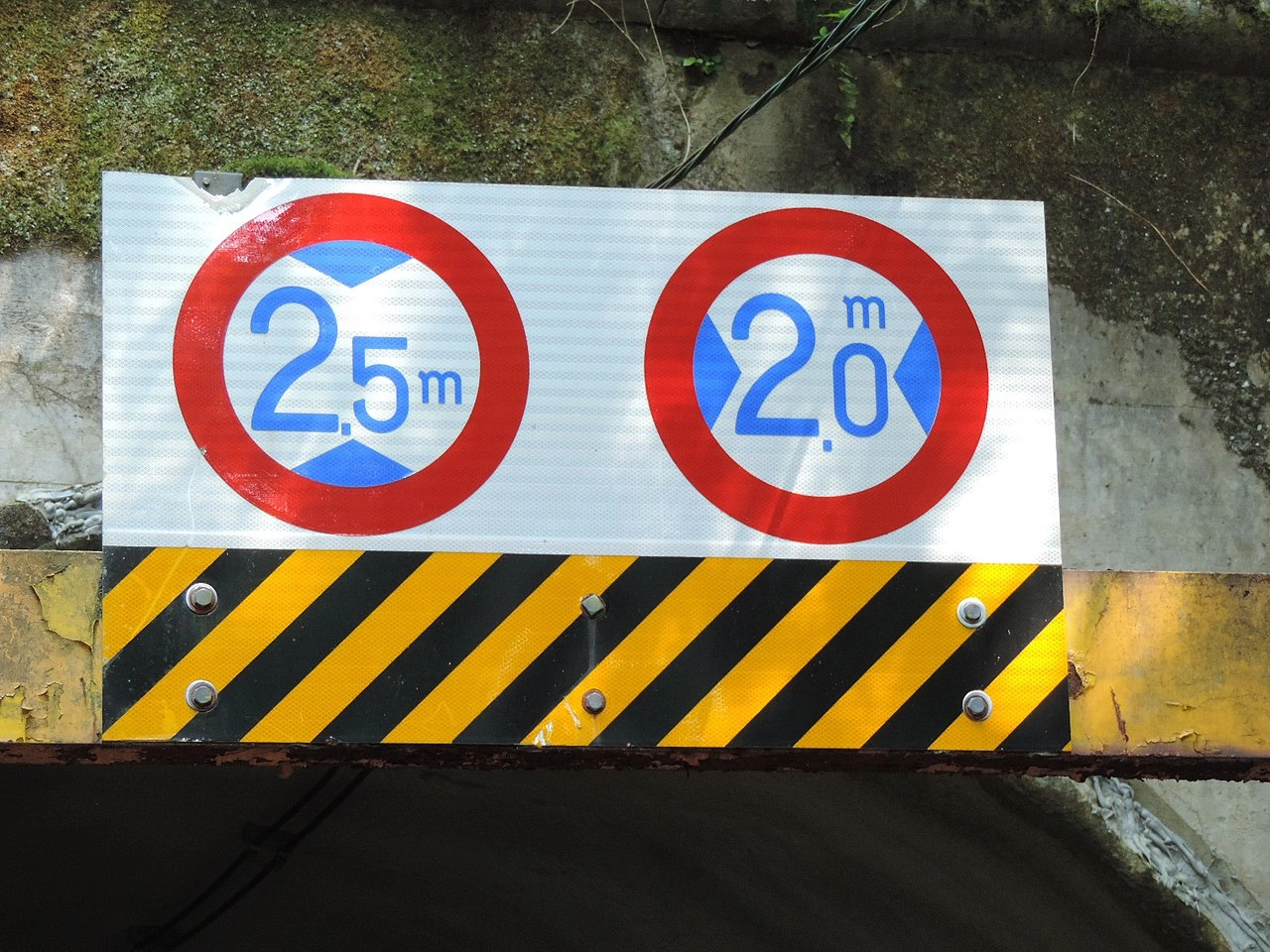
Wikimedia.org • 運動会プロテインパワー • CC BY-SA
What does a posted vehicle-width restriction mean in Japan?
Read the actual regulatory width limit, any supplementary conditions and any separate warning of limited clearance. Check the vehicle and its load against the applicable restriction and the physical space available. A road that appears wide enough does not cancel a binding width limit.
🔗 laws.e-gov.go.jp • e-Gov — current enforced Road Traffic Act, revision metadata and full text
🔗 npa.go.jp • NPA — Traffic Lights and Road Signs, official English definitions
🔗 npa.go.jp • NPA — traffic instruction handbook, sign groups and road use; read with current Act
How should you check the width of a loaded vehicle in Japan?
Check the vehicle and any projecting load or equipment. The legal measurement may exclude particular fittings such as mirrors, depending on local rules, but those fittings still need physical space to pass safely. Never assume the statutory measurement guarantees sufficient real-world clearance.
🔗 laws.e-gov.go.jp • e-Gov — current enforced Road Traffic Act, revision metadata and full text
🔗 npa.go.jp • NPA — Traffic Lights and Road Signs, official English definitions
🔗 npa.go.jp • NPA — traffic instruction handbook, sign groups and road use; read with current Act
Can a driver ignore a width restriction if the road looks wide enough in Japan?
No. A regulatory width limit must be obeyed unless an applicable exemption or authorised arrangement permits entry. Check your route before driving a wide van, trailer or load through a narrow town, bridge or roadworks section.
🔗 laws.e-gov.go.jp • e-Gov — current enforced Road Traffic Act, revision metadata and full text
🔗 npa.go.jp • NPA — Traffic Lights and Road Signs, official English definitions
🔗 npa.go.jp • NPA — traffic instruction handbook, sign groups and road use; read with current Act
36. Weight limit
A weight limit prohibits vehicles or vehicle combinations whose mass exceeds the value shown from entering or passing a road section, bridge, tunnel or other structure. Depending on local law, the restriction may concern the vehicle’s actual loaded mass, maximum authorised mass or load on an individual axle.
Drivers must know which type of mass the sign refers to and must include the vehicle, passengers, cargo and any trailer where required. A vehicle that exceeds the limit must use another suitable route.
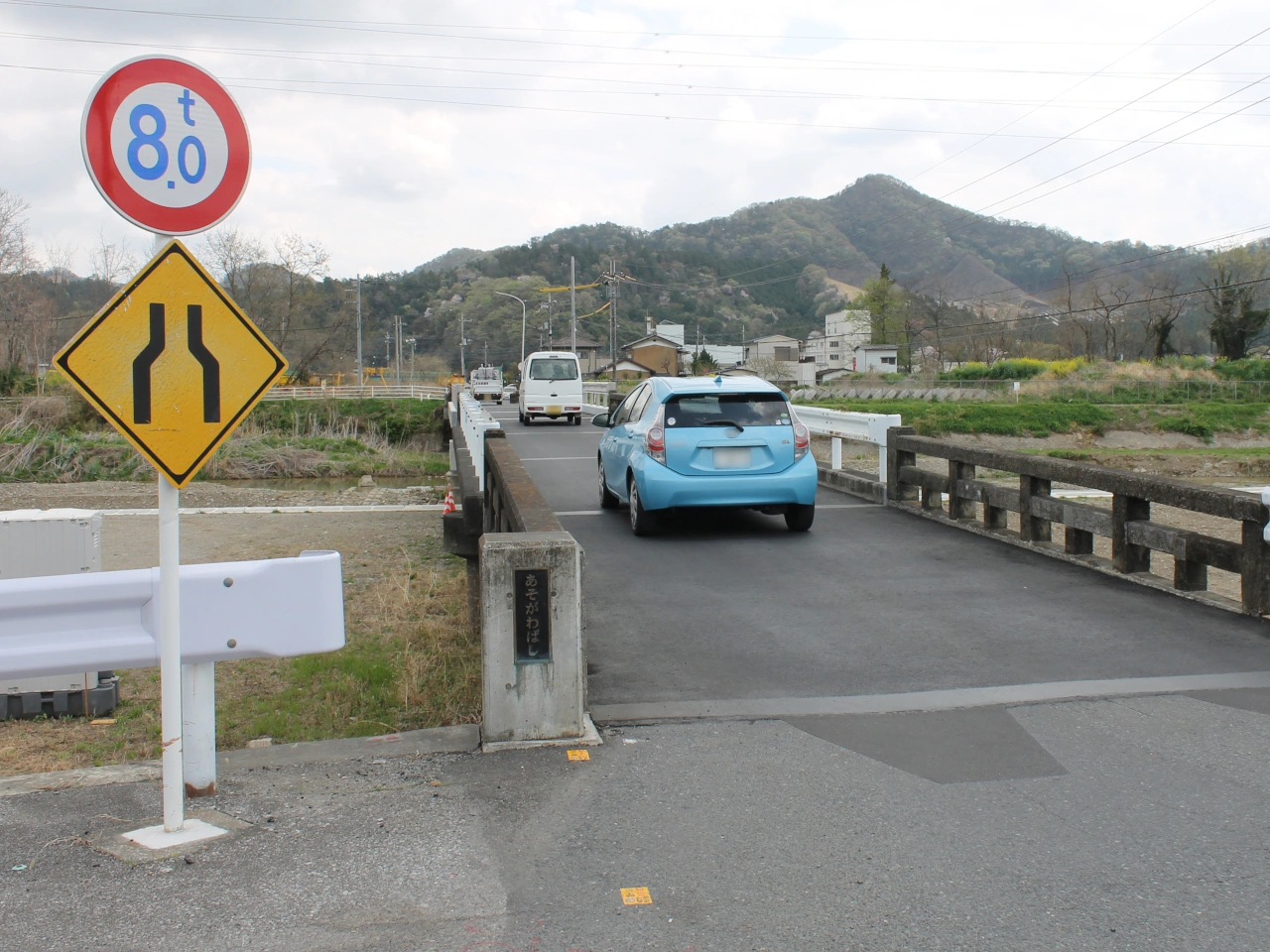
Wikimedia.org • LERK • CC BY-SA
What should you do if your vehicle exceeds a bridge weight limit in Japan?
Do not drive onto the bridge. Follow the signed alternative route and check the vehicle’s gross and axle loads as applicable. A general heavy-vehicle permit does not automatically authorise crossing every restricted bridge.
🔗 laws.e-gov.go.jp • e-Gov — current enforced Road Traffic Act, revision metadata and full text
🔗 npa.go.jp • NPA — Traffic Lights and Road Signs, official English definitions
🔗 npa.go.jp • NPA — traffic instruction handbook, sign groups and road use; read with current Act
37. Radar speed sign
A radar speed sign warns drivers that vehicle speeds may be monitored by a fixed camera, mobile radar, lidar or average-speed enforcement system. It reminds drivers to check and respect the applicable speed limit.
The sign does not normally establish the speed limit itself. Drivers must follow the general, posted or variable speed limit applying to the road and must not brake suddenly merely because speed enforcement is indicated.
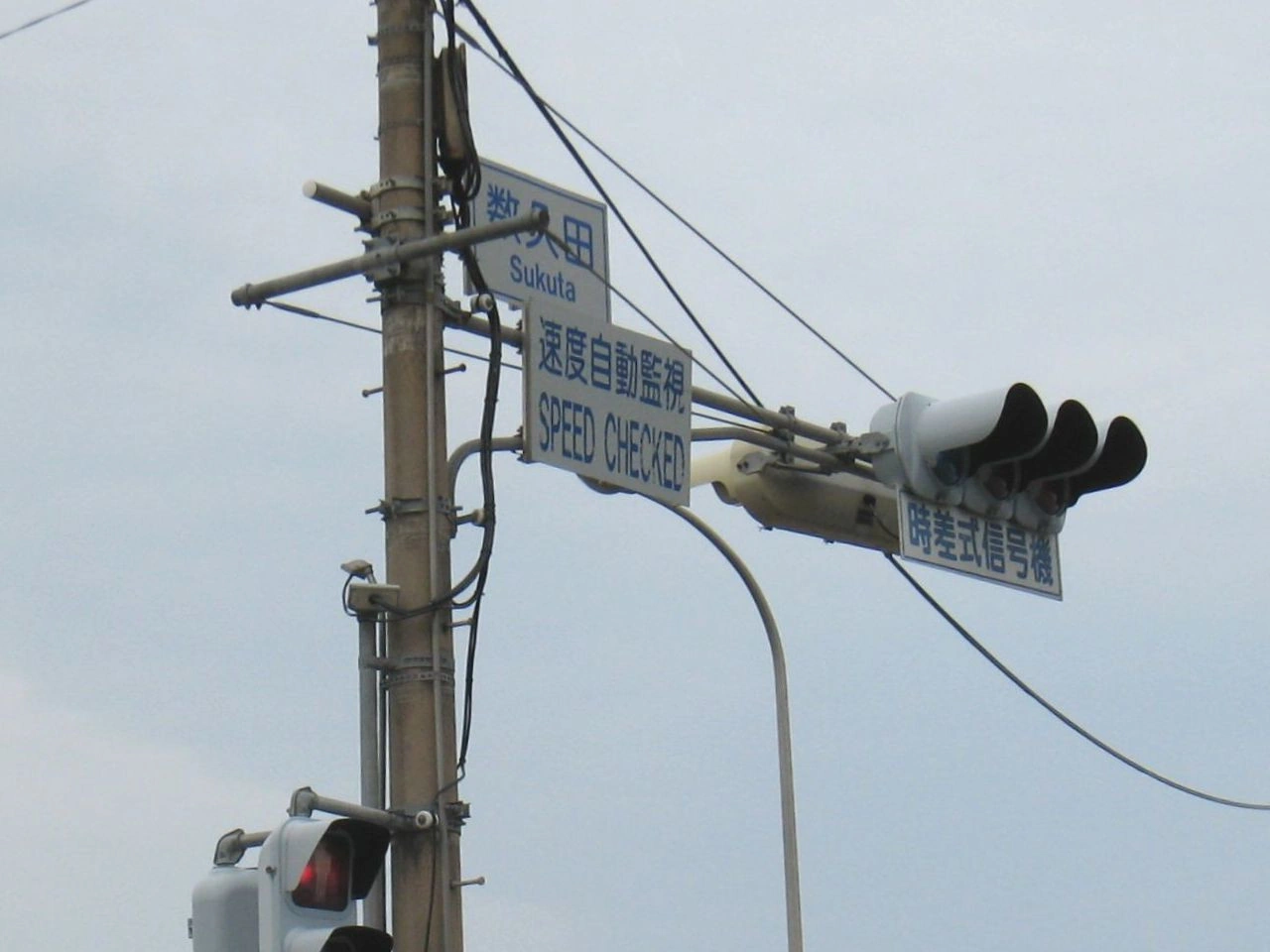
Wikimedia.org • Worldx • CC BY-SA
What should a driver understand from a radar or speed-camera warning in Japan?
A notice warning of speed monitoring is separate from a regulatory speed-limit sign. Obey the applicable road, vehicle and posted maximum regardless of whether equipment is visible. Do not infer the exact equipment, coverage or a legal duty to provide a warning from a camera pictogram alone.
🔗 laws.e-gov.go.jp • e-Gov — current enforced Road Traffic Act, revision metadata and full text
Which speed limit applies when a radar warning is displayed in Japan?
Follow the speed-limit sign, applicable speed zone or statutory road and vehicle limit. A camera symbol or enforcement notice must not be mistaken for a sign raising or ending that limit.
🔗 laws.e-gov.go.jp • e-Gov — current enforced Road Traffic Act, revision metadata and full text
Should you brake abruptly when you notice a radar sign in Japan?
No. Adjust to the lawful and safe speed smoothly, leaving adequate space behind and ahead. Enforcement information does not authorise sudden unsafe manoeuvres or stopping to inspect the camera.
🔗 laws.e-gov.go.jp • e-Gov — current enforced Road Traffic Act, revision metadata and full text
38. Selective barriers
Selective barriers are physical access-control devices that allow certain road users or authorised vehicles to pass while restricting other traffic. They may include fixed, removable, folding or retractable bollards, gates, barriers and width-filtering installations.
The permitted users are determined by traffic signs, access conditions and local regulations, not by the barrier alone. Drivers should approach slowly, verify that they are authorised and wait until any moving barrier is fully open or retracted before continuing.
Wikimedia.org • 玄史生 • CC0
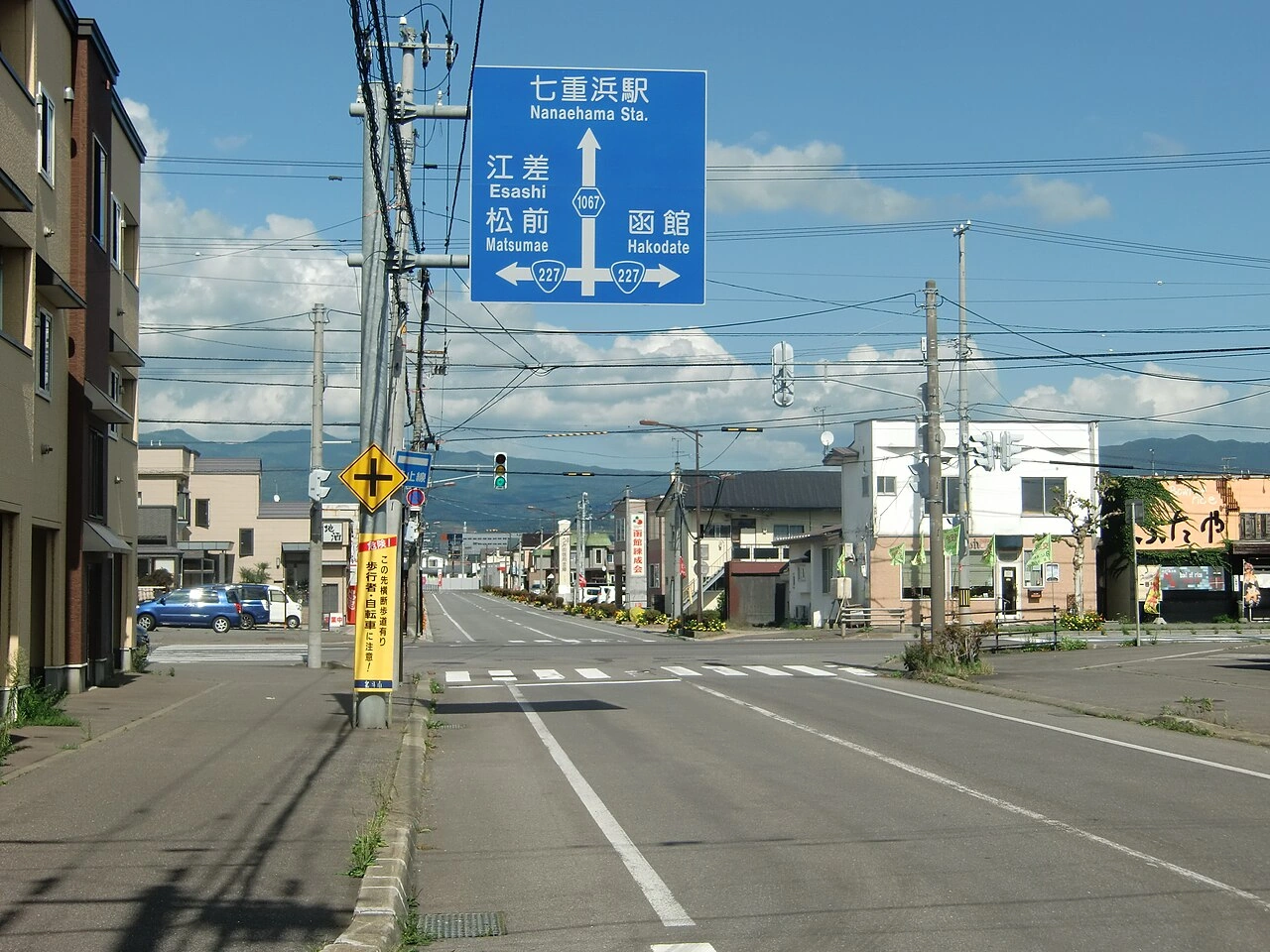
39. Intersection direction sign
An intersection direction sign shows the destinations and routes available at an approaching or current intersection. Arrows, road numbers, symbols and place names help drivers choose the correct direction and, where indicated, the correct traffic lane.
The sign provides route guidance but does not normally establish priority, permission to turn or a speed limit. Drivers must still obey traffic lights, regulatory signs, lane arrows, road markings and local traffic rules.
Wikimedia.org • Bord de rivière gratuit • CC BY-SA
What is the purpose of an intersection direction sign in Japan?
It identifies destinations, routes or directions at an upcoming junction. On routes around Japanese cities, the road’s route number or destination may appear beside an arrow or junction diagram. This is navigation information, not a grant of priority.
🔗 laws.e-gov.go.jp • e-Gov — current enforced Road Traffic Act, revision metadata and full text
🔗 npa.go.jp • NPA — Traffic Lights and Road Signs, official English definitions
🔗 npa.go.jp • NPA — traffic instruction handbook, sign groups and road use; read with current Act
Does a junction direction sign decide which vehicle goes first in Japan?
No. Traffic signals, Stop or Give Way signs and the legally applicable priority rules determine who must yield. A diagram showing the road layout is not, by itself, a priority instruction.
🔗 laws.e-gov.go.jp • e-Gov — current enforced Road Traffic Act, revision metadata and full text
🔗 npa.go.jp • NPA — Traffic Lights and Road Signs, official English definitions
🔗 npa.go.jp • NPA — traffic instruction handbook, sign groups and road use; read with current Act
What should you do if you are in the wrong lane for a signed destination in Japan?
Continue in a legal and safe direction and find another route. Do not stop abruptly, reverse into a junction or cross a solid line to recover a missed turning. Obey any mandatory lane-direction arrows separately from destination advice.
🔗 laws.e-gov.go.jp • e-Gov — current enforced Road Traffic Act, revision metadata and full text
🔗 npa.go.jp • NPA — Traffic Lights and Road Signs, official English definitions
🔗 npa.go.jp • NPA — traffic instruction handbook, sign groups and road use; read with current Act
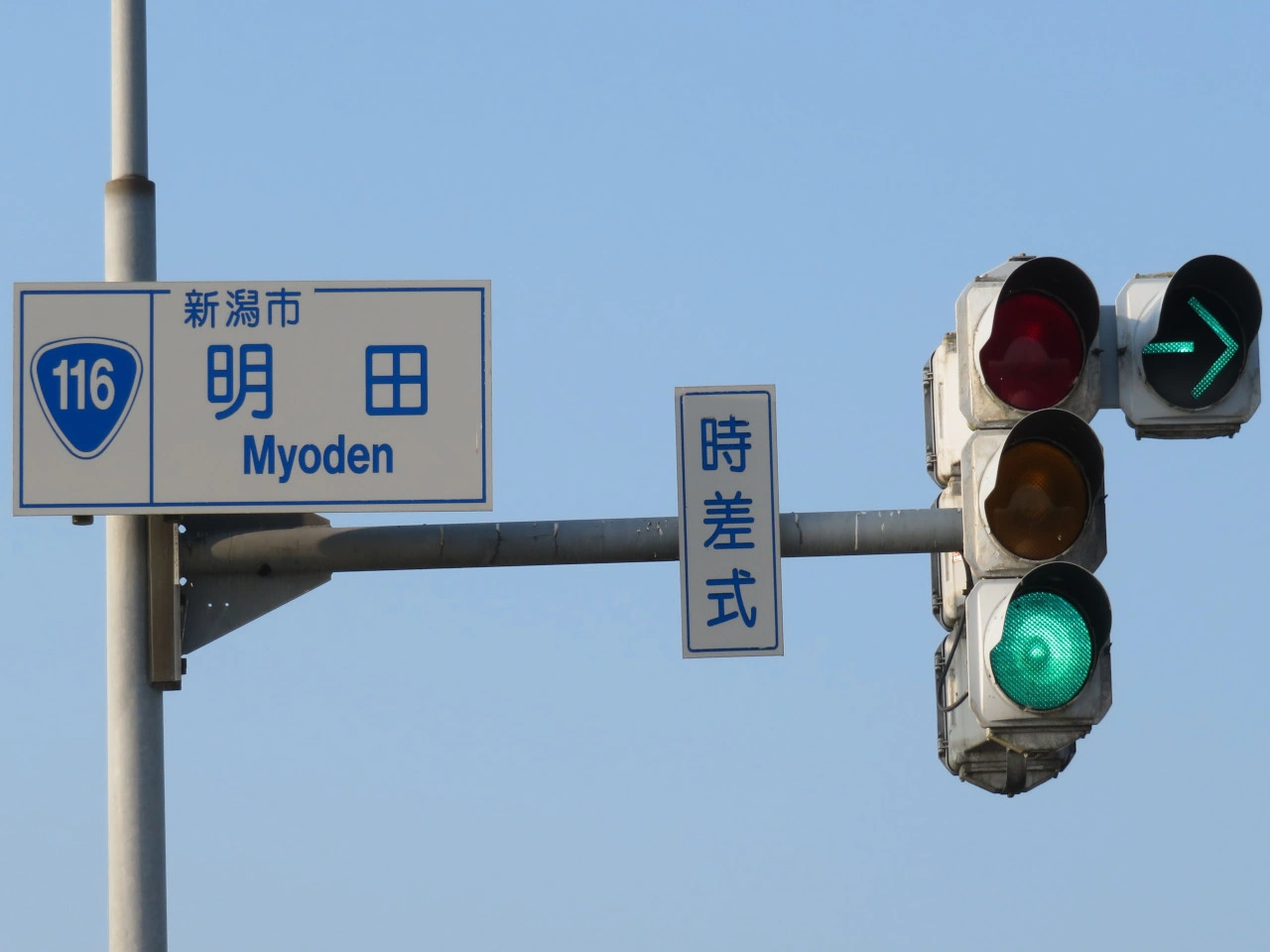
40. Traffic lights
Traffic lights use coloured lights, arrows or symbols to regulate when road users may proceed, must prepare to stop or must remain stopped. Separate signals may apply to particular directions, lanes, pedestrians, cyclists or public-transport vehicles.
A green light permits movement only when the route is clear and the movement is otherwise legal. Road users must still follow priority rules, turning restrictions, lane markings and instructions from authorised traffic controllers.
Wikimedia.org • Ebiebi2 • CC BY-SA
What must a driver do at red, amber and green signals in Japan?
Red requires stopping before the stopping point. Yellow also requires stopping unless you are too close to stop safely. Green permits the movements applicable to your vehicle category; obey directional arrows and give way to pedestrians.
🔗 npa.go.jp • National Police Agency traffic-light meanings and pedestrian safety guidance
May you turn at a red traffic light in Japan?
A plain red signal does not permit starting a left or right turn. An applicable illuminated green arrow permits its indicated direction even while the main signal is red, subject to vehicle-category restrictions and the other road rules.
🔗 npa.go.jp • National Police Agency traffic-light meanings and pedestrian safety guidance
Can a green light remove the need to give way to pedestrians in Japan?
No. Drivers must give way to pedestrians. At a crossing, stop for pedestrians crossing or about to cross; turning on a permitted vehicle signal does not cancel this duty.
🔗 npa.go.jp • National Police Agency traffic-light meanings and pedestrian safety guidance
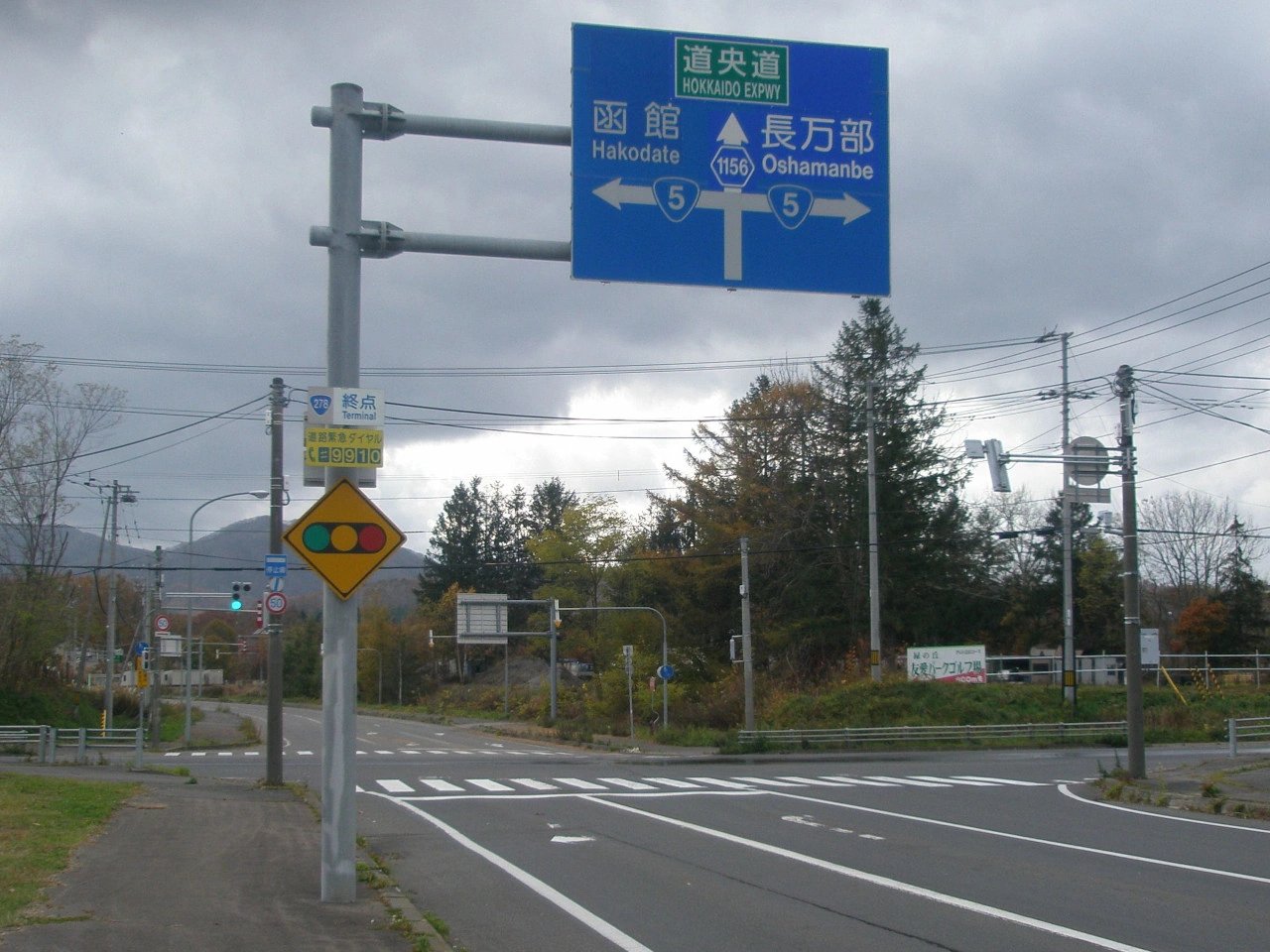
41. Traffic lights warning
A traffic lights warning is a warning sign that alerts drivers that traffic signals are located ahead. It is commonly used where the signals may be unexpected, difficult to see from a distance or located on a road where drivers need additional time to prepare to stop.
Drivers approaching a traffic lights warning should reduce speed when necessary, watch for the signals ahead and be prepared to stop if the traffic light changes or traffic is waiting at the intersection.
Wikimedia.org • BATACHAN • CC BY-SA
How are traffic lights ahead warned of in Japan?
A yellow warning sign showing a traffic-signal symbol can alert drivers to traffic lights ahead; the exact shape and application follow local sign standards. It warns of a potential need to stop, but does not replace the actual signals.
🔗 laws.e-gov.go.jp • e-Gov — current enforced Road Traffic Act, revision metadata and full text
🔗 npa.go.jp • NPA — Traffic Lights and Road Signs, official English definitions
🔗 npa.go.jp • NPA — traffic instruction handbook, sign groups and road use; read with current Act
Does a traffic-lights-ahead warning require an immediate stop in Japan?
No. A warning sign is not an automatic STOP instruction and does not create a new numerical speed limit. Reduce speed when necessary, look for a queue or a concealed signal, and obey the traffic lights and any separate speed or stop signs.
🔗 laws.e-gov.go.jp • e-Gov — current enforced Road Traffic Act, revision metadata and full text
🔗 npa.go.jp • NPA — Traffic Lights and Road Signs, official English definitions
🔗 npa.go.jp • NPA — traffic instruction handbook, sign groups and road use; read with current Act
What should you check if the next traffic lights are difficult to see in Japan?
Allow enough distance to stop before the marked line, watch for vehicles braking suddenly and be ready for a pedestrian or cyclist crossing. If the signals are out of order or flashing, follow the applicable local failure and priority rules rather than guessing from the warning sign.
🔗 laws.e-gov.go.jp • e-Gov — current enforced Road Traffic Act, revision metadata and full text
🔗 npa.go.jp • NPA — Traffic Lights and Road Signs, official English definitions
🔗 npa.go.jp • NPA — traffic instruction handbook, sign groups and road use; read with current Act
42. Pedestrian lights
Pedestrian lights are traffic signals that regulate when pedestrians may begin crossing a road. They normally display a red standing figure to prohibit starting and a green walking figure to permit crossing.
A flashing signal or countdown may warn that the permitted crossing period is ending. Pedestrians should cross without unnecessary delay, while turning drivers must remain alert and allow pedestrians who entered lawfully to finish crossing safely.
Wikimedia.org • BATACHAN • CC BY-SA
What do pedestrian traffic signals mean in Japan?
Green permits crossing. Red prohibits crossing. Yellow or flashing green means do not start; if already crossing, finish promptly or turn back as appropriate. Check traffic before stepping out.
🔗 npa.go.jp • National Police Agency traffic-light meanings and pedestrian safety guidance
What if the pedestrian signal changes while you are crossing in Japan?
On yellow or flashing green, do not start a new crossing. The National Police Agency advises a pedestrian already crossing to finish promptly or turn back. Do not treat flashing green as an invitation to begin.
🔗 npa.go.jp • National Police Agency traffic-light meanings and pedestrian safety guidance
May turning drivers ignore pedestrians on a signal-controlled crossing in Japan?
No. At a crossing, stop and give way to pedestrians crossing or about to cross. A permitted turn does not remove the need to protect pedestrians.
🔗 npa.go.jp • National Police Agency traffic-light meanings and pedestrian safety guidance
43. Road markings
Road markings are lines, symbols, arrows, words or other markings applied to the road surface to regulate, guide or inform road users. They can separate traffic lanes and opposing directions, indicate where vehicles must stop or give way, mark pedestrian and cyclist crossings and identify areas reserved for particular road users.
Road users should observe the meaning of each road marking and combine it with the applicable traffic signs, signals and traffic rules. Colours, patterns and legal meanings can differ between countries.
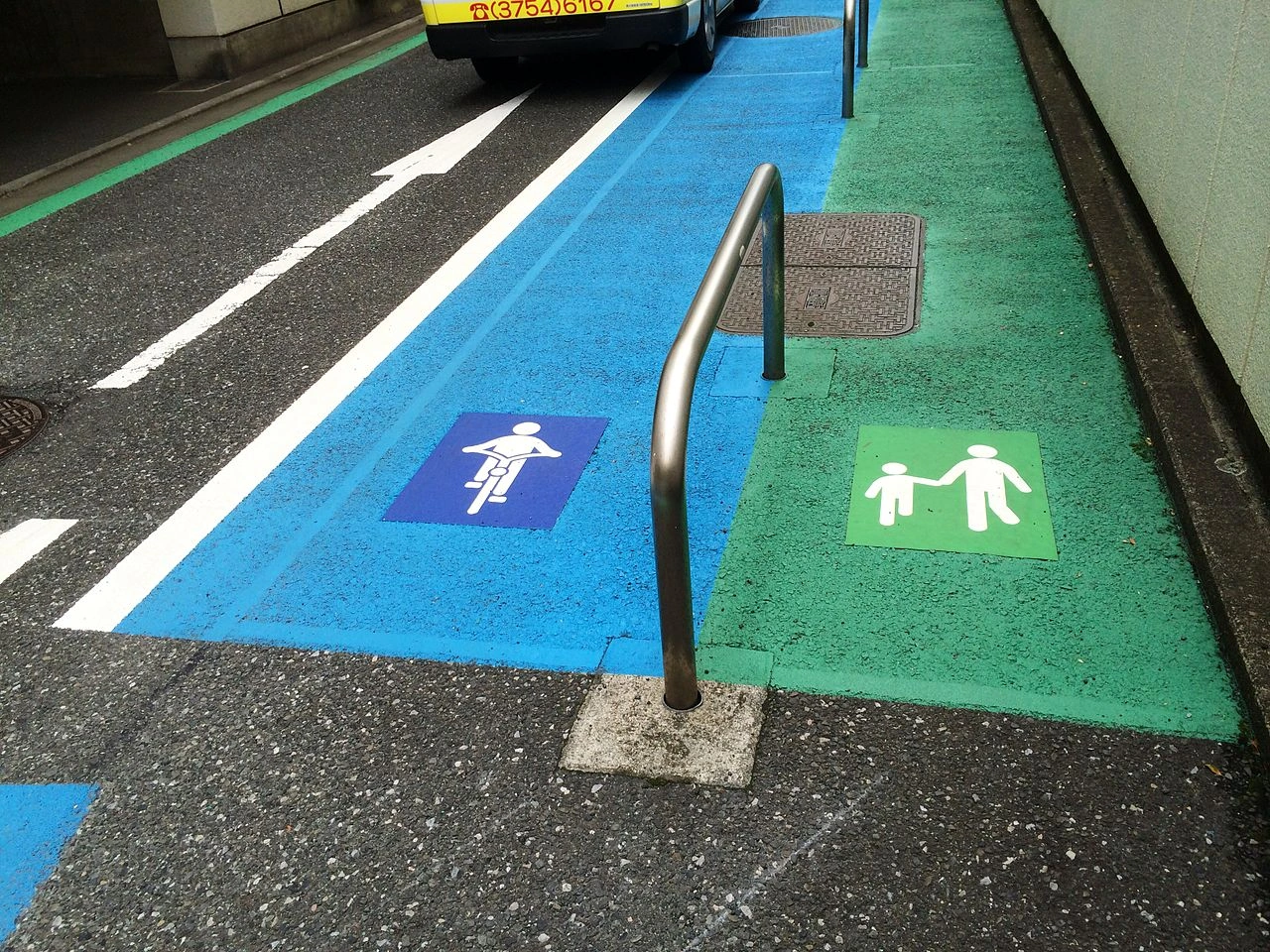
Wikimedia.org • Steven-L-Johnson • CC BY
Which road markings are important to recognise in Japan?
Road markings can be used to indicate stop positions, travel lanes and pedestrian crossings. A marking that looks familiar abroad can carry a different specific rule in Japan, so follow Japanese road markings and signs.
🔗 laws.e-gov.go.jp • e-Gov — current enforced Road Traffic Act, revision metadata and full text
🔗 npa.go.jp • NPA — Traffic Lights and Road Signs, official English definitions
🔗 npa.go.jp • NPA — traffic instruction handbook, sign groups and road use; read with current Act
May drivers cross a solid road line in Japan?
Not simply because the road looks clear. A continuous or barrier line normally restricts crossing, but precise restrictions and statutory exceptions depend on the marking and national law. Check the road markings and any associated signs before turning or overtaking.
🔗 laws.e-gov.go.jp • e-Gov — current enforced Road Traffic Act, revision metadata and full text
🔗 npa.go.jp • NPA — Traffic Lights and Road Signs, official English definitions
🔗 npa.go.jp • NPA — traffic instruction handbook, sign groups and road use; read with current Act
Can painted arrows or stop lines be ignored when signs are not obvious in Japan?
No. Lane arrows, stop lines and give-way markings can direct where to wait or which movement a lane permits. Read them together with traffic lights, vertical signs and directions from authorised traffic controllers; temporary changes may also apply.
🔗 laws.e-gov.go.jp • e-Gov — current enforced Road Traffic Act, revision metadata and full text
🔗 npa.go.jp • NPA — Traffic Lights and Road Signs, official English definitions
🔗 npa.go.jp • NPA — traffic instruction handbook, sign groups and road use; read with current Act
44. Driving licence
A driving licence is an official document authorising a person to drive one or more specified categories of motor vehicle. It may contain conditions, restrictions, category codes and expiry dates that determine which vehicles the holder may drive.
Drivers must hold a licence that is valid for the vehicle category and jurisdiction concerned. A licence may be provisional, full, restricted, suspended or withdrawn, and additional qualifications may be required for professional driving.
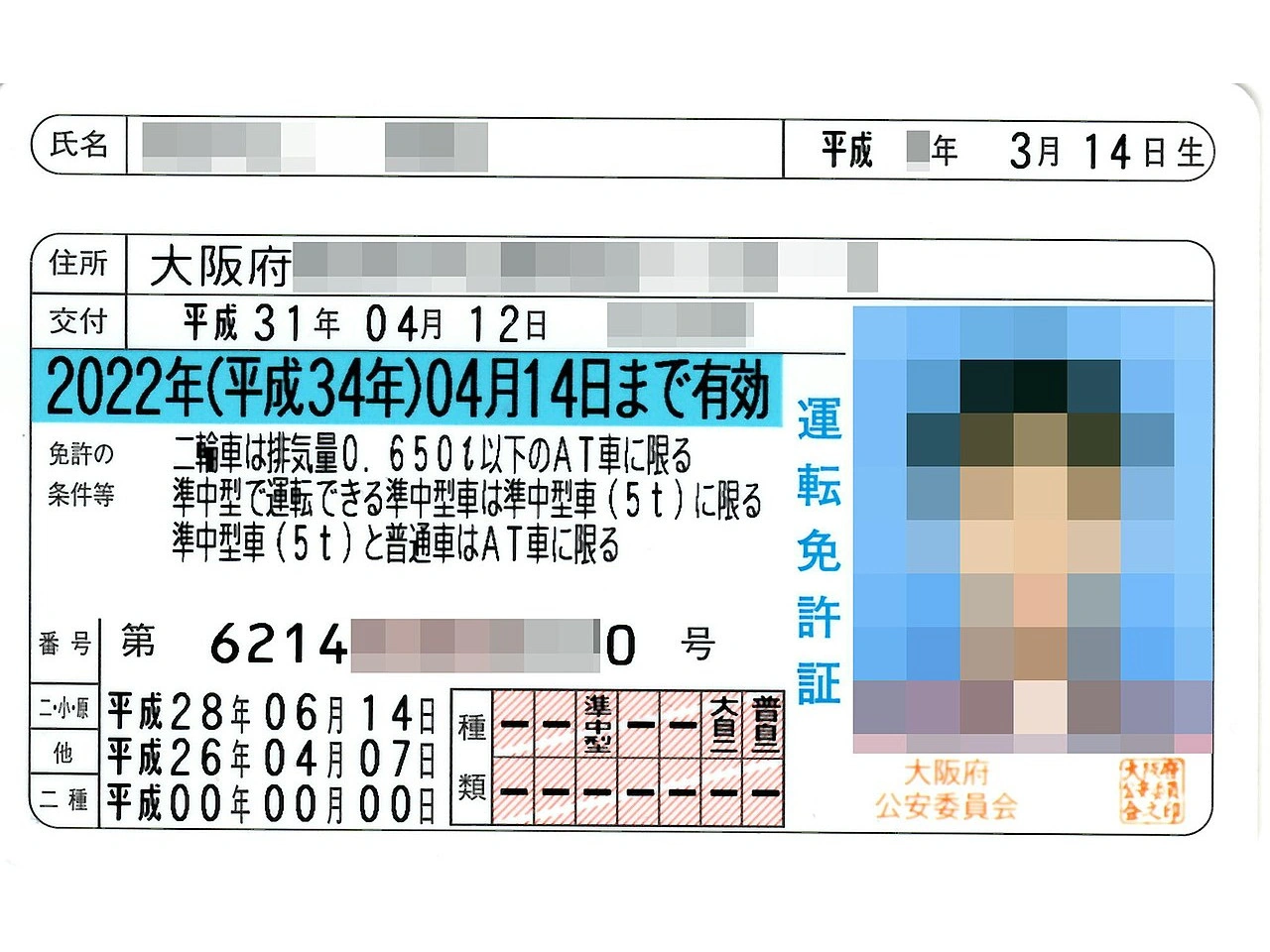
Wikimedia.org • 321keiHIKARI • CC0
Which driving-licence entitlement is needed for an ordinary car in Japan?
In Japan, an ordinary car requires the appropriate ordinary motor-vehicle licence or a legally recognised equivalent. A different entitlement may be needed for motorcycles, heavy vehicles, trailers or passenger transport.
🔗 laws.e-gov.go.jp • Japan Road Traffic Act — Articles 84–85 and 107-2
🔗 laws.e-gov.go.jp • e-Gov — current enforced Road Traffic Act, revision metadata and full text
🔗 npa.go.jp • NPA — 2026 foreign driving licence and IDP guidance
Can a visitor drive in Japan using a driving licence issued abroad?
Japan recognises a Japanese licence, a qualifying 1949 Geneva Convention International Driving Permit, or certain specifically listed foreign licences with an authorised Japanese translation. A 1968-only IDP is not sufficient. Time limits and residency restrictions apply.
🔗 laws.e-gov.go.jp • Japan Road Traffic Act — Articles 84–85 and 107-2
🔗 laws.e-gov.go.jp • e-Gov — current enforced Road Traffic Act, revision metadata and full text
🔗 npa.go.jp • NPA — 2026 foreign driving licence and IDP guidance
Does an International Driving Permit replace the original licence in Japan?
Japan recognises a qualifying 1949 Geneva Convention IDP as one of the documents that can authorise driving, subject to its validity and Japan’s entry conditions. A permit issued only under the 1968 Convention does not qualify. Applying to convert a foreign licence is a different procedure: the NPA says an IDP alone does not replace the original foreign licence for that application.
🔗 npa.go.jp • Japanese National Police Agency, permitted foreign driving licences and IDPs
🔗 keishicho.metro.tokyo.lg.jp • Tokyo Metropolitan Police, foreign-issued IDPs recognised in Japan
45. Location marker
A location marker is a roadside reference showing a measured position along a road. It normally identifies a kilometre, mile or smaller interval measured from an established starting point on that route.
Kilometre and hectometre markers help road users, emergency services, road authorities and maintenance crews identify an exact section of road. They do not impose a speed limit, priority rule or access restriction.
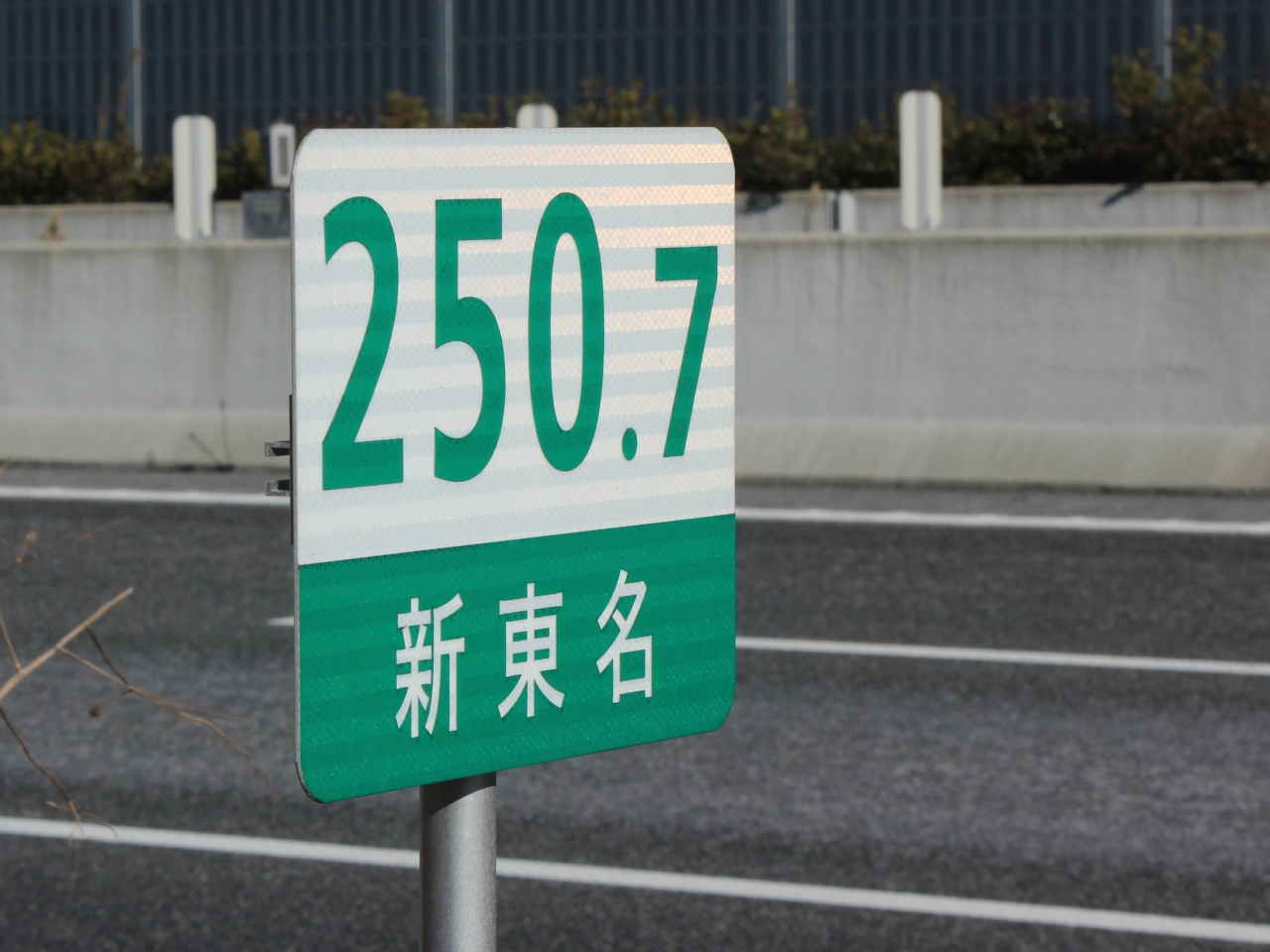
Wikimedia.org • Oka21000 • CC0
What does a roadside location marker tell you in Japan?
Japanese expressways may show kilometre posts. Give the road name, direction and kilometre position when reporting a problem.
🔗 laws.e-gov.go.jp • e-Gov — current enforced Road Traffic Act, revision metadata and full text
🔗 npa.go.jp • NPA — Traffic Lights and Road Signs, official English definitions
🔗 npa.go.jp • NPA — traffic instruction handbook, sign groups and road use; read with current Act
How can a location marker help in an emergency in Japan?
If you can see a marker safely, give the emergency operator the route number or road name, travel direction and marker reading. Additional landmarks, exits and GPS position can help. Do not leave a safe place or enter traffic to read a post.
🔗 laws.e-gov.go.jp • e-Gov — current enforced Road Traffic Act, revision metadata and full text
🔗 npa.go.jp • NPA — Traffic Lights and Road Signs, official English definitions
🔗 npa.go.jp • NPA — traffic instruction handbook, sign groups and road use; read with current Act
Does a location marker set a speed limit or permit stopping in Japan?
No. A location marker is for orientation and road management; it does not itself set a speed limit, change priority or permit parking. Follow the actual traffic signs and stop only where the law and safety allow.
🔗 laws.e-gov.go.jp • e-Gov — current enforced Road Traffic Act, revision metadata and full text
🔗 npa.go.jp • NPA — Traffic Lights and Road Signs, official English definitions
🔗 npa.go.jp • NPA — traffic instruction handbook, sign groups and road use; read with current Act
46. Traffic mirror
A traffic mirror is a convex mirror installed near an intersection, driveway, bend or other location with restricted visibility. Its curved surface provides a wider view of approaching road users than an ordinary flat mirror.
A traffic mirror is only a visibility aid. It may distort distance, speed and direction and may be affected by darkness, weather, dirt or damage. Drivers must continue to observe the road directly, obey all priority rules and proceed only when it is safe.
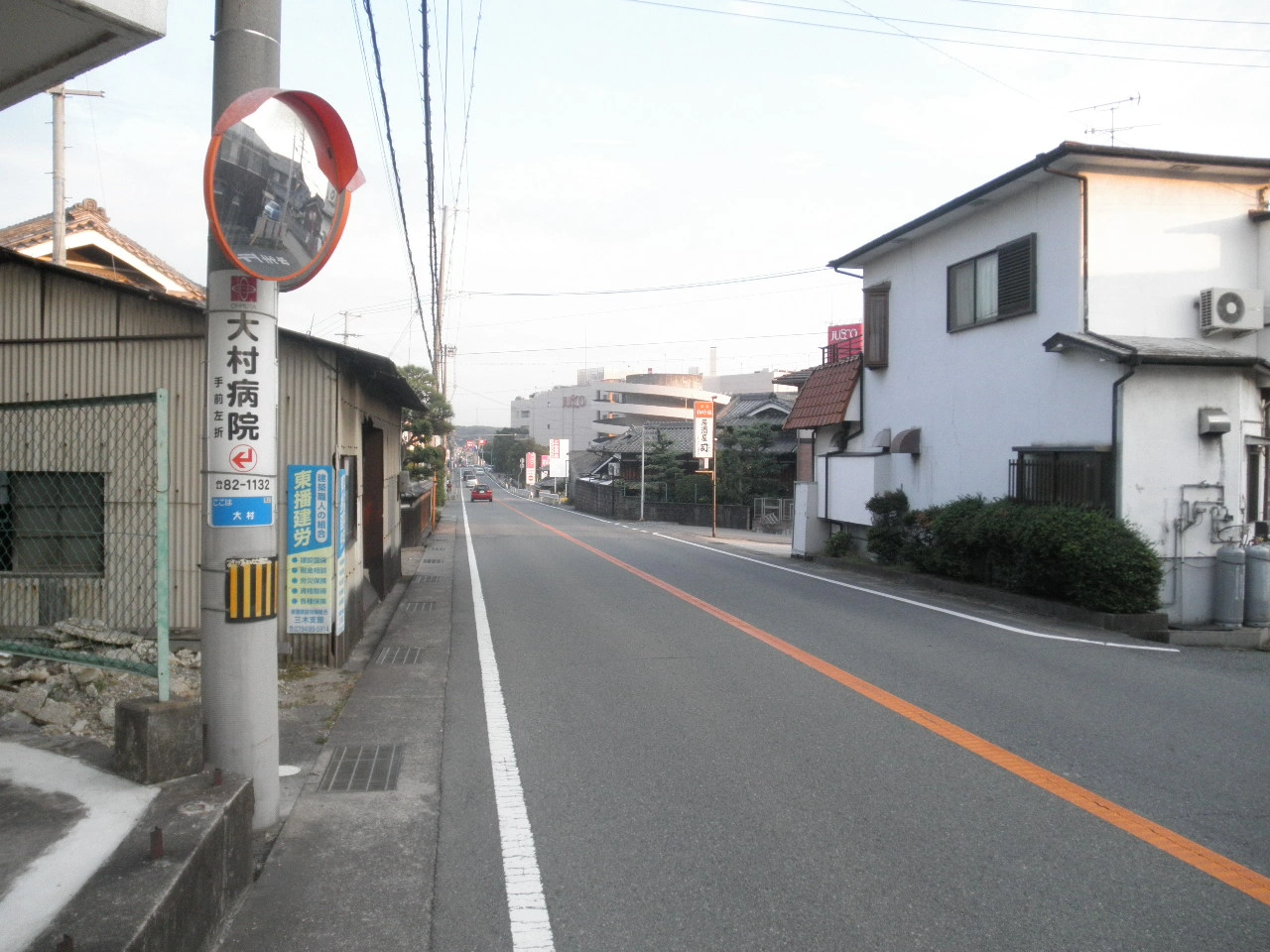
Wikimedia.org • mti • CC0
What is a traffic mirror?
A traffic mirror is a roadside visibility aid that can help users see around a blind corner or obstruction. It gives an indirect view, which may be restricted or distorted; it does not replace checking whether it is safe to proceed.
🔗 monmouthshire.gov.uk • Monmouthshire Council, roadside visibility mirrors
🔗 devon.gov.uk • Devon County Council, mirrors on the highway
Does a traffic mirror show an exact image?
No. The reflected image can be distorted, and glare, bad weather or dirt can restrict the view. Judging an approaching vehicle’s speed from a mirror can be difficult. Do not rely on the mirror alone.
🔗 monmouthshire.gov.uk • Monmouthshire Council, roadside visibility mirrors
🔗 devon.gov.uk • Devon County Council, mirrors on the highway
Does seeing an empty mirror mean the road is clear?
No. Another road user may be outside the reflected area, hidden by glare or too small to notice. Always check the road directly before proceeding.
🔗 monmouthshire.gov.uk • Monmouthshire Council, roadside visibility mirrors
🔗 devon.gov.uk • Devon County Council, mirrors on the highway
47. Emergency telephone
An emergency telephone is a dedicated roadside or tunnel telephone that connects road users directly with an emergency, traffic-control or roadside-assistance centre. Emergency telephones are commonly installed in tunnels, along motorways or at other locations where quickly reporting an accident, breakdown or fire is important. They can provide operators with useful information about the caller’s location and may remain available where mobile-phone reception is poor.
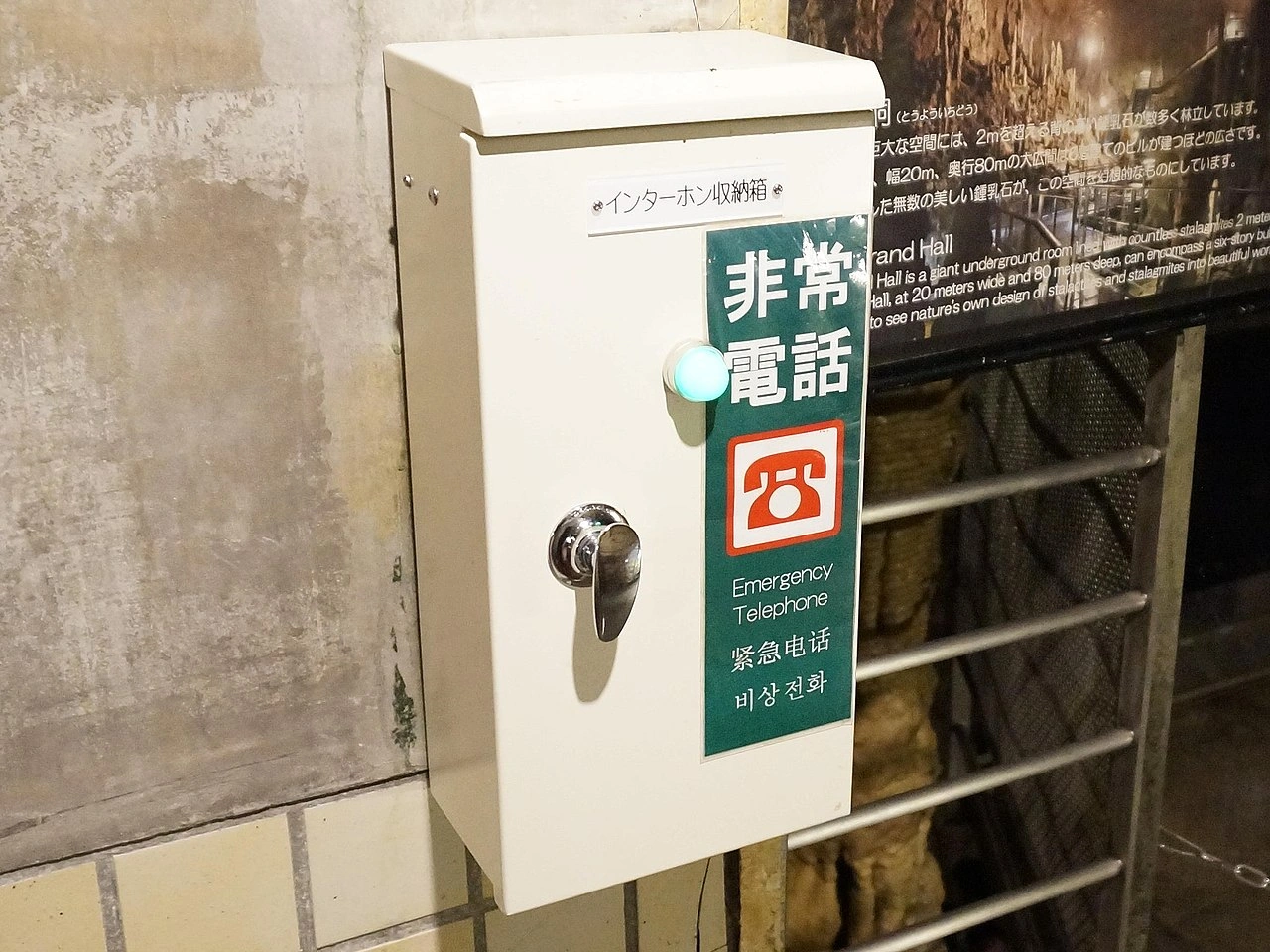
Wikimedia.org • Solomon203 • CC BY-SA
What is an emergency telephone?
An emergency telephone is a dedicated telephone used to contact emergency services, a traffic-control centre or roadside assistance from the road.
🔗 gov.uk • Great Britain Highway Code, Rules 275–279; national guidance example
🔗 gov.uk • Great Britain Highway Code, Rules 270–274; national guidance example
Where are emergency telephones commonly found?
They are commonly installed in road tunnels, motorway emergency areas and other locations where rapid assistance may be needed.
🔗 gov.uk • Great Britain Highway Code, Rules 275–279; national guidance example
🔗 gov.uk • Great Britain Highway Code, Rules 270–274; national guidance example
When should you use an emergency telephone?
Use an emergency telephone to report situations such as a breakdown, accident, fire or other serious road emergency when assistance is required.
🔗 gov.uk • Great Britain Highway Code, Rules 275–279; national guidance example
🔗 gov.uk • Great Britain Highway Code, Rules 270–274; national guidance example
48. Cycling route
A cycling route is a planned or signposted route intended to guide cyclists between places or through a particular area. It may follow cycle paths, quiet streets, shared roads, greenways or other routes considered suitable for cycling.
A cycling route does not necessarily give cyclists exclusive use of the road or path and should not be confused with a cycle path or cycle lane. The traffic rules, priority rules and permitted road users depend on the individual roads and paths that form the route and on the local signs and regulations.
Wikimedia.org • ブラックササメ • CC BY
How can you recognise a cycling route?
Cycling routes are commonly indicated by direction signs, bicycle symbols, route numbers, colours or destination markers. The design of the signs and route-numbering system varies between countries and regions.
Do cyclists have priority on a cycling route?
Not automatically. Being on a designated cycling route does not normally change the priority rules. Cyclists must continue to obey traffic lights, give-way and stop signs, crossing rules and other applicable traffic regulations.
What should you do when a cycling-route sign conflicts with a traffic sign?
Always follow the official traffic signs, signals and road markings. A route marker provides navigation and does not override a prohibition, mandatory direction, road closure or other traffic regulation.
49. Parking
Parking means leaving a vehicle stationary at a place for a period of time rather than stopping only briefly because of traffic conditions or another immediate necessity. Many countries distinguish parking from a short stop made to pick up or drop off passengers or to load or unload goods, although the exact legal definition varies.
Parking may be permitted, restricted, reserved, time-limited or prohibited by traffic signs, road markings, parking zones and local regulations. Drivers must park without creating a danger or unnecessary obstruction and must comply with any conditions concerning payment, permits, vehicle categories or maximum parking duration.
Wikimedia.org • 円周率3パーセント • CC BY-SA
What is the difference between parking and stopping?
Parking generally means leaving a vehicle stationary for longer than a brief stop required for passengers, loading or unloading. A vehicle stopped because of traffic lights, congestion, an emergency or another traffic condition is normally not considered parked. The precise legal definitions vary between countries.
🔗 wegcode.be • Belgian Road Code, articles 2, 23–27 and 70; 🔗 gesetze-im-internet.de • Germany, StVO, sections 12–13 and 19; 🔗 ris.bka.gv.at • Austria, StVO, sections 2, 23–25 and 52
How does paid parking work?
Where parking is subject to payment, drivers must follow the instructions displayed locally. Payment may be made through a parking meter, ticket machine, mobile application or another authorised system. The permitted duration and charging periods vary by location.
🔗 wegcode.be • Belgian Road Code, articles 2, 23–27 and 70; 🔗 gesetze-im-internet.de • Germany, StVO, sections 12–13 and 19; 🔗 paris.fr • City of Paris, parking payment FAQ
Can you leave a vehicle parked for an unlimited time?
Not necessarily. Local rules may impose a maximum parking duration, even where parking is otherwise permitted. Different limits may apply to abandoned, commercial, heavy or recreational vehicles.
🔗 wegcode.be • Belgian Road Code, articles 2, 23–27 and 70; 🔗 service-public.gouv.fr • French Government, prohibited and excessive parking
50. No parking
No parking indicates that vehicles may not be left parked at the location or along the section of road covered by the restriction. Depending on local law, a driver may still be allowed to stop briefly to pick up or drop off passengers or to load or unload goods, provided stopping itself is not prohibited.
A no-parking restriction may apply continuously or only during specified times, days, vehicle categories or sections of road. Its exact extent and exceptions are determined by the traffic sign, supplementary panels, road markings and local traffic regulations.
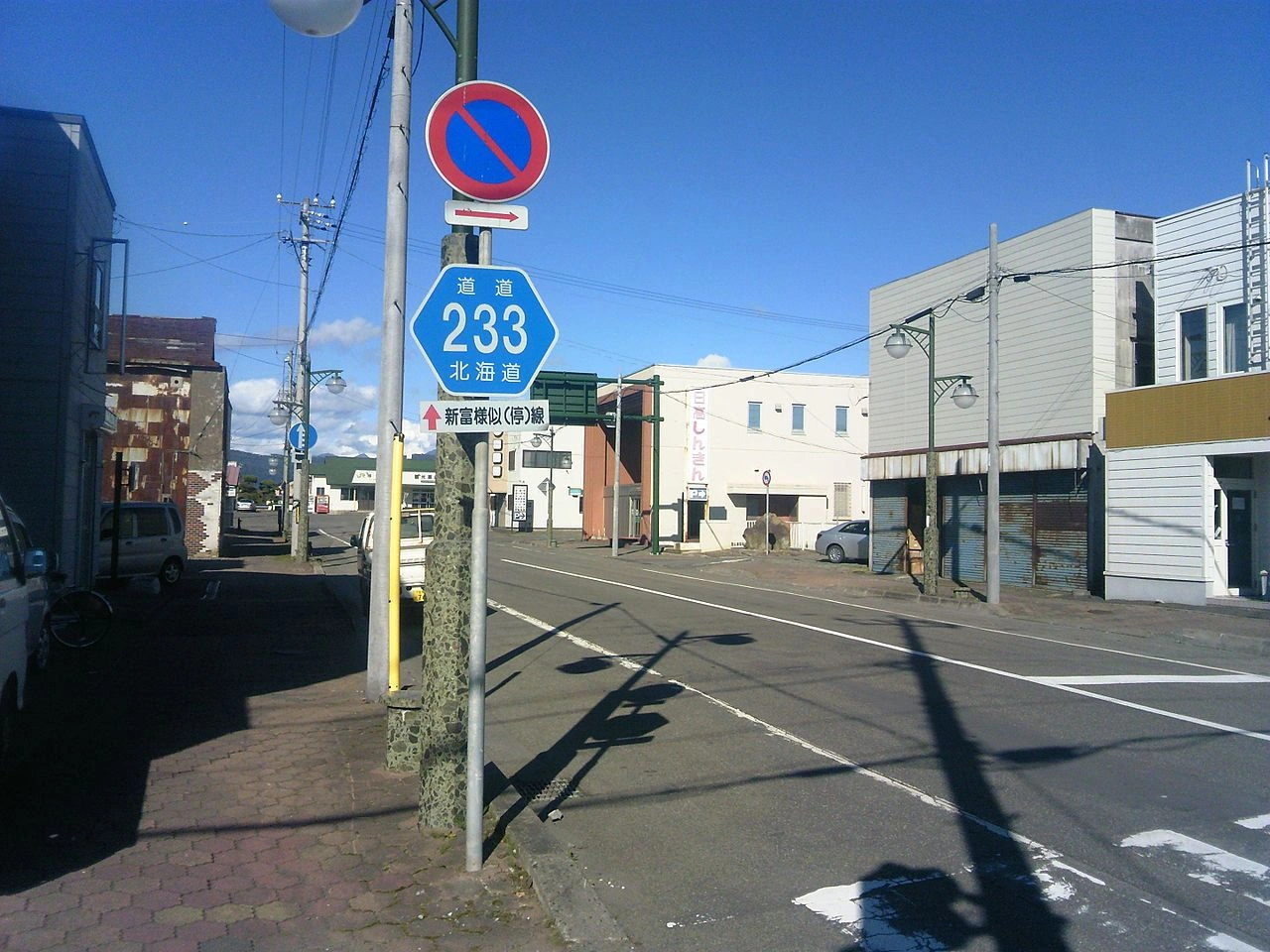
Wikimedia.org • Asasa198 • CC BY-SA
How close may you park to a Japanese garage entrance?
Keep outside the three-metre prohibited area around vehicle entrances.
🔗 pref.aichi.jp • Aichi Prefectural Police, stopping and parking restrictions
How much clearance is required around a Japanese fire hydrant?
Parking is prohibited within five metres.
🔗 pref.aichi.jp • Aichi Prefectural Police, stopping and parking restrictions
How much road space must normally remain beside a parked car in Japan?
At least 3.5 metres must remain on its right, unless a different distance is signed.
🔗 pref.aichi.jp • Aichi Prefectural Police, stopping and parking restrictions
Can you park close to a Japanese fire alarm?
Not within one metre of the alarm.
🔗 pref.aichi.jp • Aichi Prefectural Police, stopping and parking restrictions