


Traffic rulesJapan
 Traffic rules
 Japan
1. Japan
Japan is an island country in East Asia stretching from the colder, snowy north of Hokkaido to the subtropical islands of Okinawa. Traffic drives on the left, and road conditions vary from extremely dense urban networks and narrow residential streets to mountain roads and a large intercity expressway system. Written road information is primarily in Japanese, using kanji and the Japanese syllabaries, but major guide signs commonly include Roman-letter or English information and expressways use an E-number route system designed partly to make navigation easier for international visitors.
Japan has no nationwide motorway vignette; many expressways are toll roads, with ETC electronic toll collection widely used. The normal statutory maximum for an ordinary passenger car on a national expressway is 100 km/h, although selected sections are signed at up to 120 km/h. Foreign visitors also need to pay particular attention to licensing: Japan accepts qualifying 1949 Geneva Convention International Driving Permits, while licences from a small group of specified countries and regions can instead be used with an authorised Japanese translation. Snow can make winter equipment essential in northern and mountainous areas, while earthquakes, typhoons and heavy rain can cause temporary closures and special traffic restrictions.
AI-generated by Rijbewijs-online.be • WCIT • CC BY-SA
Which side of the road do you drive on in Japan?
Drive on the left-hand side of the road and normally overtake on the right.
🔗 npa.go.jp • Japanese National Police Agency, safe-driving rules, Keep left
Can you drive after drinking alcohol in Japan?
No. Do not drink alcohol before driving. Japan prohibits drink-driving and also penalises certain people who knowingly provide a vehicle or alcohol to a driver, or ride with a driver who has been drinking.
🔗 npa.go.jp • Japanese National Police Agency, safe-driving rules, Drink-driving prohibition
What speed limits apply to passenger cars in Japan?
Ordinary roads: From 1 September 2026, the statutory maximum is 30 km/h on qualifying roads without a centre line or traffic lanes. Roads with a centre line, traffic lanes, physically separated directions and certain other specified roads retain the 60 km/h statutory maximum unless another speed limit is posted.
Expressways: For an ordinary passenger car, the normal statutory maximum on a national expressway is 100 km/h. Some high-standard sections have higher posted limits of up to 120 km/h, while many other sections are signed lower because of road, weather or traffic conditions.
🔗 npa.go.jp • Japanese National Police Agency, residential-road speed change, Residential-road limit from 1 September 2026; 🔗 npa.go.jp • Japanese National Police Agency, expressway speed limits, Statutory and posted expressway speed limits
Are seat belts compulsory in Japan?
Yes. Seat belts are required in all seating positions, including rear seats, where belts are provided.
🔗 japaneselawtranslation.go.jp • Japanese Government, Road Traffic Act, English translation, Articles 33, 38, 71 and 71-3, safe-driving duties; 🔗 npa.go.jp • Japanese National Police Agency, safe-driving rules, Safe-driving rules
When must children use a child seat in Japan?
A driver must not normally carry a child under six years old without an appropriate child-restraint system, subject to limited statutory exceptions. A suitable restraint is also recommended for older children who are too small for an adult seat belt to fit correctly.
🔗 japaneselawtranslation.go.jp • Japanese Government, Road Traffic Act, English translation, Articles 33, 38, 71 and 71-3, safe-driving duties; 🔗 npa.go.jp • Japanese National Police Agency, safe-driving rules, Safe-driving rules
Can you use a mobile phone while driving in Japan?
No. A driver must not hold a mobile phone for a call or look continuously at a phone or similar display while the vehicle is moving. Stop in a safe place before operating the device.
🔗 japaneselawtranslation.go.jp • Japanese Government, Road Traffic Act, English translation, Articles 33, 38, 71 and 71-3, safe-driving duties; 🔗 npa.go.jp • Japanese National Police Agency, safe-driving rules, Safe-driving rules
Do pedestrians have priority at pedestrian crossings in Japan?
Yes. Drivers approaching a crossing must slow sufficiently to stop unless it is clearly empty, and must stop and give way when a pedestrian is crossing or about to cross.
🔗 japaneselawtranslation.go.jp • Japanese Government, Road Traffic Act, English translation, Articles 33, 38, 71 and 71-3, safe-driving duties; 🔗 npa.go.jp • Japanese National Police Agency, safe-driving rules, Safe-driving rules
Must you stop at railway crossings in Japan?
Normally yes. Before crossing railway tracks, drivers must come to a complete stop and check that it is safe. Where a traffic signal directly controls the railway crossing, drivers may proceed according to that signal.
🔗 japaneselawtranslation.go.jp • Japanese Government, Road Traffic Act, English translation, Articles 33, 38, 71 and 71-3, safe-driving duties; 🔗 npa.go.jp • Japanese National Police Agency, safe-driving rules, Safe-driving rules
Which driving documents can foreign visitors use in Japan?
International Driving Permit: Only a qualifying International Driving Permit issued under the 1949 Geneva Convention is accepted. An IDP issued under another convention or in a non-compliant format does not automatically authorise driving in Japan.
Foreign licence with a translation: Drivers normally need a Japanese licence or a qualifying Geneva Convention IDP. A special exception allows licences issued by Switzerland, Germany, France, Belgium, Monaco and Taiwan to be used with an authorised Japanese translation.
Permitted period: Generally for no more than one year after entering Japan, or until the IDP expires, whichever occurs first. Special rules affect residents who leave and re-enter Japan for short periods.
Are motorcycle helmets compulsory in Japan?
Yes. Riders of motorcycles and motorised bicycles must wear a motorcycle helmet. A motorcycle rider must not carry a passenger who is not wearing one. Both rider and passenger need the required protection.
🔗 japaneselawtranslation.go.jp • Japanese Government, Road Traffic Act, English translation
Should cyclists wear a helmet in Japan?
Yes. Since April 2023, national law asks all bicycle users to make every effort to wear a helmet. Use a suitable safety helmet and fasten the chin strap correctly. This is an effort obligation, rather than the mandatory helmet rule that applies to motorcycles.
🔗 npa.go.jp • Japanese National Police Agency, bicycle helmets

2. Motorway
A motorway is a road specially designed and signposted for motor traffic. Motorways normally have separate carriageways for opposing traffic, controlled access through designated entrances and exits, no direct access to neighbouring properties, and no level crossings with other roads, railways or paths.
Special traffic rules apply on motorways. The permitted road users, speed limits, lane rules, tolls and emergency procedures vary between countries, so drivers must follow the local traffic signs and regulations.

Wikimedia.org • shota • CC BY-SA
How do people refer to an expressway in Japan?
The general Japanese term is 高速道路 (kōsoku dōro). The legal categories include national expressways and other motor-vehicle-only roads; the same unsigned speed rule does not apply to every road called an expressway.
🔗 laws.e-gov.go.jp • e-Gov — current enforced Road Traffic Act, revision metadata and full text
🔗 laws.e-gov.go.jp • e-Gov — current enforced decree revision metadata
What speed limit applies to cars on an expressway in Japan?
For an ordinary car on a national expressway, the normal statutory maximum is 100 km/h. Selected sections are signed up to 120 km/h, while others are lower. Follow the actual signs; other expressway categories and vehicle classes can have different rules.
🔗 laws.e-gov.go.jp • e-Gov — current enforced Road Traffic Act, revision metadata and full text
🔗 laws.e-gov.go.jp • e-Gov — current enforced decree revision metadata
What should I do if I miss an expressway exit in Japan?
Continue to the next exit. Never reverse, turn around or drive against the traffic on the expressway.
🔗 laws.e-gov.go.jp • e-Gov — current enforced Road Traffic Act, revision metadata and full text
🔗 laws.e-gov.go.jp • e-Gov — current enforced decree revision metadata
What should I do if my vehicle breaks down on a Japanese expressway?
If possible, reach a safe stopping place off the traffic lanes and switch on hazard lights. If stranded on the carriageway or shoulder, warn following traffic with the prescribed stopping-warning equipment, placing it where it can be done safely. When safe to leave, move to a protected place away from traffic and report the breakdown. Do not remain in or beside a stranded vehicle where moving traffic can strike it.
🔗 laws.e-gov.go.jp • e-Gov — current enforced Road Traffic Act, revision metadata and full text
🔗 laws.e-gov.go.jp • e-Gov — current enforced decree revision metadata
3. Expressway
An expressway is a road intended to carry through traffic efficiently, usually at higher speeds than ordinary roads. Expressways often have limited access, multiple lanes, separated carriageways or grade-separated junctions, but their design and legal status vary between countries.
An expressway is not always a motorway. It may have intersections, traffic lights or direct access, and the permitted road users, speed limits and special rules depend on local signs and regulations.
Wikimedia.org • 運動会プロテインパワー • CC BY-SA
How do people refer to an expressway in Japan?
Japanese rules distinguish 高速自動車国道 (kosoku jidosha kokudo), national expressway routes, from 自動車専用道路 (jidosha senyo doro), roads reserved for motor vehicles. Urban expressways can belong to the latter category.
🔗 laws.e-gov.go.jp • e-Gov — current enforced Road Traffic Act, revision metadata and full text
🔗 laws.e-gov.go.jp • e-Gov — current enforced decree revision metadata
What speed limit applies to cars on an expressway in Japan?
Do not apply the national-expressway car default to every motor-vehicle-only road. For a motor-vehicle-only road outside that national-expressway category, the unsigned statutory maximum remains 60 km/h. Posted limits can differ; follow the actual signs.
🔗 laws.e-gov.go.jp • e-Gov — current enforced Road Traffic Act, revision metadata and full text
🔗 laws.e-gov.go.jp • e-Gov — current enforced decree revision metadata
Which lane should I normally use on a Japanese expressway?
The National Police Agency advises keeping left and choosing lanes according to your vehicle, speed, traffic restrictions and surrounding traffic. Use the overtaking lane appropriately and return left when safe.
🔗 laws.e-gov.go.jp • e-Gov — current enforced Road Traffic Act, revision metadata and full text
🔗 laws.e-gov.go.jp • e-Gov — current enforced decree revision metadata
What should I do if I miss an expressway exit in Japan?
Continue to the next exit and choose a safe onward route. Do not reverse, make a U-turn to reach a missed exit.
🔗 laws.e-gov.go.jp • e-Gov — current enforced Road Traffic Act, revision metadata and full text
🔗 laws.e-gov.go.jp • e-Gov — current enforced decree revision metadata
4. Zone
A traffic zone is an area in which a traffic rule applies throughout all included roads or road sections. The rule normally begins at a zone-entry sign and remains applicable until the corresponding end-of-zone sign is passed.
Zones may regulate speed, parking, access, vehicle categories, emissions or other traffic behaviour. The signs used, the roads covered and the effect of intersections or local exceptions depend on local traffic law.

Wikimedia.org • 円周率3パーセント • CC BY-SA
How do people refer to traffic zones in Japan?
The Japanese name ゾーン30 means Zone 30. It establishes an area with a 30 km/h maximum. ゾーン30プラス, Zone 30 Plus, combines that area restriction with physical traffic-calming measures.
🔗 laws.e-gov.go.jp • e-Gov — current enforced Road Traffic Act, revision metadata and full text
🔗 mlit.go.jp • MLIT/NPA — Zone 30 Plus: area restriction and physical traffic calming
Where does a zone rule apply in Japan?
The 30 km/h restriction covers the designated area, rather than only the point bearing the entrance sign. Observe its boundary signs and other restrictions on the roads inside it.
🔗 laws.e-gov.go.jp • e-Gov — current enforced Road Traffic Act, revision metadata and full text
🔗 mlit.go.jp • MLIT/NPA — Zone 30 Plus: area restriction and physical traffic calming
Does Japan’s Zone 30 Plus allow a different maximum speed from Zone 30?
No. The maximum remains 30 km/h. The Plus arrangement adds measures such as humps to reinforce the restriction and improve safety; it does not give permission to drive faster between them.
🔗 laws.e-gov.go.jp • e-Gov — current enforced Road Traffic Act, revision metadata and full text
🔗 mlit.go.jp • MLIT/NPA — Zone 30 Plus: area restriction and physical traffic calming
Is every Japanese road limited to 30 km/h necessarily inside a Zone 30?
No. A separately signed road or the statutory limit for qualifying ordinary roads can also be 30 km/h. Zone 30 identifies an area restriction; one road’s numerical limit alone does not establish its boundary.
🔗 laws.e-gov.go.jp • e-Gov — current enforced Road Traffic Act, revision metadata and full text
🔗 mlit.go.jp • MLIT/NPA — Zone 30 Plus: area restriction and physical traffic calming
5. Speed limit
A speed limit is the maximum legal speed permitted on a road, lane or within a designated area. It may be established by general traffic law or indicated by fixed, variable or temporary traffic signs.
A speed limit is a maximum, not a target speed. Drivers must travel more slowly whenever traffic, visibility, weather, road conditions, vulnerable road users or the condition of the vehicle make the maximum permitted speed unsafe.
Wikimedia.org • 運動会プロテインパワー • CC BY-SA
Which general speed limits should car drivers know in Japan?
From 1 September 2026, qualifying ordinary roads without a centre line, marked traffic lanes or separated directions have a statutory car maximum of 30 km/h. Other specified ordinary-road categories retain 60 km/h. A designated speed sign replaces that road’s statutory default. On qualifying national expressway main carriageways, the ordinary car default is 100 km/h, with different signed limits on many sections.
🔗 laws.e-gov.go.jp • Japan Road Traffic Act — Articles 22–23; decree Articles 11 and 27
🔗 laws.e-gov.go.jp • e-Gov — current enforced Road Traffic Act, revision metadata and full text
🔗 laws.e-gov.go.jp • e-Gov — current enforced decree revision metadata
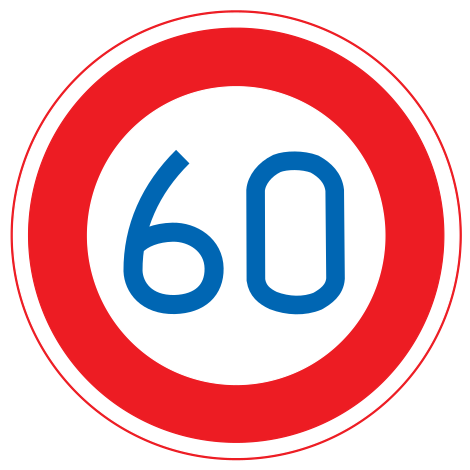 Start of a speed limit.
English • Traffic sign 323 • Maximum speed: 60 km/h. Observe any lower statutory vehicle-category limit and a speed safe for road conditions.
日本語 • 323 • 最高速度:60 km/h。 表示された最高速度は時速60キロメートルです。車種ごとの、これより低い法定速度や道路状況に応じた安全な速度にも従ってください。
Sources
🔗 Commons.wikimedia.org
🔗 Laws.e-gov.go.jp • 道路標識、区画線及び道路標示に関する命令、別表第一・第二
🔗 Mlit.go.jp • 国土交通省、道路標識一覧
SVG source: Monaneko • Public domain • Original revision 2007-03-19. Wikimedia original unmodified.
Did Japan reduce every ordinary-road default to 30 km/h in September 2026?
No. The change concerns qualifying roads without centre lines, marked traffic lanes or separated directions. Roads in the specified exempt categories retain a 60 km/h statutory default. The official term 生活道路 refers to roads used in everyday local life; the legal layout criteria and actual signs matter.
🔗 laws.e-gov.go.jp • Japan Road Traffic Act — Articles 22–23; decree Articles 11 and 27
🔗 laws.e-gov.go.jp • e-Gov — current enforced Road Traffic Act, revision metadata and full text
🔗 laws.e-gov.go.jp • e-Gov — current enforced decree revision metadata
What if a Japanese qualifying 30 km/h-default road is signed at 40 km/h?
The designated speed applies: the National Police Agency gives 40 km/h as an example replacing the road’s 30 km/h statutory default. Equally, a 30 km/h sign can reduce a road with a 60 km/h default. Always choose a safe speed within the applicable maximum.
🔗 laws.e-gov.go.jp • Japan Road Traffic Act — Articles 22–23; decree Articles 11 and 27
🔗 laws.e-gov.go.jp • e-Gov — current enforced Road Traffic Act, revision metadata and full text
🔗 laws.e-gov.go.jp • e-Gov — current enforced decree revision metadata
6. Minimum speed
A minimum speed is the lowest speed that vehicles are required to maintain on a particular road or under specified conditions. Minimum-speed rules are intended to prevent vehicles travelling unnecessarily slowly from disrupting traffic or creating large speed differences between road users.
A minimum speed does not require drivers to maintain that speed when traffic, weather, visibility, road conditions or safety require them to slow down. The way minimum speeds are indicated and enforced varies between countries.

Wikimedia.org • Oka21000 • CC BY-SA
What is Japan’s default minimum on a national expressway main carriageway?
On the qualifying main carriageway of a national expressway, the statutory minimum is 50 km/h where no minimum is designated by signs or markings. The statutory scope excludes specified carriageways; do not apply this automatically to every road called an expressway.
🔗 laws.e-gov.go.jp • Japan Road Traffic Act — Article 75-4; decree Article 27-3
🔗 laws.e-gov.go.jp • e-Gov — current enforced Road Traffic Act, revision metadata and full text
🔗 laws.e-gov.go.jp • e-Gov — current enforced decree revision metadata
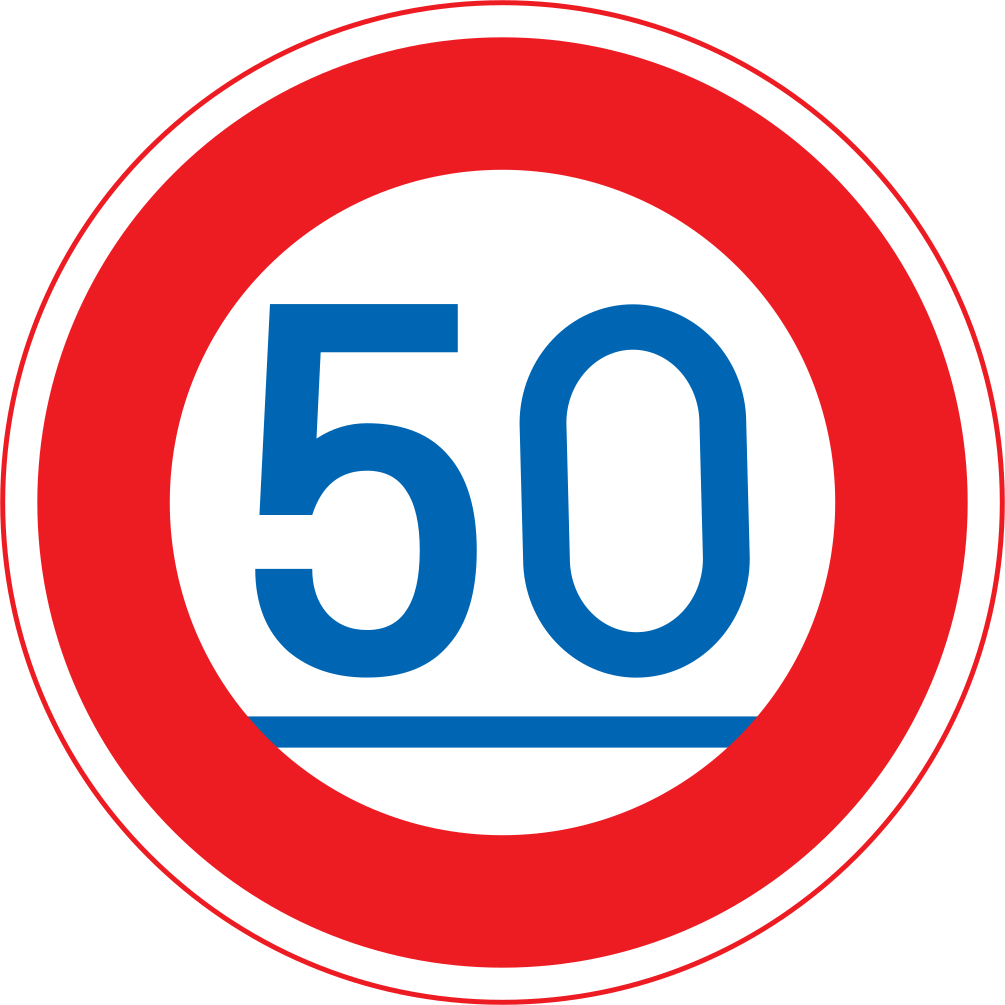 Start of a minimum speed.
English • Traffic sign 324 • Minimum speed: 50 km/h. Sets the minimum for motor vehicles. It does not require maintaining that speed when safety demands otherwise.
日本語 • 324 • 最低速度:50 km/h。 自動車の最低速度を時速50キロメートルに指定しています。安全上必要な場合にも無理に速度を維持するという意味ではありません。
Sources
🔗 Commons.wikimedia.org
🔗 Laws.e-gov.go.jp • 道路標識、区画線及び道路標示に関する命令、別表第一・第二
🔗 Mlit.go.jp • 国土交通省、道路標識一覧
🔗 Npa.go.jp • 警察庁、交通規制基準(令和8年3月16日改正)、PDF 137ページ
SVG source: Monaneko • Public domain • Original revision 2013-08-19. Wikimedia original unmodified.
What is Japan’s official term for minimum speed?
The official wording is 最低速度. Signs or markings can designate a minimum for the relevant road. Read it separately from the maximum-speed restriction; the two numbers serve different purposes.
🔗 laws.e-gov.go.jp • Japan Road Traffic Act — Article 75-4; decree Article 27-3
🔗 laws.e-gov.go.jp • e-Gov — current enforced Road Traffic Act, revision metadata and full text
🔗 laws.e-gov.go.jp • e-Gov — current enforced decree revision metadata
Can a Japanese expressway driver go below the minimum to avoid danger?
Yes. The Act recognises slowing required by another legal rule and cases where it is unavoidable to prevent danger. A minimum does not require maintaining 50 km/h into congestion or another hazard.
🔗 laws.e-gov.go.jp • Japan Road Traffic Act — Article 75-4; decree Article 27-3
🔗 laws.e-gov.go.jp • e-Gov — current enforced Road Traffic Act, revision metadata and full text
🔗 laws.e-gov.go.jp • e-Gov — current enforced decree revision metadata
7. Footpath
A footpath is a path or part of a road intended primarily for pedestrian traffic. It may run alongside a road, through a park or residential area, or independently from roads used by motor vehicles.
A footpath may be reserved exclusively for pedestrians or may form part of a shared route with cyclists or other permitted users. Access, priority and permitted users depend on the traffic signs and local regulations applying to the path.

Wikimedia.org • Colin McMillen • CC BY
What does Japan call a roadside pavement?
The official term is 歩道, a pedestrian pavement separated from the carriageway. Pedestrians must normally use it, a pedestrian roadside strip or another designated walking facility. A sign permitting bicycles changes cycling access; a pavement is not automatically a general cycle route.
🔗 laws.e-gov.go.jp • Japan Road Traffic Act — Articles 2, 10 and 63-4; decree Article 26
🔗 laws.e-gov.go.jp • e-Gov — current enforced Road Traffic Act, revision metadata and full text
🔗 npa.go.jp • NPA — current 2026 bicycle rulebook; facility allocation and passing duties
🔗 npa.go.jp • NPA — bicycle rules FAQ, April 2026 amendment
🔗 npa.go.jp • NPA/MLIT — safe and comfortable bicycle-use environment guideline, June 2024
When may an ordinary bicycle use a Japanese pavement?
Exceptions include signs permitting cycling, riders under 13 or aged 70 and over, specified physical disabilities, and situations where carriageway or traffic conditions make pavement use unavoidable for safety. These are exceptions to the normal carriageway rule, not unrestricted pavement cycling.
🔗 laws.e-gov.go.jp • Japan Road Traffic Act — Articles 2, 10 and 63-4; decree Article 26
🔗 laws.e-gov.go.jp • e-Gov — current enforced Road Traffic Act, revision metadata and full text
🔗 npa.go.jp • NPA — current 2026 bicycle rulebook; facility allocation and passing duties
🔗 npa.go.jp • NPA — bicycle rules FAQ, April 2026 amendment
🔗 npa.go.jp • NPA/MLIT — safe and comfortable bicycle-use environment guideline, June 2024
How must cyclists behave when allowed on a Japanese pavement?
Ordinarily ride slowly on the part nearest the carriageway, or use a designated bicycle part where provided. Pedestrians have priority. Stop if riding would obstruct them. Permission to ride on the pavement does not permit weaving quickly through walkers.
🔗 laws.e-gov.go.jp • Japan Road Traffic Act — Articles 2, 10 and 63-4; decree Article 26
🔗 laws.e-gov.go.jp • e-Gov — current enforced Road Traffic Act, revision metadata and full text
🔗 npa.go.jp • NPA — current 2026 bicycle rulebook; facility allocation and passing duties
🔗 npa.go.jp • NPA — bicycle rules FAQ, April 2026 amendment
🔗 npa.go.jp • NPA/MLIT — safe and comfortable bicycle-use environment guideline, June 2024
8. Bike path
A bike path is a part of a road or a separate route intended primarily or exclusively for people riding bicycles. It may be physically separated from motor traffic, marked on the road surface or identified by traffic signs.
Bike paths may be one-way, two-way or shared with other road users. The permitted users, direction of travel, priority rules and obligation to use the path depend on local traffic signs and regulations.
Wikimedia.org • Tatawidepine • CC BY-SA
What does Japan call a legally separated cycle track?
The term is 自転車道. It is a carriageway part physically divided by kerbs, fences or similar structures for cycling. A marked 普通自転車専用通行帯 is a designated lane for ordinary bicycles and is a different facility.
🔗 laws.e-gov.go.jp • Japan Road Traffic Act — Articles 2, 20 and 63-3
🔗 laws.e-gov.go.jp • e-Gov — current enforced Road Traffic Act, revision metadata and full text
🔗 npa.go.jp • NPA — current 2026 bicycle rulebook; facility allocation and passing duties
🔗 npa.go.jp • NPA — bicycle rules FAQ, April 2026 amendment
🔗 npa.go.jp • NPA/MLIT — safe and comfortable bicycle-use environment guideline, June 2024
Must ordinary bicycles use a provided Japanese cycle track?
Yes, subject to the statutory exception where unavoidable because of roadworks or other circumstances. The obligation concerns the legally designated cycle track. Ordinary bicycles also have rules for designated cycle lanes; painted guidance marks alone are a different arrangement.
🔗 laws.e-gov.go.jp • Japan Road Traffic Act — Articles 2, 20 and 63-3
🔗 laws.e-gov.go.jp • e-Gov — current enforced Road Traffic Act, revision metadata and full text
🔗 npa.go.jp • NPA — current 2026 bicycle rulebook; facility allocation and passing duties
🔗 npa.go.jp • NPA — bicycle rules FAQ, April 2026 amendment
🔗 npa.go.jp • NPA/MLIT — safe and comfortable bicycle-use environment guideline, June 2024
Do Japan’s bicycle arrows automatically create a reserved cycle lane?
No. Bicycle navigation marks and lines show the expected position and direction but do not themselves create new statutory traffic rules or penalties. Follow the arrows and applicable road controls, and continue to watch for vehicles and pedestrians.
🔗 laws.e-gov.go.jp • Japan Road Traffic Act — Articles 2, 20 and 63-3
🔗 laws.e-gov.go.jp • e-Gov — current enforced Road Traffic Act, revision metadata and full text
🔗 npa.go.jp • NPA — current 2026 bicycle rulebook; facility allocation and passing duties
🔗 npa.go.jp • NPA — bicycle rules FAQ, April 2026 amendment
🔗 npa.go.jp • NPA/MLIT — safe and comfortable bicycle-use environment guideline, June 2024
9. Shared-use path
A shared-use path is a path or part of a road intended for use by both pedestrians and cyclists. Unlike facilities where pedestrians and cyclists have clearly separated sections, users of a shared-use path normally travel within the same general space.
Because users may travel at very different speeds, cyclists should approach pedestrians carefully, adapt their speed and leave sufficient space when passing. The permitted users, priority rules and any speed restrictions depend on the local traffic signs and regulations.

When can ordinary bicycles share a Japanese pavement with pedestrians?
The national rules provide specified exceptions, including signs permitting ordinary bicycles, certain rider age or disability conditions, and circumstances making carriageway use dangerous. A pavement is not automatically a cycling route. The permission concerns ordinary bicycles as legally defined.
🔗 laws.e-gov.go.jp • Japan Road Traffic Act — Articles 17–18, 63-3 and 63-4
🔗 laws.e-gov.go.jp • e-Gov — current enforced Road Traffic Act, revision metadata and full text
🔗 npa.go.jp • NPA — current 2026 bicycle rulebook; facility allocation and passing duties
🔗 npa.go.jp • NPA — bicycle rules FAQ, April 2026 amendment
🔗 npa.go.jp • NPA/MLIT — safe and comfortable bicycle-use environment guideline, June 2024
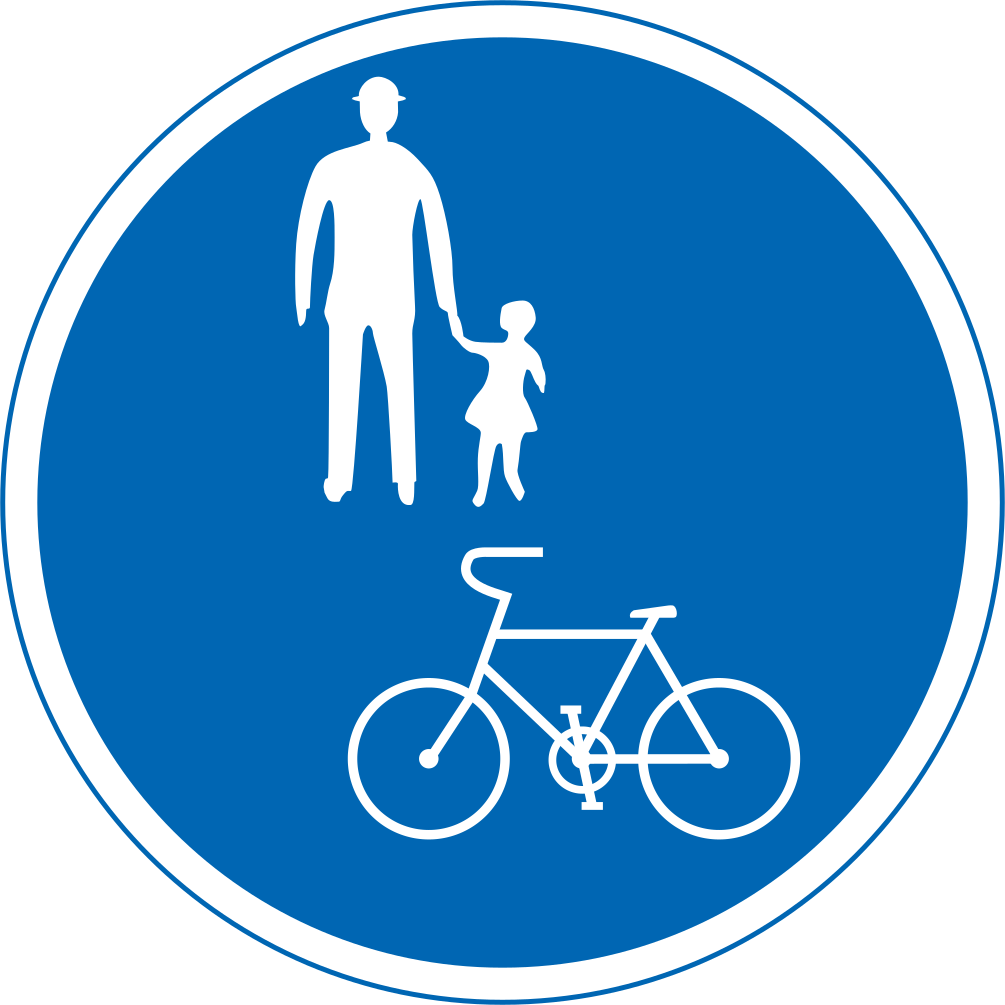 Mandatory shared pedestrian and cycle path.
English • Traffic sign 325の3 • Ordinary bicycles and similar users, and pedestrians only. Indicates a road for bicycles and pedestrians, or a pavement usable by ordinary bicycles and related categories. Also concerns eligible specified small motorised bicycles; check the road type and supplementary signs. Give pedestrians priority on pavements.
日本語 • 325の3 • 普通自転車等及び歩行者等専用。 自転車と歩行者のための道路、または普通自転車等が通行できる歩道を示します。対象となる特定小型原動機付自転車の通行にも関係するため、道路の種類と補助標識を確認してください。歩道では歩行者を優先してください。
Sources
🔗 Commons.wikimedia.org
🔗 Laws.e-gov.go.jp • 道路標識、区画線及び道路標示に関する命令、別表第一・第二
🔗 Mlit.go.jp • 国土交通省、道路標識一覧
🔗 Npa.go.jp • 警察庁、交通規制基準、PDF 175ページ(歩道通行の用法)
🔗 Npa.go.jp • 警察庁、交通規制基準(令和8年3月16日改正)、PDF 67ページ
SVG source: Monaneko • Public domain • Original revision 2021-10-06. Wikimedia original unmodified.
How must cyclists ride when permitted on a Japanese pedestrian pavement?
Normally use the part nearest the carriageway and ride slowly enough to stop immediately. If you would obstruct pedestrians, you must stop. Pedestrians have priority; permitted cycling does not allow forcing them aside.
🔗 laws.e-gov.go.jp • Japan Road Traffic Act — Articles 17–18, 63-3 and 63-4
🔗 laws.e-gov.go.jp • e-Gov — current enforced Road Traffic Act, revision metadata and full text
🔗 npa.go.jp • NPA — current 2026 bicycle rulebook; facility allocation and passing duties
🔗 npa.go.jp • NPA — bicycle rules FAQ, April 2026 amendment
🔗 npa.go.jp • NPA/MLIT — safe and comfortable bicycle-use environment guideline, June 2024
Does every Japanese bicycle symbol mean walkers and cyclists share the whole path?
No. A legally designated cycle track, a reserved carriageway cycle lane and a pavement allowing ordinary bicycles are different arrangements. Painted navigation marks alone do not create new statutory access rules. Identify the facility and follow its applicable controls.
🔗 laws.e-gov.go.jp • Japan Road Traffic Act — Articles 17–18, 63-3 and 63-4
🔗 laws.e-gov.go.jp • e-Gov — current enforced Road Traffic Act, revision metadata and full text
🔗 npa.go.jp • NPA — current 2026 bicycle rulebook; facility allocation and passing duties
🔗 npa.go.jp • NPA — bicycle rules FAQ, April 2026 amendment
🔗 npa.go.jp • NPA/MLIT — safe and comfortable bicycle-use environment guideline, June 2024
10. Tunnel
A tunnel is a covered passage that carries a road through or beneath an obstacle such as a hill, mountain, building, waterway or another transport route. Road tunnels may contain one or more traffic lanes and can carry traffic in one or both directions.
Driving in a tunnel requires particular attention because visibility, available escape routes and space for avoiding hazards are limited. Drivers should follow the applicable lighting, speed, lane and following-distance rules and pay attention to emergency exits, traffic signals and variable-message signs.
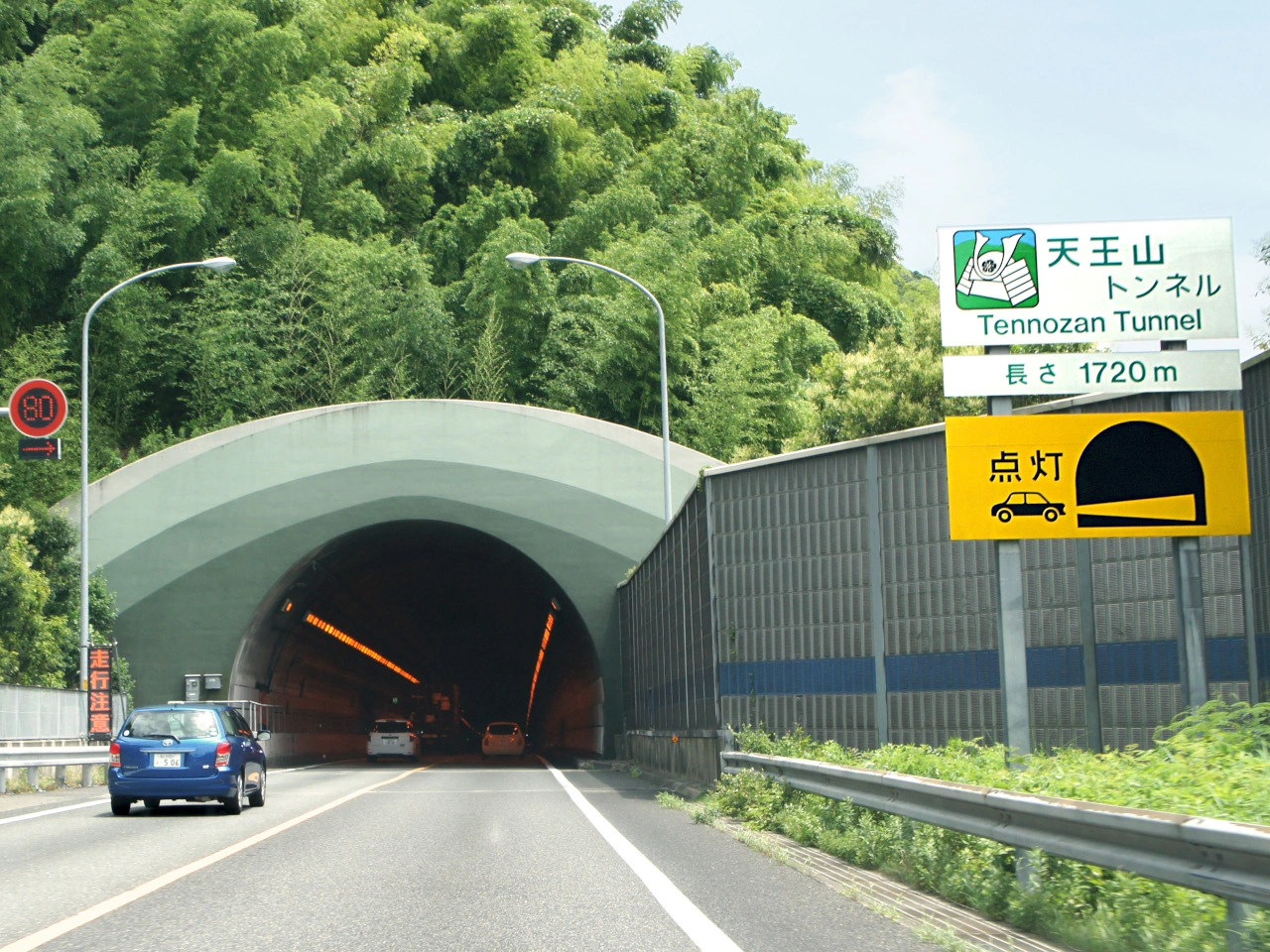
Wikimedia.org • Kirakirameister • CC BY-SA
What should I check before entering a tunnel in Japan?
Follow the tunnel’s signs and signals and use headlights when the law requires them for darkness or visibility. Overtaking restrictions depend on the tunnel’s lanes and traffic controls; do not assume every tunnel has an identical layout.
🔗 laws.e-gov.go.jp • Japan Road Traffic Act — Articles 30, 44 and 52
🔗 laws.e-gov.go.jp • e-Gov — current enforced Road Traffic Act, revision metadata and full text
Does a tunnel sign in Japan set a universal speed limit?
No single speed can be read from the tunnel pictogram. Apply the road’s relevant limit and any permanent or electronic speed restriction, and drive more slowly when visibility, queues or another hazard require it.
🔗 laws.e-gov.go.jp • Japan Road Traffic Act — Articles 30, 44 and 52
🔗 laws.e-gov.go.jp • e-Gov — current enforced Road Traffic Act, revision metadata and full text
Is every tunnel in Japan open to pedestrians and cyclists?
No. Check the road category and access signs before entering. A motorway tunnel, a vehicle-restricted tunnel and a purpose-built walking or cycling underpass have different access arrangements. Emergency evacuation routes do not establish ordinary public access.
🔗 laws.e-gov.go.jp • Japan Road Traffic Act — Articles 30, 44 and 52
🔗 laws.e-gov.go.jp • e-Gov — current enforced Road Traffic Act, revision metadata and full text
11. Toll road
A toll road is a road, motorway, bridge, tunnel or other route for which users must pay a charge. The toll may apply to all vehicles or only to particular vehicle categories, and the amount can depend on factors such as distance travelled, vehicle type, weight or emissions.
Tolls may be collected at toll booths, electronically or through a vignette or distance-based charging system. Drivers should check the applicable payment rules before using a toll road, especially when travelling in another country.

Wikimedia.org • katorisi • CC BY
Which road-charging system should I check in Japan?
Japanese expressways can use ETC or general toll lanes. Some entrances are ETC-only, so choose a route and entrance compatible with the vehicle’s payment equipment.
🔗 laws.e-gov.go.jp • e-Gov — current enforced Road Traffic Act, revision metadata and full text
What should I check before using a charged road in Japan?
Use the lane indicated for your payment method. Where a ticket system applies, take and retain the entry ticket; an ETC lane requires the correct functioning equipment and card, not simply a foreign electronic tag.
🔗 laws.e-gov.go.jp • e-Gov — current enforced Road Traffic Act, revision metadata and full text
Does the absence of a toll booth prove that a road is free in Japan?
The absence of a payment booth is not proof that a charged road is free. A vignette, electronic account, vehicle-registration record or another payment procedure may be used where the actual scheme provides for it. Follow the responsible authority or operator’s instructions for that road.
🔗 laws.e-gov.go.jp • e-Gov — current enforced Road Traffic Act, revision metadata and full text
12. One-way traffic
One-way traffic means that vehicles on a road or carriageway may travel only in one designated direction. The permitted direction is normally indicated by traffic signs, lane arrows or road markings.
Some road users, such as cyclists or public-transport vehicles, may be allowed to travel in the opposite direction when signs expressly permit it. A one-way road does not by itself determine the speed limit, priority or parking rules.

Wikimedia.org • 運動会プロテインパワー • CC BY-SA
How should I read a one-way restriction in Japan?
Follow the direction designated by the street’s one-way signs and any entrance restrictions or lane arrows. A compulsory turn at one junction is different from a restriction applying along the street.
🔗 laws.e-gov.go.jp • e-Gov — current enforced Road Traffic Act, revision metadata and full text
🔗 npa.go.jp • NPA — Traffic Lights and Road Signs, official English definitions
🔗 npa.go.jp • NPA — traffic instruction handbook, sign groups and road use; read with current Act
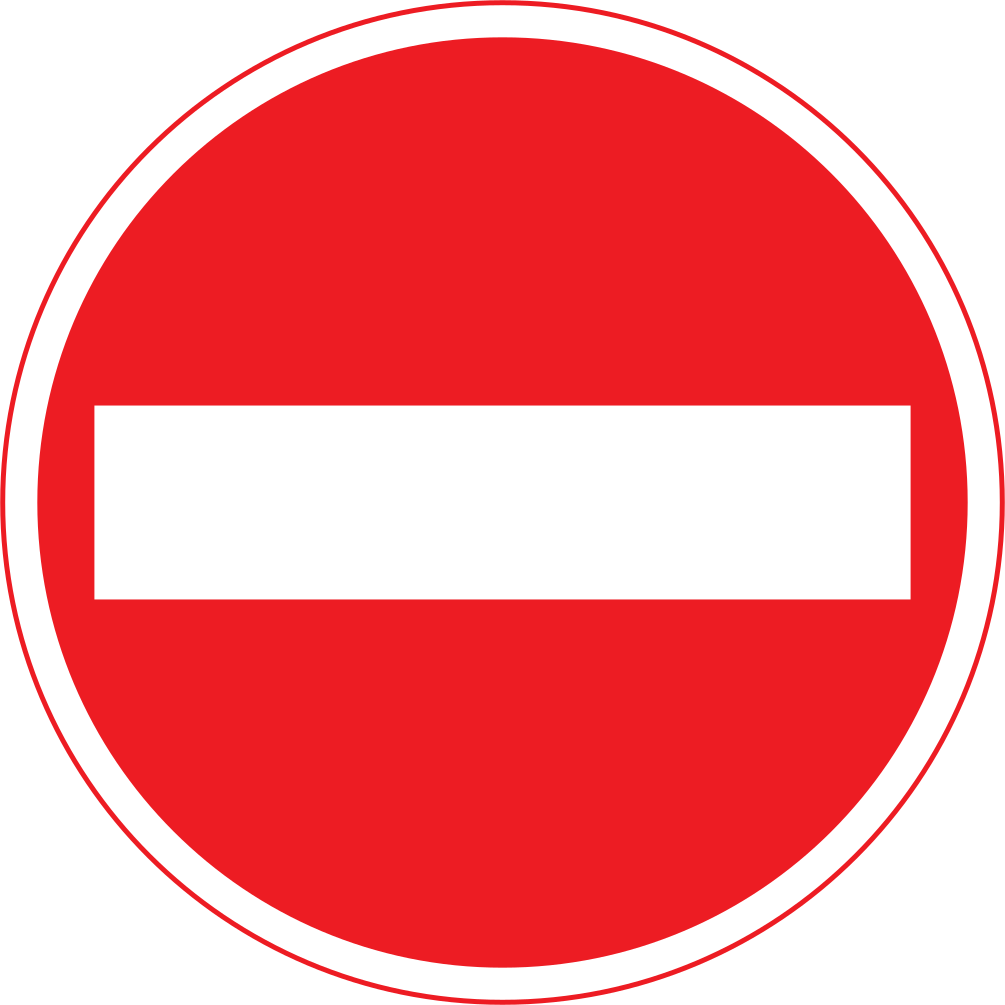 No entry.
English • Traffic sign 303 • No entry for vehicles. Vehicles must not enter from this direction.
日本語 • 303 • 車両進入禁止。 この方向から車両が進入することを禁止しています。
Sources
🔗 Commons.wikimedia.org
🔗 Laws.e-gov.go.jp • 道路標識、区画線及び道路標示に関する命令、別表第一・第二
🔗 Mlit.go.jp • 国土交通省、道路標識一覧
SVG source: Monaneko • Public domain • Original revision 2013-06-20. Wikimedia original unmodified.
May cyclists travel against the general traffic direction in Japan?
Do not assume cyclists are exempt from a road’s direction restriction. Check whether the applicable signs, local traffic arrangement or separately designated cycle facility actually authorise movement in the opposite direction; an ordinary bicycle-route sign is not enough.
🔗 laws.e-gov.go.jp • e-Gov — current enforced Road Traffic Act, revision metadata and full text
🔗 npa.go.jp • NPA — Traffic Lights and Road Signs, official English definitions
🔗 npa.go.jp • NPA — traffic instruction handbook, sign groups and road use; read with current Act
Does one-way traffic give me priority or a different speed limit in Japan?
A one-way restriction concerns direction. Continue to follow the applicable speed limit, signals, give-way or stop controls and junction-priority rules. Where authorised counterflow traffic exists, check for it before turning or crossing; your permitted direction is not automatic junction priority.
🔗 laws.e-gov.go.jp • e-Gov — current enforced Road Traffic Act, revision metadata and full text
🔗 npa.go.jp • NPA — Traffic Lights and Road Signs, official English definitions
🔗 npa.go.jp • NPA — traffic instruction handbook, sign groups and road use; read with current Act
13. Quay
A quay is a constructed area beside a river, canal, harbour or other body of water, commonly used for loading, unloading, mooring vessels or providing waterside access. A road may run alongside the water or lead directly towards the quay edge.
In road traffic, a quay warning indicates a risk that a vehicle could leave the road and enter the water. Drivers should reduce speed, observe the road layout carefully and keep a safe distance from the waterside edge.

Wikimedia.org • まも • CC0
What should I watch for near a quay or waterside road in Japan?
Look for an unprotected or poorly protected water’s edge, bends leading towards the water, barriers and local access controls. A quay can be an operational port area or a public waterside road; do not infer the traffic arrangement from the presence of water alone.
🔗 laws.e-gov.go.jp • e-Gov — current enforced Road Traffic Act, revision metadata and full text
🔗 npa.go.jp • NPA — Traffic Lights and Road Signs, official English definitions
🔗 npa.go.jp • NPA — traffic instruction handbook, sign groups and road use; read with current Act
How should I choose a safe speed beside water in Japan?
Use the applicable road or local speed limit and slow further for the foreseeable waterside danger. A hazard warning is not a promise that driving at the maximum is safe. Keep enough visibility and control to avoid the edge, pedestrians, loading activity or a blocked route.
🔗 laws.e-gov.go.jp • e-Gov — current enforced Road Traffic Act, revision metadata and full text
🔗 npa.go.jp • NPA — Traffic Lights and Road Signs, official English definitions
🔗 npa.go.jp • NPA — traffic instruction handbook, sign groups and road use; read with current Act
Does a quay warning allow me to enter or park beside the water in Japan?
Check the actual access and parking restrictions, including any port or dock controls. A waterside warning does not provide permission to enter a restricted facility or park on the edge. Keep the required passage clear and use a permitted place without endangering traffic or people beside the water.
🔗 laws.e-gov.go.jp • e-Gov — current enforced Road Traffic Act, revision metadata and full text
🔗 npa.go.jp • NPA — Traffic Lights and Road Signs, official English definitions
🔗 npa.go.jp • NPA — traffic instruction handbook, sign groups and road use; read with current Act
14. Slope
A slope is a section of road that rises or descends noticeably. A steep slope can affect vehicle speed, braking distance, traction, visibility and the ability of heavy or low-powered vehicles to maintain a steady speed.
Warning signs may indicate a steep ascent or dangerous descent and may show the gradient as a percentage. Drivers should adjust their speed early, select a suitable gear and remain prepared for slow vehicles, bends and changing road conditions.
Wikimedia.org • Kestrel • CC BY-SA
What does a steep-slope warning mean in Japan?
Japanese warning signs identify steep ascent or descent hazards. Keep a speed suited to the road and read any separate restrictions before entering a narrow or winding slope.
🔗 laws.e-gov.go.jp • Japan Road Traffic Act — Articles 30, 42 and 70
🔗 laws.e-gov.go.jp • e-Gov — current enforced Road Traffic Act, revision metadata and full text
🔗 npa.go.jp • NPA — Traffic Lights and Road Signs, official English definitions
🔗 npa.go.jp • NPA — traffic instruction handbook, sign groups and road use; read with current Act
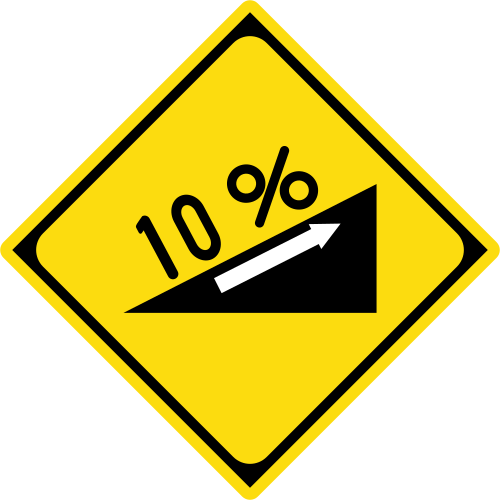 Warning for a steep ascent.
English • Traffic sign 212の3 • Steep ascent: 10%. Select a speed and gear suitable for road conditions.
日本語 • 212の3 • 上り急勾配あり:10%。 この先に勾配10%の急な上り坂があります。道路状況に適した速度とギアを選んでください。
Sources
🔗 Commons.wikimedia.org
🔗 Laws.e-gov.go.jp • 道路標識、区画線及び道路標示に関する命令、別表第一・第二
🔗 Mlit.go.jp • 国土交通省、道路標識一覧
SVG source: Monaneko • Public domain • Original revision 2013-06-19. Wikimedia original unmodified.
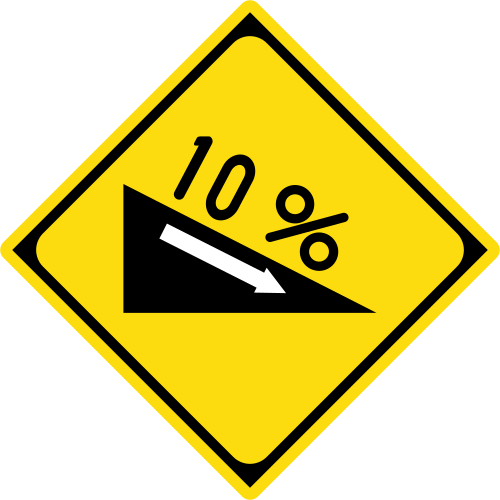 Warning for a steep descent.
English • Traffic sign 212の4 • Steep descent: 10%. Use an appropriate gear to avoid excessive speed.
日本語 • 212の4 • 下り急勾配あり:10%。 この先に勾配10%の急な下り坂があります。速度が上がりすぎないよう、適切なギアを使ってください。
Sources
🔗 Commons.wikimedia.org
🔗 Laws.e-gov.go.jp • 道路標識、区画線及び道路標示に関する命令、別表第一・第二
🔗 Mlit.go.jp • 国土交通省、道路標識一覧
SVG source: Monaneko • Public domain • Original revision 2013-06-19. Wikimedia original unmodified.
How should I approach a steep descent in Japan?
Reduce speed before the descent and select a suitable gear to help control the vehicle. Keep enough following distance and avoid building up speed that requires continuous heavy braking. A warning gives no fixed safe descent speed: the gradient, surface, visibility, load and vehicle can require a speed well below the legal maximum.
🔗 laws.e-gov.go.jp • Japan Road Traffic Act — Articles 30, 42 and 70
🔗 laws.e-gov.go.jp • e-Gov — current enforced Road Traffic Act, revision metadata and full text
🔗 npa.go.jp • NPA — Traffic Lights and Road Signs, official English definitions
🔗 npa.go.jp • NPA — traffic instruction handbook, sign groups and road use; read with current Act
What should I check when meeting or overtaking on a slope in Japan?
Japan’s Road Traffic Act prohibits overtaking near a hilltop and on a steep downhill slope, subject to the Act’s provisions. Do not treat an apparently empty road beyond the crest as a safe place to pass.
🔗 laws.e-gov.go.jp • Japan Road Traffic Act — Articles 30, 42 and 70
🔗 laws.e-gov.go.jp • e-Gov — current enforced Road Traffic Act, revision metadata and full text
🔗 npa.go.jp • NPA — Traffic Lights and Road Signs, official English definitions
🔗 npa.go.jp • NPA — traffic instruction handbook, sign groups and road use; read with current Act
15. Bus lane
A bus lane is a traffic lane reserved primarily for buses or other authorised public-transport vehicles. It is intended to improve the reliability and flow of public transport by allowing authorised vehicles to avoid general traffic congestion.
Other road users, such as taxis, cyclists, motorcycles or vehicles carrying several occupants, may also be permitted when signs expressly allow them. The operating hours, permitted vehicles, direction of travel and rules for entering or crossing the lane depend on local traffic signs and regulations.
Wikimedia.org • 運動会プロテインパワー • CC BY-SA
Which vehicles may use a bus lane in Japan?
Japan distinguishes an exclusive lane from a priority lane for fixed-route buses. An exclusive lane restricts users; a priority lane imposes duties on other traffic so that the bus can use it.
🔗 laws.e-gov.go.jp • Japan Road Traffic Act — Articles 20 and 20-2
🔗 laws.e-gov.go.jp • e-Gov — current enforced Road Traffic Act, revision metadata and full text
🔗 npa.go.jp • NPA — Traffic Lights and Road Signs, official English definitions
🔗 npa.go.jp • NPA — traffic instruction handbook, sign groups and road use; read with current Act
May bicycles and motorcycles use a bus lane in Japan?
Check which type of lane the sign establishes and which vehicles it covers. A bus-priority lane should not be described as an absolute bus-only prohibition, and cycle or small-vehicle exceptions must follow the actual rule.
🔗 laws.e-gov.go.jp • Japan Road Traffic Act — Articles 20 and 20-2
🔗 laws.e-gov.go.jp • e-Gov — current enforced Road Traffic Act, revision metadata and full text
🔗 npa.go.jp • NPA — Traffic Lights and Road Signs, official English definitions
🔗 npa.go.jp • NPA — traffic instruction handbook, sign groups and road use; read with current Act
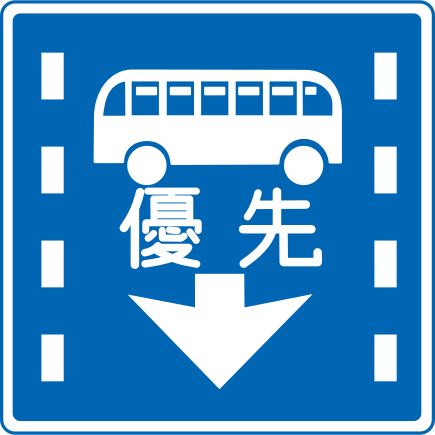 Lane for buses.
English • Traffic sign 327の5 • Priority lane for scheduled buses and similar vehicles. Gives these vehicles priority; differs from a bus-only lane symbol. Do not obstruct eligible buses and other covered vehicles.
日本語 • 327の5 • 路線バス等優先通行帯。 路線バス等を優先する車両通行帯です。バス専用通行帯を示す図柄とは異なります。対象のバス等の通行を妨げないようにしてください。
Sources
🔗 Commons.wikimedia.org
🔗 Laws.e-gov.go.jp • 道路標識、区画線及び道路標示に関する命令、別表第一・第二
🔗 Mlit.go.jp • 国土交通省、道路標識一覧
🔗 Npa.go.jp • 警察庁、交通規制基準(令和8年3月16日改正)、PDF 108ページ
SVG source: Monaneko (talk) • Public domain • Original revision 2012-08-26. Wikimedia original unmodified.
Does bus-lane access also allow stopping or parking in Japan?
In a priority lane, other traffic must allow an approaching fixed-route bus to use the lane and must not enter when congestion would prevent leaving it. Parking or stopping is a separate question and remains subject to the Road Traffic Act.
🔗 laws.e-gov.go.jp • Japan Road Traffic Act — Articles 20 and 20-2
🔗 laws.e-gov.go.jp • e-Gov — current enforced Road Traffic Act, revision metadata and full text
🔗 npa.go.jp • NPA — Traffic Lights and Road Signs, official English definitions
🔗 npa.go.jp • NPA — traffic instruction handbook, sign groups and road use; read with current Act
16. Bus stop
A bus stop is a designated place where buses stop to allow passengers to board or leave. It may be identified by a sign, shelter, raised platform, road marking or other public-transport infrastructure and can be located beside the road or in a specially constructed stopping area.
Drivers approaching a bus stop should watch carefully for buses, pedestrians and passengers crossing or entering the roadway. Parking or stopping restrictions may apply around bus stops to keep the area accessible and visible.

Wikimedia.org • NECK69 • CC BY-SA
What stopping or parking restrictions apply at bus stops in Japan?
Japan generally prohibits stopping and parking within 10 metres of a bus or tram stop sign during the service’s operating hours, subject to the Road Traffic Act’s exceptions.
🔗 laws.e-gov.go.jp • Japan Road Traffic Act — Articles 31-2 and 44
🔗 laws.e-gov.go.jp • e-Gov — current enforced Road Traffic Act, revision metadata and full text
May I briefly drop off a passenger at a bus stop in Japan?
An ordinary passenger drop-off is not a general exemption from the protected stop restriction. Use another lawful place and keep the bus’s passenger access clear.
🔗 laws.e-gov.go.jp • Japan Road Traffic Act — Articles 31-2 and 44
🔗 laws.e-gov.go.jp • e-Gov — current enforced Road Traffic Act, revision metadata and full text
What should I do near a stopped bus in Japan?
When a stopped bus signals to depart, a driver behind must not obstruct its change of course unless avoiding obstruction would require a sudden change of speed or direction. This is a qualified duty, not an unconditional right for the bus to pull out.
🔗 laws.e-gov.go.jp • Japan Road Traffic Act — Articles 31-2 and 44
🔗 laws.e-gov.go.jp • e-Gov — current enforced Road Traffic Act, revision metadata and full text
17. Stop sign
A stop sign requires drivers to bring their vehicle to a complete stop and give way before entering or crossing the road ahead. The stop must be made at the stop line or another legally prescribed position.
After stopping, the driver may continue only when this can be done safely and without interfering with traffic that has priority. The sign does not create priority for the driver who has stopped.

Wikimedia.org • 円周率3パーセント • CC BY-SA
Must I stop completely at a stop sign in Japan?
Yes. Come to a complete stop when the applicable stop sign controls your approach, even when you cannot see another road user. Slowing to a crawl is not a stop. Japan uses a red inverted triangular stop sign displaying 止まれ, with STOP on the bilingual version. It must not be mistaken for a give-way sign because of its shape.
🔗 laws.e-gov.go.jp • Japan Road Traffic Act — Article 43
🔗 laws.e-gov.go.jp • e-Gov — current enforced Road Traffic Act, revision metadata and full text
🔗 npa.go.jp • NPA — Traffic Lights and Road Signs, official English definitions
🔗 npa.go.jp • NPA — traffic instruction handbook, sign groups and road use; read with current Act
Where must I stop at a stop-controlled junction in Japan?
Stop immediately before the stop line. If no stop line is indicated, stop immediately before the junction. The Road Traffic Act’s yielding requirement continues after the stop.
🔗 laws.e-gov.go.jp • Japan Road Traffic Act — Article 43
🔗 laws.e-gov.go.jp • e-Gov — current enforced Road Traffic Act, revision metadata and full text
🔗 npa.go.jp • NPA — Traffic Lights and Road Signs, official English definitions
🔗 npa.go.jp • NPA — traffic instruction handbook, sign groups and road use; read with current Act
Does stopping first give me priority at a stop sign in Japan?
A complete stop does not, by itself, give you priority. Give way to the road users entitled to pass under the junction’s signs and rules, check pedestrians and cyclists, and proceed only when the gap is safe. Do not follow another stopped vehicle through without satisfying your own stopping and yielding duties.
🔗 laws.e-gov.go.jp • Japan Road Traffic Act — Article 43
🔗 laws.e-gov.go.jp • e-Gov — current enforced Road Traffic Act, revision metadata and full text
🔗 npa.go.jp • NPA — Traffic Lights and Road Signs, official English definitions
🔗 npa.go.jp • NPA — traffic instruction handbook, sign groups and road use; read with current Act
18. Give way
A give-way sign requires drivers to allow traffic with priority to proceed before entering, crossing or joining a road. Drivers must reduce speed, observe approaching traffic and stop when necessary.
Unlike a stop sign, a give-way sign does not always require a complete stop. The driver may continue without stopping only when the route is clearly safe and no road user with priority is forced to change speed or direction.

Wikimedia.org • 運動会プロテインパワー • CC BY-SA
What does giving way mean in Japan?
Japan regulates yielding through its junction rules and signs such as Slow and Stop. Give way to a priority road or a clearly wider intersecting road as required; do not treat a Slow instruction as a Stop instruction.
🔗 laws.e-gov.go.jp • Japan Road Traffic Act — Articles 36, 42–43
🔗 laws.e-gov.go.jp • e-Gov — current enforced Road Traffic Act, revision metadata and full text
🔗 npa.go.jp • NPA — Traffic Lights and Road Signs, official English definitions
🔗 npa.go.jp • NPA — traffic instruction handbook, sign groups and road use; read with current Act
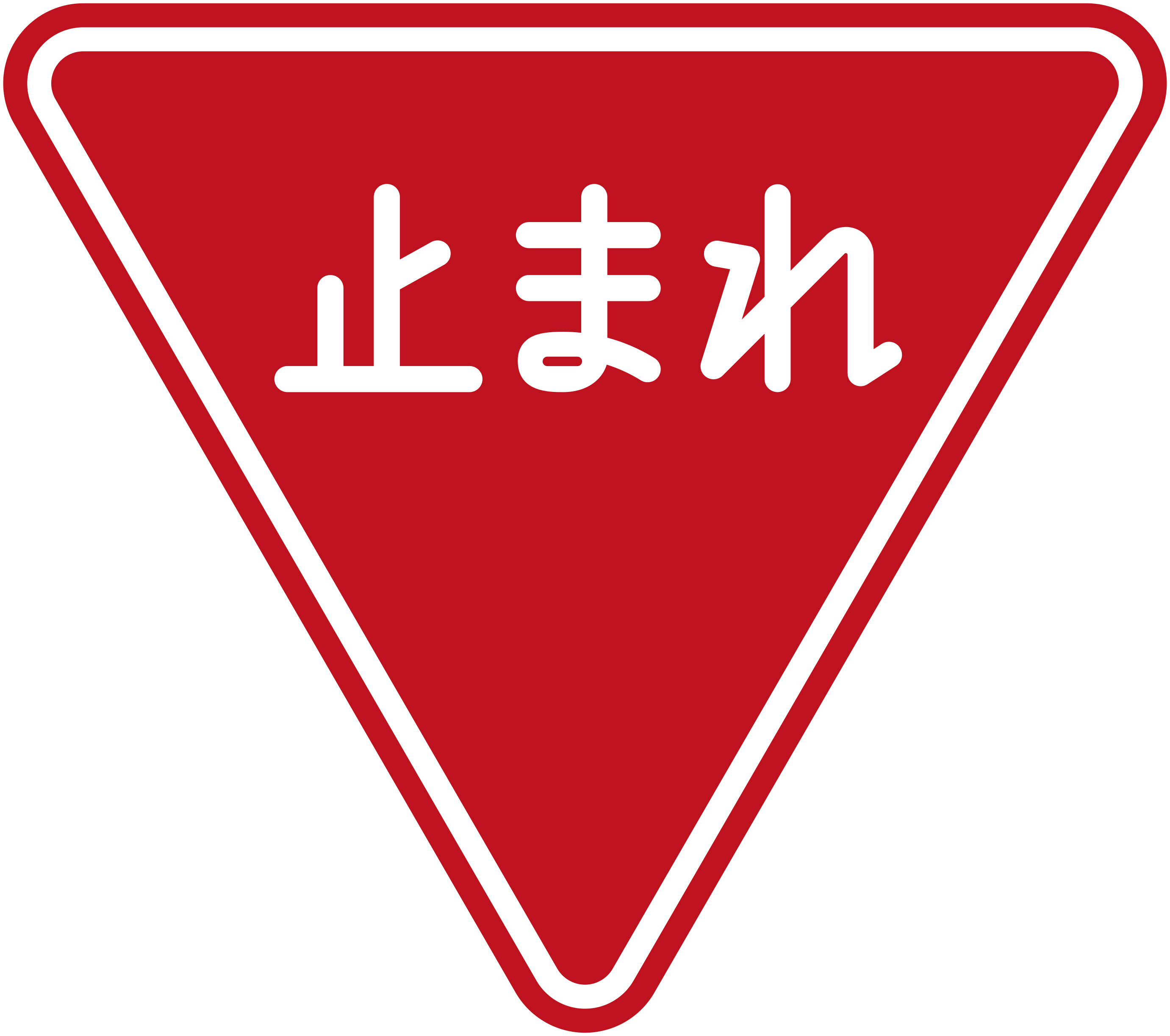 Give way.
English • Traffic sign 330-B • Stop. Stop completely immediately before the stop line or, if none exists, immediately before the junction. Proceed without obstructing traffic on the intersecting road.
日本語 • 330-B • 一時停止。 停止線の直前で完全に停止してください。停止線がない場合は交差点の直前で停止し、交差する道路の交通を妨げないように進んでください。
Sources
🔗 Commons.wikimedia.org
🔗 Laws.e-gov.go.jp • 道路標識、区画線及び道路標示に関する命令、別表第一・第二
🔗 Mlit.go.jp • 国土交通省、道路標識一覧
🔗 Npa.go.jp • 警察庁、交通規制基準(令和8年3月16日改正)、PDF 153ページ
SVG source: Eastwind41 • Public domain • Original revision 2017-11-24. Wikimedia original unmodified.
Must you always stop when giving way in Japan?
No blanket stopping duty follows from yielding alone. A Slow sign requires reduced speed, while a Stop sign requires a complete stop at the designated position. Poor visibility and the junction’s priority arrangement impose additional duties.
🔗 laws.e-gov.go.jp • Japan Road Traffic Act — Articles 36, 42–43
🔗 laws.e-gov.go.jp • e-Gov — current enforced Road Traffic Act, revision metadata and full text
🔗 npa.go.jp • NPA — Traffic Lights and Road Signs, official English definitions
🔗 npa.go.jp • NPA — traffic instruction handbook, sign groups and road use; read with current Act
Which direction has priority at an uncontrolled junction in Japan?
Japan’s ordinary uncontrolled-junction rule generally requires yielding to vehicles approaching from the left, with separate rules for priority roads, clearly wider roads and trams. Follow those rules and the actual controls; do not substitute priority from the right.
🔗 laws.e-gov.go.jp • Japan Road Traffic Act — Articles 36, 42–43
🔗 laws.e-gov.go.jp • e-Gov — current enforced Road Traffic Act, revision metadata and full text
🔗 npa.go.jp • NPA — Traffic Lights and Road Signs, official English definitions
🔗 npa.go.jp • NPA — traffic instruction handbook, sign groups and road use; read with current Act
19. Roundabout
A roundabout is a circular road arrangement in which traffic travels around a central island in one designated direction. Vehicles enter and leave through connecting roads, and traffic signs or local rules determine who has priority.
Drivers should reduce speed, choose a suitable lane, observe all road users and signal as required when leaving. The direction of travel, entry priority, lane use and rules for cyclists and pedestrians depend on local traffic signs and regulations.
Wikimedia.org • 日:もかめーる • CC BY-SA
Who has priority at a roundabout in Japan?
At a designated Japanese 環状交差点, entering vehicles must reduce speed and must not obstruct vehicles already circulating. Traffic travels clockwise; the Road Traffic Act has dedicated rules for these junctions.
🔗 laws.e-gov.go.jp • Japan Road Traffic Act — Articles 35-2 and 37-2
🔗 laws.e-gov.go.jp • e-Gov — current enforced Road Traffic Act, revision metadata and full text
How should you choose a roundabout lane in Japan?
Japan’s designated roundabout rules require approaching near the left edge and travelling, at reduced speed, along the outer edge for as long as possible, unless signs or markings specify the part of the road to use. Do not substitute an overseas multilane roundabout rule.
🔗 laws.e-gov.go.jp • Japan Road Traffic Act — Articles 35-2 and 37-2
🔗 laws.e-gov.go.jp • e-Gov — current enforced Road Traffic Act, revision metadata and full text
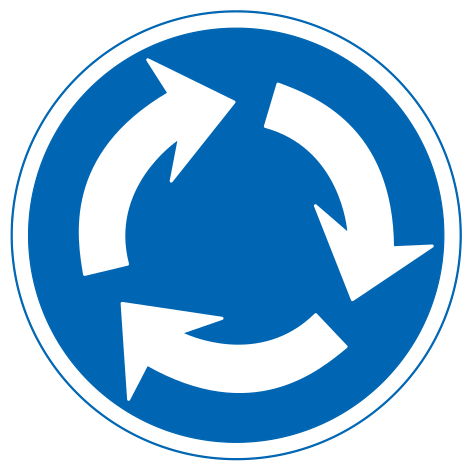 Mandatory roundabout direction.
English • Traffic sign 327の10 • Clockwise roundabout circulation. Travel clockwise around the circular junction.
日本語 • 327の10 • 環状の交差点における右回り通行。 環状交差点では右回り、つまり時計回りに通行してください。
Sources
🔗 Commons.wikimedia.org
🔗 Laws.e-gov.go.jp • 道路標識、区画線及び道路標示に関する命令、別表第一・第二
🔗 Mlit.go.jp • 国土交通省、道路標識一覧
🔗 Npa.go.jp • 警察庁、交通規制基準(令和8年3月16日改正)、PDF 148ページ
SVG source: Monaneko • Public domain • Original revision 2017-10-15. Wikimedia original unmodified.
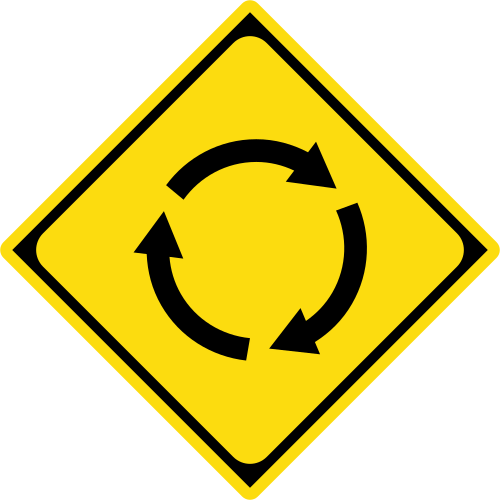 Warning for a roundabout.
English • Traffic sign 201の2 • Roundabout ahead. Observe the junction layout and traffic, and follow local restrictions.
日本語 • 201の2 • ロータリーあり。 この先にロータリーがあります。交差点の形状や交通に注意し、現地の規制に従ってください。
Sources
🔗 Commons.wikimedia.org
🔗 Laws.e-gov.go.jp • 道路標識、区画線及び道路標示に関する命令、別表第一・第二
🔗 Mlit.go.jp • 国土交通省、道路標識一覧
SVG source: Monaneko • Public domain • Original revision 2013-06-20. Wikimedia original unmodified.
What should you check when leaving a roundabout in Japan?
Check the lane you will cross or enter, signal the manoeuvre as required and look for cyclists and pedestrians at the exit. Obey any separate crossing controls and do not force an exit across another vehicle’s path.
🔗 laws.e-gov.go.jp • Japan Road Traffic Act — Articles 35-2 and 37-2
🔗 laws.e-gov.go.jp • e-Gov — current enforced Road Traffic Act, revision metadata and full text
20. Road narrowing
A road narrowing is a section where the available width of the road or carriageway becomes smaller. The narrowing may occur on both sides, on one side only, or because one or more traffic lanes end.
Drivers should reduce speed, observe approaching and adjacent traffic, maintain sufficient lateral clearance and merge when necessary. Warning signs do not always determine priority, so drivers must follow any priority signs, lane markings and local traffic rules.

Wikimedia.org • 運動会プロテインパワー • CC BY-SA
What does a road-narrowing warning mean in Japan?
Japanese narrowing warnings identify reduced road width. Keep to the required side, reduce speed for conditions and follow the actual traffic controls; the warning itself is different from a priority or Stop instruction.
🔗 laws.e-gov.go.jp • e-Gov — current enforced Road Traffic Act, revision metadata and full text
🔗 npa.go.jp • NPA — Traffic Lights and Road Signs, official English definitions
🔗 npa.go.jp • NPA — traffic instruction handbook, sign groups and road use; read with current Act
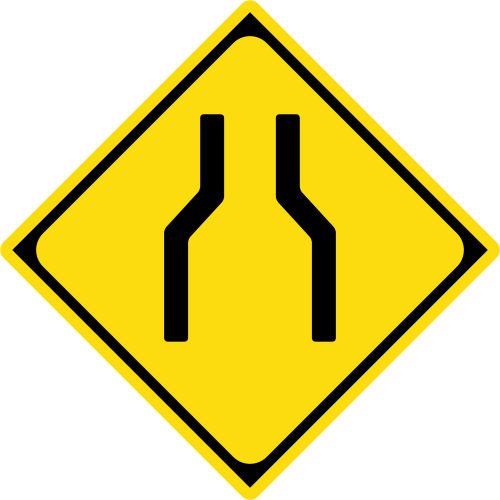 Warning for a road narrowing.
English • Traffic sign 212 • Road width decreases. Watch clearance from oncoming vehicles.
日本語 • 212 • 幅員減少。 この先で道路の幅が狭くなります。対向車との間隔に注意してください。
Sources
🔗 Commons.wikimedia.org
🔗 Laws.e-gov.go.jp • 道路標識、区画線及び道路標示に関する命令、別表第一・第二
🔗 Mlit.go.jp • 国土交通省、道路標識一覧
SVG source: Monaneko • Public domain • Original revision 2013-06-19. Wikimedia original unmodified.
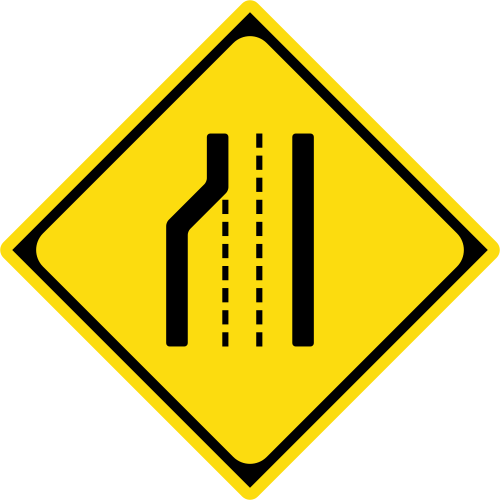 Warning for a road narrowing on the left.
English • Traffic sign 211 • Lane reduction. The left lane ends ahead. Check surrounding traffic and change lanes with a safe gap.
日本語 • 211 • 車線数減少。 この先で左側の車線がなくなります。周囲を確認し、安全な間隔を確保して車線を移ってください。
Sources
🔗 Commons.wikimedia.org
🔗 Laws.e-gov.go.jp • 道路標識、区画線及び道路標示に関する命令、別表第一・第二
🔗 Mlit.go.jp • 国土交通省、道路標識一覧
SVG source: Monaneko • Public domain • Original revision 2013-06-19. Wikimedia original unmodified.
Does a narrowing warning give you priority in Japan?
No. A warning describes the reduced width, rather than allocating priority or setting a numerical speed limit. Follow any separate priority signs, signals and meeting rules, and slow enough to pass safely or wait before entering.
🔗 laws.e-gov.go.jp • e-Gov — current enforced Road Traffic Act, revision metadata and full text
🔗 npa.go.jp • NPA — Traffic Lights and Road Signs, official English definitions
🔗 npa.go.jp • NPA — traffic instruction handbook, sign groups and road use; read with current Act
What should you do if traffic lanes merge at a narrowing in Japan?
Read the lane-ending signs and markings, check surrounding traffic and signal any lane change as required. Apply the local merging rule and enter only when safe. Do not assume the driver in an ending lane always has priority, or confuse merging with meeting oncoming traffic.
🔗 laws.e-gov.go.jp • e-Gov — current enforced Road Traffic Act, revision metadata and full text
🔗 npa.go.jp • NPA — Traffic Lights and Road Signs, official English definitions
🔗 npa.go.jp • NPA — traffic instruction handbook, sign groups and road use; read with current Act
21. Pedestrian crossing
A pedestrian crossing is a designated place where pedestrians may cross a road. It is commonly indicated by road markings, traffic signs, signals or a combination of these measures.
Drivers must approach with appropriate caution and give way when required by local law. Pedestrians must also observe approaching traffic and follow any pedestrian signals or instructions from authorised traffic controllers.

Wikimedia.org • そらみみ • CC BY-SA
When must drivers give way at a pedestrian crossing in Japan?
If someone is crossing or about to cross a designated crosswalk, stop and give way. The Japanese National Police Agency emphasises pedestrian priority.
🔗 npa.go.jp • Japanese National Police Agency, pedestrian crossings
Are all pedestrian crossings controlled the same way in Japan?
No. Follow the applicable traffic lights at controlled crossings. A green vehicle signal does not allow you to obstruct pedestrians crossing in your path, particularly when turning. At a designated crossing where pedestrians are crossing or about to cross, stop and give way as required.
🔗 npa.go.jp • Japan, National Police Agency, Traffic Lights and Road Signs; 🔗 npa.go.jp • Japan, National Police Agency, Pedestrians First at Road Crossings
May I enter a pedestrian crossing if the road beyond it is blocked in Japan?
Do not enter if traffic ahead would leave you stopped on the crossing. If a vehicle is stopped at or immediately before a crossing where pedestrians may cross, stop before passing it and continue only when safe and lawful. Overtaking is also restricted on the crossing and within 30 metres before it.
🔗 npa.go.jp • Japan, National Police Agency, Pedestrians First at Road Crossings; 🔗 japaneselawtranslation.go.jp • Japan, Ministry of Justice, Road Traffic Act, English translation through Act 76/2015
What should I do if a pedestrian is still crossing when the traffic signal changes in Japan?
Allow the pedestrian to finish crossing safely. A green vehicle signal is not permission to drive into someone who is still in the crossing; watch particularly for pedestrians obscured by turning or queued vehicles.
🔗 npa.go.jp • Japanese National Police Agency, pedestrian crossings
Must Japanese pedestrians use a nearby crossing or signal-controlled junction?
Yes. National Police Agency guidance directs pedestrians to cross there.
What does Japanese police guidance advise about nearby pedestrian footbridges and underpasses?
Use them whenever possible.
May Japanese pedestrians cross where a sign prohibits pedestrian crossing?
No. Follow the no-crossing sign.
What do white rhombus markings warn Japanese drivers about?
A pedestrian crossing or bicycle crossing lane ahead.
Should Japanese pedestrians walk through a bicycle crossing lane?
National Police Agency guidance says pedestrians should refrain from entering bicycle crossing lanes.
How far before a Japanese pedestrian crossing does the overtaking prohibition extend?
Thirty metres before it, as well as on it. NPA guidance also applies this restriction at bicycle crossing lanes.
22. Railway crossing
A railway crossing, also called a level crossing or railroad crossing, is a place where a road or path crosses railway tracks at the same level. It may be protected by barriers, warning lights, bells, traffic signs or a combination of these measures.
Road users must approach carefully and never enter when a train is approaching, warning signals are active or the exit is blocked. They should cross promptly and must never stop, wait or become trapped on the tracks.
Wikimedia.org • BATACHAN • CC BY-SA
Must drivers stop at a railway crossing in Japan?
Normally yes. The Japanese police instruct drivers to come to a complete stop and check for trains before passing over the tracks, even if the alarm is not sounding. A traffic signal directly controlling the crossing can provide a statutory exception.
🔗 npa.go.jp • Japan, National Police Agency, Follow the rules and drive safely, 2026 leaflet; 🔗 japaneselawtranslation.go.jp • Japan, Ministry of Justice, Road Traffic Act, English translation through Act 76/2015
Must I stop at every unguarded railway crossing in Japan?
Normally yes, even without an active warning alarm. Stop completely, look and listen for trains and proceed only when safe, except where the applicable signal-controlled-crossing rule permits otherwise.
🔗 npa.go.jp • Japan, National Police Agency, Follow the rules and drive safely, 2026 leaflet; 🔗 japaneselawtranslation.go.jp • Japan, Ministry of Justice, Road Traffic Act, English translation through Act 76/2015
What if road traffic is queued beyond a railway crossing in Japan?
Wait before the tracks until there is room to take your entire vehicle off the crossing. Do not follow another vehicle onto the tracks without checking the exit. Keep the tracks clear even if no train is visible.
🔗 japaneselawtranslation.go.jp • Japan, Ministry of Justice, Road Traffic Act, English translation through Act 76/2015; 🔗 npa.go.jp • Japan, National Police Agency, Follow the rules and drive safely, 2026 leaflet
Can I cross after a train has passed if the warning lights are still active in Japan?
No. Remain behind the stopping position until the crossing signals permit travel and barriers are fully clear. Another train may be approaching on a different track.
🔗 npa.go.jp • Japan, National Police Agency, Follow the rules and drive safely, 2026 leaflet; 🔗 japaneselawtranslation.go.jp • Japan, Ministry of Justice, Road Traffic Act, English translation through Act 76/2015
23. Mandatory direction
A mandatory-direction sign requires drivers to travel only in the direction or one of the directions indicated by its arrow or arrows. It may require traffic to continue straight ahead, turn, or pass an obstacle on a specified side.
The sign does not itself determine priority or speed. Drivers must still use the appropriate lane, signal when required and give way according to local traffic signs and regulations.
Wikimedia.org • ButuCC • CC BY-SA
What does a mandatory-direction sign require in Japan?
Where a compulsory-direction sign is installed in Japan, follow only the arrow direction or permitted combination of directions. The restriction applies at the location or movement it regulates; it is not an instruction to ignore other traffic controls.
🔗 laws.e-gov.go.jp • e-Gov — current enforced Road Traffic Act, revision metadata and full text
🔗 npa.go.jp • NPA — Traffic Lights and Road Signs, official English definitions
🔗 npa.go.jp • NPA — traffic instruction handbook, sign groups and road use; read with current Act
Can I choose another turn if the mandatory-direction arrow is inconvenient in Japan?
No, unless another applicable sign, lane instruction or authorised traffic direction lawfully permits it. Plan a permitted alternative route; do not make an abrupt or prohibited turn to reach your destination.
🔗 laws.e-gov.go.jp • e-Gov — current enforced Road Traffic Act, revision metadata and full text
🔗 npa.go.jp • NPA — Traffic Lights and Road Signs, official English definitions
🔗 npa.go.jp • NPA — traffic instruction handbook, sign groups and road use; read with current Act
Does a mandatory-direction sign give me priority over pedestrians in Japan?
No. It tells you which way to move, not who goes first. Check traffic lights, other priority signs, pedestrians and cyclists, and give way when required before completing the manoeuvre.
🔗 laws.e-gov.go.jp • e-Gov — current enforced Road Traffic Act, revision metadata and full text
🔗 npa.go.jp • NPA — Traffic Lights and Road Signs, official English definitions
🔗 npa.go.jp • NPA — traffic instruction handbook, sign groups and road use; read with current Act
Are lane arrows and compulsory-direction signs always identical in Japan?
Not necessarily. A lane-use arrow can govern a particular lane, while a regulatory turn or direction sign can govern the approach or indicated manoeuvre. Read both together and comply with the active control.
🔗 laws.e-gov.go.jp • e-Gov — current enforced Road Traffic Act, revision metadata and full text
🔗 npa.go.jp • NPA — Traffic Lights and Road Signs, official English definitions
🔗 npa.go.jp • NPA — traffic instruction handbook, sign groups and road use; read with current Act
24. Turn prohibition
A turn prohibition prevents drivers from turning in the direction indicated by a traffic sign. It may prohibit a left turn, a right turn or a U-turn at an intersection or along a specified section of road.
Drivers must continue along a permitted route and follow any lane arrows or mandatory-direction signs. A turn prohibition does not itself determine priority or speed, and any exemption for cyclists, public transport or other road users must be expressly indicated.

Wikimedia.org • Taichi Hiromatsu《スペルチェック》 • CC BY-SA
What does a no-turn sign prohibit in Japan?
It prohibits the left, right or other turn shown at the junction or position controlled by the sign in Japan. Follow any supplementary panel or authorised direction and choose another legal route.
🔗 laws.e-gov.go.jp • e-Gov — current enforced Road Traffic Act, revision metadata and full text
🔗 npa.go.jp • NPA — Traffic Lights and Road Signs, official English definitions
🔗 npa.go.jp • NPA — traffic instruction handbook, sign groups and road use; read with current Act
Does a no-left-turn sign always prohibit a U-turn in Japan?
Do not assume that a U-turn is allowed or prohibited solely from a no-left-turn sign. Separate U-turn signs and local road rules may apply, and some jurisdictions treat turning restrictions differently. Check the actual control.
🔗 laws.e-gov.go.jp • e-Gov — current enforced Road Traffic Act, revision metadata and full text
🔗 npa.go.jp • NPA — Traffic Lights and Road Signs, official English definitions
🔗 npa.go.jp • NPA — traffic instruction handbook, sign groups and road use; read with current Act
Can a no-turn restriction apply only to certain vehicles or hours in Japan?
Yes, where the local sign system provides a supplementary condition or exemption, such as a vehicle class, time or authorised access. Without a valid exception, comply with the prohibited movement shown.
🔗 laws.e-gov.go.jp • e-Gov — current enforced Road Traffic Act, revision metadata and full text
🔗 npa.go.jp • NPA — Traffic Lights and Road Signs, official English definitions
🔗 npa.go.jp • NPA — traffic instruction handbook, sign groups and road use; read with current Act
If a traffic light permits movement, can I ignore a prohibited-turn sign in Japan?
Not automatically. A green traffic signal normally authorises proceeding only in a lawful direction; an applicable no-turn restriction may still prohibit the manoeuvre. Follow any specific turn signal and authorised traffic direction.
🔗 laws.e-gov.go.jp • e-Gov — current enforced Road Traffic Act, revision metadata and full text
🔗 npa.go.jp • NPA — Traffic Lights and Road Signs, official English definitions
🔗 npa.go.jp • NPA — traffic instruction handbook, sign groups and road use; read with current Act
25. School area
A school area is a road or group of roads near a school where large numbers of children may walk, cycle, cross the road or enter and leave vehicles. It may be identified by warning signs, zone signs, road markings, traffic-calming measures or flashing lights.
Special speed limits, parking restrictions or access rules may apply permanently or only during school arrival and departure times. Drivers should reduce speed, watch carefully for children and be prepared to stop.

Wikimedia.org • halfrain • CC BY-SA
What speed rules apply around schools in Japan?
From September 2026, many ordinary roads without a centre line or marked lanes have a 30 km/h statutory maximum; this road-layout rule is not a blanket limit for every road outside a school.
🔗 laws.e-gov.go.jp • e-Gov — current enforced Road Traffic Act, revision metadata and full text
🔗 laws.e-gov.go.jp • e-Gov — current enforced decree revision metadata
🔗 npa.go.jp • NPA — Traffic Lights and Road Signs, official English definitions
🔗 npa.go.jp • NPA — traffic instruction handbook, sign groups and road use; read with current Act
Does a school warning sign in Japan automatically set the speed limit?
A children or school warning alerts you to a potential hazard; the enforceable numerical speed limit depends on the applicable law, regulatory signs and any time or variable display. Slow further if children are near the road.
🔗 laws.e-gov.go.jp • e-Gov — current enforced Road Traffic Act, revision metadata and full text
🔗 laws.e-gov.go.jp • e-Gov — current enforced decree revision metadata
🔗 npa.go.jp • NPA — Traffic Lights and Road Signs, official English definitions
🔗 npa.go.jp • NPA — traffic instruction handbook, sign groups and road use; read with current Act
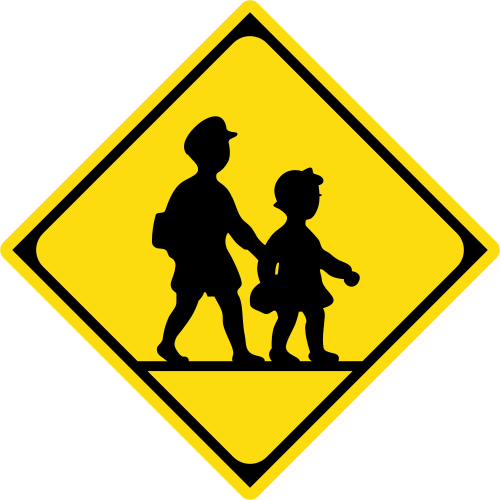 Warning for children.
English • Traffic sign 208 • School, nursery or kindergarten nearby. Reduce speed and watch carefully for children.
日本語 • 208 • 学校、幼稚園、保育所等あり。 この先に学校、幼稚園、保育所などがあり、子どもの通行に注意が必要です。速度を落として周囲をよく確認してください。
Sources
🔗 Commons.wikimedia.org
🔗 Laws.e-gov.go.jp • 道路標識、区画線及び道路標示に関する命令、別表第一・第二
🔗 Mlit.go.jp • 国土交通省、道路標識一覧
SVG source: Monaneko • Public domain • Original revision 2021-10-12. Wikimedia original unmodified.
How should you pass a school entrance in Japan?
Watch for children stepping out from between parked vehicles, obey crossings and any school patrol, and follow stopping or parking restrictions. Do not obstruct visibility near a crossing or school entrance; approach at a speed that permits a safe stop.
🔗 laws.e-gov.go.jp • e-Gov — current enforced Road Traffic Act, revision metadata and full text
🔗 laws.e-gov.go.jp • e-Gov — current enforced decree revision metadata
🔗 npa.go.jp • NPA — Traffic Lights and Road Signs, official English definitions
🔗 npa.go.jp • NPA — traffic instruction handbook, sign groups and road use; read with current Act