


Separated pathPortugal
 Traffic rules
 Portugal
1. Separated path
A separated path is a path or part of a road where different categories of road users, typically pedestrians and cyclists, are assigned separate sections of the same overall route. The sections may be distinguished by road markings, different paving materials, a kerb or another physical separation.
Users should remain within the part of the path intended for them and take particular care where the sections cross, merge or connect with roads. The permitted users, priority rules and any speed restrictions depend on the local traffic signs and regulations.
What does Portugal call a signed walking and cycling route with separate parts?
The official sign category is pista obrigatória para peões e velocípedes. Its divided version is used where there is separation between the pedestrian and cycling parts. The undivided version identifies a route without that separation.
🔗 pgdlisboa.pt • Portugal, Código da Estrada — articles 17, 78, 99–100, 104; RST D7a–D7f and D13
🔗 ansr.pt • ANSR official RST — corrected 2019 republication, sign descriptions and markings
🔗 pgdlisboa.pt • PGDL Road Code, second page — pedestrian and crossing provisions, articles 99–104
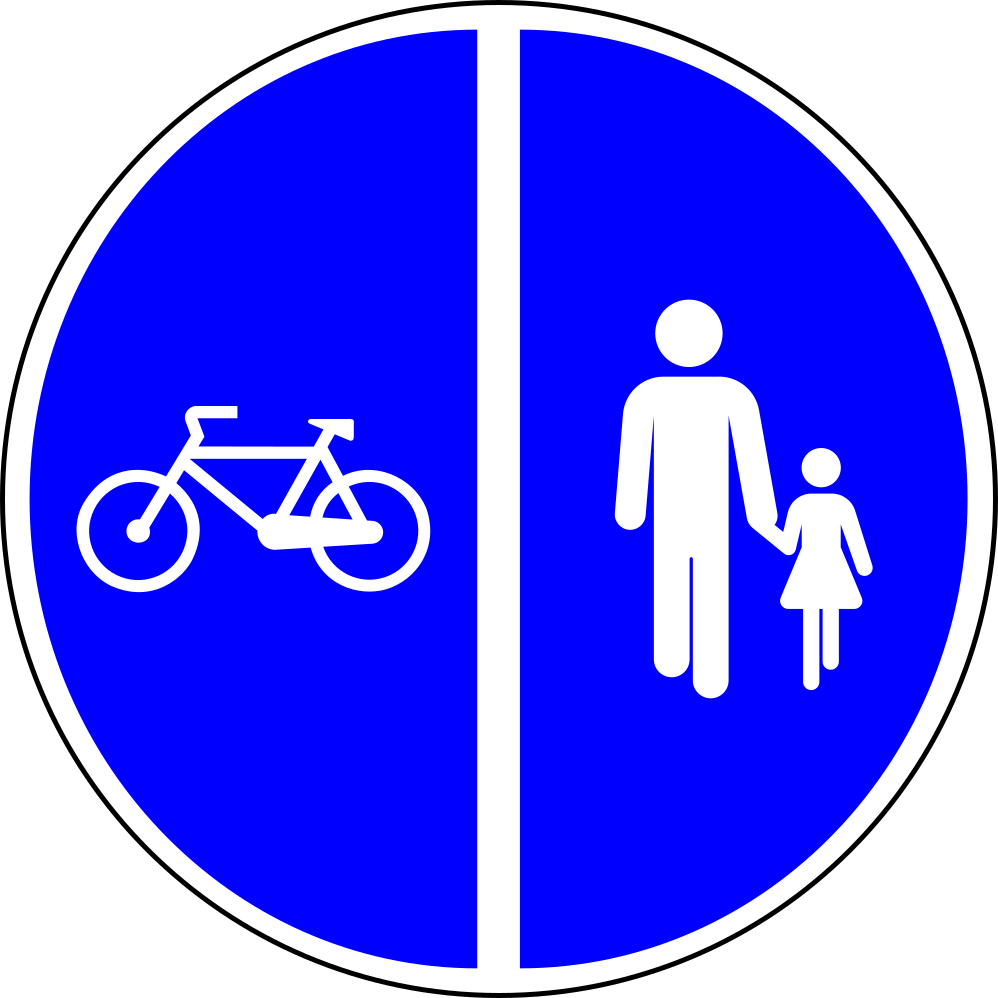 Mandatory divided pedestrian and cycle path.
English • Traffic sign D7f • Compulsory path for pedestrians and cycles. Both must use the path specifically provided for them. Sign D7e is used where the pedestrian and cycle parts are not separated; D7f is used where they are separated.
Português • D7f • Pista obrigatória para peões e velocípedes. Indicação de que os peões, bem como os velocípedes, são obrigados a utilizar uma pista que lhes é especialmente destinada, devendo, para sinalizar esta pista, ser utilizado o sinal D7e ou D7f, consoante e respetivamente não exista ou exista separação entre as duas partes da pista destinadas ao trânsito de peões e ao de velocípedes.
Sources
🔗 Commons.wikimedia.org
🔗 Diariodarepublica.pt • Regulamento de Sinalização do Trânsito • artigo 27.º • D7f
🔗 Ansr.pt • Republicação oficial retificada • D7f • página 16
Image via Commons.wikimedia.org
Republic of Portugal • Public domain • Source revision 2015-03-03. Wikimedia original unmodified.
Can Portuguese walkers use either section of a divided mixed path?
On a pista mista, pedestrians must not use the part intended for cycles. Use the walking section and follow the allocation shown by the sign and layout. A combined route designation does not make each part available to every user.
🔗 pgdlisboa.pt • Portugal, Código da Estrada — articles 17, 78, 99–100, 104; RST D7a–D7f and D13
🔗 ansr.pt • ANSR official RST — corrected 2019 republication, sign descriptions and markings
🔗 pgdlisboa.pt • PGDL Road Code, second page — pedestrian and crossing provisions, articles 99–104
Does every Portuguese pedestrian-and-cycle sign mean the surface is shared throughout?
No. The Road Signalling Regulation provides different versions for divided and undivided facilities. Both serve pedestrians and cycles, but one indicates separation between their parts. Check the actual sign and division of space.
🔗 pgdlisboa.pt • Portugal, Código da Estrada — articles 17, 78, 99–100, 104; RST D7a–D7f and D13
🔗 ansr.pt • ANSR official RST — corrected 2019 republication, sign descriptions and markings
🔗 pgdlisboa.pt • PGDL Road Code, second page — pedestrian and crossing provisions, articles 99–104

