

ExpresswaySwitzerland
 Traffic rules
 Switzerland
3. Expressway
An expressway is a road intended to carry through traffic efficiently, usually at higher speeds than ordinary roads. Expressways often have limited access, multiple lanes, separated carriageways or grade-separated junctions, but their design and legal status vary between countries.
An expressway is not always a motorway. It may have intersections, traffic lights or direct access, and the permitted road users, speed limits and special rules depend on local signs and regulations.
Wikimedia.org • Marc Mongenet • CC BY-SA
How do people refer to an expressway in Switzerland?
The terms are Autostrasse in German, semi-autoroute in French and semiautostrada in Italian. These roads are separate from motorways.
🔗 fedlex.admin.ch • Switzerland: Road Signalling Ordinance, state 1 October 2026
🔗 fedlex.admin.ch • Switzerland: Road Traffic Act, state 1 July 2026
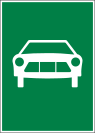 Start of an expressway.
English • Traffic sign 4.03 • Expressway.
Deutsch • Verkehrssignal 4.03 • Autostrasse.
Français • Signal 4.03 • Semi-autoroute.
Italiano • Segnale 4.03 • Semiautostrada.
Sources
🔗 Commons.wikimedia.org
🔗 Fedlex.admin.ch • SSV, Anhang 2 (DE)
🔗 Fedlex.admin.ch • OSR, annexe 2 (FR)
🔗 Fedlex.admin.ch • OSStr, allegato 2 (IT)
SVG source: Commons.wikimedia.org • Original SVG
Bundesamt für Strassen (ASTRA) • Public domain • Original revision 2017-06-30. Wikimedia original unmodified.
Artwork reviewed against the Swiss signalling ordinance, version 1 October 2026, annex 2: Fedlex.admin.ch • Signal 4.03, PDF page 113. Catalogue-equivalent illustration; intentional update from the previous PNG. This is an educational illustration, not a manufacturing specification.
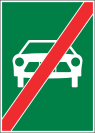 End of the expressway.
English • Traffic sign 4.04 • End of expressway.
Deutsch • Verkehrssignal 4.04 • Ende der Autostrasse.
Français • Signal 4.04 • Fin de la semi-autoroute.
Italiano • Segnale 4.04 • Fine della semiautostrada.
Sources
🔗 Commons.wikimedia.org
🔗 Fedlex.admin.ch • SSV, Anhang 2 (DE)
🔗 Fedlex.admin.ch • OSR, annexe 2 (FR)
🔗 Fedlex.admin.ch • OSStr, allegato 2 (IT)
SVG source: Commons.wikimedia.org • Original SVG
Bundesamt für Strassen (ASTRA) • Public domain • Original revision 2017-06-30. Wikimedia original unmodified.
Artwork reviewed against the Swiss signalling ordinance, version 1 October 2026, annex 2: Fedlex.admin.ch • Signal 4.04, PDF page 113. Catalogue-equivalent illustration; intentional update from the previous PNG. This is an educational illustration, not a manufacturing specification.
What speed limit applies to cars on an expressway in Switzerland?
For an ordinary passenger car without a trailer, the general maximum is 100 km/h. Obey lower posted limits and slow down when traffic, weather or visibility requires it. Other vehicle classes can have lower limits.
🔗 fedlex.admin.ch • Switzerland: Road Signalling Ordinance, state 1 October 2026
🔗 fedlex.admin.ch • Switzerland: Road Traffic Act, state 1 July 2026
Who may use an expressway in Switzerland?
Only eligible motor vehicles and combinations that are capable and legally permitted to reach at least 80 km/h may normally use these roads. Pedestrians and bicycles are excluded. Congestion and safety can require a lower actual speed.
🔗 fedlex.admin.ch • Switzerland: Road Signalling Ordinance, state 1 October 2026
🔗 fedlex.admin.ch • Switzerland: Road Traffic Act, state 1 July 2026
What should I do if I miss an expressway exit in Switzerland?
Continue to the next exit and choose a safe onward route. Do not reverse or make a U-turn to reach a missed exit.
🔗 fedlex.admin.ch • Switzerland: Road Signalling Ordinance, state 1 October 2026
🔗 fedlex.admin.ch • Switzerland: Road Traffic Act, state 1 July 2026


