


Shared-use pathSwitzerland
 Traffic rules
 Switzerland
10. Shared-use path
A shared-use path is a path or part of a road intended for use by both pedestrians and cyclists. Unlike facilities where pedestrians and cyclists have clearly separated sections, users of a shared-use path normally travel within the same general space.
Because users may travel at very different speeds, cyclists should approach pedestrians carefully, adapt their speed and leave sufficient space when passing. The permitted users, priority rules and any speed restrictions depend on the local traffic signs and regulations.
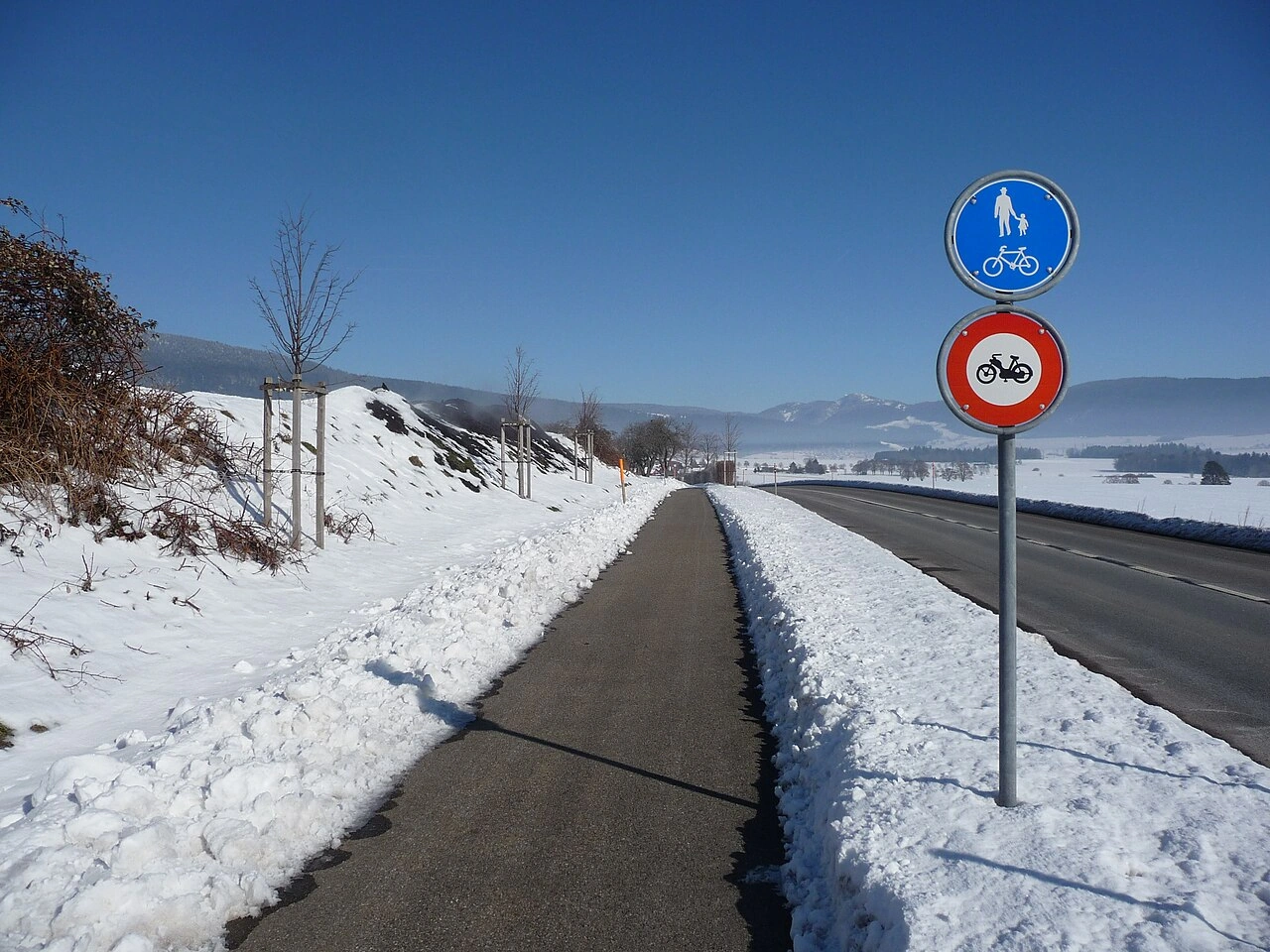
What are Switzerland’s official terms for a shared walking and cycling path?
The German term is gemeinsamer Rad- und Fussweg; the French term is piste cyclable et chemin pour piétons sans partage de l’aire de circulation. The sign shows both users without assigning separate sides.
🔗 fedlex.admin.ch • OSR Art 33(4): sign 2.63.1 and pedestrian protection
🔗 fedlex.admin.ch • OSR 741.21, 1 October 2026: OSR Art 33(4): sign 2.63.1 and pedestrian protection
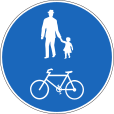 Mandatory shared pedestrian and cycle path.
Traffic sign 2.63.1 • Shared cycle track and footpath without separation of the traffic space (example).
Sources
🔗 Commons.wikimedia.org
🔗 Fedlex.admin.ch • SSV, Anhang 2 (DE)
🔗 Fedlex.admin.ch • OSR, annexe 2 (FR)
🔗 Fedlex.admin.ch • OSStr, allegato 2 (IT)
SVG source: Commons.wikimedia.org • Original SVG
Bundesamt für Strassen (ASTRA) • Public domain • Original revision 2017-07-08. Wikimedia original unmodified.
Artwork reviewed against the Swiss signalling ordinance, version 1 October 2026, annex 2: Fedlex.admin.ch • Signal 2.63.1, PDF page 110. Catalogue-equivalent illustration; intentional update from the previous PNG. This is an educational illustration, not a manufacturing specification.
Deutsch • Verkehrssignal 2.63.1 • Gemeinsamer Rad- und Fussweg (Beispiel).
Français • Signal 2.63.1 • Piste cyclable et chemin pour piétons sans partage de l’aire de circulation (exemple).
Italiano • Segnale 2.63.1 • Ciclopista e strada pedonale (esempio).
How must cyclists treat pedestrians on a Swiss shared-use path?
Cyclists must show consideration for pedestrians and warn them when necessary. A shared designation does not reserve the surface for cycling. Adapt speed and passing space to the people using the path.
🔗 fedlex.admin.ch • OSR Art 33(4): sign 2.63.1 and pedestrian protection
🔗 fedlex.admin.ch • OSR 741.21, 1 October 2026: OSR Art 33(4): sign 2.63.1 and pedestrian protection
How does a Swiss divided path differ from a shared-use path?
Its sign allocates a separate side to pedestrians and cyclists. Each group uses the indicated part. On the undivided version, the same general surface is available to both, with the specific duty of consideration towards pedestrians.
🔗 fedlex.admin.ch • OSR Art 33(4): sign 2.63.1 and pedestrian protection
🔗 fedlex.admin.ch • OSR 741.21, 1 October 2026: OSR Art 33(4): sign 2.63.1 and pedestrian protection


