

Residential areaSwitzerland
 Traffic rules
 Switzerland
4. Residential area
A residential area is a street or group of streets where housing and access to local properties are the main functions. Drivers should expect pedestrians, cyclists, children, parked vehicles and vehicles entering or leaving driveways.
Some countries identify particular residential areas with traffic signs and apply special low-speed and residential-area rules. The speed limit, pedestrian rights, parking rules and permitted road users therefore depend on local signs and regulations.
Wikimedia.org • Suzanne Michel • CC BY-SA
How do people refer to a residential area in Switzerland?
The official local terms are Begegnungszone in German, zone de rencontre in French and zona d’incontro in Italian. These identify the specially signposted 20 km/h category.
🔗 fedlex.admin.ch • Switzerland: Road Signalling Ordinance, state 1 October 2026
🔗 fedlex.admin.ch • Switzerland: Road Traffic Act, state 1 July 2026
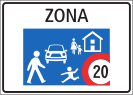 Start of a residential area.
English • Traffic sign 2.59.5 • Residential area.
Deutsch • Verkehrssignal 2.59.5 • Begegnungszone.
Français • Signal 2.59.5 • Zone de rencontre.
Italiano • Segnale 2.59.5 • Zona d’incontro.
Sources
🔗 Commons.wikimedia.org
🔗 Fedlex.admin.ch • SSV, Anhang 2 (DE)
🔗 Fedlex.admin.ch • OSR, annexe 2 (FR)
🔗 Fedlex.admin.ch • OSStr, allegato 2 (IT)
SVG source: Commons.wikimedia.org • Original SVG
Bundesamt für Strassen (ASTRA) • Public domain • Original revision 2017-07-08. Wikimedia original unmodified.
Artwork reviewed against the Swiss signalling ordinance, version 1 October 2026, annex 2: Fedlex.admin.ch • Signal 2.59.5, PDF page 112. Catalogue-equivalent illustration; intentional update from the previous PNG. This is an educational illustration, not a manufacturing specification.
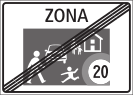 End of the residential area.
English • Traffic sign 2.59.6 • End of residential area.
Deutsch • Verkehrssignal 2.59.6 • Ende der Begegnungszone.
Français • Signal 2.59.6 • Fin de la zone de rencontre.
Italiano • Segnale 2.59.6 • Fine della zona d’incontro.
Sources
🔗 Commons.wikimedia.org
🔗 Fedlex.admin.ch • SSV, Anhang 2 (DE)
🔗 Fedlex.admin.ch • OSR, annexe 2 (FR)
🔗 Fedlex.admin.ch • OSStr, allegato 2 (IT)
SVG source: Commons.wikimedia.org • Original SVG
Bundesamt für Strassen (ASTRA) • Public domain • Original revision 2017-07-08. Wikimedia original unmodified.
Artwork reviewed against the Swiss signalling ordinance, version 1 October 2026, annex 2: Fedlex.admin.ch • Signal 2.59.6, PDF page 113. Catalogue-equivalent illustration; intentional update from the previous PNG. This is an educational illustration, not a manufacturing specification.
What speed limit applies in a residential area in Switzerland?
The maximum in the specially signposted category is 20 km/h. A 30 km/h zone is different and does not automatically give pedestrians the same priority.
🔗 fedlex.admin.ch • Switzerland: Road Signalling Ordinance, state 1 October 2026
🔗 fedlex.admin.ch • Switzerland: Road Traffic Act, state 1 July 2026
What rights do pedestrians have in a signposted residential area in Switzerland?
Pedestrians may use the whole circulation area and have priority over ordinary vehicle traffic, but must not obstruct vehicles unnecessarily. Priority over rail vehicles is governed by separate rules.
🔗 fedlex.admin.ch • Switzerland: Road Signalling Ordinance, state 1 October 2026
🔗 fedlex.admin.ch • Switzerland: Road Traffic Act, state 1 July 2026
Where may I park in a residential area in Switzerland?
For cars, park only in places designated by signs or markings. Bicycles and mopeds follow the general parking rules. Do not park elsewhere merely because the road is wide or vehicles must travel slowly.
🔗 fedlex.admin.ch • Switzerland: Road Signalling Ordinance, state 1 October 2026
🔗 fedlex.admin.ch • Switzerland: Road Traffic Act, state 1 July 2026


