


Separated pathHungary
 Traffic rules
 Hungary
1. Separated path
A separated path is a path or part of a road where different categories of road users, typically pedestrians and cyclists, are assigned separate sections of the same overall route. The sections may be distinguished by road markings, different paving materials, a kerb or another physical separation.
Users should remain within the part of the path intended for them and take particular care where the sections cross, merge or connect with roads. The permitted users, priority rules and any speed restrictions depend on the local traffic signs and regulations.
How are walking and cycling sections divided on a Hungarian combined path?
A gyalog- és kerékpárút may have a line separating its walking and cycling parts. Where it does, pedestrians and cyclists must use their respective allocated sections. The combined name does not mean that the entire width is shared.
🔗 njt.jog.gov.hu • KRESZ §13(1)(i),(2); §21(13); §54(10),(11)
Does a Hungarian combined-path sign always mean the surface is undivided?
No. Check for the separating line and the allocation shown by the sign. The traffic rules expressly distinguish a combined route with separate pedestrian and cycling parts from one without that division.
🔗 njt.jog.gov.hu • KRESZ §13(1)(i),(2); §21(13); §54(10),(11)
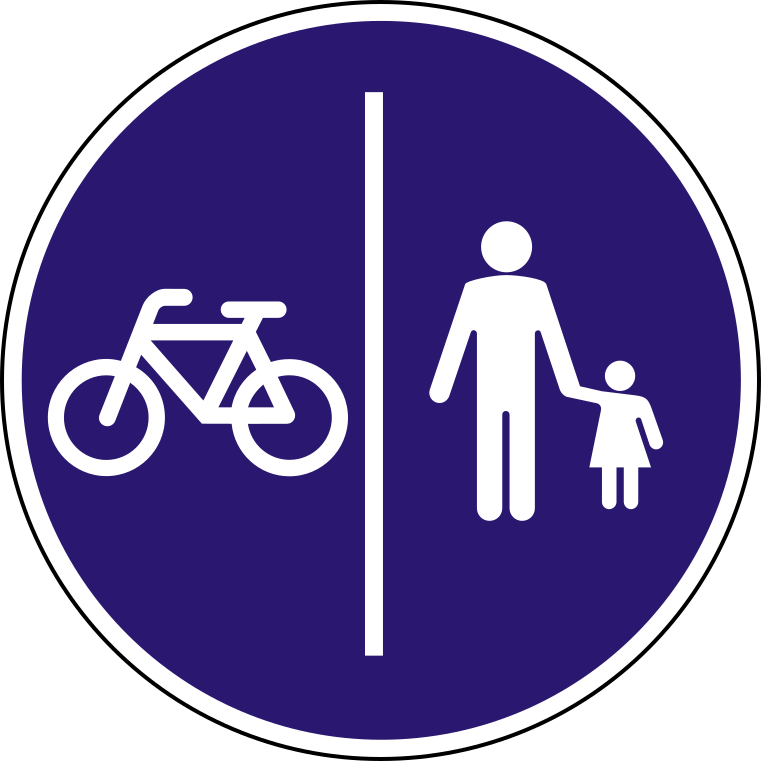 Mandatory divided pedestrian and cycle path.
English • Traffic sign figure 26/e • Pedestrian and cycle path. A route designated for pedestrians, wheelchairs and two-wheeled bicycles. If pedestrian and cycle traffic are separated by road markings (figure 26/e), pedestrians and cyclists may use only the part designated for them. Direction arrows and layout diagrams are illustrative; the sign always depicts the actual situation.
Magyar • 26/e. ábra • Gyalog- és kerékpárút. A gyalogos, a kerekes szék és a kétkerekű kerékpár közlekedésére kijelölt út. Ha a gyalogos és a kerékpáros forgalmat burkolati jel választja el (26/e. ábra), a gyalogos és a kerékpáros csak az útnak a részére kijelölt részén közlekedhet. Az irányt jelző nyilak és az alaprajzi vázlatok példálózó jellegűek; a jelzés mindig a tényleges helyzetet tünteti fel.
Sources
🔗 Commons.wikimedia.org
🔗 Njt.jog.gov.hu • 1/1975. (II. 5.) KPM–BM együttes rendelet (KRESZ) • 13(1)i • 26/e. ábra
🔗 Njt.jog.gov.hu • KRESZ • 20/A. §
Image via Commons.wikimedia.org
Gigillo83 • Public domain • Source revision 2014-03-19. Wikimedia original unmodified.
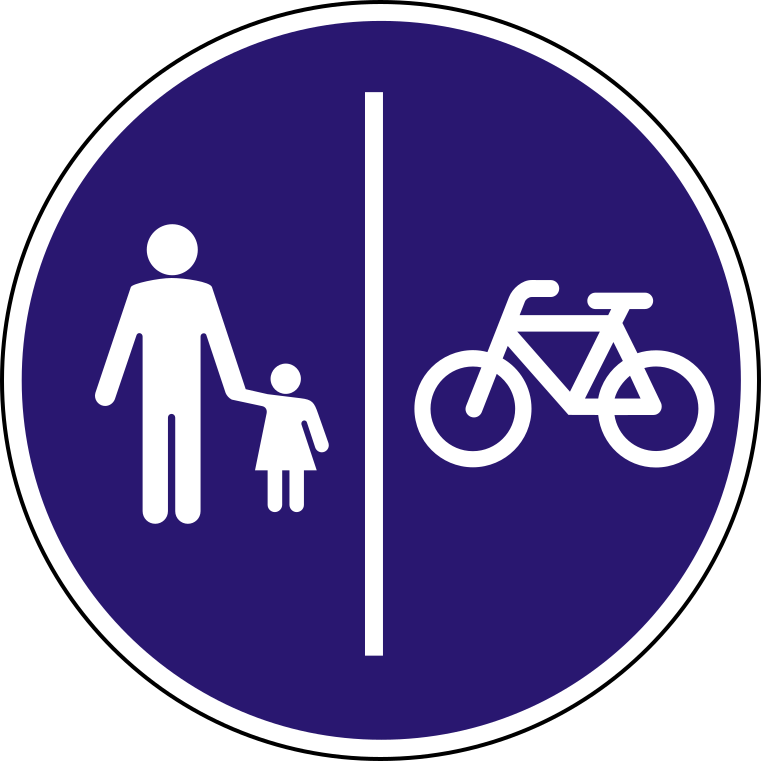 Mandatory divided pedestrian and cycle path.
English • Traffic sign figure 26/e • Pedestrian and cycle path. A route designated for pedestrians, wheelchairs and two-wheeled bicycles. If pedestrian and cycle traffic are separated by road markings (figure 26/e), pedestrians and cyclists may use only the part designated for them.
Magyar • 26/e. ábra • Gyalog- és kerékpárút. A gyalogos, a kerekes szék és a kétkerekű kerékpár közlekedésére kijelölt út. Ha a gyalogos és a kerékpáros forgalmat burkolati jel választja el (26/e. ábra), a gyalogos és a kerékpáros csak az útnak a részére kijelölt részén közlekedhet.
Sources
🔗 Commons.wikimedia.org
🔗 Njt.jog.gov.hu • 1/1975. (II. 5.) KPM–BM együttes rendelet (KRESZ) • 13(1)i • 26/e. ábra
Image via Commons.wikimedia.org
Gigillo83 • Public domain • Source revision 2014-03-19. Wikimedia original unmodified.
Can Hungarian cyclists use the road if pedestrians obstruct a combined walking and cycling route?
The rules allow cyclists to use the carriageway where pedestrian traffic obstructs their progress on a gyalog- és kerékpárút. This is a specific exception. It does not make the designated walking section an unrestricted overtaking lane.
🔗 njt.jog.gov.hu • KRESZ §13(1)(i),(2); §21(13); §54(10),(11)

