


Traffic rulesHungary
 Traffic rules
 Hungary
1. Hungary
Hungary is a landlocked country in Central Europe, bordered by Austria, Slovakia, Ukraine, Romania, Serbia, Croatia and Slovenia. Traffic drives on the right, and passenger cars using tolled sections of the motorway and expressway network generally need an electronic motorway vignette (e-matrica). Hungary also applies a strict zero-alcohol rule for drivers, while cars must use daytime running lights or dipped headlights on roads outside built-up areas even during good daylight conditions.
Hungarian is the official language and is the main language used on text-based road and destination signs. Hungarian uses the Latin alphabet but includes distinctive accented letters such as á, é, í, ó, ö, ő, ú, ü and ű. In some communities with recognised national minorities, drivers may also encounter bilingual settlement and street-name signs alongside Hungarian. Winter tyres are not generally compulsory during a fixed season, but snow chains become mandatory where the appropriate traffic sign requires them.
AI-generated by Rijbewijs-online.be • WCIT • CC BY-SA
Which number can you call in an emergency in Hungary?
Call 112 for urgent emergency assistance. Give the operator your location and explain what happened.
🔗 police.hu • Hungarian Police, when to call the emergency numbers
What is the legal alcohol limit for drivers in Hungary?
Hungary applies a zero-alcohol rule for drivers. A driver must not have alcohol from alcoholic drinks in their body while driving.
🔗 europa.eu • Your Europe / national authorities, Hungary road rules, Alcohol limits
What speed limits apply to passenger cars in Hungary?
Built-up areas: For passenger cars, the general maximum speed is 50 km/h, unless signs indicate another limit.
Outside built-up areas: For passenger cars, the general maximum speed on ordinary roads outside built-up areas is 90 km/h, unless signs indicate another limit.
Expressways: For passenger cars, the general maximum speed on an autóút is 110 km/h, unless signs indicate another limit.
Motorways: For passenger cars, the general maximum speed on an autópálya is 130 km/h, unless signs indicate a lower limit.
What are the seat-belt and child-restraint rules in Hungary?
Seat belts must be worn by drivers and passengers using seats equipped with them, subject to specific legal exemptions.
Children shorter than 150 cm normally need a suitable child restraint. An exception allows a child aged 3 or older and at least 135 cm tall to travel on a rear seat using the fitted belt if it safely fits their body.
A rear-facing seat in front requires the frontal airbag to be absent or deactivated. Children under 3 may not travel in a car whose original construction does not allow a child restraint to be fitted. Separate exemptions include rear-seat travel in a taxi operating as a taxi.
🔗 europa.eu • Your Europe / national authorities, Hungary road rules, Seat belts and child restraints; 🔗 police.hu • Hungarian Police, Road Traffic Rules, section 48(7) and (8); 🔗 police.hu • Hungarian Police, safe travel with children
Can you use a handheld mobile phone while driving in Hungary?
A car driver may not use a handheld mobile phone while driving. The restriction also applies to riders of two-wheeled and certain three-wheeled vehicles while temporarily stopped for traffic reasons.
🔗 njt.jog.gov.hu • Hungarian National Legislation Database, Road Traffic Rules
What safety equipment should you carry in a car in Hungary?
Carry a first-aid kit, warning triangle and accessible reflective clothing. Hungary’s technical rules prescribe first-aid equipment and a triangle for passenger cars; qualifying foreign-registered vehicles are subject to the separate Vienna Convention provision. Use the triangle for a breakdown on the carriageway or hard shoulder outside built-up areas. Wear reflective clothing there or on the roadside verge at night or in poor visibility.
🔗 njt.jog.gov.hu • Hungarian National Legislation Database, Technical Regulation 6/1990, sections 1(2), 103 and 106, version 10 October 2026; 🔗 njt.jog.gov.hu • Hungarian National Legislation Database, current KRESZ, sections 16(4)(b), 21(12) and 56(6), version 11 April 2026
Can a visitor use a driving licence issued in another EU country in Hungary?
Yes. A valid, full EU driving licence is recognised for the vehicle categories it covers. You must meet the applicable minimum age. A learner licence or a temporary replacement certificate does not have the same automatic recognition.
Are motorcycle helmets compulsory in Hungary?
Yes. On an ordinary, open motorcycle, both the rider and passenger must wear a protective helmet. Use a helmet that meets the applicable approval requirements and fasten it correctly. Check the specific rules before relying on an exemption for an enclosed or specially equipped vehicle.
🔗 europa.eu • Your Europe / national authorities, Hungary road rules

2. Motorway
A motorway is a road specially designed and signposted for motor traffic. Motorways normally have separate carriageways for opposing traffic, controlled access through designated entrances and exits, no direct access to neighbouring properties, and no level crossings with other roads, railways or paths.
Special traffic rules apply on motorways. The permitted road users, speed limits, lane rules, tolls and emergency procedures vary between countries, so drivers must follow the local traffic signs and regulations.
Wikimedia.org • L.Kenzel • CC BY
How do people refer to a motorway in Hungary?
The Hungarian term is autópálya. An autóút is a separate road category with a different general car speed limit.
🔗 njt.jog.gov.hu • Hungary: KRESZ sections 11(1)(a)-(b),26(1)(a),33,37(1),(3)
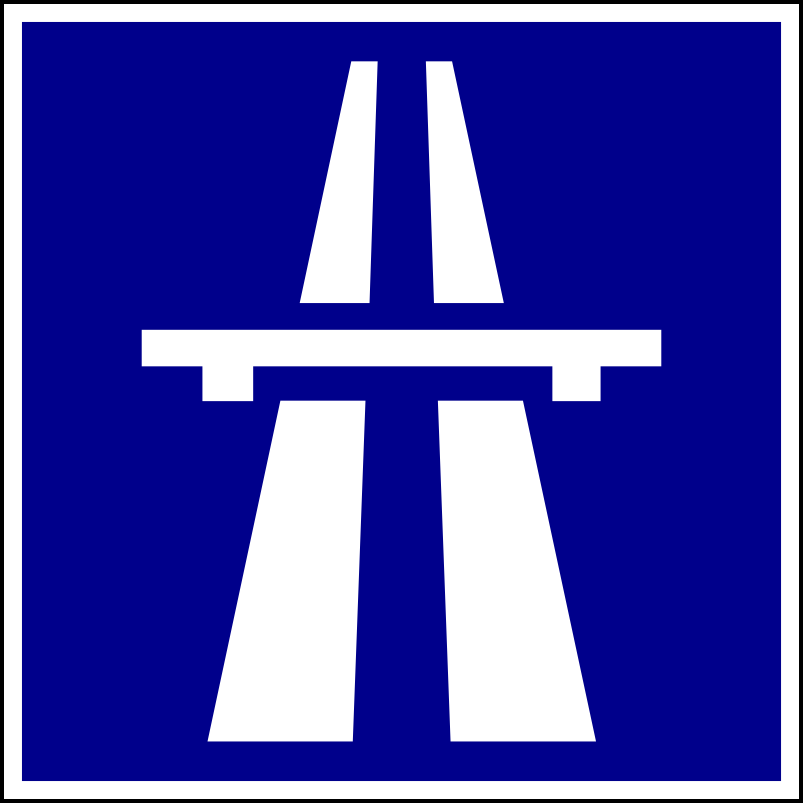 Start of a motorway.
English • Traffic sign figure 1 • Motorway. The sign marks the beginning of a motorway. KRESZ section 37 sets out the special motorway rules.
Magyar • 1. ábra • Autópálya. Az autópálya kezdetét jelzi. Az autópályára vonatkozó külön szabályokat a KRESZ 37. §-a határozza meg.
Sources
🔗 Commons.wikimedia.org
🔗 Njt.jog.gov.hu • 1/1975. (II. 5.) KPM–BM együttes rendelet (KRESZ) • 11(1)a • 1. ábra
Image via Commons.wikimedia.org
Gigillo83 • Public domain • Source revision 2014-03-22. Wikimedia original unmodified.
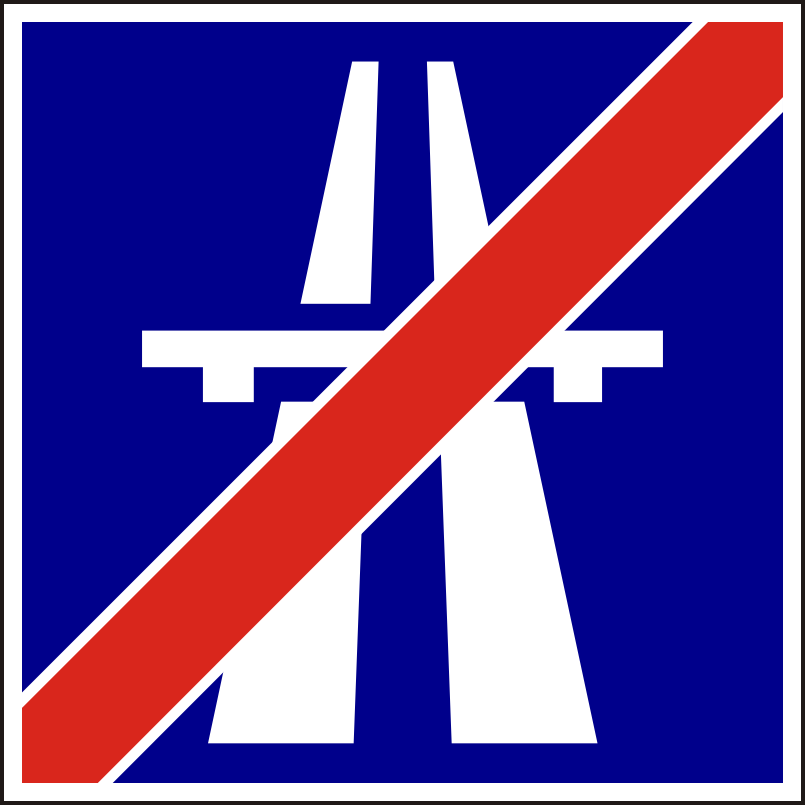 End of the motorway.
English • Traffic sign figure 2 • End of motorway. The motorway ends.
Magyar • 2. ábra • Autópálya vége. Az autópálya vége.
Sources
🔗 Commons.wikimedia.org
🔗 Njt.jog.gov.hu • 1/1975. (II. 5.) KPM–BM együttes rendelet (KRESZ) • 11(1)b • 2. ábra
Image via Commons.wikimedia.org
Gigillo83 • Public domain • Source revision 2014-03-22. Wikimedia original unmodified.
What speed limit applies to cars on a motorway in Hungary?
For an ordinary passenger car without a trailer, the general maximum is 130 km/h. Obey lower posted limits and reduce speed when traffic, weather or visibility requires it. Different limits can apply to other vehicle classes.
🔗 njt.jog.gov.hu • Hungary: KRESZ sections 11(1)(a)-(b),26(1)(a),33,37(1),(3)
Who may use a motorway in Hungary?
Only motor vehicles and combinations capable of at least 60 km/h on a level road may use motorways and their signed approach roads. This capability requirement does not mean maintaining that speed in a queue or unsafe conditions.
🔗 njt.jog.gov.hu • Hungary: KRESZ sections 11(1)(a)-(b),26(1)(a),33,37(1),(3)
What should I do if I miss a motorway exit in Hungary?
Continue to the next exit and choose a safe onward route. Do not reverse, make a U-turn or cross the central reservation to return to a missed exit.
🔗 njt.jog.gov.hu • Hungary: KRESZ sections 11(1)(a)-(b),26(1)(a),33,37(1),(3)
3. Residential area
A residential area is a street or group of streets where housing and access to local properties are the main functions. Drivers should expect pedestrians, cyclists, children, parked vehicles and vehicles entering or leaving driveways.
Some countries identify particular residential areas with traffic signs and apply special low-speed and residential-area rules. The speed limit, pedestrian rights, parking rules and permitted road users therefore depend on local signs and regulations.
Wikimedia.org • Szajci • CC BY-SA
How do people refer to a residential area in Hungary?
The official Hungarian term is lakó-pihenő övezet. The entrance and exit signs define a special residential-area category with restricted motor-vehicle access.
🔗 njt.jog.gov.hu • Hungary: KRESZ sections 17(1),39/A(1)-(3)
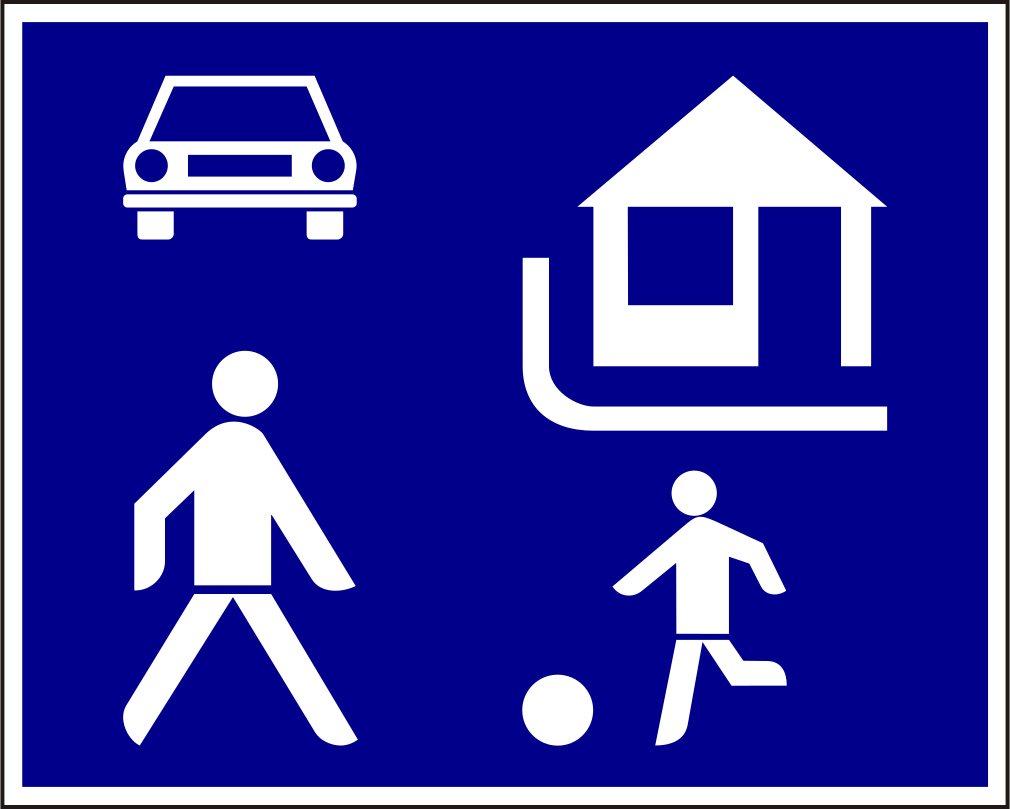 Start of a residential area.
English • Traffic sign figure 122 • Residential area. The sign marks the beginning of a residential area. Vehicles may travel at no more than 20 km/h. KRESZ section 39/A governs entry and traffic in the area.
Magyar • 122. ábra • Lakó-pihenő övezet. A lakó-pihenő övezet kezdetét jelzi. Járművel legfeljebb 20 km/óra sebességgel szabad közlekedni; a behajtásra és a közlekedésre a KRESZ 39/A. §-a irányadó.
Sources
🔗 Commons.wikimedia.org
🔗 Njt.jog.gov.hu • 1/1975. (II. 5.) KPM–BM együttes rendelet (KRESZ) • 17(1)j • 122. ábra
Image via Commons.wikimedia.org
Gigillo83 • Public domain • Source revision 2014-03-22. Wikimedia original unmodified.
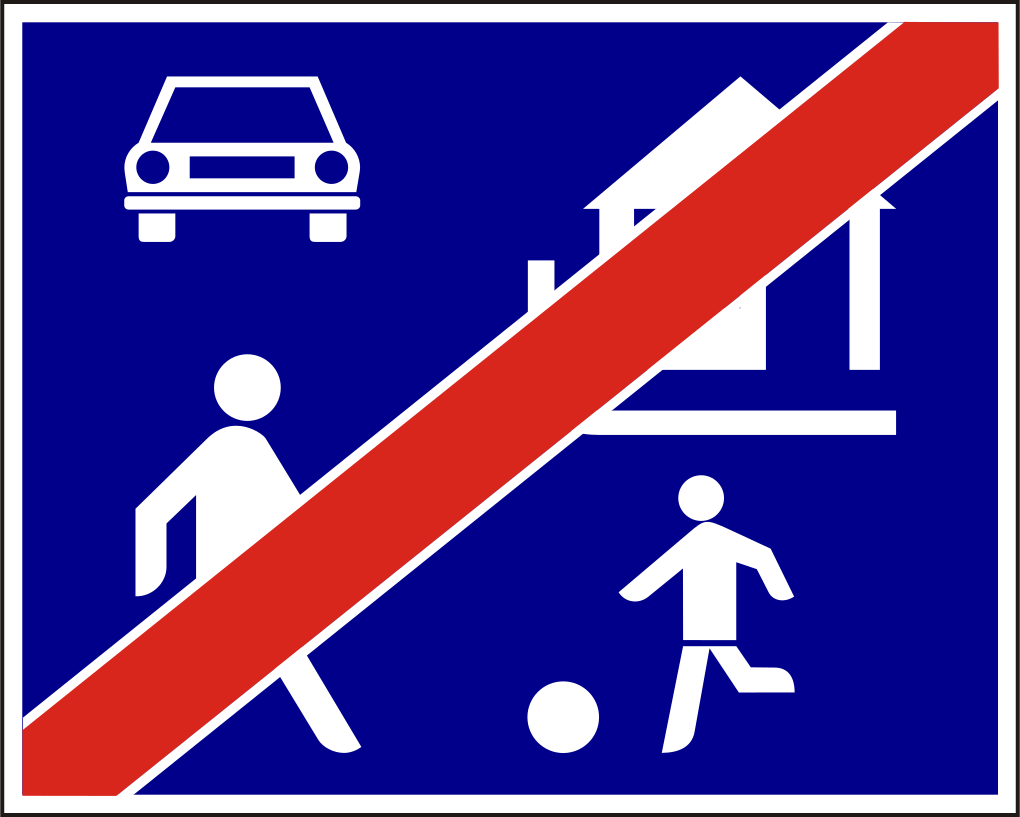 End of the residential area.
English • Traffic sign figure 123 • End of the residential area. The residential area ends.
Magyar • 123. ábra • Lakó-pihenő övezet vége. A lakó-pihenő övezet vége.
Sources
🔗 Commons.wikimedia.org
🔗 Njt.jog.gov.hu • 1/1975. (II. 5.) KPM–BM együttes rendelet (KRESZ) • 17(1)k • 123. ábra
Image via Commons.wikimedia.org
Gigillo83 • Public domain • Source revision 2014-03-22. Wikimedia original unmodified.
What speed limit applies in a residential area in Hungary?
The maximum in the specially signposted category is 20 km/h. Drive with extra care for pedestrians and cyclists and slow further whenever needed.
🔗 njt.jog.gov.hu • Hungary: KRESZ sections 17(1),39/A(1)-(3)
What rights do pedestrians have in a signposted residential area in Hungary?
Drivers must be especially careful around pedestrians and cyclists. On a street without a pavement in this category, pedestrians may use the whole width but must not obstruct vehicle traffic unnecessarily.
🔗 njt.jog.gov.hu • Hungary: KRESZ sections 17(1),39/A(1)-(3)
May anyone drive through a signposted Hungarian residential area?
Only the vehicle categories listed in the rules may enter, including bicycles, permitted vehicles serving residents or visitors, specified deliveries and essential services, and vehicles driven by or carrying a disabled person. Being a through route does not itself authorise a motor vehicle to enter.
🔗 njt.jog.gov.hu • Hungary: KRESZ sections 17(1),39/A(1)-(3)
4. Zone
A traffic zone is an area in which a traffic rule applies throughout all included roads or road sections. The rule normally begins at a zone-entry sign and remains applicable until the corresponding end-of-zone sign is passed.
Zones may regulate speed, parking, access, vehicle categories, emissions or other traffic behaviour. The signs used, the roads covered and the effect of intersections or local exceptions depend on local traffic law.
Wikimedia.org • Globetrotter19 • CC BY-SA
How do people refer to traffic zones in Hungary?
A restricted-speed zone is a korlátozott sebességű övezet. A korlátozott forgalmú övezet is a traffic-restricted zone, which can restrict specified heavier vehicles rather than set a speed limit.
Where does a zone rule apply in Hungary?
The speed shown on the speed-zone sign applies until the corresponding end-of-zone sign. A junction inside the zone does not by itself cancel it. Read any supplementary conditions affecting particular vehicles.
How do you know when a traffic zone ends in Hungary?
The corresponding zone-end sign ends the restriction. Check whether it concerns speed, vehicle access or parking: an end sign for one kind of zone does not cancel every rule in the area.
5. Speed limit
A speed limit is the maximum legal speed permitted on a road, lane or within a designated area. It may be established by general traffic law or indicated by fixed, variable or temporary traffic signs.
A speed limit is a maximum, not a target speed. Drivers must travel more slowly whenever traffic, visibility, weather, road conditions, vulnerable road users or the condition of the vehicle make the maximum permitted speed unsafe.
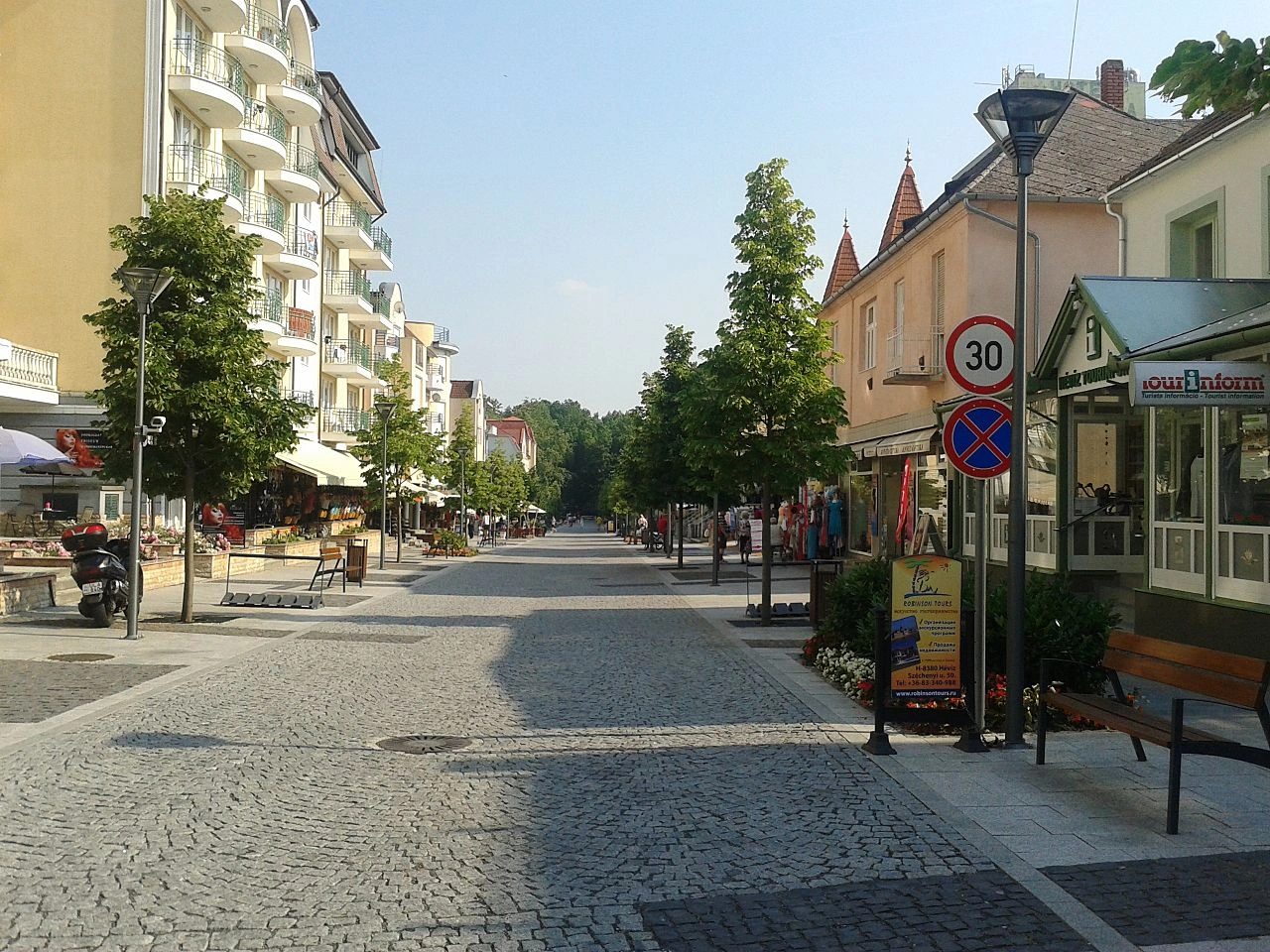
Wikimedia.org • HTME • CC BY-SA
Which general speed limits should car drivers know in Hungary?
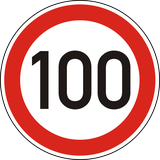
For an ordinary car without a trailer, the general maxima are 50 km/h in built-up areas, 90 km/h on ordinary rural roads, 110 km/h on expressways and 130 km/h on motorways. The official road names are autóút and autópálya for the last two categories. Follow applicable signs and special-area rules.
 Start of a speed limit.
English • Traffic sign figure 30 • Speed limit. Travelling faster than the speed shown is prohibited. A supplementary plate indicating snowfall (figure 97/a) or rain (figure 97/b) means that the limit applies only in the indicated weather conditions or when the road surface is wet. A supplementary plate may indicate that the limit applies during a specified period or to particular vehicle categories.
Magyar • 30. ábra • Sebességkorlátozás. Az úton a táblán megjelöltnél nagyobb sebességgel haladni tilos. A tábla alatt elhelyezett hóesésre (97/a. ábra) vagy esőzésre (97/b. ábra) utaló kiegészítő jelzőtábla azt jelzi, hogy a sebességkorlátozás csak a megjelölt időjárási körülmények vagy nedves útburkolat esetében érvényes. Kiegészítő tábla jelezheti, hogy a sebességkorlátozás meghatározott időszakra vagy bizonyos járműkategóriákra vonatkozik.
Sources
🔗 Commons.wikimedia.org
🔗 Njt.jog.gov.hu • 1/1975. (II. 5.) KPM–BM együttes rendelet (KRESZ) • 14(1)d • 30. ábra
Image via Commons.wikimedia.org
Rl91 • Public domain • Source revision 2011-07-21. Wikimedia original unmodified.
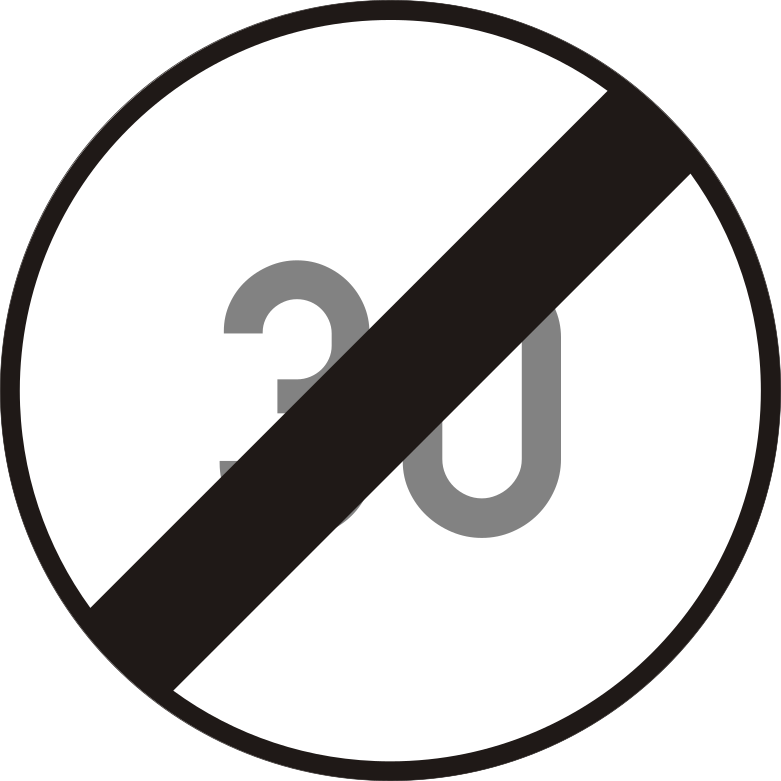 End of the speed limit.
English • Traffic sign figure 56 • End of the speed limit. The sign cancels the effect of the Speed limit sign.
Magyar • 56. ábra • Sebességkorlátozás vége. A tábla a „Sebességkorlátozás” jelzőtábla hatályát feloldja.
Sources
🔗 Commons.wikimedia.org
🔗 Njt.jog.gov.hu • 1/1975. (II. 5.) KPM–BM együttes rendelet (KRESZ) • 14(7) • 56. ábra
Image via Commons.wikimedia.org
Gigillo83 • Public domain • Source revision 2014-03-18. Wikimedia original unmodified.
Does the Hungarian car speed table also apply when towing a trailer?
No. For an ordinary car towing a trailer, the general maxima are 80 km/h on a motorway, 70 km/h on other roads outside built-up areas, including an expressway, and 50 km/h in built-up areas. Lower signs, special-area rules and any lower technical limit for the vehicle still apply.
Is a Hungarian expressway treated as a motorway for speed limits?
No. An autóút, an expressway, has a general car maximum of 110 km/h; an autópálya, a motorway, has 130 km/h. Their entrance signs identify different road categories, and lower signed limits can apply on either.
6. Bike path
A bike path is a part of a road or a separate route intended primarily or exclusively for people riding bicycles. It may be physically separated from motor traffic, marked on the road surface or identified by traffic signs.
Bike paths may be one-way, two-way or shared with other road users. The permitted users, direction of travel, priority rules and obligation to use the path depend on local traffic signs and regulations.
Wikimedia.org • Stipkovits7 • CC BY-SA
What does Hungary call a cycle path and cycle lane?
A cycle path is a kerékpárút, a cycle lane is a kerékpársáv, and a combined walking and cycling route is a gyalog- és kerékpárút. Check the facility’s signs and any marked division between users.
🔗 njt.jog.gov.hu • KRESZ §§13, 17; 54(1),(4)(b),(11)
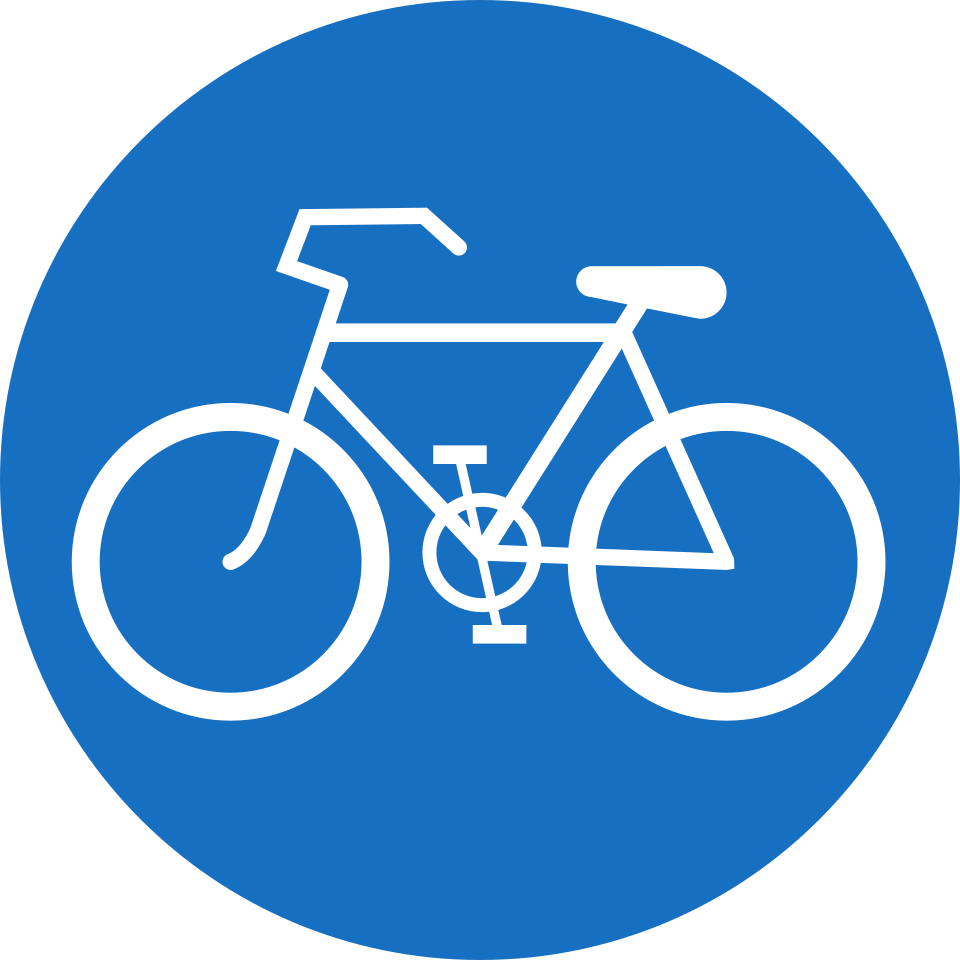 Mandatory path for cyclists.
English • Traffic sign figure 26 • Cycle path. The sign identifies a route designated for two-wheeled bicycles. Outside built-up areas, motorised invalid carriages, powered wheelchairs and two-wheeled mopeds may use it unless signs prohibit this. Other vehicles are prohibited.
Magyar • 26. ábra • Kerékpárút. A tábla a kétkerekű kerékpárok közlekedésére kijelölt utat jelez; a segédmotoros rokkantkocsi, a gépi meghajtású kerekes szék és a kétkerekű segédmotoros kerékpár lakott területen kívül a kerékpárutat igénybe veheti, ha ezt jelzőtábla nem tiltja. A kerékpárúton más jármű közlekedése tilos.
Sources
🔗 Commons.wikimedia.org
🔗 Njt.jog.gov.hu • 1/1975. (II. 5.) KPM–BM együttes rendelet (KRESZ) • 13(1)e • 26. ábra
Replacement SVG: Commons.wikimedia.org • Wikimedia Commons original • 3247 • Public domain • Original revision 2006-08-27. Wikimedia original unmodified.
Image via Commons.wikimedia.org
3247 • Public domain • Source revision 2006-08-27. Wikimedia original unmodified.
Must two-wheeled cyclists use a Hungarian path running alongside their road?
Normally yes, where a cycle path or combined walking and cycling path follows the road. In a built-up area beside a road that is not a main road, cycle symbols on the carriageway can permit carriageway use unless the signs indicate otherwise.
May I turn left directly from a Hungarian cycle path onto the parallel road?
No. The rules prohibit that manoeuvre. Dismount and push the bicycle across the carriageway under the pedestrian rules instead. The path’s proximity to the road does not permit a direct riding turn across its traffic.
7. Pedestrian warning
A pedestrian warning is a traffic warning indicating that pedestrians may be crossing or entering the roadway ahead. It is commonly used near pedestrian crossings or other locations where drivers need advance notice of frequent pedestrian activity.
Drivers approaching a pedestrian warning should reduce speed when necessary, watch carefully for pedestrians and be prepared to stop. The design of the warning sign and the priority rules at the crossing vary between countries.
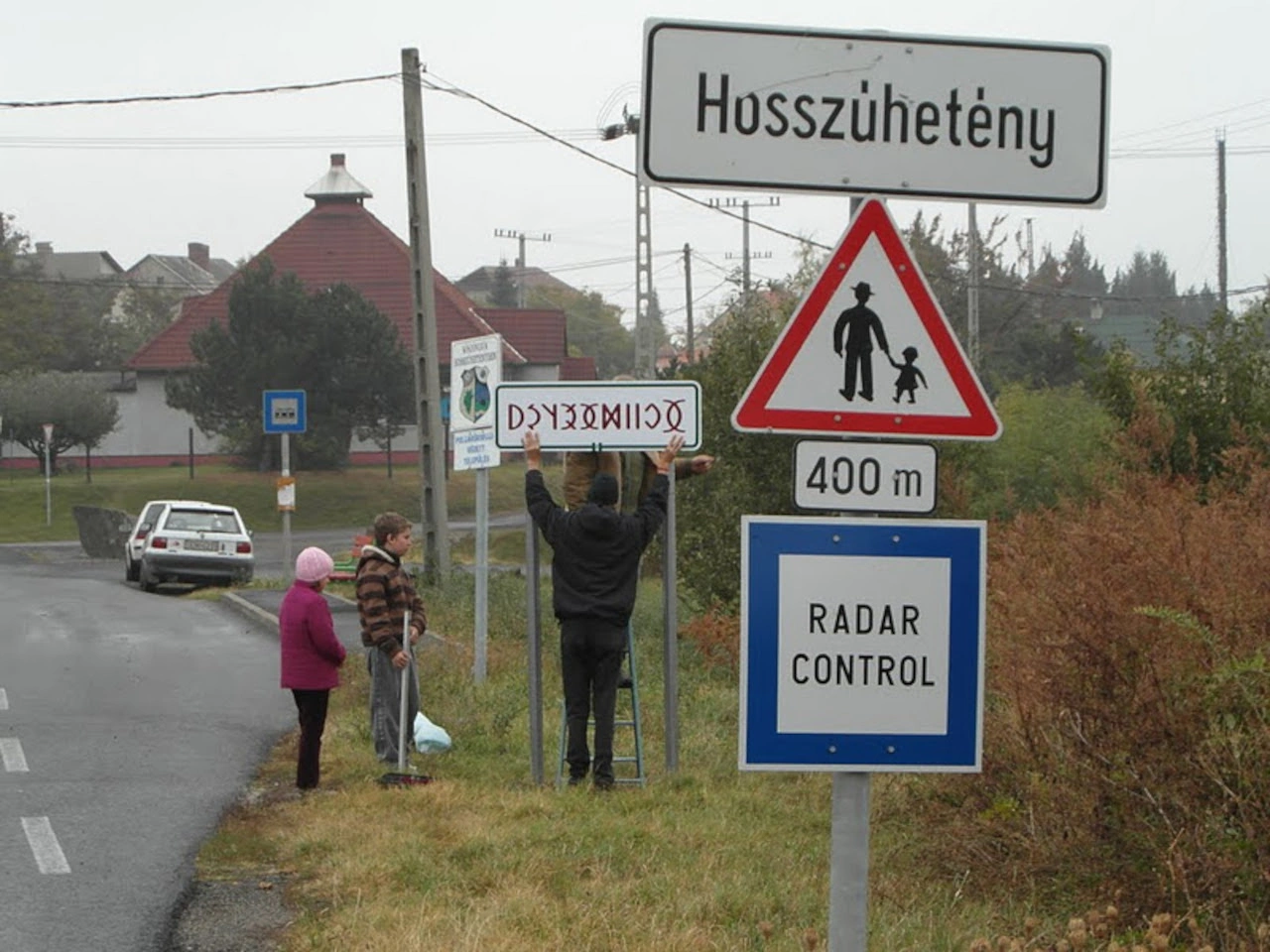
Wikimedia.org • Rovas Alapitvany • CC BY-SA
How should I react to a pedestrian warning in Hungary?
Reduce speed, look along both sides of the road and be ready to stop. The warning identifies a pedestrian hazard ahead; children, people with limited mobility or others may enter the road unexpectedly.
🔗 njt.jog.gov.hu • Hungary: KRESZ sections 16(1)(p)-(q),17(1)(a),43
Does a pedestrian warning in Hungary identify the crossing itself?
Not necessarily. An advance warning alerts you to danger ahead. The actual crossing is identified by its own signs, markings or signals. Apply the crossing rules when you reach it, and follow any supplementary distance information.
🔗 njt.jog.gov.hu • Hungary: KRESZ sections 16(1)(p)-(q),17(1)(a),43
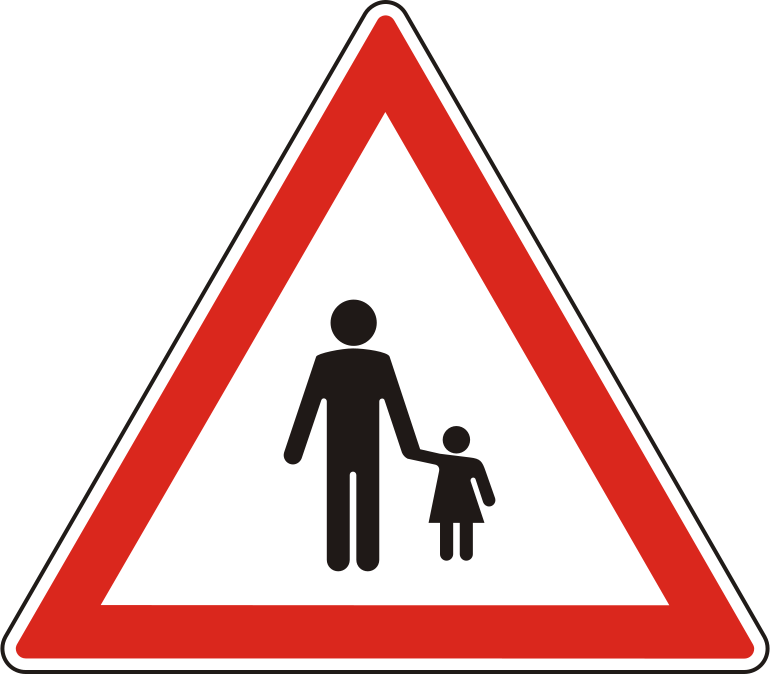 Warning for pedestrians.
English • Traffic sign figure 95/a • Pedestrians. There is an increased likelihood of pedestrians using the carriageway.
Magyar • 95/a. ábra • Gyalogosok. Fokozottan számolni kell az úttesten gyalogosok közlekedésével.
Sources
🔗 Commons.wikimedia.org
🔗 Njt.jog.gov.hu • 1/1975. (II. 5.) KPM–BM együttes rendelet (KRESZ) • 16(1)z/1 • 95/a. ábra
Image via Commons.wikimedia.org
Gigillo83 • Public domain • Source revision 2014-03-17. Wikimedia original unmodified.
What should drivers know about pedestrian crossings in Hungary?
Pedestrians have priority at a designated crossing. Approach slowly enough to stop before it. A turning vehicle must also give way to pedestrians crossing the road it turns into, even without a marked crossing.
🔗 njt.jog.gov.hu • Hungary: KRESZ sections 16(1)(p)-(q),17(1)(a),43
8. Pedestrian zone
A pedestrian zone is an area consisting of one or more streets that are reserved primarily for pedestrians. Motor-vehicle access is normally prohibited or restricted to authorised users, particular purposes or specified times.
Pedestrians may usually use the full width of the available road space. Rules concerning cyclists, deliveries, public transport, vehicle speed, stopping and parking depend on local traffic signs and regulations.
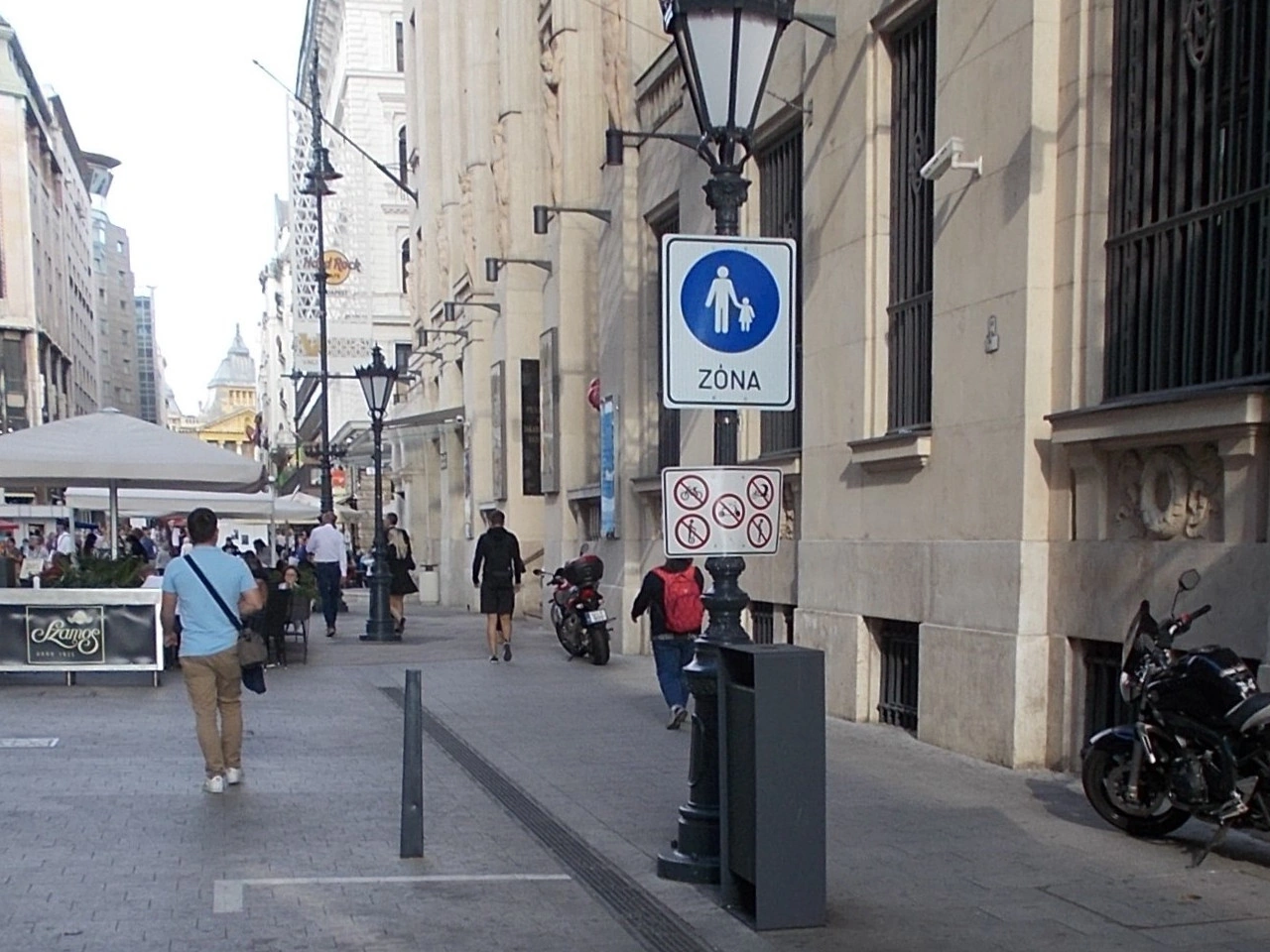
Wikimedia.org • Globetrotter19 • CC BY-SA
How should I recognise pedestrian-only access in Hungary?
A gyalogos övezet is a pedestrian zone where vehicle traffic is prohibited, subject to the stated exceptions. A gyalogos és kerékpáros övezet is the separate pedestrian-and-cycle-zone category.
🔗 njt.jog.gov.hu • KRESZ §13(1)(g/1),(i/1): access, time panels and exceptions
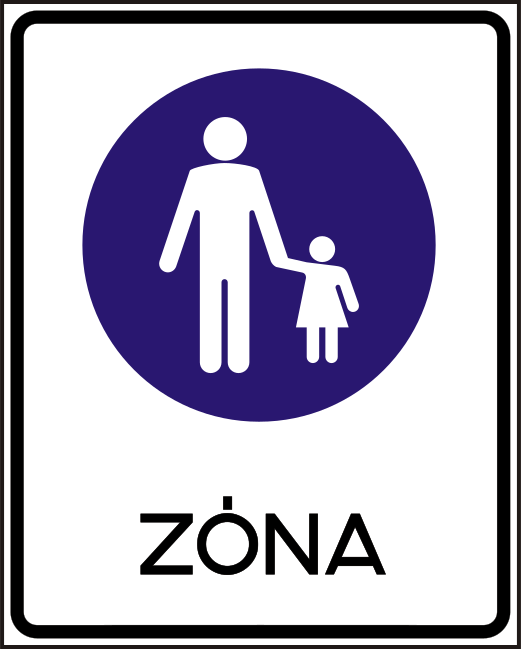 Start of a zone for pedestrians.
English • Traffic sign figure 26/h • Pedestrian zone. The sign marks the beginning of an area whose roads are intended for pedestrians. Vehicles are prohibited. If a supplementary plate specifies a period, outside that period residents' vehicles, vehicles with a permit from the road manager, and cyclists may travel at no more than 10 km/h without endangering pedestrians. Parking is prohibited during the period shown on the plate. A vehicle carrying a person with reduced mobility may travel and park in the zone if the applicable conditions are met.
Magyar • 26/h. ábra • Gyalogos övezet (zóna). A jelzőtábla olyan terület kezdetét jelzi, amelynek útjai a gyalogosok közlekedésére szolgálnak; jármű közlekedése a gyalogos övezetben tilos. Ha a tábla alatt időszakot megjelölő kiegészítő tábla van – a jelzett időszakon kívül – az ott lakók járművei, illetőleg az út kezelője által kiadott engedéllyel rendelkezők járművei, valamint a kerékpárosok – a gyalogosok veszélyeztetése nélkül – legfeljebb 10 km/óra sebességgel közlekedhetnek. A kiegészítő táblán jelzett időszakban az övezetben a várakozás tilos. A mozgáskorlátozott személyt szállító jármű – amennyiben ennek feltételei adottak – az övezetben közlekedhet és várakozhat.
Sources
🔗 Commons.wikimedia.org
🔗 Njt.jog.gov.hu • 1/1975. (II. 5.) KPM–BM együttes rendelet (KRESZ) • 13(1)g/1 • 26/h. ábra
Image via Commons.wikimedia.org
Gigillo83 • Public domain • Source revision 2014-03-22. Wikimedia original unmodified.
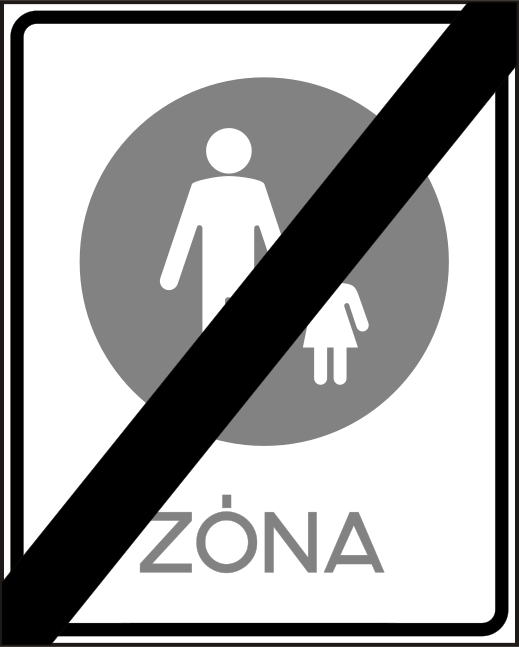 End of the zone for pedestrians.
English • Traffic sign figure 26/i • End of the pedestrian zone. The pedestrian zone ends.
Magyar • 26/i. ábra • Gyalogos övezet (zóna) vége. A gyalogos övezet vége.
Sources
🔗 Commons.wikimedia.org
🔗 Njt.jog.gov.hu • 1/1975. (II. 5.) KPM–BM együttes rendelet (KRESZ) • 13(1)h/1 • 26/i. ábra
Image via Commons.wikimedia.org
Gigillo83 • Public domain • Source revision 2014-03-22. Wikimedia original unmodified.
May cyclists ride in pedestrian areas in Hungary?
In a pedestrian zone with a displayed operating period, cyclists may ride outside that period at up to 10 km/h, without endangering pedestrians. This timed exception must not be read as unrestricted daytime bicycle access.
🔗 njt.jog.gov.hu • KRESZ §13(1)(g/1),(i/1): access, time panels and exceptions
Which rules apply to vehicles admitted to pedestrian areas in Hungary?
Outside the displayed restricted period, qualifying resident or permit-holder vehicles may enter at up to 10 km/h. Accessibility exceptions also exist. Read the time plate and permission conditions before entering.
🔗 njt.jog.gov.hu • KRESZ §13(1)(g/1),(i/1): access, time panels and exceptions
9. Slope
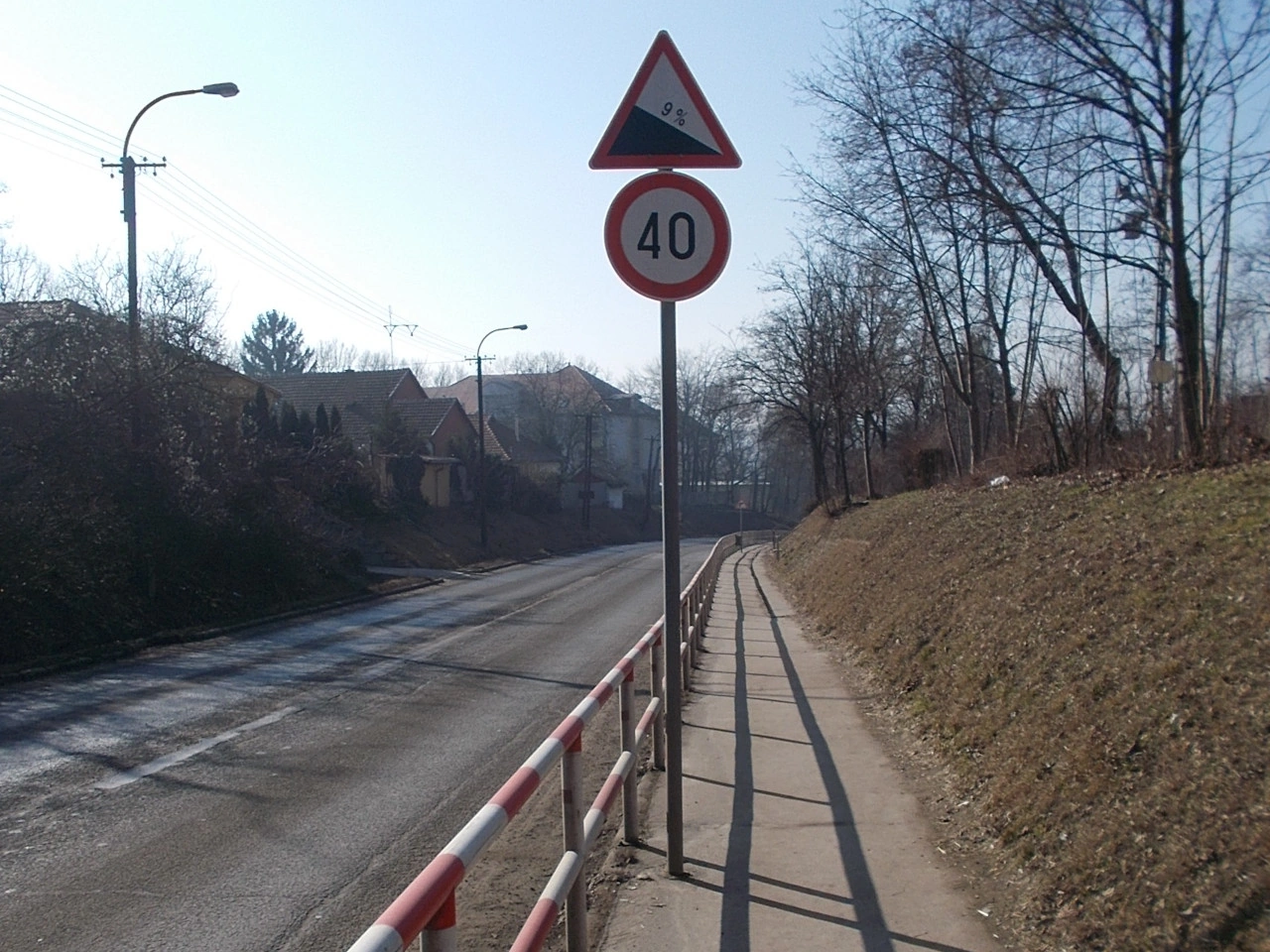
A slope is a section of road that rises or descends noticeably. A steep slope can affect vehicle speed, braking distance, traction, visibility and the ability of heavy or low-powered vehicles to maintain a steady speed.
Warning signs may indicate a steep ascent or dangerous descent and may show the gradient as a percentage. Drivers should adjust their speed early, select a suitable gear and remain prepared for slow vehicles, bends and changing road conditions.
Wikimedia.org • Globetrotter19 • CC BY-SA
What does a steep-slope warning mean in Hungary?
Hungarian warnings are called Veszélyes lejtő and Veszélyes emelkedő. The figure on the sign describes the steepest gradient of the hazardous section as a percentage.
🔗 njt.jog.gov.hu • Hungary: KRESZ sections 16(1)(c),26-27,32,34
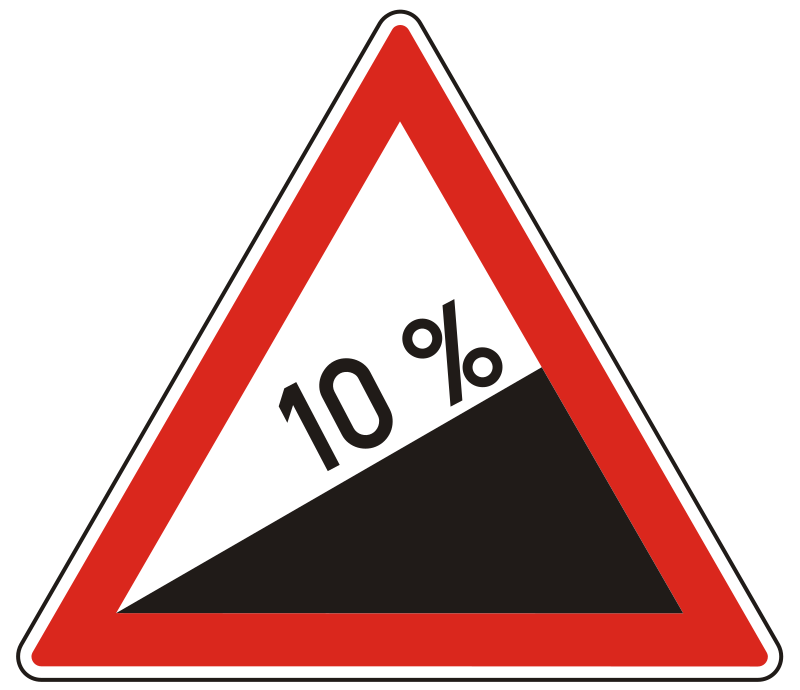 Warning for a steep ascent.
English • Traffic sign figure 69 • Dangerous ascent. A substantial ascent lies ahead. The number shown gives the maximum uphill gradient of the dangerous section as a percentage.
Magyar • 69. ábra • Veszélyes emelkedő. Jelentősebb emelkedő következik; a feltüntetett szám a veszélyes útszakasz legnagyobb emelkedésének százalékos mértékét jelzi.
Sources
🔗 Commons.wikimedia.org
🔗 Njt.jog.gov.hu • 1/1975. (II. 5.) KPM–BM együttes rendelet (KRESZ) • 16(1)c • 69. ábra
Image via Commons.wikimedia.org
Rl91 • Public domain • Source revision 2018-09-25. Wikimedia original unmodified.
 Warning for a steep descent.
English • Traffic sign figure 68 • Dangerous descent. A substantial descent lies ahead. The number shown gives the maximum downhill gradient of the dangerous section as a percentage.
Magyar • 68. ábra • Veszélyes lejtő. Jelentősebb lejtő következik; a feltüntetett szám a veszélyes útszakasz legnagyobb lejtésének százalékos mértékét jelzi.
Sources
🔗 Commons.wikimedia.org
🔗 Njt.jog.gov.hu • 1/1975. (II. 5.) KPM–BM együttes rendelet (KRESZ) • 16(1)c • 68. ábra
Image via Commons.wikimedia.org
Rl91 • Public domain • Source revision 2012-07-14. Wikimedia original unmodified.
How should I approach a steep descent in Hungary?
Reduce speed before the descent and select a suitable gear to help control the vehicle. Keep enough following distance and avoid building up speed that requires continuous heavy braking. A warning gives no fixed safe descent speed: the gradient, surface, visibility, load and vehicle can require a speed well below the legal maximum.
🔗 njt.jog.gov.hu • Hungary: KRESZ sections 16(1)(c),26-27,32,34
What should I check when meeting or overtaking on a slope in Hungary?
Do not overtake where a crest or bend prevents a sufficient view. Slow before entering a narrow section and follow its actual priority controls; the gradient warning itself is not a priority sign.
🔗 njt.jog.gov.hu • Hungary: KRESZ sections 16(1)(c),26-27,32,34
10. Bus stop
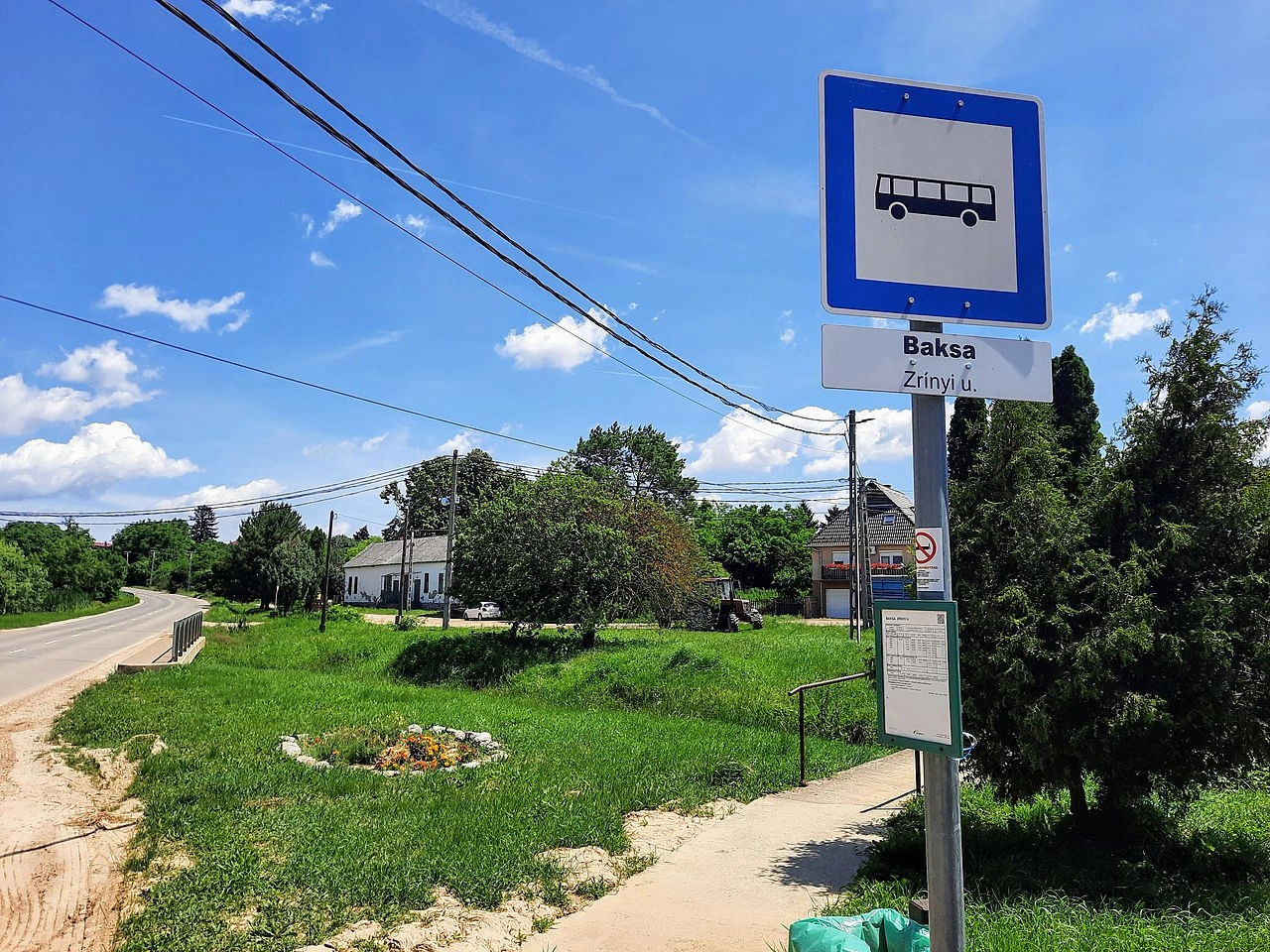
A bus stop is a designated place where buses stop to allow passengers to board or leave. It may be identified by a sign, shelter, raised platform, road marking or other public-transport infrastructure and can be located beside the road or in a specially constructed stopping area.
Drivers approaching a bus stop should watch carefully for buses, pedestrians and passengers crossing or entering the roadway. Parking or stopping restrictions may apply around bus stops to keep the area accessible and visible.
Wikimedia.org • Györkő Zsombor • CC BY-SA
What stopping or parking restrictions apply at bus stops in Hungary?
Hungary normally prohibits stopping within 15 metres before and 5 metres after the stop sign, unless the road marking establishes a different extent. A bus bay has its own specified exceptions.
May I briefly drop off a passenger at a bus stop in Hungary?
A private car has no general passenger-drop-off exception in the protected stop area. The Rules list limited exceptions for specified vehicles, including certain immediate passenger operations in a bus bay.
What should I do near a stopped bus in Hungary?
Within a built-up area, allow the indicated departure of scheduled buses and trolleybuses, school buses and buses carrying children into the rightmost lane where you can do so without sudden braking. Slow down or stop as necessary. The departing driver must first make sure the manoeuvre is safe.
11. Stop sign
A stop sign requires drivers to bring their vehicle to a complete stop and give way before entering or crossing the road ahead. The stop must be made at the stop line or another legally prescribed position.
After stopping, the driver may continue only when this can be done safely and without interfering with traffic that has priority. The sign does not create priority for the driver who has stopped.
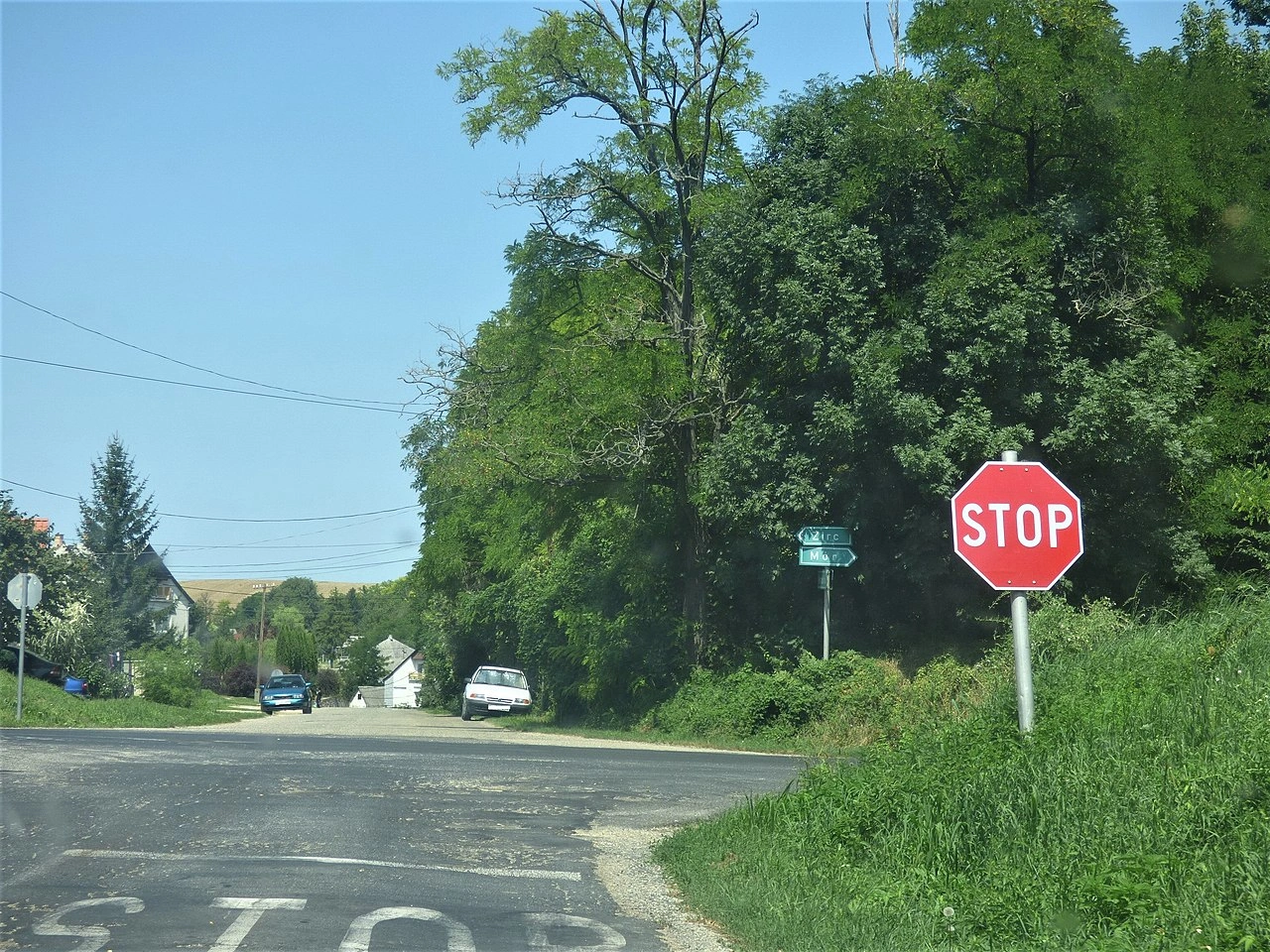
Wikimedia.org • Kriszti2083 • CC BY-SA
Must I stop completely at a stop sign in Hungary?
Yes. Come to a complete stop when the applicable stop sign controls your approach, even when you cannot see another road user. Slowing to a crawl is not a stop. The Hungarian term Állj! Elsőbbségadás kötelező means stop and give way.
🔗 njt.jog.gov.hu • KRESZ sections 12(1)(b),18(1)(i),28; Appendix 1 III(b)
 Stop and give way.
English • Traffic sign figure 11 • Stop and give way. At the junction, drivers must stop before the stop-line road marking or, if there is no such marking, before entering the junction, and give way to vehicles approaching on the road referred to in point a). A level crossing may be entered after stopping in accordance with section 39.
Magyar • 11. ábra • ÁLLJ! Elsőbbségadás kötelező. Az útkereszteződésnél – a megállás helyét jelző útburkolati jel előtt, ilyen útburkolati jel hiányában az útkereszteződésbe való behaladás előtt – meg kell állni, és az a) pontban említett úton érkező jármű részére elsőbbséget kell adni. A vasúti átjáróra a megállás után a 39. §-ban foglaltak szerint szabad ráhajtani.
Sources
🔗 Commons.wikimedia.org
🔗 Njt.jog.gov.hu • 1/1975. (II. 5.) KPM–BM együttes rendelet (KRESZ) • 12(1)b • 11. ábra
Replacement SVG: Commons.wikimedia.org • Wikimedia Commons original • EthanL13 • Public domain • Original revision 2024-01-26. Wikimedia original unmodified.
Image via Commons.wikimedia.org
EthanL13 • Public domain • Source revision 2024-01-26. Wikimedia original unmodified.
Where must I stop at a stop-controlled junction in Hungary?
Stop before the road marking indicating the stopping place. Without that marking, stop before entering the junction. The Hungarian rule calls this Állj! Elsőbbségadás kötelező, meaning stop and give way.
🔗 njt.jog.gov.hu • KRESZ sections 12(1)(b),18(1)(i),28; Appendix 1 III(b)
Does stopping first give me priority at a stop sign in Hungary?
A complete stop does not, by itself, give you priority. Give way to the road users entitled to pass under the junction’s signs and rules, check pedestrians and cyclists, and proceed only when the gap is safe. Do not follow another stopped vehicle through without satisfying your own stopping and yielding duties.
🔗 njt.jog.gov.hu • KRESZ sections 12(1)(b),18(1)(i),28; Appendix 1 III(b)
12. Give way
A give-way sign requires drivers to allow traffic with priority to proceed before entering, crossing or joining a road. Drivers must reduce speed, observe approaching traffic and stop when necessary.
Unlike a stop sign, a give-way sign does not always require a complete stop. The driver may continue without stopping only when the route is clearly safe and no road user with priority is forced to change speed or direction.
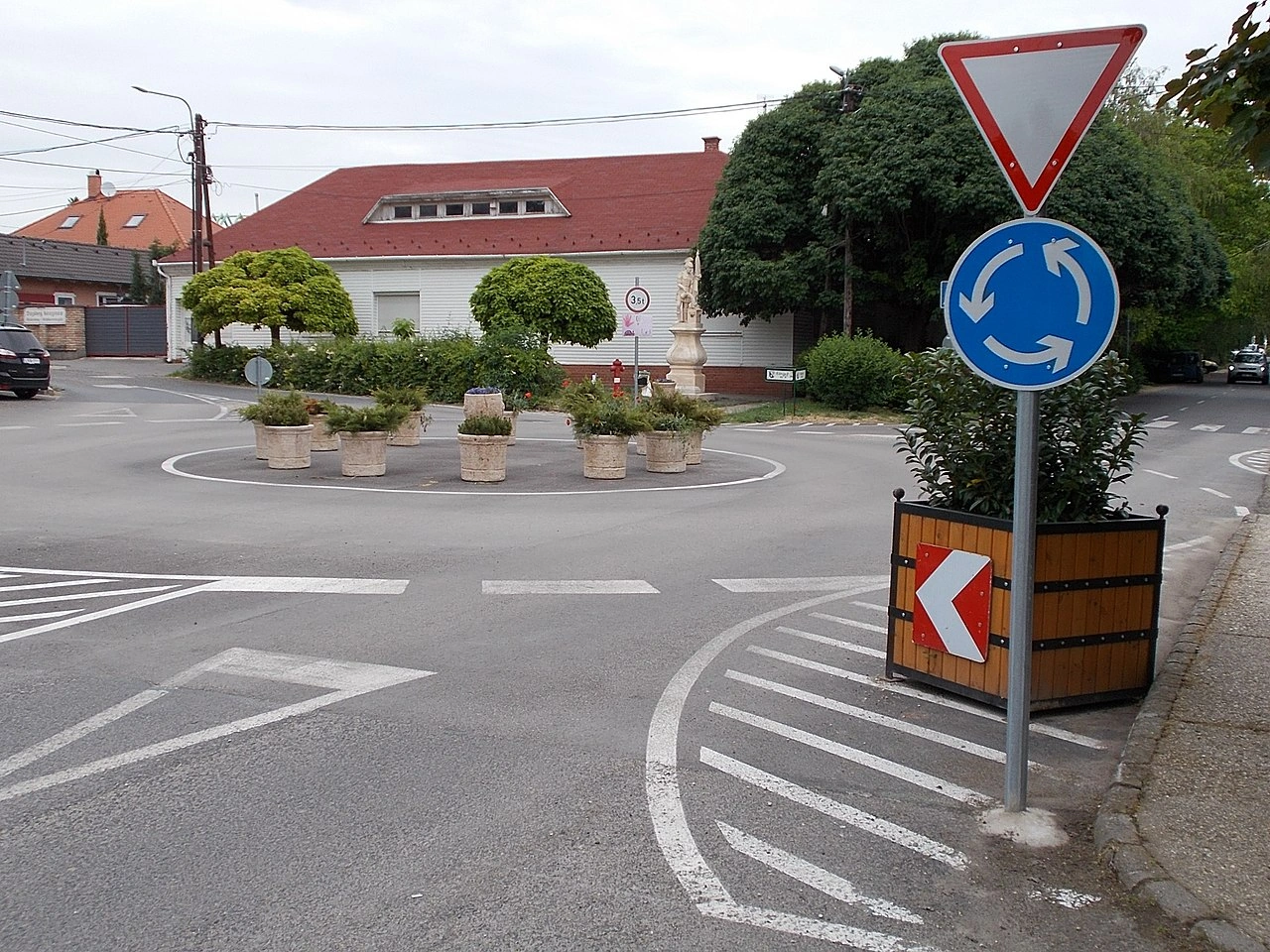
Wikimedia.org • Globetrotter19 • CC BY-SA
What does giving way mean in Hungary?
Giving way means allowing the road user with priority to proceed. Do not force a priority vehicle to change direction or speed abruptly, and do not obstruct a pedestrian who has priority. At a give-way sign, check the crossing road and any supplementary priority-route or cycle indication.
🔗 njt.jog.gov.hu • KRESZ sections 12(1)(a),28; Appendix 1 III(b)
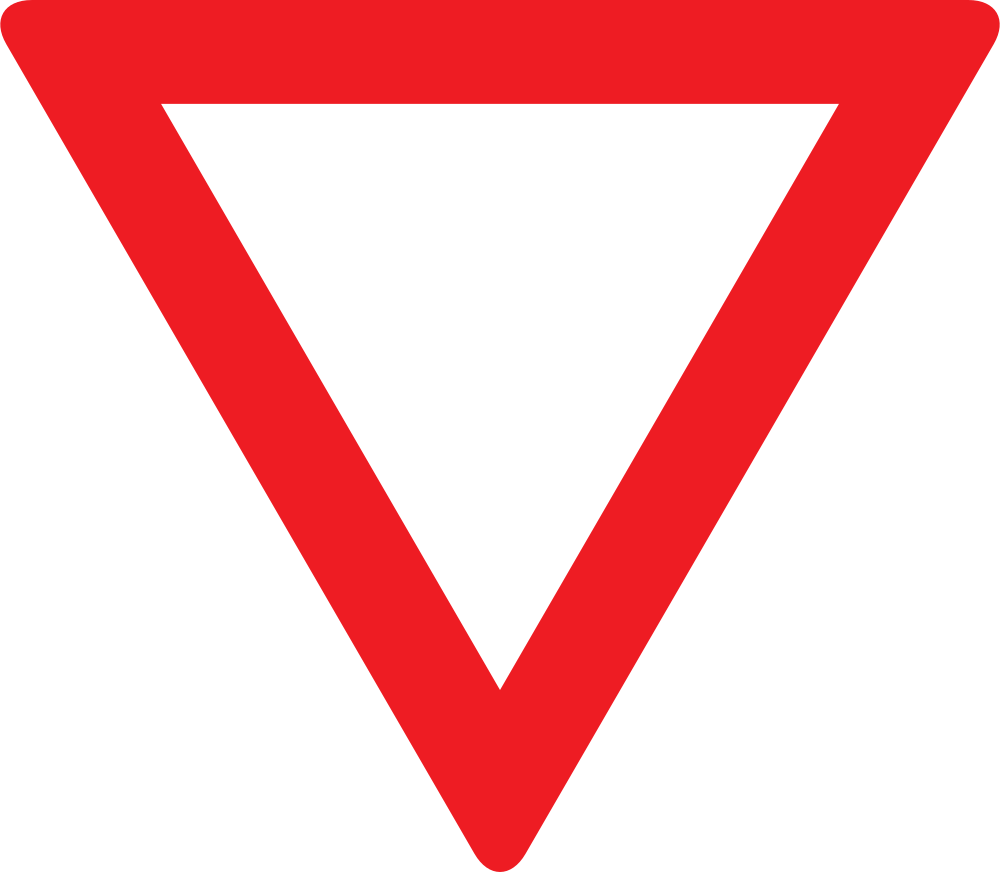 Give way.
English • Traffic sign figure 9 • Give way. At the junction, drivers must give way to vehicles approaching on the intersecting or joining road, or, if a supplementary plate shows the junction layout, on the road shown by a thick line (figure 10). If the supplementary plate includes a cycle-traffic symbol (figure 10/a), drivers must give way to cyclists crossing on the part of the carriageway marked for cycle traffic.
Magyar • 9. ábra • Elsőbbségadás kötelező. Az útkereszteződésben elsőbbséget kell adni a keresztező (betorkolló) úton – illetőleg, ha a jelzőtábla alatt az útkereszteződés alaprajzi vázlatát feltüntető kiegészítő tábla van, az ezen vastag vonallal jelzett úton (10. ábra) – érkező jármű részére. Ha a kiegészítő táblán a kerékpár-közlekedésre utaló jelzés van (10/a. ábra), abban az esetben az úttest kerékpár-közlekedés céljára burkolati jellel kijelölt részén áthaladó kerékpáros részére elsőbbséget kell adni.
Sources
🔗 Commons.wikimedia.org
🔗 Njt.jog.gov.hu • 1/1975. (II. 5.) KPM–BM együttes rendelet (KRESZ) • 12(1)a • 9. ábra
Replacement SVG: Commons.wikimedia.org • Wikimedia Commons original • 3247 • Public domain • Original revision 2006-08-27. Wikimedia original unmodified.
Image via Commons.wikimedia.org
3247 • Public domain • Source revision 2006-08-27. Wikimedia original unmodified.
Must you always stop when giving way in Hungary?
No. A give-way control requires stopping when necessary to yield or obtain a safe view. A stop sign requires a complete stop even if the road appears empty.
🔗 njt.jog.gov.hu • KRESZ sections 12(1)(a),28; Appendix 1 III(b)
What should you check before proceeding after giving way in Hungary?
Wait until the manoeuvre is safe. Check the priority traffic, the view in both directions and enough space to complete the entry. Giving way to one vehicle does not remove duties towards another driver, a cyclist or a pedestrian.
🔗 njt.jog.gov.hu • KRESZ sections 12(1)(a),28; Appendix 1 III(b)
13. Roundabout
A roundabout is a circular road arrangement in which traffic travels around a central island in one designated direction. Vehicles enter and leave through connecting roads, and traffic signs or local rules determine who has priority.
Drivers should reduce speed, choose a suitable lane, observe all road users and signal as required when leaving. The direction of travel, entry priority, lane use and rules for cyclists and pedestrians depend on local traffic signs and regulations.
Wikimedia.org • CC BY-SA
Who has priority at a roundabout in Hungary?
Hungary’s Körforgalom sign establishes circulation around the island. Give-way signs at entry assign priority to circulating traffic; do not infer priority from the circular shape alone. The national rules also protect trams crossing the roundabout.
🔗 njt.jog.gov.hu • KRESZ sections 13(1)(c),28(2)(b),(d),29,31,36,43
 Mandatory roundabout direction.
English • Traffic sign figure 23 • Roundabout. The sign identifies a road on which drivers must travel with the enclosed central area on their left.
Magyar • 23. ábra • Körforgalom. A tábla olyan utat jelez, amelyen úgy kell haladni, hogy az út által körbezárt terület a vezetőtől balra essék.
Sources
🔗 Commons.wikimedia.org
🔗 Njt.jog.gov.hu • 1/1975. (II. 5.) KPM–BM együttes rendelet (KRESZ) • 13(1)c • 23. ábra
Replacement SVG: Commons.wikimedia.org • Wikimedia Commons original • Kys5g • CC BY 4.0 • Original revision 2023-12-07. Wikimedia original unmodified.
Image via Commons.wikimedia.org
Kys5g • CC BY 4.0 • Source revision 2023-12-07. Wikimedia original unmodified.
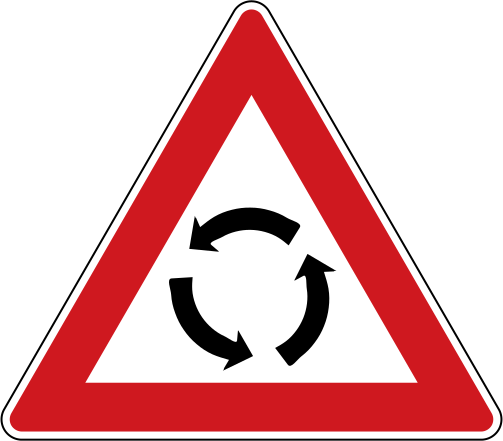 Warning for a roundabout.
English • Traffic sign figure 95/e • Roundabout. The next junction operates as a roundabout.
Magyar • 95/e. ábra • Körforgalom. A következő útkereszteződésben körforgalmú forgalmi rend van.
Sources
🔗 Commons.wikimedia.org
🔗 Njt.jog.gov.hu • 1/1975. (II. 5.) KPM–BM együttes rendelet (KRESZ) • 16(1)z/5 • 95/e. ábra
Replacement SVG: Commons.wikimedia.org • Wikimedia Commons original • Government of the Czech Republic • Public domain • Original revision 2013-12-06. Wikimedia original unmodified.
Image via Commons.wikimedia.org
Government of the Czech Republic • Public domain • Source revision 2013-12-06. Wikimedia original unmodified.
How should you choose a roundabout lane in Hungary?
Follow the lane arrows and signs for your intended exit. Change lanes only when safe and give way to vehicles continuing without changing direction. Do not assume that priority over entering traffic also gives you priority to change lanes.
🔗 njt.jog.gov.hu • KRESZ sections 13(1)(c),28(2)(b),(d),29,31,36,43
What should you check when leaving a roundabout in Hungary?
Signal in good time before leaving and keep signalling until the manoeuvre is complete. Check pedestrians, cyclists and vehicles alongside; give way where the turning or lane-change rules require. Entry to the roundabout is excluded from the ordinary turn-signalling requirement.
🔗 njt.jog.gov.hu • KRESZ sections 13(1)(c),28(2)(b),(d),29,31,36,43
14. Priority road
A priority road is a road whose traffic is given priority over traffic entering from intersecting roads. It is normally identified by a priority-road sign, while an end sign indicates where that continuing priority status stops.
Drivers on a priority road must still obey traffic lights, authorised officers, speed limits, crossings and turning rules. Having priority never allows a driver to proceed when doing so would create danger or block an intersection.
Wikimedia.org • Bálint Sallói • CC BY-SA
How does priority-road status work in Hungary?
Hungary calls a signed priority road a Főútvonal. Read the corresponding end sign and any supplementary diagram where the road’s course changes at a junction.
🔗 njt.jog.gov.hu • KRESZ sections 11(1)(d)-(e),12,28,31(8),43
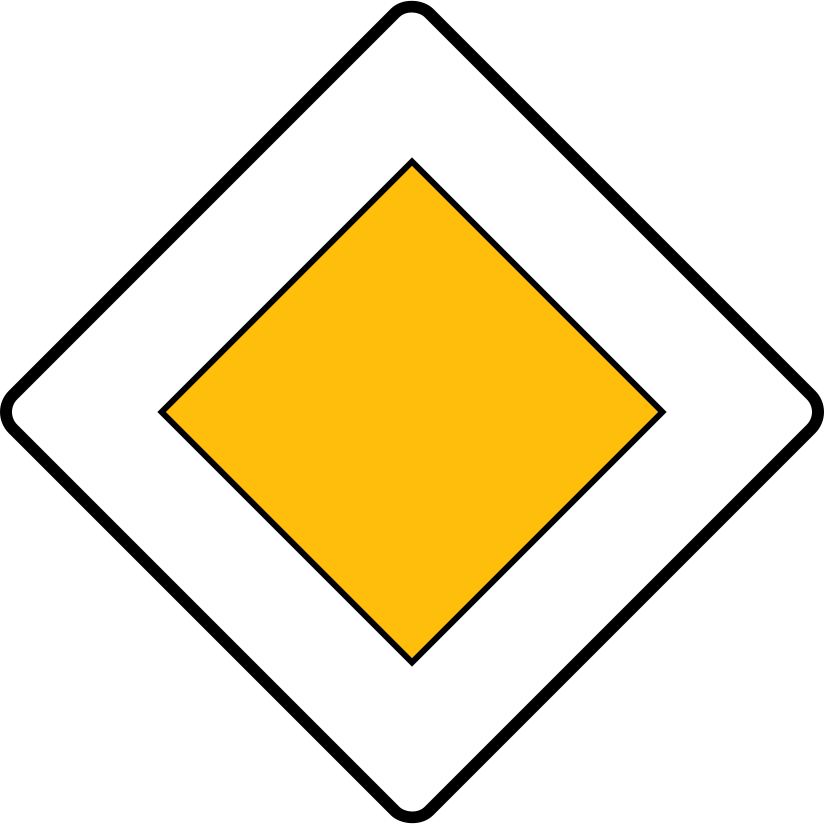 Start of a priority road.
English • Traffic sign figure 5 • Priority road. This is a priority road. The priority rules in KRESZ section 28 apply.
Magyar • 5. ábra • Főútvonal. Főútvonal. A KRESZ 28. §-ában meghatározott elsőbbségi szabályokat kell alkalmazni.
Sources
🔗 Commons.wikimedia.org
🔗 Njt.jog.gov.hu • 1/1975. (II. 5.) KPM–BM együttes rendelet (KRESZ) • 11(1)e • 5. ábra
Replacement SVG: Commons.wikimedia.org • Wikimedia Commons original • Szczepan dyskusja Mail 18:29, 31 December 2006 (UTC) • Public domain • Original revision 2025-10-11. Wikimedia original unmodified.
Image via Commons.wikimedia.org
Szczepan dyskusja Mail 18:29, 31 December 2006 (UTC) • Public domain • Source revision 2025-10-11. Wikimedia original unmodified.
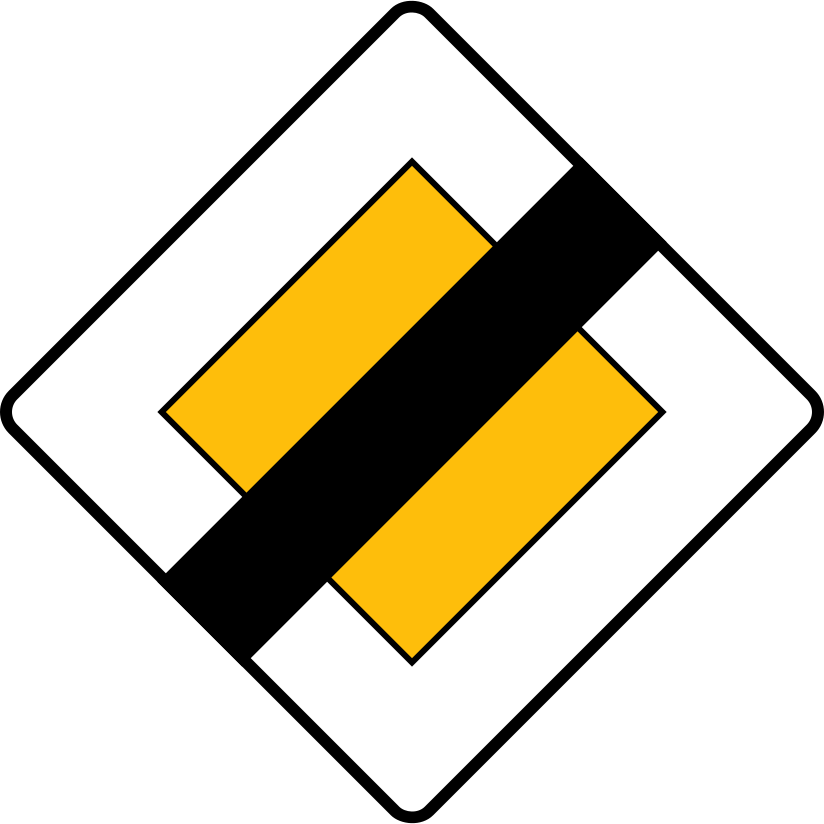 End of the priority road.
English • Traffic sign figure 6 • End of the priority road. The priority road ends.
Magyar • 6. ábra • Főútvonal vége. A főútvonal vége.
Sources
🔗 Commons.wikimedia.org
🔗 Njt.jog.gov.hu • 1/1975. (II. 5.) KPM–BM együttes rendelet (KRESZ) • 11(1)f • 6. ábra
Replacement SVG: Commons.wikimedia.org • Wikimedia Commons original • Szczepan dyskusja Mail 18:29, 31 December 2006 (UTC) • Public domain • Original revision 2025-10-11. Wikimedia original unmodified.
Image via Commons.wikimedia.org
Szczepan dyskusja Mail 18:29, 31 December 2006 (UTC) • Public domain • Source revision 2025-10-11. Wikimedia original unmodified.
How can you tell where a priority road applies in Hungary?
Read the priority-road sign, the corresponding end indication and any supplementary junction diagram. Distinguish a continuing road designation from a sign that regulates only one junction. If a diagram shows the priority route turning, follow that diagram rather than assuming the straight-ahead road has priority.
🔗 njt.jog.gov.hu • KRESZ sections 11(1)(d)-(e),12,28,31(8),43
Does having road priority let you ignore other controls in Hungary?
No. Obey the applicable traffic signals and authorised directions, speed limits and crossing rules. Turning or changing lanes can require yielding, and having priority never permits entering a conflict that cannot be crossed safely.
🔗 njt.jog.gov.hu • KRESZ sections 11(1)(d)-(e),12,28,31(8),43
15. Road narrowing
A road narrowing is a section where the available width of the road or carriageway becomes smaller. The narrowing may occur on both sides, on one side only, or because one or more traffic lanes end.
Drivers should reduce speed, observe approaching and adjacent traffic, maintain sufficient lateral clearance and merge when necessary. Warning signs do not always determine priority, so drivers must follow any priority signs, lane markings and local traffic rules.
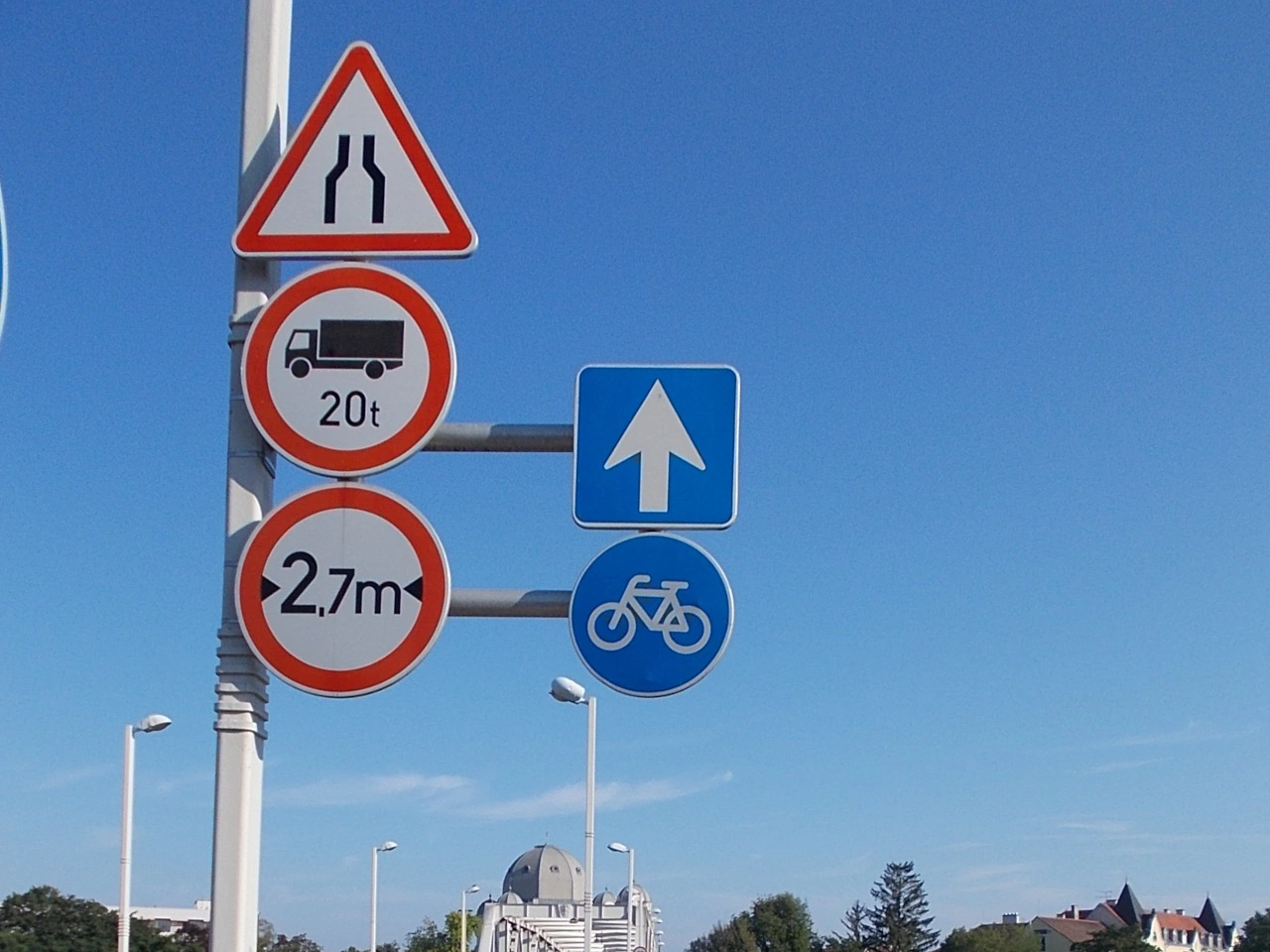
Wikimedia.org • Globetrotter19 • CC BY-SA
What does a road-narrowing warning mean in Hungary?
Hungary’s Útszűkület warning identifies road narrowing. Separate signs establish giving way to, or priority over, oncoming traffic through a restricted width.
🔗 njt.jog.gov.hu • KRESZ sections 12(1)(c)-(d),16(1)(b),29,32,36(7)
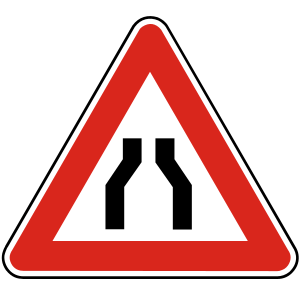 Warning for a road narrowing.
English • Traffic sign figure 70 • Road narrows. The carriageway becomes substantially narrower than on the preceding section.
Magyar • 70. ábra • Útszűkület. Az úttest szélessége a megelőző útszakaszhoz képest számottevően csökken.
Sources
🔗 Commons.wikimedia.org
🔗 Njt.jog.gov.hu • 1/1975. (II. 5.) KPM–BM együttes rendelet (KRESZ) • 16(1)d • 70. ábra
Replacement SVG: Commons.wikimedia.org • Wikimedia Commons original • Ministry of Interior of the Slovak Republic • Public domain • Original revision 2010-08-24. Wikimedia original unmodified.
Image via Commons.wikimedia.org
Ministry of Interior of the Slovak Republic • Public domain • Source revision 2010-08-24. Wikimedia original unmodified.
 Warning for a road narrowing on the left.
English • Traffic sign figure 70–71 • Road narrows. The carriageway becomes substantially narrower than on the preceding section. Direction arrows and layout diagrams are illustrative; the sign always depicts the actual situation.
Magyar • 70–71. ábra • Útszűkület. Az úttest szélessége a megelőző útszakaszhoz képest számottevően csökken. Az irányt jelző nyilak és az alaprajzi vázlatok példálózó jellegűek; a jelzés mindig a tényleges helyzetet tünteti fel.
Sources
🔗 Commons.wikimedia.org
🔗 Njt.jog.gov.hu • 1/1975. (II. 5.) KPM–BM együttes rendelet (KRESZ) • 16(1)d • 70–71. ábra
🔗 Njt.jog.gov.hu • KRESZ • 20/A. §
Image via Commons.wikimedia.org
Rl91 • Public domain • Source revision 2012-07-14. Wikimedia original unmodified.
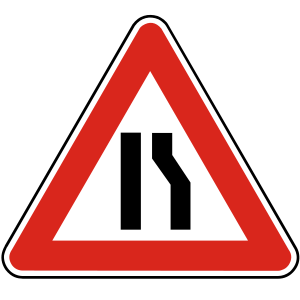 Warning for a road narrowing on the right.
English • Traffic sign figure 71 • Road narrows. The carriageway becomes substantially narrower than on the preceding section.
Magyar • 71. ábra • Útszűkület. Az úttest szélessége a megelőző útszakaszhoz képest számottevően csökken.
Sources
🔗 Commons.wikimedia.org
🔗 Njt.jog.gov.hu • 1/1975. (II. 5.) KPM–BM együttes rendelet (KRESZ) • 16(1)d • 71. ábra
Replacement SVG: Commons.wikimedia.org • Wikimedia Commons original • Ministry of Interior of the Slovak Republic • Public domain • Original revision 2010-08-24. Wikimedia original unmodified.
Image via Commons.wikimedia.org
Ministry of Interior of the Slovak Republic • Public domain • Source revision 2010-08-24. Wikimedia original unmodified.
Does a narrowing warning give you priority in Hungary?
No. A warning describes the reduced width, rather than allocating priority or setting a numerical speed limit. Follow any separate priority signs, signals and meeting rules, and slow enough to pass safely or wait before entering.
🔗 njt.jog.gov.hu • KRESZ sections 12(1)(c)-(d),16(1)(b),29,32,36(7)
What should you do if traffic lanes merge at a narrowing in Hungary?
When a lane ends, give priority to a vehicle that can continue without crossing a lane line. If lanes are unmarked, priority belongs to the vehicle that can continue without changing direction. If both must change direction, the vehicle previously in the lane on the right has priority. Signal any lane change and avoid forcing a conflict.
🔗 njt.jog.gov.hu • KRESZ sections 12(1)(c)-(d),16(1)(b),29,32,36(7)
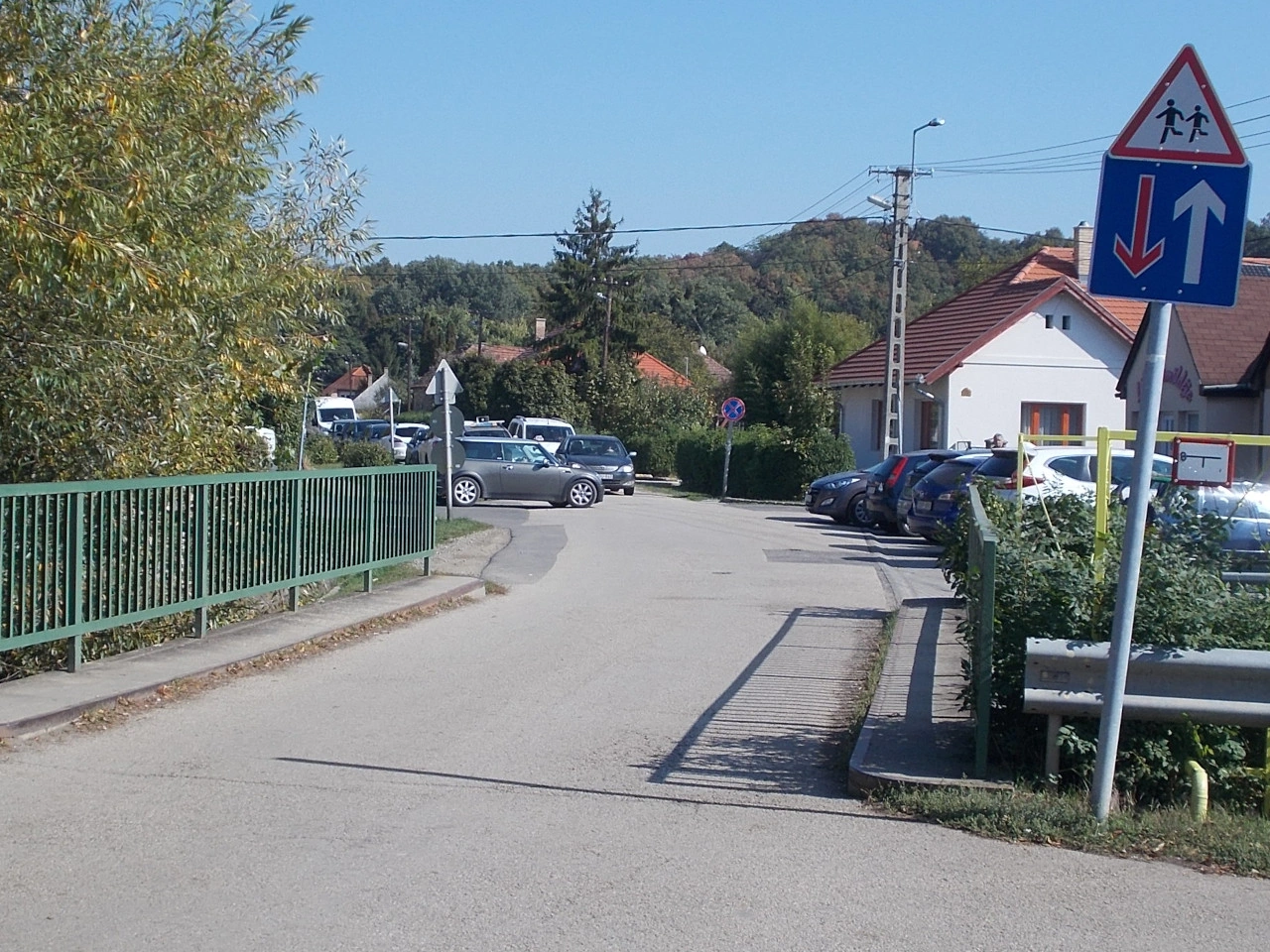
16. Priority over oncoming traffic
Priority over oncoming traffic means that drivers travelling in one direction have priority through a narrow section of road over drivers approaching from the opposite direction. The rule is normally indicated by a priority sign facing one direction and a corresponding give-way sign facing the other.
Drivers with priority must still approach cautiously and must not force their way through when the passage is blocked or already occupied. The signs regulate priority through the narrow section, not speed, parking or priority at nearby intersections.
Wikimedia.org • Globetrotter19 • CC BY-SA
How is priority over oncoming traffic controlled in Hungary?
Hungary’s Elsőbbség a szembejövő forgalommal szemben gives priority over opposing traffic at the narrowing. The corresponding opposite sign requires yielding to oncoming vehicles.
🔗 njt.jog.gov.hu • KRESZ sections 3,12(1)(d),28,32
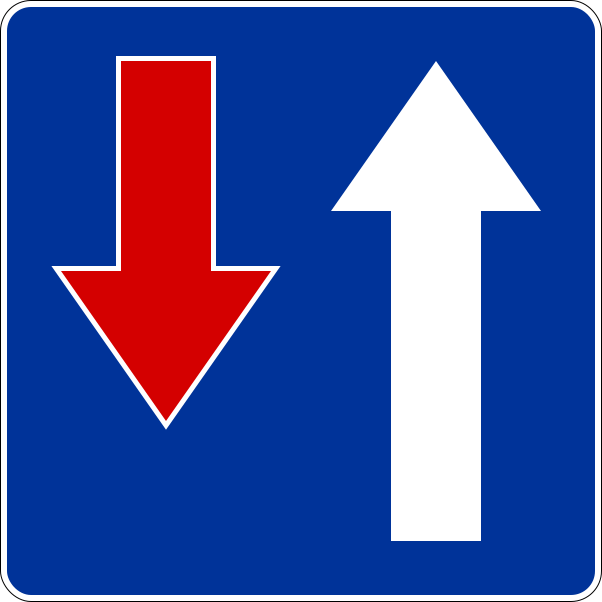 Road narrowing, oncoming drivers have to give way.
English • Traffic sign figure 14 • Priority over oncoming traffic. Vehicles have priority over oncoming vehicles at the narrowing.
Magyar • 14. ábra • Elsőbbség a szembejövő forgalommal szemben. Az útszűkületben a járműnek elsőbbsége van a szembejövő járművel szemben.
Sources
🔗 Commons.wikimedia.org
🔗 Njt.jog.gov.hu • 1/1975. (II. 5.) KPM–BM együttes rendelet (KRESZ) • 12(1)d • 14. ábra
Replacement SVG: Commons.wikimedia.org • Wikimedia Commons original • Szczepan dyskusja Mail 18:29, 31 December 2006 (UTC) • Public domain • Original revision 2025-10-10. Wikimedia original unmodified.
Image via Commons.wikimedia.org
Szczepan dyskusja Mail 18:29, 31 December 2006 (UTC) • Public domain • Source revision 2025-10-10. Wikimedia original unmodified.
Can you enter an occupied narrow passage when you have priority in Hungary?
Do not force a conflict. Check the full available width and let a vehicle already committed to the passage clear it when both vehicles cannot pass safely. A priority control does not permit creating danger or disregarding a red signal or authorised instruction.
Does priority through a narrow passage extend to nearby junctions in Hungary?
No. A control releasing your direction or giving priority over opposing traffic concerns that passage. Junction priority, speed limits, crossings and any later restriction must be assessed separately from their own signs and rules.
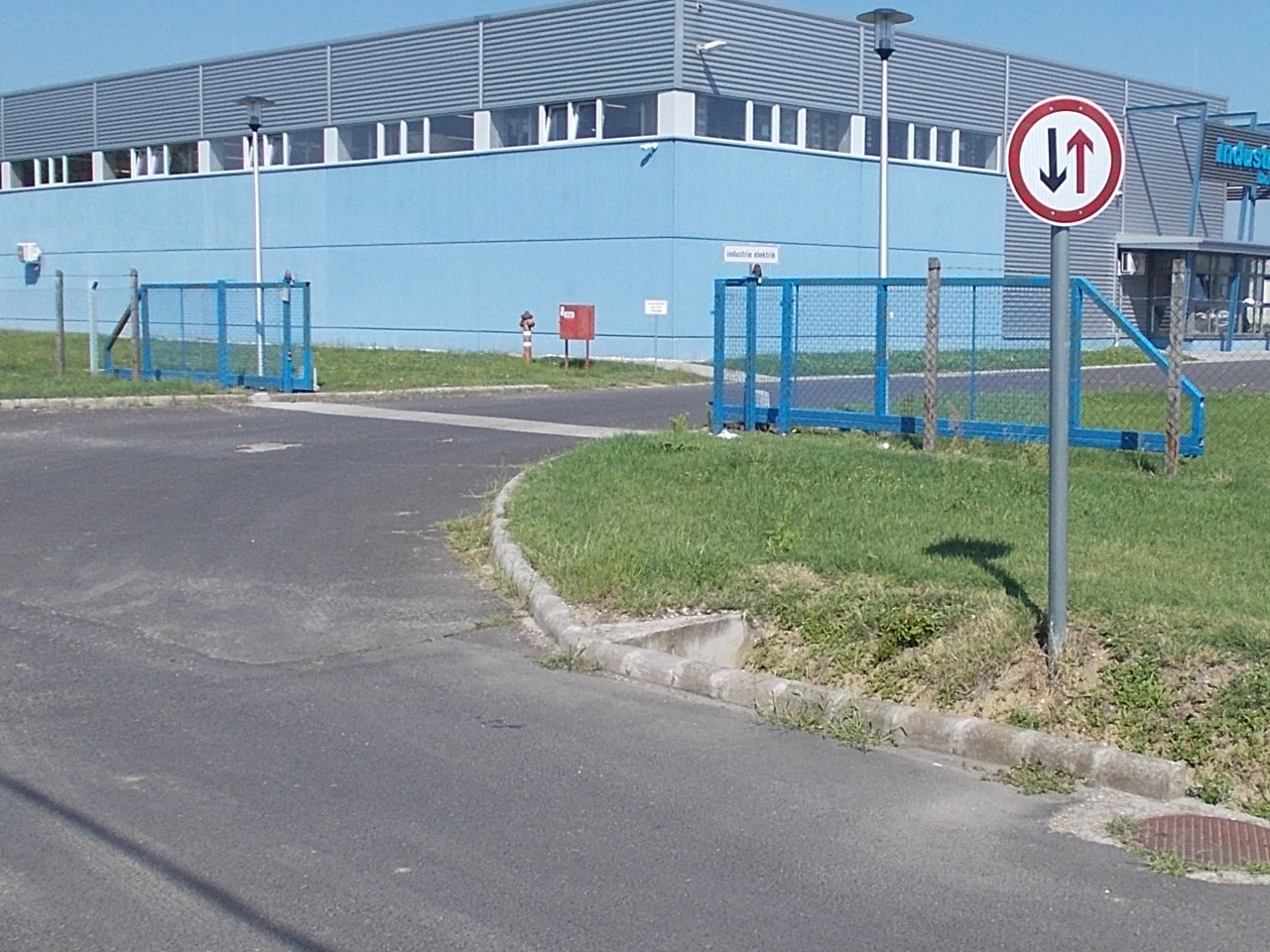
17. Give way to oncoming traffic
Give way to oncoming traffic means that drivers must allow vehicles approaching from the opposite direction to pass first through a narrow section of road. The rule is normally indicated by a sign facing the direction that must yield and a corresponding priority sign facing oncoming traffic.
Drivers must reduce speed and stop when necessary before entering the narrow passage. They may continue only when they can do so safely and without obstructing oncoming traffic that has priority.
Wikimedia.org • Globetrotter19 • CC BY-SA
When must I give way to oncoming traffic in Hungary?
Give way where the oncoming-priority sign, an applicable signal or an authorised controller requires it. Without such a control, vehicles meeting on a road too narrow for safe passage must stop and make room; if reversing is needed, the vehicle for which it is easier must reverse, considering the vehicles and conditions.
🔗 njt.jog.gov.hu • KRESZ sections 3,12(1)(c),16(1)(b),32
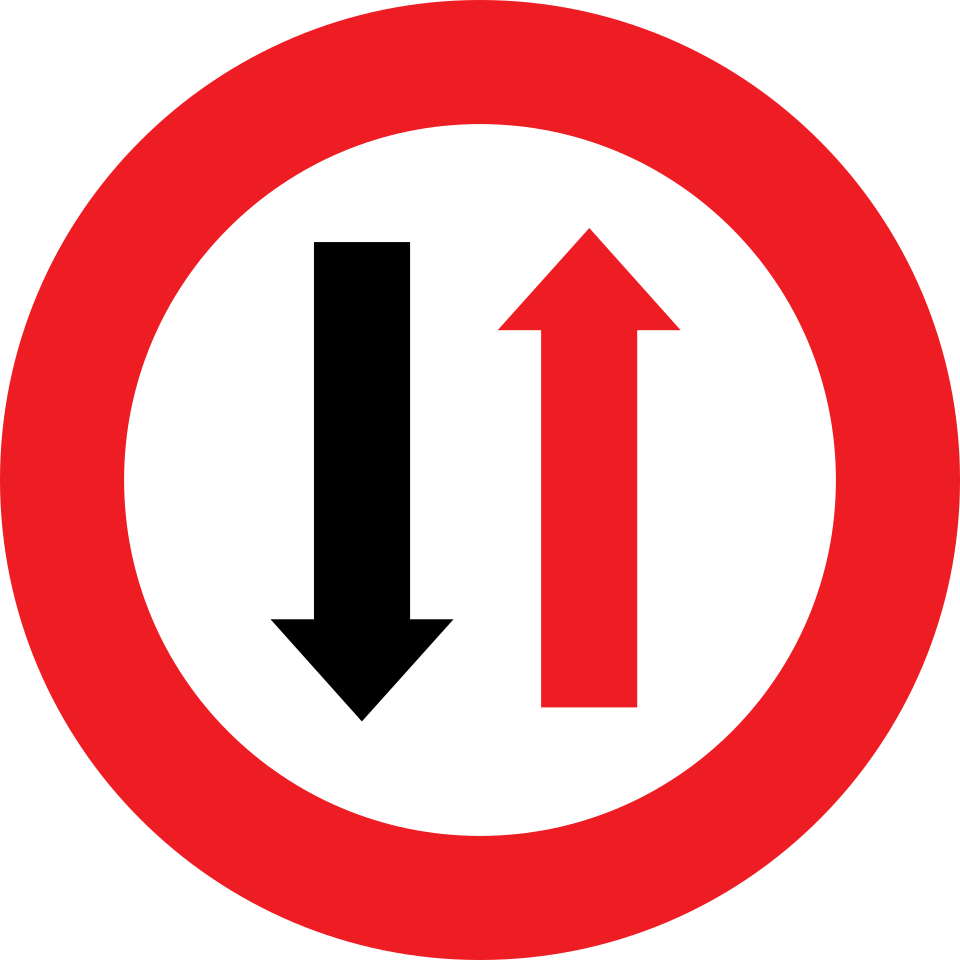 Road narrowing, give way to oncoming drivers.
English • Traffic sign figure 13 • Priority for oncoming traffic. Drivers must give way to oncoming vehicles at the narrowing.
Magyar • 13. ábra • A szembejövő forgalom elsőbbsége. Az útszűkületben elsőbbséget kell adni a szembejövő jármű részére.
Sources
🔗 Commons.wikimedia.org
🔗 Njt.jog.gov.hu • 1/1975. (II. 5.) KPM–BM együttes rendelet (KRESZ) • 12(1)c • 13. ábra
Replacement SVG: Commons.wikimedia.org • Wikimedia Commons original • 3247 • Public domain • Original revision 2006-08-27. Wikimedia original unmodified.
Image via Commons.wikimedia.org
3247 • Public domain • Source revision 2006-08-27. Wikimedia original unmodified.
Does a road-narrows warning automatically give oncoming traffic priority in Hungary?
Not necessarily. A warning of a narrow carriageway is not itself the same as an instruction to give way. Check whether there is a separate priority sign, signal or temporary traffic control, and take account of any rules for an obstruction on your side.
What if an oncoming vehicle is already entering a narrow passage in Hungary?
Reduce speed and wait where you can do so safely rather than forcing two vehicles into insufficient space. Even if a sign gives your approach priority, that does not justify a collision or endangering another road user.
18. Pedestrian crossing
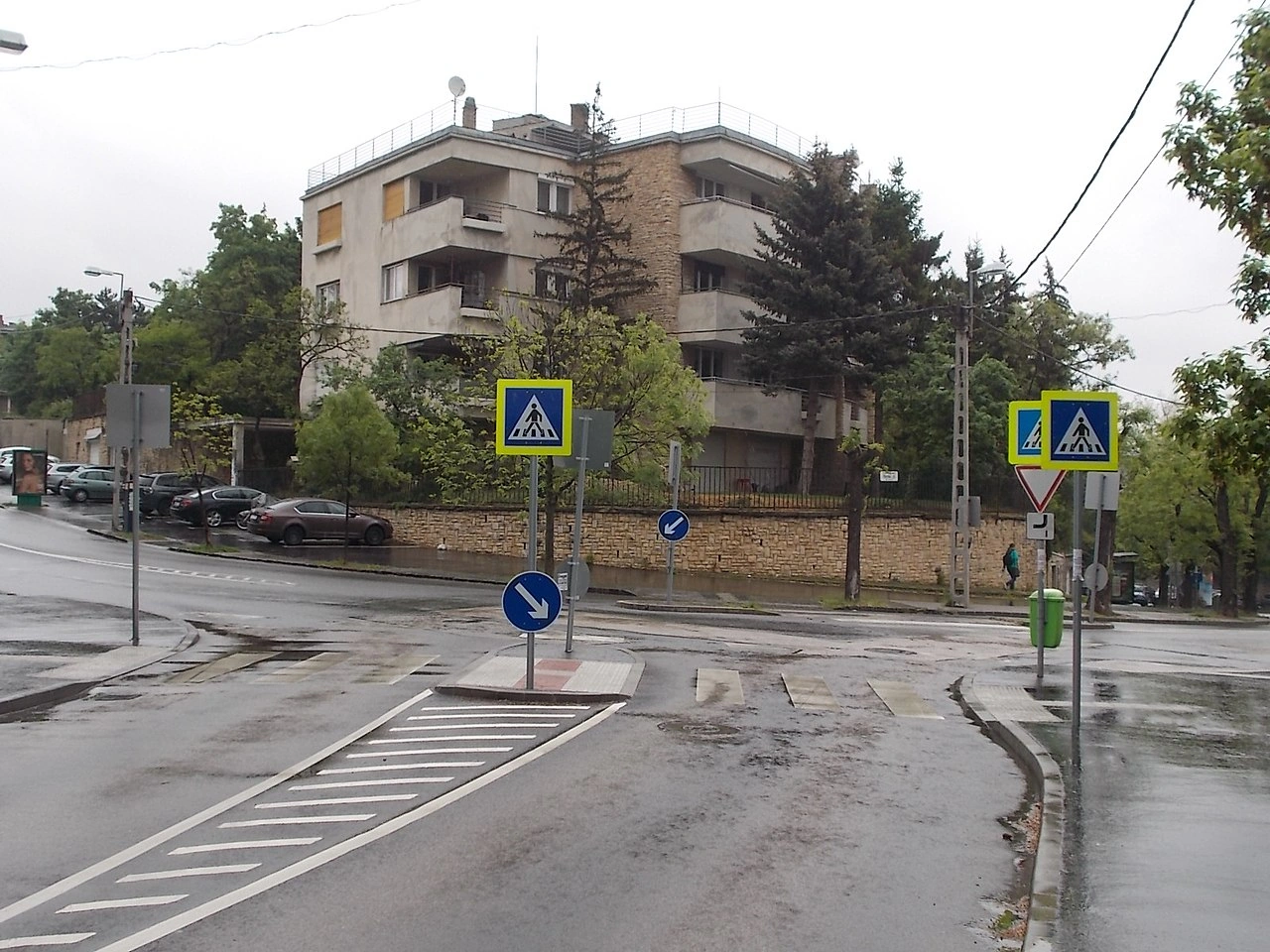
A pedestrian crossing is a designated place where pedestrians may cross a road. It is commonly indicated by road markings, traffic signs, signals or a combination of these measures.
Drivers must approach with appropriate caution and give way when required by local law. Pedestrians must also observe approaching traffic and follow any pedestrian signals or instructions from authorised traffic controllers.
Wikimedia.org • Globetrotter19 • CC BY-SA
When must drivers give way at a pedestrian crossing in Hungary?
Give way to pedestrians crossing at a designated pedestrian crossing. Approach with particular care and slowly enough to stop before it if necessary. At a junction, turning drivers must also give way to pedestrians crossing the road they are entering, even where no pedestrian crossing is marked. Follow any applicable traffic controls.
🔗 njt.jog.gov.hu • Hungary, National Legislation Database, KRESZ, edition 11 April 2026
Are all pedestrian crossings controlled the same way in Hungary?
No. Where pedestrian signals are provided, steady green permits crossing, flashing green means pedestrians must not start crossing, and red prohibits entry. Drivers follow their signals and must give way when turning across pedestrians crossing with permission. At an uncontrolled marked crossing, pedestrian priority and the careful-approach rules apply.
🔗 njt.jog.gov.hu • Hungary, National Legislation Database, KRESZ, edition 11 April 2026
May I enter a pedestrian crossing if the road beyond it is blocked in Hungary?
Wait before the crossing until you can clear it without obstructing pedestrians. If a vehicle is stopped before a designated pedestrian crossing, including because of traffic, stop before passing it. Continue only after checking that you can do so without infringing pedestrian priority.
🔗 njt.jog.gov.hu • Hungary, National Legislation Database, KRESZ, edition 11 April 2026
Must Hungarian pedestrians use a nearby marked crossing?
Yes. Section 21 requires using a designated pedestrian crossing when one is nearby.
🔗 njt.jog.gov.hu • Hungary, National Legislation Database, KRESZ, edition 11 April 2026
Where may Hungarian pedestrians cross an urban main road without a nearby marked crossing?
At a junction along the pavement’s continuation, or between a public-transport stop island and the nearer pavement along the island’s length.
🔗 njt.jog.gov.hu • Hungary, National Legislation Database, KRESZ, edition 11 April 2026
May Hungarian pedestrians cross at road level beside a nearby pedestrian underpass or footbridge?
No. Section 21 prohibits crossing the carriageway where such a facility is nearby.
🔗 njt.jog.gov.hu • Hungary, National Legislation Database, KRESZ, edition 11 April 2026
May Hungarian pedestrians duck under a roadside chain to cross?
No. Do not open, climb over, duck under or go around barriers to enter the closed area.
🔗 njt.jog.gov.hu • Hungary, National Legislation Database, KRESZ, edition 11 April 2026
Do Hungarian pedestrians retain crossing priority over emergency vehicles using special warning signals?
No, even at designated crossings and junctions where pedestrians would normally have priority.
🔗 njt.jog.gov.hu • Hungary, National Legislation Database, KRESZ, edition 11 April 2026
May Hungarian pedestrians step out beside a large parked vehicle where they lack priority?
No, if it or another obstacle blocks a clear view.
🔗 njt.jog.gov.hu • Hungary, National Legislation Database, KRESZ, edition 11 April 2026
19. Railway crossing
A railway crossing, also called a level crossing or railroad crossing, is a place where a road or path crosses railway tracks at the same level. It may be protected by barriers, warning lights, bells, traffic signs or a combination of these measures.
Road users must approach carefully and never enter when a train is approaching, warning signals are active or the exit is blocked. They should cross promptly and must never stop, wait or become trapped on the tracks.
Wikimedia.org • Globetrotter19 • CC BY-SA
When must drivers stop at a railway level crossing in Hungary?
Stop before the railway crossing sign or marked stopping place if a train approaches, barriers are not fully open or are moving, red lights or the warning bell operate, railway staff signal stop, a STOP sign is present, or you cannot cross continuously. A light-protected crossing also requires a stop if its flashing white signal is absent. After a failure, proceed only under the special visibility or railway-guard conditions in section 39(6).
🔗 njt.jog.gov.hu • Hungary, National Legislation Database, KRESZ, edition 11 April 2026
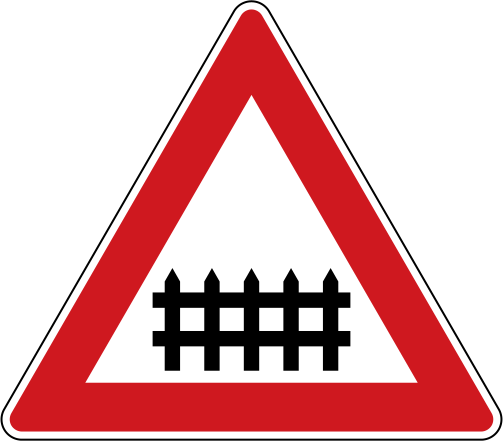 Warning for a railway crossing with barriers.
English • Traffic sign figure 92 • Level crossing with barriers. There is a railway crossing protected by full or half barriers. The supplementary plate referred to in point v), placed below the sign, indicates if it is also protected by light signals.
Magyar • 92. ábra • Sorompóval biztosított vasúti átjáró. Az úton teljes, vagy félsorompóval biztosított vasúti átjáró van; a jelzőtábla alatt elhelyezett – a v) pontban említett – kiegészítő tábla jelzi, ha az átjárót fénysorompó is biztosítja.
Sources
🔗 Commons.wikimedia.org
🔗 Njt.jog.gov.hu • 1/1975. (II. 5.) KPM–BM együttes rendelet (KRESZ) • 16(1)x • 92. ábra
Replacement SVG: Commons.wikimedia.org • Wikimedia Commons original • Government of the Czech Republic • Public domain • Original revision 2013-12-06. Wikimedia original unmodified.
Image via Commons.wikimedia.org
Government of the Czech Republic • Public domain • Source revision 2013-12-06. Wikimedia original unmodified.
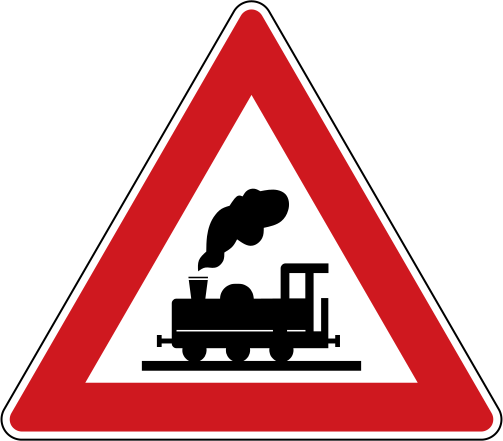 Warning for a railway crossing without barriers.
English • Traffic sign figure 90 • Level crossing without barriers. There is a railway crossing without full or half barriers. A supplementary plate below the sign indicates if it is protected by light signals (figure 91).
Magyar • 90. ábra • Sorompó nélküli vasúti átjáró. Az úton olyan vasúti átjáró van, amelynél teljes vagy félsorompó felszerelve nincs; a jelzőtábla alatt kiegészítő tábla jelzi, ha az átjárót fénysorompó biztosítja (91. ábra).
Sources
🔗 Commons.wikimedia.org
🔗 Njt.jog.gov.hu • 1/1975. (II. 5.) KPM–BM együttes rendelet (KRESZ) • 16(1)v • 90. ábra
Replacement SVG: Commons.wikimedia.org • Wikimedia Commons original • Government of the Czech Republic • Public domain • Original revision 2013-12-06. Wikimedia original unmodified.
Image via Commons.wikimedia.org
Government of the Czech Republic • Public domain • Source revision 2013-12-06. Wikimedia original unmodified.
 Warning for a railway crossing with one track.
English • Traffic sign figure 98 • Beginning of a level crossing. The sign marks the beginning of a railway crossing. Section 39 of the KRESZ governs approaching and crossing it.
Magyar • 98. ábra • Vasúti átjáró kezdete. A tábla a vasúti átjáró kezdetét jelzi. Az átjáró megközelítésére és az áthaladásra a KRESZ 39. §-a irányadó.
Sources
🔗 Commons.wikimedia.org
🔗 Njt.jog.gov.hu • 1/1975. (II. 5.) KPM–BM együttes rendelet (KRESZ) • 16(4)a • 98. ábra
Replacement SVG: Commons.wikimedia.org • Wikimedia Commons original • 3247 • Public domain • Original revision 2006-08-27. Wikimedia original unmodified.
Image via Commons.wikimedia.org
3247 • Public domain • Source revision 2006-08-27. Wikimedia original unmodified.
 Warning for a railway crossing with two or more tracks.
English • Traffic sign figure 99/a • Beginning of a level crossing with two or more tracks. The sign marks the beginning of a railway crossing with two or more tracks. Section 39 of the KRESZ governs approaching and crossing it.
Magyar • 99/a. ábra • Két- vagy több vágányú vasúti átjáró kezdete. A tábla két- vagy több vágányú vasúti átjáró kezdetét jelzi. Az átjáró megközelítésére és az áthaladásra a KRESZ 39. §-a irányadó.
Sources
🔗 Commons.wikimedia.org
🔗 Njt.jog.gov.hu • 1/1975. (II. 5.) KPM–BM együttes rendelet (KRESZ) • 16(4)a • 99/a. ábra
Replacement SVG: Commons.wikimedia.org • Wikimedia Commons original • Ministerstvo dopravy a spojů České republiky • Public domain • Original revision 2011-10-25. Wikimedia original unmodified.
Image via Commons.wikimedia.org
Ministerstvo dopravy a spojů České republiky • Public domain • Source revision 2011-10-25. Wikimedia original unmodified.
Must I stop at every unguarded railway crossing in Hungary?
The absence of barriers does not itself require a stop at every crossing. Before entering an unprotected crossing, check that no rail vehicle is approaching from either direction and that you can cross continuously without stopping. Stop whenever a STOP sign, approaching train, warning or another condition in section 39 requires it.
🔗 njt.jog.gov.hu • Hungary, National Legislation Database, KRESZ, edition 11 April 2026
What if road traffic is queued beyond a railway crossing in Hungary?
Wait before the tracks until there is room to take your entire vehicle off the crossing. Do not follow another vehicle onto the tracks without checking the exit. Keep the tracks clear even if no train is visible.
🔗 njt.jog.gov.hu • Hungary, National Legislation Database, KRESZ, edition 11 April 2026
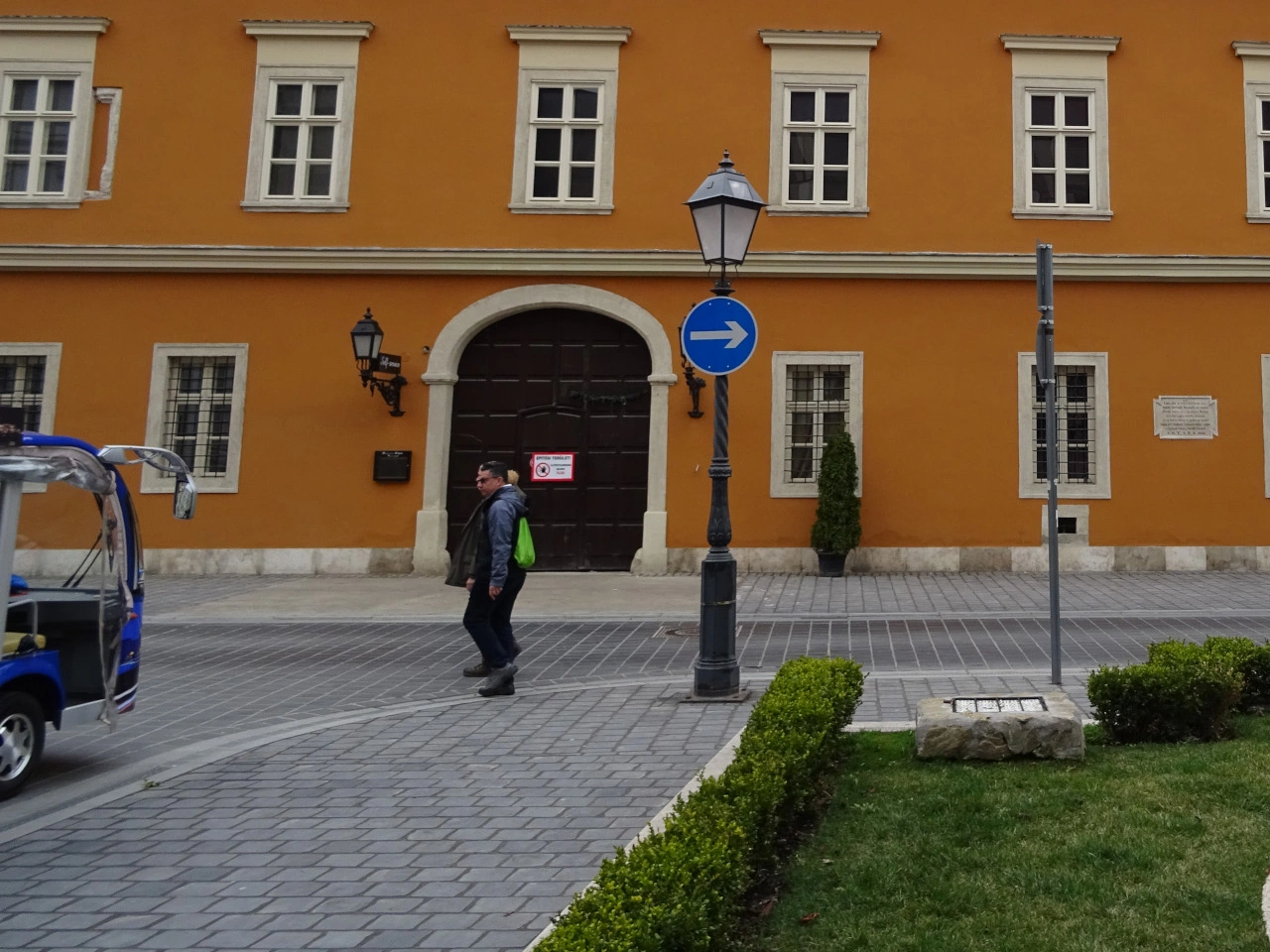
20. Mandatory direction
A mandatory-direction sign requires drivers to travel only in the direction or one of the directions indicated by its arrow or arrows. It may require traffic to continue straight ahead, turn, or pass an obstacle on a specified side.
The sign does not itself determine priority or speed. Drivers must still use the appropriate lane, signal when required and give way according to local traffic signs and regulations.
Wikimedia.org • Spudgun67 • CC BY-SA
What does a mandatory-direction sign require in Hungary?
At the controlled junction, follow one of the directions shown by the compulsory-direction arrows. A supplementary bus or bicycle panel may permit a different indicated direction for those users. A compulsory direction does not give priority over other road users.
Can I choose another turn if the mandatory-direction arrow is inconvenient in Hungary?
No, unless another applicable sign, lane instruction or authorised traffic direction lawfully permits it. Plan a permitted alternative route; do not make an abrupt or prohibited turn to reach your destination.
Does a mandatory-direction sign give me priority over pedestrians in Hungary?
No. The sign controls direction, not priority. In particular, a turning driver must give way to pedestrians crossing the carriageway of the road being entered, as well as cyclists and other road users where the applicable turning rules require.
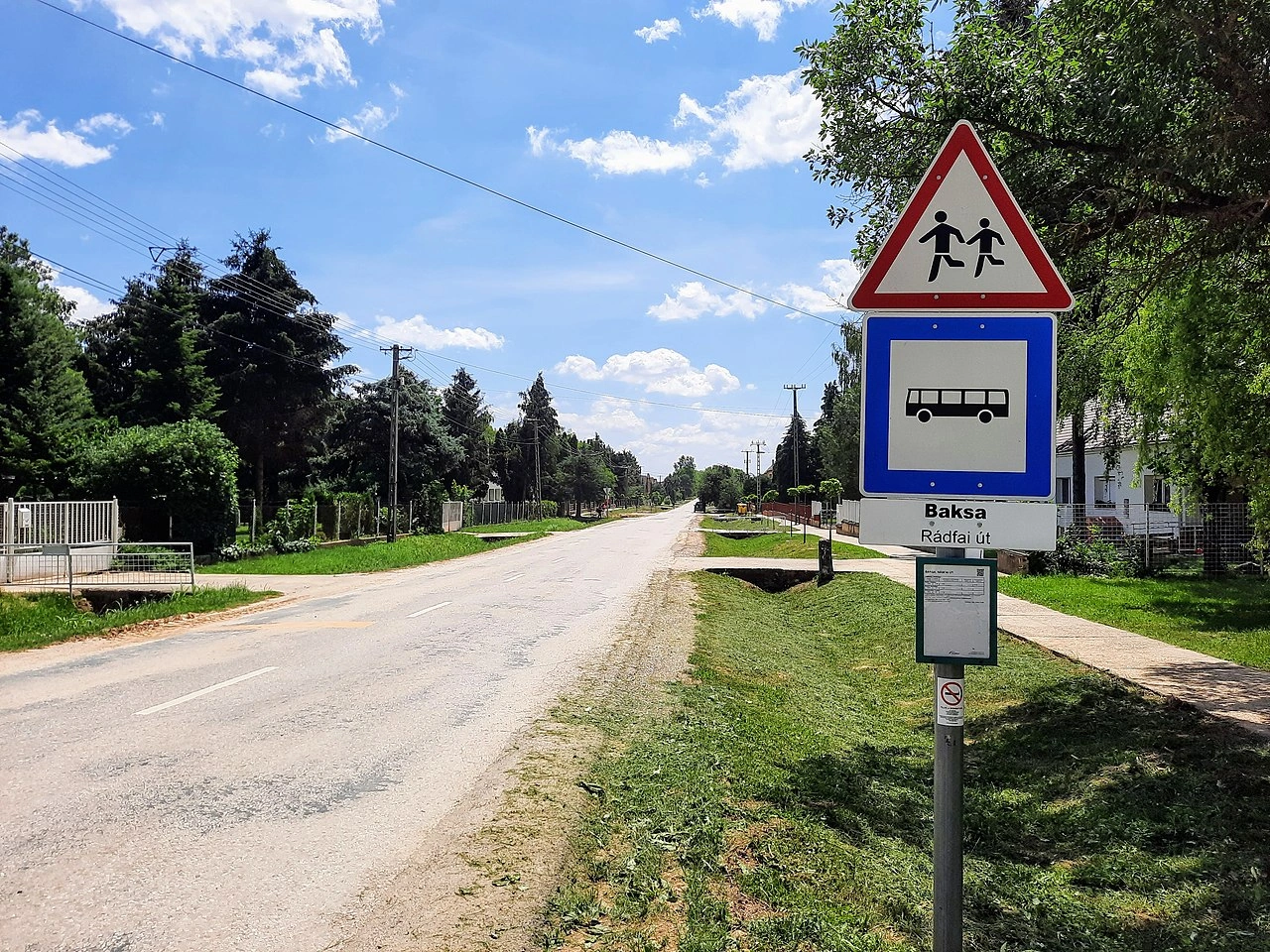
21. School area
A school area is a road or group of roads near a school where large numbers of children may walk, cycle, cross the road or enter and leave vehicles. It may be identified by warning signs, zone signs, road markings, traffic-calming measures or flashing lights.
Special speed limits, parking restrictions or access rules may apply permanently or only during school arrival and departure times. Drivers should reduce speed, watch carefully for children and be prepared to stop.
Wikimedia.org • Györkő Zsombor • CC BY-SA
What speed rules apply around schools in Hungary?
Read both warning signs and their panels. A children-warning sign with the prescribed supplementary length panel makes 30 km/h the maximum over that section unless other traffic signs indicate otherwise. A time panel may limit when that restriction applies. Always slow further when conditions require it.
🔗 njt.jog.gov.hu • Hungary: KRESZ sections 16(1)(q);26(4),(6);40;43
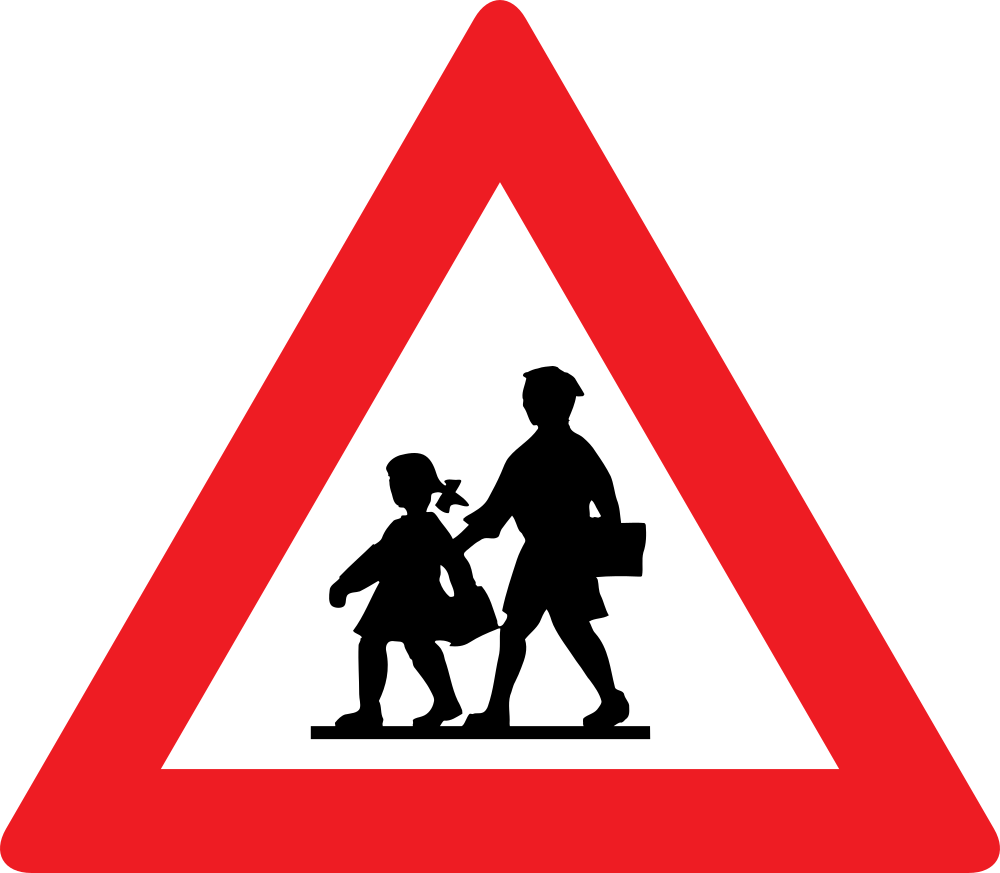 Warning for children.
English • Traffic sign figure 84 • Children. There is an increased likelihood of children entering the carriageway.
Magyar • 84. ábra • Gyermekek. A gyermekeknek az úttestre lépésével fokozottan számolni kell.
Sources
🔗 Commons.wikimedia.org
🔗 Njt.jog.gov.hu • 1/1975. (II. 5.) KPM–BM együttes rendelet (KRESZ) • 16(1)q • 84. ábra
Replacement SVG: Commons.wikimedia.org • Wikimedia Commons original • 3247 • Public domain • Original revision 2022-09-01. Wikimedia original unmodified.
Image via Commons.wikimedia.org
3247 • Public domain • Source revision 2022-09-01. Wikimedia original unmodified.
Does a school warning sign in Hungary automatically set the speed limit?
A children-warning sign alone warns of children. With the prescribed supplementary length panel, a specific rule limits speed on that section to 30 km/h unless another traffic sign indicates otherwise. The panel may also state the applicable times; read the whole sign combination.
🔗 njt.jog.gov.hu • Hungary: KRESZ sections 16(1)(q);26(4),(6);40;43
How should you pass a school entrance in Hungary?
Watch for children stepping out from between parked vehicles, obey crossings and any school patrol, and follow stopping or parking restrictions. Do not obstruct visibility near a crossing or school entrance; approach at a speed that permits a safe stop.
🔗 njt.jog.gov.hu • Hungary: KRESZ sections 16(1)(q);26(4),(6);40;43
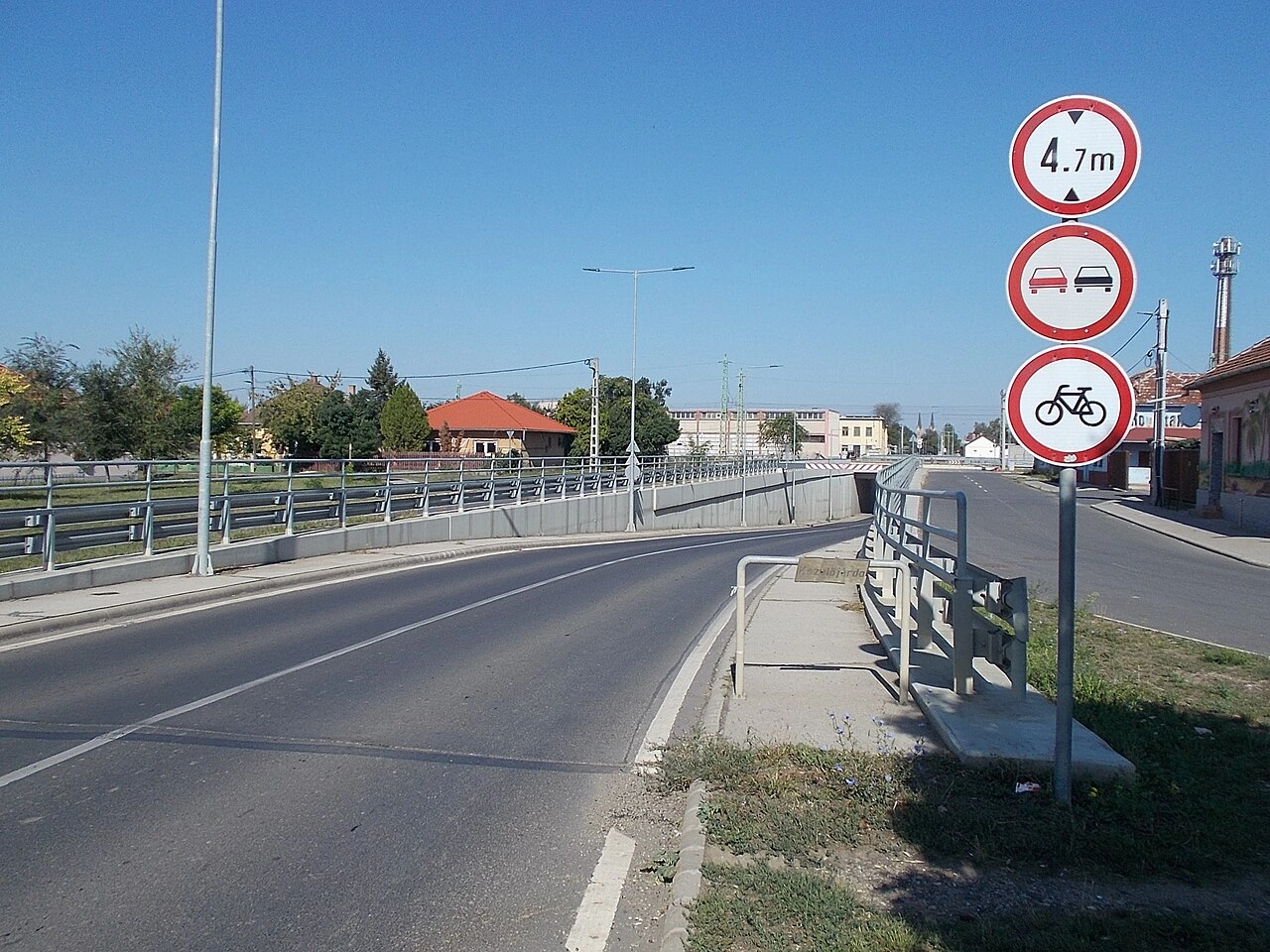
22. Overtaking
Overtaking is the act of passing another road user travelling in the same direction. It normally involves moving to another position or lane, passing the slower road user and returning to the appropriate position when it is safe.
Before overtaking, a driver should make sure there is sufficient visibility and space, check mirrors and blind spots, signal when required and ensure that no other road user is already overtaking. The manoeuvre must be completed without exceeding the speed limit or endangering other road users.
Wikimedia.org • Globetrotter19 • CC BY-SA
On which side do drivers normally overtake in Hungary?
As traffic normally keeps right, drivers ordinarily overtake on the left. This is the general rule, not permission to pass wherever a lane is available; exceptions and restrictions depend on the local law.
When should you avoid overtaking in Hungary?
Do not begin if approaching traffic, restricted visibility, road markings, an intersection, a crossing or another road user makes the manoeuvre unsafe or unlawful. Check behind and ahead, allow enough space and never exceed the speed limit to complete the pass.
What extra care is needed when overtaking slower road users in Hungary?
Give generous lateral clearance when passing cyclists and pedestrians, and allow for unexpected changes of direction. National rules may prescribe a minimum passing distance in particular situations. If there is insufficient space, wait rather than squeeze through.
23. Crossing animals
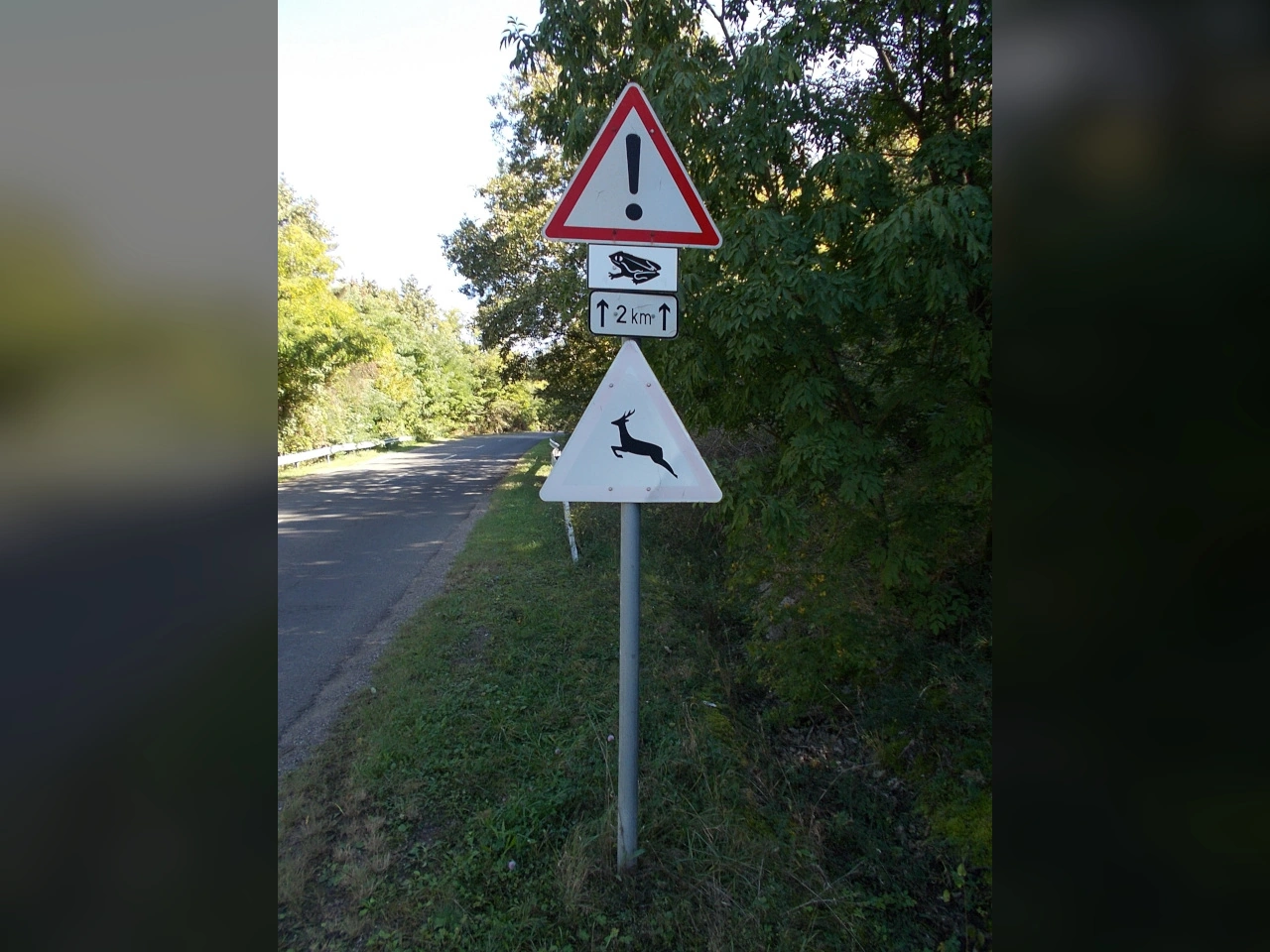
An animals-crossing warning indicates a place or road section where wild animals, livestock or ridden animals may enter or cross the road. Animals may appear suddenly, move unpredictably or be difficult to see in darkness, vegetation or poor weather.
Drivers should reduce speed, scan both sides of the road and remain prepared to stop. The warning sign does not itself give animals priority or impose a numerical speed limit, but drivers must avoid frightening, endangering or colliding with them.
Wikimedia.org • Globetrotter19 • CC BY-SA
Which animals might drivers encounter on roads in Hungary?
Watch for domestic or wild animals on the road. The animal-warning signs indicate a greater risk of their presence; check the road edges and any supplementary indication of the length of the hazardous section.
🔗 njt.jog.gov.hu • Hungary: KRESZ sections 16(1)(r),26-27,30
 Warning for cattle on the road.
English • Traffic sign figure 85 • Animals. There is an increased likelihood of domestic animals on the carriageway.
Magyar • 85. ábra • Állatok. Háziállatok megjelenésével fokozottan számolni kell az úttesten.
Sources
🔗 Commons.wikimedia.org
🔗 Njt.jog.gov.hu • 1/1975. (II. 5.) KPM–BM együttes rendelet (KRESZ) • 16(1)r • 85. ábra
Image via Commons.wikimedia.org
Rl91 • Public domain • Source revision 2012-07-17. Wikimedia original unmodified.
 Warning for crossing deer.
English • Traffic sign figure 86 • Animals. There is an increased likelihood of wild animals on the carriageway.
Magyar • 86. ábra • Állatok. Szabadon élő állatok megjelenésével fokozottan számolni kell az úttesten.
Sources
🔗 Commons.wikimedia.org
🔗 Njt.jog.gov.hu • 1/1975. (II. 5.) KPM–BM együttes rendelet (KRESZ) • 16(1)r • 86. ábra
Image via Commons.wikimedia.org
Rl91 • Public domain • Source revision 2012-07-17. Wikimedia original unmodified.
Does an animal-crossing warning sign in Hungary set a new speed limit?
A warning of animals is not, by itself, a numerical speed-limit sign. Continue to obey the applicable speed limit, but slow down whenever animals could enter the road or visibility is poor. A separate regulatory speed sign must also be obeyed.
🔗 njt.jog.gov.hu • Hungary: KRESZ sections 16(1)(r),26-27,30
What should you do if an animal enters the road in Hungary?
Brake as necessary while keeping control and checking the surrounding traffic. Avoid swerving into opposing traffic or off the road. Give livestock and ridden animals room, avoid unnecessary horn use, and watch for more animals following.
🔗 njt.jog.gov.hu • Hungary: KRESZ sections 16(1)(r),26-27,30
24. Slippery road
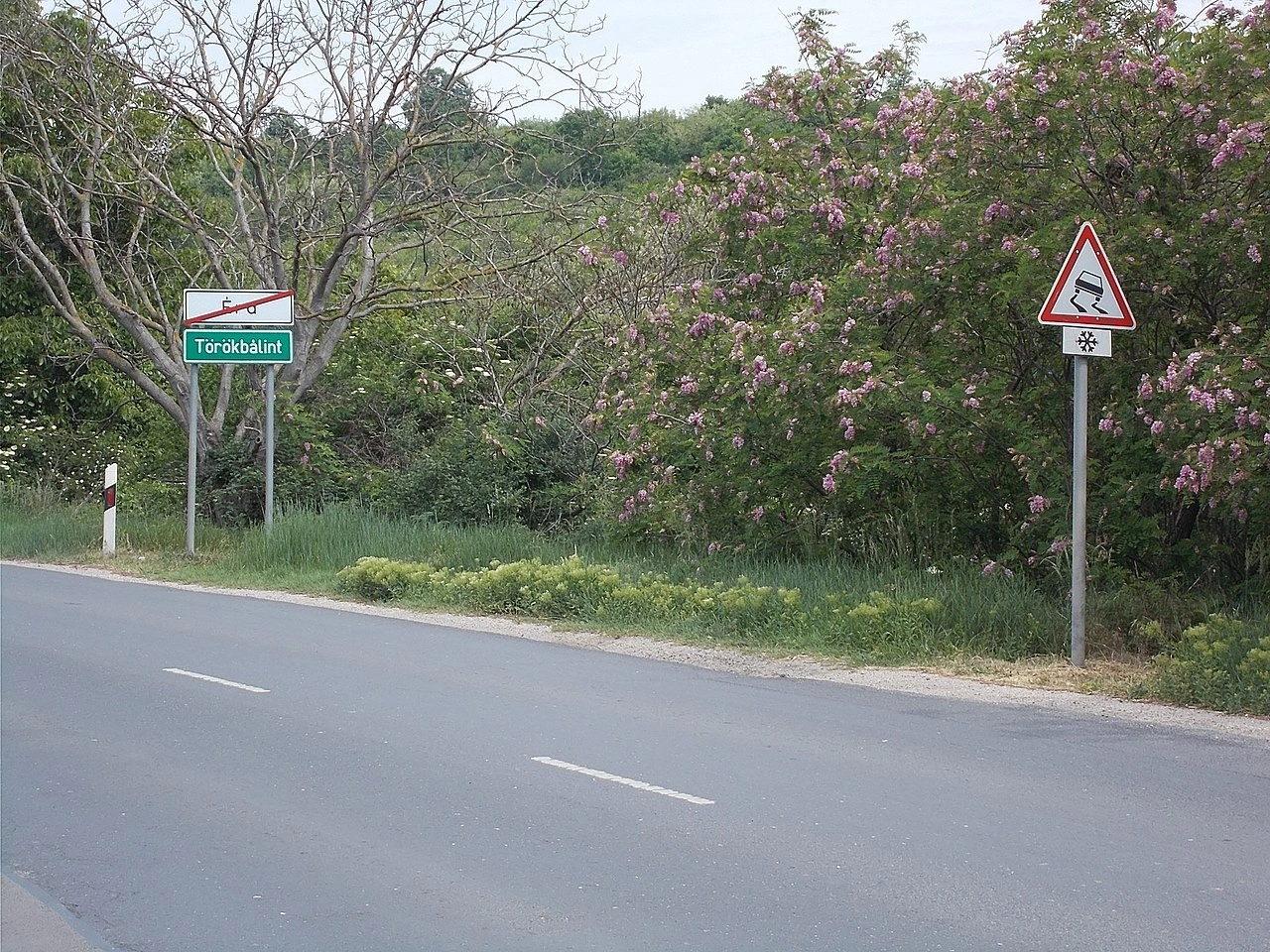
A slippery road has reduced tyre grip and can make steering, braking and acceleration less effective. Roads may become slippery because of rain, ice, snow, mud, oil, loose material or other substances on the surface. Drivers should reduce speed, increase their following distance and avoid sudden steering, braking or acceleration. Extra caution is needed in bends, on bridges and wherever the road surface changes unexpectedly.
Wikimedia.org • Globetrotter19 • CC BY-SA
What can make roads slippery in Hungary?
Rain, ice, snow, mud or other material can reduce grip. A surface can be slippery even when it looks clear, and grip can change within a short distance. Reduce speed and increase following distance for the actual conditions.
🔗 njt.jog.gov.hu • Hungary: KRESZ sections 16(1)(j),26(4),27
How should you drive on a slippery road in Hungary?
Reduce speed early, increase the gap to the vehicle ahead and use smooth steering, braking and acceleration. Do not rely on the posted maximum as a safe target when grip is poor.
🔗 njt.jog.gov.hu • Hungary: KRESZ sections 16(1)(j),26(4),27
Does a slippery-road warning sign in Hungary automatically impose a lower number?
The warning sign highlights a reduced-grip risk; it normally does not itself prescribe a new numerical speed limit. A separate speed-limit sign, temporary restriction or local condition may still apply. Travel below the legal maximum when necessary for safety.
🔗 njt.jog.gov.hu • Hungary: KRESZ sections 16(1)(j),26(4),27
 Warning for a slippery road surface.
English • Traffic sign figure 77 • Slippery carriageway. The carriageway may become very slippery.
Magyar • 77. ábra • Csúszós úttest. Az úttest erősen csúszóssá válhat.
Sources
🔗 Commons.wikimedia.org
🔗 Njt.jog.gov.hu • 1/1975. (II. 5.) KPM–BM együttes rendelet (KRESZ) • 16(1)j • 77. ábra
Image via Commons.wikimedia.org
Rl91 • Public domain • Source revision 2012-07-17. Wikimedia original unmodified.
25. Chevron
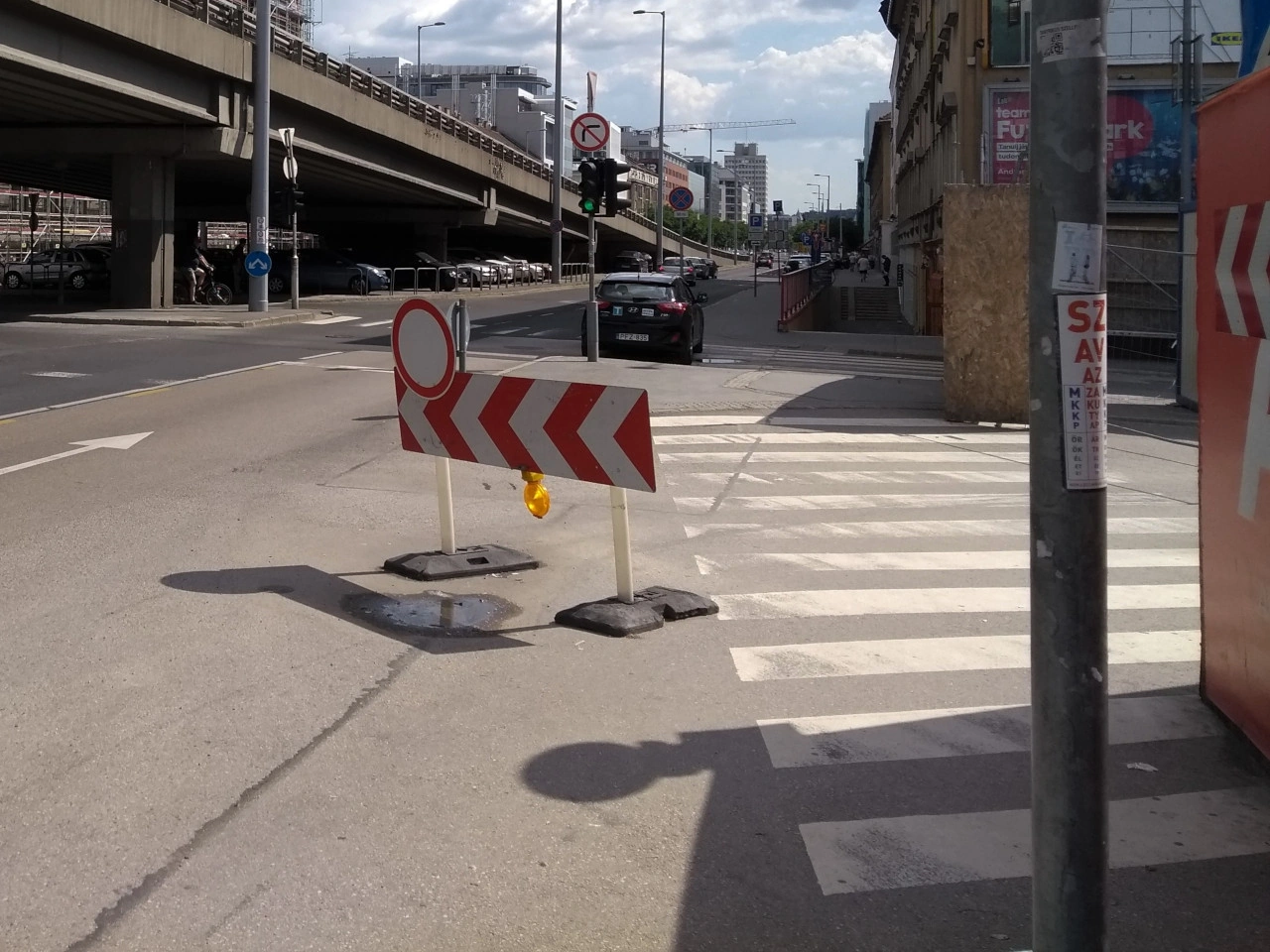
A chevron is a V-shaped or arrow-shaped road marker used to show a sharp change in the direction of a road. Chevron boards are normally placed along the outside of a curve so that their points indicate the direction in which the road continues.
Chevrons improve the visibility and alignment of a curve, especially in darkness or poor weather. They do not normally impose a speed limit or determine priority, so drivers must reduce speed before the curve and follow all other signs and road markings.
Wikimedia.org • Vauia Rex • CC BY-SA
What is the purpose of chevron boards on a road in Hungary?
Chevron alignment boards help drivers see which way a sharp bend continues, especially in darkness or poor visibility. Their precise shape and colour depend on the local sign system; pay attention to the alignment shown rather than assuming one universal design.
🔗 njt.jog.gov.hu • Hungary: GKM Decree 83/2004 Annex 20.4; KRESZ sections 3,13-14,16,26
Do chevron boards give priority or order a turn at junctions in Hungary?
Not ordinary curve-alignment chevrons. They guide you around a bend. Give-way, no-entry, keep-direction and other mandatory traffic signs must be read separately; similar-looking arrows can have different legal meanings.
🔗 njt.jog.gov.hu • Hungary: GKM Decree 83/2004 Annex 20.4; KRESZ sections 3,13-14,16,26
Is the speed shown by a chevron in Hungary a compulsory maximum?
A curve-alignment board alone does not set a numerical maximum speed. Obey any separate regulatory speed sign and reduce speed further for the bend, visibility and surface. The road maximum is not necessarily a safe speed through the curve.
🔗 njt.jog.gov.hu • Hungary: GKM Decree 83/2004 Annex 20.4; KRESZ sections 3,13-14,16,26