
Traffic rulesUnited States
Learn the traffic rules of United States with lots of pictures, clear traffic signs and interactive quizzes. Simple, visual and easy to follow.




Driving licence basics in the United States of America
Who issues ordinary driver's licences in the United States?
Driver's licences are issued by the individual states, the District of Columbia and U.S. territories rather than by one national licensing authority.
Is there one federal licence for driving an ordinary private car?
No. The federal government does not issue a general private-car licence; applicants must use the licensing agency for the state or territory where they live.
What is the state licensing agency usually called?
The name varies. It may be called the Department of Motor Vehicles, Bureau of Motor Vehicles, Motor Vehicle Administration, Department of Licensing, Department of Public Safety or another state-specific name.
Where can an applicant find the correct state licensing authority?
USAGov provides an official directory linking to the motor-vehicle agency for every state, the District of Columbia and participating U.S. territories.
Can a licence issued by one state normally be used in another state?
Yes. A valid state driver's licence normally authorises the holder to drive throughout the United States, subject to the licence restrictions and the traffic laws of the state being visited.
Do driving-licence rules remain identical throughout the country?
No. Minimum ages, documents, fees, test procedures, licence classes, renewal periods and restrictions can differ substantially between states and territories.
Is a state identification card the same as a driver's licence?
No. A state identification card can establish identity but does not grant permission to operate a motor vehicle.
Does a driver's licence also serve as identification?
Yes, it is commonly accepted as government-issued photo identification, although a non-REAL-ID card is not accepted for every federal purpose.
Are vehicle registration and driver licensing the same process?
No. A driver's licence authorises a person to drive, while registration identifies a vehicle. Insurance, inspection and registration requirements are handled separately.
Should applicants study a national driving manual?
Applicants should study the official driver's manual published by their own state or territory because the knowledge test is based on that jurisdiction's rules and signs.
Why does this FAQ repeatedly refer applicants to their state agency?
The United States has no single ordinary-licence procedure. State guidance is the controlling source for exact ages, documents, appointments, tests, fees and deadlines.
Licence classes, endorsements and vehicle permissions
Do all states use the same non-commercial licence classes?
No. Class names and the vehicles covered by an ordinary non-commercial licence vary by state, even though a standard passenger-car licence is available everywhere.
What licence is normally used for an ordinary passenger car?
Most drivers obtain the state's standard non-commercial operator licence, but the class letter or title printed on the card depends on the issuing state.
Does an ordinary car licence automatically authorise motorcycle riding?
Usually not. States generally require a separate motorcycle licence, motorcycle endorsement or motorcycle-specific credential.
Is the motorcycle endorsement identical in every state?
No. Minimum ages, permit stages, training-course waivers, tests and endorsement codes are established by each state.
Can a standard car licence be used for a moped or motor scooter?
That depends on the engine size, maximum speed and state definition. Some vehicles require a motorcycle credential, while others may be covered by a special permit or ordinary licence.
Does an ordinary licence always cover a large recreational vehicle?
Not always. Some states require a non-commercial higher class, endorsement or additional test for an RV above specified weight, length or braking thresholds.
Can a driver tow any trailer with a standard licence?
No universal rule applies. A state may require an additional class or endorsement when a trailer or combination exceeds specified weight or size limits.
Is a special credential required to drive a taxi or limousine?
It may be. State or local rules can require a chauffeur licence, for-hire endorsement, background check or separate operating permit in addition to an ordinary licence.
Does driving for a rideshare service change the licence class?
A standard licence is often sufficient for the driver, but state law, local regulation, insurance rules and platform requirements must also be satisfied.
Can a private-car licence be used to drive a school bus?
No. A school bus normally requires the appropriate commercial driver's licence, passenger and school-bus endorsements, and additional state qualification requirements.
Are farm vehicles always exempt from special licensing?
No. Federal and state exemptions may apply to limited farm operations, but their scope, distance limits and vehicle conditions must be checked carefully.
May a state place restriction codes on a licence?
Yes. Common restrictions concern corrective lenses, adaptive equipment, daylight driving, automatic transmission, geographic limits or other conditions needed for safe driving.
Are endorsements printed or encoded on the licence?
Yes. When a state grants an additional vehicle privilege, the endorsement or class is recorded on the driver's credential and licensing record.
Are commercial licence classes standardised nationally?
Yes. Federal standards establish commercial Class A, Class B and Class C definitions, although states issue the actual commercial credentials.
Should a driver rely only on the class letter shown by another state?
No. Non-commercial class letters do not always mean the same thing across states, so the issuing state's description should be checked.
Minimum ages, residency and application documents
Is there one national minimum age for a learner permit?
No. The entry age for a learner permit is set by each state and can vary considerably.
Is there one national age for an unrestricted private-car licence?
No. States use different minimum ages and graduated-licensing schedules before a young driver receives full privileges.
Must an adult applicant always obtain a learner permit first?
Many states require an adult first-time driver to obtain a permit before practising or taking the road test, but the exact procedure and holding period vary.
Must an applicant apply in the state where they live?
Ordinary licences are generally issued by the applicant's state of residence, and proof of state residency is normally required.
What identity documents are commonly requested?
States commonly request evidence of identity and date of birth, such as a passport, birth certificate or other document accepted by that state's licensing agency.
Is proof of residential address normally required?
Yes. Applicants are commonly asked for one or more documents showing their current address, but accepted documents and the required number vary by state.
Is a Social Security number always required?
States commonly request a Social Security number or evidence that the applicant is not eligible for one, but applicants must follow the exact rule published by their state.
Do immigration-status requirements differ between states?
Yes. Eligibility and documentary requirements for non-citizens are governed by state law together with applicable federal identity rules, so the state agency must be consulted.
Is parental or guardian consent required for a minor?
Usually, but the age threshold, signature procedure and financial-responsibility provisions vary by state.
What documents are needed after a legal name change?
The applicant normally must present the legal document supporting the change and update other identity records as required before or during the licence transaction.
Learner permits, driver education and supervised practice
What is a learner permit?
A learner permit allows a new driver to practise under specified supervision and restrictions before qualifying for an independent licence.
Must a permit holder be accompanied by a licensed driver?
Yes in ordinary circumstances. The required supervisor's minimum age, licence history, seating position and relationship to the learner are set by state law.
How long must a learner permit be held?
The minimum holding period differs by state and often depends on the learner's age.
Are supervised driving hours required?
Most graduated-licensing systems require young applicants to complete and document supervised practice, but the number and required night hours vary.
Is formal driver education mandatory for teenagers?
Many states require or strongly integrate approved driver education for younger applicants, while others use age-based alternatives or different training requirements.
Must an adult complete a driver-education course?
Some states require a course for certain adult first-time applicants, while others allow adults to prepare independently.
Can an online driver-education course be used?
Only when the state recognises the provider and delivery method. Applicants should verify approval before paying for a course.
May a learner drive alone for a short journey?
No. A permit does not normally authorise unsupervised driving unless a state has issued a separate restricted privilege under specific conditions.
Do learner permits include night-time or passenger restrictions?
They may. Permit restrictions are established by the issuing state and can be stricter for younger drivers.
Must the practice vehicle be registered and insured?
Yes. The vehicle used on public roads must satisfy the state's registration, insurance and equipment requirements.
Does the learner need to be covered by insurance?
Insurance rules differ, but the vehicle owner and learner should confirm coverage with the insurer before practice begins.
Is a learner permit automatically valid in every other state?
Not necessarily. Recognition of an out-of-state learner permit and its restrictions depends on the law of the state being visited.
Knowledge tests, vision screening and test preparation
Must a first-time applicant pass a knowledge test?
Usually. States generally test traffic laws, road signs, safe-driving practices and responsibilities before issuing a permit or licence.
Is there one national knowledge-test question bank?
No. Each state creates or approves its own test based primarily on its official driver's manual.
How many questions are on the knowledge test?
The number of questions and permitted errors vary by state and sometimes by licence type or applicant age.
Is the passing score the same throughout the United States?
No. Each licensing authority sets its own passing standard.
Can the knowledge test be taken online?
Some states offer approved online testing for eligible applicants, while others require testing at a licensing office or authorised location.
Are knowledge tests available in languages other than English?
Many states provide additional languages, audio options or approved assistance, but availability and interpreter rules vary.
What should an applicant study before the test?
The current official state driver's manual, state practice materials and any separate motorcycle or commercial manual required for the requested credential.
Must applicants identify road signs during the test?
Road-sign recognition is commonly included, but the test structure is determined by the state.
Is vision screening normally required?
Yes. States generally screen vision when issuing an initial licence and may screen again at renewal or after a medical review.
What happens if an applicant needs glasses or contact lenses?
The person may qualify with a corrective-lenses restriction requiring those lenses whenever they drive.
Can a failed knowledge test be retaken immediately?
Retest waiting periods, attempt limits and additional fees vary by state.
Are appointments required for testing?
Some agencies require appointments, others accept walk-ins, and many use a mixture of both depending on the service and office.
Road tests and completing the licensing process
Must a new driver pass a road test?
Normally yes, unless a state authorises a specific waiver, reciprocity arrangement or approved-course exemption.
Who conducts the road test?
It may be conducted by a state examiner or, where state law permits, an authorised third-party tester or approved driver-training provider.
Must the applicant provide the test vehicle?
In many states the applicant supplies a suitable vehicle, but local procedures and commercial test arrangements vary.
Can a rental car be used for a road test?
Only if the state accepts it and the rental agreement authorises the use. Some rental companies prohibit road-test use.
What documents are needed for the test vehicle?
The examiner commonly checks current registration and proof of required insurance, subject to state rules.
Does the vehicle receive a safety check before the test?
Yes in many jurisdictions. Defective lights, signals, tyres, brakes, seat belts or other required equipment can cause cancellation.
Must a licensed driver accompany the applicant to the test site?
When the applicant cannot yet drive independently, a properly licensed accompanying driver is normally required.
What skills are commonly assessed on the road test?
Examiners typically assess observation, vehicle control, signalling, lane position, intersections, turns, right-of-way decisions, speed management and safe interaction with traffic.
Is parallel parking tested in every state?
No. Parking and manoeuvring exercises differ by state and may also depend on the test location.
Does every road test include motorway or freeway driving?
No. Test routes and road types vary, and many tests are conducted entirely on local roads.
Can an examiner end the test early?
Yes. Dangerous conduct, a serious traffic violation, examiner intervention or an unsafe vehicle can result in immediate failure or termination.
What happens after a failed road test?
The applicant must follow the state's retest rules, which may include a waiting period, appointment, fee or additional practice.
Can a successful applicant drive before the plastic card arrives?
Many states issue an interim paper credential or receipt, but its driving and identification uses must be checked on the document and state website.
How is the physical licence normally delivered?
Depending on the state, it may be issued at the office or mailed after the applicant's photograph, signature and records have been processed.
Graduated driver licensing and novice-driver restrictions
What is graduated driver licensing?
Graduated driver licensing, or GDL, introduces young drivers through stages with increasing privileges as they gain supervised and lower-risk experience.
Do all states use a graduated system for teenagers?
Yes. All 50 states and the District of Columbia have a three-stage GDL system, although the ages and restrictions differ.
What are the usual three GDL stages?
They are generally a supervised learner stage, an intermediate or provisional stage with restrictions, and a full-privilege stage.
Does GDL apply to every first-time adult driver?
Usually it is age-based and aimed primarily at teenagers, but some states impose permit or provisional requirements on older first-time applicants as well.
Are novice drivers commonly restricted at night?
Yes. Intermediate licences commonly prohibit or limit late-night driving, with state-specific hours and exceptions.
Are young drivers restricted from carrying passengers?
Many states limit young passengers during the intermediate stage, but the number, ages and family exceptions vary.
Do phone restrictions apply to novice drivers?
Many states prohibit all handheld or wireless-device use by permit and provisional drivers, even where adult rules are less restrictive.
Can work or school travel be exempt from a night restriction?
Some states provide limited exceptions for employment, education, medical necessity, religious activity or emergencies, often requiring documentation.
Can traffic violations delay full driving privileges?
Yes. Convictions, crashes or GDL violations can extend a restricted stage, trigger suspension or require additional conditions.
Must a parent certify supervised driving practice?
Many states require a parent, guardian or qualified adult to certify that a young applicant completed the required practice hours.
Does turning 18 automatically erase every restriction?
Not always. The effect of reaching a particular age depends on the issuing state's law and the driver's current licence status.
What happens when a provisional driver moves to another state?
The new state decides how prior permits, training and restricted-licence experience are credited, so the driver should contact the new agency promptly.
Licence validity, renewal, replacement and REAL ID
How long is a U.S. driver's licence valid?
There is no national validity period. Expiration cycles differ by state, age, immigration-document duration and licence type.
Can a licence normally be renewed online?
Many states allow online renewal for eligible drivers, while others require in-person renewal at specified intervals or in particular circumstances.
Are mail renewals available?
Some states offer renewal by mail to eligible residents, military personnel or people temporarily outside the state.
Is a vision test required at every renewal?
Not everywhere. Renewal vision-screening rules and acceptable reports from eye-care professionals vary by state and age.
Do older drivers face different renewal rules?
Some states use shorter renewal periods, more frequent in-person visits or additional vision requirements above a specified age; there is no federal maximum driving age.
Must a driver report an address change?
Yes. States require licence-record updates, but the deadline and whether a replacement card is required vary.
How is a lost, stolen or damaged licence replaced?
The holder should use the issuing state's duplicate-licence procedure, which may be available online, by mail or in person.
How is a name changed on a driver's licence?
The driver normally presents the legal name-change document and follows any required sequence for updating federal and state identity records.
Can military personnel or residents abroad receive an extension?
Some states offer extensions, remote renewal or special procedures, but eligibility and documentation are state-specific.
What is a REAL ID-compliant driver's licence?
It is a state-issued licence that meets federal REAL ID security standards and can be used for specified federal identification purposes.
Is REAL ID required merely to drive a car?
No. A state may still issue a non-REAL-ID driver's licence, and that licence can remain valid for driving even though it is not accepted for certain federal purposes.
When did federal REAL ID enforcement begin for domestic air travel?
Federal enforcement began on 7 May 2025 for travellers aged 18 or older using a state licence or identification card at airport security and certain federal facilities.
Can a person fly domestically without a REAL ID licence?
Yes. A valid passport or another identification document accepted by the Transportation Security Administration can be used instead.
Foreign licences, visitors and moving between states
Can a foreign visitor drive in the United States with a home-country licence?
Often yes for a limited visit, but recognition, duration and translation requirements are determined by each state.
May a state require an International Driving Permit from a visitor?
Yes. USAGov advises visitors to check every state they plan to drive in because some may require an IDP together with the foreign licence.
Does an IDP replace the visitor's national licence?
No. The visitor must carry the valid licence issued by the home country and any IDP that is required.
Can a foreign visitor obtain an IDP after arriving in the United States?
The United States does not issue IDPs to foreign visitors. The permit must be obtained from the authorised organisation in the country that issued the licence before travel.
Is a rental company required to accept every foreign licence?
No. Rental companies may impose their own age, licence-format, translation, payment and insurance conditions in addition to state law.
Can a permanent resident apply for a state driver's licence?
A non-citizen living in the United States may be eligible to apply in the state of residence, subject to that state's identity, residency and eligibility requirements.
Is a foreign licence automatically exchanged without tests?
No national exchange rule exists. A state may require knowledge, vision and road tests unless its law or a specific reciprocity arrangement provides otherwise.
How soon must a new resident obtain the new state's licence?
The deadline varies by state and may depend on when residency is established, employment begins or a vehicle is registered.
Must a person moving between states surrender the old licence?
The new state generally requires the prior state licence to be surrendered or invalidated when the replacement credential is issued.
Can someone keep active driver's licences from several states?
Drivers should not maintain multiple active state licences. They should transfer the credential to their current state of residence according to state law.
Does a new state automatically accept every restriction and endorsement?
The state reviews the prior record and determines which classes, endorsements, tests or restrictions apply under its own law.
Does a state-issued licence allow a resident to drive elsewhere in the country?
Yes. Once validly issued, a state driver's licence normally permits driving across the United States, subject to the vehicle privileges and restrictions shown on it.
International Driving Permits and driving outside the United States
What is an International Driving Permit?
An IDP is a standardised translation of identifying and licence information that can accompany a valid driver's licence when driving abroad.
Is an IDP a stand-alone international driver's licence?
No. It has no independent driving authority and must be carried with the valid U.S. driver's licence.
Which organisations are authorised to issue IDPs in the United States?
USAGov identifies the American Automobile Association and the American Automobile Touring Alliance as the two organisations authorised by the U.S. Department of State.
How long is a U.S.-issued IDP valid?
It is valid for one year and cannot be renewed; a new permit must be obtained when needed.
Does every country require a U.S. driver to carry an IDP?
No. Requirements are set by the destination country, so the traveller should check official destination information before departure.
Do U.S. citizens need an IDP to drive in Canada?
USAGov states that U.S. citizens visiting Canada do not need an IDP, although they must carry a valid driver's licence and meet all other requirements.
Do U.S. citizens need an IDP to drive in Mexico?
USAGov states that U.S. citizens visiting Mexico do not need an IDP, but Mexican vehicle, insurance and entry requirements still apply.
Should the national licence still be carried abroad?
Yes. The driver must carry both the U.S. licence and the IDP wherever the destination requires the permit.
Are websites selling digital international licences always legitimate?
No. USAGov warns that many unofficial international-licence or IDP websites are fraudulent or misleading.
Where should travellers verify the destination's licensing rules?
They should consult the U.S. Department of State destination page, the destination country's authorities and the rental company before driving.
Medical fitness, vision and restricted licences
Is there one federal medical standard for ordinary private drivers?
No. States establish the medical and functional fitness standards for non-commercial driver's licences.
Can a medical condition automatically end a person's right to drive?
Not necessarily. The licensing agency may request medical information, testing or review and can allow driving when the person can do so safely, sometimes with restrictions.
Who can initiate a medical review?
Depending on state law, a review may begin after a driver report, physician or family report, law-enforcement referral, crash, renewal observation or other safety concern.
Must physicians report medically unsafe drivers?
Reporting duties and legal protections differ by state; some reports are mandatory in defined circumstances and others are voluntary.
What restrictions can be used instead of full denial?
States may use corrective-lens, daylight-only, speed, geographic, vehicle-equipment or other restrictions tailored to the driver's abilities.
Can adaptive equipment be required?
Yes. A driver may be restricted to a vehicle fitted with hand controls, mirrors, steering aids, automatic transmission or other approved adaptations.
Can the agency require a new road or knowledge test?
Yes. A medical or competency review can include vision, knowledge, road, specialist or functional assessments under state procedures.
Is there a national age at which a licence is automatically withdrawn?
No. Age alone does not create a federal cutoff, although individual states may change renewal or testing procedures for older drivers.
Does a disability prevent someone from obtaining a licence?
No. A disability does not by itself disqualify an applicant; the decision concerns whether the person can meet the state's safe-driving standards, with reasonable adaptations where applicable.
Commercial driving, suspensions and reinstatement
What is a Commercial Driver's Licence?
A Commercial Driver's Licence, or CDL, is required for drivers of specified large, heavy, passenger-carrying or hazardous-material commercial motor vehicles.
Who issues CDLs in the United States?
States issue CDLs and commercial learner's permits under minimum standards established and overseen by the Federal Motor Carrier Safety Administration.
What are the three federal CDL classes?
Class A covers qualifying heavy combinations, Class B covers qualifying heavy single vehicles, and Class C covers certain passenger or hazardous-material vehicles that do not meet Class A or B definitions.
What endorsements can be added to a CDL?
Federal endorsement codes include double or triple trailers, passenger vehicles, tank vehicles, hazardous materials, school buses, and the combined tank and hazardous-material endorsement.
What is a commercial learner's permit?
A CLP authorises supervised practice in the relevant commercial vehicle with a properly qualified CDL holder, subject to federal and state conditions.
When is federal entry-level driver training required?
It applies to a first Class A or Class B CDL, a Class B-to-Class A upgrade, and first-time school-bus, passenger or hazardous-material endorsements, subject to the federal exceptions.
Must entry-level training come from an approved provider?
Yes. Training covered by the federal rule must be completed through a provider listed on FMCSA's Training Provider Registry.
Are commercial drivers subject to medical requirements?
Yes. Many commercial drivers must self-certify their operating category and maintain a valid Medical Examiner's Certificate, although exemptions and excepted operations exist.
How old must a driver be for interstate commercial driving?
A driver generally must be at least 21 to operate a commercial motor vehicle in interstate commerce; states may allow younger CDL holders to operate only within the state under state rules.
Can a person hold a CDL from more than one state?
No. A commercial driver must obtain the CDL through the home state and cannot hold licences from multiple states.
Can offences committed in a private car affect a CDL?
Yes. CDL holders are held to higher federal and state standards, and specified serious offences can disqualify commercial privileges even when committed in a non-commercial vehicle.
Are suspension and reinstatement rules identical nationwide?
No. Ordinary suspensions, point systems, fees, insurance filings, courses and reinstatement procedures are mainly state-specific, while CDL disqualifications also follow federal minimum standards.
Sources and methodology
Which source was used for state licensing authorities?
The official USAGov state motor-vehicle services directory was used to confirm that ordinary licensing is administered by state and territorial agencies and to direct readers to the controlling local authority.
Which source was used for graduated driver licensing?
The official NHTSA teen-driving guidance was used for the nationwide three-stage GDL framework and the warning that restrictions vary between states.
Which source was used for REAL ID?
The official USAGov REAL ID guidance was used for federal identification purposes, the 7 May 2025 enforcement date and alternative documents for domestic air travel.
Which source was used for foreign visitors and foreign licences?
The official USAGov non-citizen driving page was used for state-by-state recognition, IDP requirements and applications by permanent residents.
Which source was used for U.S. International Driving Permits?
The official USAGov international driving-permit page was used for authorised issuers, one-year validity, Canada and Mexico, and the requirement to carry the national licence.
Which sources were used for commercial licences?
The official FMCSA CDL programme and CDL application guidance were used for state issuance, classes, endorsements, testing and commercial learner permits.
Which sources were used for commercial training and medical fitness?
The official FMCSA entry-level driver-training guidance and FMCSA medical guidance were used for ELDT, provider registration, self-certification and medical certificates.
When was this FAQ last reviewed?
This English master was last reviewed on 4 August 2026. Because ordinary licensing is state-based, readers must verify current ages, tests, fees, documents, reciprocity, renewal rules and restrictions with the relevant state or territorial agency.

1. What does this traffic sign mean?
This traffic sign indicates a warning for a slippery road surface. The road ahead may provide reduced tire grip because of water, ice, mud, oil or another surface condition. Reduce speed and avoid sudden braking, acceleration or steering movements.
English • W8-5 • Slippery surface. Warns of a road surface that may be slippery. Reduce speed and avoid sudden manoeuvres.
Sources
🔗 Commons.wikimedia.org
🔗 Mutcd.fhwa.dot.gov • FHWA: MUTCD, 11th Edition with Revision1, PDF page215
SVG source: Federal Highway Administration • Public domain • Original revision 2024-05-23. Wikimedia original unmodified.
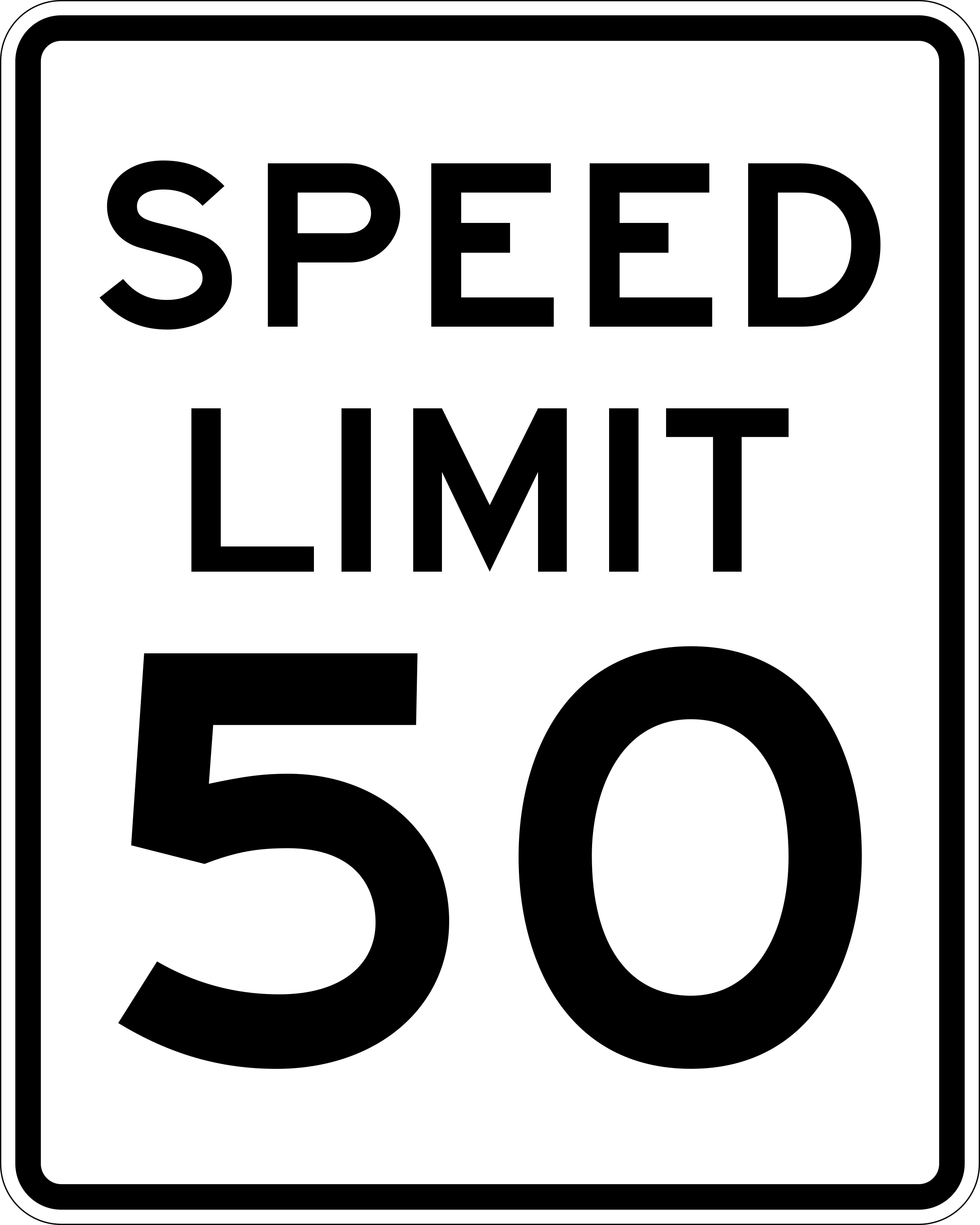
2. What does this traffic sign mean?
This traffic sign indicates the start of a speed limit. The displayed value is the maximum permitted speed from this point. The limit remains in force until it ends or is replaced according to the applicable traffic signs and local rules.
English • R2-1 • Speed limit. Sets a maximum speed of 50 mph, as shown in the illustration. Drive more slowly when conditions require it.
Sources
🔗 Commons.wikimedia.org
🔗 Mutcd.fhwa.dot.gov • FHWA: MUTCD, 11th Edition with Revision1, PDF page127
SVG source: Federal Highway Administration – United States Department of Transportation • Public domain • Original revision 2025-07-05. Wikimedia original unmodified.

3. What does this traffic sign mean?
This traffic sign indicates a warning for cattle. Cattle or other livestock may be crossing, walking along or standing near the road. Reduce speed, be prepared to stop and avoid sudden movements or unnecessary use of the horn that could startle the animals.
English • W11-4 • Cattle. Warns that cattle may enter or cross the road. Slow down and be prepared to stop.
Sources
🔗 Commons.wikimedia.org
🔗 Mutcd.fhwa.dot.gov • FHWA: MUTCD, 11th Edition with Revision1, PDF page234
SVG source: Author not stated on source page • Public domain • Original revision 2024-05-23. Wikimedia original unmodified.
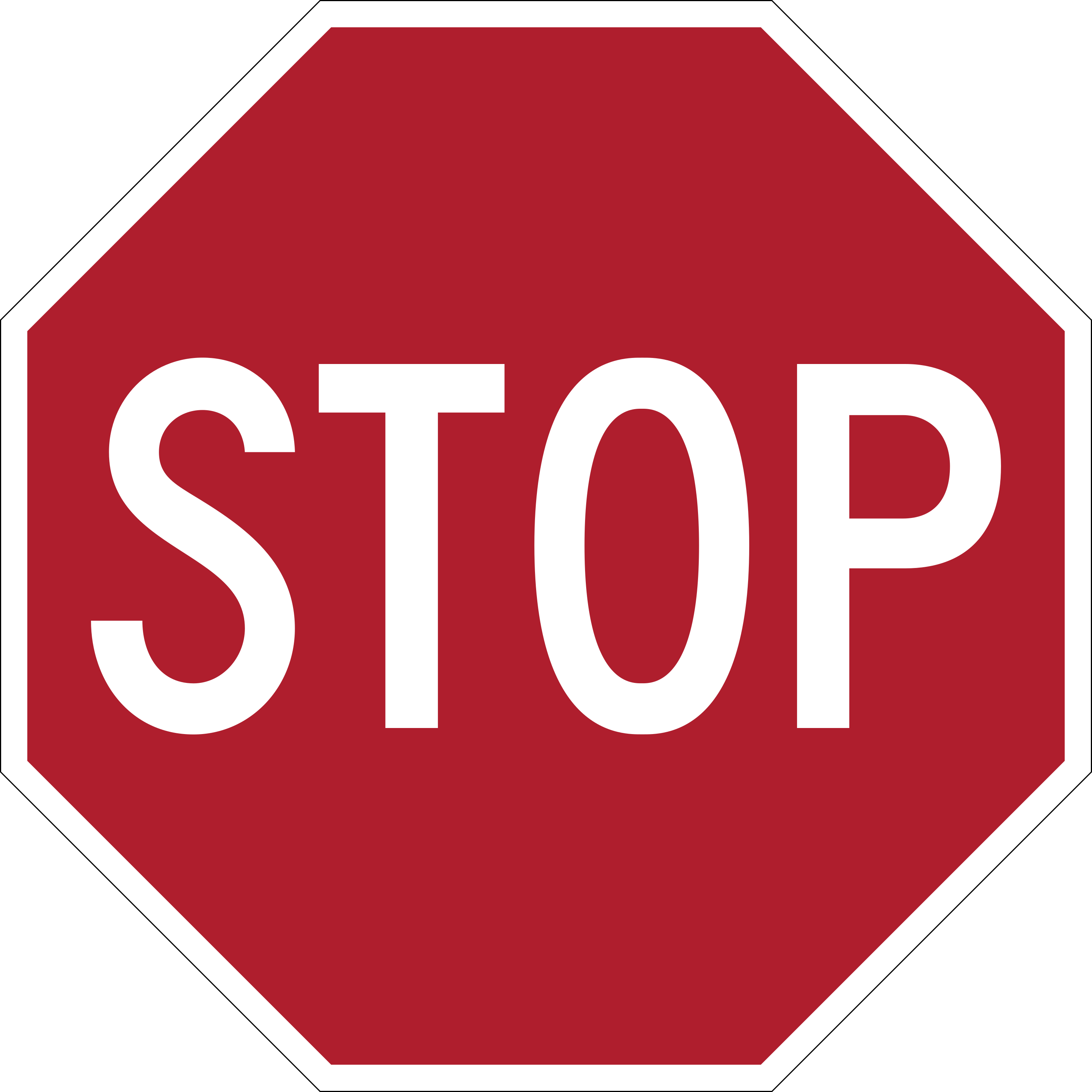
4. What does this traffic sign mean?
This traffic sign means stop and yield. You must come to a complete stop before entering the intersection and yield to traffic that has the right-of-way. Proceed only when it is safe.
English • R1-1 • Stop. Stop completely before entering the junction and proceed only when it is safe.
Sources
🔗 Commons.wikimedia.org
🔗 Mutcd.fhwa.dot.gov • FHWA: MUTCD, 11th Edition with Revision1, PDF page115
SVG source: Federal Highway Administration – United States Department of Transportation • Public domain • Original revision 2024-07-01. Wikimedia original unmodified.

5. What does this traffic sign mean?
This traffic sign indicates a warning for a steep descent. A steep downhill gradient lies ahead and the vehicle may gain speed quickly. Reduce speed before the descent, select a suitable gear and use engine braking where appropriate. Allow extra distance for heavy or towing vehicles.
English • W7-1a • Hill with grade. Warns of a steep descent; the illustration shows an 8% grade. Use a suitable gear and control your speed.
Sources
🔗 Commons.wikimedia.org
🔗 Mutcd.fhwa.dot.gov • FHWA: MUTCD, 11th Edition with Revision1, PDF page208
SVG source: Author not stated on source page • Public domain • Original revision 2013-05-04. Wikimedia original unmodified.

6. What does this traffic sign mean?
This traffic sign indicates a warning for a side road merging with the main road. Traffic from a side road joins the traffic flow ahead. Stay alert, maintain a safe gap and adjust your speed when necessary to allow traffic to merge safely.
English • W4-1R • Merge from the right. Warns that traffic streams merge from the right. Adjust your speed and maintain a safe gap.
Sources
🔗 Commons.wikimedia.org
🔗 Mutcd.fhwa.dot.gov • FHWA: MUTCD, 11th Edition with Revision1, PDF page223
SVG source: Author not stated on source page • Public domain • Original revision 2024-05-23. Wikimedia original unmodified.

7. What does this traffic sign mean?
This traffic sign indicates a warning for a movable bridge. The bridge ahead can open, lift or move to allow water traffic to pass. Reduce speed and be prepared to stop when required by barriers, traffic signals or other signals.
English • W3-6 • Drawbridge. Warns of a movable bridge ahead. Obey its signals, barriers and other traffic controls.
Sources
🔗 Commons.wikimedia.org
🔗 Mutcd.fhwa.dot.gov • FHWA: MUTCD, 11th Edition with Revision1, PDF page219
SVG source: Federal Highway Administration - MUTCD • Public domain • Original revision 2024-05-23. Wikimedia original unmodified.
Artwork verified against Mutcd.fhwa.dot.gov • official published diagram W3-6.

8. What does this traffic sign mean?
This traffic sign warns of a hairpin curve to the right. The road ahead makes a very sharp turn, so reduce speed and be prepared to steer sharply to the right.
English • W1-11R • Hairpin curve to the right. Warns of a very sharp curve to the right. Reduce speed before entering the curve.
Sources
🔗 Commons.wikimedia.org
🔗 Mutcd.fhwa.dot.gov • FHWA: MUTCD, 11th Edition with Revision1, PDF page194
SVG source: Author not stated on source page • Public domain • Original revision 2024-05-23. Wikimedia original unmodified.
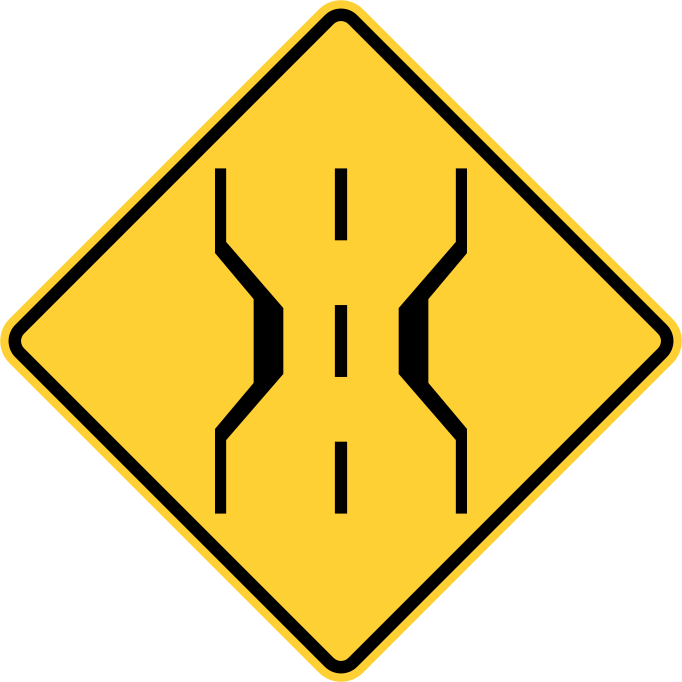
9. What does this traffic sign mean?
This traffic sign indicates a warning for a narrowing ahead. The available road width decreases ahead. Reduce speed when necessary and be prepared for less lateral space between vehicles, obstacles or the road edge.
English • W5-2a (2000 design) • Narrow bridge. Warns of a narrow bridge ahead. Reduce speed and allow space for oncoming vehicles. This is the narrow-bridge symbol from the 2000 MUTCD. In the current manual, W5-2a identifies a NARROW UNDERPASS word sign; the older symbol is not presented as the current design.
Sources
🔗 Commons.wikimedia.org
🔗 Mutcd.fhwa.dot.gov • FHWA: 2000 MUTCD, Chapter2C, printed page2C-15
SVG source: FHWA, Department of Transportation • Public domain • Original revision 2014-03-15. Wikimedia original unmodified.

10. What does this traffic sign mean?
This traffic sign indicates a warning for loose gravel. Loose stones or gravel may reduce tire grip and can be thrown up by passing vehicles. Reduce speed, increase your following distance and avoid sudden braking, acceleration or steering movements.
English • W8-7 • Loose gravel. Warns of loose gravel on the road. Reduce speed and avoid sudden braking or steering.
Sources
🔗 Commons.wikimedia.org
🔗 Mutcd.fhwa.dot.gov • FHWA: MUTCD, 11th Edition with Revision1, PDF page215
SVG source: Federal Highway Administration - MUTCD • Public domain • Original revision 2024-05-23. Wikimedia original unmodified.

11. What does this traffic sign mean?
This traffic sign indicates a warning for successive curves, with the first curve to the right. Reduce speed before entering the winding section, maintain your lane position and be prepared for further changes in direction.
English • W1-4R • Reverse curve, first to the right. Warns of successive curves, first to the right and then to the left.
Sources
🔗 Commons.wikimedia.org
🔗 Mutcd.fhwa.dot.gov • FHWA: MUTCD, 11th Edition with Revision1, PDF page194
SVG source: MUTCD_W1-4L.svg: derivative work: Fry1989 • Public domain • Original revision 2024-05-23. Wikimedia original unmodified.

12. What does this traffic sign mean?
This traffic sign indicates a warning for a sharp curve to the right. A tight right-hand curve lies ahead. Reduce speed before entering the curve, remain within your lane and use smooth steering, particularly when visibility or road grip is reduced.
English • W1-1R • Turn to the right. Warns of a sharp change of direction to the right. Reduce speed before the turn.
Sources
🔗 Commons.wikimedia.org
🔗 Mutcd.fhwa.dot.gov • FHWA: MUTCD, 11th Edition with Revision1, PDF page194
SVG source: MUTCD_W1-1L.svg: derivative work: Fry1989 • Public domain • Original revision 2024-05-23. Wikimedia original unmodified.

13. What does this traffic sign mean?
This traffic sign indicates a warning for a railroad crossing without barriers. It alerts drivers to an upcoming railroad crossing where railroad tracks cross the road and no barriers or gates are present to stop traffic. Drivers should slow down and look both ways for trains.
English • W10-1 • Railway crossing ahead. Warns of a railway level crossing ahead. Be prepared to obey its signals and signs, and never enter if your exit is blocked.
Sources
🔗 Commons.wikimedia.org
🔗 Mutcd.fhwa.dot.gov • FHWA: MUTCD, 11th Edition with Revision1, PDF page1043
SVG source: Federal Highway Administration – United States Department of Transportation • Public domain • Original revision 2024-05-23. Wikimedia original unmodified.
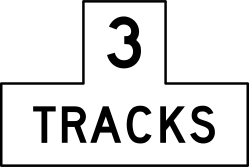
14. What does this traffic sign mean?
This traffic sign indicates a warning for a railroad crossing with two or more tracks. It alerts drivers to a railroad crossing where more than one railroad track crosses the road. More than one train may pass in succession or from different directions, so drivers should check carefully before crossing and never proceed until all tracks are clear.
English • R15-2P • Number of tracks. A supplementary plaque indicating the number of tracks at a railway crossing; the illustration shows three. Check for trains on every track before crossing.
Sources
🔗 Commons.wikimedia.org
🔗 Mutcd.fhwa.dot.gov • FHWA: MUTCD, 11th Edition with Revision1, PDF page1037
SVG source: Federal Highway Administration - MUTCD • Public domain • Original revision 2012-10-05. Wikimedia original unmodified.
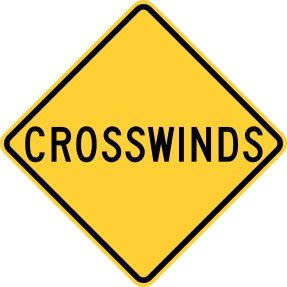
15. What does this traffic sign mean?
This traffic sign indicates a warning for strong crosswinds. Side winds may suddenly affect vehicle stability and steering. Reduce speed, keep a firm but controlled grip on the steering wheel and take extra care with high-profile vehicles, motorcycles and trailers.
English • NYW7-16 • Crosswinds. Warns that strong winds may blow across the road. Reduce speed as necessary and keep firm control of the vehicle. New York design, documented in NYSDOT sign drawing SD-W23.
Sources
🔗 Commons.wikimedia.org
🔗 Dot.ny.gov • NYSDOT: SD-W23, NYW7-16
SVG source: No machine-readable author provided. Overpush~commonswiki assumed (based on copyright claims). • Public domain • Original revision 2013-05-04. Wikimedia original unmodified.
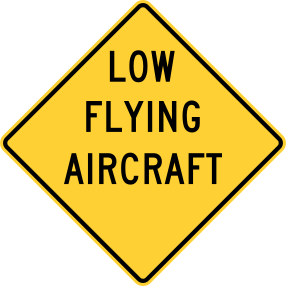
16. What does this traffic sign mean?
This traffic sign indicates a warning for low-flying aircraft. Aircraft may pass over the road at low altitude and can create sudden noise or visual distraction. Keep your attention on the road and maintain control of the vehicle.
English • W11-23-DE • Low-flying aircraft. Warns of low-flying aircraft near the road. Remain attentive and maintain control of the vehicle. Delaware design, documented in the 2018 DelDOT sign book.
Sources
🔗 Commons.wikimedia.org
🔗 Deldot.gov • DelDOT: 2018 sign book, printed page44
Image via Commons.wikimedia.org
No machine-readable author provided. Overpush~commonswiki assumed (based on copyright claims). • Public domain • Source revision 2013-05-04. Wikimedia original unmodified.
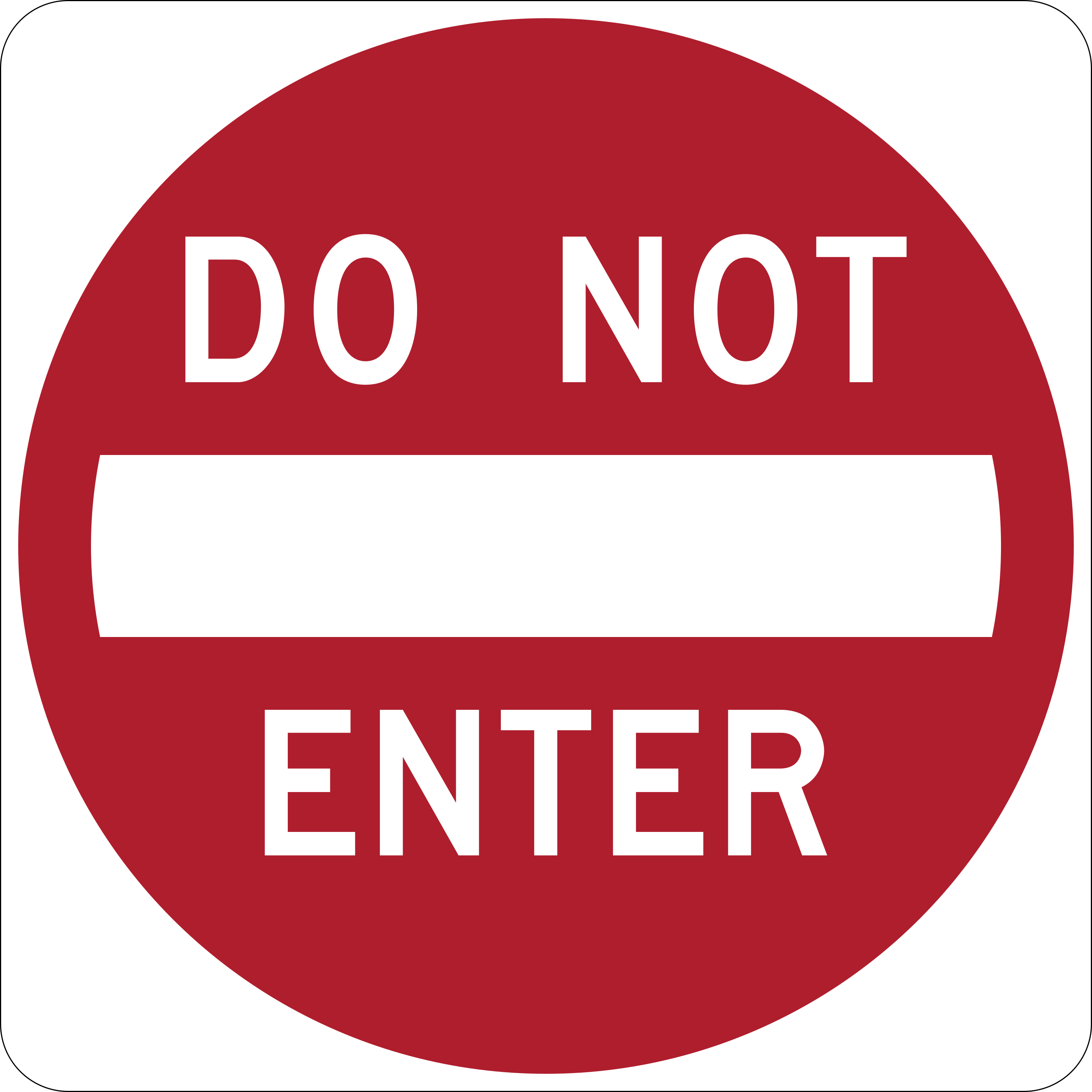
17. What does this traffic sign mean?
This traffic sign means no entry. Drivers may not enter from the direction in which the sign is placed.
English • R5-1 • Do not enter. Prohibits entering the road from this direction.
Sources
🔗 Commons.wikimedia.org
🔗 Mutcd.fhwa.dot.gov • FHWA: MUTCD, 11th Edition with Revision1, PDF page150
SVG source: Federal Highway Administration – United States Department of Transportation • Public domain • Original revision 2025-01-19. Wikimedia original unmodified.
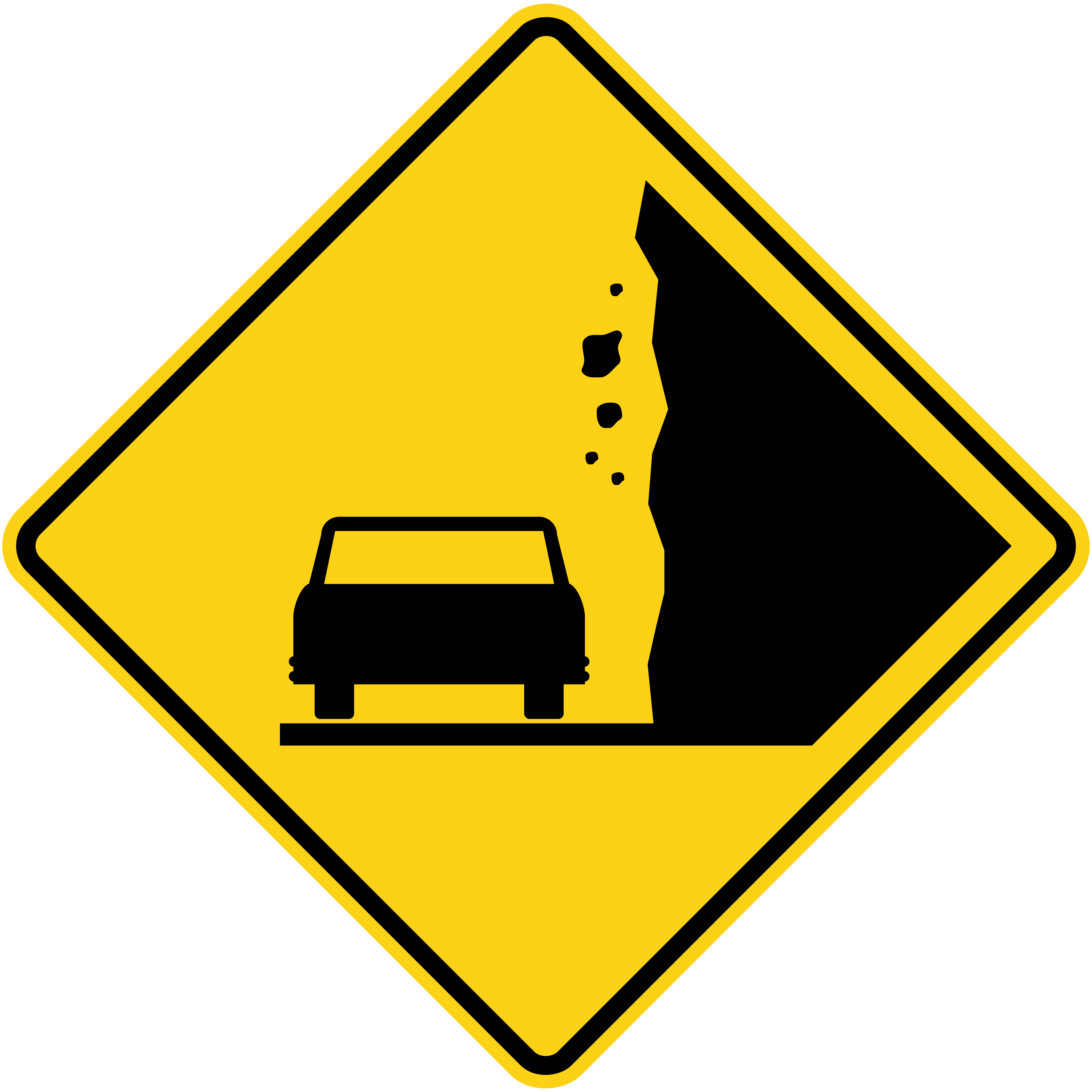
18. What does this traffic sign mean?
This traffic sign indicates a warning for falling rocks. Rocks or stones may fall from nearby slopes or may already be lying on the road. Reduce speed, scan the road ahead and be prepared to avoid or stop for fallen material.
English • W50-1(CA) • Rock-slide area. Warns that rocks may fall or slide onto the road. Reduce speed and watch for debris. California design, documented as W50-1(CA) in the Caltrans sign specifications.
Sources
🔗 Commons.wikimedia.org
🔗 Dot.ca.gov • Caltrans: W50-1(CA) specification
SVG source: California Department of Transportation • Public domain • Original revision 2024-05-22. Wikimedia original unmodified.

19. What does this traffic sign mean?
This traffic sign indicates a warning for crossing deer. Deer or other wild animals may enter the road unexpectedly, especially around dawn or dusk. Reduce speed, watch the roadside carefully and be prepared for more than one animal to cross.
English • W11-3 • Deer. Warns that deer may enter or cross the road. Slow down and be prepared to stop.
Sources
🔗 Commons.wikimedia.org
🔗 Mutcd.fhwa.dot.gov • FHWA: MUTCD, 11th Edition with Revision1, PDF page234
SVG source: Author not stated on source page • Public domain • Original revision 2024-05-23. Wikimedia original unmodified.
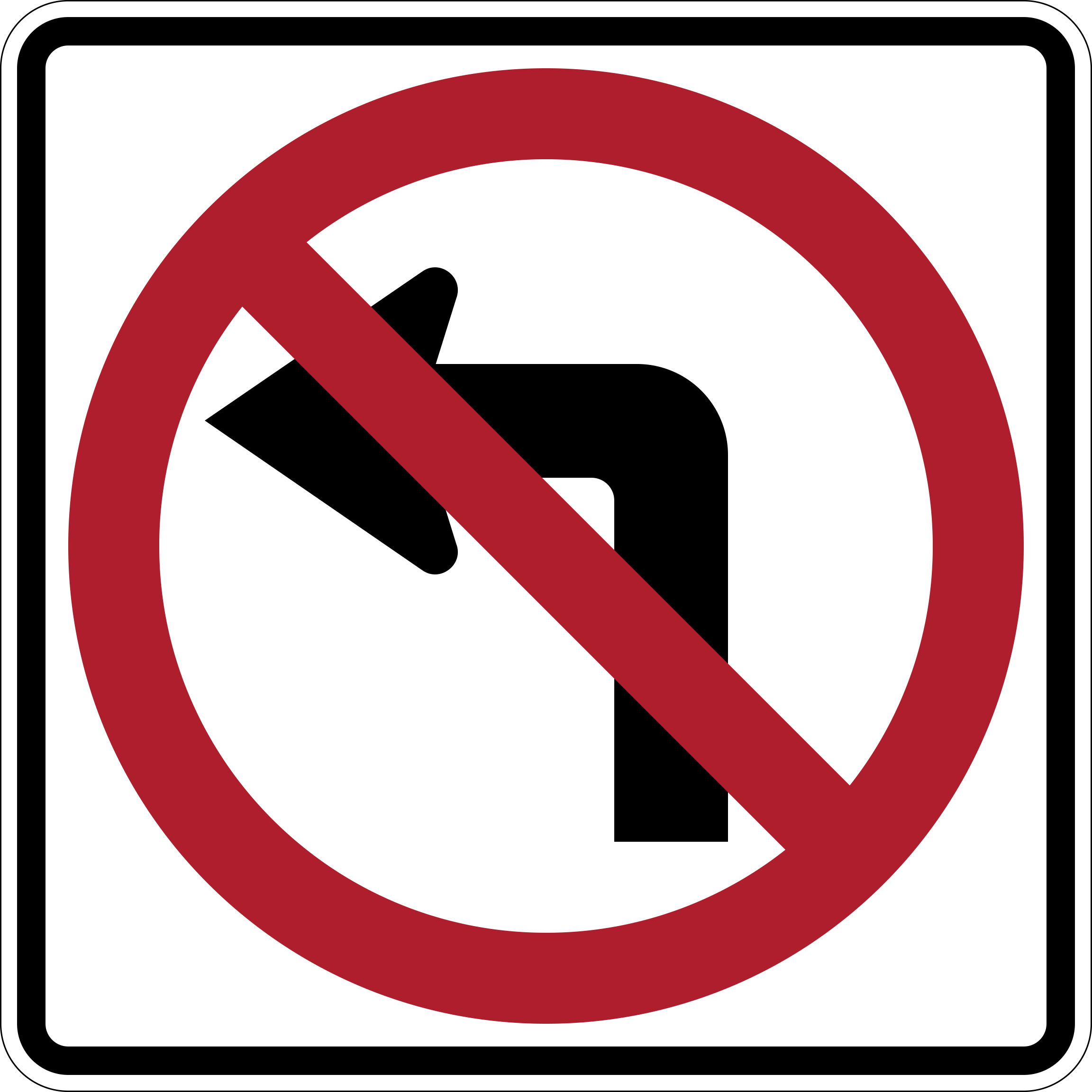
20. What does this traffic sign mean?
This traffic sign indicates that turning left is prohibited. A left turn may not be made where the sign applies. Other movements may still be permitted unless another restriction applies.
English • R3-2 • No left turn. Prohibits turning left at the indicated location.
Sources
🔗 Commons.wikimedia.org
🔗 Mutcd.fhwa.dot.gov • FHWA: MUTCD, 11th Edition with Revision1, PDF page131
SVG source: Federal Highway Administration – United States Department of Transportation • Public domain • Original revision 2024-08-01. Wikimedia original unmodified.

21. What does this traffic sign mean?
This traffic sign indicates a warning for a series of curves. One or more changes in direction lie ahead and may occur in quick succession. Reduce speed before entering the winding section, maintain your lane position and use smooth steering.
English • W1-5R • Winding road, first curve to the right. Warns of a series of curves, beginning with a curve to the right.
Sources
🔗 Commons.wikimedia.org
🔗 Mutcd.fhwa.dot.gov • FHWA: MUTCD, 11th Edition with Revision1, PDF page194
SVG source: Author not stated on source page • Public domain • Original revision 2024-05-23. Wikimedia original unmodified.
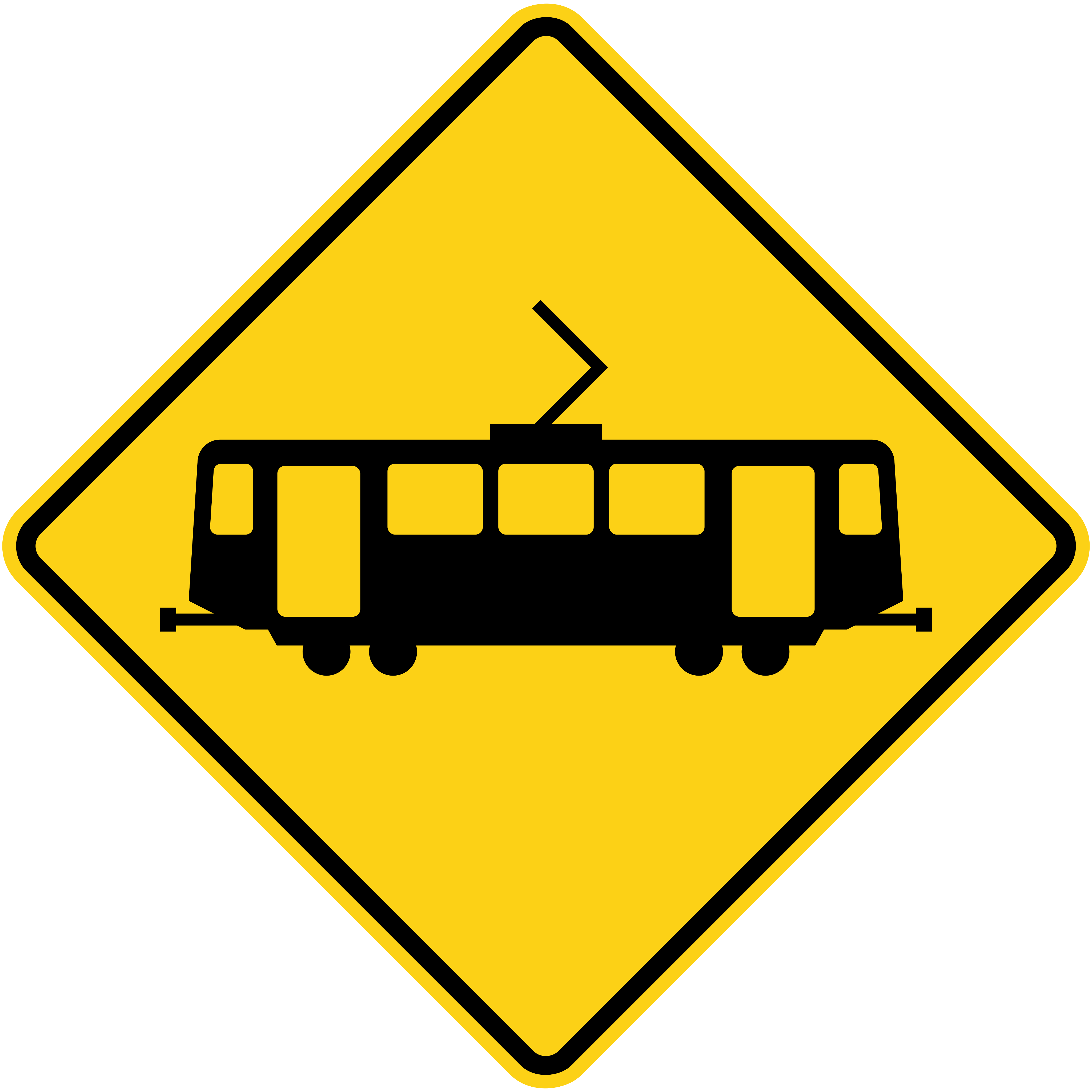
22. What does this traffic sign mean?
This traffic sign indicates a warning for streetcars. Streetcar tracks cross or run along the road ahead, and streetcars may enter the traffic path. Reduce speed, watch carefully for approaching streetcars and follow the applicable traffic signals, right-of-way signs and local rules.
English • W82(CA) • Light rail crossing. Warns of a light rail or tram crossing ahead. Watch for rail vehicles and obey the crossing controls. California design, documented as W82(CA) in the Caltrans sign specifications.
Sources
🔗 Commons.wikimedia.org
🔗 Dot.ca.gov • Caltrans: W82(CA) specification
Image via Commons.wikimedia.org
California Department of Transportation • Public domain • Source revision 2024-05-22. Wikimedia original unmodified.
23. What does this traffic sign mean?
This traffic sign indicates that trucks are prohibited. Trucks covered by the sign may not enter or continue beyond it. Any applicable weight threshold or vehicle-category limitation is determined by the sign, supplemental information and local rules.
English • R5-2 • No trucks. Prohibits trucks from using the indicated road or area.
Sources
🔗 Commons.wikimedia.org
🔗 Mutcd.fhwa.dot.gov • FHWA: MUTCD, 11th Edition with Revision1, PDF page148
SVG source: Federal Highway Administration – United States Department of Transportation • Public domain • Original revision 2023-08-23. Wikimedia original unmodified.
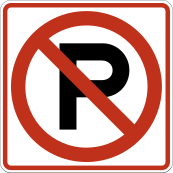
24. What does this traffic sign mean?
This traffic sign indicates that parking is prohibited. Vehicles may not be parked in the area covered by the sign unless an exception applies. Brief stopping to pick up or drop off passengers or to load or unload goods may still be permitted where local rules allow it.
English • R8-3 • No parking. Prohibits parking in the indicated area. This sign alone is not a no-stopping instruction.
Sources
🔗 Commons.wikimedia.org
🔗 Mutcd.fhwa.dot.gov • FHWA: MUTCD, 11th Edition with Revision1, PDF page165
SVG source: Author not stated on source page • Public domain • Original revision 2025-08-10. Wikimedia original unmodified.
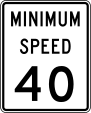
25. What does this traffic sign mean?
This traffic sign indicates the start of a minimum speed. Road users covered by the sign must travel at or above the indicated speed when conditions allow. Driving more slowly may still be necessary because of traffic, weather, road conditions or another safety-related reason.
English • R2-4a • Minimum speed. Sets a minimum speed of 40 mph, as shown in the illustration, subject to safety requirements and applicable law.
Sources
🔗 Commons.wikimedia.org
🔗 Mutcd.fhwa.dot.gov • FHWA: MUTCD, 11th Edition with Revision1, PDF page127
Image via Commons.wikimedia.org
Federal Highway Administration - MUTCD • Public domain • Source revision 2013-01-13. Wikimedia original unmodified.
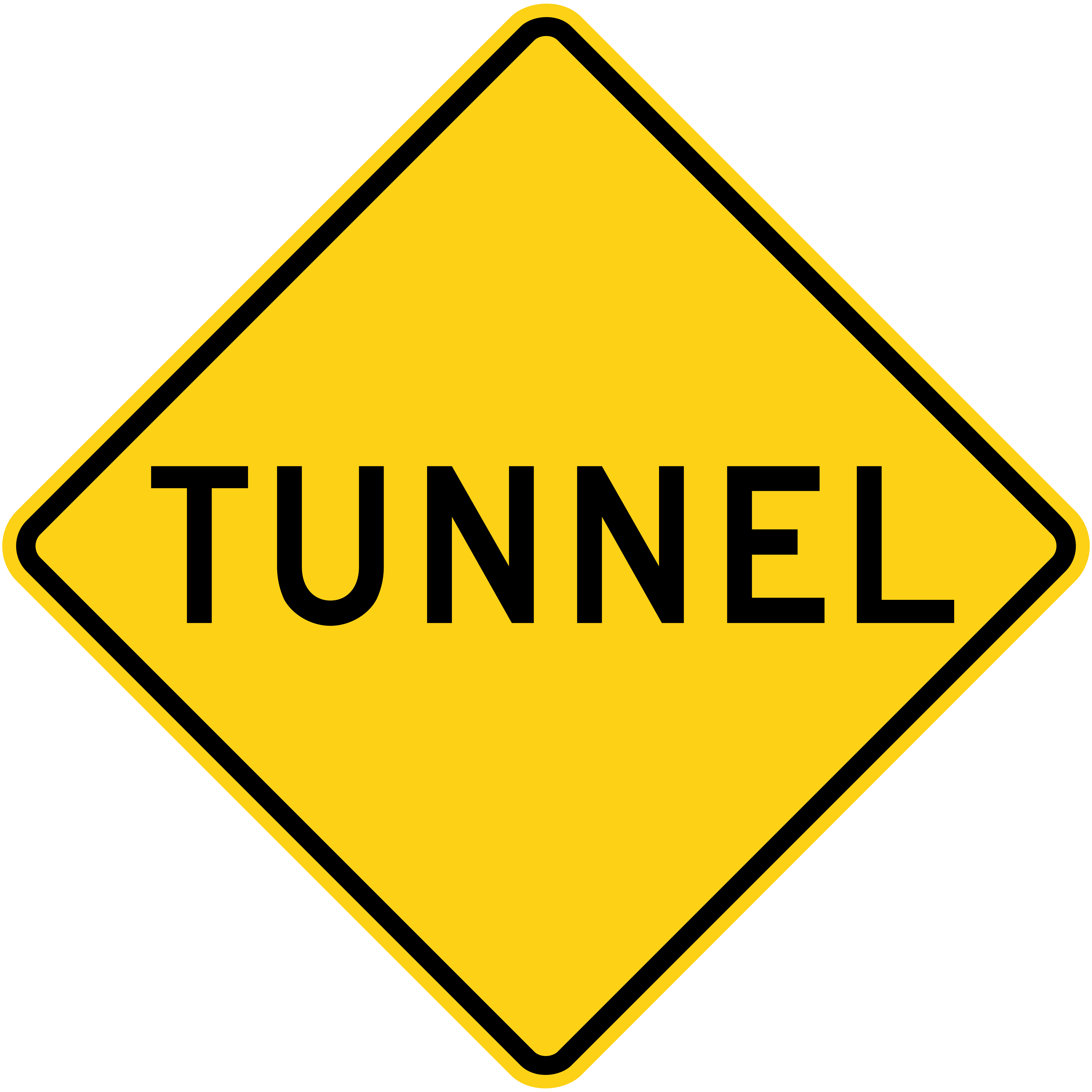
26. What does this traffic sign mean?
This traffic sign indicates a warning for a tunnel. Driving conditions may change at the tunnel entrance because of reduced light, limited visibility or restricted space. Reduce speed when necessary and follow the applicable rules for vehicle lighting, stopping, passing and lane use.
English • SW37(CA) • Tunnel ahead. Warns of a tunnel ahead. Adjust your speed and follow the tunnel's traffic controls. California design, documented in the Caltrans sign specifications and the 2026 California MUTCD.
Sources
🔗 Commons.wikimedia.org
🔗 Dot.ca.gov • Caltrans: SW37(CA) specification
🔗 Dot.ca.gov • Caltrans: 2026 California MUTCD, section2C.18
SVG source: California Department of Transportation • Public domain • Original revision 2024-05-22. Wikimedia original unmodified.
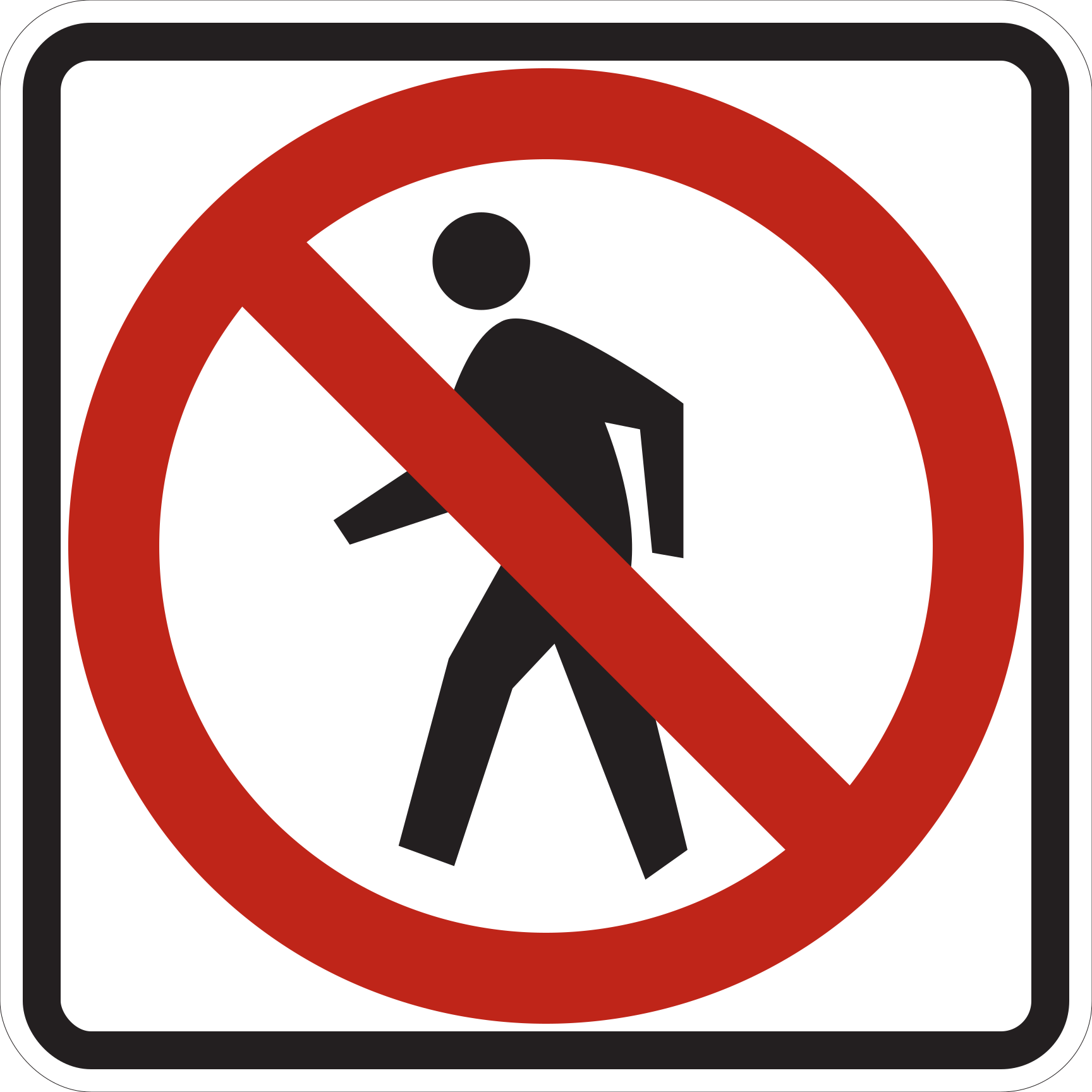
27. What does this traffic sign mean?
This traffic sign indicates that pedestrians are prohibited. Pedestrians may not enter or continue beyond the sign. Other road users may still be permitted unless another restriction applies.
English • R9-3 • No pedestrians. Prohibits pedestrians from using the indicated road or area.
Sources
🔗 Commons.wikimedia.org
🔗 Mutcd.fhwa.dot.gov • FHWA: MUTCD, 11th Edition with Revision1, PDF page1093
SVG source: Author not stated on source page • Public domain • Original revision 2026-07-26. Wikimedia original unmodified.

28. What does this traffic sign mean?
This traffic sign indicates yield ahead. A yield requirement applies at the location ahead. Reduce speed in good time and be prepared to stop if necessary.
English • W3-2 • Yield ahead. Warns of a yield sign ahead. Prepare to slow down and give way.
Sources
🔗 Commons.wikimedia.org
🔗 Mutcd.fhwa.dot.gov • FHWA: MUTCD, 11th Edition with Revision1, PDF page218
SVG source: Federal Highway Administration – United States Department of Transportation • Public domain • Original revision 2024-05-23. Wikimedia original unmodified.
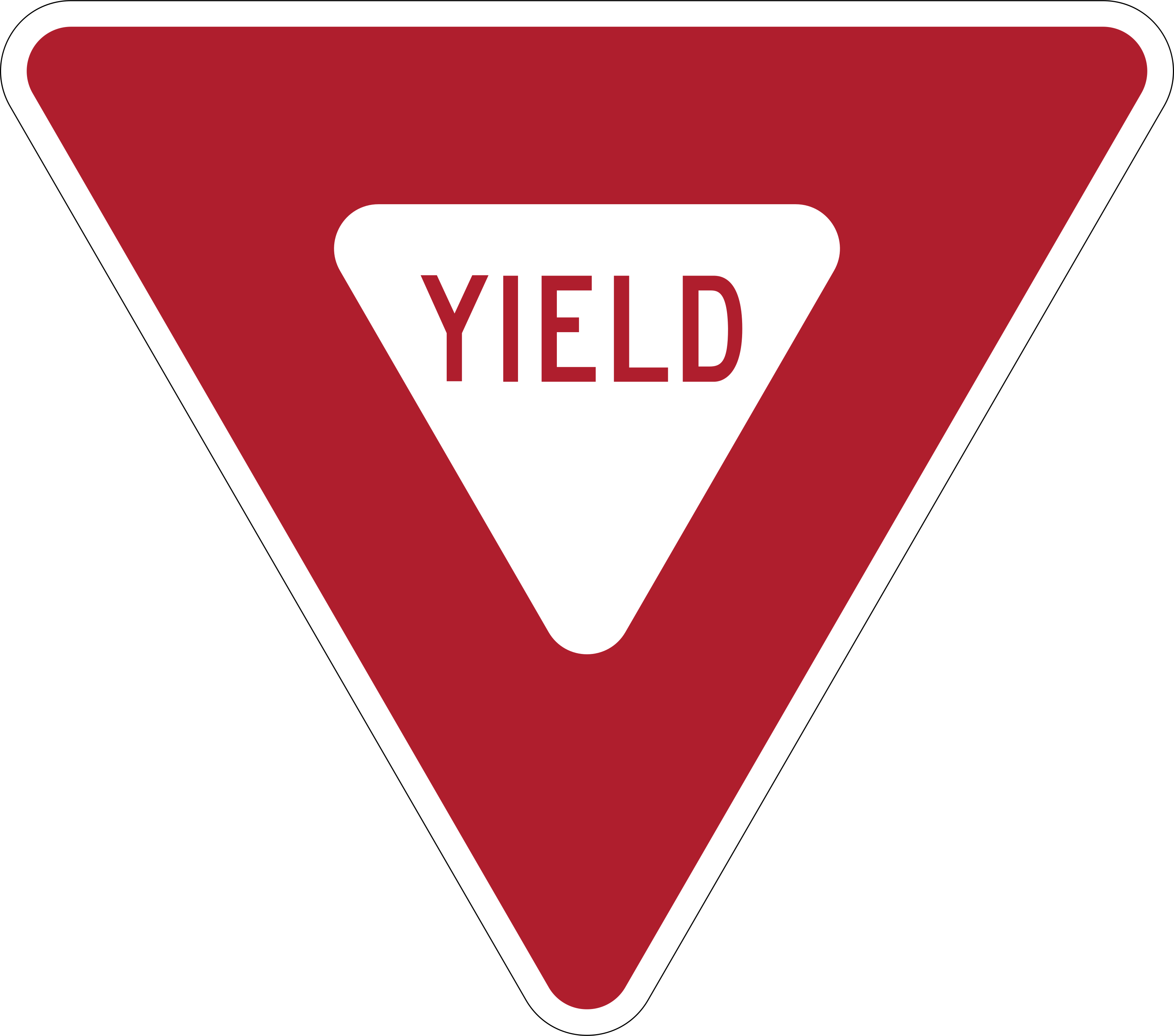
29. What does this traffic sign mean?
This traffic sign means yield. Slow down and yield to traffic that has the right-of-way. Stop if necessary and proceed only when it is safe.
English • R1-2 • Yield. Give way to conflicting traffic. Slow down or stop as necessary before proceeding.
Sources
🔗 Commons.wikimedia.org
🔗 Mutcd.fhwa.dot.gov • FHWA: MUTCD, 11th Edition with Revision1, PDF page115
SVG source: Federal Highway Administration – United States Department of Transportation • Public domain • Original revision 2024-07-03. Wikimedia original unmodified.
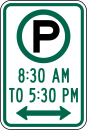
30. What does this traffic sign mean?
This traffic sign indicates that parking is allowed. Vehicles may be parked in the area covered by the sign subject to any indicated conditions, restrictions or local parking rules.
English • R7-23 (2009 design) • Parking permitted during stated hours. Permits parking from 8:30 am to 5:30 pm in the area indicated by the arrows. Check other signs for conditions or restrictions outside those hours. This is the parking-permitted design documented as R7-23 in the 2009 MUTCD. It is not shown in the current manual; this caption identifies the older design.
Sources
🔗 Commons.wikimedia.org
🔗 Mutcd.fhwa.dot.gov • FHWA: 2009 MUTCD, Figure2B-24, sheet1
SVG source: Federal Highway Administration - MUTCD • Public domain • Original revision 2012-09-23. Wikimedia original unmodified.

31. What does this traffic sign mean?
This traffic sign indicates a warning for a road narrowing on the right. The available road width decreases from the right side ahead. Reduce speed, follow the lane markings and maintain sufficient clearance from other traffic and the road edge.
English • W4-2R • Right lane ends. Warns that the right lane ends ahead. Merge safely into the continuing lane.
Sources
🔗 Commons.wikimedia.org
🔗 Mutcd.fhwa.dot.gov • FHWA: MUTCD, 11th Edition with Revision1, PDF page223
SVG source: see below • Public domain • Original revision 2024-05-23. Wikimedia original unmodified.

32. What does this traffic sign mean?
This traffic sign indicates a warning for pedestrians. Pedestrians may be walking near or crossing the road ahead. Reduce speed, watch carefully and be prepared to stop.
English • W11-2 • Pedestrians. Warns that pedestrians may enter or cross the road. Slow down and be prepared to give way or stop.
Sources
🔗 Commons.wikimedia.org
🔗 Mutcd.fhwa.dot.gov • FHWA: MUTCD, 11th Edition with Revision1, PDF page234
SVG source: Federal Highway Administration - MUTCD • Public domain • Original revision 2020-10-27. Wikimedia original unmodified.
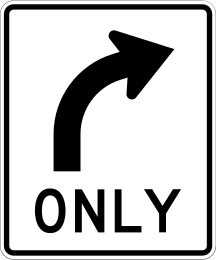
33. What does this traffic sign mean?
This traffic sign indicates that turning right is mandatory at the intersection ahead. Traffic must turn right and may not continue straight ahead or turn left.
English • R3-5R • Right turn only. Traffic in the indicated lane must turn right.
Sources
🔗 Commons.wikimedia.org
🔗 Mutcd.fhwa.dot.gov • FHWA: MUTCD, 11th Edition with Revision1, PDF page131
SVG source: Author not stated on source page • Public domain • Original revision 2023-07-22. Wikimedia original unmodified.

34. What does this traffic sign mean?
This traffic sign indicates a warning for a road narrowing. The available width of the road or roadway decreases ahead. Reduce speed, maintain sufficient lateral clearance and watch carefully for approaching or adjacent traffic.
English • W5-1 • Road narrows. Warns that the road becomes narrower ahead. Reduce speed and allow space for oncoming traffic.
Sources
🔗 Commons.wikimedia.org
🔗 Mutcd.fhwa.dot.gov • FHWA: MUTCD, 11th Edition with Revision1, PDF page210
SVG source: Federal Highway Administration – United States Department of Transportation • Public domain • Original revision 2024-05-23. Wikimedia original unmodified.
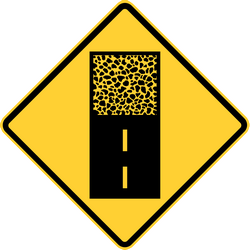
35. What does this traffic sign mean?
This traffic sign indicates a warning for an unpaved road surface. The paved surface ends or changes to gravel, dirt or another loose material. Reduce speed and be prepared for reduced grip, uneven surfaces, dust and loose stones.

36. What does this traffic sign mean?
This traffic sign indicates a warning for an uncontrolled intersection. An intersection without traffic signals or signs assigning priority lies ahead. Reduce speed, watch for traffic approaching from other directions and follow the applicable local right-of-way rules.
English • W2-1 • Cross road. Warns of a crossroads ahead where traffic may enter or cross your path.
Sources
🔗 Commons.wikimedia.org
🔗 Mutcd.fhwa.dot.gov • FHWA: MUTCD, 11th Edition with Revision1, PDF page220
SVG source: Federal Highway Administration - MUTCD • Public domain • Original revision 2024-05-23. Wikimedia original unmodified.

37. What does this traffic sign mean?
This traffic sign indicates a warning for tractors or other agricultural vehicles. Slow-moving agricultural vehicles may enter, cross or travel along the road ahead. Reduce speed and pass only where it is permitted and clearly safe.
English • W11-5 • Farm vehicles. Warns that tractors or other farm vehicles may enter or cross the road.
Sources
🔗 Commons.wikimedia.org
🔗 Mutcd.fhwa.dot.gov • FHWA: MUTCD, 11th Edition with Revision1, PDF page232
SVG source: Author not stated on source page • Public domain • Original revision 2024-05-23. Wikimedia original unmodified.

38. What does this traffic sign mean?
This traffic sign indicates a warning for a speed bump. A raised traffic-calming feature lies ahead. Reduce speed before reaching it to maintain vehicle control and avoid damage or discomfort.
English • W8-1 • Bump. Warns of a sharp rise in the road surface. Reduce speed before reaching it.
Sources
🔗 Commons.wikimedia.org
🔗 Mutcd.fhwa.dot.gov • FHWA: MUTCD, 11th Edition with Revision1, PDF page215
SVG source: Federal Highway Administration – United States Department of Transportation • Public domain • Original revision 2024-05-23. Wikimedia original unmodified.
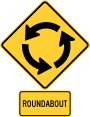
39. What does this traffic sign mean?
This traffic sign indicates a warning for a roundabout. A roundabout lies ahead. Reduce speed and follow the applicable right-of-way signs, traffic signals and local roundabout rules when approaching and entering it.
English • W2-6 + W16-12aP • Roundabout ahead. Warns of a roundabout ahead. Slow down and follow the signs controlling the approach.
Sources
🔗 Commons.wikimedia.org
🔗 Mutcd.fhwa.dot.gov • FHWA: MUTCD, 11th Edition with Revision1, PDF page220
Image via Commons.wikimedia.org
Federal Highway Administration - MUTCD • Public domain • Source revision 2013-05-10. Wikimedia original unmodified.

40. What does this traffic sign mean?
This traffic sign indicates a warning for a height restriction. The available clearance ahead is limited, for example at a bridge, tunnel or other overhead structure. Drivers of tall vehicles should check their vehicle height and use another route if the vehicle cannot pass safely.
English • W12-2 • Low clearance. Warns of restricted overhead clearance; the illustration shows 12 feet 6 inches. Do not proceed if your vehicle or load cannot clear the obstruction safely.
Sources
🔗 Commons.wikimedia.org
🔗 Mutcd.fhwa.dot.gov • FHWA: MUTCD, 11th Edition with Revision1, PDF page210
SVG source: Author not stated on source page • Public domain • Original revision 2024-05-23. Wikimedia original unmodified.
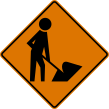
41. What does this traffic sign mean?
This traffic sign indicates a warning for road work. Construction or maintenance work is taking place on or beside the road. Reduce speed where necessary and be prepared for workers, machinery, temporary traffic signals, changed lane layouts or uneven road surfaces.
English • W21-1 • Workers. Warns of workers in or near the road. Slow down and follow the temporary traffic controls.
Sources
🔗 Commons.wikimedia.org
🔗 Mutcd.fhwa.dot.gov • FHWA: MUTCD, 11th Edition with Revision1, PDF page842
SVG source: Federal Highway Administration - MUTCD • Public domain • Original revision 2024-05-23. Wikimedia original unmodified.
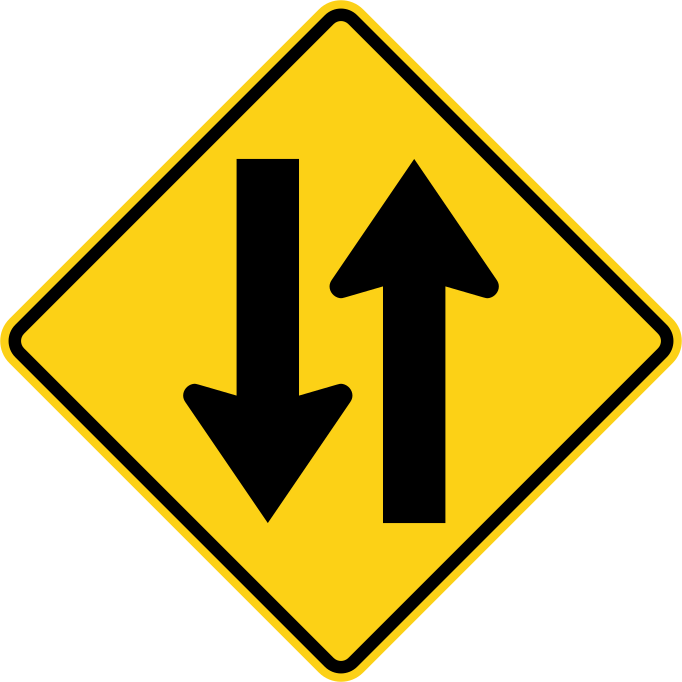
42. What does this traffic sign mean?
This traffic sign indicates a warning for two-way traffic. Oncoming traffic will use the same road or roadway ahead. Keep to the correct side of the road and pass only where it is permitted and clearly safe.
English • W6-3 • Two-way traffic. Warns of two-way traffic ahead. Keep to the right and watch for oncoming vehicles.
Sources
🔗 Commons.wikimedia.org
🔗 Mutcd.fhwa.dot.gov • FHWA: MUTCD, 11th Edition with Revision1, PDF page223
SVG source: Federal Highway Administration - MUTCD • Public domain • Original revision 2024-05-23. Wikimedia original unmodified.
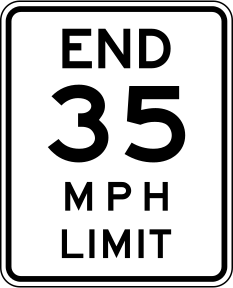
43. What does this traffic sign mean?
This traffic sign indicates the end of the previously indicated speed limit. From this point, follow any newly posted limit or the applicable default speed rules for the road and vehicle category.
English • NYR2-11 • End of posted speed limit. Marks the end of the posted 35 mph limit. Follow the speed limit that applies beyond this point; it does not mean that no speed limit applies. New York design, documented as NYR2-11 in the state supplement.
Sources
🔗 Commons.wikimedia.org
🔗 Dot.ny.gov • NYSDOT: state supplement, SD-R1, page194
SVG source: No machine-readable author provided. Overpush~commonswiki assumed (based on copyright claims). • Public domain • Original revision 2012-09-01. Wikimedia original unmodified.

44. What does this traffic sign mean?
This traffic sign indicates a warning for a dip in the road. A sudden depression in the road surface lies ahead and may affect vehicle stability or visibility. Reduce speed before reaching the dip and be prepared for water or other hazards that may collect in the lowered section.
English • W8-2 • Dip. Warns of a sharp depression in the road surface. Reduce speed before reaching it.
Sources
🔗 Commons.wikimedia.org
🔗 Mutcd.fhwa.dot.gov • FHWA: MUTCD, 11th Edition with Revision1, PDF page215
SVG source: Federal Highway Administration – United States Department of Transportation • Public domain • Original revision 2024-05-23. Wikimedia original unmodified.

45. What does this traffic sign mean?
This traffic sign indicates a warning for bicyclists. Bicyclists may be riding along or crossing the road ahead. Reduce speed, watch carefully for bicyclists and maintain the passing distance required by the applicable local rules.
English • W11-1 • Bicycles. Warns that cyclists may enter or cross the road. Slow down and maintain a safe separation.
Sources
🔗 Commons.wikimedia.org
🔗 Mutcd.fhwa.dot.gov • FHWA: MUTCD, 11th Edition with Revision1, PDF page232
SVG source: Author not stated on source page • Public domain • Original revision 2024-05-23. Wikimedia original unmodified.
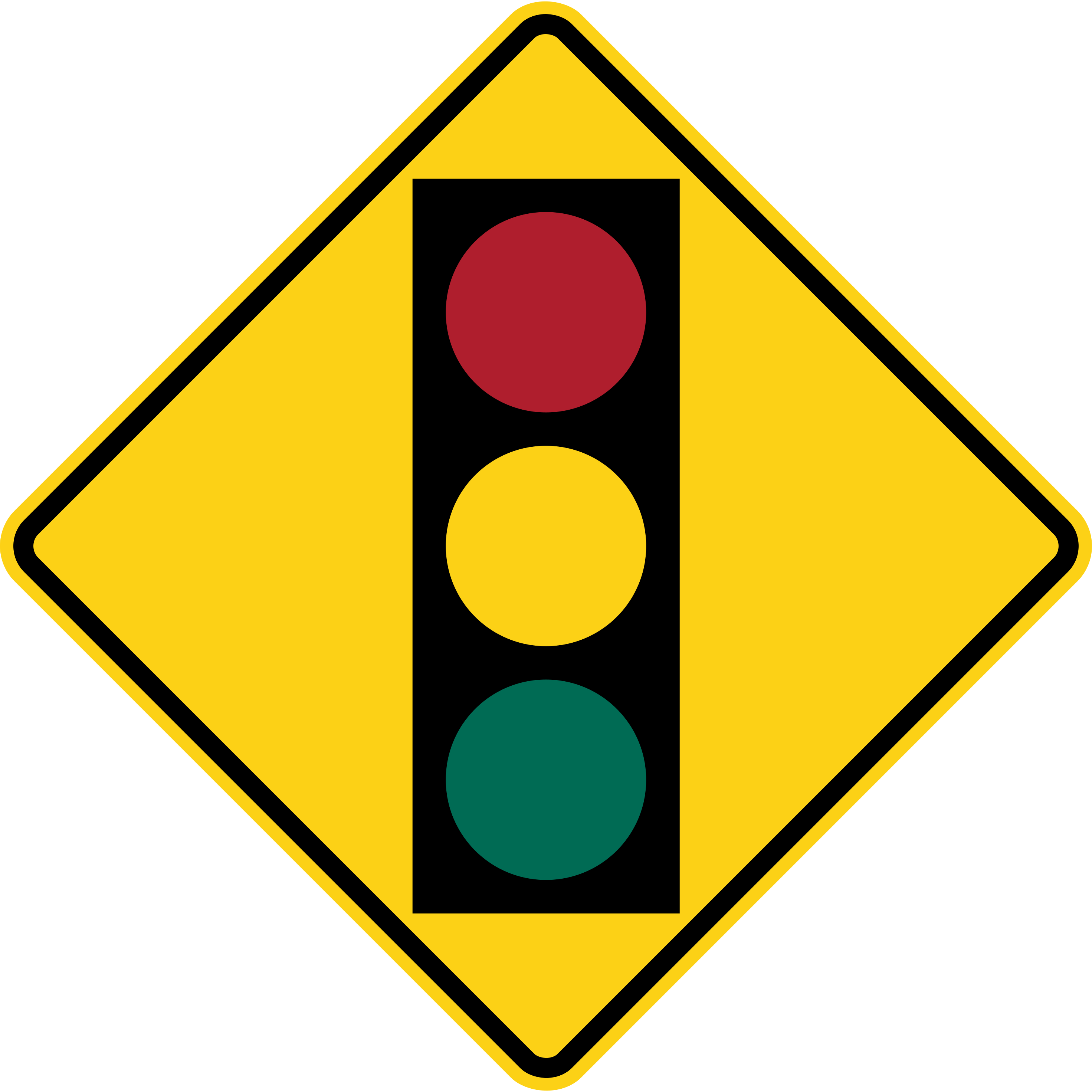
46. What does this traffic sign mean?
This traffic sign indicates a warning for traffic signals ahead. Traffic signals are located ahead and may not be visible early enough without advance warning. Reduce speed and be prepared to stop if the signal requires it.
English • W3-3 • Signal ahead. Warns of traffic lights ahead. Be prepared to stop when the signal requires it.
Sources
🔗 Commons.wikimedia.org
🔗 Mutcd.fhwa.dot.gov • FHWA: MUTCD, 11th Edition with Revision1, PDF page218
SVG source: Federal Highway Administration – United States Department of Transportation • Public domain • Original revision 2024-06-06. Wikimedia original unmodified.
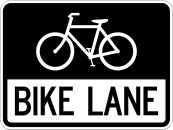
47. What does this traffic sign mean?
This traffic sign indicates a lane for bicyclists. The lane is designated for bicycle traffic, subject to the applicable pavement markings, traffic signs and local rules.
English • R3-17 • Bike lane. Identifies a lane designated for bicycle traffic. Other road users must respect the lane's restrictions.
Sources
🔗 Commons.wikimedia.org
🔗 Mutcd.fhwa.dot.gov • FHWA: MUTCD, 11th Edition with Revision1, PDF page1093
SVG source: Federal Highway Administration – United States Department of Transportation • Public domain • Original revision 2023-07-25. Wikimedia original unmodified.
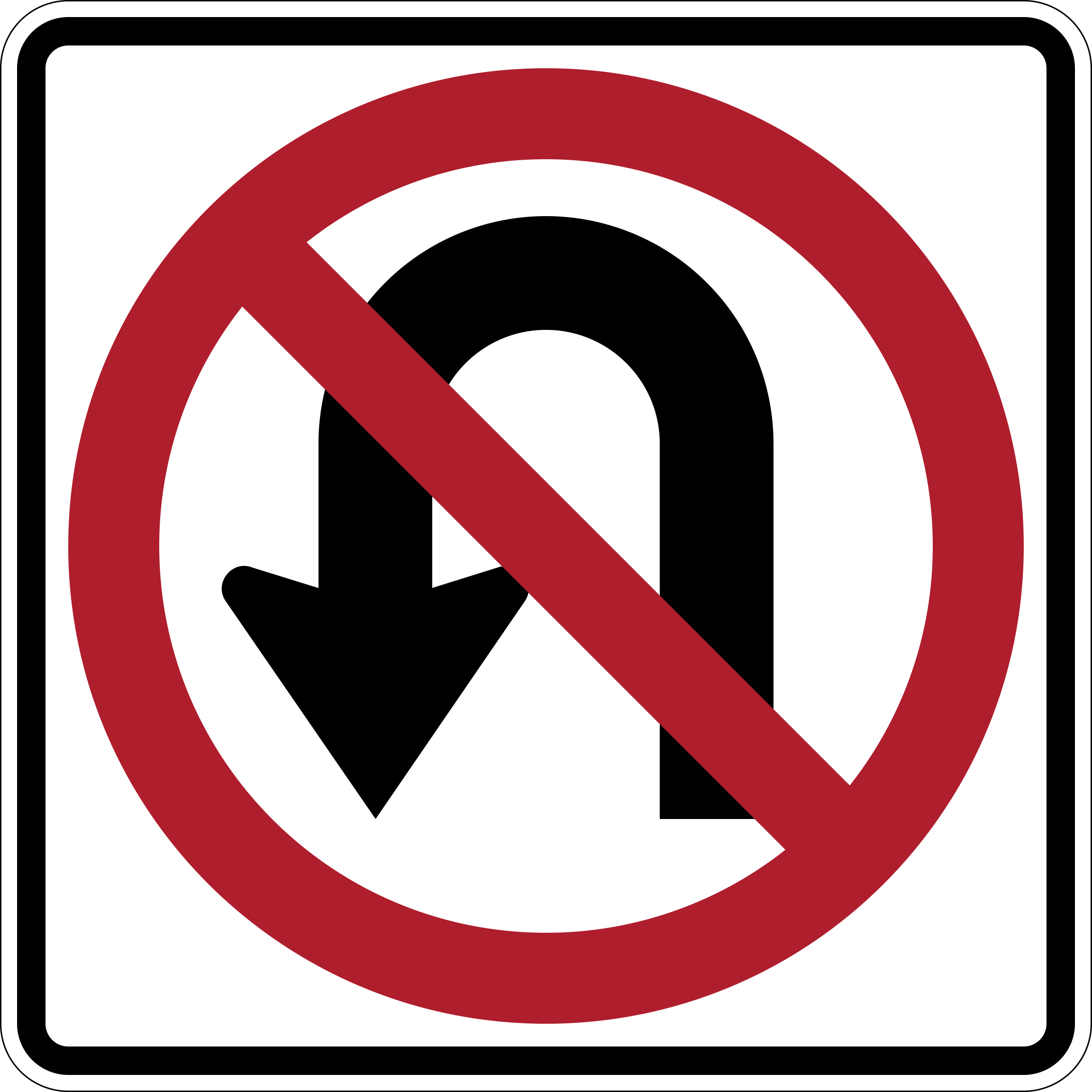
48. What does this traffic sign mean?
This traffic sign indicates that turning around (making a U-turn) is prohibited. A U-turn may not be made where the prohibition applies. Other movements may still be permitted unless another restriction applies.
English • R3-4 • No U-turn. Prohibits turning around in a U-turn at the indicated location.
Sources
🔗 Commons.wikimedia.org
🔗 Mutcd.fhwa.dot.gov • FHWA: MUTCD, 11th Edition with Revision1, PDF page131
SVG source: Federal Highway Administration – United States Department of Transportation • Public domain • Original revision 2024-08-01. Wikimedia original unmodified.
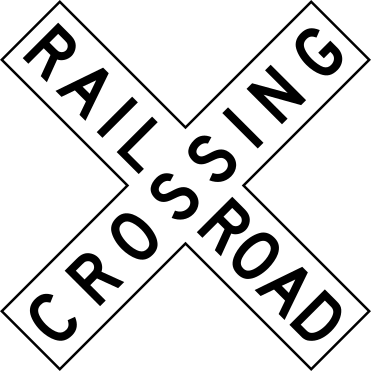
49. What does this traffic sign mean?
This traffic sign indicates a warning for a railroad crossing with one track. It alerts drivers to a railroad crossing where a single railroad track crosses the road. Drivers should approach with caution and be prepared to stop, even if no barriers or warning lights are active.
English • R15-1 • Railway crossing crossbuck. Marks a railway level crossing. Give way to rail traffic and obey any stop sign, yield sign, signals or barriers at the crossing.
Sources
🔗 Commons.wikimedia.org
🔗 Mutcd.fhwa.dot.gov • FHWA: MUTCD, 11th Edition with Revision1, PDF page1037
SVG source: Author not stated on source page • Public domain • Original revision 2013-05-04. Wikimedia original unmodified.
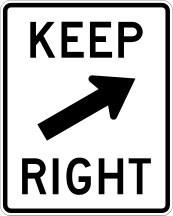
50. What does this traffic sign mean?
This traffic sign indicates that traffic must pass an obstacle on the right. Keep to the right of the obstacle and follow any accompanying signs or pavement markings.
English • R4-7b • Keep right. Pass to the right of the island or obstruction indicated by the sign.
Sources
🔗 Commons.wikimedia.org
🔗 Mutcd.fhwa.dot.gov • FHWA: MUTCD, 11th Edition with Revision1, PDF page144
SVG source: Federal Highway Administration – United States Department of Transportation • Public domain • Original revision 2023-08-22. Wikimedia original unmodified.
Artwork verified against Mutcd.fhwa.dot.gov • official published diagram R4-7b.