


Stop signBrazil
 Traffic rules
 Brazil
5. Stop sign
A stop sign requires drivers to bring their vehicle to a complete stop and give way before entering or crossing the road ahead. The stop must be made at the stop line or another legally prescribed position.
After stopping, the driver may continue only when this can be done safely and without interfering with traffic that has priority. The sign does not create priority for the driver who has stopped.
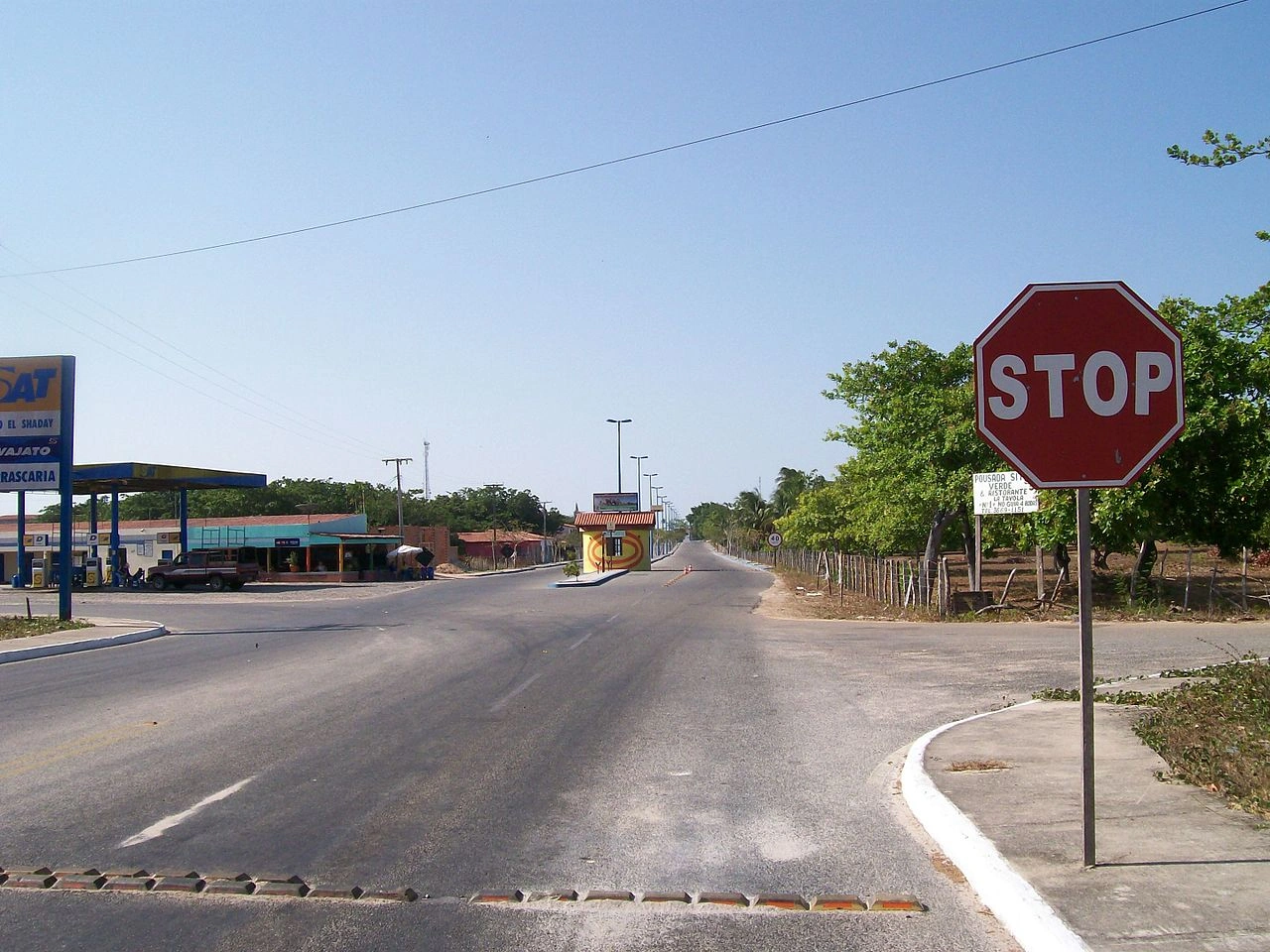
Wikimedia.org • Claudio Oliveira Lim • CC BY-SA
Must I stop completely at a stop sign in Brazil?
Yes. Come to a complete stop when the applicable stop sign controls your approach, even when you cannot see another road user. Slowing to a crawl is not a stop. The Brazilian stop indication uses PARE.
🔗 gov.br • Brazil, CONTRAN, Sign Manual Volume I, 2007 edition hosted by DNIT; 🔗 planalto.gov.br • Brazil, Traffic Code, Law 9,503, compiled text
Where must I stop at a stop-controlled junction in Brazil?
Stop before the prescribed stop line. Where no line is provided, stop before entering the junction at the applicable safe position. Give way to the traffic controlled as having priority and keep the pedestrian route clear.
🔗 gov.br • Brazil, CONTRAN, Sign Manual Volume I, 2007 edition hosted by DNIT; 🔗 planalto.gov.br • Brazil, Traffic Code, Law 9,503, compiled text
Does stopping first give me priority at a stop sign in Brazil?
A complete stop does not, by itself, give you priority. Give way to the road users entitled to pass under the junction’s signs and rules, check pedestrians and cyclists, and proceed only when the gap is safe. Do not follow another stopped vehicle through without satisfying your own stopping and yielding duties.
🔗 gov.br • Brazil, CONTRAN, Sign Manual Volume I, 2007 edition hosted by DNIT; 🔗 planalto.gov.br • Brazil, Traffic Code, Law 9,503, compiled text


