


Speed limitBrazil
 Traffic rules
 Brazil
2. Speed limit
A speed limit is the maximum legal speed permitted on a road, lane or within a designated area. It may be established by general traffic law or indicated by fixed, variable or temporary traffic signs.
A speed limit is a maximum, not a target speed. Drivers must travel more slowly whenever traffic, visibility, weather, road conditions, vulnerable road users or the condition of the vehicle make the maximum permitted speed unsafe.
Wikimedia.org • Agencia CNT de Noticias • CC BY
Which general speed limits should car drivers know in Brazil?
Without another regulatory sign, Brazil’s urban defaults are 80 km/h on rapid-transit roads, 60 km/h on arterial roads, 40 km/h on collector roads and 30 km/h on local roads. For ordinary cars, unsigned paved rural-highway maxima are 110 km/h on divided roads and 100 km/h on single-carriageway roads; unpaved rural roads have a 60 km/h default. Authorised signed limits can differ.
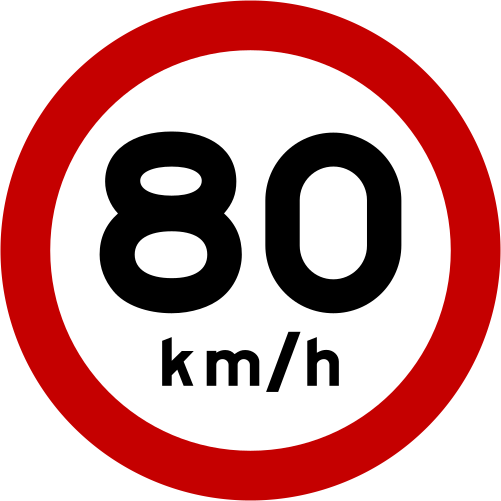 Start of a speed limit.
English • Traffic sign R-19 • Maximum permitted speed. Sets an 80 km/h maximum, as illustrated. Reduce speed when conditions require.
Português • R-19 • Velocidade máxima permitida. Estabelece a velocidade máxima de 80 km/h, valor mostrado na ilustração. Reduza a velocidade quando as condições exigirem.
Sources
🔗 Commons.wikimedia.org (Amateria1121 • CC BY-SA 3.0)
🔗 Gov.br • CONTRAN/SENATRAN: MBST, Volume I, página PDF 35
SVG source: Commons.wikimedia.org • Original SVG
Amateria1121 • CC BY-SA 3.0 • Original revision 2022-12-29. Wikimedia original unmodified.
Artwork reviewed against the Brazilian Manual Brasileiro de Sinalização de Trânsito (current SENATRAN catalogue): Gov.br • R-19, PDF page 35. Intentional educational illustration update from the previous PNG; original SVG unmodified.
Does an unsigned Brazilian urban road always have a 50 km/h default?
No. The Traffic Code uses the road classes via de trânsito rápido, via arterial, via coletora and via local, with defaults of 80, 60, 40 and 30 km/h respectively. The actual road classification matters when no regulatory speed sign is present.
Can a Brazilian road authority sign a different limit from the default?
Yes. The authority responsible for the road can establish a higher or lower signed limit according to its characteristics and traffic conditions. Follow that restriction and any vehicle-specific rule; the unsigned default does not override an authorised regulatory sign.


