


MexicoMexico
 Traffic rules
 Mexico
1. Mexico
Mexico stretches from the southern border of the United States to Guatemala and Belize, with coastlines on the Pacific Ocean, Gulf of Mexico and Caribbean Sea. Traffic drives on the right. Its road network ranges from busy metropolitan streets to long desert highways and winding mountain routes. A particularly Mexican distinction is the choice on many intercity journeys between carreteras libres, which are free to use, and higher-standard autopistas de cuota, where tolls are collected.
Mexico has no nationwide vignette. Toll-road payment depends on the operator; CAPUFE uses toll plazas and the IAVE electronic-tag system, while cash remains in use during the transition toward greater electronic collection. Traffic regulation combines federal, state and municipal rules, although national law establishes minimum road-safety requirements and maximum speed ceilings. Road signage is standardised nationally and written signs are primarily in Spanish, together with widely recognisable traffic symbols.
AI-generated by Rijbewijs-online.be • WCIT • CC BY-SA
What alcohol limits apply to drivers in Mexico?
General rule: Mexico's national mobility law prohibits driving above 0.05% BAC (0.05 g/dL) or 0.25 mg/L of alcohol in breath. State and local rules may impose stricter requirements.
Motorcycle riders: Motorcycle riders are subject to a lower national ceiling of 0.02% BAC (0.02 g/dL) or 0.1 mg/L in breath.
Passenger and goods transport: Drivers of vehicles used for passenger or goods transport must have no alcohol concentration in their breath or blood under the national mobility law.
What speed limits apply to passenger cars in Mexico?
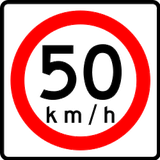
Urban roads: Mexico's national law sets maximum ceilings rather than one universal urban speed limit: 30 km/h on secondary and tertiary streets, 50 km/h on primary avenues without controlled access and 80 km/h on the central lanes of controlled-access avenues. Lower posted or local limits can apply.
Schools and hospitals: The national maximum is 20 km/h around hospitals and similar care facilities. School areas are limited to 20 km/h on secondary and tertiary streets and up to 30 km/h on primary roads and highways.
Are seat belts compulsory in Mexico?
Yes. Mexico's national mobility law requires seat-belt use by all passengers in motor vehicles, subject to the applicable technical requirements.
Can you use a mobile phone while driving in Mexico?
National law prohibits talking on or otherwise using a mobile phone or electronic communication device while driving, including reading or sending messages, unless it is used through hands-free technology.
Are motorcycle helmets compulsory in Mexico?
Yes. An appropriate helmet is compulsory for both motorcycle riders and passengers under the national mobility law.
🔗 diputados.gob.mx • Mexican Chamber of Deputies, General Mobility and Road Safety Act, Article 49
Are child car seats compulsory in Mexico?
National law requires a person under 12 years old, or someone whose physical size requires it, to travel in a rear seat using an appropriate child-restraint system or safety seat that meets the applicable Mexican standard.
🔗 diputados.gob.mx • Mexican Chamber of Deputies, General Mobility and Road Safety Act, Article 49

