

Railway crossingPoland
 Traffic rules
 Poland
31. Railway crossing
A railway crossing, also called a level crossing or railroad crossing, is a place where a road or path crosses railway tracks at the same level. It may be protected by barriers, warning lights, bells, traffic signs or a combination of these measures.
Road users must approach carefully and never enter when a train is approaching, warning signals are active or the exit is blocked. They should cross promptly and must never stop, wait or become trapped on the tracks.
Wikimedia.org • Ralf Lotys • CC BY
When must drivers stop at a railway level crossing in Poland?
Approach slowly enough to stop safely and check that no rail vehicle is approaching. Stop for a STOP sign, red warning or authorised stop instruction; do not enter while barriers are down, lowering or not yet fully raised. Do not enter unless there is room beyond the tracks to continue. A train having passed does not cancel an active warning.
🔗 eli.gov.pl • Poland, Sejm, Road Traffic Act, consolidated working text dated 12 October 2026; 🔗 eli.gov.pl • Poland, Signs and Signals Regulation, 2019 consolidated text, sections 21, 95–96 and 98–99
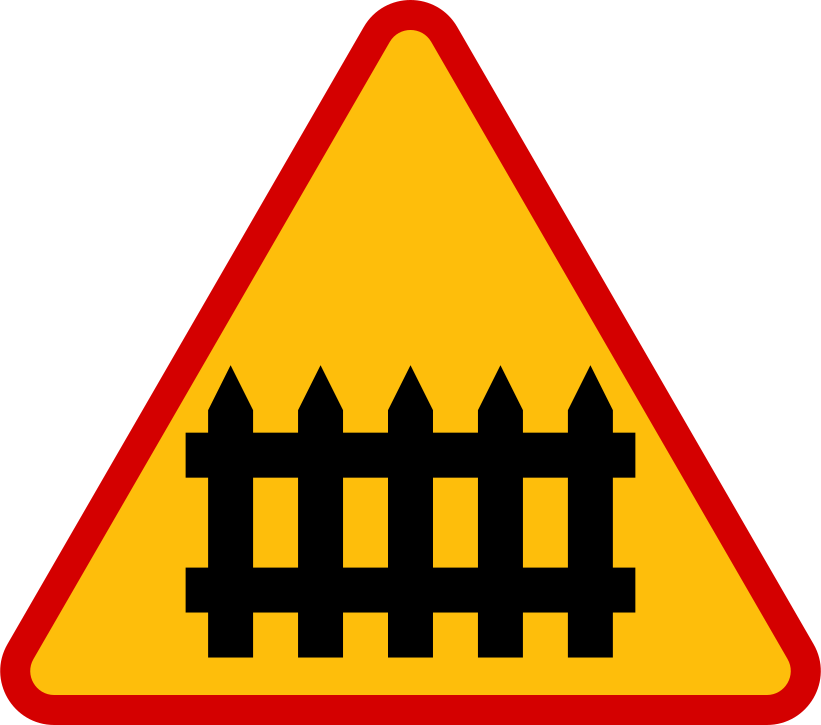 Warning for a railway crossing with barriers.
English • Traffic sign A-9 • Level crossing with barriers. Sign A-9 warns of a railway crossing with full or half barriers.
Polski • A-9 • przejazd kolejowy z zaporami. Znak A-9 „przejazd kolejowy z zaporami” ostrzega o przejeździe kolejowym wyposażonym w zapory lub pół-zapory.
Sources
🔗 Commons.wikimedia.org
🔗 Eli.gov.pl • § 6 ust. 1
SVG source: Commons.wikimedia.org • Original SVG
Author not stated on source page • Public domain • Original revision 2025-10-07. Wikimedia original unmodified.
Artwork reviewed against the Polish official sign catalogue, Dz.U. 2019 poz. 2310: Eli.gov.pl • A-9, PDF page 41, with amendments 2021/433, 2021/2065, 2022/2372 and 2026/133 checked. Catalogue-equivalent illustration; intentional update from the previous PNG. This is an educational illustration, not a manufacturing specification.
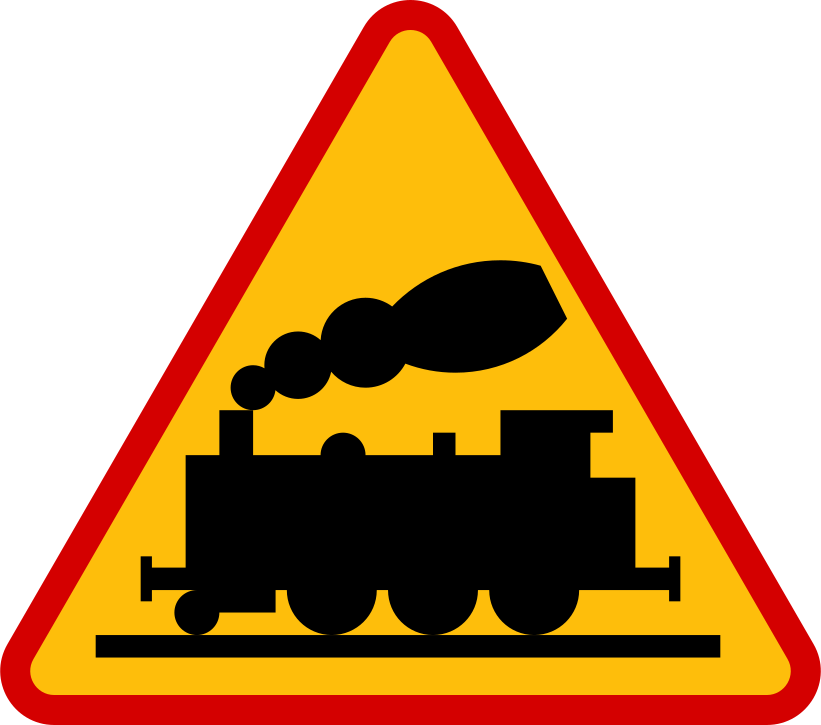 Warning for a railway crossing without barriers.
English • Traffic sign A-10 • Level crossing without barriers. Sign A-10 warns of a railway crossing without full or half barriers.
Polski • A-10 • przejazd kolejowy bez zapór. Znak A-10 „przejazd kolejowy bez zapór” ostrzega o przejeździe kolejowym niewyposażonym ani w zapory, ani w półzapory.
Sources
🔗 Commons.wikimedia.org
🔗 Eli.gov.pl • § 6 ust. 2
SVG source: Commons.wikimedia.org • Original SVG
Paweł Grzywocz • Public domain • Original revision 2025-10-07. Wikimedia original unmodified.
Artwork reviewed against the Polish official sign catalogue, Dz.U. 2019 poz. 2310: Eli.gov.pl • A-10, PDF page 41, with amendments 2021/433, 2021/2065, 2022/2372 and 2026/133 checked. Catalogue-equivalent illustration; intentional update from the previous PNG. This is an educational illustration, not a manufacturing specification.
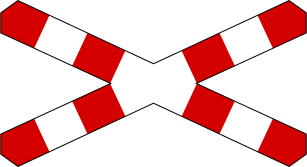 Warning for a railway crossing with one track.
English • Traffic sign G-3 • Crossbuck before a single-track level crossing. Signs G-3, Crossbuck before a single-track level crossing, and G-4, Crossbuck before a multiple-track level crossing, mark where to stop for a train or other rail vehicle at a crossing without full or half barriers. They indicate respectively that the crossing has one track or more than one track.
Polski • G-3 • krzyż św. Andrzeja przed przejazdem kolejowym jednotorowym. Znaki: G-3 „krzyż św. Andrzeja przed przejazdem kolejowym jednotorowym”, G-4 „krzyż św. Andrzeja przed przejazdem kolejowym wielotorowym” wyznaczają miejsce zatrzymania się w związku z ruchem pociągu lub innego pojazdu szynowego na przejeździe kolejowym bez zapór lub półzapór; znaki te informują, że na przejeździe występują odpowiednio jeden lub więcej torów.
Sources
🔗 Commons.wikimedia.org
🔗 Eli.gov.pl • § 78 ust. 5
SVG source: Paweł Grzywocz • Public domain • Original revision 2012-04-14. Wikimedia original unmodified.
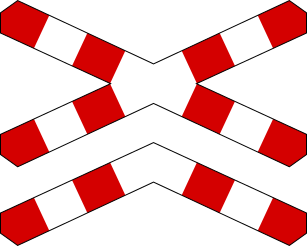 Warning for a railway crossing with two or more tracks.
English • Traffic sign G-4 • Crossbuck before a multiple-track level crossing. Signs G-3, Crossbuck before a single-track level crossing, and G-4, Crossbuck before a multiple-track level crossing, mark where to stop for a train or other rail vehicle at a crossing without full or half barriers. They indicate respectively that the crossing has one track or more than one track.
Polski • G-4 • krzyż św. Andrzeja przed przejazdem kolejowym wielotorowym. Znaki: G-3 „krzyż św. Andrzeja przed przejazdem kolejowym jednotorowym”, G-4 „krzyż św. Andrzeja przed przejazdem kolejowym wielotorowym” wyznaczają miejsce zatrzymania się w związku z ruchem pociągu lub innego pojazdu szynowego na przejeździe kolejowym bez zapór lub półzapór; znaki te informują, że na przejeździe występują odpowiednio jeden lub więcej torów.
Sources
🔗 Commons.wikimedia.org
🔗 Eli.gov.pl • § 78 ust. 5
SVG source: Paweł Grzywocz • Public domain • Original revision 2012-04-14. Wikimedia original unmodified.
Must I stop at every unguarded railway crossing in Poland?
Not merely because there are no barriers. Approach with particular care, check for trains and obey any STOP sign, warning signal or authorised direction. A STOP sign at a railway crossing requires a full stop. A crossbuck identifies the stopping place associated with rail traffic; it is not itself the same instruction as a STOP sign.
🔗 eli.gov.pl • Poland, Sejm, Road Traffic Act, consolidated working text dated 12 October 2026; 🔗 eli.gov.pl • Poland, Signs and Signals Regulation, 2019 consolidated text, sections 21, 95–96 and 98–99
What if road traffic is queued beyond a railway crossing in Poland?
Wait before the tracks until there is room to take your entire vehicle off the crossing. Do not follow another vehicle onto the tracks without checking the exit. Keep the tracks clear even if no train is visible.
🔗 eli.gov.pl • Poland, Sejm, Road Traffic Act, consolidated working text dated 12 October 2026


