


SwedenSweden
 Traffic rules
 Sweden
1. Sweden
Sweden occupies the eastern side of the Scandinavian Peninsula in Northern Europe, bordering Norway and Finland and linked to Denmark by the Öresund connection. Traffic drives on the right. Its long north-south extent produces very different driving conditions, from busy roads around Stockholm, Gothenburg and Malmö to sparsely populated forest roads in the north. Snow, ice, long periods of winter darkness and encounters with moose, deer and reindeer can all be important considerations. Swedish is the principal language used for written road information, while Sweden's distinctive warning signs use the familiar triangular European form with a yellow background rather than the white background common in many other European countries.
Sweden has no nationwide motorway vignette. Most roads can be used without a road-use charge, although congestion taxes apply in Stockholm and Gothenburg and separate infrastructure charges apply to certain bridges. Winter rules are particularly important: passenger cars and other light vehicles must use winter tyres from 1 December to 31 March when winter road conditions exist. Studded tyres are normally permitted from 1 October to 15 April, although local streets can prohibit them. Vehicle lights must also be used during daytime driving throughout the year.
AI-generated by Rijbewijs-online.be • WCIT • CC BY-SA
Which number can you call in an emergency in Sweden?
Call 112 for urgent emergency assistance. Give the operator your location and explain what happened.
What is the alcohol limit for driving in Sweden?
The drink-driving offence thresholds are 0.2‰ in blood (0.2 g/kg) or 0.10 mg/l in exhaled breath. Blood per mille is a mass ratio, not the same unit as grams per litre. These are legal thresholds; the safest approach is not to drink alcohol before driving.
🔗 polisen.se • Swedish Police, alcohol offence thresholds in breath and blood
What speed limits apply to passenger cars in Sweden?
Built-up areas: The statutory base limit in a built-up area is 50 km/h. However, many urban streets are signed at 30 or 40 km/h, so always follow the posted limit.
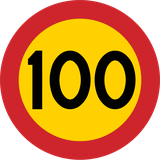
Outside built-up areas: The statutory base limit outside built-up areas is 70 km/h where no other limit has been established. Many main roads are instead specifically signed at 80, 90, 100 or 110 km/h.
Motorways: The general motorway maximum is 110 km/h, but designated motorway sections may have a signed maximum of 120 km/h.
🔗 data.riksdagen.se • Sweden, current Traffic Ordinance 1998:1276, Chapters 3, 4 and 9
What are the seat-belt and child-restraint rules in Sweden?
Everyone travelling in a vehicle equipped with seat belts must normally use the available seat belt.
Children shorter than 135 cm must normally use a suitable child seat, booster seat or booster cushion. Once they reach 135 cm, they use the fitted seat belt. The driver must ensure that passengers under 15 are correctly restrained.
For an occasional short journey when no child restraint can be used, a child aged 3 or older may travel on a rear seat and must use a belt where possible. A child under 3 may travel without a child restraint only under the separate exception for an occasional short taxi journey, away from the front seat.
🔗 europa.eu • Your Europe / national authorities, Sweden road rules, Seat belts and child restraints
🔗 data.riksdagen.se • Sweden, current Traffic Ordinance 1998:1276, Chapters 3, 4 and 9
Can you use a mobile phone while driving in Sweden?
You must not use a mobile phone or other communication equipment in a way that negatively affects your driving, and you must not hold the device in your hand while driving.
🔗 data.riksdagen.se • Sweden, current Traffic Ordinance 1998:1276, Chapters 3, 4 and 9
Are winter tyres mandatory in Sweden?
Yes. From 1 December to 31 March, passenger cars and other covered light vehicles must use winter tyres or equivalent equipment whenever winter road conditions exist. Winter conditions mean snow, ice, slush or frost on any part of the road.
🔗 polisen.se • Official national authority, claim-specific guidance
🔗 transportstyrelsen.se • Official national authority, claim-specific guidance
What safety equipment must a car carry in Sweden?
A car must carry an approved warning triangle. If the vehicle becomes immobilised in a hazardous position, the triangle must be used where required to warn approaching traffic. A reflective vest is sensible to carry but is not generally mandatory equipment for an ordinary passenger car.
🔗 data.riksdagen.se • Sweden, current Traffic Ordinance 1998:1276, Chapters 3, 4 and 9
Must you use headlights during the daytime in Sweden?
Yes. Vehicle lighting must be used while driving on the road. During normal daylight, daytime running lights or permitted equivalent lighting may be used instead of dipped headlights.
🔗 data.riksdagen.se • Sweden, current Traffic Ordinance 1998:1276, Chapters 3, 4 and 9
Can a visitor use a driving licence issued in another EU country in Sweden?
Yes. A valid, full EU driving licence is recognised for the vehicle categories it covers. You must meet the applicable minimum age. A learner licence or a temporary replacement certificate does not have the same automatic recognition.
Are motorcycle helmets compulsory in Sweden?
Yes. On an ordinary, open motorcycle, both the rider and passenger must wear a protective helmet. Use a helmet that meets the applicable approval requirements and fasten it correctly. Check the specific rules before relying on an exemption for an enclosed or specially equipped vehicle.
🔗 europa.eu • Your Europe / national authorities, Sweden road rules

