

Mandatory signsThailand
 Traffic rules
 Thailand
 Priority signs
 Warning signs
 Prohibitory signs
 Mandatory signs
 Information signs
Mandatory signs
A mandatory sign is a traffic sign that tells drivers what they must do. Instead of prohibiting actions, these signs impose obligations such as following a specific direction, using a particular lane, or keeping a minimum speed. Their purpose is to guide traffic safely and efficiently by ensuring that all road users follow the same required behaviour in places where it is necessary for order and safety.




1. Mandatory roundabout direction
This traffic sign indicates the mandatory direction around a roundabout. Traffic must circulate in the direction shown by the arrows. The sign does not itself determine priority; follow the applicable priority signs, traffic signals and local rules.
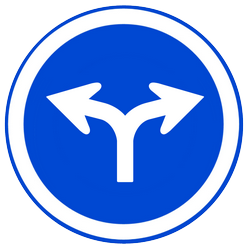
2. Turning left or right mandatory
This traffic sign indicates that turning left or right is mandatory at the junction ahead. Traffic may turn either left or right but may not continue straight ahead.
3. Pass obstacle on the left
This traffic sign indicates that traffic must pass an obstacle on the left. Keep to the left of the obstacle and follow any accompanying signs or road markings.
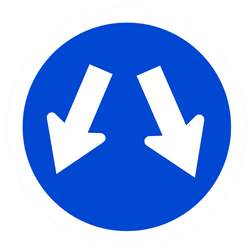
4. Pass obstacle on either side
This traffic sign indicates that traffic must pass an obstacle on either the left or the right. Use either permitted side while following the road layout and any accompanying signs or markings.
5. Pass obstacle on the right
This traffic sign indicates that traffic must pass an obstacle on the right. Keep to the right of the obstacle and follow any accompanying signs or road markings.
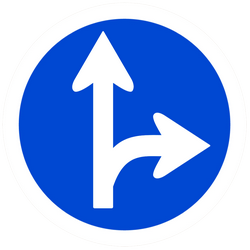
6. Driving straight ahead or turning right mandatory
This traffic sign indicates that traffic must continue straight ahead or turn right. One of the indicated directions must be followed; turning left is prohibited.
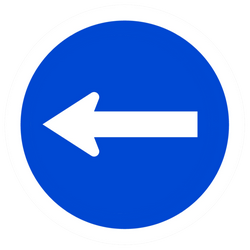
7. Mandatory left
This traffic sign indicates a mandatory direction to the left. Traffic must proceed to the left at the sign and may not continue straight ahead or to the right.
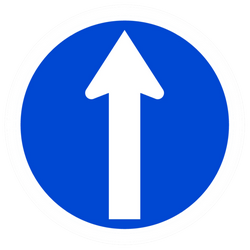
8. Driving straight ahead mandatory
This traffic sign indicates that driving straight ahead is mandatory. Traffic must continue straight ahead and may not turn left or right at the location to which the sign applies.
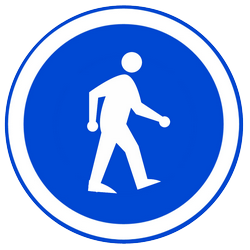
9. Mandatory path for pedestrians
This traffic sign indicates the start of a mandatory path for pedestrians. Pedestrians must use the designated path, while other road users may use it only where the applicable signs or local rules permit them to do so.
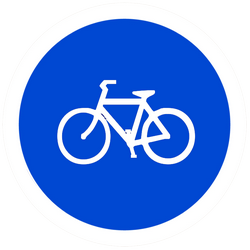
10. Mandatory path for cyclists
This traffic sign indicates a mandatory path for cyclists. Cyclists must use the designated path where the sign applies. Other road users may use the path only where the applicable signs or local rules permit them to do so.
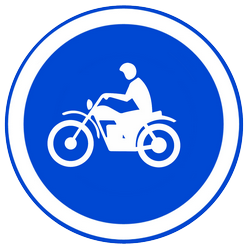
11. Mandatory path for motorcycles
This traffic sign indicates a mandatory path for motorcycles. Motorcyclists must use the designated path or route where the sign applies. Other road users may use it only where the applicable signs or local rules permit them to do so.
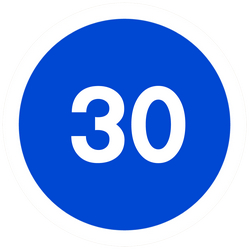
12. Start of a minimum speed
This traffic sign indicates the start of a minimum speed. Road users covered by the sign must travel at or above the indicated speed when conditions allow. Driving more slowly may still be necessary because of traffic, weather, road conditions or another safety-related reason.
