


ChevronFrance
 Règles de circulation
 France
43. Chevron
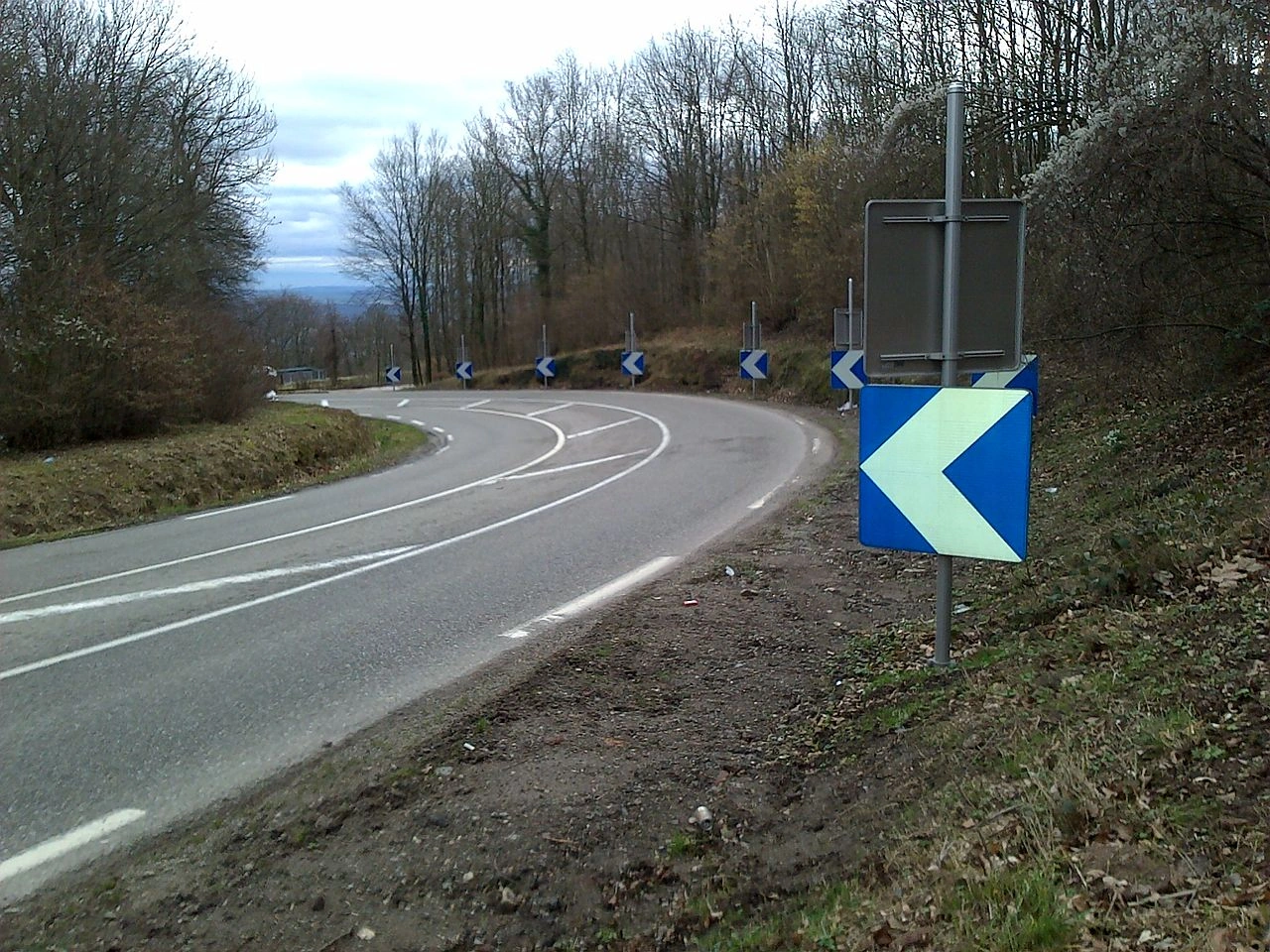
Un chevron est un repère routier en forme de V ou de flèche utilisé pour indiquer un changement marqué de direction de la route. Les panneaux à chevrons sont normalement placés à l’extérieur d’un virage de manière à ce que leurs pointes indiquent la direction dans laquelle la route continue.
Les chevrons améliorent la visibilité et l’alignement d’un virage, surtout dans l’obscurité ou par mauvais temps. Ils n’imposent normalement pas de limitation de vitesse et ne déterminent pas la priorité ; les conducteurs doivent donc réduire leur vitesse avant le virage et respecter tous les autres panneaux et marquages routiers.
What is a road chevron?
A road chevron is a V-shaped or arrow-shaped marker used to guide drivers through a curve or another sharp change in road direction.
How can you recognise a chevron?
It is normally displayed on a rectangular board using strongly contrasting colours. Several chevrons may be placed in sequence around a curve.
Which direction does a chevron indicate?
The point of the chevron indicates the direction in which the road continues. A chevron pointing left guides traffic through a left curve, while one pointing right guides traffic through a right curve.
Where are chevrons normally placed?
They are generally placed along the outside of a curve, facing approaching traffic so that drivers can clearly see the road alignment.
What is the purpose of a series of chevrons?
A series of chevrons visually traces the curve and helps drivers judge its direction, length and changing alignment.
Is a chevron the same as a curve-warning sign?
No. A curve-warning sign normally warns drivers before the curve. Chevron boards are usually positioned within or around the curve to guide drivers through it.
Does a chevron impose a speed limit?
No. It guides drivers through the change in direction but does not normally introduce a numerical speed limit.
Does a chevron show a recommended speed?
Not by itself. A separate advisory-speed or speed-limit sign may indicate an appropriate or legally required speed.
Does a chevron determine priority?
No. Traffic lights, priority signs and the ordinary priority rules remain applicable.
Does a chevron mean the curve is dangerous?
It normally indicates that the curve requires additional visual guidance. Drivers should expect a noticeable or potentially sharp change in direction.
Does the number of chevrons show how sharp the curve is?
Not directly. The number and spacing depend on the length, radius and design of the curve and on the road authority’s signing standards.
Does a larger chevron mean a sharper curve?
Not necessarily. Larger boards may be used where approach speeds are higher or where greater visibility is needed.
How should you approach chevrons?
Reduce speed before the curve, observe the direction of the boards and remain within your traffic lane.
Should you brake heavily after reaching the chevrons?
No. Complete most braking before entering the curve and use smooth steering, braking and acceleration while following it.
May you drive towards the chevron boards?
No. The boards normally mark the outside edge of the curve. Follow the road around them rather than steering towards them.
May you cut across the centre line to straighten the curve?
No. Remain within your lane and do not enter the path of oncoming traffic.
May you overtake beside chevrons?
The chevrons do not automatically prohibit overtaking, but overtaking is unsafe when the curve restricts visibility or available road width.
Why are chevrons reflective?
Reflective material makes the boards easier to see in darkness and poor weather when illuminated by vehicle headlights.
Can chevrons be illuminated?
Yes. Some high-risk curves use illuminated or flashing chevrons to make the change in direction more conspicuous.
Can chevrons have different colours?
Yes. Their colours and design vary between countries, but contrasting colours are used to make the direction clearly visible.
What should motorcyclists consider?
Reduce speed before the curve, choose a stable path and look through the turn. Do not focus exclusively on the chevrons or allow the motorcycle to cross the centre line while leaning.
Does the absence of chevrons mean a curve is safe at the speed limit?
No. Drivers must assess every curve and select a safe speed whether or not chevron boards are installed.


