

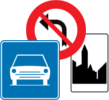
AutobahnBrüssel
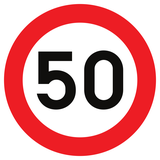 Verkehrsregeln
 Brüssel
2. Autobahn
Eine Autobahn ist eine Straße, die speziell für den motorisierten Verkehr gebaut und entsprechend ausgeschildert ist. Autobahnen haben normalerweise getrennte Richtungsfahrbahnen, kontrollierte Zu- und Abfahrten, keine direkten Zufahrten zu angrenzenden Grundstücken und keine höhengleichen Kreuzungen mit anderen Straßen, Eisenbahnen oder Wegen.
Auf Autobahnen gelten besondere Verkehrsregeln. Welche Verkehrsteilnehmer zugelassen sind, welche Geschwindigkeitsbegrenzungen und Fahrstreifenregeln gelten sowie Maut- und Notfallvorschriften unterscheiden sich je nach Land. Fahrer müssen daher die örtlichen Verkehrszeichen und Vorschriften beachten.

How can you recognise a motorway in Belgium?
A motorway begins at traffic sign F5 and ends at traffic sign F7. From sign F5, the special rules for motorway traffic apply until sign F7 is reached.
 Beginn einer Autobahn.
Signal routier F5 • Commencement d'une autoroute ou accès à une autoroute. Les règles spéciales de circulation sur les autoroutes s'appliquent à partir de l'endroit où le signal est placé.
Verkeersbord F5 • Begin of oprit van een autosnelweg. De bijzondere verkeersregelen op de autosnelwegen gelden vanaf de plaats waar het verkeersbord aangebracht is. Dit verkeersbord wordt rechts geplaatst en mag links herhaald worden.
 Ende der Autobahn.
Signal routier F7 • Fin d'autoroute. Ce signal est placé à droite et peut être répété à gauche.
Verkeersbord F7 • Einde van een autosnelweg. Dit verkeersbord wordt rechts geplaatst en mag links herhaald worden.
What changes for motorways under Belgium’s new Road Code?
Belgium’s new Code of the Public Road takes effect on 1 June 2027. The motorway signs are renumbered: the current traffic sign F5 for the beginning of a motorway becomes traffic sign R29, while traffic sign F7 for the end of a motorway becomes traffic sign R31. The main motorway rules remain largely familiar, including the general maximum speed of 120 km/h and the special access and driving rules that apply on motorways. During the transition period, drivers may encounter both the current and new motorway signs.
 Beginn einer Autobahn.
Signal routier R29 • Début d’une autoroute.
Verkeersbord R29 • Begin van een autosnelweg.
 Ende der Autobahn.
Signal routier R31 • Fin d’une autoroute.
Verkeersbord R31 • Einde van een autosnelweg.
What is the speed limit on Belgian motorways?
The general maximum speed is 120 km/h unless traffic signs impose a lower limit. Vehicles and combinations with a maximum authorised mass exceeding 3.5 tonnes and buses are generally limited to 90 km/h. Coaches that meet the applicable seat-belt and speed-limiter requirements may travel at up to 100 km/h.
Is there a minimum speed on Belgian motorways?
Drivers must normally travel at no less than 70 km/h unless a lower speed is imposed or traffic, weather, visibility, road conditions or another safety reason requires them to slow down. Vehicles and combinations that cannot reach 70 km/h on a level road are not permitted on the motorway.
Who may not use a Belgian motorway?
Belgian motorways may not be used by pedestrians, cyclists, moped riders, riders or drivers of animals, agricultural vehicles, motorised quadricycles without a passenger compartment and certain other slow or restricted vehicles. Vehicles and combinations unable to reach 70 km/h on a level road are also prohibited.
Which lane should you use on a Belgian motorway?
Drivers must normally remain as close as possible to the right-hand side of the carriageway and return to the right when conditions allow. Other lanes may be used for overtaking or when required by traffic signs, congestion or the intended destination.
Which lanes may heavy vehicles and buses use?
On a motorway with three or more lanes in the same direction, buses, coaches and vehicles or combinations exceeding 3.5 tonnes may normally use only the two rightmost lanes, unless lane-direction signs indicate otherwise.
How do you form an emergency corridor in Belgium?
Drivers must form an emergency corridor as soon as congestion develops. Vehicles in the leftmost lane move as far left as possible. Vehicles in every other lane move as far right as possible. The corridor is formed between the leftmost lane and the lane immediately beside it.
May you drive on the emergency lane?
No. Ordinary drivers may not use the emergency lane to overtake congestion, reach an exit or continue their journey. Its use is reserved for authorised emergency vehicles, recovery vehicles and certain authorised services in the circumstances provided by law.
What should you do after a breakdown on a Belgian motorway?
Move the vehicle away from the traffic lanes when this can be done safely and take the necessary measures to protect other road users. If the vehicle cannot be moved and is stopped where stopping or parking is prohibited, place the warning triangle at least 100 metres behind the vehicle. The driver must wear a retro-reflective safety vest when leaving a broken-down vehicle stopped at such a location.
May you stop or park on a Belgian motorway?
Stopping and parking are prohibited except in designated parking areas or when stopping is required by traffic, an emergency or another unavoidable circumstance. The emergency lane is not an ordinary parking or waiting area.
May you reverse or make a U-turn on a Belgian motorway?
No. Reversing, making a U-turn, driving against the direction of traffic and using connections through the central reservation are prohibited. If you miss an exit, continue to the next suitable exit.


