

Vorgeschriebene FahrtrichtungBrüssel
 Verkehrsregeln
 Brüssel
27. Vorgeschriebene Fahrtrichtung
Ein Gebotszeichen zur Fahrtrichtung verpflichtet Fahrer, nur in die durch einen oder mehrere Pfeile angezeigte Richtung zu fahren. Es kann vorschreiben, geradeaus zu fahren, abzubiegen oder ein Hindernis auf einer bestimmten Seite zu passieren.
Das Zeichen bestimmt für sich allein weder Vorfahrt noch Geschwindigkeit. Fahrer müssen weiterhin den richtigen Fahrstreifen benutzen, bei Bedarf blinken und gemäß den örtlichen Verkehrszeichen und Vorschriften Vorfahrt gewähren.
Which Belgian sign indicates a mandatory direction?
Traffic sign D1 requires drivers to follow the direction indicated by its arrow.
 Geradeausfahren vorgeschrieben.
Signal routier D1 • Obligation de suivre la direction indiquée par la flèche. La disposition des lieux détermine la position de la flèche. Si le signal présentant une flèche non coudée, est placé sur un obstacle, il signifie obligation de passer du côté indiqué par la flèche.
Verkeersbord D1 • Verplichting de door de pijl aangeduide richting te volgen. De plaatsgesteldheid bepaalt de stand van de pijl. Wanneer het verkeersbord dat een niet-gebogen pijl voorstelt, op een hindernis geplaatst is, betekent het dat langs de door de pijl aangeduide richting moet voorbijgereden worden.
What does Belgian traffic sign D3 mean?
Traffic sign D3 requires drivers to follow one of the directions indicated by its arrows. Any direction not displayed is prohibited.
What determines the direction of a D1 or D3 arrow?
The arrow or arrows are positioned to correspond with the actual road layout and permitted movement.
What does a straight upward D1 arrow mean?
It requires drivers to continue straight ahead. Turning left or right at that location is not permitted.
What does a curved D1 arrow mean?
It requires drivers to turn or follow the road in the direction indicated by the arrow.
What does D1 mean when placed on an obstacle?
When a D1 sign with a straight arrow is placed on a traffic island, barrier or other obstacle, drivers must pass the obstacle on the side indicated by the arrow.
What is the difference between D1 and D3?
D1 permits only one indicated direction. D3 permits the driver to choose one of two or more displayed directions.
What is the difference between D1 and C31?
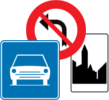
D1 prescribes the direction that must be followed. C31 prohibits turning in the direction indicated by its crossed arrow.
Can D1 and C31 be used together for the same rule?
No. Belgian placement rules prohibit using D1 and C31 together to impose the same direction requirement.
What sign is used when both left and right turns are prohibited?
A D1 sign with an upward arrow is used to require drivers to continue straight ahead.
Does D1 create one-way traffic?
No. D1 prescribes a direction at its location. Belgian one-way traffic is indicated separately by F19 and prohibited entry from the opposite direction by C1.
Does D1 or D3 impose a speed limit?
No. The applicable regional, zonal, posted and vehicle-specific speed limits remain in force.
Does a mandatory direction give you priority?
No. Drivers must still comply with priority signs, traffic lights and the normal rules concerning turning, crossing and manoeuvres.
Must you use an indicator when following D1?
Yes, when the required direction involves turning. Signal in time and stop signalling after the movement has been completed.
Must you signal when passing an obstacle?
Use the indicators when passing the obstacle requires a lateral movement that should be communicated to other road users.
Does using an indicator give you priority?
No. You must still give way to oncoming traffic, users continuing along the same public road and pedestrians crossing the road you enter where the applicable rules require it.
Can D1 apply only to one traffic lane?
Yes. When a mandatory sign is positioned above a traffic lane or another part of the public road, it applies only to that lane or part.
Must you follow lane arrows as well?
Yes. White lane-selection arrows indicate which lane must be used for a particular direction. At the intersection, drivers must follow one of the directions displayed in their lane.
Can a Belgian mandatory-direction sign be announced in advance?
Yes. A similar sign with a supplementary distance panel may announce approximately where the obligation begins.
May cyclists be exempted from D1?
Yes. Supplementary panel M2 indicates that the D1 obligation does not apply to cyclists.
May class A mopeds also be exempted?
Yes. Supplementary panel M3 indicates that the exception applies to cyclists and riders of two-wheeled class A mopeds.
May speed pedelecs be exempted?
Yes. Panel M11 exempts speed-pedelec riders, while M12 exempts cyclists, class A moped riders and speed-pedelec riders from the D1 obligation.
Do these cyclist exceptions automatically apply to D3?
No. The current rules specifically provide these supplementary-panel exceptions for D1. Where an exception is needed for a movement otherwise regulated by D3, another sign arrangement may be required.
Can public-transport vehicles be exempted?
Yes, in specifically permitted situations. Belgian placement rules allow a D1 exception for vehicles operating scheduled public-transport services where the road layout permits it.
Can D1 or D3 regulate entry to a bus lane?
Yes. Where D1 or D3 regulates access to a bus lane or special traversable public-transport site, supplementary panels may indicate the categories permitted to use it.
What does Belgian traffic sign D4 mean?
D4 requires vehicles carrying specified dangerous goods to follow the direction indicated by the arrow.
Does D4 apply to every vehicle?
No. It applies to vehicles carrying dangerous goods covered by the relevant transport rules. A supplementary letter B, C, D or E may connect the prescribed route to the corresponding tunnel category.
Do traffic lights cancel D1 or D3?
No. Traffic lights determine when you may move. D1 or D3 still determines which direction you must follow once movement is permitted.
What if an authorised person directs you differently?
Follow the authorised person’s instructions. Those instructions take precedence over traffic lights, signs, road markings and ordinary traffic rules.
What should you do after entering the wrong lane?
Do not make a sudden or prohibited movement. Follow the direction permitted from your lane and choose another lawful route afterwards.
What changes under Belgium’s new road code?
From 1 June 2027, the D1 family is divided into signs D1a to D1g for mandatory intersection directions, passing obstacles and other required directions. D3 becomes D3a to D3c for combinations of permitted directions. D4 remains the mandatory route sign for dangerous-goods vehicles.


