
Double curveCzechia

Learn traffic rules with clear explanations and visual examples in our illustrated book, designed to make studying simple and engaging.


264. Double curve

A double curve is a road section containing two successive curves in opposite directions. The first curve may turn left and then right, or right and then left.

The same warning sign may also indicate a longer succession of curves. Drivers should reduce speed before the first curve, remain within their lane and be prepared for the following curves to differ in direction, sharpness and length.
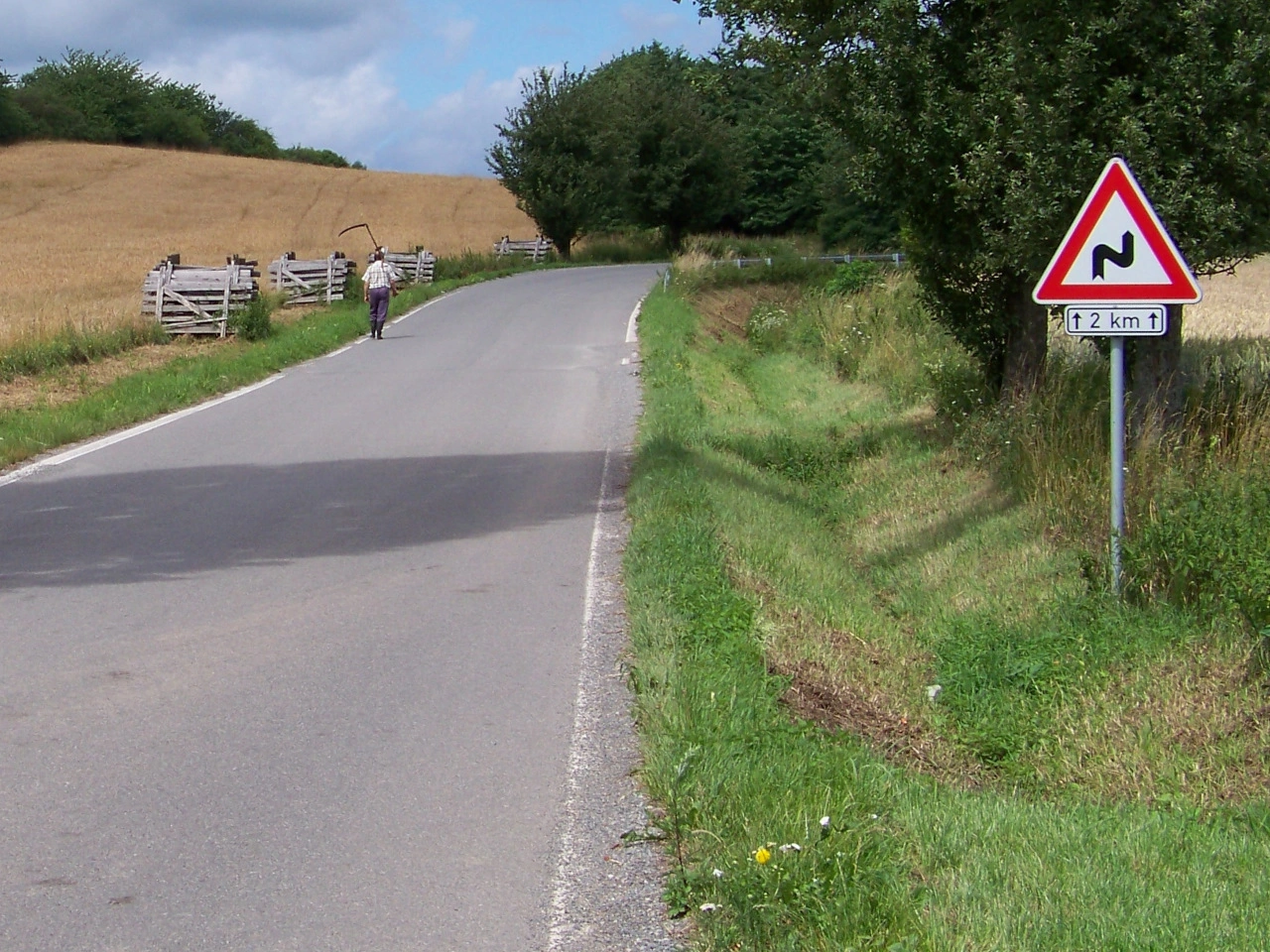
Double curve
Warning for a double curve first to the right then left for 2 km. (Příbram, Czechia)
Wikimedia.org • ŠJů • CC BY-SA
What is a double curve?

A double curve consists of two successive curves in opposite directions.

How can you recognise a double-curve warning sign?

It normally shows an S-shaped road symbol. The symbol indicates whether the first curve turns left or right.

What does first curve to the left mean?

It means that the road first bends left and is then followed by a curve in the opposite direction.

What does first curve to the right mean?

It means that the road first bends right and is then followed by a curve in the opposite direction.

Can the sign warn of more than two curves?

Yes. In many countries, the same sign may warn of a longer succession of curves. A supplementary panel may indicate the length of the winding section.

Does the sign show the exact shape of every curve?

No. It normally shows only the general direction of the first curves. Their radius, length and spacing may be different from the symbol.

Does a double-curve sign impose a speed limit?

No. It normally warns of danger rather than establishing a numerical limit. Drivers must reduce speed whenever the legal maximum would be unsafe.

When should you reduce speed?

Reduce speed before entering the first curve, while the vehicle is still travelling straight and has maximum stability.

Should you accelerate between the two curves?

Do not accelerate strongly merely because there is a short straight section between them. Maintain a controlled speed until the direction and exit of the following curve are clear.

Should you brake while changing direction?

Avoid harsh braking while steering from one curve into the next. Complete most braking beforehand and use smooth control inputs.

Where should you look?

Look towards the visible road ahead and through each curve while continuing to monitor your lane position, road surface and nearby traffic.

Must you remain within your lane?

Yes. Do not cut across the centre line or another traffic lane to straighten the sequence of curves.

Why can a double curve be more difficult than one curve?

The vehicle’s weight shifts from one side to the other, visibility may change rapidly and the second curve may be sharper or closer than expected.

Why should you leave more following distance?

The vehicle ahead may brake unexpectedly for the second curve, an obstruction or changing road conditions that are not yet visible to you.

May you overtake in a double curve?

Do not overtake when you cannot see far enough ahead to complete the manoeuvre safely. Signs, continuous lines and local law may also prohibit overtaking.

May you stop or park in a double curve?

Only where it is permitted and your vehicle remains clearly visible. Stopping or parking where visibility is limited may create a serious hazard.

How do rain, snow or ice affect double curves?

They reduce tyre grip and increase the risk of skidding during the rapid change of direction. Reduce speed earlier and steer, brake and accelerate smoothly.

Why should motorcyclists take extra care?

Motorcyclists must change lean direction between the curves and depend heavily on tyre grip. Loose material, markings or wet surfaces can make the transition hazardous.

How can a double curve affect a trailer or caravan?

A trailer may sway or follow a tighter path through the curves. Excessive speed or abrupt steering can reduce stability.

Why do trucks and buses need additional space?

Long vehicles may track towards the inside of each curve or approach lane boundaries. Other drivers should avoid travelling beside them through a tight sequence.

What should you do if the second curve is sharper than expected?

Look towards the intended path, reduce acceleration and steer smoothly. Avoid sudden braking or crossing into another lane.

Does the absence of a warning sign mean the curves are safe at the speed limit?

No. Drivers must assess every road section and choose a safe speed even when no warning sign is displayed.

1 Czechia 2 Motorway 3 Residential area 4 Zone 5 Speed limit 6 Advisory speed 7 Footpath 8 Bike path 9 Shared-use path 10 Pedestrian warning 11 Pedestrian zone 12 Speed bump 13 Customs 14 Slope 15 Bus lane 16 Bus stop 17 Dead end 18 Stop sign 19 Give way 20 Roundabout 21 Priority road 22 Road narrowing 23 Priority over oncoming traffic 24 Give way to oncoming traffic 25 Pedestrian crossing 26 Railway crossing 27 School area 28 Crossing animals 29 Slippery road 30 Aircraft 31 Curve 32 Chevron 33 Wrong-way driving 34 Roadworks 35 Height limit 36 Weight limit 37 Radar speed sign 38 Selective barriers 39 Priority at the next junction 40 Traffic lights 41 Traffic lights warning 42 Pedestrian lights 43 Road markings 44 Junction layout 45 Bike box 46 Speed feedback 47 Location marker 48 Countdown markers 49 Traffic mirror 50 Emergency telephone 51 International border 52 Pedestrian underpass 53 Cycling route 54 Parking 55 No parking 56 No stopping 57 Park and ride 58 Kiss and ride 59 Disabled parking 60 Traffic management 61 Reversing 62 Road surface 63 Provisional licence 64 Hazardous cargo 65 Runaway truck ramp 66 Tourist attraction 67 Axle weight limit 68 Licence plate 69 Charging station 70 Dangers 71 Cyclist 72 Bus 73 Police 74 Ambulance 75 Taxi 76 Police signals 77 European emission standard 78 Pothole 79 Path 80 Particulates 81 Air pollution 82 Rush hour 83 Road code 84 Train station 85 Street gutter 86 Cargo bike 87 Forestry vehicle 88 Construction vehicle 89 Semi-trailer truck 90 Trolleybus 91 Speed pedelec 92 Delivery vehicle 93 Idling 94 Tow truck 95 Four-wheel drive 96 No vehicles 97 Bicycle 98 Motorcycle equipment 99 Tram 100 Rail track ... 101 Caravan 102 Trailer 103 Tow hitch 104 Fire truck 105 Siren 106 Convoy 107 Emergency vehicle lighting 108 Tractor 109 Agricultural machinery 110 Electric bicycle 111 Electric vehicle 112 Pedelec 113 Quadricycle 114 Microcar 115 All-terrain vehicle 116 Van 117 Recreational vehicle 118 Scooter 119 Trikke 120 Personal mobility device 121 Skateboard 122 Segway 123 Kick scooter 124 Roller skates 125 Mailman 126 Hitchhiker 127 Toddler 128 Child 129 Disability 130 Motorail 131 km/h 132 mph 133 Speedometer 134 Ride height 135 Dirt road 136 Driving 137 Start-stop system 138 Manual transmission 139 Automatic transmission 140 Throttle 141 Tachometer 142 Steering wheel 143 Power steering 144 Visual scanning 145 Mirror 146 Fuel 147 Fuel gauge 148 Petrol 149 Diesel 150 Diesel exhaust fluid 151 Car insurance 152 First aid kit 153 Fire extinguisher 154 High-visibility clothing 155 First aid 156 Guardrail 157 Concrete step barrier 158 Barriers 159 Vehicle lights 160 Street lights 161 Dipped beam 162 High beam 163 Fog lights 164 Front fog lights 165 Rear fog lights 166 Side lights 167 Turn signals 168 Hazard lights 169 Dashboard lights 170 Bicycle lighting 171 Bicycle bell 172 Headlight flashing 173 Seat belt 174 Child restraints 175 Head restraints 176 Airbag 177 ABS 178 Esp 179 Traction control system 180 Helmet 181 Bicycle helmet 182 Hands-free 183 Smartphone 184 GPS 185 Brake 186 Handbrake 187 Brake fluid 188 Tyres 189 Tyre code 190 Winter tyres 191 Tyre pressure 192 Snow chains 193 Bicycle tyre 194 Continuous track 195 Gross Vehicle Weight 196 Gross Vehicle Weight Rating 197 Cargo 198 Car body 199 Trunk 200 Roof rack 201 Windscreen 202 Emergency hammer 203 Car battery 204 Traction battery 205 Suspension 206 Shock absorber 207 Spring 208 Exhaust 209 Exhaust gas 210 Soot 211 Catalytic converter 212 Engine 213 Petrol engine 214 Diesel engine 215 Electric motor 216 Timing belt 217 Glow plug 218 Cylinder 219 Engine oil 220 Coolant 221 Maintenance 222 Spare tyre 223 Flat tyre 224 Jack 225 Vehicle inspection 226 Key 227 Dashboard 228 Windscreen wiper 229 Doors 230 Glovebox 231 Visibility 232 Rain 233 Fog 234 Hail 235 Sunlight 236 Sunglasses 237 Salt 238 Air conditioning 239 Hydroplaning 240 Distraction 241 Emotions 242 Road rage 243 Health 244 Epilepsy 245 Night blindness 246 Visual impairment 247 Fatigue 248 Defects 249 Traffic violation 250 Alcohol 251 Alcohol control 252 Ignition interlock device 253 Breath test 254 Breath analysis 255 Blood alcohol content 256 Blood test 257 Saliva test 258 Drugs 259 Medication 260 Penalties 261 Speeding 262 Smoking 263 Traffic enforcement camera 264 Double curve 265 Accident 266 Injuries 267 Nosebleed 268 Damage 269 Breakdown 270 Warning triangle 271 Traffic rules 272 Driving school 273 Traffic signs