


Give wayJapan
 Traffic rules
 Japan
18. Give way
A give-way sign requires drivers to allow traffic with priority to proceed before entering, crossing or joining a road. Drivers must reduce speed, observe approaching traffic and stop when necessary.
Unlike a stop sign, a give-way sign does not always require a complete stop. The driver may continue without stopping only when the route is clearly safe and no road user with priority is forced to change speed or direction.

Wikimedia.org • 運動会プロテインパワー • CC BY-SA
What does giving way mean in Japan?
Japan regulates yielding through its junction rules and signs such as Slow and Stop. Give way to a priority road or a clearly wider intersecting road as required; do not treat a Slow instruction as a Stop instruction.
🔗 laws.e-gov.go.jp • Japan Road Traffic Act — Articles 36, 42–43
🔗 laws.e-gov.go.jp • e-Gov — current enforced Road Traffic Act, revision metadata and full text
🔗 npa.go.jp • NPA — Traffic Lights and Road Signs, official English definitions
🔗 npa.go.jp • NPA — traffic instruction handbook, sign groups and road use; read with current Act
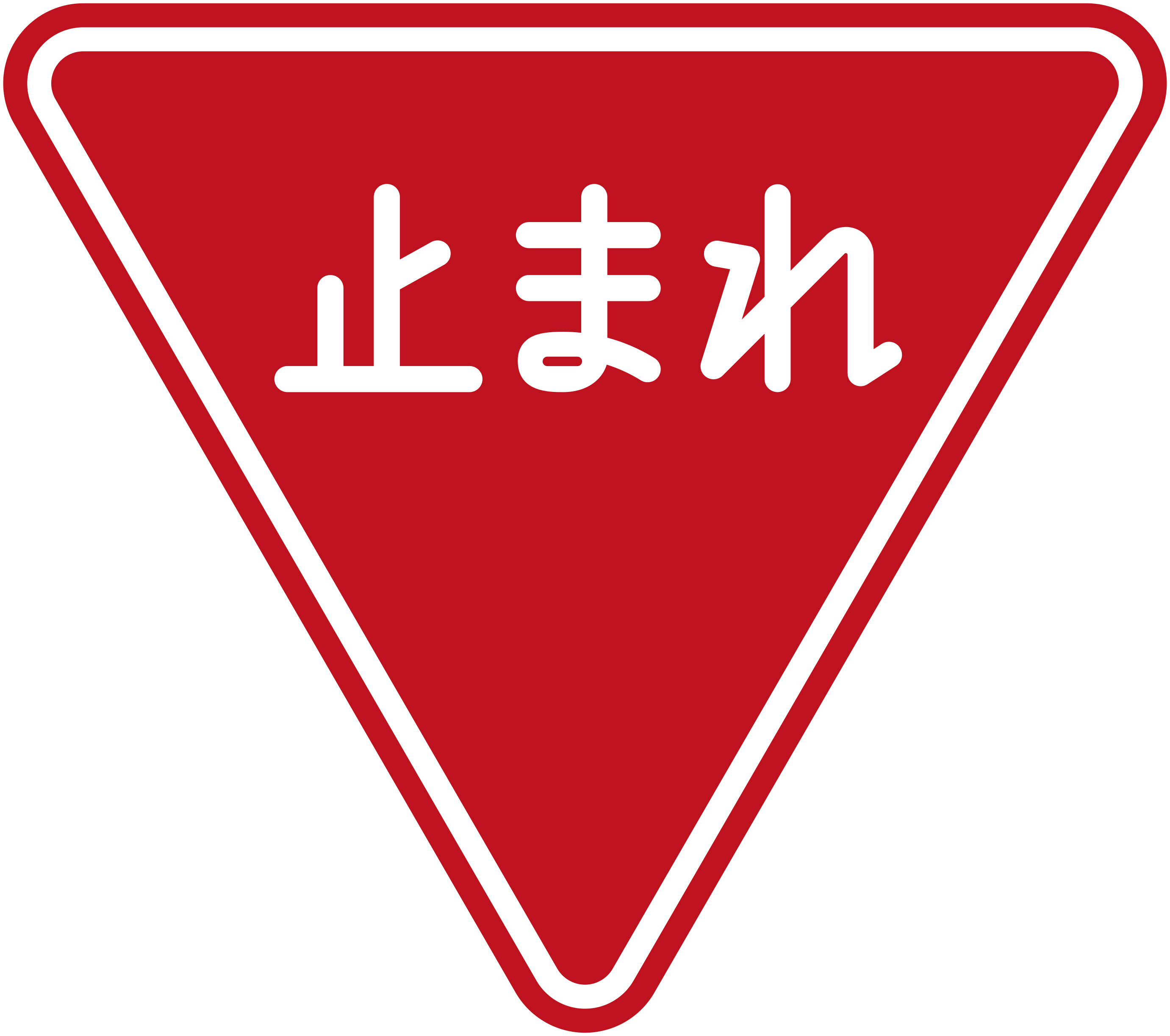 Give way.
English • Traffic sign 330-B • Stop. Stop completely immediately before the stop line or, if none exists, immediately before the junction. Proceed without obstructing traffic on the intersecting road.
日本語 • 330-B • 一時停止。 停止線の直前で完全に停止してください。停止線がない場合は交差点の直前で停止し、交差する道路の交通を妨げないように進んでください。
Sources
🔗 Commons.wikimedia.org
🔗 Laws.e-gov.go.jp • 道路標識、区画線及び道路標示に関する命令、別表第一・第二
🔗 Mlit.go.jp • 国土交通省、道路標識一覧
🔗 Npa.go.jp • 警察庁、交通規制基準(令和8年3月16日改正)、PDF 153ページ
SVG source: Eastwind41 • Public domain • Original revision 2017-11-24. Wikimedia original unmodified.
Must you always stop when giving way in Japan?
No blanket stopping duty follows from yielding alone. A Slow sign requires reduced speed, while a Stop sign requires a complete stop at the designated position. Poor visibility and the junction’s priority arrangement impose additional duties.
🔗 laws.e-gov.go.jp • Japan Road Traffic Act — Articles 36, 42–43
🔗 laws.e-gov.go.jp • e-Gov — current enforced Road Traffic Act, revision metadata and full text
🔗 npa.go.jp • NPA — Traffic Lights and Road Signs, official English definitions
🔗 npa.go.jp • NPA — traffic instruction handbook, sign groups and road use; read with current Act
Which direction has priority at an uncontrolled junction in Japan?
Japan’s ordinary uncontrolled-junction rule generally requires yielding to vehicles approaching from the left, with separate rules for priority roads, clearly wider roads and trams. Follow those rules and the actual controls; do not substitute priority from the right.
🔗 laws.e-gov.go.jp • Japan Road Traffic Act — Articles 36, 42–43
🔗 laws.e-gov.go.jp • e-Gov — current enforced Road Traffic Act, revision metadata and full text
🔗 npa.go.jp • NPA — Traffic Lights and Road Signs, official English definitions
🔗 npa.go.jp • NPA — traffic instruction handbook, sign groups and road use; read with current Act


