

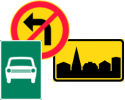
Built-up areaFinland
 Traffic rules
 Finland
3. Built-up area
A built-up area is an area containing concentrated buildings, streets and regular local activity. Drivers should expect more pedestrians, cyclists, intersections, parked vehicles, public transport and vehicles entering or leaving properties.
Many countries apply special traffic rules and lower default speed limits within built-up areas. The area may be identified by entrance and exit signs, street lighting or other legal criteria, so drivers must follow local signs and regulations.
Wikimedia.org • Santeri Viinamäki • CC BY-SA
How can you recognise a built-up area?
A built-up area commonly contains closely spaced buildings, local streets, intersections, pavements, pedestrians and regular access to properties. Some countries use official entrance and exit signs, while others define built-up roads through street lighting or other legal criteria.
Is a built-up area the same as a town or city?
Not necessarily. A legally defined built-up area may cover only part of a town or may include several connected settlements. Administrative boundaries and traffic-law boundaries do not always coincide.
Is a built-up area the same as a residential area?
No. A built-up area may contain residential, commercial, industrial and public streets. A residential area is mainly associated with housing and may form only one part of a built-up area.
How does a built-up area begin and end?
In many countries, the area begins and ends at official traffic signs. In others, road lighting, development or another legal definition determines whether a road is inside a built-up area. Drivers should not rely only on the appearance of the surroundings.
What is the speed limit in a built-up area?
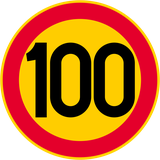
There is no universal built-up-area speed limit. The default limit differs between countries and regions, and traffic signs may impose a lower or higher limit on a particular road or throughout a zone.
Does the built-up-area speed limit apply on every road?
The general limit normally applies unless a traffic sign, road category or special rule establishes another limit. Major urban roads may have a higher signed limit, while residential streets, school areas and city centres may have lower limits.
Does a speed-limit sign remain valid after an intersection?
This depends on local law and the type of sign. A local speed restriction may end at the next intersection in some countries, while a zonal speed limit normally continues until an end-of-zone sign.
Do pedestrians have priority throughout a built-up area?
No. Pedestrians do not automatically have priority everywhere merely because they are in a built-up area. Their priority depends on crossings, traffic signals, shared-space rules and local law. Drivers must nevertheless remain especially alert for pedestrians.
How should you drive in a built-up area?
Adjust your speed, watch both sides of the road and expect frequent changes in traffic. Be prepared for pedestrians crossing, cyclists changing position, buses leaving stops, opening vehicle doors and vehicles emerging from side roads or driveways.
Are parking rules different in a built-up area?
Some countries apply additional stopping and parking restrictions inside built-up areas. Drivers must follow signs, markings and local rules and must not obstruct pavements, crossings, entrances, cycle facilities or visibility at intersections.
What is the difference between a built-up area and a speed zone?
A built-up area is a broader traffic-law area that may contain many different roads and activities. A speed zone imposes a particular maximum speed throughout the signed zone and may be located inside or outside a built-up area.
When do the built-up-area rules end?
The rules end at the legally defined boundary, which may be indicated by an end-of-built-up-area sign. After that point, the rules and default speed limits for roads outside built-up areas normally apply.


