

FootpathFinland
 Traffic rules
 Finland
6. Footpath
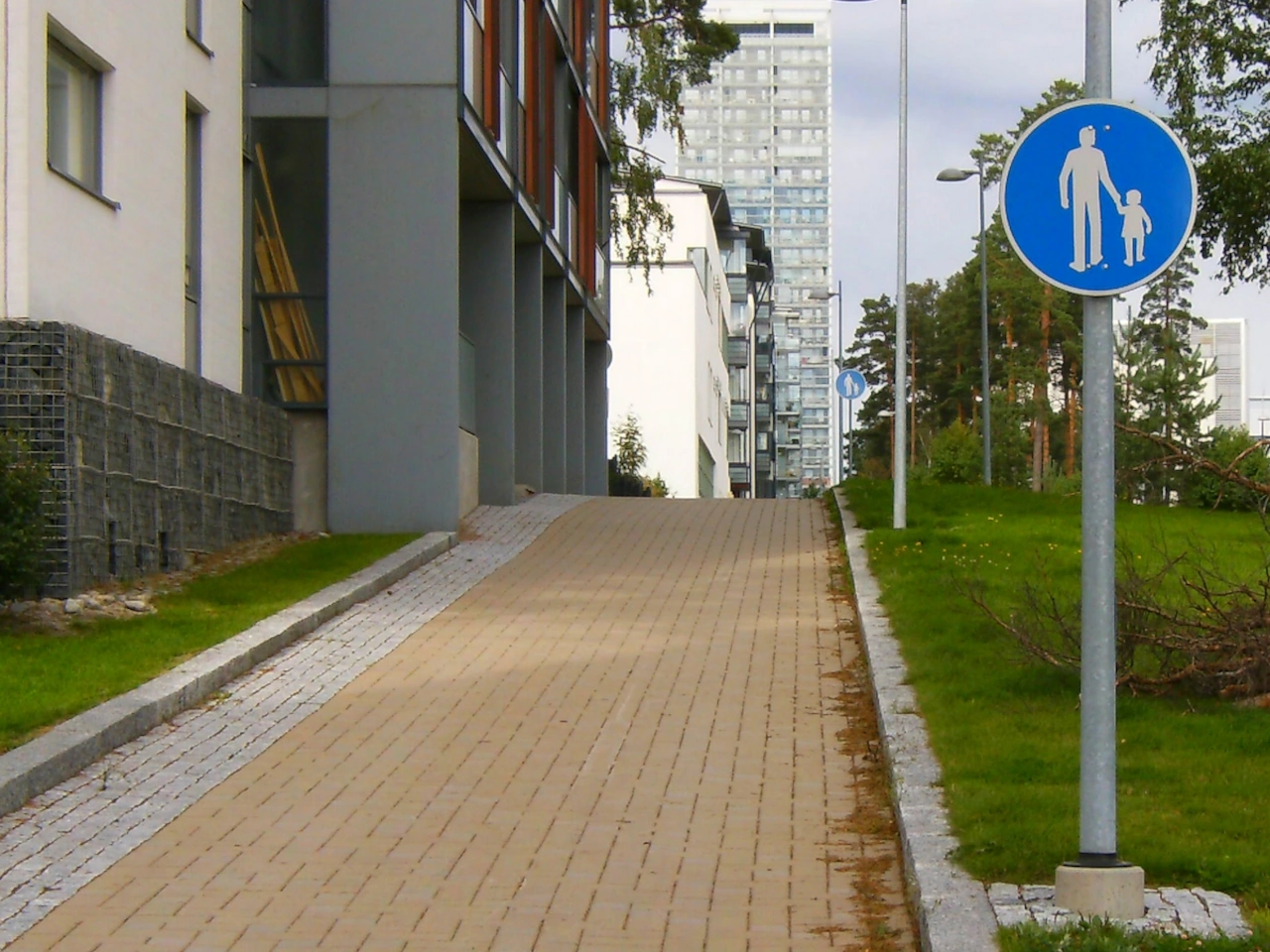
A footpath is a path or part of a road intended primarily for pedestrian traffic. It may run alongside a road, through a park or residential area, or independently from roads used by motor vehicles.
A footpath may be reserved exclusively for pedestrians or may form part of a shared route with cyclists or other permitted users. Access, priority and permitted users depend on the traffic signs and local regulations applying to the path.
Wikimedia.org • DreferComm • CC BY-SA
What is Finland’s official wording for a pedestrian footpath or pavement?
The Road Traffic Act uses jalkakäytävä for the pedestrian part of a road and for the pedestrian-only route indicated by its blue circular sign. A route signed for both pedestrians and cyclists is a different facility; follow any division between the two sides.
🔗 finlex.fi • Finlex, Finnish Road Traffic Act 729/2018 — 13, 18, 29; Annex 3 D4–D7
🔗 finlex.fi • Finlex — corresponding current Finnish statutory text
Can children cycle on Finnish pavements?
Children under 12 may ride a bicycle on a pavement provided this causes no substantial inconvenience to pedestrians. This age exception does not allow ordinary adult cycling there. A signed shared walking and cycling path has different access rules.
🔗 finlex.fi • Finlex, Finnish Road Traffic Act 729/2018 — 13, 18, 29; Annex 3 D4–D7
🔗 finlex.fi • Finlex — corresponding current Finnish statutory text
Where should pedestrians walk when there is no Finnish pavement?
Use a verge where available. If neither a pavement nor a usable verge exists, a cycle path or the carriageway edge may be used. On the carriageway, normally walk on the left, unless the right side is safer for the route or circumstances.
🔗 finlex.fi • Finlex, Finnish Road Traffic Act 729/2018 — 13, 18, 29; Annex 3 D4–D7
🔗 finlex.fi • Finlex — corresponding current Finnish statutory text


