


Railway crossingAustralia
 Traffic rules
 Australia
18. Railway crossing
A railway crossing, also called a level crossing or railroad crossing, is a place where a road or path crosses railway tracks at the same level. It may be protected by barriers, warning lights, bells, traffic signs or a combination of these measures.
Road users must approach carefully and never enter when a train is approaching, warning signals are active or the exit is blocked. They should cross promptly and must never stop, wait or become trapped on the tracks.
Wikimedia.org • Maksym Kozlenko • CC BY-SA
When must I stop at a railway level crossing in Australia?
In NSW, stop for a STOP sign, flashing red lights, a closed gate or a railway employee’s stop signal. Do not enter while a boom gate is closing, down or opening; wait until the warnings have stopped and the gate is fully open. Do not enter with a train approaching or unless your whole vehicle can clear the crossing. Other states and territories set their own detailed rules.
🔗 nsw.gov.au • Australia, NSW Government, Railway level crossings
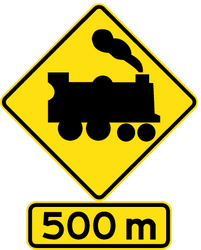 Warning for a railway crossing without barriers.
English • W7-7(R) with distance plate • Railway crossing ahead. A railway level crossing is 500 m ahead. Approach cautiously, look for trains and obey the crossing controls.
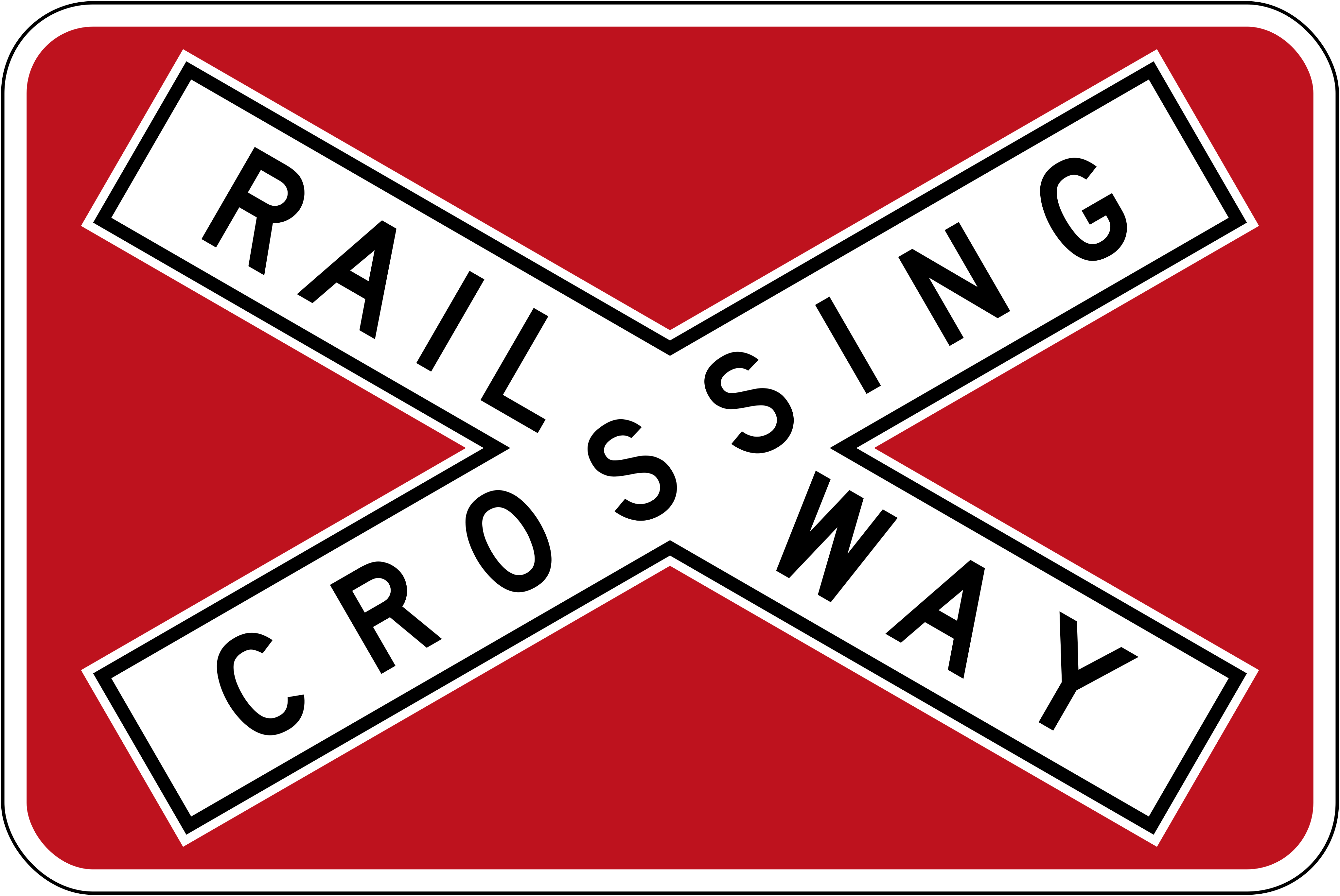 Warning for a railway crossing with one track.
English • Model rule 120 • level crossing sign • Railway crossing. A railway level crossing is at this location. Check for trains and obey any stop sign, give way sign, lights or barriers. State and territory rules and exceptions apply.
Sources
🔗 Commons.wikimedia.org
🔗 Pcc.gov.au • Australian Road Rules • model law • rule120; Schedule2p309
🔗 Legislation.qld.gov.au • Queensland Road Rules • local legislation example
SVG source: Standards Australia • Public domain • Original revision 2020-04-06. Wikimedia original unmodified.
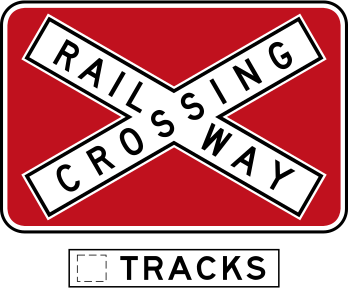 Warning for a railway crossing with two or more tracks.
English • Model rule 120 • level crossing and track plate • Railway crossing with multiple tracks. More than one railway track crosses the road. After a train passes, check for another train before proceeding. The illustration leaves the number of tracks blank. State and territory rules and exceptions apply.
Sources
🔗 Commons.wikimedia.org
🔗 Pcc.gov.au • Australian Road Rules • model law • rule120; Schedule2p309 + track plate
🔗 Legislation.qld.gov.au • Queensland Road Rules • local legislation example
Image via Commons.wikimedia.org
Government of Queensland • Public domain • Source revision 2012-11-09. Wikimedia original unmodified.
Must I stop at every unguarded railway crossing in Australia?
Not merely because there are no barriers. In NSW, a STOP sign requires a full stop; at a GIVE WAY sign, slow down, look both ways and stop if a train is coming. At crossings without gates or flashing lights, look and listen carefully in both directions and cross only when safe. Check the applicable state or territory rules elsewhere.
🔗 nsw.gov.au • Australia, NSW Government, Railway level crossings
What if road traffic is queued beyond a railway crossing in Australia?
In NSW, you must not enter unless your entire vehicle can clear the railway crossing. Wait before the tracks until there is enough room beyond them; do not simply follow the vehicle ahead. Keep the tracks clear even if no train is visible. Other states and territories set their own detailed rules.
🔗 nsw.gov.au • Australia, NSW Government, Railway level crossings
Can I cross after a train has passed if the warning lights are still active in Australia?
In NSW, no. Wait until the warning lights have stopped flashing and the gates or boom gates are fully open. Check that no other train is approaching before crossing. Follow the applicable state or territory rules elsewhere in Australia.
🔗 nsw.gov.au • Australia, NSW Government, Railway level crossings


