

ExpresswayBrussels
 Traffic rules
 Brussels
3. Expressway
An expressway is a road intended to carry through traffic efficiently, usually at higher speeds than ordinary roads. Expressways often have limited access, multiple lanes, separated carriageways or grade-separated junctions, but their design and legal status vary between countries.
An expressway is not always a motorway. It may have intersections, traffic lights or direct access, and the permitted road users, speed limits and special rules depend on local signs and regulations.
How can you recognise an expressway in Belgium?
A Belgian expressway begins at the expressway sign showing a car symbol. Its special rules continue until the corresponding end-of-expressway sign.
🔗 codex.vlaanderen.be • Belgian Road Code — articles 2.4, 10–12, 21.4, 21.6, 22 and 71 (F9/F11)
🔗 wegcode.be • Belgian Road Code of 1 December 1975 — 2.4, 10–12, 21.4, 21.6, 22 and 71 (F9/F11)
🔗 be.brussels • Brussels Mobility — City 30 and residential-area speeds
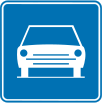 Start of an expressway.
English • Traffic sign F9 • Road for motor vehicles. The special traffic rules for roads for motor vehicles apply from the location of the sign.
Français • Signal routier F9 • Route pour automobiles. Les règles spéciales de circulation sur les routes pour automobiles s'appliquent à partir de l'endroit où le signal est placé.
Nederlands • Verkeersbord F9 • Autoweg. De bijzondere verkeersregelen op de autowegen gelden vanaf de plaats waar het verkeersbord is aangebracht. Dit verkeersbord wordt rechts geplaatst en mag links herhaald worden.
Sources
SVG source: Commons.wikimedia.org
Vascer • Public domain. Original SVG unmodified.
🔗 Wegcode.be • Artikel 71. Aanwijzingsborden (NL)
🔗 Codedelaroute.be • Article 71. Signaux d'indication (FR)
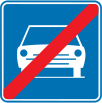 End of the expressway.
English • Traffic sign F11 • End of a road for motor vehicles. This sign is placed on the right and may be repeated on the left.
Français • Signal routier F11 • Fin de route pour automobiles. Ce signal est placé à droite et peut être répété à gauche.
Nederlands • Verkeersbord F11 • Einde van een autoweg. Dit verkeersbord wordt rechts geplaatst en mag links herhaald worden.
Sources
SVG source: Commons.wikimedia.org
Vascer • Public domain. Original SVG unmodified.
🔗 Wegcode.be • Artikel 71. Aanwijzingsborden (NL)
🔗 Codedelaroute.be • Article 71. Signaux d'indication (FR)
What is the difference between an expressway and a motorway in Belgium?
A motorway is identified by motorway signs; an autoweg / route pour automobiles is identified by signs showing a car symbol. The Road Code applies selected motorway rules to an expressway, rather than the whole motorway regime. At an expressway entrance or intersection, follow the traffic signs and ordinary priority rules.
🔗 codex.vlaanderen.be • Belgian Road Code — articles 2.4, 10–12, 21.4, 21.6, 22 and 71 (F9/F11)
🔗 wegcode.be • Belgian Road Code of 1 December 1975 — 2.4, 10–12, 21.4, 21.6, 22 and 71 (F9/F11)
🔗 be.brussels • Brussels Mobility — City 30 and residential-area speeds
Who may use a Belgian expressway?
Only motor vehicles and their trailers may use a Belgian expressway. Mopeds, agricultural vehicles, fairground vehicle combinations and motorised quadricycles without a passenger compartment are prohibited. Pedestrians, cyclists and animals may not use the expressway itself.
🔗 codex.vlaanderen.be • Belgian Road Code — articles 2.4, 10–12, 21.4, 21.6, 22 and 71 (F9/F11)
🔗 wegcode.be • Belgian Road Code of 1 December 1975 — 2.4, 10–12, 21.4, 21.6, 22 and 71 (F9/F11)
🔗 be.brussels • Brussels Mobility — City 30 and residential-area speeds
What is the speed limit on a Belgian expressway?
The expressway entrance sign does not impose one fixed speed limit. Inside a built-up area, the general limit is normally 30 km/h in Brussels and 50 km/h in Flanders and Wallonia unless signs indicate otherwise. Outside built-up areas, a physically divided road with at least two lanes in each direction may allow up to 120 km/h. On other roads, the general limit is normally 70 km/h in Brussels and Flanders and 90 km/h in Wallonia, although traffic signs and vehicle-specific limits may impose another speed.
🔗 codex.vlaanderen.be • Belgian Road Code — articles 2.4, 10–12, 21.4, 21.6, 22 and 71 (F9/F11)
🔗 wegcode.be • Belgian Road Code of 1 December 1975 — 2.4, 10–12, 21.4, 21.6, 22 and 71 (F9/F11)
🔗 be.brussels • Brussels Mobility — City 30 and residential-area speeds
Do drivers entering a Belgian expressway automatically have to give way?
There is no special priority rule solely because a road is an expressway. Drivers must follow the traffic signs, road markings and normal priority rules at the entrance or intersection.
🔗 codex.vlaanderen.be • Belgian Road Code — articles 2.4, 10–12, 21.4, 21.6, 22 and 71 (F9/F11)
🔗 wegcode.be • Belgian Road Code of 1 December 1975 — 2.4, 10–12, 21.4, 21.6, 22 and 71 (F9/F11)
🔗 be.brussels • Brussels Mobility — City 30 and residential-area speeds
May you stop or park on a Belgian expressway?
Voluntary stopping and parking are prohibited except on parking strips indicated by traffic sign E9a. An unavoidable stop caused by congestion, a breakdown or another emergency must be handled according to the applicable safety procedures.
🔗 codex.vlaanderen.be • Belgian Road Code — articles 2.4, 10–12, 21.4, 21.6, 22 and 71 (F9/F11)
🔗 wegcode.be • Belgian Road Code of 1 December 1975 — 2.4, 10–12, 21.4, 21.6, 22 and 71 (F9/F11)
🔗 be.brussels • Brussels Mobility — City 30 and residential-area speeds
How do Belgians refer to an expressway?
The official Dutch term is autoweg. The French term is route pour automobiles. This category is identified by the expressway sign showing a car symbol and is legally distinct from a motorway.
🔗 codex.vlaanderen.be • Belgian Road Code — articles 2.4, 10–12, 21.4, 21.6, 22 and 71 (F9/F11)
🔗 wegcode.be • Belgian Road Code of 1 December 1975 — 2.4, 10–12, 21.4, 21.6, 22 and 71 (F9/F11)
🔗 be.brussels • Brussels Mobility — City 30 and residential-area speeds


