

ZoneBrussels
 Traffic rules
 Brussels
6. Zone
A traffic zone is an area in which a traffic rule applies throughout all included roads or road sections. The rule normally begins at a zone-entry sign and remains applicable until the corresponding end-of-zone sign is passed.
Zones may regulate speed, parking, access, vehicle categories, emissions or other traffic behaviour. The signs used, the roads covered and the effect of intersections or local exceptions depend on local traffic law.
Wikimedia.org • Alain Rouiller • CC BY-SA
How can you recognise a traffic zone in Belgium?
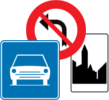
A Belgian traffic zone is normally indicated by a rectangular zonal sign displaying the applicable prohibition, speed restriction or parking rule. For example, a Zone 30 begins at traffic sign F4a and ends at traffic sign F4b. Other zonal regulations use the relevant prohibition sign from the C series or parking and stopping sign from the E series within a zonal panel. The corresponding end-zone sign indicates where the zonal regulation ends.
 Start of a zone with speed limit.
Signal routier F4a • Commencement d'une zone dans laquelle la vitesse est limitée à 30 km à l'heure. Ce signal est placé à droite de chaque accès à une zone dans laquelle la vitesse est limitée à 30 km à l'heure; il peut être répété à gauche.
Verkeersbord F4a • Begin van een zone met een snelheidsbeperking van 30 km per uur. Dit verkeersbord wordt rechts geplaatst aan elke toegang tot een zone met een snelheidsbeperking van 30 km per uur; het mag links herhaald worden.
 End of the zone with speed limit.
Signal routier F4b • Fin d'une zone dans laquelle la vitesse est limitée à 30 km à l'heure. Ce signal est placé à droite de chaque sortie d'une zone dans laquelle la vitesse est limitée à 30 km à l'heure; il peut être répété à gauche.
Verkeersbord F4b • Einde van een zone met een snelheidsbeperking van 30 km per uur. Dit verkeersbord wordt rechts geplaatst aan elke uitgang van een zone met een snelheidsbeperking van 30 km per uur; het mag links herhaald worden.
What changes for traffic zones under Belgium’s new Road Code?
Belgium’s new Code of the Public Road takes effect on 1 June 2027. Zonal traffic signs receive their own numbering: traffic sign Z1 marks the beginning of a zone and traffic sign Z3 marks the end. The traffic sign whose rule applies throughout the zone is displayed within these signs. A Z5 sign may be used as a reminder of the zonal regulation. For example, a speed zone may be indicated by Z1-C43 at the beginning and Z3-C43 at the end.
 Start of a zone with speed limit.
Signal routier Z1-C43 • Début d’une zone de vitesse.
Verkeersbord Z1-C43 • Begin van een snelheidszone.
 End of the zone with speed limit.
Signal routier Z3-C43 • Fin d’une zone de vitesse.
Verkeersbord Z3-C43 • Einde van een snelheidszone.
Which Belgian traffic signs can have zonal validity?
Zonal validity may be given to certain prohibition signs and signs concerning parking. Not every Belgian traffic sign may be used as a zonal sign.
Where does a Belgian zonal rule apply?
The regulation applies throughout the entire area enclosed by the zone signs. It may therefore cover several roads, road sections and intersections.
Does an intersection end a Belgian traffic zone?
No. Passing an intersection does not normally end a zonal regulation. The rule continues until the corresponding end-zone sign or another legally applicable change is reached.
How does a Belgian traffic zone end?
The zone ends when you pass the corresponding end-zone sign. The rules applicable to the surrounding road, built-up area or another zone then take effect.
What is a Belgian speed zone?
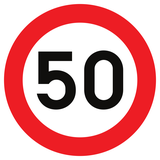
A speed zone is an area in which the maximum speed displayed on a zonal C43 sign applies from the beginning of the zone until its end.
Which zonal speed limits may be used in Belgium?
A zonal speed limit of 30 km/h may be introduced. Zonal limits of 50 km/h and 70 km/h may also be used outside built-up areas under the conditions prescribed by Belgian regulations.
How is a Belgian Zone 30 indicated?
A Zone 30 begins at traffic sign F4a and ends at traffic sign F4b. The maximum permitted speed throughout the zone is 30 km/h.
Can a lower speed limit apply inside a Belgian speed zone?
Yes. An ordinary C43 sign may impose a lower speed on a particular road section. From the next intersection, the original zonal speed applies again without the zone sign having to be repeated.
Can a higher speed limit be displayed inside a Belgian speed zone?
No. An ordinary C43 sign displaying a speed higher than the zonal speed may not be placed within the speed zone.
What happens after leaving a woonerf, erf or school environment inside a speed zone?
The original zonal speed limit applies again after leaving the woonerf, erf or school environment. The original zone sign does not normally need to be repeated.
Can another speed zone exist inside a Belgian speed zone?
Yes. A different speed zone may be created within a larger zone. Where the original zone continues afterwards, its entrance sign must be displayed again when legally required.
How does a Belgian parking zone work?
A zonal parking rule applies throughout the defined area. A different parking regulation may nevertheless be indicated for a particular location by local parking signs or road markings.
Can two zonal rules apply at the same time?
Yes. Belgian signs may introduce up to two zonal regulations together at an entrance, subject to the prescribed exceptions and placement rules.
Must a Belgian zone sign be repeated after every intersection?
No. The sign does not normally need to be repeated after each intersection. A reminder sign may nevertheless be placed with the word Herhaling.
Are small Zone 30 signs attached to poles legally binding?
Small stickers or recognition signs displaying the zonal speed may be attached to lighting or traffic poles as reminders. They are informational reminders and do not create a speed restriction by themselves.
Does a Belgian Zone 30 automatically change the priority rules?
No. Entering a Zone 30 does not by itself change priority at intersections. Drivers must continue to follow priority signs, traffic signals and the normal priority rules.
Does a zonal rule apply to every vehicle?
Not necessarily. Text, symbols or additional panels may specify that a zonal rule applies only to certain vehicles, road users, times or conditions.


