


PeruPeru
 Traffic rules
 Peru
1. Peru
Peru’s roads connect the Pacific coast with the high Andes and the Amazonian east, so driving conditions can vary considerably across the country. Traffic keeps to the right. Long climbs, tight mountain bends, steep gradients and sections affected by fog, heavy rain or rockfall make careful route planning especially important. On a steep section that is wide enough for only one vehicle, the ascending vehicle has priority over one travelling downhill.
Peru uses route-specific tolls rather than a national vignette, with toll stations on a number of concession roads and electronic telepeaje available on some routes. Low-beam headlights must be used 24 hours a day on the national and departmental/regional road networks. Road signs follow national MTC standards and are principally in Spanish. Before a long journey, particularly through mountainous areas, drivers should check current road conditions because maintenance, severe weather and natural events can cause temporary restrictions or closures.
AI-generated by Rijbewijs-online.be • WCIT • CC BY-SA
What is the alcohol limit for driving in Peru?
Under Peru’s criminal-law thresholds, an ordinary driver can commit the offence of drink-driving when the blood-alcohol concentration is over 0.5 g/L. For drivers providing public passenger, goods or cargo transport, the lower threshold is over 0.25 g/L. The traffic regulations also prohibit driving when alcohol, drugs or other substances reduce the ability to drive safely.
🔗 gob.pe • Peruvian Ministry of Justice, drink-driving thresholds, Criminal thresholds, Article 274
What speed limits apply to passenger cars in Peru?
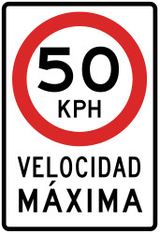
Built-up areas: Where no lower limit is posted, the general maximum is 30 km/h on streets and jirones and 50 km/h on avenues. The competent road authority can impose lower signed limits where conditions require them.
Highways: On carreteras, the general maximum is 100 km/h for cars, pickup-type vehicles and motorcycles; 90 km/h for public passenger vehicles and motorhomes; 80 km/h for freight vehicles and vehicles towing a motorhome; and 70 km/h for dangerous-goods and school-transport vehicles. A lower posted limit must be obeyed.
Rural roads: The general maximum on caminos rurales is 60 km/h, unless another limit is established and signed by the competent authority.
Highways through populated areas: For highways crossing populated areas or sections with continuous or partly dispersed housing, the general maxima are 30 km/h in commercial areas and 50 km/h in residential areas. The maximum in school and hospital areas covered by this rule is 30 km/h, and the crossing must be signed by the competent authority.
Poor visibility and adverse weather: On sections with poor visibility or adverse weather such as fog, heavy rain, snow, smoke or dust clouds, the maximum limits established by Articles 162, 163 and 164 of the Traffic Regulation are reduced to half of the normal maximum.
🔗 gob.pe • Peruvian Government, urban speed limits, Updated urban and populated-area limits
Are seat belts compulsory in Peru?
Yes. Seat belts are compulsory for occupants of the front seats, subject to the vehicle-category rules. In rear seats, their use is compulsory when the vehicle was equipped with them at the factory and in other cases where the regulations require them.
Can you use a mobile phone while driving in Peru?
Do not use a handheld mobile device while driving when doing so means taking your hands away from control of the vehicle. The regulations allow a mobile or portable device to be used with the hands only when the vehicle is parked and the engine is switched off.
What safety equipment should a car carry in Peru?
Carry usable warning triangles, a suitable fire extinguisher and a spare tyre. SUTRAN also recommends a reflective vest, jack, wheel wrench, basic tools and other supplies for breakdowns. Check the mandatory equipment for the vehicle category and service.
Are motorcycle helmets compulsory in Peru?
Yes. The driver and passenger of a non-cabined motorised minor vehicle must wear a compliant safety helmet. If the helmet has no visor, protective glasses are also required. Motorcycle helmets must meet the technical specifications established by the MTC.
Who has priority at a roundabout in Peru?
The vehicle already circulating on the roundabout has priority over a vehicle attempting to enter it, unless traffic control directs otherwise.

